When hunting or when competing in a field tactical match, you need to be able to shoot from a variety of positions. While the prone position is normally the most stable, hunters (and tactical marksmen) will encounter situations that demand the ability to shoot from a higher position.
In this NSSF Video, Ryan Cleckner, a former Sniper Instructor for the 1st Ranger Battalion, explains how to shoot from sitting, kneeling, and standing positions. Cleckner demonstrates both rested and non-rested variations of these three positions. Cleckner explains: “When you’re out hunting, often times you’re going to have grass or obstacles in your way, so [prone is] not practical — you’re going to have to get higher up off the ground. However, the problem with getting higher off the ground is that you are less stable. As a rule, the closer we are to the ground, the more stable we are… so we are going to [encounter] problems as we get taller up. I’m going to teach you some tricks to get you as stable as possible….”
Cleckner demonstrates the proper kneeling/sitting/standing body positions and he shows how to use your sling for extra support. This video also demonstrates the use of “field expedient” rests that provide a front support point for the rifle. Both hunters and field tactical shooters should find this 7-minute video very informative, and well worth watching.
We know our readers like accurate rifles — the more accurate the better. You guys also love really great craftsmanship and state-of-the art componentry. To satisfy that lust for amazing, accurate rifles, we’re starting a new feature — Sunday GunDay. We’ll try to do this a couple Sundays a month, provided we have some great candidates. For our first Sunday GunDay feature, we are presenting a stunning .284 Win F-Open match rifle owned by David Christian of Team Borden/Brux/Lapua. This impressive rig is as good as it gets in the F-Open game. The write-up is by David’s friend, Forum member F-Class John.
Tips For Competitors from David Christian
1. Tracking is Really Important. I learned this lesson from Bill Brown. Make sure your rifle is tracking exactly on your bags. If you slide the gun back and forth and it does not line up on your original aim point, something is out of alignment with you rear bag or mat and needs to be adjusted.
2. Wind Calls — Be Brave. Don’t be timid with your wind calls. It is better to err with a slight over-correction, rather than miss a change entirely.
3. More Data is Good. Keep track of as much data as you can so that you can learn from it. For example I shoot as much as I can with my chrono and track my load speeds so that I can tell if I am drifting out of my node.
David Christian’s .284 Win F-Open Rig
Report by F-Class John
Here’s match rifle that’s as handsome as it is effective (and accurate!). In its first-ever tournament, this impressive rig took 8th place overall in F-Open at the 2019 Berger Southwest Nationals. This .284 Win hammer was wielded by David Christian, the newest member of Team Borden/Brux/Lapua. David built this .284 Winchester around a Borden BRMXD action with black PVD coating and a Jewell BR trigger. What I found fascinating is that David had built all of this before ever being approached for the team. When I asked him how that worked out, he simply said he picked the components he liked the best and knew would do the job. It was just the universe in action that he’s now on the team that matches his gear and he’s certainly not complaining that he gets to represent them now.
David uses a custom-contour 32″-long Brux 1:8.5″-twist barrel that tapers from 1.35” to 1.25” because he likes the extra stability and weight it brings. It’s all mounted in an amazingly-crafted Cerus Stock (Speedy Gonzales “Spear of Destiny” design). While Will McCloskey built the stock, it was finished to perfection by Devin Wiggett and mounted by Terry Wright of Right Rifle in Oregon. You might also notice that the buttstock features a R.A.D. recoil system which adds the final touch to the system.
Stunning Laminated Maple/Cherry/Walnut/Wenge Cerus Stock
When asked what people comment on when they see his gun, David says it’s the stock, hands down. Having handled this gun myself, I have to agree and believe me when I say the pictures don’t do it justice. The exterior forearms are torrified Maple while the core is made up of Brazilian Cherry, Walnut, and African Wenge wood. It makes for an ultra-strong stock with stunning beauty to match.
David currently tops this beauty with a Kahles K1050 10-50x56mm scope featuring the MOAK reticle. David really likes the 20 MOA per revolution dial as well as the top-mounted parallax adjustment. This is especially helpful for him as David shoots left-handed. Most scopes have a left-side parallax knob which is difficult for him to use during a match.
You can’t have a rifle this good-looking and functional without riding on the right gear. David uses a Protektor DR Bag and a SEB Special Edition NEO coaxial front rest. All told it took nearly six months to get all the parts delivered and assembled but he looks at that as a short term loss and a long term gain. Using Erik Cortina’s load development methods with Berger 180gr Hybrid Target or 184gr Hybrid Target bullets and quality Lapua brass, David has achieved some amazing results. Here’s a representative target from a recent match. That’s mighty fine shooting!
If you want to “hit the ground running” in the F-Open game, this wouldn’t be bad setup to emulate and if you see David at a match, he’s always more than happy to talk to you about it.
The Making of MatchKings — How Sierra Produces SMKs
All Sierra bullets begin life as a strip of gilding metal, an alloy consisting of 95% copper and 5% zinc. To meet Sierra’s strict quality requirements, the gilding metal requires three times more dimensional and quality control standards than is considered standard in the copper manufacturing industry.
A blanking press stamps out a uniform disc and forms the cup that will be drawn into the MatchKing jacket. The cup is then polished and sent to a draw press to be drawn into a jacket that is longer than needed for the future MatchKing, thus allowing for the trim process. Press operators constantly check concentricity to make sure we have only quality jackets. The jackets then go to a trimmer where they are visually inspected again.
After being polished a second time, the jacket travels to the bullet press. In the meantime, 80-pound lead billets are being extruded into lead wire for the cores where great care is taken so that the core wire is not stretched. The core wire is lightly oiled before continuing to the bullet press to be swaged.
The lead core wire and trimmed jacket meet at the bullet press where the first stage forms a boattail on the jacket. The lead core is then formed on top of the bullet press and fed down into the jacket. In one stroke of the press, the MatchKing is formed.
Quality control technicians pull samples from each lot of MatchKings to make sure they meet Sierra’s stringent standards. Samples are then sent to Sierra’s 300-meter underground test range (shown below) to be shot for accuracy on mechanical mounts referred to as “unrestricted return to battery rests” that Sierra designed and built in-house.
After inspection, the bullets are placed in the familiar green box along with reloading labels. They are then shrink-wrapped and shipped all over the world.
This Plano two-gun case is Amazon’s #1 Best Seller in wheeled, heavy-duty firearms cases. This is offered in three sizes: 36″, 42″, and 52″. We like the biggest 52″ version, as it is long enough inside to fit most scoped match rifles. Alternatively, if you have a really long F-Class, ELR, or Palma rig, you can detach the barreled action from the stock, and run the two sections in the shorter 42″ case. The big case lets you easily carry TWO scoped hunting rifles. That’s great because this case is strong enough for airline travel, meeting FAA requirements for checked baggage. This Plano case offers a good balance between strength and weight, all for a reasonable cost. Yes a Pelican 1750 is somewhat better, but that will cost $270.00.
Specifications for 52″ Case:
Exterior Size: 53.5″ x 17″ x 7″
Interior Size: 51.5″ x 14″ x 5.5″
Dri-loc Seal and Pressure Release Valve
Dual Stage Lockable Latches for Travel
Customizable Pluck-to-fit Foam
Easy Glide Enclosed Wheels
These Plano All-Weather 2-Gun cases offer a water-resistant and dust-proof seal. NOTE: While Plano claims this case is water-PROOF, some buyers have observed slight moisture leakage from the ends. But as long as you don’t immerse the case or leave it out in intense rain for long periods it should be OK for most duties. You’ll have to pay three times as much for a much heavier, mil-spec hard case that is truly 100% waterproof. For most users, this case will do the job. The foam padding provides excellent protection.
Purchasers are generally happy with this top-selling case:
“Great value for the $$. From what I have seen on the range this is very well-built for the money. You will spend triple digits more to get better. Opens flat. Thick fiber-plastic case with formed ridging, good latches and spots for locks. Case has a fitted rubber gasket to ensure water resistance. Foam is dense and easy to use.” — The Critic, October 2018
Here is a very interesting test for the 6 BRA (6mmBR Ackley) cartridge. Forum member James Phillips, a talented long-range benchrest shooter, tested SIX different primer types from three different manufacturers. To help determine vertical dispersion, James set his target out at 500 yards. He then proceeded to shoot 4-shot groups, in order, with each primer type. Velocities were recorded with a chrono. The photo above shows the results. James says: “I’ll retest the best two for accuracy and consistency with 10 shots each”. CLICK HERE for full-screen target photo.
As you can see, ALL the groups are pretty impressive. The smallest groups, 1.253″, was shot with CCI 400 primers. Next best (and very close) was CCI BR4, at 1.275″ for four shots. The “flat line” winner was the Remington 7.5, at upper left. There was almost no vertical. If you are intrigued by this interesting primer test, you can ask join the discussion in this Primer Test FORUM THREAD.
Primer Brand
Group Size
Velocity
Extreme Spread
Std Deviation
Remington 7.5
1.985″ 4 shot
2955 FPS
8 FPS
4.0 FPS
Federal 205M
2.200″ 4 shot
2951 FPS
11 FPS
4.8 FPS
Sellier Bellot SR
1.673″ 4 shot
2950 FPS
14 FPS
5.9 FPS
CCI 450M
2.341″ 4 shot
2947 FPS
14 FPS
6.6 FPS
CCI 400
1.253″ 4 shot
2950 FPS
3 FPS
1.3 FPS
CCI BR4
1.275″ 4 shot
2949 FPS
15 FPS
6.9 FPS
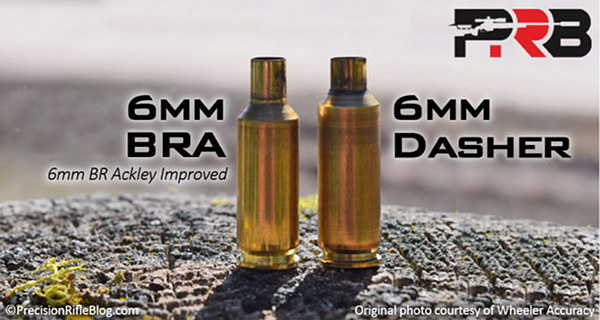
CARTRIDGE: 6mmBR Ackley, aka 6 BRA. Parent case is 6mmBR Norma. The 6 BRA is fire-formed to create a 40-degree shoulder and less body taper. Capacity is increased, but the neck is longer than a 6mm Dasher. The capacity is enough to get to the 2950+ FPS accuracy node. Some shooters say the 6 BRA is more forgiving than the 6mm Dasher. The 6 BRA is certainly easier to fire-form.
TEST REPORT — Conditions, Shooting Method, Loading Method
Tester James Phillips posted this report in ourShooters’ Forum:
Conditions: The testing was done in the morning over flags. The flags never moved or even twitched. I had as perfect conditions as I could have asked for. It was overcast so no mirage and no wind. There were no other shooters, just me.
Test Procedure: Each shot was precisely shot at my pace and centered the best possible using my Nightforce 15-55X scope. I did not use the round-robin method. Each four-shot group with the same was shot at one time. Then I moved onto the next primer. Everything felt right for each and every shot fired today. Of course I could repeat the test tomorrow and it could be exact opposite of today’s test. We can chase this forever. But [soon] I’m going to test the BR4 and 400 primer… for best accuracy and consistency for 10 shots each.
How Rounds Were Loaded: Each load was weighed to one (1) kernel of powder. So I know that’s as good as I can weigh them. Each bullet seating force was within 1# on my 21st Century hydraulic arbor press.
Previous Initial Load Testing: All groups were shot with 31.1 grains of H4895. During initial load testing I settled in on the Sellier & Bellot primer to finalize everything as it showed more promise over the CCI 450 Magnum I also tried. I was actually surprised to have seen the higher ES and SD from that primer today along with the vertical shown. [Editor: Look carefully — one shot from the CCI 450 is right in the center black diamond, stretching the vertical. By contrast the Rem 7.5 had almost no vertical.]
Velocity and NODE Considerations: I was about 5-6 FPS above what appeared to been my optimum velocity of 2943-2945 FPS, so I’ll test 5 shots of 31.0 and 5 of 31.1 and see what happens from there. I can only assume my velocities where higher due to the higher humidity and of course temps were 5 degrees warmer this morning as well. It wasn’t far off but I noticed it.
President Donald Trump will address NRA members at the NRA-ILA Leadership Forum on Friday, April 26, 2019 in Indianapolis, Indiana. This is the third consecutive year that President Trump will deliver the keynote address at the Leadership Forum. This is part of the NRA Annual Meetings & Exhibits, which runs April 25-28 at the Indiana Convention Center in Indianapolis.
“Donald Trump is the most enthusiastic supporter of the Second Amendment to occupy the Oval Office in our lifetimes. It is truly an honor to have President Trump address NRA members for the fifth consecutive year,” said Chris Cox, NRA-ILA Executive Director. “President Trump’s Supreme Court [and Appellate Court] appointments ensure that the Second Amendment will be respected for generations to come. Our members are excited to hear him speak and thank him for his support for our Right to Keep and Bear Arms.”
President Donald Trump
Keynote Speaker, NRA-ILA Leadership Forum
WHEN:
Friday, April 26, 2019
11:00 am – 4:00 pm
Tickets Required
GET FREE APP for NRA Annual Meetings and Exhibits
If you plan to attend the 2019 NRA Annual Meetings & Exhibits, you should get the official Mobile APP. This will help you access Convention info quickly and easily. You can search for exhibitors, tag your favorites, request meetings, add notes, and map booth locations. Key APP features include: Event Floorplan, Searchable Directory of Exhibitors, Event and Seminar Schedule, New Products Info with Product Photos.
From your mobile device, click buttons for official NRA Meetings mobile APP:
Three factory ammo types shot 0.53″, 0.55″, and 0.57″ respectively. That’s impressive.
Chassis rifles are hugely popular for PRS/NRL practical rifle competition. There are many good options for Production Class. You may not know that Weatherby, a company that built its reputation on hunting rifles, offers a great-shooting chassis rifle for PRS comps and other tactical disciplines.
Called the Vanguard® Modular Chassis (VMC), this rig has shown remarkable accuracy. Vanguard’s VMC features a Modular Driven Technologies (MDT) aluminum stock, Luth AR MBA-1 buttstock, and 22″ heavy barrel. The Weatherby Vanguard action is fitted with an adjustable 2-stage trigger. Priced at $1519.00 MSRP, this rifle can be campaigned in the PRS “Production Class”, which limits complete rifles to $2000.00 without optics. The rifle is offered in three chamberings: .223 Rem, 6.5 Creedmoor, and .308 Winchester.
Weatherby says its Vanguard Modular Chassis tactical rifle is very accurate. To back that claim, Weatherby offers a SUB-MOA accuracy guarantee — Weatherby guarantees the rifle will shoot .99” or smaller 3-shot groups at 100 yards when used with Weatherby® factory or premium ammunition.
Near Half-MOA Accuracy with Factory Ammo (5-Shot Groups)
It turns out Weatherby’s accuracy claims are conservative. This tactical rifle is closer to a half-MOA rig than a 1-MOA gun. American Rifleman tested a .308 Win version of this rifle and recorded really stellar accuracy — close to half-MOA. What’s more, this rifle is not fussy — with a 1:10″-twist barrel it proved very accurate with six types of factory ammo, with three of types registering 0.57″ or better.
The rifle delivered near-half-inch 5-shot groups with two types of Hornady ammo along with Black Hills 168gr. The worst group of six ammo types tested, Black Hills 175gr, was 0.76″, still very impressive for factory fodder. With good hand-loads this gun could go well under half-MOA (for five shots).
Vanguard Modular Chassis FIVE-SHOT Factory Ammo Test Groups:
0.53 inches | Hornady 168gr Match BTHP (2718 fps)
0.55 inches | Hornady 155gr Steel Match (2612 fps)
0.57 inches | Black Hills 168gr BTHP (2608 fps)
0.66 inches | Federal Premium 168gr MatchKing BTHP (2659 fps)
0.70 inches | Hornady 155gr American Gunner (2697 fps)
0.76 inches | Black Hills 175gr BTHP (2603 fps)
NOTE: Group sizes are for 5-shot groups shot from bench at 100 yards with Caldwell pedestal rest and rear sandbag. Pentax Lightseeker 6-24x50mm scope. Velocities in FPS from PACT Chronograph.
The accuracy testing was done by gunwriter Mike Detty, who notes: “My single best group was fired with Hornady’s Match 168-gr. BTHP ammunition. Five shots measured just slightly more than a half-inch. Hornady’s 155-gr. Steel Match ammo wasn’t far behind with a group of .55″. Also accounting for the small groups is the VMC’s wonderful trigger. It is a two-stage affair and the first stage has about 3/8” take up with about a pound of pressure until it reaches the second stage where another 1 ¾ lbs. was required to break the shot.”
Vanguard Modular Chassis FEATURES:
Action with Fully Enclosed Bolt Sleeve, Integral Recoil Lug
CNC-machined, hard-anodized, 6061 aluminum chassis
Fully adjustable LUTH-AR MBA-1 buttstock
Adjustable 2-stage trigger with 3-Position Safety
PRS Production Class Cost Limits
Production Division combined rifle and scope MSRP as listed on the company’s website shall not exceed $3,000 USD, the rifle shall not exceed $2,000 USD and the optic not exceed $2,000 USD. [Editor: For example, you could have a $2,000 rifle with a $1000.00 scope or vice-versa. The total system cannot exceed $3000. Rifle alone cannot exceed $2000.00 retail sale price.]
Production Division rifles are not permitted to be altered or improved in any way from the original factory configuration.
Early 6-shot Model 617 shown. Current Model 617s have 10-round cylinders.
“But Honey, I really do need a new gun….”
If you are looking for justification for getting a new handgun, show your spouse this article. Today we explain why every serious shooter should have a .22 LR wheelgun. Rimfire revolvers are versatile, reliable, easy-to-operate, and fun to shoot. A good .22 revolver will be considerably more accurate than 90% of the self-loading pistols you could buy. With a good a .22-caliber rimfire revolver you will learn sight alignment and trigger control. Plus you can practice with inexpensive ammunition.
The better .22 LR revolvers also hold their value. In particular, a Smith & Wesson Model 617 (or its predecessor, the Model 17, shown below) is a good investment. You could use your S&W wheelgun all your life and then pass it on to your kids. If you or your heirs ever wear out the barrel or cylinder, Smith & Wesson will replace the parts for free, forever. Think about that…
The Model 63 Kit Gun is a compact 6-shot (older) or 8-shot (newer) revolver. Older Model 63s are in high demand, so this is another Smith wheelgun that holds its value well…
Smith & Wesson Model 617 — Smith’s Model 617 is extremely accurate, with a very crisp trigger (in single-action mode), and good sights. You can learn all the fundamentals with this ultra-reliable handgun, shooting inexpensive .22 LR ammo. The Model 617 is rugged, durable, and can give you a lifetime of shooting fun.
Once you have mastered the basics of shooting with a .22 LR, you can move on to larger caliber handguns suitable for self-defense. Below is a slide-show illustrating a S&W Model 617 ten-shot, with 6″ barrel. S&W also makes a 4″-barrel version of this revolver. (See: Shooting Demo Video with 4″ model 617.)
Long-time site sponsor Powder Valley notified us about some great Rebate offers from Vista Outdoor companies Alliant, CCI, Federal, and Speer. If you need powder, primers, or bullets, now is a great time to buy. The rebated offers are good now through June 30, 2019. These rebates may also be available when you purchase qualifying products from other vendors Bruno’s, Graf’s, Midsouth, and Precision Reloading.
1. ALLIANT Powder — More Bang for your Buck$ Rebate
If you buy at least four (4) pounds of powder you get $2.00 back per pound, with a rebate limit of $20 (for ten pounds). Minimum purchase four (4) pounds required. This is a great deal when you combine the rebate with Powder Valley’s already low prices.
2. Federal — Handload and Save Rebate
Spend at least $100 on Federal® reloading components (including bullets, brass and primers) to get 20% of the purchase price back. Rebate amount calculated on purchase price only, does not include taxes and/or shipping/handling fees. Maximum rebate $100 per person or household. Minimum spend $100 required.
3. CCI — Primed for Action Rebate
Spend at least $100 on CCI® reloading primers to get 20% of the purchase price back. Rebate amount calculated on purchase price only, does not include taxes and/or shipping/handling fees. Reloading components only; offer does not apply to percussion caps. Maximum rebate $100 per person or household. Minimum spend $100 required.
4. Speer — More Bullets for your Benjamins Rebate
Spend at least $100 on Speer® component bullets to get 20% of the purchase price back. Rebate amount calculated on purchase price only, does not include taxes and/or shipping/handling fees. Maximum rebate $100 per person or household. Minimum spend $100 required.
Get up to $320 Total Rebate — Alliant, CCI, Federal, and Speer
These Rebate Offers are good through June 30, 2019. Powder Valley explains that these rebates are all separate programs: “Each of these brands have their own rebate, No Mixing and Matching of these brands unless you want to participate in all four rebates. If you have any questions please read the Terms or call us to explain.” To get any particular rebate you’ll need to buy the qualifying amount of product for that particular brand. If you do all four Rebates, you could get a total of $320.00 back.
Many of our Forum members have expressed interest in a recoil-reduction system for prone F-Open competition rifles shooting heavy bullets from powerful cartridges. A .300 WSM shooing 200+ grain bullets can definitely take its toll over the course of a match. One system that has been used with considerable success is the hydraulic “Bump Buster” recoil system. This definitely reduces the pounding your shoulder gets during a long match. To illustrate this system, we’ve reprised an article on Brett Soloman’s F-Open rifle from a couple years back. Watch the Videos to see the Bump Buster in action.
On his Facebook page, Hall-of-Fame shooter and ace gunsmith Thomas “Speedy” Gonzalez unveiled an impressive new F-Open rifle built for Bret Solomon. The rifle features Speedy’s new low-profile F-Class stock.
Bret’s gun is chambered for his 300 Solomon wildcat, shooting heavy 210gr bullets, so it can can be a real shoulder-buster, without some kind of buffer. The stock is fitted with a Ken Rucker’s Bump Buster hydraulic recoil reduction system to tame the recoil. The Bump Buster was originally designed for shotguns and hard-hitting, big game rifles. It is interesting to see this hydraulic buffer adapted to an F-Open rig.
Here you can see Bret shooting the gun, coached by Nancy Tompkins and Michele Gallagher:
Bret’s gun features a stainless Viper (Stiller) action, barrel tuner, and an innovative Speedy-crafted wood stock. Speedy says this stock design is all-new: “It is a true, low Center-of-Gravity F-Class stock, not a morphed Palma stock merely cut out on the bottom”. See all the details in this short video:
Stock Features: Glue-in or Bolt-In and Optional Carbon Pillars and Cooling Ports
Speedy explained the features of the new stock design: “Terry Leonard and I started working on an F-Class version of his stocks last year during the F-Class Nationals and came up with what he and I consider the first true low-CG stock in the sport. As you can see by the videos, there is very little torqueing of the stock during recoil. I add the carbon fiber tunnel underneath the forearms to save Terry some time. This bonds very well to his carbon fiber skeleton within the stock adding addition stiffness to the forearm to support the heavy barrels found on the F-Class rigs. We are playing with both glue-ins like we benchresters use and bolt-ins as well. The rifles on the videos are glue-ins. Bret just took delivery today of his first bolt-in employing carbon fiber pillars and the first Leonard stock ever to have cooling ports.”
Need for Recoil Reduction Follows F-Class Trend to Bigger Calibers and Heavier Bullets
In recent years we have seen F-Open competitors move to bigger calibers and heavier bullets in pursuit of higher BC. There is no free lunch however. Shooting a 210gr .30-caliber bullet is going to produce much more recoil than a 140gr 6.5mm projectile (when they are shot at similar velocities). Does this mean that more F-Open shooters will add hydraulic buffers to their rigs? Will a recoil-reduction system become “de rigueur” on F-Open rifles shooting heavy bullets?
Our friend Boyd Allen observes: “You may imagine that shooting a short magnum, or even a .284 Win with heavy bullets, involves a fair amount of recoil, and in the prone position this can be more than a little wearing. It can in fact beat you up over the course of a match. Some time back, Lou Murdica told me about having a hydraulic recoil absorbing device installed on one of his F-Class rifles, chambered in .300 WSM. Lou is shooting heavy (210-215gr) bullets so the recoil is stout. According to Lou, the hydraulic recoil-reduction system made all the difference.”
Story tip from Boyd Allen. We welcome reader submissions.


 When hunting or when competing in a field tactical match, you need to be able to shoot from a variety of positions. While the prone position is normally the most stable, hunters (and tactical marksmen) will encounter situations that demand the ability to shoot from a higher position.




 Smith & Wesson Model 617 — Smith’s Model 617 is extremely accurate, with a very crisp trigger (in single-action mode), and good sights. You can learn all the fundamentals with this ultra-reliable handgun, shooting inexpensive .22 LR ammo. The Model 617 is rugged, durable, and can give you a lifetime of shooting fun.


 On his


