Sportsmen spend millions of dollars on hunting and recreational shooting equipment, but which brands are they buying? In 2018, Southwick Associates surveyed more than 20,000 hunters and recreational shooters to find the top brands in the market. The product preferences of hunters and recreational shooters were determined via HunterSurvey.com and ShooterSurvey.com online polls.
The top handgun maker was Smith & Wesson and the top handgun ammo brand was Federal. Those choices make sense. But some of the other choices were a bit surprising…
IMPORTANT COMMENT: Keep in mind these are just survey results. In many cases, the top choices are simply the cheapest options that sell the most. For example the top choice in reloading dies was Lee Precision. Lee makes some decent products (we like Lee decapping dies), but you won’t find many National Champions using Lee seating or sizing dies.
So assess the survey results with a “grain of salt”, understanding that these aren’t necessarily the best products when gauged by quality or performance. They are just the most popular among those surveyed. A Big Mac isn’t better than a filet mignon, but more Big Macs are purchased. You get the idea…
SURVEY Results — Most Purchased Hunting & Shooting Brands:
Top rimfire rifle brand: Ruger/Sturm Ruger
Top handgun brand: Smith & Wesson
Top handgun ammunition brand: Federal (including Fusion)
Top holster/ammo belt brand: Uncle Mikes
Top reflex/red dot sight brand: Vortex
Top laser rangefinder brand: Nikon
Top laser sight brand: Crimson Trace
Top scope mount brand: Leupold
Top reloading powder brand: Hodgdon
Top reloading bullets brand: Hornady
Top propellant/powder brand: Triple Seven
Top reloading dies brand: Lee Precision
Top gun cleaning brand: Hoppes
Top hunting knife brand: Gerber
Top game call brand: Primos
Top crossbow brand: Barnett
Top arrow brand: Easton
More than one hundred products are examined in the 2018 Hunting & Shooting Participation and Equipment Purchases Report (CLICK HERE). This in-depth resource covers buying preferences, including the percentage of sales occurring across different retail channels, brand purchased, price paid, and demographics for hunters and shooters buying specific products. Additional information tracked includes total days spent per activity, type of hunting / shooting activity, preferred species and where they hunt. In addition to the topline reports covering hunting and target shooting, annual reports are also offered for special segments including archery consumers, deer hunters, turkey hunters, and waterfowl hunters. To purchase a report or discuss custom research, email Nancy [at] SouthwickAssociates.com.
Why You CANNOT Rely on the MV Printed on the Ammo Box!
When figuring out your come-ups with a ballistics solver or drop chart it’s “mission critical” to have an accurate muzzle velocity (MV). When shooting factory ammo, it’s tempting to use the manufacturer-provided MV which may be printed on the package. That’s not such a great idea says Bryan Litz of Applied Ballistics. Don’t rely on the MV on the box, Bryan advises — you should take out your chrono and run your own velocity tests. There are a number of reasons why the MV values on ammo packaging may be inaccurate. Below is a discussion of factory ammo MV from the Applied Ballistics Facebook Page.
Five Reasons You Cannot Trust the Velocity on a Box of Ammo:
1. You have no idea about the rifle used for the MV test.
2. You have no idea what atmospheric conditions were during testing, and yes it matters a lot.
3. You have no idea of the SD for the factory ammo, and how the manufacturer derived the MV from that SD. (Marketing plays a role here).
4. You have no idea of the precision and quality of chronograph(s) used for velocity testing.
5. You have no idea if the manufacturer used the raw velocity, or back-calculated the MV. The BC used to back track that data is also unknown.
1. The factory test rifle and your rifle are not the same. Aside from having a different chamber, and possibly barrel length some other things are important too like the barrel twist rate, and how much wear was in the barrel. Was it just recently cleaned, has it ever been cleaned? You simply don’t know anything about the rifle used in testing.
2. Temperature and Humidity conditions may be quite different (than during testing). Temperature has a physical effect on powder, which changes how it burns. Couple this with the fact that different powders can vary in temp-stability quite a bit. You just don’t know what the conditions at the time of testing were. Also a lot of factory ammunition is loaded with powder that is meter friendly. Meter friendly can often times be ball powder, which is less temperature stable than stick powder often times.
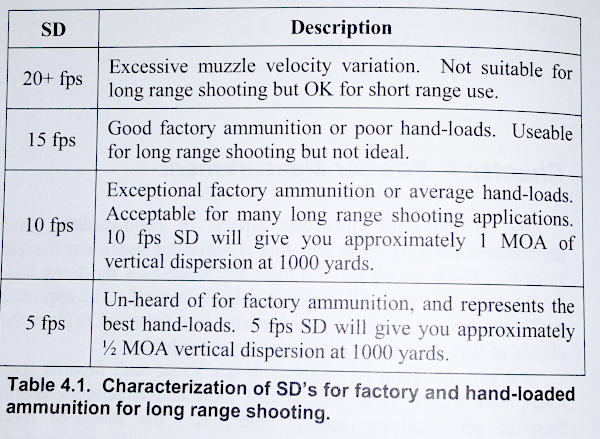
3. The ammo’s Standard Deviation (SD) is unknown. You will often notice that while MV is often listed on ammo packages, Standard Deviation (normally) is not. It is not uncommon for factory ammunition to have an SD of 18 or higher. Sometimes as high as 40+. As such is the nature of metering powder. With marketing in mind, did they pick the high, low, or average end of the SD? We really don’t know. You won’t either until you test it for yourself. For hand-loaded ammo, to be considered around 10 fps or less. Having a high SD is often the nature of metered powder and factory loads. The image below is from Modern Advancements in Long Range Shooting: Volume II.
4. You don’t know how MV was measured. What chronograph system did the manufacturer use, and how did they back track to a muzzle velocity? A chronograph does not measure true velocity at the muzzle; it simply measures velocity at the location it is sitting. So you need to back-calculate the distance from the chrono to the end of the barrel. This calculation requires a semi-accurate BC. So whose BC was used to back track to the muzzle or did the manufacturer even do that? Did they simply print the numbers displayed by the chronograph? What kind of chronograph setup did they use? We know from our Lab Testing that not all chronographs are created equal. Without knowing what chronograph was used, you have no idea the quality of the measurement. See: Applied Ballistics Chronograph Chapter Excerpt.
5. The MV data may not be current. Does the manufacturer update that data for every lot? Or is it the same data from years ago? Some manufacturers rarely if ever re-test and update information. Some update it every lot (ABM Ammo is actually tested every single lot for 1% consistency). Without knowing this information, you could be using data for years ago.
CONCLUSION: Never use the printed MV off a box of ammo as anything more than a starting point, there are too many factors to account for. You must always either test for the MV with a chronograph, or use carefully obtained, live fire data. When you are using a Ballistic Solver such as the AB Apps or Devices integrated with AB, you need to know the MV to an accuracy down to 5 fps. The more reliable the MV number, the better your ballistics solutions.
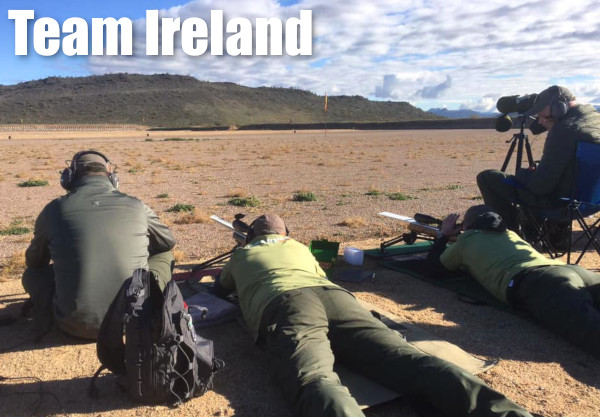
The Creedmoor Cup is an historic challenge match between American and Irish marksmen. The first match was held in in 1874 between American and Irish Teams in Creedmoor, New York. (Read Match History). The Match was revived in 2011 and is now held every four years.
In 2019, the match was held this week at the Ben Avery Range in Arizona, following the Berger Southwest Nationals. It proved to be a great match, with Team USA coming out on top. Erik Cortina stated: “What a great experience this has been. Team USA won the 2019 Creedmoor cup vs Ireland. It had been over 100 years since match was shot in the United States. Glad to see this tradition continue.”
Congrats to the Members of Winning Team USA:
F-TR Riflemen
Alan Barnhart
Ellis Berry
David Conrath
Tracy Hogg
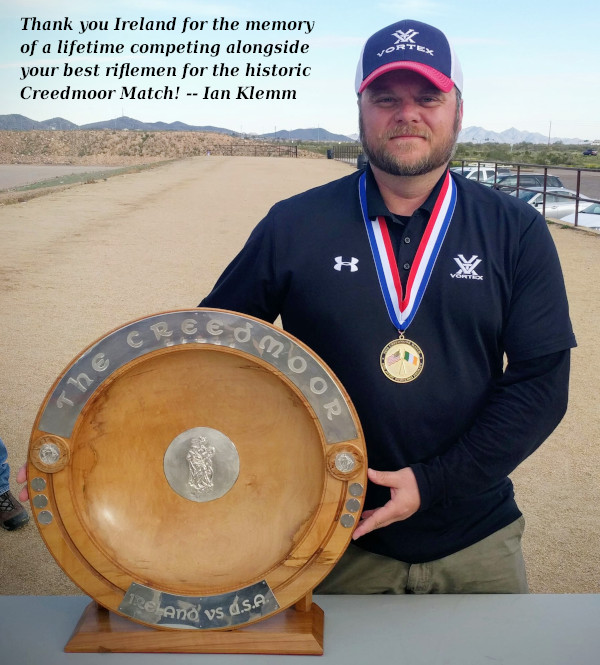
Ian Klemm
Matthew Schwartzkopf
Ed Shelley
Keith Trapp
F-Open Riflemen
Larry Bartholome
Erik Cortina
Ken Dickerman
David Gosnell
Rick Jensen
Jim Murphy
Pat Scully
Keith Weil
Coaches
Kent Reeve (Head Coach)
James Crofts
Scott Fulmer
Bob Seabold
Nancy Tompkins
Team Staff
Captain Phil Kelley
Vice-Captain Dan Bramley
Adjutant Stephen Ireland
Team USA Captain Phil Kelly told us this was a great match: “USA wins the Creedmoor Cup in a great competition with Team Ireland! Two days of cold and windy conditions challenged both 16-shooter teams. Final ceremonies included Native American dancers and great camaraderie among all the competitors. Thank you to all from Team Ireland who made the trip! The best of competitors and friends.” Phil added: “Special thanks to additional Creedmoor Committee members including Michelle Gallagher, Pete Ricci, and Mark Walker. We look forward to the next gathering in four years. Safe travels all.”
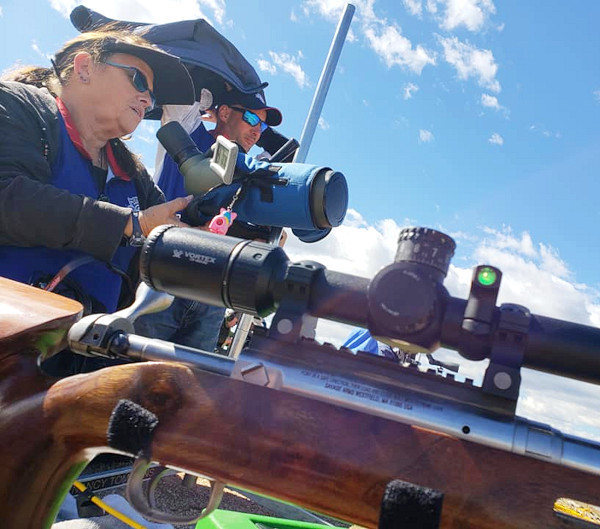
Nancy Tompkins looks down-range. With the wind-chill, competitors and coaches dressed warm.
Not Your Typical Warm Arizona Days at Ben Avery
There were variable conditions at the match — first easy, then tough. USA Captain Phil Kelley reported: “On Day 1 of the 2-day match, things started good then got tougher. The morning and 800-yard line saw 34° and light winds leading to high scores.
That changed as the 16-shooter teams made their way to the 900-yard line as sun, moderate wind and building mirage hit the range providing more challenging conditions.
After an excellent lunch both teams were in for a challenge. Winds of 12-16 mph with constant angle changes and surging mirage made communications and coordination among five coaches critical. The wind chill also dropped as teams stayed on the line for the majority of allotted time.”
The First-Ever Creedmoor Challenge Match in 1874
The Irish International Shooting team arrived in New York on the 16th of September and proceeded to “take in the sights”, which was understandable, before some practice at the Creedmoor range. On September 26th they presented themselves for the match with confidence and in high spirits. The crowds that day were reported to be between 5,000 and 10,000 strong, which showed the huge support already growing for the fledgling sport in America.
The course of fire was 15 shots to each man at 800, 900, and 1000 yards. Unfortunately, the details of each mans scores at the individual distances have been lost to time but we do know that the Americans were well ahead after the 800-yard shoot. The Irish then caught up after the 900-yard and finished the 1000-yard shoot ahead by 1 point. The Americans still had one man left to shoot and it came down to his very last shot with which he scored a 4 giving the American team the win over the Irish by 3 points.
Post-Competition Camaraderie and “Craic” at the Pub
“Craic” is an Irish term referring to positive interaction among people through conversation, stories, and music. The Craic was strong after the 2019 Creedmoor Match.
Desert Sharpshooters posted: “The ‘Craic’ is amazing tonight with the Irish rifle team to finish the Creedmoor. Thank you to the USA team members that came out tonight to show the Irish a good time. This is truely what the Creedmoor Cup is about, Friendship and good times.”
File photo showing Kestrel 5700 Elite. See video below for 6.5 Creedmoor rifle.
It’s not easy to place a first shot on target at 1500 yards. You must measure the wind speed with precision, know your exact muzzle velocity, and have a sophisticated ballistics solver. In this short video from Ryans Range Report, the shooter manages a first-round hit on a steel silhouette at 1500 yards. He used a Kestrel 4500 NV Weather Meter with Applied Ballistics software to figure out the trajectory for his 6.5 Creedmoor rounds.
The Kestrel recorded a wind velocity, and the internal software calculated a solution of 17 Mils elevation (that’s 928 inches of drop) with 2.5 Mils windage. “Bang” — the shooter sends it, and 2.6 seconds later “Clang” he had a hit (flight time was 2.6 seconds). Bryan Litz observes: “This is the science of accuracy (in the form of an Applied Ballistics Kestrel) being put to good use at 1500 yards”.
Later in the video (1:05-1:15) the shooter places three rounds on steel at 1000 yards in just 10 seconds. The three shots all fall within 10″ or so — pretty impressive for rapid fire. The shooter reports: “[In my 6.5 Creedmoor] I’m using a 136gr Lapua Scenar L. This bullet has impressed me. It screams out of my barrel at 2940 fps and holds on all the way out to 1,500 yards.”
The rifle was built by Aaron Roberts of Roberts Precision Rifles (RPRifles.com). Chambered for the 6.5 Creedmoor, it features a Leupold Mark VI 3-18x44mm scope.
Roberts Precision Rifles
19515 Wied Rd. Suite D
Spring, Texas 77388
Phone: 281-651-5593
Email: rprifles @ gmail.com
The 2019 Berger Southwest Nationals (SWN) are history. It was a great event, with challenging conditions. Forum member Matt Peetz reports: “This year was one of the best — the toughest competitors battling for position in some tough conditions. You never knew how the day was going to end up.” For detailed results and more photos, visit the Desert Sharpshooters Facebook Page.
This Berger SWN brings together sling shooters and F-Class competitors in one of the most popular rifle matches of the year, and definitely the biggest match West of the Mississippi. We congratulate the three divisional champions: Curtis Gordon (Sling), John Myers (F-Open), and Keith Trapp (F-TR)
Keith Trapp won the F-TR division at the Berger SWN with the best overall Aggregate for the week. Keith’s name will be placed on the SWN Nightforce Perpetual Trophy overall. Fellow F-TR Shooter Luke Ramsey won the Berger Trophy for the 600-yard Individual Agg. Phil Kelley said: “It was pretty cool to see good friend Keith Trapp win it all. Our little Butner Club matches just make me smile. That’s 3 SWN champions riding in the same car many days.”
F-TR Top Three
Keith Trapp, 1227-44X; Peter Johns, 1224-40X; Ian Klemm, 1222-51X
(Special Mention: Fritz Braun, 1220-58X, High Senior)
F-Open Top Three
John Myers, 1244-71X; Stephen Potter, 1241-69X; Cody Richardson, 1241-62X
(Special Mention: Sixth Overall and F-Open Palma Match Winner, AccurateShooter System Admin Jay Christopherson, 1239-61X)
Sling (Palma) Top Three
Curtis Gordon, 1241-67X; Kent Reeve, 1241-52X; Oliver Milanovic, 1240-68X
(Special Mention: Tom Whitaker, 1232-55X, High Grand Senior)
F-Open Team Results
Winner: Team Lapua-Brux-Borden, 2375-137X
Alphabetical Order: Jay Christopherson, Erik Cortina (Shooter/Captain), Tod Hendricks, Pat Scully, Bob Sebold (Coach); David Christian (Alt), Steve Harp (Alt)
Second Place: Team Grizzly, 2374-109X
Shiraz Balolia (Shooter/Captain), David Mann, John Meyers, Emil Kovan, Emil Praslick III (Coach)
F-TR Team Results
Winner: Team Texas, 2359-111X
Otis Riffey, Jason Peel, David Parck, Greg Barkley, Randy Littleton, Skip Barkley (Captain), Peter Johns (Coach)
Second Place: Team USA Freedom, 2345-108X
Ian Klemm, Wade Fillingame, Alan Barnhart, Fritz Braun, Kent Reeve (Captain); James Crofts (Coach)
Sling Team Results
Winner: Blazing Saddles, 2347-108X
Thomas Thompson, Andrew Wilde, Mike Kelley (Shooter/Captain), Oliver Milanovic (Shooter/Coach)
Gary Eliseo said: “Congratulations to team Blazing Saddles — Mike Kelley, Tom Thompson, Andrew Wilde, and Oliver Milanovic winners of the gold medal in the team event of the 2019 BSWN matches. Well done!”
Second Place: Team U.S. National Black, 2346-107X
Steffen Bunde, Tony Miller, Yvonne Roberts, Jerry Iliff (Shooter/Captain), Yvonne Roberts (Shooter/Coach)
Friends in Life and on the Podium
Congratulations to Allen Thomas and Gary Eliseo who both shot great in the “Any Rifle” class, a subdivision of the sling division. Both men were shooting Eliseo Chassis Rifles with Pierce Engineering’s new Gen 2 short-cycle Ultra slick actions. Gary noted: “I’m honored to share the podium with my friend and teammate Allen Thomas (first place ‘Any Rifle’) and me (second place ‘Any Rifle’) winners at the 2019 BSWN matches.
We like well-executed DIY (Do-It-Yourself) projects. You can save money with DIY projects, and often create something unique and special that can’t be purchased from any vendor. That’s the case with this very cool double shooting bench built by Jacob D., a pilot and 6.5 Creedmoor shooter.
Jacob, who flys for Arizona’s Mesa Airlines, built his own side-by-side benchrest shooting bench. He then posted photos of this on the 6.5 Creedmoor Group Facebook Page. We like this — very nice work Jacob!
Jacob writes: “Sighting in my new Ruger Precision Rifle with Leupold VX3i LRP 6.5-20x50mm and Burris tactical rings, using my benchrest table I built. Very happy with the combo!”
There is plenty of room for two shooters and two rifles on Jacob’s big and sturdy DIY shooting bench.
We know you guys like taking photos of your rifles at the range. And, if you’re selling a rifle, scope, front rest, or rear bag, you need good photos to post in our Forum classifieds. Here’s a basic photography tip that can help you produce dramatically better photos. Use your camera’s ability to add “fill flash” even in daylight.
There’s plenty of light on a bright day. But bright light also means strong shadows. The shadows can leave parts of your subject literally in the dark. Daylight flash will help fill in those dark spots. In addition, if you are on a covered firing area, and want to include the range in your photo, you can benefit from using flash. This will prevent the foreground subject from being too dark while the downrange background is much too bright.
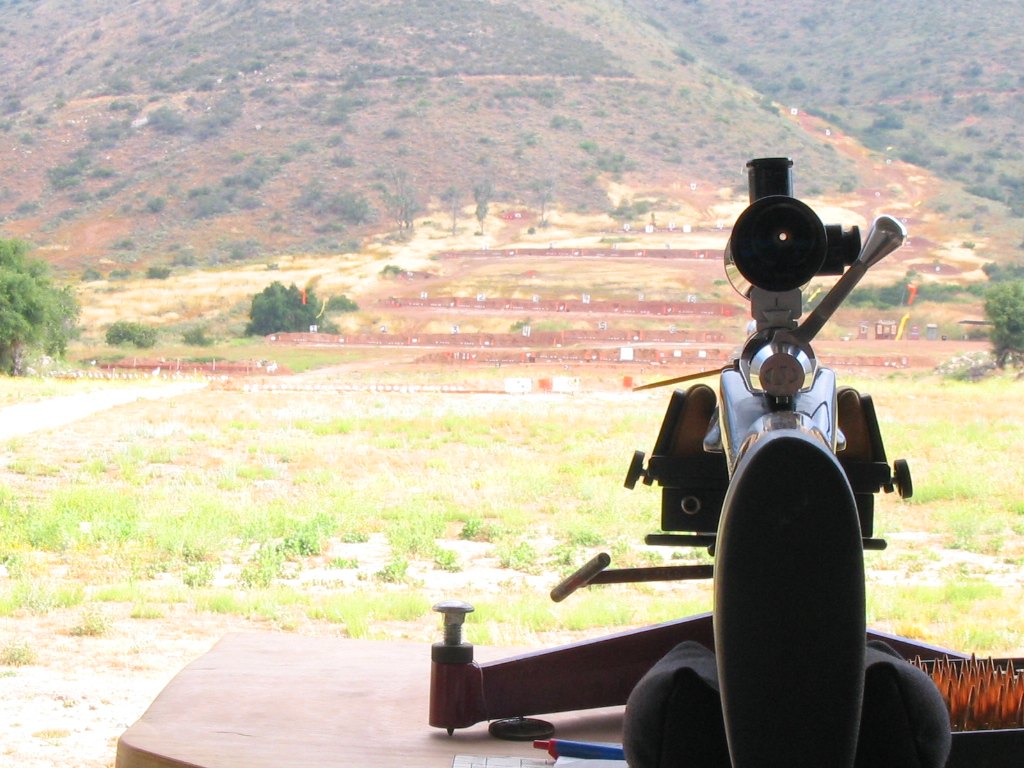
Photo without Flash
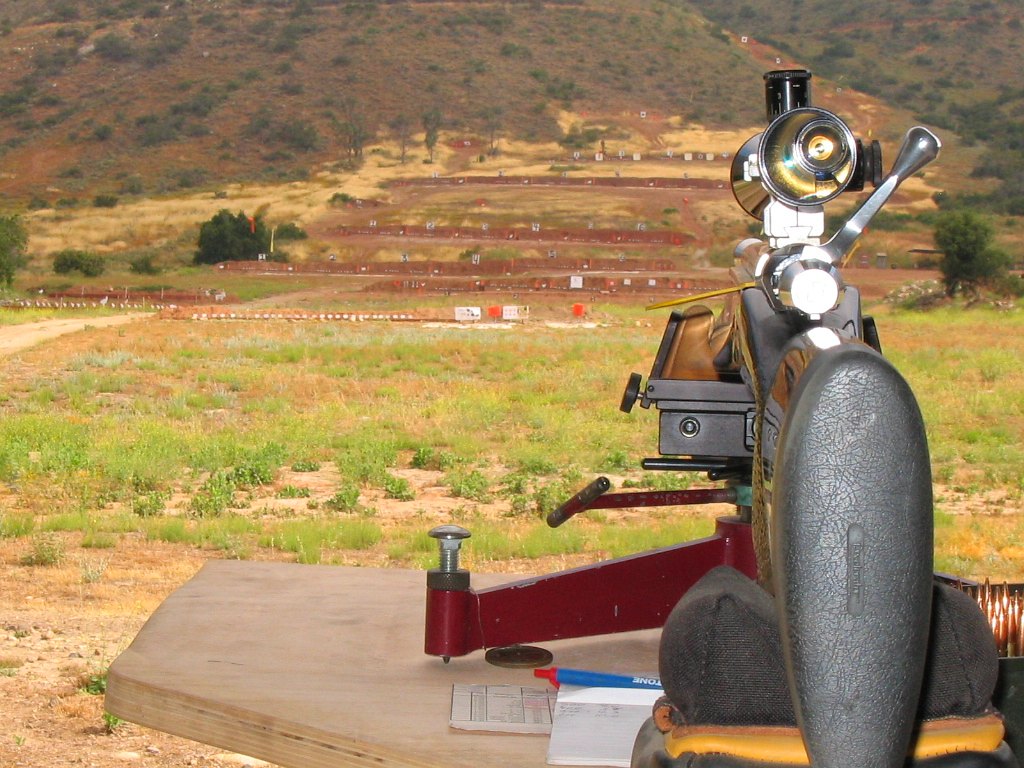
The photo above was taken without flash. As you can see, the rifle is too dark so details are lost. At the same time, the background (downrange) is over-exposed and washed out. The second photo below is taken with daylight flash. The difference is dramatic. Now you can see details of the rifle, while the background is exposed properly. Note how much easier it is to see the the targets downrange and the colors of the front rest. NOTE: these two photos were taken at the same time — just seconds apart.
Photo with Daylight “Fill-Flash”
Be sure to click on the larger versions of each photo.
How to Activate Daylight Flash
Most digital cameras have daylight flash capability. Some cameras have a separate setting for “auto fill flash”. On other cameras, you’ll have to set the camera to aperture priority and stop down the aperture to force the flash to fire. Read your camera’s manual. On many Canons, a menu that lets you set the “flash output”. For “fill flash” we like to set the flash at 30% to 50% output. This fills in the shadows sufficiently without “killing contrast” or creating too much reflection on shiny metal. Below is a photo taken with 30% flash output. Note the rich colors and how the exposure is balanced between foreground and background. Without flash the sky and target area would be “washed out”.
Here’s another tip for Canon owners. If you like deep, rich colors, use the “Vivid” setting in the effects menu. This punches up saturation and contrast.
Gear Report by Kip Staton
Shooters in the market for an accurate anemometer that doesn’t break the bank need to take a hard look at the WeatherFlow Wind Meter, which retails on Amazon.com for just $39.89. Even though it is inexpensive, owner reviews have been generally very positive (so long as the software is compatible with your device). One Amazon reviewer says the WeatherFlow measures wind velocity as accurately a dedicated anemometer.
A big part of the reason the WeatherFlow Wind Meter is so inexpensive is that you’ve probably already got the brains of the system in your pocket. Yes, it connects to and communicates with any standard smartphone or tablet, in either iOS or Android flavors. Users simply download the free WeatherFlow Wind Meter app to their smart device, insert the anemometer into the headphone jack, and can immediately start measuring the wind.
Of course, the first question any serious shooter will ask is “How accurate is this thing?” Pretty dang accurate, as it turns out. The device was calibrated by the University of Florida’s Aerospace Engineering Department, and the unique design allows it to consistently report to within a half a percentage point of the true wind value, even if the breeze is up to 15 degrees off-axis to the meter.
Wind speeds are measurable from as slow as two miles per hour to as high as 125 MPH. The Wind Meter outputs average, lull, and gusts windspeed data to your phone, with velocities indicated in 0.1 MPH increments. Furthermore, a hard-sided protective case is included for safe transportation.
Naturally, since the WeatherFlow Wind Meter is App-based, it’s connectable to a variety of social media websites and distribution sources. This makes saving and sharing information about climate conditions a breeze.
To read more gear reviews by Kip Staton, visit KipStaton.com.
No personal rifle collection is complete without a .50 BMG — the big boy. The single-shot, bolt-action Noreen is one of the most affordable Fifties. This 32-pound beast boasts a 34″ barrel with a massive muzzle brake. Simple and bomb proof, what more could you need? The .50 BMG Noreen Ultra Long Range (ULR) rifle features a single shot bolt action, 34″ barrel with 1:15″ twist, Noreen collapsible stock, A2 pistol grip, timney adjustable trigger, and Noreen muzzle brake with 1.25-12 thread. NOTE: The photo above shows one version with a custom camo paint job. You’ll have to do that yourself. The gun is available from EuroOptic.com at this $2149.00 price only with a matte black finish.
The Noreen’s bolt is stout, sporting a large diameter bolt body. This jumbo-sized rifle comes with Timney trigger and AR-type pistol grip (which can be exchanged by purchaser). The wide bipod is included with the rifle. EuroOptic now offers the Noreen .50 BMG in Matte Black for $2149.00 price. Heck you could pay that much for a puny little .22 LR Anschutz. So go BIG instead — be the first on your block with a .50 BMG! You can also purchase this rig directly from Noreen Firearms, with a choice of four calibers: .338 Lapua Magnum, .408 CheyTac, .416 Barrett, and .50 BMG.
About the .50 BMG Cartridge
The .50 Browning Machine Gun (.50 BMG, aka 12.7×99mm NATO or 50 Browning) is a cartridge developed for the Browning .50 caliber machine gun in the late 1910s, entering official service in 1921. Under STANAG 4383, it is a standard cartridge for NATO forces as well as many non-NATO countries. John Browning had the idea for this round during World War I in response to a need for an anti-aircraft weapon, based on a scaled-up .30-06 Springfield design, used in a machine gun based on a scaled-up M1919/M1917 design that Browning had initially developed around 1900. According to the American Rifleman: “The Browning .50 originated in the Great War. American interest in an armor-piercing cartridge was influenced by the marginal French 11 mm design, prompting U.S. Army Ordnance officers to consult Browning. They wanted a heavy projectile at 2700 FPS, but the ammunition did not exist. Browning pondered the situation and, according to his son John, replied, ‘Well, the cartridge sounds pretty good to start. You make up some cartridges and we’ll do some shooting’.”
Every year our friends Ed and Steve, aka the 6.5 Guys, produce informative SHOT Show videos. These two hard-working dudes visited dozens of product booths during SHOT Show 2019, producing over 40 video interviews for 65Guys.com. Ed and Steve roamed the Expo Center finding the latest and greatest rifles, stocks, optics, and accessories. Here are five 6.5 Guys Videos about new rifles and chassis systems. Next week we’ll feature more 6.5 Guys videos covering new optics. You can see all 42 SHOT Show 2019 videos from Ed and Steve on the 6.5 Guys YouTube Channel.
Modular Driven Technologies
Modular Driven Technologies (MDT) produces impressive chassis systems with innovative features, including modular weights. MDT is now a top choice for the PRS/NRL tactical disciplines. Steve was quite impressed by the new MDT ACC. See more at MDTTac.com.
Accuracy International — Mile High Shooting Accessories
One of the most impressive rifles at SHOT Show 2019 was the massive Accuracy Int’l Advanced Sniper Rifle (ASR) at the Mile High Shooting Accessories booth. The Advanced Sniper Rifle (ASR) will be submitted for SOCOM’s multi-caliber rifle program. It is offered in a $19,544 deployment kit with three barrels: (.308 Win, .300 Norma Mag, and .338 Norma Mag).
Seekins Precision — Complete Rifles and Actions
Seekins Precision showcased some impressive custom actions plus complete rifles for both tactical competitors and long range hunters. We were impressed with the build quality of the Seekins precision rifles. We liked the new Seekins Havak Bravo, and the Seekins action has some interesting features, such as four locking lugs with 90° bolt throw. Full Seekins Havak Bravo Review.
Gunwerks — Long Range Precision Rifles
Gunwerks is more than a builder of expensive (some say over-priced) rifles. It also sells branded electro-optics, and suppressors. Gunwerks also runs shooting clinics, and has hundreds of training and hunting videos on the Gunwerks YouTube channel. We like what Gunwerks is doing in the media space. Here the 6.5 Guys showcase some of the latest rifle and stock options from Gunwerks. Steve said he liked the adjustability and ergonomics on the Gunwerks stocks.
Legacy Sports International (Howa)
Legacy Sports Int’l (LSI) offers a variety of hunting and tactical rifles featuring the smooth-running Howa actions from Japan. At SHOT Show 2019, Legacy previewed a new tactical rig featuring a modular MDT Oryx chassis and Howa 1500 barreled action. The 6.5 Guys got to shoot this rig during media day and were impressed. This will be offered for Howa Short, Long, and Mini Actions.






 It’s not easy to place a first shot on target at 1500 yards. You must measure the wind speed with precision, know your exact muzzle velocity, and have a sophisticated ballistics solver. In this short video from


 We know you guys like taking photos of your rifles at the range. And, if you’re selling a rifle, scope, front rest, or rear bag, you need good photos to post in our Forum classifieds. Here’s a basic photography tip that can help you produce dramatically better photos. Use your camera’s ability to add “fill flash” even in daylight.