When you make a reloading mistake, you may need to “pull down” assembled ammo. The embedded UltimateReloader.com video demonstrates how to use the Hornady Cam-Lock bullet pulling system.
When Reloading Goes Bad — The Danger of Over-Charging
Our friend Gavin Gear of UltimateReloader.com was recently reloading some 9mm pistol ammo with his Hornady progressive press. As part of his reloading procedure, he visually checks the cases — and he noticed that the charges seemed high. Sure enough, his most recently-produced rounds were about two grains over spec. He diagnosed the issue: “I was using a powder measure without a baffle. What happened was, over the course of the loading session, things settled in, and the charge level increased.”
Not knowing just when his powder measure started delivering too much powder, Gavin decided, for safety’s sake, to pull down all the ammo he had just reloaded. Yes that’s time-consuming, but it’s better than the alternative — having a dangerous Kaboom while shooting. With fast-burning pistol powders, a two-grain over-charge could cause a blown case, damaged firearm, and/or serious injury.
Watch Cam-Lock Bullet Puller Used to Remove Bullets from Loaded Ammo:
Use of Bullet Puller starts 4:00 minutes into video.
Gavin says it is vitally important to perform safety checks during the reloading process: “You’ve got to do it — check every single round to make sure there IS powder, and that there’s not too MUCH powder. Double, Triple, Quadruple check your components… and your powder charges. You can’t be too careful.”
To pull down a loaded round, first place the cartridge in the shellholder on your press ram. Then raise the round up into the bullet puller device installed where a die would go. The Hornady Cam-lock bullet puller works by clamping the bullet in a collet when you flip down the red-coated lever. Then, with the case held by the rim in the shell-holder, the bullet exits the cartridge as the press ram is lowered. It takes time, but it’s pretty fool-proof once you get the hang of it. This entire process is illustrated in Gavin’s video, starting near the four-minute mark.
The Hornady Cam Lock Bullet Puller has four (4) key components: 1. Cam-Lock die body; 2. Cam-Lock lever; 3. Stem; and 4. Collet (Caliber-specific).
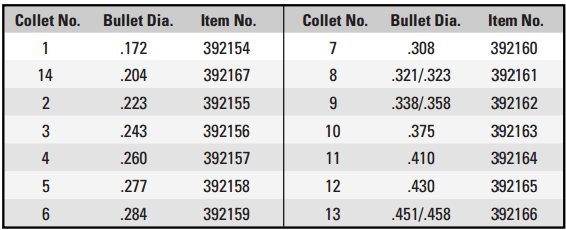
NOTE: In order to use this tool, you’ll need the appropriate collet for each diameter range of bullets you intend to pull. For example use collet #3 for 6mm, collect #6 for 7mm, and collet #7 for .308 Caliber.
RCBS Lock-Out Die
A good safety option for users with progressive presses is the RCBS Lock-Out Die. This has a charge detection rod that dips into each case after powder has dropped. You adjust the die to the proper charge height for your desired load. If the actual dispensed charge is too high or too low, the Lock-Out Die senses the problem and stops the press from advancing to the next case (it does this by preventing the ram/shellplate from fully elevating). We’ve used the Lock-out die with success for both pistol and rifle cartridges. It’s sensitive to about one-half grain with pistol powders.
This Lock-Out Die works with Hornady and Dillon progressives as well as with RCBS progressives. It does take up one die station on the press.
One of the most unique and exotic rifles in the NRA Museum is the Fuchs Double Barrel Bolt Action Rifle. “This is the … most substantial bolt action rifle ever made,” said NRA Museums Senior Curator Philip Schreier. This unique double barrel bolt-action rifle loads two cartridges at the same time. It is the world’s only repeating double rifle design. Incorporating titanium components to reduce weight, this .416 Remington Magnum rifle has an eight-shot capacity, feeding from a beautifully engraved massive magazine assembly mounted under the receiver. Hungarian inventor Joseph Szecsei developed this innovative design after being charged simultaneously by three elephants in 1989. These rifles are sold by Fuchs Fine Guns in Innsbruck, Austria.
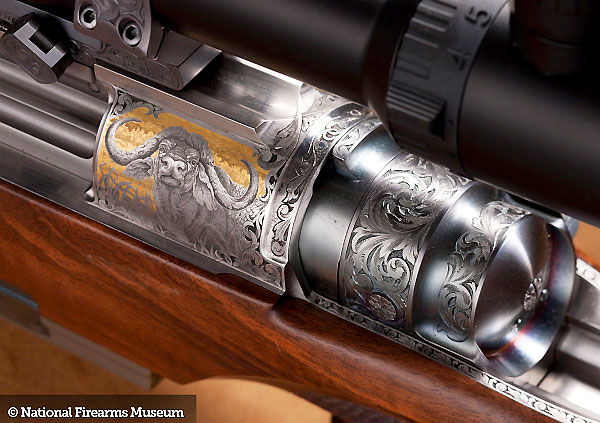
An engineering tour de force, this elaborately engraved rifle is also a work of art. On the action, and bottom metal are engraved images of the “Big Five” African game species: elephant, cape buffalo, rhino, lion, and leopard. This rifle has been featured on Curator’s Corner on the Outdoor Channel, and it now resides behind glass in the Robert E. Peterson Collection at the NRA Museum.
Here gun builder Gerhard Fuchs explains the features of the exotic double-barreled bolt-action rifle:
This amazing twin-barreled bolt-gun has a unique closing mechanism that locks two separate bolt bodies into the chambers of the right and left barrels. Yes there are two firing pins, two ejectors, two extractors, and two triggers. We’re not sure how one jumbo camming system closes two bolts — Perhaps one of our gunsmith readers can explain how this system works.
This Rifle Has TWO Barrels and TWO Bolts
Just $78,000 at “Half-off Pricing”
Shown here (above and below) is another Fuchs double bolt rifle chambered in .416 Remington. This example, without the “Big Five” animal engravings, sold a few years back on Gunbroker.com for $78,000. That astronomical sum is just half the original cost, according to the seller. This amazing double safari rifle has 22″ barrels and weighs 11.5 pounds.
More Eye-Catching Examples of the Fuchs Double Barrel Rifle
Along with the rifle featured in this article, you can see other Fuchs Double Barrel Repeater rifles with the same twin-bolt action on the Fuchs Fine Guns website. Here are examples.
The RCBS Lock-Out Die can also be used with some Dillon and Hornady progressive presses.
If you load pistol or rifle ammo with a progressive press, we strongly recommend you get a Lock-Out Die from RCBS. This unique reloading die will prevent your progressive press from advancing if the dispensed powder charge is more or less than about 0.3 grains too high or too low. The Lock-Out Die really works. Your Editor uses it on his RCBS 2000 progressive press. I can affirm that a Lock-Out Die has “saved my bacon” a half-dozen times over the years when there was an over-charge (which could cause a Kaboom) or a low charge (which could cause a squib load).
The Lock-Out Die works by using a central die detection rod that sets its vertical position based on the height of the powder column in the case. Through an ingenious design, if the powder column height is too low or too high, the rod locks in place as you start to pull the press handle. This halts the press before the ram can lift and the cartridge plate can advance. Unlike a beeping alarm system (which can be ignored or defeated), the Lock-Out Die physically stops the movement of the press ram and prevents a bullet being seated in the “problem” case.
It takes a bit of tweaking to get the Lock-Out Die detection rod setting just right, but once it is correctly positioned, the Lock-Out Die works smoothly in the background. The Lock-Out Die won’t interfere with the loading process unless it detects a high or low charge — and then it positively stops the progressive loading cycle.
While crafted for use in RCBS progressive presses, the RCBS Lock-Out Die can also be used on a Dillon XL Progressive (see video below) or Hornady Lock-N-Load progressive — though it does take up one station which could otherwise be used for a final crimp die (after the seating die). The RCBS 2000 has one more station than a Dillon 550/650, so it’s an ideal platform for using the Lock-Out Die.
Learn More at UltimateReloader.com
On the UltimateReloader.com website, run by our friend Gavin Gear, you’ll find an excellent two-part series on the function and set-up of the RCBS Lock-Out Die. Part One explains how the Lock-Out Die functions, using cut-away illustrations. Part Two shows how to install and adjust the Lock-Out Die on various progressive presses. The Ultimate Reloader video at the top of this article shows setup of the RCBS Lock-Out Die on the Dillon XL-650 progressive press, while the Reloading Bench video below shows the Lock-Out Die on a Hornady LnL progressive.
Shooting steel silhouettes is fun. For many of us, the “instant gratification” of knocking down steel is more fun than shooting paper. In fact, this very website came into being because the founder enjoyed shooting 600-yard steel silhouette matches in Southern California. That lead him to building a 6mmBR rifle and starting 6mmBR.com which evolved to become AccurateShooter.com.
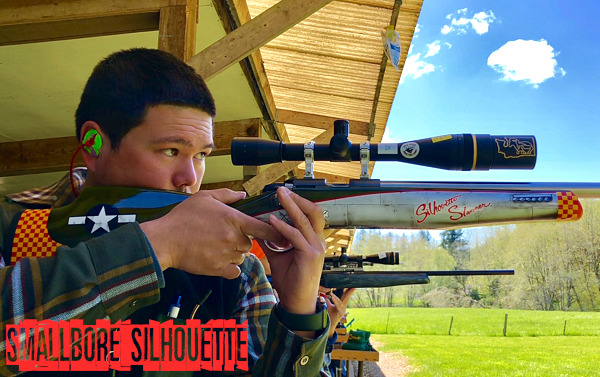
Today’s video showcase covers a variety of metallic silhouette shooting disciplines. There are the classic smallbore and centerfire silhouette formats, shot from a standing position. One of the world’s top silhouette shooters, Eric Mietenkorte, shows how to shoot silhouette standing. But we also show varmint silhouette matches shot from prone position and from the bench. The Editor’s 600-yard silhouette matches were initially shot from prone (F-class style), and then later from a bench. Both formats were fun.
We also feature a cool video from New Zealand, showing handgun silhouette matches hosted at a beautiful, verdant range in Kiwi country. The handgun shooters use a reclined, foot-forward prone position.
So, whether you shoot prone, sitting, or standing, shooting metallic silhouettes is fun and challenging. Hearing the clang of steel and seeing a metal silhouette tip over is true “instant gratification”.
Metallic Silhouette — A Mexican Import
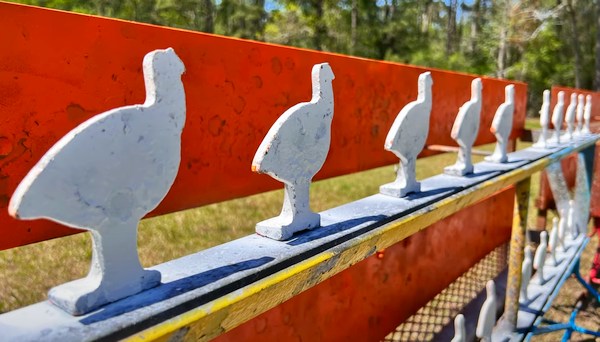
Silhouette shooting came to this country from Mexico in the 1960s. It is speculated that sport had its origins in shooting contests between Pancho Villa’s men around 1914. After the Mexican Revolution the sport spread quickly throughout Mexico. ‘Siluetas Metalicas’ uses steel silhouettes shaped like game animals. Chickens up front followed by rows of pigs, turkeys, and furthest away, rams. Being that ‘Siluetas Metalicas’ was originally a Mexican sport, it is common to hear the targets called by Spanish names Gallina (chicken), Javelina (pig), Guajalote (turkey) and Borrego (ram). Depending on the discipline one is shooting, these animals are set at different distances from the firing line, but always in the same order. CLICK HERE for NRA Rifle Silhouette Rules.
In this next video, silhouette champion Eric Mietenkorte talks about proper hold: “Consistency is key! Form a solid stance that is repeatable and allows you to have a natural point of aim. If you don’t come down on target adjust your feet, don’t rotate your body with your torso muscles.”
Erich explains his aiming method: “Pick a spot on the target and shoot for that. Try not to hesitate, if you’re on target, take the shot. It’s easy to get locked up by trying to make a great shot better. Make sure to follow through, keep that trigger pulled back. Don’t forget to have fun!”
Beautiful Rosebud Silhouette Range in Alberta, Canada
This video was created at the scenic Rosebud Silhouette and Benchrest Club in Alberta, Canada. The video offers an introduction to both centerfire (High Power) and smallbore Metallic Silhouette Rifle disciplines, including equipment and match format. These fun and challenging sports can be shot year-round, as you can see in the video below, which includes winter sequences.
Texas Varmint Benchrest Silhouette
If you like accurate rifles and reactive targets, you’ll enjoy this 48-minute video from Shooting USA TV, which features long-range varmint silhouette competition in Texas, the Lone Star State. We have participated in these kind of matches on the West Coast — they are definitely a ton of fun. The sport combines the pure accuracy of benchrest competition with the fun of knocking down critter targets. These are smaller than standard silhouettes, so it’s quite a challenge to hit them at 300 yards and beyond.
In this episode, host John Scoutten competes with his 6.5 Creedmoor PRS rifle. He found that 1-MOA Coyotes offered plenty of challenge at 385 meters! Most shooters at this Texas match use benchrest-grade rifles with premium front rests.
A similar Varmint Silhouette bench/prone match is held monthly at the Pala Range in Southern California. Prone shooters compete side-by-side with bench shooters. Ten steel “critter” targets are set at each of five yardages: 200m – Field Mice (“pikas”); 300m – Crows; 385m – Ground Squirrels; 500m – Jack Rabbits; 600 yards – Prairie Dogs. Competitors shoot 50 targets, 10 each at five different yardages, alternating among the five distances. So you might start at 500m then do 200m next, then do 600 yards etc. — the target distances are in mixed order to enhance the challenge.
Rimfire Speed Silhouette from the Bench
Fast and full of action, the Speed Silhouette competition is an exciting event shot on the clock. Competitors take 16 shots from 30 to 60 yards. The event is timed and the timer stops whenever the shooter finishes their final target by knocking it down. This event is a blast to shoot, and may even be more fun to watch live, as the results unfold within seconds of each relay start.
New Zealand Handgun Metallic Silhouette
New Zealand is one of the world’s most beautiful island nations, so we can’t think of a better venue for a silhouette match. This video features a handgun silhouette match with targets at multiple distances. The competitors use a special reclining position on the ground, with the handguns (mostly revolvers) aligned on the side of the leg.
Silhouette Shooting Scoring Procedures
This video from the Metallic Silhouette Shooters Society (MSSS) covers the basic rules of rimfire and centerfire silhouette matches. And then the video explains how the shooting strings during silhouette matches are scored. Yes the system is binary (knock-down vs. miss), but there are details, such as when a plate is hit but doesn’t fall. CLICK HERE for a second MSSS video that explains how to get started in silhouette shooting and lists the equipment you’ll need.
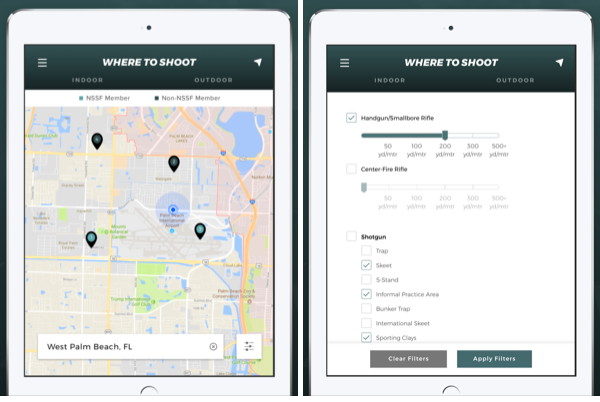
The Where To Shoot Mobile App quickly locates shooting ranges near you, drawing on North America’s most comprehensive directory of shooting ranges. Users can search by current location, state, or zip code. Once you locate a range, you can view activities offered along with a summary of range facilities. You can even get driving directions. If you don’t want to install an App, you can also access the NSSF shooting range database and maps via the NSSF WheretoShoot webpage.
The app is modeled after NSSF’s popular WhereToShoot.org® website and is updated frequently with range information for every U.S. state and Canadian province. Once you’ve located a place to shoot, the App can provide directions to the range. The App also includes video tips for shooters, news, and firearm-safety information.
Each day, on Facebook, the NRA National Firearms Museum showcases something special from the Museum collections. A while back the Museum displayed a trio of snakes — three very special Colt Pythons. From bottom to top, these three prized wheelguns are: Colt Python serial number 2, number 3, and number 5. And yes, that is the original box for Python #2 (at bottom). The museum says such low serial number guns were typically produced for a company executive or key members of the gun design team.
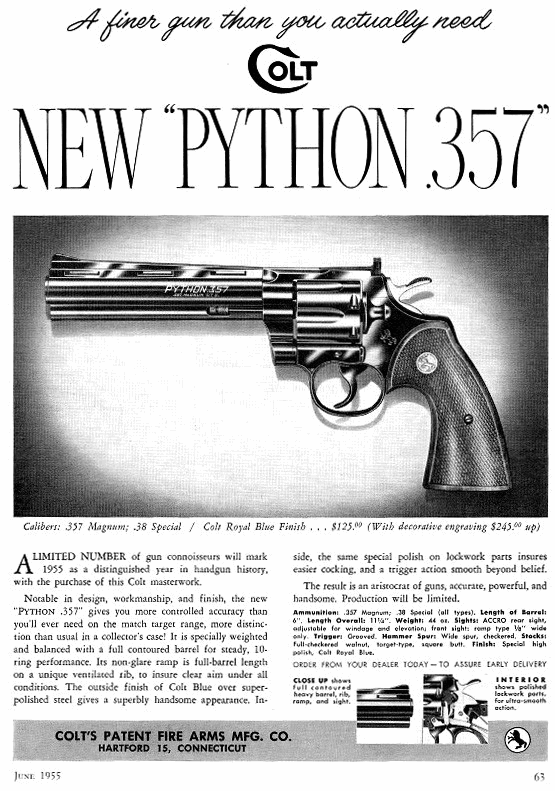
Loved for their beautiful finish, nice balance, and great trigger, Colt Pythons have proven to be excellent investments. Since the Colt Python was first introduced in 1955, Python prices have gone through the roof. A pristine, LNIB early-era Colt Python can now command very high values in the thousands. And these rare single digit examples might sell for over $15,000+, as estimated by the NRA museum. How much did a Python cost in 1955? You could purchase the Royal Blue model for just $125.00! Factory-engraved models started at $245.00, according to this Colt advertisement from June, 1955:
History and Design Evolution of Colt Python Revolvers
You can see hundreds of other interesting firearms on the National Firearm Museum website, www.NRAMuseum.com. Or, if you’re lucky, you can see the collections in person. The NRA now operates three Museum locations: the NRA National Firearms Museum in Fairfax, Virginia; the NRA National Sporting Arms Museum in Springfield, MO; and the Frank Brownell Museum of the Southwest in Raton, NM.
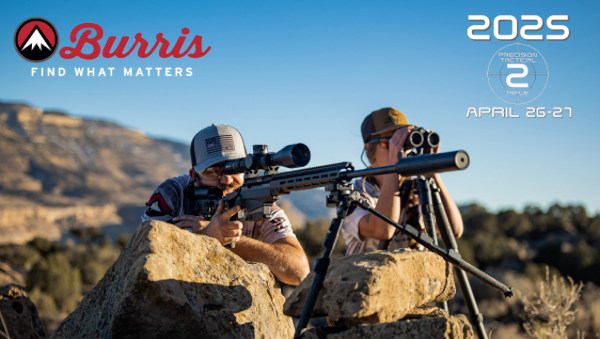
The 2025 Precision Tactical 2-Rifle Match runs this weekend, April 26–27, 2025 at the NRA Whittington Center in Coal Canyon, New Mexico. This unique event challenges competitors with eight dynamic stages designed to test their skills with two rifles — an AR-15 (.223 Rem/5.56 NATO) and a precision rifle (.223 Rem to .300 WinMag). This event is challenging — shooters must carry all their gear including bipods, packs, rangefinders, slings, and optics. The stages are quite varied, with everything from close rapid-fire challenges to 1,000-yard precision shots. Match stages include both field and stationary formats. Competitors transition between rifles while managing gear, movement, target acquisition, and time limits.
The NRA Whittington Center, nestled in the Sangre de Cristo Mountains in New Mexico, provides a world-class backdrop for this tactical challenge. Match directors state: The “Two-rifle match at the NRA Whittington Center in Coal Canyon is a rugged and demanding shooting competition set against a stunning New Mexico backdrop. The event is designed for competitors looking to put their skills to the test. Competitors will tackle eight stages across two days, each crafted to challenge their proficiency with two different rifles. These stages require shooters to adapt to various positions and distances. The natural terrain adds to the excitement of the match.”
Advanced Optics with HUD and Custom Ballistic Profiles
Among the high-tech gear being used in this match is the new Burris XTR Precision Shooter (XTR PS) riflescope. Available in 3-18x50mm and 5.5-30x56mm models, XTR PS has a Programmable Elevation Knob (PĒK) system. Even more impressive, this optic boasts an integrated HUD (“Heads Up Display”). The digital HUD delivers real-time data — elevation, wind hold, angle compensation, and countdown timer. The scope’s HUD works with custom ballistic profiles via the BurrisConnect™ App.
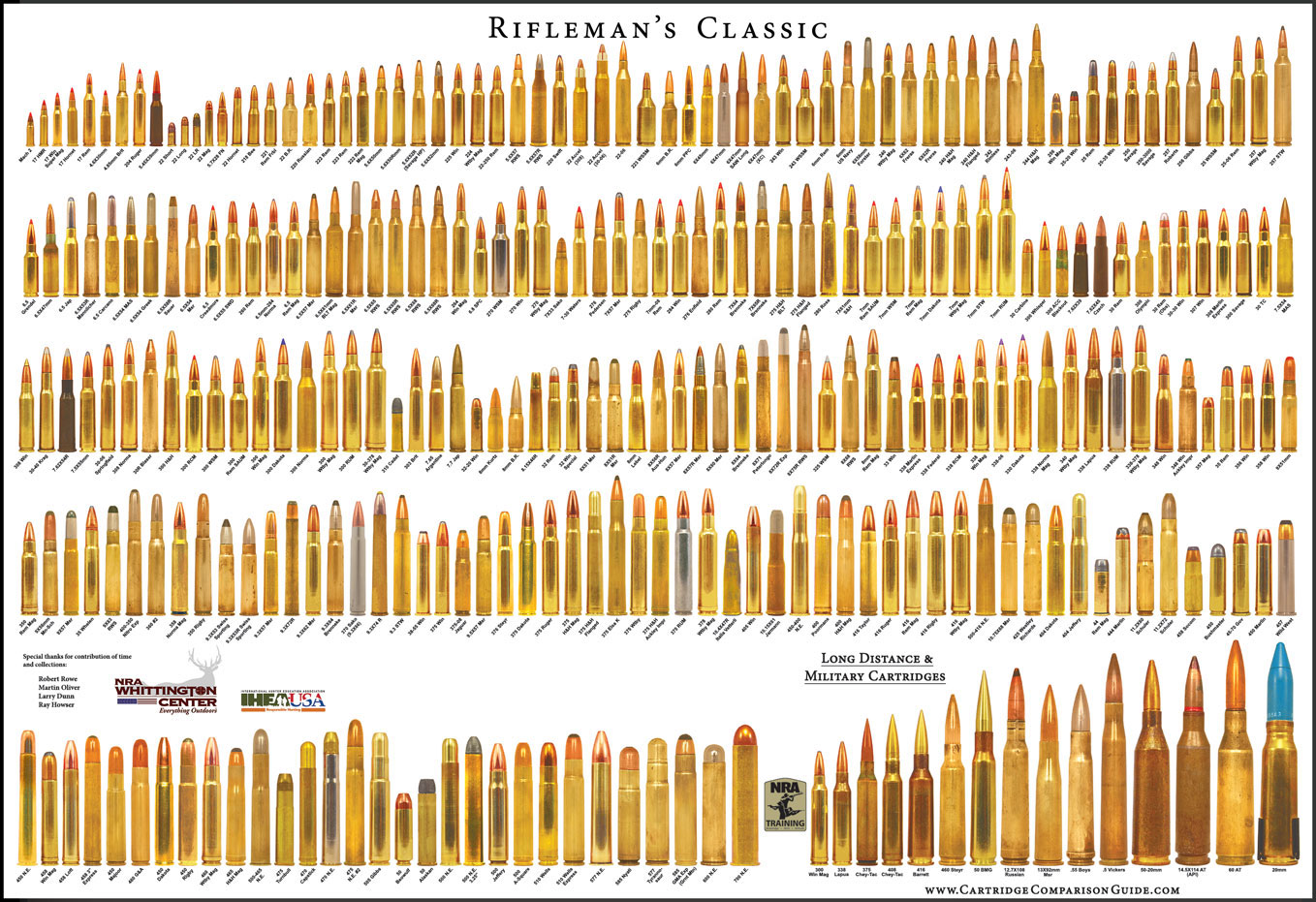
Need something for the walls of your “man cave” or reloading room? Looking for a great birthday gift for one of your shooting buddies? The creators of the Cartridge Comparison Guide offer a collection of wall posters showing ammunition types from 17 caliber rimfire cartridges all the way up to giant 35mm military rounds. ChamberIt.com currently offers 12 different large wall posters that display a huge variety of cartridge types. For example, the American Standard Poster (shown above) contains every standardized cartridge mass produced in the USA as of 2021. The cartridges are 100% to scale (life size). These posters feature full color images on high gloss / high quality 100-lb poster paper.
For example, the Rifleman’s Classic Poster (below), a full 38 inches wide and 27 inches tall, is the most comprehensive. This $17.76 poster displays over 300 rifle cartridge types at true size (within 4/1000 of an inch). Cartridges shown range from .17 caliber all the way up to the big boomers (including some cannon shells). The Rifleman’s Classic Poster includes nearly all American Standardized Rifle Cartridges and many European rifle cartridges.
Rifleman’s Classic Poster Click to view large size poster.
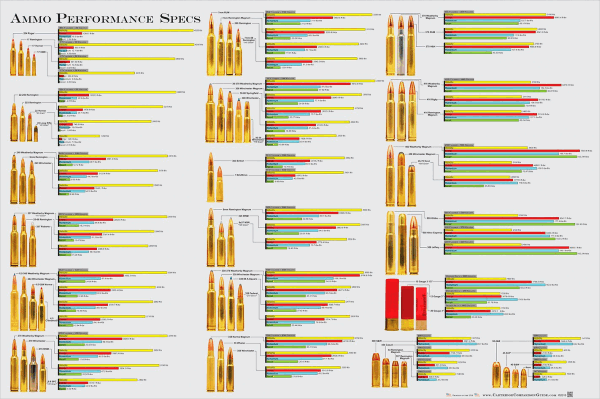
Ammunition Performance Specifications Poster
There is also an interesting Ammo Performance Specs poster. This shows dozens of popular hunting cartridges with the velocity, energy, momentum and recoil for each cartridge displayed in a bar graph.
This shows the actual size of the Ammo Performance Poster as displayed on a wall.
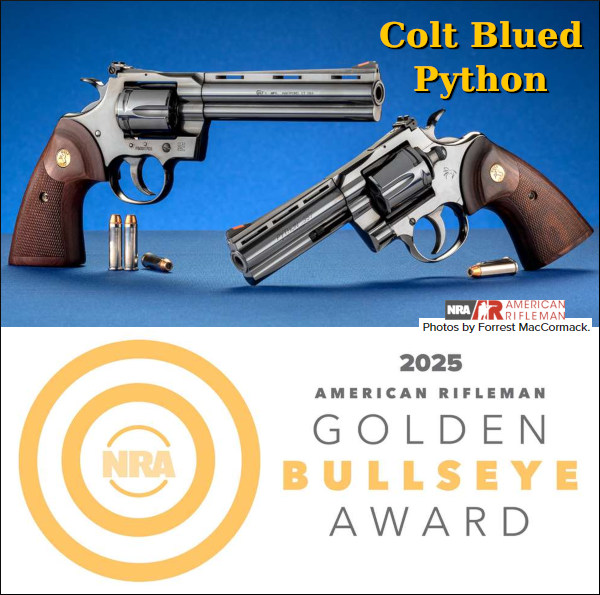
The handsome Colt Blued Python revolver has earned the 2025 NRA Golden Bullseye Award for Handgun of the Year, as chosen by the editors of NRA publication American Rifleman. This prestigious award will be presented at the NRA Annual Meetings & Exhibits being held this week in Atlanta, Georgia.
The double-action Colt Blued Python is offered with 3″, 4.24″, 5″, 6″ and 8″ barrels in .357 Magnum chambering. It has a superb trigger and features a target adjustable rear sight and user-replaceable front sight.
» CLICK HERE for Photo Gallery of New Blued Python
Colt has posted: “Built on a legacy of performance, the Blued Python is a .357 Magnum available in 3″, 4.24″, 5″, 6″ and 8″ barrel configurations, appealing to both collectors and avid shooters. The classic carbon steel Blued Python serves as a passport to a bygone era, where firearms were not just tools but also exquisite works of art. Modern upgrades ensure finely tuned double-action operation that delivers an impressively smooth trigger pull and consistent shot-to-shot reliability.”
Colt’s new Blued Python has a target-adjustable rear sight and replaceable front sight. The modernized ergonomic Walnut grip features a Colt Gold-tone Medallion.
“We’re honored the Blued Python is being recognized for what it is – an iconic American revolver,” said Joshua Dorsey, President of Colt’s Manufacturing Company LLC. “This NRA award is a testament to the craftsmanship and dedication of our design and engineering teams, and a nod to shooters who demand reliability, accuracy, and confidence in every trigger pull.”
The 2025 NRA Annual Meetings & Exhibits kick off today. The big event runs April 24-27, 2025, at the Georgia World Congress Center in Atlanta, Georgia. The NRA expects tens of thousands of attendees. The event includes speeches, seminars, exhibits, and a large, 14-acre exhibit hall where gun manufacturers and other vendors showcase their products. This Thursday the 24th there are Ring of Freedom member gatherings and the Wall of Guns opens for viewing. The full Exhibit Hall opens Friday morning, April 25th.
Key Highlights
The NRA Leadership Forum features respected political Leaders and Second Amendment advocates.
Seminars and workshops on firearm safety, shooting sports, and the Second Amendment.
Exhibit Hall showcasing over 14 acres of guns, gear, and other products from various companies.
Special events, concerts, and notable celebrity meet-and-greets.
The NRA Foundation Wall of Guns returns for 2025 with great gun prizes. The member favorite Wall of Guns is open April 24-27 with 60+ prize guns.
Outfitter Area — Attendees can book the hunt of a lifetime in the outfitter section with respected hunting guide services from throughout the world.
The Exhibit Hall is open all three days, with over 14 acres of the latest guns and gear from the most popular companies in the industry as well as smaller, newer companies.
Show Registration and App
The NRA Annual Meetings & Exhibits is free to all NRA members and their families (spouses and children under 18 years old), uniformed military and law enforcement personnel.
Registration: You can register online or join the NRA at the door if you are not an NRA member. Nonmembers can grab a 3-day pass for just $10.
FREE Event Phone App: Download SHOW Map App for Android.
Visit NRAAM.org for event schedules and Atlanta hotel information.
There will also be music events including a big show on April 26th with country music stars Big & Rich performing in the Sidney Marcus Auditorium.


 RCBS Lock-Out Die

 This amazing twin-barreled bolt-gun has a unique closing mechanism that locks two separate bolt bodies into the chambers of the right and left barrels. Yes there are two firing pins, two ejectors, two extractors, and two triggers. We’re not sure how one jumbo camming system closes two bolts — Perhaps one of our gunsmith readers can explain how this system works.











 The handsome Colt Blued Python revolver has earned the 2025 NRA Golden Bullseye Award for Handgun of the Year, as chosen by the editors of NRA publication


