We support Hunters for the Hungry, a program that feeds needy families in the USA. Hunters for the Hungry (HFTH) is an NRA program that gives back to communities by supplying meals throughout the country. The NRA works closely with state agencies that supervise meat donations. Since the program’s inception, Hunters for the Hungry has brought millions of pounds of venison to homeless shelters, soup kitchens, and food banks across the United States. This program has been in place for 24 years. In 2013, HFTH affiliates donated 2.6 million pounds of meat, equating to 10.3 million meals.
Hunt and Help Others
Many American hunters are able to harvest more than they can eat or share with friends and family. Through Hunters for the Hungry you can help share your bounty with those in need.
Donation Rules and Regulations
All donated game must be field dressed and legally harvested. Note that each state has different rules and regulations for donations, please check with your local drop off location prior to donating.
To learn more about Hunters for the Hungry, call (800) 492-4868 (option3) or email hservices@nrahq.org for more information.
Many hunters work with organizations dedicated to the cause of helping the hungry, such as Hunters for the Hungry, Farmers & Hunters Feeding the Hungry, Hunt to Feed, and Buckmasters, among others. The game meat satisfies shelters’ need for nutritious food items. Dave Williams, who manages food resources for a Georgia food bank, said that “Deer venison is such a low-fat, high-protein item, agencies greatly appreciate getting it.” Another recent news report pointed out that one deer can feed up to 200 people. Ground venison is a versatile food, with cooks using it in pasta sauces, chili, tacos, meatloaf, burgers and other dishes.
Ever wondered what pistol, rifle, and shotgun ammo really looks like on the inside? Well, thanks to two clever friends, you can NOW see exactly what’s on the inside. Bernard Martinage and David Swanson, fellow NRA-certified firearms instructors, have created a new kind of training tool — cutaway ammo samples. The two men call their line of cutaways, AmVIEWnition. The sliced cartridges and shotshells are employed as visual/tactile training aids. These cutaways help new shooters understand ammo components and how cartridges and shotshells are engineered.
Bernard Martinage (L) and David Swanson (R) are the inventors of AmVIEWnition products — cutaway ammo samples for training.
Bernard told the NRA Blog: “In order to make teaching easier and increase trainee comprehension, I simply decided to cut bullets lengthwise and show them [students] what’s inside. It certainly sped up their understanding and it was cool to look at! I always liked inventing and creating things that solved problems or made life easier. So, doing it with firearm training was no different.” To learn more about the history of AmVIEWnition, read the NRA Blog’s Interview with Bernard Martinage.
Bernard and David also produce Barrel Cutaways and “Solo-Blast” 3-D Ballistics Models of projectile wound channels. Visit www.AmVIEWnition.com to see these products as well as the full line of pistol, rifle, and shotgun AmVIEWnition cutaways.
Ellis Wins Three-Gun and Four-Gun Titles at 2017 Western CMP Games Story based on Report by Ashley Brugnone, CMP Writer
In a masterful showing of marksmanship, William Ellis of Langley, England won both the Three-Gun and Four-Gun Aggregate rifle competitions during the CMP Western Games in Phoenix last month. 2017 was a great year for Ellis, who first traveled to the Western Games in 2009. William’s 2017 performances earned him the second Distinguished Rifleman Badge by a non-U.S. citizen this past year.
Earning twin Aggregate Titles was a great accomplishment for Ellis, who had nearly won three years ago. In 2014, Ellis was the runner-up (second-place) in both 3-Gun and 4-Gun. But this was Ellis’s year — he was unstoppable. He shot superbly in the Arizona desert, taking the top spot in the Springfield Rifle Match along with second place in the Vintage Military Match. Those strong showings helped earn Ellis the 3-Gun and 4-Gun overall victories. To accompany his centerfire victories, Ellis shot great in the Rimfire Match, winning the Tactical Class. This was truly a masterful five days of shooting by Ellis.
Ellis Will Be Featured on Shooting USA
The media took notice of Ellis, who may have traveled farther than any other competitor at this year’s Western Games. Ellis will be featured in a Carbine Match video segment by Shooting USA TV, which filmed portions of the 2017 CMP Western Games for an upcoming episode.
Other Winners at CMP Western Games — Ben Avery Shooting Facility, October 13-17, 2017
Garand Match: Randall Dwornik, 287-3X
Vintage Military: William Fairless, 290-7X
Modern Military: Jeffrey Schneider, 293-6X
Vintage Sniper Team Match:
Manual Class: Michael Miller, Mike Barranco – 393-11X
Vintage Sniper Semi-Auto Class: SSG Steven Ophoff, Jeffrey Schneider – 364-8X
Training and Instruction at Western Games
Along with competitive events, Western Games also featured a Small Arms Firing School class, a Garand-Springfield-Military new competitor clinic, and a High Power Level II Range Officer class.
Hot Day-Time Temps and Wicked Night Winds at Ben Avery
2017 Western Games competitors experienced hot weather in Phoenix. Temperatures reached well into the 90s each day. The afternoon of the Sniper team match day saw temps topping out at 102° F. But the real weather problem was a gale-force wind that howled one night. The CMP’s 30 electronic targets were set up on the berm in front of the High Power rifle range pits wall. After the Small Arms Firing School was concluded, 40+ MPH overnight wind gusts toppled the entire target line. Thanks to the CMP staff and several competitors, the majority of the targets were reset, and all matches were fired upon them for the scheduled day and the remainder of the matches.
About the CMP Western Games at Ben Avery
The CMP Western Games include Garand, Springfield, Vintage Military, Modern Military, Rimfire Sporter, Carbine, and Vintage Sniper matches. The October Western Games event is the last of the CMP Travel Games events held each year. The other Travel Games, hosted in Oklahoma, North Carolina, and New England, feature both vintage and modern rifle and pistol events — recreational competition for both adults and juniors and all experience levels. The Western Games is the only Travel event for rifles only.
Enjoy the Shooting Sports USA Archives
Winter is right around the corner. Soon we’ll all be spending more time indoors. For some folks, that means long sessions in front of the boob tube. We have a better idea — there’s a vast resource of good gun-related content available online for free. Check out the Shooting Sports USA Articles Archive. SSUSA maintains a vast digital library with hundreds of articles going back to June 2009.
It’s easy to find back issues of Shooting Sports USA magazine. Here’s how: Using the gray Toolbar at the top, click on the “Archives” icon in the upper right area (blue arrow) and you’ll be presented with a selection of magazine covers/dates in a vertical column. Simply use the vertical scroll bar to go from 2017 all the way back to 2009. Click any issue cover to read.
How to Find and Save Articles
To search through back issues, select “More Options” from the gray Toolbar. Then click the “Search” button. When that opens, select either “Search archives” for ALL back issues or select “Search Only this Issue”. When you’ve made your choice, enter your search term(s). For example, you could search for “F-Class” or “Camp Perry”. You can also save any archived issue for viewing offline as a PDF file. Just click “Save” to download the article you’re reading.
Read Sample Articles
Here are a couple of our favorite SSUSA feature stories from recent years. There are hundreds of other informative articles worth reading.
Dave Emary is concluding his 24-year career at Hornady. Although retiring from full-time duties, Emary will continue with Hornady as a consultant. AccurateShooter.com wants to acknowledge Dave’s decades of important work in the gun industry. Brilliant, dedicated, and forward-thinking, Dave has been one of the top minds in our industry for many years. He will be missed. He can claim credit for many of the most important innovations in cartridge and bullet design in recent decades.
Ask Dave Emary what he liked best about his job as senior ballistics scientist at Hornady, and he’d tell you that it was finding better ways to do things. “At the heart of me, I’m a tinkerer,” Emary said.
To borrow an expression from aeronautics, this Air Force veteran is inclined to “push the envelope,” to think outside the box. “I’m not one willing to just go with the status quo,” Emary said.
Over his 24-year tenure with the company, Emary helped accomplish some of the biggest breakthroughs at Hornady. Although Emary said he was merely in the right place at the right time, the list of projects he influenced in one way or another is a long one.
Dave Emary the Innovator
Fans of Hornady products will quickly recognize the names of ammunition lines such as Critical Defense®, Precision Hunter™ and LEVERevolution®, or cartridges like the 6.5 Creedmoor and 17 HMR, but those are just a few of the dozens Emary worked on after being hired as bullet/ammo lab manager in 1994. For his groundbreaking work, Emary was honored as one of Outdoor Life’s Top 25 for Innovation in 2007.
Emary came by his interest in ballistics naturally, growing up on a farm near Wakeman, Ohio, where he began shooting when he was 10 years old. His dad had a .22, and he shot a lot of small game, rocks and other targets of opportunity.
In this 2008 video, Dave Emary talks about the “new” 6.5 Creedmoor cartridge.
Father And Son at the Vintage Sniper Match
Dave Emary was a key figure in starting the CMP’s Vintage Sniper Rifle Match. Dave was instrumental in bringing the new match to fruition and he says his father was his inspiration. Below, Dave Emary and his father Robert reflect on the success of the first Vintage Sniper Rifle Team Match held at Camp Perry.
Robert Emary (above right) was a decorated World War II scout sniper who parachuted into Holland after the Normandy Invasion and fought all the way to the Eagle’s Nest. (Photo: CMP The First Shot)
Dave Emary was a competitive shooter. This photo shows Dave (left) and “Gunny” R. Lee Ermey (right) shooting the Vintage Sniper Team Match at Camp Perry. (Photo: NRA Blog)
Q and A with Dave Emary
There is an interesting interview with Dave Emary on the Hornady Blog. Dave shares some insider knowledge on how new cartridge types are developed and SAAMI/CIP standardized. And Dave also comments on his favorite new and old cartridges:
Q: Which Hornady rounds have you helped design?
A: This list gets pretty long, Light and Heavy Magnum, A-MAX Match bullets, V-MAX bullets and the Varmint Express line, 450 Marlin, 17 HMR, 204 Ruger, 17 M2, LEVERevolution bullets and ammunition, 308 and 338 Marlin Express, Ruger Compact Magnums, Critical Defense bullets and ammunition line, 6.5 Creedmoor, Critical DUTY bullets and ammunition, Superformance propellants and ammunition. There’s probably some I’ve forgotten.
Q: What is your personal favorite caliber and why?
A: I love the 6.5 Creedmoor. It provides exceptional accuracy along with being very easy and comfortable to shoot. The external and terminal performance offered by 6.5 mm bullets for the ease of shooting is unmatched. At this point in time it is the only bolt action hunting rifle I own. I occasionally pick it up rather than my lever guns to go hunting. It almost seems unfair hunting with it because of how accurate and flat it shoots and how effective it is.
Q: Which historic calibers do you admire and which is the greatest in your view?
A: It’s hard to look past the .303 British and 8×57 because of their tremendous historic significance. I would also rate the .30–06 in with the previous two. The other cartridge I think really started the present day commercial sporting ammunition designs is the 30–30 Winchester. It was one of the first high velocity, smokeless, commercial offerings and lead the way for cartridge development that eventually far eclipsed it.
Dave Emary’s Background — Physics, Astronomy, Air Force Service, and Ballistics
After earning his Bachelor of Science in physics from Bowling Green State University, Dave worked for a year at the National Radio Astronomy Observatory’s Karl G. Jansky Very Large Array in New Mexico before joining the U.S. Air Force. In the Air Force, he earned a second bachelor’s degree, in aeronautical/astronomical engineering. He served for six years, rising to the rank of captain.
After the Air Force, Emary worked at the New Mexico Institute of Mining and Technology’s Energetic Materials Research and Testing Center (EMRTC), the largest ordnance-testing facility in the U.S. outside the government. “That’s where I really got into the ballistics side of things,” Emary said. Among other things, research by Emary and his colleagues led to the development of the electromagnetic railguns now being used by the U.S. Navy that launch projectiles at 4,500 mph.
From there, he went to work for St. Marks Powder in Florida, the nation’s largest gun propellant producer. There, his work caught the attention of Steve Hornady, who offered Emary a job. “Dave had built a reputation as an innovative thinker and problem solver, and I wanted those qualities for our team,” Hornady said.
Dave Emary Returns to EMRTC as Engineering Director
Although he has retired from Hornady, Dave Emary will still use his skill set and vast ballistics knowledge in a new job at a familiar place — as Director of Engineering at the Energetic Materials Research and Testing Center. EMRTC is internationally recognized in explosives research and testing. For Emary, it’s just his way of easing into retirement.
“I feel incredibly blessed to have been able to be a member of this industry, Hornady Manufacturing and to have been afforded the opportunities I have been given,” Emary said. “I thank the Lord every day for the success I have had, which has been enormously aided by many other people.” — Dave Emary
This week’s edition of Shooting USA, which airs Wednesday, November 8, features the NRA Bianchi Cup. This competition is one of the most prestigious and popular events in the world of handgun shooting. Officially, the annual competition in Columbia, Missouri is known as the National Championship of NRA Action Pistol. But to everybody, world-wide, it’s the Bianchi Cup, the trophy named for one of the founders, John Bianchi. In the past 30 years the match has become the richest handgun tournament in the world, with cash and prizes for the best scores on four stages of fire. Shooting USA will spotlight top male and female Bianchi Cup competitors in both wheelgun and and semi-auto pistol divisions. Along with North American shooters, the Bianchi Cup draws top handgun competitors from around the globe. Shooting USA airs Wednesday nights, on the Outdoor Channel, at 9:30 pm, and 1:30 am (Thursday) — East Coast Times.
John Scoutten and S&W shooter Julie Golob report the action from the Bianchi Cup. This year shooters from as far away as Australia, New Zealand, and Japan traveled to Columbia, Missouri in search of the perfect 1920 match score. Each round is the aggregate of the four (4) fired events: Practical, Barricade, Falling Plate, and Moving Target Events. Each of the four events requires 48 shots to complete. 480 points possible on each event. Three of the four are scored on the NRA tombstone P1 target. You must hit in the 10-ring or inner X-Ring on EVERY shot to shoot a “clean” 1920.
27 Years ago Doug Koening set the standard with a 1920. Since then, every Open shooter knows that he or she must “clean” this match (i.e. score a “1920”) to have a chance to take the title of “Champion”. The X-Count is the tie-breaker.
Here are the top four women shooting the Practical Event during the Colt Championship Final. From top: 2017 Bianchi Women’s Champion Cherie Blake, third place SFC Katie Bahten, second place Anita Mackiewicz, and fourth place Jessie Duff. Shooting Sports USA Photo
This Bianchi Cup Preview, filmed a few seasons back, offers the perpective of newcomers to the game…
Bianchi Cup — Classic Course of Fire
The MidwayUSA/NRA Bianchi Cup is a combination of Speed and Accuracy. Competitors shoot from both standing and prone positions and are also required to shoot with both strong and weak hands at various stages. Stages may combine stationary and moving targets. As conceived by former police officer and holster-maker John Bianchi, the Bianchi Cup originated in 1979 as a Law Enforcement Training match. The Course of Fire consists of four separate matches:
The Practical Event: From the appropriate shooting line, the shooter fires at distances from 10 yards to 50 yards under varying time limits.
The Barricade Event: From within shooting boxes and behind barricades, a shooter fires at targets on either side of the barricade at different distances and under varying time limits.
The Falling Plate Event: From the appropriate shooting line, the shooter fires at 8 inch round steel plates arranged in banks of six at distances from 10 to 25 yards under varying time limits.
The Moving Target Event: From within shooting boxes at distances ranging from 10 to 25 yards, the shooter fires at a target moving from left to right with the target being exposed for only 6 seconds.
Due to the high accuracy required in each stage of the Bianchi Cup, the tournament is widely considered one of the most difficult handgun championships on the planet.
Here’s one of the most popular videos from the Daily Bulletin archives. If you’ve ever wondered how a top-flight, custom rifle is built, watch carefully….
This video, produced for the folks at S&S Precision in Denton, Texas, shows a full custom 6.5×47 bench rifle being crafted from start to finish. It is a fantastic video, one of the best precision rifles video you’ll find on YouTube. It shows every aspect of the job — action bedding, chambering, barrel-fitting, muzzle crowning, and stock finishing.
You’ll be amazed at the paint job on this rig — complete with flames and four playing cards: the 6, 5, 4, and 7 of spades. Everyone should take the time to watch this 13-minute video from start to finish, particularly if you are interested in stock painting or precision gunsmithing. And the video has a “happy ending”. This custom 6.5×47 proves to be a real tack-driver, shooting a 0.274″ three-shot group at 400 yards to win “small group” in its first fun match. NOTE: If you have a fast internet connection, we recommend you watch this video in 720p HD.
We’re told that the founder of S&S Precision, the inimitable “Stick” Starks, is retiring from full-time gunsmithing duties. This video is a nice tribute to Stick’s dedication to his craft for so many decades.
First there were books, then Videos/DVDs, then Ballistic Apps, then Seminars, and now Applied Ballistics is moving into the gun-building business. Founded by Ballistics guru Bryan Litz, Applied Ballistics LLC has been a world leader in the science of ballistics for the shooting sports. Now Applied Ballistics is using its expertise to produce complete rifle systems capable of world-beating Extreme Long Range performance.
Applied Ballistics Weapons Division Will Offer Complete Tactical ELR System
Applied Ballistics Weapons Division (ABWD) states: “We have the capability to build you a custom rifle, with ammo matched for that system. We can test the ammo and rifle combination over Radar in the lab. ABWD [will be] offering a complete system, with a CDM specific to that rifle. The first rifles are purpose built for 2500+ yard engagements.”
Based on the “teaser” video above, ABWD will offer a complete rifle system featuring Nightforce riflescope, ELR optical prism, laser rangefinder, Kestrel wind meter, and ammo that has been tuned for the rifle and trajectory-verified with Doppler Radar. This promises a “turn-key” system with sub-MOA 1000-yard accuracy plus hit capability at ranges out to 2500+ yards.
One Facebook reader asked: “Will you focus your rifle builds to just Extreme Long Range or will you be doing PRS-style type rifles as well?
AB states: “We are starting out with this ELR system, but will be offering more systems in the near future, as well as custom rifle builds. Stay tuned as the ABWD website should be up soon!”
Many Questions about ABWD’s New Products:
Of course, like our readers, we have many questions about this new project:
1. What cartridge types will be available in ABWD Rifles?
2. What companies will supply the rifle actions and chassis systems?
3. Who will supply the barrels and what are length/chambering options?
4. Will ABWD rifle systems be offered to the general public (vs. military/LEO)?
5. When will the first ABWD rifle systems be available?
And last but not least…
6. What will these ABWD ELR Rifles cost, both by themselves and as a complete package (with solvers, LRFs, optics etc.)?
News Tip from EdLongrange. We welcome reader submissions.
Need something for the walls of your “man cave” or reloading room? The creators of the Cartridge Comparison Guide offer a nice poster showing 85 classic varmint and hunting cartridges. Along with cartridges (from 17 Mach2 all the way up to the 517 Nitro Express), this full-color 18″ x 24″ wall poster shows dozens of game animal types, including all the great African species. This unique Game & Ammo Hunting Poster opens reveals the range and breadth of game animals that can be hunted on the world stage, while providing a comprehensive sampling of proven cartridges for hunting these animals. Priced at $14.99, this poster was developed in cooperation with Hunter Education instructors.
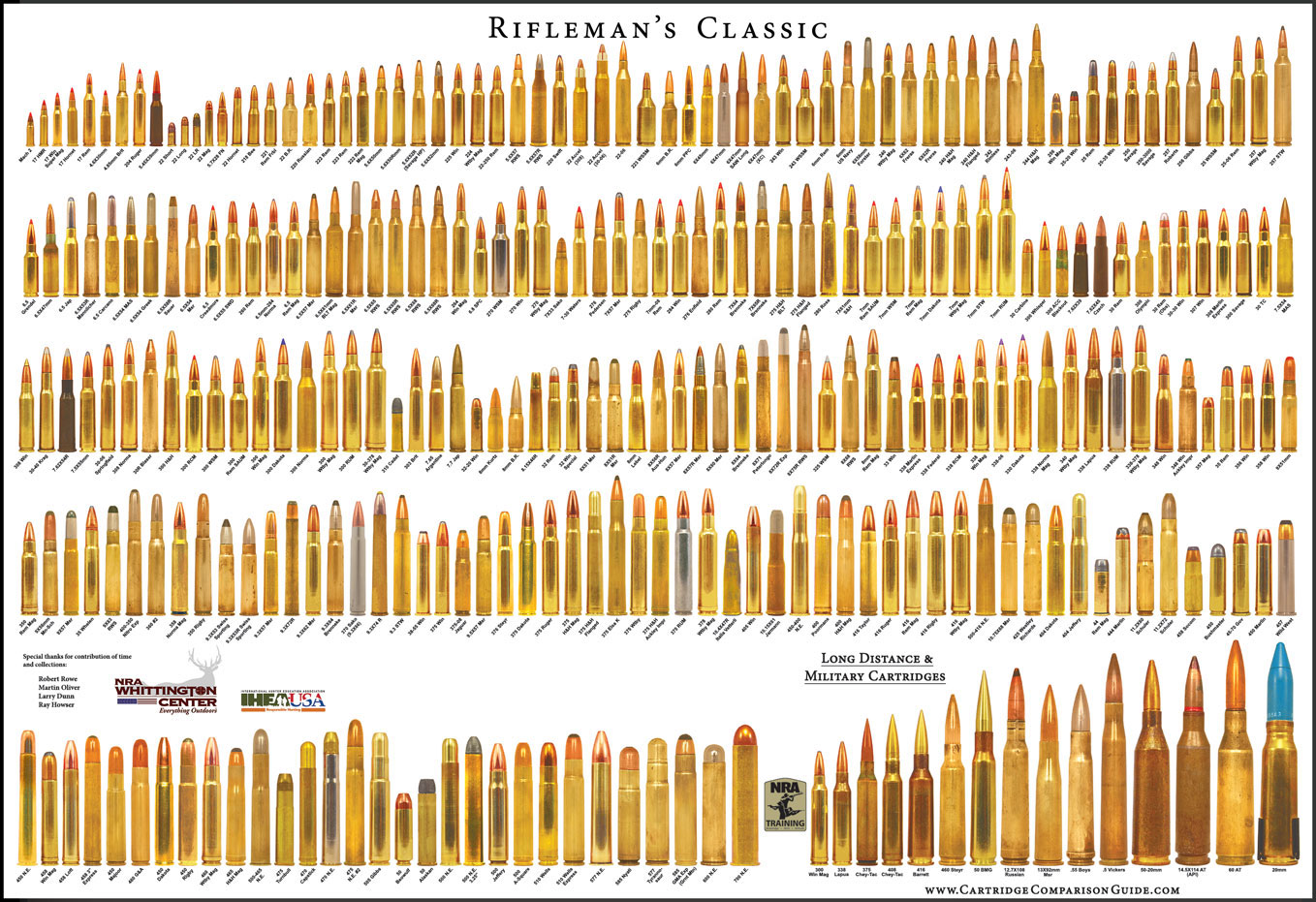
In addition to the Game & Ammo Poster, ChamberIt.com offers 15 other large wall posters that display a variety of cartridge types. For example, the Rifleman’s Classic Poster, a full 38 inches wide and 27 inches tall, is the most comprehensive. This $15.99 poster displays 272 rifle cartridge types at true size (within 4/1000 of an inch). Cartridges shown range from .17 caliber all the way up to the big boomers (including some cannon shells). The Rifleman’s Classic Poster includes all American Standardized Rifle Cartridges (as of 2013) and many European rifle cartridges.
Rifleman’s Classic Poster Click to view large size poster.
Ammunition Performance Specifications Poster
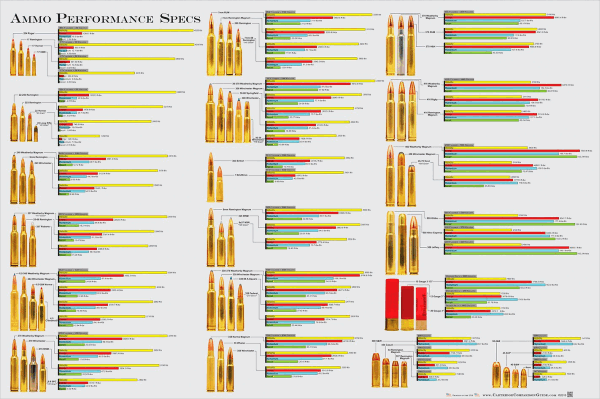
There is also an interesting Ammo Performance Specs poster. This shows dozens of popular hunting cartridges with the velocity, energy, momentum and recoil for each cartridge displayed in a bar graph.
This shows the actual size of the Ammo Performance Poster as displayed on a wall.
March 48x52mm High Master Scope — Tested in Competition
by Jay Christopherson, AccurateShooter.com Systems Admin
Using a fixed power scope on your F-Class rifle is not only effective, but can save you weight and money — key benefits when it comes to the F-Class game.
I recently tested the March High Master 48x52mm scope on my F-Open rifle in three different matches, including a Long Range Regional match in Montana and the recent 2017 US F-Class National Championships in Lodi, WI. While I’ve long been considering a fixed-power optic, it wasn’t until a recent F-TR build came in over-weight (with a large zoom scope), that I finally decided to give it a fixed-power comp scope a try. The March High Master 48x52mm saved me both weight (10.6 oz. or 300 grams) and money ($800+) compared to a top-end, variable-power March.
Across three matches and multiple conditions (including heavy mirage), I never found myself wishing that I had a variable-power scope on top of my rifle. And I never experienced issues holding rings on the target. A fixed-power scope might not be for everyone. However a serious F-Class shooter who needs to cut some weight, or save a little cash (compared to high-end zoom scope), shouldn’t be worried about being “under-glassed” with a fixed power scope such as the March HM 48x52mm. It can do the job. [Editor: Jay finished second overall in F-Open Division at the 2017 F-Class Nationals.]
The Case for A Fixed Power F-Class Optic
There’s been a thought bouncing around and growing in my head for the past few years while shooting F-Class — Why don’t more guys shoot a fixed power scope in F-Class? Nine out of ten F-Class shooters I’ve polled spend most of their time between 40 power and 50 power, regardless of the conditions. It seemed to me that a fixed power in the 40X – 50X range would be a great option.
I’ll admit, that I’ve long been an advocate of needing a variable-power scope so that I could “dial down to see the rings” on those really heavy mirage relays. There’s even been times when I’ve been successful dialing down to 35X – 25X just for that reason. But still, like most guys, I find that I rarely go above 50X and rarely below 40X – 99% of my time is spent right around 42X – 45X. Having gotten used to shooting high magnification now, it’s been quite a long time since I’ve bothered to dial down below 40X, even in very heavy mirage. But, I held on to that notion that it’s better to have it and not need it, than to need it and not have it.
I recently built an F-TR rifle. I made a slight mistake on the weight. Fully built with my zoom scope, the rig ended up at 8.3kg (8.25kg is the limit for F-TR). That’s not much overweight, but I don’t like to be too close to the limit anyhow. There are lots of ways I could have addressed the issue, but I started thinking again about the scope. I love my current variable-power scopes, but I couldn’t help thinking that a fixed power scope in the 40X – 50X range might solve my issue nicely (and give me a chance to try something new). So I obtained a March High Master 48x52mm fixed-power scope to test. The 48X magnification falls right into my comfort zone. With its 52MM objective, the March HM matched the profile of my existing variable-power scopes nicely. Aesthetics is at least part of the goal and in my opinion, 50MM+ objective scopes look “right” on F-Class rifles. It’s also worth noting that this is the only fixed power scope that I have tried so far and that I have no affiliation with the manufacturer.
There’s the notion out there that fixed power scopes have inherently brighter sight pictures or maybe “clarity” is a better word. This may be due to there being less complex lenses and fewer parts inside. I don’t have any way to quantify that, so I’ll just say that the image clarity is excellent on the 48X March. I also found that the scope weighed 300 grams less than my variable-power scope, which brought me under the F-TR weight limit nicely, as I had hoped.
Fixed-Power Scope at 2017 F-Class Nationals and Other Matches
Because my F-TR rifle was still in load development, I decided to try out the March HM 48x52mm at a couple matches on my F-Open rifle, while I waited on a part for my F-TR rifle. I fitted the 48x52mm scope to my F-Open rifle and used it at three matches: 1) a local 600-yard mid-range match in WA State; 2) the Long Range Regional at Deep Creek in Montana; and 3) the 2017 US F-Class Nationals in Lodi, WI. I ended up using it the entire match at all three matches. With three different matches, all a few weeks apart and in different parts of the country, I got a nice cross-section of light, weather, and mirage conditions to sample. At all three matches, and even in a medium-heavy mirage situation, I never found myself wishing I could dial down the power. In fact, I never thought about variable power at all — the scope was excellent in all of the different conditions. Even with a good deal of mirage present, I never had a problem making out the rings well enough to hold on. For what it’s worth, I used the scope while shooting on two different teams that set (pending) National LR and MR F-Open team records at those matches. If I didn’t have confidence in a fixed-power scope (and the March in particular), I would never have taken a chance shooting it where a team depended on me. [Editor: In individual competition, Jay finished second in F-Open at the Nationals.]
Scope Tracked Great and Click Values Were Right On
In terms of technical details, the scope tracked perfectly on my scope checker (there are several threads on the AccurateShooter forums regarding checking a scope for drift), which meant I felt comfortable using it at the F-Class Nationals. Critically, I spent a good bit of time working on the ocular focus (reticle focus) so that it would be perfectly set-up for my eye. I’ve found that many complaints about parallax and “soft” or “blurry” images can be traced back to the owner never taking this critical step with a new scope. Normally my scopes all have external, tactical-style turrets — the March HM 48×52 has covered turrets. I wondered how this would work for me, but again, I never thought about it while shooting. Once the covers are off, the clicks are extremely tactile and easy to read and it just never became an issue. The parallax adjustment works nicely and the scope tracked well with every adjustment I made, from 600 yards to 1000 yards.
What Could Be Improved
On the con side of things, I find the scale on the elevation turret to be a bit confusing. Most scopes I have used have an incrementing scale on the elevation (and windage) turrets, so that you can count up from zero as you dial up the adjustments. The 48X HM uses a ‘0’ that is centered on the turret travel (see photo above), so that you count down or up on the scale. Here, I would prefer a scale that bottoms out at zero (or that you can adjust to bottom out at zero) and then increments. I think it’s an easier and more consistent way to measure, but your mileage may vary. Other March scopes I’ve used have a color-coded system on the turrets which I also find a little less than useful. Again, I wouldn’t mind at all if March re-thought its system there.
The other con for me is the eye-relief. It’s middle of the road as far as other high-end scopes I’ve used, but for me personally, I still find it a bit on the short side — I would prefer more eye relief.
Save Hundreds Compared to a Premium Zoom Scope
On the plus side (from a cost standpoint), fixed power scopes are generally priced quite a bit lower than equivalent-quality, variable-power optics. The March HM 48x52mm (product # MAR1076) I tested is no exception. Bullets.com sells the HM 48x52mm for $1951.00. That’s $810 less than its variable-power relative, the March HM 10-60x52mm, priced at $2763.00. I consider the 48x52mm’s $1951 price to be very reasonable for such a quality piece of hardware.
Conclusion — High-Quality, Fixed-Power Scopes Are Worth Considering
Overall, if you find that you spend 99% of your time in the 40X – 50X range with your variable-power scope, I’d encourage you to give some thought to a fixed-power scope for F-Class. I’ve only tried one fixed-power optic — the March HM 48x52mm. But having used this excellent, fixed-power scope in several high-level F-Class competitions now, I’d have no qualms about recommending a high-grade, fixed-power optic to anyone shooting F-Class.


 This week’s edition of


 This video, produced for the folks at