In response to the rapidly growing number of first-time gun buyers in the USA, the NRA’s Education & Training Division is offering multiple Online Gun Safety Courses that can be done online at home. The six NRA Online Gun Safety Courses ARE:
Each course, lasting from one to eight hours, is available online at NRAInstructors.org. To Access the 0nline training options, first CLICK HERE. Then under the Heading “DISTANCE LEARNING”, you will see options. CLICK the small gray box at the left of the title to select the course. IMPORTANT — Next you MUST SCROLL to the bottom of the NRA webpage to SEARCH. Select your state or Zip code, then you will get a list of the moderated online courses in your area.
Here is the Procedure to Follow:
1. CLICK HERE to Access ALL Course Listings
2. Select a “Distance Learning” Course.
3. Scroll Down and SEARCH for your State or Zip Code.
4. Review Course Dates and Times.
For example, here are the listed NRA online safety courses for Texas only. Elsewhere (in other states), YOUR list will be different!
NRA ONLINE Training Courses Sample List
The listed “blended” courses typically involve an online lecture segment followed by hands-on training at a range at a later time. Though range time is an important part of the classes, there is still a wealth of knowledge available in the online programs. “The NRA recommends that all new gun owners seek professional training at the range, but that doesn’t mean you can’t get a head start on learning the basics of firearm safety at home”, said Joe DeBergalis, Exec. Dir. of NRA General Operations.
At the request of our readers, we provide select “Deals of the Week”. Every Sunday afternoon or Monday morning we offer our Best Bargain selections. Here are some of the best deals on firearms, hardware, reloading components, optics, and shooting accessories. Be aware that sale prices are subject to change, and once clearance inventory is sold, it’s gone for good. You snooze you lose.
NOTE: All listed products are for sale to persons 18 years of age or older. No products are intended for use by minors.
1. Peterson Cartridge — New Direct Sales, with 10% OFF
⏺️ Now buy cartridge brass direct from Peterson and save 10%
If you’re looking to grab some top shelf brass consider going straight to source with the Peterson Cartridge ‘Buy Direct’ Sale. Peterson brass is now available direct from the manufacturer and for a limited time you can save 10% on your entire purchase. This 10% Off promo is good through March 31, 2025. With direct sales you also get fast delivery.
2. Graf & Sons — Hornady Lock-N-Load Kit, $526.49
⏺️ Full-featured complete reloading system, now 10% Off
If you are getting started in reloading Hornady makes it easy with its Lock-N-Load Classic Deluxe Single Stage Reloading Press Kit. This combo, the most complete single stage reloading package Hornady offers, includes Single Stage Press, powder measure (with bracket), digital scale, case prep tools, powder trickler, bullet puller, priming tool, reloading manual and much more. This big kit includes 21 different tools — basically everything you need to reload except dies.
3. CDNN Sports — Walther Pistol Sale, plus 3 Free Mags with PDP
⏺️ Sale on centerfire and rimfire Walther handguns, FREE Mags or StopBox
We like the triggers, ergonomics, and accuracy of Walther handguns — both rimfire and centerfire types. And right now you can get major savings (up to 50%) with the CDNN Walther Pistol Sale. Plus, along with a major discount you can get 3 FREE Magazines with a Walther PDP model pistol. Or, with the purchase of a Walther P22 rimfire pistol you get a FREE StopBox locking case ($99 MSRP).
4. Amazon — Vevor 50″ Rifle TSA-Std Hard Case, $134.99
⏺️ Good waterproof hard case with wheels — great value (may be $107.09)
Protecting your firearms requires a good, tough transport case. The VEVOR 50″ Rifle Case features 3 layers of fully-protective foam, solid locking points, wheels, and a IP67 waterproof case. This VEVOR gun case meets all TSA gun case requirements, making it a good choice for marksmen and hunters who travel by air. At just $134.99 this is a good deal — cheaper than other sturdy, wheeled rifle cases of similar size. NOTE: This has bounced down to $107.09 multiple times on 3/17/2025 (See PHOTO). Try to grab one at that $107.09 low price.
⏺️ Quality Electronic muffs plus rest good for rifle sight-in
For sighting-in rifles and load testing a quality rest is important. One affordable option is the Birchwood Casey Alpha Shooting Rest. With a combo sale now at MidwayUSA you can get this Alpha Rest PLUS Walker’s Razor Slim Electronic Earmuffs ($60 value), both for just $139.99 total. This rest works well for sighting-in hunting and varmint rifles and it also can secure your rifle for cleaning and maintenance. This Birchwood Casey rest/muffs combo is now $120.00 off the regular MidwayUSA price — a 46% discount.
6. Midsouth — 2000 Rounds Aguila .22 LR Ammo, $114.99
⏺️ Good reliable rimfire ammo for just six cents a round
Here is one of the best deals on rimfire ammunition that we’ve seen in years. Right now at Midsouth, you can get 2000 rounds of Aguila .22 LR High Velocity 40gr ammo for just $114.99 on sale. As shipped in four 500rd boxes, that works out to just $2.87 per 50 rounds (6 cents per round). This Aguila ammo works well for both rimfire pistol shooting and rimfire rifle plinking.
Ever serious shooter should have a handy shooting mat that protects you and your gear on the ground. One very affordable and versatile option is the BZTAC Waterproof Tactical Foldable Shooting Mat (#ad). Lightweight, comfortable and water resistant, this mat has a closed-cell-foam interior plus a sealed surface layer that’s easily wiped clean. Fully extended this mat measures a big 75″ long x 22″ wide, yet weighs just 1.25 pounds. Folded in half it works for sitting or kneeling positions. Conveniently, this mat can fold up into a compact 15″ x 11″ rectangle that’s easy to store and transport.
8. Creedmoor Sports — Hornady One Shot Case Lube, $11.95
⏺️ Very effective and handy case lube favored by users
Are you looking for a easy way to lube a lot of brass without having to manually rub each case with lube? Try Hornady One Shot Spray Case Lube. This popular lubricant has no petroleum, teflon, or synthetic silicone ingredients so it will not contaminate your powder or primers. Just “spray and go” to prep cases for sizing (both in single stage and progressive presses). This One Shot lube is popular with handloaders from many disciplines — F-Class, ELR, PRS/NRL and more.
9. Amazon — Kynup 6″ Digital Calipers, $19.99 with Coupon
⏺️ Digital waterproof calipers for use at home and at the range
Every handloader needs a good set of calipers. One affordable option (now just $19.99 with coupon), is the Kynup 6″ Stainless Digital Calipers (#ad). These “waterproof” calipers have a highly visible screen plus a 6-inch (150mm) measurement range with accuracy to ±0.001 inches or 0.02 mm. The Splash Proof micrometer is constructed of stainless steel and has a strong frame with lockable head. Note: List Price is $29.99, but you can click a $10.00 Off coupon button to lower your net cost to $19.99.
As an Amazon affiliate, this site can earn revenues through sales commissions.
Today, March 17th, is St. Patrick’s Day. On this day when the world celebrates Irish history and culture, you can print out some lucky targets and have fun at the range. Here are two FREE Irish-themed targets to provide some fun and a bit of challenge. Shoot these Shamrocks or the Pot of Gold and see if you have the “Luck of the Irish”.
To help celebrate this traditional day of Irish pride, the NRA has created two (2) fun targets you can download, print, and shoot. Try out these free targets. Click each Irish target photo below to open a high-rez PDF file you can download and print. NOTE: The PDFs should open up in your browser, then you can click the download icon. Save to your device and then print.
The first target features a large four-leaf clover in the middle, with 17 other smaller three-leaf shamrocks around the outside. With five black bulls-eyes in the center graphic, that gives you a total of 22 aiming points for shooting fun. For added challenge we suggest you set this Shamrock Target at 100 yards for rimfire rifle and 200 yards for a centerfire gun.
CLICK Below for Big Shamrock 4-Leaf Clover PDF Target
The second target offers the legendary Pot of Gold at the end of the rainbow. Along with a big bullseye on the pot, there are 15 shamrocks in gold circles, plus five small gold, diamond-shaped nuggets with tiny bullseyes. Those small red dots will be a challenge even at 100 yards. You’ll need a half-MOA (or better) rifle to “clean” this Pot of Gold Target, hitting the tiny red dots on the diamond nuggets.
CLICK Below for Big Pot of Gold PDF Target
Whether you’re Irish or not, these targets will hopefully bring you a bit of luck. Click each image above to open a high-rez PDF file that you can print out. Then, this St. Patty’s day, wear your green, grab your gear, and head to range for some fun shooting.
The Hornady Handbook of Cartridge Reloading is now available in App form. Like the print and eBook versions of the Reloading Handbook, the new Hornady Reloading Guide App provides comprehensive reloading information. It covers rifle cartridges from the 17 Hornet to the 50 BMG and handgun cartridges from the 22 Hornet to the 500 S&W. This is a convenient mobile App, that works with both iOS (Apple) and Android devices. There are versions for both smartphones and tablets (iPads and Android). With this App you can access load data at the range, making it easier to do efficient load development at the range.
Hornady Reloading App Features:
Velocity and powder charts
An impressive lineup of powders
Find reliable loads by cartridge and bullet weight
Information on bullet design and shooting application
Very comprehensive load data from .17 Cal up to .50 Cal
Download FREE APP — Apple and Android compatible
The Hornady Reloading App is FREE to download. The App includes more than 200 calibers with a variety of loads featuring Hornady bullets, such as the A-Tip Match, ELD-X, and ELD® Match line.
Subscription Options
The iOS and Android download pages explain that fees may be required for detailed information: “Derived from extensive testing by Hornady Manufacturing Company, this App includes reloading data for over 200 cartridges and 300 bullets. [Hornady reports] only data that proved safe in our research. Users have the ability to purchase data for individual cartridges, purchase the whole current edition of the handbook, or subscribe and receive the entire handbook plus more. Subscription provides access to all handbook data on your mobile device and real updates for all new data without waiting for the new handbook publication to be produced.”
This story, from our Gun of the Week Archives, offers a good intro to the 30 BR cartridge, which is still the leading chambering for short-range Score Benchrest.
What’s better than one custom-built 30 BR with gorgeous wood and top-shelf components? A matching pair of course. Just ask Australian shooter Greg Roche (“Caduceus” in our Forum). A decade ago, Greg spent two years living and working in the USA. While in America, he commissioned two matched custom rifles to bring back to Australia for Hunter Class BR matches. Though the look-alike rigs are both chambered in 30 BR, one is designed for the Australian “Traditional” centerfire Hunter Class (10-lb limit), while the other is purpose-built for the “Custom” centerfire Hunter Class (14-lb limit). The 10-lb Traditional rifle features a fully-functioning two-round magazine and a 6-power scope. In contrast the Custom Class rifle is a single-shot action, with a 45X Leupold scope. The Custom weighs 13.5 pounds so it can also be used in traditional Heavy Varmint Benchrest matches if desired.
Tale of Two Rifles Story and Photos by Greg Roche (“Caduceus”)
The USA boasts some of the finest precision rifle-builders and Benchrest parts suppliers in the world. Before returning to Australia after two years in the States, I decided to have two special BR rifles built using American components and skilled labor. I wanted a matched pair — twin guns that would be as handsome as they were accurate. The heavier gun of the pair, the 13.5-lb Custom Class rifle, features top-of-the-line (but well-proven) technologies and components. With the 10.5-lb Traditional Class rifle, we had to develop new solutions to allow the 30 BR cartridge to feed from a functional two-round magazine. Here is my saga of how my twin 30 BRs were conceived and built, and how they have performed in competition.
BACKGROUND — The 30 BR for Score Competition
The 30 BR is a wildcat cartridge based on a necked-up version of the 6mmBR Norma case. It originated in U.S. Benchrest circles where it found its niche in Varmint For Score (VFS) matches. Unlike traditional Benchrest, where group size determines the winner, VFS matches are shot on a target with multiple, concentric-ringed bullseyes. Point total is based on “best edge” shot location (one shot per bull). In score competition, the 30 BR’s “supersized” .308-diameter hole offers an advantage over the 6mm hole created by a 6 PPC, the dominant group BR chambering.
The starting point for loading the 30 BR wildcat is Lapua 6mmBR brass. These are necked up as a single-step operation using a .30 caliber tapered expander ball (or dedicated expander mandrel). This will leave a bulge in the neck, so the expanded case neck is normally turned to bring the thickness down to the correct dimension for the chamber. I turned these necks down to .010″ wall thickness using a Stiller neck-turning tool. It features an eccentric mandrel similar to the Nielson “Pumpkin”. Loaded rounds measure .328″ neck diameter. This gives minimum clearance in my .330″ neck chamber, so very little neck resizing is needed after firing. Cases are trimmed to 1.500″ prior to turning to ensure consistency since the Stiller tool indexes the length of cut off the case mouth. Other than that, cases are just chamfered, loaded and made ready to shoot. No special fire-forming is required.
17-Twist Barrels for Both Rifles
Texan gunsmith Mike Bryant chambered both barrels. Mike also polished both barrels to a high-gloss to match the receivers. In this game, barrels are consumables, much like powder and primers, so most owners wouldn’t bother to polish their barrels. However a 30 BR barrel can provide up to 5000 rounds of accurate life (unlike a 6PPC barrel which might be tossed after 800-1000 rounds.) So, these barrels are likely to be on the rifles for many seasons. Given the high-gloss finish of the Grizzly actions and the beauty of the Red Cedar stocks, it would have been an injustice to leave a dull finish on the barrels.
The chambers were both cut with the same reamer supplied by Dave Kiff of Pacific Tool and Gauge. Randy Robinett, one of the originators of the 30 BR wildcat, specified the reamer dimensions. Randy’s 118gr, 10-ogive custom BIB bullets and the 30 BR cartridge enjoy a winning track record in the USA. The 30 BR Robinette reamer has zero free-bore and a .330″ neck, and is optimized for the BIB 118s. The bullets perform best when seated far enough out to jam firmly into the rifling as the bolt is closed. The long ogive means the bullet’s bearing surface is very short.
Slow Twists for Maximum Accuracy
You may note the unusually slow twist rate of both barrels. In most .30-caliber chamberings, the barrel twist rate is 1:11 or 1:12 to stabilize 150gr to 200gr bullets. The 30 BR is optimized for 115gr to 118gr flat-base bullets and 1:17 provides sufficient stability at muzzle velocities around 2900-3000 fps. In competitive Benchrest, where every thousandth of an inch counts, over-stabilization of projectiles can hurt accuracy, so “just stable enough” is the goal; hence the 1:17 twist.
Case Forming, Case Prep, and Reloading Methods
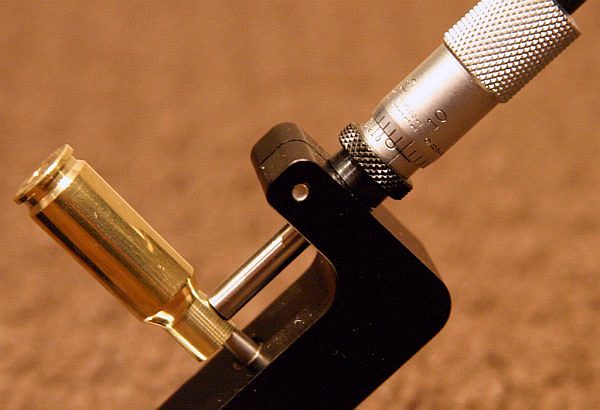
A Sinclair case neck micrometer indicates neck thickness of 0.010″ after neck turning.
30 BR dies are readily available from a number of manufacturers. I personally use Wilson neck and seating dies with a Sinclair Arbor press, but Redding and Forster both supply high-quality threaded dies for use in a conventional press. For under $100.00 US, custom full-length dies can be obtained from Hornady and CH Tool & Die by sending them reamer prints or a couple of fired cases. Harrell’s Precision offers “semi-custom” dies. Just send them some fired cases and they select a pre-made CNC-cut die that ideally fits your chamber. You can ask the Harrell brothers for a die that’s tighter at the shoulder or base, or otherwise customized to your preferences.
Load Development and Accuracy Testing
With cases formed and bullets selected, load development is simply a matter of choosing the right primer, powder and charge weight, and loading the most consistent ammunition possible. The Lapua BR cases use a small rifle primer. The choice here was Federal 205 Match primers vs. CCI BR4 Benchrest primers. Some shooters have also had success using CCI 450 Magnum primers but it is very unlikely the small case needs this much spark to light off regular extruded powders. In my case, I selected Federal primers because availability tends to be better in Australia.
The relatively large bore-to-capacity ratio of the 30 BR case means that fast burning powders are the order of the day. Once again, US experience suggests H4198 (the Hodgdon equivalent of ADI AR2207) is the choice of match winners. The fact that H4198/AR2207 is an Australian-made product is an added bonus. So, I loaded up test rounds with AR2207 from 32.5 grains to 35.0 grains in approximately 0.3 grain increments. All bullets were seated to jam +0.010″ into the lands. This places the bullet base about two-thirds of the way down the neck and well short of the neck-shoulder junction.
Action Choice — Stainless Grizzly II from Kelbly’s
The heart of any rifle is the action. Both my two 30BRs have RBLP Grizzly II actions from Kelbly’s. Kelbly’s is perhaps most famous for the Stolle Panda flat-bottomed aluminum actions but the Grizzly II also has a match-winning pedigree and precise tolerances. The Grizzly II is a round-profile, stainless steel, Remington-style action. I chose Right-Bolt, Left-Port configuration for ease of loading at the bench. The Traditional Class action has a magazine cut out in the floor and a plunger-style ejector (both required to meet the class rules). By contrast, the Custom Class action has a solid floor and no ejector. Other minor differences are the shape of the loading/ejection port and the profile of the bolt noses. The bolt from the single-shot action has a conical face, which theoretically gives maximum accuracy when mated to a similarly profiled barrel. However, the bolt from the repeater is made square for reliable pickup of the next round in the magazine without jumping over the top. Both bolt face diameters are 0.473″ for .308 case heads and feature sliding-plate style extractors.
Both receivers have pinned recoil lugs. These are not always required in Benchrest actions since a square tang can perform the same role when the stock is inletted accordingly. Since the actions are pillar-bedded into their timber stocks rather than glued, and because the 30BR recoils more stoutly than the 6mmPPC, I decided to fit recoil lugs on both rifles. Jewell triggers are standard fare–both set at 2 ounces. Bolt stops are integral to the action as with most benchrest actions.
Scope Options — 6X for Traditional, 45X for Custom
Both rifles are fitted with Leupold scopes in Kelbly aluminum rings and bases. The Traditional rifle’s scope is a 6x42mm to comply with class restrictions. It has a front-adjustable objective for parallax correction and a target dot reticle. I like the target dot when “holding off” for wind correction on the Hunter Class targets. The other rig wears a 45-power scope since magnification is unrestricted in Custom Class. It has a side-parallax adjustment and target dot reticle. The greater magnification really helps with precision aiming, and is probably the main reason why Custom Class scores are higher.
Q: What’s more important — wind speed, or direction?
A: Obviously they both matter, but they do trade dominance based on direction. For example, a 10 mph wind between 2:30 and 3:30 is only changing its value from 9.7 to 10 to 9.7 mph (bracket of 0.3 mph). However a 10 mph wind between 11:30 and 12:30 is changing its cross wind component value from 2.6 mph left to zero to 2.6 mph right (bracket of 5.2 mph). There is the same 30° change in direction, but this results in a massively different bracket.
Point being, in this case, a direction change is far more critical if it’s near 6 or 12 o’clock. A small direction change when it’s close to 3 or 9 o’clock is negligible.
On the contrary, a change in wind SPEED when it’s near 3 or 9 affects your crosswind component directly. But for a near head or tail wind, a fluctuation in wind speed only causes a small fraction of a change to the crosswind component.
SUMMARY: If you’re in a near full-value wind, pay more attention to wind SPEED. If you’re closer to a head- or tail-wind, nailing the exact DIRECTION will be more important.
Get More Tips on Bryan Litz Ballistics Facebook Page
This post is from the new Bryan Litz Ballistics Facebook Page. FB users should check that page regularly for more tips from Bryan, American’s leading ballistics expert and founder of Applied Ballistics LLC.
Shiny brass — it may not shoot more accurately, but it does make you feel better about your hand-loaded ammo. While it’s not necessary to get brass “bright and shiny” after every firing, it is a good idea to clean powder residue, grime, and grit off your brass before you run cases into sizing dies. There are many ways to clean cartridge cases. A quick wipe with solvent on a patch may suffice for recently-shot cases. Older brass with baked-on carbon may require lengthy tumbling. Ultrasonic cleaning is another popular option that gets your brass clean inside and out.
Sinclair International has a series of helpful videos on brass cleaning. These short “how-to” videos, hosted by Bill Gravatt, Sinclair’s past President and current Creedmoor Sports President, cover the various processes you can use — tumbling, ultrasonic cleaning, chemical cleaning, and cleaning by hand.
Video ONE — Cleaning Brass in Vibratory or Rotary Tumbler
TIP: Brass that has recently been shot will clean more easily than brass that has been sitting many days or weeks. If your tumbling media is fresh the job should be done in an hour or less. It’s your choice whether to tumble with primers removed or with primers still in the cases. If you choose to tumble with primers out, we suggest you deprime with a depriming die, rather that put dirty brass into your sizing die. Some people like to add a teaspoon of liquid polish to the media. This does work, cutting tumble time, and making your brass more shiny. However, if you add liquid polish, do that BEFORE you add the brass and let the tumbler run for a 15 minutes to get the polish completely mixed into the media. Otherwise you can else up with gooey gunk inside your cases — a very bad thing.
Video TWO — Ultrasonic Case Cleaning
TIP: There are many different types of solutions you can use. Soapy water suffices for some folks, particularly if you add a little Lemi-Shine. The Hornady One-Shot Sonic Clean and Lyman Turbo Sonic solutions both work well, and can be used multiple times, provided you strain the solution to remove dirt and grit after cleaning sessions. Many ultrasonic cleaning machines have timers. Experiment with dwell time to see how long you need to immerse your brass. A very small amount of Ballistol in the solution will help lubricate your necks on the inside. This can make bullet seating go more smoothly, with more consistent neck tension.
Video THREE — Chemical Cleaners (Soaking without Ultrasound)
TIP: After using chemical cleaners, such as the Iosso solution, you need to water-rinse your brass thoroughly. A kitchen strainer helps with this (see video at 0:20). Also, don’t forget your brass in the chemical solution — follow the manufacturers recommendations and don’t exceed the recommended dwell time. Chemical cleaners work surprisingly well to remove grease and grime, and the solution can be re-used multiple times. However, if you want your cases to look bright and shiny (like new brass), you will probably have to tumble. [Editor: A very effective new chemical cleaner is the Brass Monkey product from the makers of Wipe-Out and Carb-Out. Add a teaspoon to a gallon of water then soak your brass for 20-30 minutes. It really works — the cases clean up dramatically].
Video FOUR — Manual Cleaning (By Hand)
TIP: Keep some oversize patches in your range kit. At the end of your shooting sessions, wipe off your fired brass with a patch dampened with a mild, non-corrosive solvent (once again Ballistol works well). Before the carbon sets up on your brass it is very easy to remove. For tougher jobs, you can use 0000 Steel Wool (as Bill recommends in the video). You may find that timely hand-cleaning lets you avoid tumbling altogether — or you may choose to tumble (or ultra-sound) your brass only after a half-dozen or so firings.
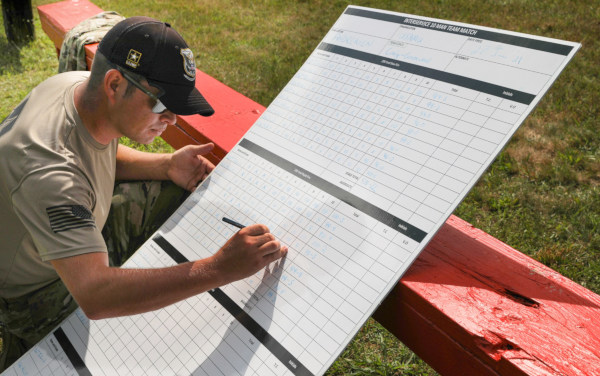
The U.S. Army Marksmanship Unit (USAMU) has created a series of instructional videos about High Power Rifle shooting, Service Rifle shooting, 3-Gun matches, and pistol competition. We’ve linked five of these informative USAMU videos today along with a special profile video on Amanda Elsenboss, who, as a USAMU shooter, has won both the Long Range and High Power National Championships in recent years.
In addition, as a major BONUS, we link twenty (20) informative articles authored by expert USAMU shooters and coaches. Those excellent, detailed articles covering a wide range of topics including rifle positions, wind reading, fitness training, trigger control, nutrition, training plans, and much more.
Amanda Elsenboss — National HP and Long Range Champion
The gifted SSG Amanda Elsenboss won the 2023 NRA High Power Championship, the 2021 NRA High Power National Championship, and the 2019 NRA Long-Range Championship. In 2022 Amanda also won the National President’s Rifle Match, the first woman ever to do so. Those accomplishments place Amanda among America’s legendary shooters. Amanda started shooting at age 8 with her father, then began competitive marksmanship at age 13. In 2009, she joined the U.S. Army as part of the USAMU rifle team. She has left full-time service, but is now a member of the Pennsylvania National Guard.
Sight Alignment and Trigger Control
In this USAMU Shooter’s Corner instructional video, SFC Kenneth Rose explains key elements of using sights on a service rifle. Rose also explain how to make the trigger pull at the optimum moment when the sights are perfectly aligned and steady.
How to Set Up Sling and Rifle for Prone Shooting
In this video, the USAMU’s SGT Jonathan Wannemacher explains how to set up a service rifle sling for prone rifle shooting. Wannemacher has earned a number of coveted awards including the the Distinguished Rifleman Badge and President’s Hundred Tab.
Rifle Grip, Stance, and Body Position for 3-Gun Action Matches
SFC Daniel Horner, now with SIG Sauer, is arguably the best 3-Gun action shooter on the planet. Horner has won multiple major 3-Gun Championships, shooting rifle, shotgun, and pistol in timed action matches. Horner’s speed, accuracy, and mobility is without peer. In this video, Horner shows techniques for AR-type rifle shooting in 3-Gun competition.
Amazing Trick Shot with Air Rifle
In this Trick Shot Tuesday video SPC Ivan Roe shoots a pill (at two different angles) off the top of a balloon. Very impressive shooting! Ivan hails from Manhattan, Montana and has been a notable member of the USAMU International Rifle Team.
How to Use Data Books During Matches
Data books can be very valuable tools during marksmanship training. In this video, USAMU shooter SGT Lane Ichord explains Data Book basics and how to log information during practice and matches.
BONUS: 20 Marksmanship Articles from USAMU Experts
USAMU shooters and coaches have written an excellent series of articles on highpower and service rifle shooting. Many of these originally appeared in The First Shot, the CMP’s on-line magazine. Here are twenty notable USAMU expert articles:
The much-loved Shilen SWAP MEET is happening today. The popular event takes place in Ennis, Texas this Saturday, March 15, 2025 from 8:00 am through 2:00 pm CDT. This will be at Shilen’s new, bigger and better production facility. If you are looking for some great bargains on gun gear, and are near the Dallas-Fort Worth area, definitely mark this date on your calendar. The Shilen Swap Meet is one of the best events of its kind, and Team Shilen will even deliver a complimentary lunch to attendees. Plus machines will run from 8:00 am to 11:00 am so you can see how Shillen crafts top-quality barrels.
No Vendor Fees, No Entry Fees, and FREE Lunch!
ANYONE can come and ANYONE can be a vendor. There are NO entry or vendor fees and the event will proceed rain or shine. There will be gun stuff everywhere –buy and sell as much as you like. There will be free lunch, as always.
There will be prize drawings — get signed up when you arrive so you can have a chance to win some free stuff. If you want to sell products let Shilen add you to the list of vendors on Shilen’s website. This is not required, you can just show up and set up. Call 972-875-5318 or send email to comments@shilen.com.
SHILEN SWAP MEET HIGHLIGHTS
Watch Barrel-Making. A Shilen crew will run barrel-making machines from 8:00 am to 11:00 am. Watch precision barrels being made. The techs will answer all your questions about the process.
Sign up for Door Prizes — Shilen Merchandise. There will be multiple drawings for free or discounted Shilen apparel or merchandise. Go to the sign-up table to be entered in the drawings.
Get Shilen Barrels and Actions at Huge Discounts. Shilen Barrels, Actions, and Barreled Actions will be sold at huge discounts on Saturday. “Swap Meet Barrels” were originally ordered by Shilen customers throughout the year, but orders were canceled or customers changed their mind on contour, chamber, etc. These barrels were placed back in stock for resale. When Swap Meet Time arrives any such barrels still remaining in stock are sold at huge discounts. NOTE: These barrels are in NO WAY factory “seconds” or any lower quality. The warranty on these barrels is the same as any other Shilen barrels.
Sell Your Own Gear. At the Shilen Swap Meet, you can Bring Your Own Table (BYOT). Register to sell anything gun-related: presses, reloading gear, stocks, triggers, scope rings — you name it. Vendor Space is available on a first come-first served basis, starting Saturday morning at 7:00 am. Email or call Shilen for more information. Email: comments@shilen.com. Call: 972-875-5318.
TIPS for Visitors: The SWAP MEET concludes at 2:00 pm. The best stuff sells fast, so if you are looking for something particular get there early! Keep an eye on the Shilen’s Swap Meet page for a preview of Vendors and the products they’ll be selling.
We first ran this story a few years back. We’re republishing it today as a reminder to our readers that safety should be their paramount concern at the range. Avoid distractions and always check your barrel for obstructions before you chamber a round or pull the trigger. A moment of inattention can result in a catastrophic kaboom.
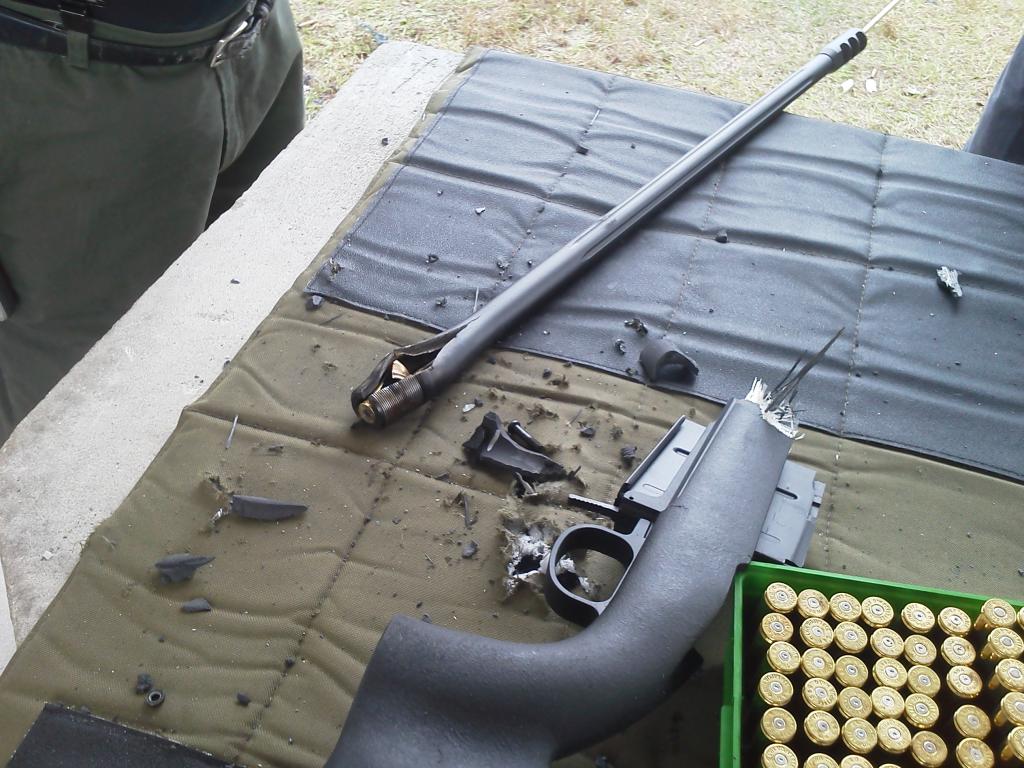
Discharging a .338 Lapua Magnum round with a cleaning rod in the barrel — that’s a recipe for disaster. What happens when a fired .338 caliber bullet and a cleaning rod try to occupy the same place at the same time? Well you get a catastrophic kaboom, with metal pieces flying all over the place, and a shooter very lucky to escape without serious injury. This incident occurred recently in Manatee, Florida, as reported by Sniper’s Hide member Queequeg. We thank SnipersHide.com for granting permission to publish these revealing images in the Daily Bulletin. CLICK HERE for more Kaboom info from the ‘Hide.
This story should serve as a chilling reminder to follow proper safety practices whenever you are at the range. Always check to make sure there is no obstruction in the bore BEFORE loading a live round.
.338 Lapua Magnum + Cleaning Rod + Inattention = Kaboom!
Kaboom at Manatee!
Sniper’s Hide member Queequeg recently published shocking photos of a catastrophic kaboom involving a .338 Lapua Magnum (Savage action). The action was blown off the rifle, shrapnel went through the roof, and the barrel split at the tenon before taking an excursion downrange. The action did crack in the front but the lugs remained engaged so the bolt did not slam to the rear (luckily for the shooter).
Here’s the report: “This happened [January 20, 2014] at the Manatee Gun and Archery Club. Al, Ren and myself were there with a couple other folks. Ren was at bench 12, I was at 13. The fellow at 11 was running a Savage .338 Lapua. He had a very bad day! He damn sure could have killed himself and quite likely Ren as well.”
Queeqeg added: “After the boom, I heard Ren ask ‘Are you alright’ and then turned to look in time to see the fellow reacting in total shock — literally stunned. Ren and I went over to him and could not see any major injuries. Ren was uninjured as well but had a lot of fiberglass splinters on him. The barrel nut is what I presume punched the two holes in the roof. The shooter is a regular there[.] He had been having a problem with sticky cases though he said he was certain the loads were mild. That’s why he was content to knock the sticky ones out with the rod. He simply forgot to remove the rod after knocking out the last stuck case. You can see what happened next.”
To learn more about this incident, go to the original Snipers Hide Forum Thread. There you’ll find more details and four pages of related discussions.
The Important Lesson Here
What did the .338 LM shooter do wrong here? You will say — “Well that’s obvious, he left a cleaning rod in the barrel and then shot a round.” Yes, that was a potentially fatal error. But that was his second mistake — one that occurred only because he made a more fundamental judgment error first.
The FIRST mistake was not acknowledging the problem with his ammo. Had he heeded the warning signs, he would still have a rifle (and an unsoiled pair of trousers). When he first observed that he was having problems with extracting cases, a warning light should have gone off in his head. Presuming his extractor was not broken (and that the chamber was cut properly) he should have been able to extract his brass if he was running safe loads. The lesson here we all need to learn is that if you observe a serious ammo-related issue, it is time to stop shooting. Don’t try to invent work-arounds just to extend your range session, when there are clear signs that something is wrong, very wrong.





 Velocity and powder charts


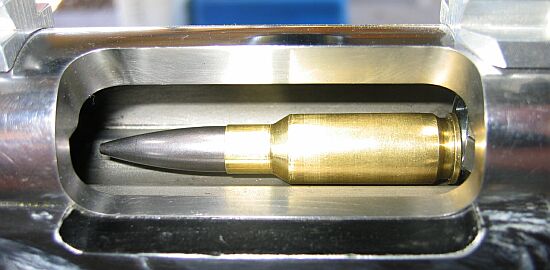
 30 BR dies are readily available from a number of manufacturers. I personally use Wilson neck and seating dies with a Sinclair Arbor press, but Redding and Forster both supply high-quality threaded dies for use in a conventional press. For under $100.00 US, custom full-length dies can be obtained from


 Shiny brass — it may not shoot more accurately, but it does make you feel better about your hand-loaded ammo. While it’s not necessary to get brass “bright and shiny” after every firing, it is a good idea to clean powder residue, grime, and grit off your brass before you run cases into sizing dies. There are many ways to clean cartridge cases. A quick wipe with solvent on a patch may suffice for recently-shot cases. Older brass with baked-on carbon may require lengthy tumbling. Ultrasonic cleaning is another popular option that gets your brass clean inside and out.