This year, the Civilian Marksmanship Program (CMP) will offer a new Range Officer Training Program. This comprehensive training program will train and certify Range Officers for the CMP phases of the National Matches, CMP Travel (Regional) Games competitions, and CMP 3-position air rifle championships. The first objective of the new program is to train volunteers to serve as Range Officers in the 2017 National Matches. The course fee will be waived for National Matches volunteers.
CMP Chief Operating Officer Mark Johnson explained: “Knowledgeable, fair, effective Range Officers are absolutely essential… The CMP recognizes that the best way to make sure it has excellent Range Officers for its competitions is to train them.”
The CMP held the first-ever New England CMP Games event in 2016.
Range Officer Volunteers will be enrolled in Level I training to be completed in the first months of 2017. Level II courses will be available prior to the start of the National Matches. If you have questions about the RO Training Program, email the CMP Competition Department: competitions [at] thecmp.org.
Level I Range Officer Training
Level I Range Officer instruction covers general topics common to all Range Officer work. Enrollees will receive a Range Officer Handbook titled Becoming a Range Officer and be able to complete an online training course. Enrollees who complete Level I training will receive a certification and CMP Range Officer Vest and be eligible to attend Level II training.
Levels II and III Range Officer Training
Level II courses are discipline-specific, 1-day, in-person sessions taught by CMP-appointed instructors. Level II RO instruction will be offered for four shooting disciplines: 1) Highpower Rifle; 2) Bulls-Eye Pistol; 3) Rimfire Sporter; and 4) 3-Position Air Rifle. The highest Level III certification will be issued after Range Officers who complete Level II training serve as Range Officers in CMP competitions under the supervision of a CMP Master Range Officer. CMP Master Range Officers will conduct/supervise the training of Level II and Level III students. The first Level II courses should begin in March or April.
CMP Rimfire Sporter Competition Level II Training will be offered for this and other specific disciplines.
Boresighting the old-fashioned way — by looking down the bore of a rifle at a target — is not difficult. With a conventional bolt-action rifle, visual bore-sighting can be done quickly and easily: rest your gun securely on bags, remove your bolt and set up a 50-yard target with a large bright orange or black center circle. Look through the back of the action and you should be able to sight down the bore with your own eyes just fine. There’s no need for expensive hardware. In fact it may be easier to bore-sight the “old-fashioned way” rather than try to see a laser in bright sunlight at 50 yards (or even 25).
However, with lever guns and semi-auto rifles, including the popular AR15, M1 Garand, and M1A service rifles, the design of the receiver may make it virtually impossible to sight down the bore with the naked eye. That’s where a modern laser bore-sighting device comes in handy. For those situations where a bore-sighting tool is actually needed, we recommend a laser bore-sighter that fits inside your chamber. The in-chamber configuration is more fool-proof, and is inherently safer.
In-Chamber Laser Should Be Safer
Among the laser bore-sighters available on the market, we strongly favor those that fit in the chamber, rather than in the bore. With muzzle-entry laser bore-sighters, you could have a nasty accident if you forget to remove the device. There is always the chance you could chamber and fire a round with the muzzle-entry bore-sighter still in place. Instant Kaboom. That has happened more than once. With an in-chamber bore-sighter, there is no possibility you could chamber a loaded round with the bore-sighter in place. That’s an important safety advantage. Sightmark in-chamber bore-sights are shown in the video below. You can see that, with the bore-sighter in place, you cannot chamber a live round.
In-Chamber Bore-Sighters for Rifles Sightmark offers compact laser bore-sighters that fit inside your firearm’s chamber. The laser is housed in a brass assembly machined to duplicate a cartridge. These are easy to use — simply twist the end-cap to activate the laser, then place the bore-sighter in the rifle’s chamber. The affordable ($29.99 – $35.77) Sightmark boresighters are offered in a wide variety of pistol, shotgun, and rifle “chamberings”. Rifle options include: 17 HMR, .223 Rem, 22-250 30/30, .308 Win Family, .25-06/.270/.30-06, 6.5×55, .270/.300 WSM, .300 Win Mag, 50 BMG, and many other large hunting calibers. SEE Full Product Line.
Cabela’s also offers a Professional .223 Laser Chamber Boresighter that fits in a .223 Rem rifle chamber. This $59.99 unit, shown below, can be adapted to other chamberings by adding a caliber-specific sleeve over the .223 core unit.
Adapt Basic Unit to other Calibers with Sleeves
Cabela’s Professional .223 Laser Chamber Boresighter unit can be used for a variety of chamberings by fitting additional $19.99 caliber-specific sleeves (sold separately). Each sleeve is precision-machined from brass to SAAMI specs. One purchaser notes: “Extremely well made, the fit is so precise that I would recommend using a drop or two of light oil on the 223 laser insert before fitting it into the sleeve.” Available chamber sleeve calibers include:
TacticalWalls.com, producers of home security/concealment products, has introduced a new line of furniture with hidden gun storage. Tactical Walls’ new Coffee Table, End Table, and Night Stand provide “hidden in plain sight” solutions for defensive firearms. These tables all feature a clandestine metal gun compartment that can be instantly accessed via RFID card.
At first glance, the TacticalWalls tables appear to be nothing more than quality wood furniture pieces. (Each unit is made from hardwood and crafted in Shenandoah, Virginia.) But what’s special are the remote-activated hidden gun bays. By swiping a pre-programmed RFID card supplied with each unit, the hidden compartment underneath the table-top is unlocked, giving instant access to your handgun, shotgun, or rifle.
These products are nicely crafted, and RFID access is a smart use of modern technology. However, the TacticalWall tables are pretty expensive. The Coffee Table (49″L x 24″W x 19″H) costs $795.00! That will buy a pretty big gun safe. The two smaller units, the Night Table (above left, 23″L x 23″W x 31″H) and End Table (above right, 23″L x 23″W x 25″H) each cost $495.00. For that kind of money you have a variety of gun storage choices. Still, this could be a nice “instant access” bedroom option. You could keep your pistol right at your bedside, close at hand, but still completely secure.
A new .22 LR rimfire shooting discipline has been developed, copying the PRS series. Call it “PRS Lite” — a practical-style match shot with .22 LR bolt-action and self-loading rimfire rifles. This series will be called the Practical Rimfire Challenge (PRC) with ELEY as Title Sponsor. The first three matches will be held at the Peacemaker National Training Center in Glengary, West Virginia. Match Dates are March 25, May 13, and September 30, 2017.
PRC Matches Will Feature Multiple Positions and Movement
ELEY Practical Rimfire Challenge series matches are positional shooting events in field conditions out to 300 yards. You can use either a bolt-action or semi-auto .22 LR rimfire rifle. Much like PRS (Precision Rifle Series), competitors will shoot from a variety of positions: prone, strong/weak shoulders, standing, sitting, and kneeling. There will be shots from barricades, and movement from position to position during stages.
PRC rules will, to a large degree, mirror PRS rules. However, shooters will see some different type of stages than what is normally seen at a PRS match. For example, there may be unsupported standing or unsupported kneeling shots in some stages. Peacemaker’s goal, along with ELEY, is not to replicate PRS in Rimfire, but rather to create the ultimate challenge for shooters on the rimfire rifle platform.
Cole McCulloch, owner of Peacemaker, says that the PRC should appeal to a wide variety of shooters: “We expect to see recreational, action, Olympic, NRA and PRS shooters all competing and having fun”. McCulloch also expects rapid evolution in the equipment: “I fully anticipate a Space Race for this sport. Meaning, we already know that the ammunition coming out from ELEY is fully capable of hitting small targets out to 300 yards. What will be fun to watch is the different types of rifles and optics the shooters choose to use. Some examples of this will be: Bolt or semi, heavy or ultra-light weight, MILS or MOA, 10 power or 30 power. The debate will rage and the rifle platform approaches will vary greatly.”
Rimfire Tactical Matches Aren’t Really New
We’re pleased to see this new PRC shooting discipline — it sounds like fun. However, the concept of a rimfire tactical/practical match is not new — at least on the West Coast. California shooting clubs have been running “Rimfire Tactical” matches for a nearly a decade already. CLICK HERE to read our comprehensive Rimfire Tactical report from way back in 2008. This article includes free targets, ballistics charts, and a complete run-down on suitable rimfire rifles.
The Concept Behind the Rimfire Tactical Match by Bill Erwin
Many guys who shoot long-range tactical matches practice with .22 LR rifles of similar configuration. Rimfire ammo is way more affordable than centerfire, you do not need a big range facility, and shooting rimfire saves wear and tear on your centerfire rifle. Further, for learning how to read the wind, there really is no better training tool than a 22 LR, even as close as 50 yards. Check out this table showing how a .22 LR ballistics compare to .308 Win:
22 LR vs. .308, Distances for Equal 10 MPH Wind Drift
This table shows the corresponding distances at which a 10 mph full-value crosswind pushes a .22 LR bullet and .308 projectile the same amount. Values are based on 0.130 BC for a 40gr .22 LR bullet, and 0.496 BC for 175gr .308 bullet.
22 LR 40gr 1050 fps
50 yd Wind 1.0″
75 yd Wind 2.2″
100 yd Wind 3.8″
125 yd Wind 5.8″
150 yd Wind 8.2″
175 yd Wind 11.0″
200 yd Wind 14.3″
.308 Win 175gr 2650 fps
130 yd Wind 1.07″
180 yd Wind 2.15″
230 yd Wind 3.68″
280 yd Wind 5.63″
330 yd Wind 7.98″
380 yd Wind 10.71″
440 yd Wind 14.56″
This table shows how the .22 LR can be an effective substitute for a .308 Win during training. Because the smaller bullet drifts more in the wind, a 22 rimfire shooter will experience roughly the same crosswind effects as if he was shooting a 175gr .308 twice as far out. So, rimfire work can teach you to dope the wind like a .308, but at less than half the distance. Shooting a .22 LR at 100 yards is like shooting a .308 (with 175 SMK) at 230 yards.
Shooting Peacemaker NTC Plate Rack at 100 Yards with Suppressed Rimfire
SPECIAL BONUS–Rimfire Tactical Precision Targets
These FREE targets by DesertFrog are offered in Adobe Acrobat format for easy printing. CLICK HERE to download all six targets as a .ZIP archive.
While many folks enjoy the convenience of an electronic powder scale/dispenser such as the RCBS Chargemaster, some hand-loaders still prefer to use a traditional balance beam. Balance beam scales are simple, compact, and don’t suffer from electronic “glitches”. Moreover, even if you use a digital dispenser at home, when you’re doing load development at the range, a balance-beam scale may be more convenient. A scale doesn’t require electrical power, so you don’t need to bring battery packs or string long power cables. Just bring some kind of box to shelter your beam scale from the wind.
While designs like the RCBS 10-10 are decent performers as built, they can be made much more precise (and repeatable), by “tuning” of key parts. Forum member Scott Parker (aka SParker) optimizes a variety of popular beam scales, including the Ohaus 10-10 (USA-made model), RCBS 10-10 (USA-made model), RCBS 5-10, Lyman M5, Lyman D5, and others. You send Scott your scale, he tunes the key components, tests for precision and repeatability, and ships it back to you. The price is very affordable (under $85.00).
Scott tells us: “I have tuned several 10-10s. They all have turned out very sensitive, consistent and hold linearity like a dream. If only they came that way from the factory. The sensitivity after tuning is such that one kernel of powder registers a poise beam deflection. For repeatability, I remove the pan and replace it for the zero 10 times. The zero line and the poise beam balance line must coincide for each of those 10 tries. I then set the poises to read 250.0 grains. I remove and replace the pan 10 times with the calibration weight. For linearity, the poise beam balance line and the zero line should coincide within the line width. This is roughly one half a kernel of powder. For repeatability, the poise beam balance line must return to that same balance point ten times. I then adjust the poises back to zero and recheck the zero. I have a master’s degree in chemistry, thus I am very familiar with laboratory balances. Email me at vld223 [at] yahoo.com or give me a call at (661) 364-1199.”
The video above, created by British shooter Mark (aka 1967spud), shows a 10-10 beam scale that has been “tuned” by Scott Parker. In the video, you can see that the 10-10 scale is now sensitive to one (1) kernel of powder. Mark also demonstrates the’s scale’s repeatability by lifting and replacing a pan multiple times. You can contact Mark via his website, www.1967spud.com. To enquire about balance-beam scale tuning, call Scott Parker at (661) 364-1199, or send email to: vld223 [at] Yahoo.com.
Video tip from Boyd Allen. We welcome reader submissions.
One Hundred Men vs. One Hundred Women — get ready for the Battle of the Sexes at the Second Annual Babes with Bullets 3-Gun Challenge. The match takes place May 20th and 21st at the Miculek’s Shootout Range near Shreveport, LA. In this unique match, there will be an equal number of male and female participants, for a total of 200 competitors. The first place in men’s division will be a $2,000 check as will the first place in the ladies division. This match follows an “equal pay” philosophy rarely seen in the shooting sports. The prize tables, valued at over $50,000, will also be divided equally between men and women’s divisions. Each division will also have a junior and senior category.
Match directors state: “Our goal is to have an equal number of female and male participants. All competitors will shoot the same stages of fire, with the Women’s Domain and Men’s Domain scored separately. Equal play, equal pay!” Men’s and Women’s Domains will have separate prize tables with Tactical Optics Division winners guaranteed $2,000 cash OR first pick from the respective prize tables.
Otis Technology Sponsors Event Otis Technology, makers of gun cleaning products, is the presenting sponsor of the BWB 3-Gun Challenge. Otis’s Marketing Manager, Heather Pleskach, notes that “Last year’s inaugural match was a well-organized event that welcomed shooters from all experience levels. We couldn’t be more proud to continue our participation for 2017 and look forward to another successful event.” At this year’s 3-Gun Challenge, Otis Technology will partner up with Thompson Center/Smith & Wesson for an exciting side match at the event. Tracy and Lanny Barnes, former Olympic Biathletes, will be competing in the match on behalf of Otis.
About Babes with Bullets: Since 2004, Babes with Bullets have provided firearms handling and safety training for women. Co-founders Deb Ferns, camp director, and Kay Miculek, head instructor, have led these camps for almost thirteen years. See the 2017 camp schedule at BabeswithBullets.com.
Here’s a comprehensive “reveal” of the latest and greatest rifle optics for 2017, thanks to our friends Ed and Steve, aka the 6.5 Guys. These two hard-working dudes visited dozens of product booths during SHOT Show, producing over 40 video interviews for 6.5guys.com. Below we’ve included the 6.5 Guys’ videos for Nightforce, Vortex, and Schmidt & Bender. Plus you’ll find links to other videos for Burris, Bushnell, Steiner, and U.S. Optics. Enjoy these videos, and for more great coverage of SHOT Show, visit the 6.5 Guys’ YouTube Channel.
NIGHTFORCE Optics — New for 2017
The big news at Nightforce’s SHOT Show booth was a new First Focal Plane (FFP) ATACR with a five times zoom range. The new 7-35x56mm ATACR offers tactical and long range shooters the ability to go from a wide field of view at seven power, all the way up to very high 35X magnification. That makes this one scope that can truly “do it all” — from short-range moving targets to 1000 yards and beyond.
VORTEX Optics — New for 2017
Vortex is releasing a new “Gen II” series of Viper PST riflescopes. The versatile Viper PST series can work for many disciplines — Target Shooting, 3-Gun, Hunting, or Precision Long Range. The new second generation PSTs offer many improvements.
NEW 2-10×32, 3-15×44, and 5-25×50: Vortex offers a wide magnification range with these three new PSTs. Each offers tall tactical turrets and side-focus parallax adjustment with integrated illumination. To ensure reliable return-to-zero, all new models feature the patented RZR Zero Stop from the Razor HD 5-20×50 riflescope. Reticles include Vortex’s new EBR-4 and EBR-2C with MOA or MRAD stadia to match your turrets. First Focal Plane reticles are available on select models.
SCHMIDT & BENDER — New for 2017
Schmidt & Bender had many premium riflescopes on display, none more impressive than the recently-introduced 5-45x56mm PM II “super-zoom” optic. This impressive (and razor-sharp) scope offers a remarkable 9X zoom ratio. That makes it suitable for a wide variety of shooting disciplines. A tactical competitor can dial back to 5-power for a wide field of view on close-in targets. Or, for 1000-yard shooting, crank the scope all the way up to 45-power. S&B says the scope is intended for “tactical ultra-long-range shooting”.
Also on display was the 5-25x56mm PM II Digital BT — this Bluetooth-enabled scope can project data from external devices, such as laser rangefinders, into the field of view. S&B is leading the way in the integration of optics and digital devices.
And There’s More — Burris, Bushnell, Steiner, and U.S. Optics
The 6.5 Guys also visited other optics makers including Burris, Bushnell, Steiner, and U.S. Optics. There were interesting offerings from all these scope manufacturers. Click the links below to watch four more 6.5 Guys videos covering new developments in the sport optics arena. The videos focus on products for tactical/practical and long-range shooting.
Most of us have access to a printer at home or at work. That means you can print your own targets. You’ll find hundreds of free target designs online, including dozens of downloadable targets on our AccurateShooter.com Target Page. If you’re feeling creative, you can design your own target with a computer drawing program such as MS Paint.
Paper Stock Is Important
If you want your self-printed targets to show shots cleanly (and not rip when it gets windy), you should use quality paper stock. We recommend card stock — the kind of thick paper used for business cards. Card stock is available in both 65-lb and 110-lb weights in a variety of colors. We generally print black on white. But you might experiment with bright orange or yellow sheets. Forum Member ShootDots report: “They sell cardstock at Fed-Ex Kinko! I use either Orange or Yellow. That makes it easy to see the bullet holes clearly.” On some printers, with the heavier 110-lb card stock, you will need to have the paper exit through the rear for a straighter run.
Here are some Target-Printing Tips from our Forum members:
“Staples sells a 67-lb heavy stock that I have settled on. I use the light grey or light blue, either of these are easy on the eyes on bright days. I have used the 110-lb card stock as well and it works fine. It’s just a little easier to print the lighter stuff.” (JBarnwell)
“Cardstock, as mentioned, works great for showing bullet holes as it doesn’t tear or rip like the thin, lightweight 20-lb paper. I’ve never had a problem with cardstock feeding in the printer, just don’t stick too many sheets in there. If I need three targets, I load only three card stock sheets”. (MEMilanuk)
“I’ve used Staples Sticker paper. This works well and no staples are required (joke intended). It helps if you put slight tension on the lighter weight paper when mounting it on the target frame.” (Mac 86951).
Here are some tips for using lighter weight paper (if you want to save money or your printer won’t work with heavier stock):
“20-lb bond works pretty well for me if I use a spray adhesive and stick the entire back of the paper’s surface to the backer board.” (Lapua40X)
“I use the regular 20-lb paper but the only time it tears is when there is no backer to support it. This can be an issue when going to a public range and the backer are all shot out. I use a large construction paper backer that I clip onto the stands.” (CPorter)
Here Are Three of Our Favorite Targets. Click to Download PDFs.
In the recent past, it was hard to find .22 LR rimfire ammo for plinking and fun shooting at affordable prices. Now that’s changing. Supply is catching up with demand so prices are starting to return to pre-hoarding levels. Here’s a great deal if you need good basic fodder for fun plinking and plate shooting. We’ve tried this copper-nosed .22LR rimfire ammo in pistols, boat-action rifles, and semi-auto rifles and it functioned fine. Hard to beat this price — $19.99 for 325 rounds with no limit on the amount you can purchase. Buy some and have a plinkin’ party for the who family next time you head to the range.
This Federal Value Pack contains 325 rounds of reliable .22 LR rimfire ammo loaded with 36-grain hollow-point bullets, suitable for target shooting and plinking. Item: IK-217964
Save more at Cabelas.com with Coupon “17WINTER” for 10% OFF + Free S/H over $49 on Select Winter Clothing, Hunting Clothing, Footwear and Accessories or Coupon “27FLAT” for $5 S/H over $99.00.
The following article by Tom Alves describes a very practical approach to physical training for those of us who are not as young and spry as we once were. Tom shows us how to give our bodies at least some of the maintenance we give our rifles. While we all realize that our rifles will outlive us, let’s see if we can’t narrow the margin a bit with some personal maintenance that just might help the shooting too! This article originally appeared in the Rifleman’s Journal, and appears with permission of GS Arizona.
A Suggested Training Approach for Older Shooters
By Tom Alves
Most articles and discussions regarding competitive shooting center around equipment. Now and then one will come across an article about training such as the recent one from the AMTU posted on www.6mmbr.com/. If you break the articles down they often discuss “core strength” and durability. The purpose of this paper is to elaborate on those points with a bit different perspective. Many of the articles you will read in books about position shooting and the one mentioned before are directed more toward the younger generation of shooters in their 20’s. If you look down the line at a typical high power match these days you are likely to see quite a few folks who are in their middle 30’s and up. Many people in that age range have had broken bones and wear and tear on their joints so a training program needs to take that into account. For instance, while jogging for an extended period for heart and lung conditioning – often called cardio exercises – may be the recommended approach for younger folks, it may be totally inappropriate for older people. The procedure to repair meniscus tears in knees is one of the most frequently performed operations in this country. Another approach one often sees in training to improve core strength is the use of weight machines which isolate certain muscle groups in their operation. I would like to suggest an alternative approach that not only does not require special equipment but uses the body’s muscles in a coordinated fashion in the same way they are used in our natural movements. So, let’s set down some criteria:
1. The approach has to be low impact to conserve joints.
2. One goal is to improve the strength of the core muscles which are the muscles of our trunk that keep us erect and from where all movements initiate.
3. Along with core strength we need flexibility and full range of motion.
4. We want to improve our lung and heart function so we can have a good flow of oxygen going to our organs and muscles to reduce the rate at which we become fatigued during a competitive event.
Before I continue I believe it is appropriate for the reader to understand that I am a fellow shooter and this is a program I have designed for myself based on considerable reading and experience over a number of years. I am not a medical doctor, a formally trained exercise professional or any other type of specialist in the field. Consequently, this information is offered with the advice that you consult your medical advisor or similar authority before you embark on this or any similar regimen.
I will start with core strength and flexibility. Pilates exercises are resistance exercises that can incorporate the use of resistance bands, light weights and the weight of your body parts in order to strengthen the muscles in the abdomen, back, hips, chest and shoulders. The exercises can be performed alone but I recommend attending classes put on by a certified instructor who will ensure that you perform a balanced routine meaning you work on the front and back and both sides of your trunk. As to flexibility, yoga complements Pilates exercises and they are often taught together. In practical terms yoga strengthens through resistance using the weight of the body and increases flexibility by stretching the various muscle groups in a coordinated fashion. Some yoga exercises also work on balance which is helpful in position shooting and life in general. Again, I suggest attending formal yoga classes since an instructor can help you address such things as a joint misalignment. As an example, my right leg healed improperly after the femur was broken and my right foot splays out putting undue load on my left knee. There are a number of books available on Pilates and yoga and some of them get pretty involved; I leave that to the reader to explore. I will list some reference material at the end of the article that I have found useful.
Finally, heart and lung improvement. In order to exercise the heart and lungs while not abusing the joints, particularly the knees and hips, one has to resort to something other than jogging. Walking, bicycling, elliptical machines and swimming may be alternative methods you’d like to consider. Based on my reading, in order to get the most benefit it is important to exercise so that the pulse rate becomes elevated for periods of time rather than kept at a constant rate. The process I use, called PACE, is promoted by Al Sears, MD, http://www.alsearsmd.com/. It is interval training for the non-athlete. In simple terms one exercises, using whatever equipment one desires, to achieve a heart rate in which you are slightly above your ability to bring enough oxygen into your body to sustain the activity for an extended period. This is similar to wind sprints for a sprinter or a football player. After each episode you must rest until you have achieved recovery, meaning you can catch your breath easily. A series of three sets is recommended which covers a total time of about 20 minutes.
As a result of this training program I have experienced increased strength in my legs and trunk, less joint stiffness, lower blood pressure, and lower resting pulse rate. I will be 64 in June of this year. The Pilates/yoga classes are usually attended 2 to 3 times a week and the interval training performed twice a week.
Before I close I would like to touch briefly on two other related subjects: hydration and visual training. When one is exerting oneself, the body produces perspiration to keep the body’s temperature at an acceptable level. As one perspires the blood gets thicker and the ocular fluid in one’s eyes thickens as well. The heart has to work harder to supply oxygen and nutrients to the body so visual and cognitive functions degrade and fatigue sets in rapidly. Essential chemicals called electrolytes are also carried out of the body with the perspiration. As a result, it is necessary to replace moisture and electrolytes to maintain basic health and a competitive level of performance. If one goes on the Internet there is a multitude of articles on hydration. Due to the kindness of my lead Pilates/yoga instructor, Ms. Annette Garrison, I have a pretty comprehensive article on various aspects of hydration that I have included, http://www.ideafit.com/fitness-library/hyponatremia-other-side-hydration-story , for your information.
Last I want to mention visual performance training. The New Position Rifle Shooting, A Comprehensive Guide To Better Target Shooting by Bill Pullum and Frank Hanenkrat mentions sports vision training amongst other aspects of vision in competitive shooting. If one goes on the Internet you will find training programs directed at golfers, baseball and football players. There is one site that has a demo which, if one looks at it for long, it is obviously very similar to a shooting gallery video game. The training involves rapid recognition and hand-eye coordination. Another source of visual training exercises, along with a wealth of other information, is the book Prone And Long Range Rifle Shooting by Nancy Tompkins.
Hopefully, I have provided some information which will be helpful in improving shooting performance and extending the time you can participate at a competitive level. It is important that you proceed at your own pace. I have pushed myself too hard in the interval training and now have to back off a bit. In closing I would like to thank Annette Garrison and GS Arizona for their help, considerable patience and encouragement.
Additional Reference Material
1. Framework by Nicholas A. DiNubile, MD This is required reading for anybody who has suffered an injury like a torn meniscus or has muscular skeletal issues. This is the book that led me to Pilates/yoga
2 P. A. C. E., The Twelve Minute Fitness Revolution by Al Sears, MD The approach I use to interval training. I am sure there are other sources.
3. Physical Conditioning For Highpower Shooting by SGT Walter E. Craig, USAMTU


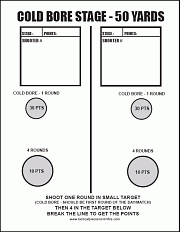


 Most of us have access to a printer at home or at work. That means you can print your own targets. You’ll find hundreds of free target designs online, including dozens of downloadable targets on our


