Have you ever seen bullet trace? Do you know how to read trace? Well watch this NSSF video to learn how to recognize trace, and use trace to help adjust your aim on the target. Watch the video from 1:50 to 2:20 to see trace in slow motion. Watch carefully starting and you can see the trace in the milli-seconds before the bullet hits the target.
Rod Ryan of Storm Mountain Training Center explains how to read bullet trace: “If you’re looking through your spotting scope, and you focus on your target, and then back off about a quarter-turn counter-clockwise (in most cases) you’ll be able to focus a little closer to you and you’ll actually see this movement of air — it’s called the trace — going down range.”
Watch the Slow-Mo Trace Starting at 1:50. From 2:10 to 2:20 you can actually see the bullet hanging in the air just before it hits the target.
Trace is easier to see when there’s some moisture in the air. By following the bullet trace you can see if you shot is running high or low, left or right, even if you can’t see a shot imparct on the target. This is important, particularly when you’re attempting an steep-angled shot and it’s hard to see bullet impact on the ground near the target. Rod Ryan explains: “A lot of times we have an angular hill-top and you’re shooting directly into a [steep] drop [so] you can’t see any splash at all or any dirt flow after the miss happens. In this case the last thing you see is that trace.”
What you’re seeing is akin to the wake that forms behind a motorboat, but it is a trail of disturbed air rather than disturbed water. Ryan says: “It’s just like you’re looking down from space at a motorboat in the water, you can see that wake. Very close to the target, you can actually see it roll in… if you’re taking a shot at say… four, five, six hundred yards, it’s very prevalent, you can see it very well.”
Video find by EdLongrange. We welcome reader submissions.
At the request of our readers, we provide select “Deals of the Week”. Every Monday morning we offer our Bargain selections. Here are some of the best deals on firearms, hardware, reloading components, and shooting accessories. Be aware that sale prices are subject to change, and once clearance inventory is sold, it’s gone for good. You snooze you lose.
The LabRadar is the most advanced chronograph on the market. When it was first released, you had to wait months to get one of these Doppler Radar units. Now they are in-stock and ready to ship at Bruno Shooters Supply for $559.95. Once you learn how to position and adjust the LabRadar, you should find the machine reliable and versatile. We do recommend getting a separate battery pack. If you are considering purchasing a LabRadar Chronograph, we strongly suggest you read the very thorough and informative LabRadar Review by Ray Gross, Captain of the USA F-TR team.
2. CDNN — ANSI Z87.1-Approved Safety Eyewear, $1.35 Each
You won’t find a better deal on name-brand ANSI Z87.1-approved safety glasses. Choose from Pyramex, Radians, or Winchester brands on sale now at CDNN Sports. We have used Pyramex safety eyewear for years. These are lightweight, comfortable and fairly rugged. The Radians Maverick features a stylish silver frame, while the Winchester eyewear features wrap-around amber lenses.
3. Eurooptic.com — Leupold VX-6 Scope Super-Sale
Eurooptic.com has received hundreds of brand-new Leupold VX-6 riflescopes, and will sell them at very deep discounts. Leupold’s VX-6 line spans 15 models, all with 6:1 zoom magnification ranges. From the 1-6x24mm CDS optic to the impressive 7-42x56mm Side Focus Target model, you can find a VX-6 for virtually any rifle application. And now you can save hundreds by purchasing overstock VX-6s on sale.
Benchrest Matches have been won (and many records set) with 36X Weaver T-Series optics. Our friend Boyd Allen observed “You can pay three or four times as much for a scope but not necessarily be more competitive — a 36X front objective Weaver is enough to win with…” The Classic T-Series Weaver has proven to be one of the most reliable high-magnification scopes ever made. The “old-fashioned” adjustable objective works well and the Weaver Micro-Trac turret system delivers precise and repeatable elevation and windage control. Now just $369.99 at Natchez, this is a great deal.
5. Able Ammo — 247 Rounds .223 Rem, HP Bullets
Here you go — instant varmint safari. This Hornady-made .223 Rem ammo features quality hollowpoint bullets, rather than the not-so-accurate FMJ bullets with most bulk .223 ammo. This stuff is much more accurate (with lower ES/SD) than other low-priced ammo. Users report sub-MOA accuracy with this stuff. If you’re planning a varmint safari this spring but don’t have the time (or gear) to reload, pick up a couple boxes of this stuff and you’re good to go. There are 247 rounds in each polymer ammo “can”. This ammo usually comes loaded with Hornady’s XTP (eXtreme Terminal Performance) bullets which work great on varmints.
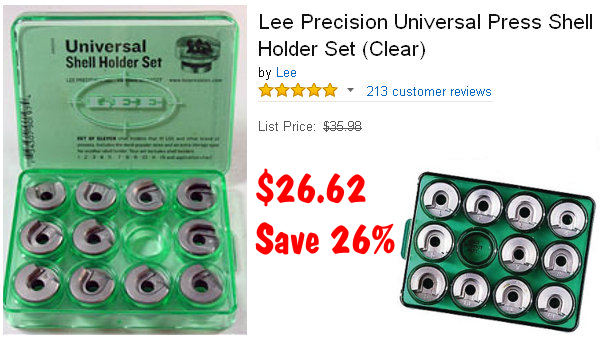
6. Amazon.com — Lee Universal Shell Holder Set, $26.62
Every hand-loader needs one of these Lee Universal Shell Holder Sets. The kit contains 11 shell-holders for most popular rifle and pistol cartridge types. This editor bought one of these kits 25 years ago, and I still use it every week. It’s nice having one, compact container that has every shell-holder I need for both pistol and rifle cartridges. Even if you prefer more expensive Redding shell-holders, this 11-piece kit serves as a valuable back-up. Right now the Shell Holder Set is on sale at Amazon.com for $26.62, with free shipping for Amazon Prime members.
This is quality, CCI made-in-USA ammo with reloadable, brass casings. We have used this CCI-made Blazer 9mm ammo in Sig, HK, and Glock pistols and it performed very well. This stuff won’t last long at this price (less than $0.20 per round). If you need 9mm practice ammo, order soon — this very same 1000-round case of Blazer 9mm ammo costs $60.00 more at MidwayUSA. Blazer Brass is loaded in boxer-primed, reloadable brass cases for added value.
Happy New Year to all our readers worldwide, and especially the nearly 34,000 members of our AccurateShooter Forum. We hope 2017 brings you happiness in your lives and success in your endeavors. And we wish for small groups, good scores, and successful hunts in the New Year.
We upgraded our site in the beginning of 2016, making our Forum mobile-friendly with new faster, more modern software. We hope you’ll continue to enjoy our feature articles, our Daily Bulletin, our match reports, and our Free Forum Classifieds. The formula seems to be working — our audience is bigger than ever and it just keeps growing, with over 550,000+ unique users visiting the site every month.
Forum Membership Grows 14% in 2016
Our Shooters’ Forum grew significantly in 2016. Our membership grew by over 14% as Forum ranks swelled to nearly 34,000 members! More people are successfully buying and selling in our FREE Forum Classifieds section than ever before. Remember, user donations help make our Free Classifieds possible.
Join our Shooters’ Forum Community — 34,000 Strong
Site is Modern and Mobile-Friendly!
We need your support. For over 13 years the site has relied largely on volunteer efforts by dedicated shooters. But as the site grows, serving a larger audience, we need the assistance of freelance writers and video producers, plus help from expert computer and software techs. Those guys don’t work for glory alone.
Consider this — what do you pay for a couple of movie tickets these days? Maybe 20 bucks for 90 minutes of escapism. For around two bucks a month ($20-$25 per year) you can help this site provide a YEAR’s worth of info, tests, tech tips, bargains, and shooting news.
In the past quarter of 2016 about 190 site users have donated. We thank all those who have generously contributed. But that still leaves tens of thousands of users who access the site regularly without contributing. With more donations we can deliver more premium content and offer more services to our members.
Here’s our proposal. First, if you have used our FREE Classifieds to successfully sell your rifles or shooting gear, consider sending in $10.00 from your sale proceeds. Second, for those who use the site regularly, consider donating $20 for the year. That will help us sustain our operations, for the cost of couple of movie tickets (or one large pizza).
How to Contribute
Making a donation to the site is simple and easy. Just click on the orange “Donate” button at right. If you have a credit card, you don’t need a Paypal account to contribute. Any sum is welcome — with $20 the average annual donation.
Help Support this Site by Making a Secure Donation.
If you don’t like Paypal, you can send a check. Make the check payable to our “Answerman” Jeff Williams. Please list your Forum Log-In Name (if any), and mail the check to:
Jeff Williams
P.O. Box 240
Solon Springs, WI 54873
What do you get when you cut a 6.5 Creedmoor-chambered barrel down to just over 16 inches? A lot more velocity than you might think. Our friends at Rifleshooter.com recently did a barrel cut-down test with 6.5 Creedmoor test rifle, shortening the barrel from 27 to 16.1 inches in one-inch increments. Surprisingly, with a 142gr Sierra MK, the total velocity loss (as measured with a Magnetospeed) was just 158 FPS, an average of 14.4 FPS per inch of barrel length. With the lighter 120gr A-Max bullet, the total velocity loss was 233 FPS, or 21.8 FPS average loss per inch of barrel.
Test Procedure
Five (5) rounds of each type of cartridge were fired at each barrel length and the velocity data was recorded with a MagnetoSpeed V3 barrel-mounted chronograph. The rifle was then cleared and the barrel was cut back one inch at a time from 27″ to just over 16″. NOTE: During this winter test, the air temperature was a very chilly 23° F. One would expect higher velocities across the board had the outside temperature been higher.
The photo below shows how the barrel was cut down, inch-by-inch, using a rotary saw. The barrel was pre-scored at inch intervals. As the main purpose of the test was to measure velocity (not accuracy) the testers did not attempt to create perfect crowns.
6.5 Creedmoor vs. Other Mid-Sized 6.5mm Cartridges
The 6.5 Creedmoor is a very popular cartridge with the tactical and PRS crowd. This mid-size cartridge offers good ballistics, with less recoil than a .308 Winchester. There’s an excellent selection of 6.5mm bullets, and many powder choices for this cartridge. When compared to the very accurate 6.5×47 Lapua cartridge, the 6.5 Creedmoor offers similar performance with less expensive brass. For a tactical shooter who must sometimes leave brass on the ground, brass cost is a factor to consider. Here’s a selection of various 6.5 mm mid-sized cartridges. Left to right are: 6.5 Grendel, 6.5×47 Lapua, 6.5 Creedmoor with 120gr A-Max, 6.5 Creedmoor with 142gr Sierra MK, and .260 Remington.
When asked to compare the 6.5 Creedmoor to the 6.5×47 Lapua, Rifleshooter.com’s editor stated: “If you don’t hand load, or are new to precision rifle shooting, get a 6.5 Creedmoor. If you shoot a lot, reload, have more disposable income, and like more esoteric cartridges, get a 6.5×47 Lapua. I am a big fan of the 6.5×47 Lapua. In my personal experience, the 6.5×47 Lapua seems to be slightly more accurate than the 6.5 Creedmoor. I attribute this to the quality of Lapua brass.”
Our friend Kirsten Joy Weiss has just released a useful video that shows how to refine your trigger control for better accuracy. In this video, Kirsten talks about the actual placement of a shooter’s index finger on the trigger. It is important to have the finger positioned optimally. Otherwise you can pull the shot slightly left or slightly right.
Kirsten tells us: “Finger placement on the trigger might not seem like a big deal, but it actually is. The reason for this is because, depending on where your index finger is placed on the trigger, [this] translates to different muscle interactions with the gun.” Watch this video to see Kirsten demonstrate proper finger placement (and explain problems caused by improper finger positioning).
Here Kirsten Illustrates how the index finger should be aligned along the face of the trigger shoe.
When you pull the trigger, you only want to engage the last section of your finger, in order to avoid unwanted muscle engagement and to achieve a smooth shot.
Remember there is a “sweet spot” between the crease (first joint) and the tip of the finger. If you position the trigger in that “sweet spot”, you should see an increase in your accuracy. Don’t make the mistake of putting the trigger in the crease of your finger, as shown below.
Effects of Incorrect Finger Placements
You want to place the trigger shoe between the end of your finger and the first joint. If you place the trigger on the very tip of you finger you’ll tend to push the rear of the rifle to the left when engaging the trigger, causing shots to go right (for a right-handed shooter). On the other hand, if you put the trigger in the crease (first joint), you’ll tend to bring the rear of the rifle to the right, causing shots to fall left. This is illustrated below for a right-handed shooter.
At the request of many Forum members, we’re reprising this archived video from past IBS 600-yard Shooter of the Year Samuel Hall. Without a doubt, Sam is one of the best mid-range benchrest shooters in the nation. While the video quality is rough (to say the least), Sam’s offers plenty of tips you can “take to the bank”. Even if you don’t shoot competitively, the techniques described here can improve your accuracy when shooting from a bench.
2008 IBS 600-yard National Champion Samuel Hall has prepared a 9-minute VIDEO showing his techniques for shooting from the bench. Sam covers a number of topics including bag set-up, body position, bolt manipulation, and loading skills. He also explains the importance of having a relaxed, comfortable posture and keeping your head in the same position shot to shot.
If you’re serious about accurate benchrest shooting, at ANY distance, you should watch this video. Sam’s tips can really help you. We guarantee it. While the video itself is grainy and wind noise affects the audio, you can still glean many great points from the video. From minute 8:00 on Sam shoots a 5-shot string on camera with his BAT-actioned, Leonard-stocked 6BR. Though he was fighting 20-mph winds Sam achieves a half-inch group at 200 yards. Quarter-MOA in such conditions is good shooting.
The NRA Blog has produced an interesting graphic guide to firearms function. This “How Guns Work” infographic shows the basics of bolt-action rifle operation and how a centerfire cartridge propels a bullet through a barrel during the “firing sequence”. There’s some good artistry here, with cutaway drawings letting you look inside an action and cartridge.
Enjoy this technical graphic. The NRA Blog says: “In celebration of cartridges big and small, we partnered with OutdoorHub to bring you a detailed look into how guns work. While the infographic will be most instructive to newcomers, we think avid shooters will find it interesting, too.”
Someone is going to snag a heck of a deal. As part of its End of Year Clearance Sale, Midsouth Shooters Supply is offering bulk quantities of quality Norma brass at a huge discount. Right now you can get 2000 pieces of Norma 6mm PPC or 6mmBR brass for just $798.26. You can also get twenty-five .22 PPC cases for just $11.06. There are similar discounts on other products at Midsouth, but we just had to bring this to our readers’ attention. That’s enough brass to last a lifetime. If you are thinking of building a PPC-based or BR-based varmint rifle, such as a 22BR, 2000 cases will see you through a week-long varmint safari. This brass would also make a great item for a youth program.
The Norma brass is outstanding — certainly capable of winning matches. It may not be quite as hard as Lapua brass, but it is nonetheless very high quality stuff. NOTE: This is the last day of Midsouth’s E.0.Y.C. sale, so don’t dawdle. You snooze you loose. You could pick up one of these 2000-count cartons and sell off some to your shooting buddies.
OK, you guys can now officially stop complaining about the price of rimfire ammunition. Right now Cabelas.com is offering “Holiday Packs” of 40gr CCI standard velocity LRN ammo. Price is $3.99 for 50 rounds, with no limits (until inventory is sold). If you need good, reliable plinking ammo… place your order soon. Here’s a review from a recent purchaser: “Good Deal! I ordered 40 boxes and got them all. I have already used a box and they work great! I may need to order more before they are all gone! Would you recommend this product to a friend? Yes.”
NOTE to California-based readers — you may want to stock up on affordable .22 LR ammo before the ammo-buyer licensing requirements take effect on 1/1/2018. New laws will prohibit all mail-order ammo sales for California residents.
Terms of Sale: Online Only, Do Not Call, one coupon per order.
Item number#: IK-219647; SKU#: 931GFT ($4.99); Sale Price $3.99 per 50-round box.
Here is the original Sierra manufacturing facility in Whittier, CA.
Sierra Bullets — How It Got Started
Report Based on Story by Carroll Pilant, Sierra Bullets Media Relations Manager
What became Sierra Bullets started in the late 1940s in a Quonset hut in California. In 1947, three aircraft machinists, Frank Snow, Jim Spivey, and Loren Harbor, rented machine space to produce rivets for the aircraft industry along with fishing rod guides and rifle front sight ramps. In the post-WWII years, sport shooting was becoming hugely popular, but quality ammunition was in short supply. For shooting enthusiasts, reloading was the solution to the ammo supply shortage. Snow, Spivey, and Harbor recognized this, creating Sierra Bullets to help fill the void. Before long, they were selling a 53-grain match bullet to the Hollywood Gun Shop. These bullets are still in production today as the Sierra #1400 53-grain MatchKing.
A few years later, an accomplished competitive shooter named Martin Hull joined Sierra. Hull helped develop new bullet types and served as manager of Sierra’s ballistics laboratory for nearly 20 years. With Hull’s help, Sierra’s output grew rapidly. The California company outgrew several locations before it moved to a large facility in Santa Fe Springs, CA, in 1963.
New Owners and New President in the Late Sixties
In 1968, the Leisure Group bought Sierra Bullets. Other Leisure Group companies included Lyman Reloading, High Standard Manufacturing Company, Yard Man, Thompson Sprinkler Systems, Flexible Flyer Sleds, and Dodge Trophies (Which made the Oscar and Rose Bowl Game trophies).
Soon after purchasing Sierra, the Leisure Group hired Robert Hayden as President and General Manager. Hayden was a mechanical engineer who had worked for Remington Arms. Hayden remained the president of Sierra for 42 years, retiring in 2012 when Pat Daly became president.
Sierra Moves to Missouri
In 1990, Sierra relocated to Sedalia, Missouri, where the company remains today. Sierra Bullets now employs over 100 people including five full-time ballistic technicians who answer daily reloading and firearms questions by both phone and e-mail.
The Making of MatchKings — How Sierra Produces SMKs
All Sierra bullets begin life as a strip of gilding metal, an alloy consisting of 95% copper and 5% zinc. To meet Sierra’s strict quality requirements, the gilding metal requires three times more dimensional and quality control standards than is considered standard in the copper manufacturing industry.
A blanking press stamps out a uniform disc and forms the cup that will be drawn into the MatchKing jacket. The cup is then polished and sent to a draw press to be drawn into a jacket that is longer than needed for the future MatchKing, thus allowing for the trim process. Press operators constantly check concentricity to make sure we have only quality jackets. The jackets then go to a trimmer where they are visually inspected again.
After being polished a second time, the jacket travels to the bullet press. In the meantime, 80-pound lead billets are being extruded into lead wire for the cores where great care is taken so that the core wire is not stretched. The core wire is lightly oiled before continuing to the bullet press to be swaged.
The lead core wire and trimmed jacket meet at the bullet press where the first stage forms a boattail on the jacket. The lead core is then formed on top of the bullet press and fed down into the jacket. In one stroke of the press, the MatchKing is formed.
Quality control technicians pull samples from each lot of MatchKings to make sure they meet Sierra’s stringent standards. Samples are then sent to Sierra’s 300-meter underground test range (shown below) to be shot for accuracy on mechanical mounts referred to as “unrestricted return to battery rests” that Sierra designed and built in-house.
After inspection, the bullets are placed in the familiar green box along with reloading labels. They are then shrink-wrapped and shipped all over the world.


 Have you ever seen bullet trace? Do you know how to read trace? Well watch this NSSF video to learn how to recognize trace, and use trace to help adjust your aim on the target. Watch the video from 1:50 to 2:20 to see trace in slow motion. Watch carefully starting and you can see the trace in the milli-seconds before the bullet hits the target.