Here’s a very clever way to store firearms securely. All an intruder will see is an innocent-looking wall mirror. But behind that artifice is a gun cabinet that will hold a rifle or shotgun, a pistol and more. For added security, the firearms in the cabinet are clamped by a rapid biometric locking system that releases the guns only for authorized users.
The patent-pending NRA Home Defense Cabinet is a covert gun cabinet featuring a sliding mirrored front and proprietary biometric securing system. The Cabinet is offered in both dual-firearm and single-firearm configurations. Slide open the cabinet and you can see the guns, securely clamped in place. When an authorized user successfully engages the biometric system, your firearms are unlocked and ready for use. The discrete cabinet doesn’t communicate “guns inside” like a bedside handgun safe. Also, the simple-looking mirror offers nothing to attract the attention of intruders or children.
The interior of the NRA Home Defense Cabinet Features a proprietary biometric locking system.
The NRA Home Defense cabinet is offered in a one-gun version (rifle/shotgun) for $750.00, or a two-gun version for $995.00. There is also a manual lock two-gun version for $549.00. Since this product is recessed into a wall, you also have to figure on installation costs. But if you are building a new house, this is an interesting new security option worth considering.
The U.S. Army has selected variants of the SIG Sauer P320 pistol to replace the venerable M9 pistol from Beretta. The Army will purchase the new 9mm striker-fired SIG handgun, designated the XM17, in both compact and full-size versions. The Army will purchase a minimum of 280,000 handguns, with options for another 212,000. This represents a huge contract, worth $580,000,000 through budget year 2027. According to American Rifleman: “The XM17 will likely lose the ‘X’ and be made by American workers in an American factory for American soldiers.”
In adopting the new SIG XM17, the U.S. Army has chosen its first new handgun in three decades. The lengthy Modular Handgun System (MHS) selection process took two years and $17 million, with twelve different candidates vying to be chosen as the Army’s new sidearm. SIG Sauer triumphed over other major pistol-makers (including Beretta, CZ, Glock, FNH, and S&W), by best fulfilling a complex set of requirements. According to Popular Mechanics: “The bureaucracy surrounding the M17 Modular Handgun System contract was oppressive. The Army’s Final Solicitation document, which spelled out the terms of the competition, was whopping 351 pages long. Senator John McCain of Arizona described the rules as ‘byzantine.’ Then-Secretary of Defense Robert Gates complained, ‘This is absurd — it’s a handgun for God’s sake’.”
The Army’s new XM17 is fully ambidextrous, with safety and slide release levers on both sides. Importantly, unlike Glock pistols, the new SIG XM17 can be taken down without pulling the trigger. In accordance with the XM17 design protocols, the new SIG features a front Picatinny rail for accessories, as well as interchangeable grip panels to fit various hand sizes. There will be threaded barrel options for use with a suppressor. The Army’s selection of the SIG Sauer XM17 was announced this past week at SHOT Show in Las Vegas.
The big news at Nightforce’s SHOT Show booth was a new First Focal Plane (FFP) ATACR with a five times zoom range. The new 7-35x56mm ATACR offers tactical and long range shooters the ability to go from a wide field of view at seven power, all the way up to very high 35X magnification. That makes this one scope that can truly “do it all” — from short-range moving targets to 1000 yards and beyond.
With a fat 34mm main tube, the 39.3 ounce 7-35x56mm ATACR offers 60 MOA of windage adjustment and a whopping 100 MOA of total elevation adjustment. The elevation turret includes a ZeroStop. Nightforce notes: “With parallax adjustment down to 10 meters and 100 MOA of elevation travel, precision is attainable from short range distances to … extreme long range[.] This riflescope offers an incredible field of view across the entire magnification range[.].”
The new 7-35X ATACR is offered with either 1/4 MOA or 0.1 Mil click values and three reticle choices: Mil-R F1, MOAR F1, TReMoR3 F1. The illuminated MIL-R and MOAR reticles are shown below. Note that the MOAR offers 80 MOA of hold-over below center.
Here is AccurateShooter’s Forum Boss with the Ruger Precision Rifle (RPR). The commercial success of this innovative firearm inspired other gun-makers to release their own “blacktical” bolt-guns.
It looks like 2017 will be the year of the metal-stocked, tactical-style bolt-action rifle. Inspired by the success of the Ruger Precision Rifle, other rifle-makers have built their own Blacktical Bolt-guns. These feature modular chassis systems with adjustable buttstocks. While optimized for PRS and tactical competition, these tough, versatile rifles can also be used for hunting. Popular chamberings are: 6mm Creedmoor, 6.5 Creedmoor, .260 Rem, and .308 Winchester. All the rifles showcased here retail for under $2000.00, so they can be campaigned in the new PRS Factory Class.
PRS Production Class Cost Limits
Production Division combined rifle and scope MSRP as listed on the company’s website shall not exceed $3,000 USD, the rifle shall not exceed $2,000 USD and the optic not exceed $2,000 USD. [Editor: For example, you could have a $2,000 rifle with a $1000.00 scope or vice-versa. The total system cannot exceed $3000. Rifle alone cannot exceed $2000.00 retail sale price.] Production Division rifles are not permitted to be altered or improved in any way from the original factory configuration.
Bergara B14 BMP Chassis Rifle
The Bergara B14 rifle features a modern, modular aluminum chassis. The buttstock assembly offers an adjustable comb and adjustable length of pull. Like Savages, the BMP employs a barrel nut so owners can quickly swap barrels. The new B14 features a good adjustable trigger. Current chamberings are 6.5 Creedmoor and .308 Winchester (both fed from AICS-type box mags). Our friends Ed and Steve (aka the 6.5 Guys) were impressed with the new Bergara: “Bergara has in-sourced chassis and triggers to produce very high-quality offerings at a very competitive price. Handling, shooting and cycling the bolt on the $1150 MSRP Hunting and Match Rifle would lead one to believe the price tag was a mistake (maybe the first digit should have been a 2). We felt the same when we got behind the $1,699 Bergara Match Precision Rifle.”
Howa HCR Modular Rifle
The new Howa HCR Chassis Rifle combines a Howa 1500 barreled action with a modern aluminum chassis and LUTH-AR MBA-3 stock. Length of pull is adjustable from 12.5″ to 16.75″. Comb height is also adjustable. Weight with a 24″ barrel is 10.2 pounds (before optics) so the Howa HCR is lighter that many of its competitors. The Howa’s MSRP is $1299.00, a good value in this category. These guns feature a smooth-running action plus excellent 2-stage HACT adjustable trigger. Available chamberings are: .223 Remington, .243 Winchester, 6.5 Creedmoor, and .308 Winchester. NOTE: If basic black’s not your color, this rifle is also offered with a rugged, Multicam CeraKote finish.
Tikka T3X TAC 1
We got a chance to handle the impressive new Tikka T3X TAC 1 at Media Day at the Range. The ergonomics are good and the rifle balances well. Bolt cycling is smooth and the T3X boasts an excellent, adjustable 2-stage trigger. The Tikka T3X has a nice folding stock, and the T3X accepts other AR-platform buttstock units and pistol grips. The T3X will be offered with choice of 16″, 20″, or 24″ barrels, all threaded at muzzle (factory muzzle brake is standard). There are three chamberings: 6.5 Creedmoor, .260 Remington, and .308 Winchester. MSRP is $1899.00, so the T3X is legal for PRS Production Class. We really liked the Tikka T3X, and so did GunsAmerica.com: “Chambered in 6.5 Creedmoor or .260 Remington, the barrel is a perfect balance of being thick enough to shoot seriously, while thin enough not to feel like a benchrest gun. It ships with three magazines, which is a bargain for anyone looking to shoot PRS. I see lots of guns at SHOT Show I want to test or review, but few I would write a check for in the booth. The Tikka T3 TAC A1 is an exception to that rule.”
Weatherby Vanguard Modular Chassis
Weatherby’s new Vanguard® Modular Chassis (VMC) rifle features a Modular Driven Technologies (MDT) aluminum stock, Luth AR MBA-1 buttstock, and 22″ heavy barrel. The Weatherby Vanguard action is fitted with an adjustable 2-stage trigger. Priced at $1519.00 MSRP, this rifle is offered in three chamberings: .223 Rem, 6.5 Creedmoor, and .308 Winchester.
Winchester Repeating Arms XPC
As reported in the NRA Blog: “The XPC Rifle from Winchester Repeating Arms is a full-house precision chassis rifle based on their proven XPR bolt action. The stock features a Cerakoted fully-machined alloy chassis frame paired with a Magpul PRS Gen III stock. A full-length Picatinny rail allows for mounting optics, and M-LOK and QD mounts grace the XPC for easy attachments. A Magpul MOE-K grip rounds out the furniture, and the rifle comes bundled with one 10-round Magpul AICS PMAG and one five-round MDT metal mag.” The barrel is threaded for muzzle brake or suppressors.
With the Berger Southwest Nationals coming up soon (Feb. 6-12), we thought we would share some tips from a past Champion who really knows the Ben Avery range in Phoenix. In 2015, Bryan won the F-TR Mid-Range AND Long-Range National Championships hosted at Ben Avery. And at the 2014 Berger SW Nationals (SWN), Bryan took top honors among all sling shooters. If you only know Bryan Litz from his Applied Ballistics Books and DVDs, you may not realize that this guy is a great marksman (along with being an actual rocket scientist). This guy can shoot.
Given his impressive track record at Ben Avery, we asked Bryan if he had any advice for other long-range competitors. First Bryan provided three tips concerning Ballistics, his special area of expertise. Next Bryan offered three more general tips about long-range competition — how to analyze your shooting, how to choose your ‘wind strategy’, and how to avoid the most costly mistakes, i.e. how to avoid the “train-wrecks”.
Here is the sleek F-TR Rig Bryan Litz used to win the 2015 F-TR Mid-Range and Long-Range Championships at Ben Avery:
Litz Ballistics Tips
Ballistics TIP ONE. If you’re having trouble getting your ballistic software to match actual drops, you need to look at a number of possible reasons. Here are some common issues that can cause problems.
Click Values Are Not Exact. Scopes and iron sights don’t always produce accurate adjustments. In other words, if your ballistics program predicts 30 MOA of drop, and you dial 30 MOA but hit low, it might be that your sight actually only moved 28 MOA (for example). To see if your sight is adjusting accurately, shoot a tall target at 100 yards and measure group separation when dialing your sight.
Barometric vs. Station Pressure. This is a commonly misunderstood input to ballistics programs. You can avoid this pitfall by remembering the following: station pressure is the actual measured pressure at your location, and you don’t need to tell the program your altitude when using station pressure. Barometric pressure is corrected for sea level. If you’re using barometric pressure, you also have to input your altitude.
Muzzle Velocity. Chronographs are not always as accurate as shooters think they are — your true MV may be off by 10-20 fps (or more). If your drop is different than predicted at long range, it might be because your muzzle velocity input is wrong.
Mixing Up BC (G1 vs. G7). Knowledgeable long range shooters know that the G7 standard is a more representative standard for modern LR bullets. However, using G7 BCs isn’t just a matter of clicking the ‘G7′ option in the program. The numeric value of the BC is different for G1 and G7. For example, the G1 BC of the Berger 155.5 grain Fullbore bullet is .464 but the G7 BC is .237. If you were to enter .464 but click on G7, the results would be way off.
Ballistics TIP TWO. A properly installed level is absolutely essential for long range shooting. Without a good level reference, your long range wind zero will be off due to minor canting of the rifle from side to side. You can verify that your level is installed correctly on a 100-yard ‘tall target’. Draw a plumb line straight up the target and verify that your groups track straight up this line as you go up in elevation.
Ballistics TIP THREE. If your long range ballistic predictions aren’t tracking, always come back and verify your 100-yard zero. Sometimes a simple zero shift can be misconstrued as errors in long range ballistics predictions.
Litz Competition Shooting Tips
Competition TIP ONE. Improving your scores in long range competition is a constant process of self-assessment. After each match, carefully analyze how you lost points and make a plan to improve. Beginning shooters will lose a lot of points to fundamental things like sight alignment and trigger control. Veteran shooters will lose far fewer points to a smaller list of mistakes. At every step along the way, always ask yourself why you’re losing points and address the issues. Sometimes the weak links that you need to work on aren’t your favorite thing to do, and success will take work in these areas as well.
Competition TIP TWO. Select your wind shooting strategy carefully. For beginners and veterans, most points are typically lost to wind. Successful shooters put a lot of thought into their approach to wind shooting. Sometimes it’s best to shoot fast and minimize the changes you’ll have to navigate. Other times it’s best to wait out a condition which may take several minutes. Develop a comfortable rest position so you have an easier time waiting when you should be waiting.
Competition TIP THREE. Actively avoid major train wrecks. Sounds obvious but it happens a lot. Select equipment that is reliable, get comfortable with it and have back-ups for important things. Don’t load on the verge of max pressure, don’t go to an important match with a barrel that’s near shot out, physically check tightness of all important screws prior to shooting each string. Observe what train wrecks you and others experience, and put measures in place to avoid them.
“Must-Watch” SWN Video has aerial view of Ben Avery plus highlights from Saturday
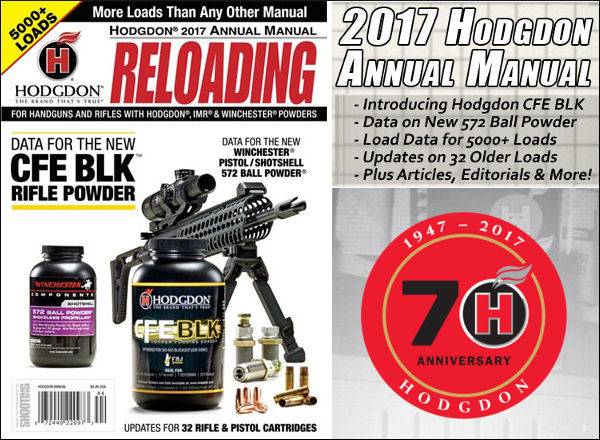
If you spend money on any gun-related print publication this spring, we recommend you pick up the Hodgdon 2017 Reloading Manual. Available for just $6.99 at Midsouth, the 2017 Reloading Guide contains new load data for Hodgdon’s latest powder offerings, including new CFE BLK rifle propellant. This guide also contains important load updates for 32 rifle and pistol cartridges. Along with over 5000 load recipes, the 2017 Hodgdon Reloading Guide features many informative “how-to” articles that can help you achieve the best results with your hand-loads.
70 Years of Hodgdon Powder
This year Hodgdon celebrates its 70th Anniversary. At SHOT Show 2017 we had a chance to talk with Chris Hodgdon. Chris was proud to note that his family-owned company is now marking its 70th year in business. The company has been very successful, but sometimes that means supply can’t catch up with demand. Our Forum members often ask about the availability of Hodgdon H4350 powder, which is extremely accurate and also temp-stable. Chris said: “Getting more H4350 to our customers is one of our top priorities. With the booming popularity of the 6.5 Creedmoor and other similar cartridges, there is a lot of demand for that powder.”
We also discussed the continued popularity of Varget, which has become more readily available in recent months. You can find even find the Varget 8-lb jugs now at Midsouth. Chris said that Varget users may also want to try IMR 8208 XBR. Chris observed: “I think IMR 8208 XBR is one of the very best powders we make. It is accurate, temp-stable, and it meters very well because the kernels are very small. The guys who try 8208 have been very happy.”
We concur with Chris — we’ve used 8208 XBR in a .308 Win and it shot exceptionally well. It is definitely “match-ready” powder for cartridges that like a medium burn-rate powder, such as the .308 Winchester, 7mm-08, and 6mmBR Norma.
Digital editions of the four issues of SHOT Daily, the magazine printed each day of the SHOT Show, are available free in convenient Web eZine formats. Three web issues are available right now, and the fourth issue will be released later today (Friday, 1/20/17). You’ll find many product features plus articles that can benefit shooting club directors and range managers. Definitely check out the Day One Issue’s extensive coverage of new-for-2017 firearms. SHOT Daily is produced for NSSF by Bonnier Corp., publishers of Outdoor Life, Field & Stream, and many other magazines.
Highlights Day 1: New Savage MSR (AR type) rifles, New Firearm Roundup, Exhibitors.
Highlights Day 2: New Products Reports, New Optics, New Ammunition.
Highlights Day 3: New Products Reports, Savage Rimfire, Knives, Accessories
Kirsten Joy Weiss has created a useful video about Dry-Fire practice. Dry-Fire is a method of training without a live round in the chamber. Dry-Firing is effective, Kirsten explains, because “it eliminates all the extra noise and messages that you get when you fire a live round. Without recoil, without the sound of a shot going off etc., all you hear is the click of the trigger. This allows you to focus on your sight picture and your trigger press.” This the lastest installment in Kirsten’s ‘How to Shoot Awesomely’ series. Kisten says: “I hope it helps you, and keep on aiming true!”
The Benefits of Dry-Fire Training
If you are not doing Dry-Fire practice yet, then it’s time to start. Dry-Fire training is essential to the sling disciplines, and very useful for F-Class. Dennis DeMille, a national Service Rifle Champion, told us that, for every minute he spent in actual competition, he would spend hours practicing without ammunition. While in the USMC, Dennis would practice in the barracks, working on his hold and dry-firing:
“The most important thing is to spend time off the range practicing. Most of what I learned as a High Power shooter I learned without ammunition — just spending time dry firing and doing holding exercises. Holding exercises will really identify the weak parts of your position. The primary purpose of dry firing is to get you used to shooting an empty rifle. If you can shoot a loaded rifle the same way you shoot an empty rifle then eventually you will become a High Master.”
Dry-Fire Training Can Benefit Benchrest Shooters
What about benchrest? Well, we’ve found that Dry-Fire sessions can even benefit benchresters — it can help reveal flaws in your trigger technique, or inconsistencies in the way you address the rifle from shot to shot. With the gun set up with your front rest and rear bag, if you see the scope’s cross-hairs wiggle a lot when you pull the trigger, you need to work on your technique. Also, dry-fire practice can help you learn to work the bolt more smoothly so you don’t disturb the gun on the bags.
SHOT Show is a cornucopia of products, with everything gun-related under the sun on display. The SHOW features a vast array of items for hand-loaders. Here are some of the most notable reloading and ammunition products we found at SHOT Show, Wednesday, January 18th.
Alliant Reloder 16 — Great Powder — Accurate and Temp-Stable
If you like Hodgdon H4350, you should like Alliant’s Reloder 16 powder. First revealed at SHOT Show 2016, the impressive Reloder 16 is now widely available at vendors nationwide. This advanced-formulation powder is extremely temp stable. We confirmed that during hot weather testing sessions last summer. In addition, in mid-sized match cartridges such as the 6XC, 6mm Creedmoor, 6.5×47 Lapua, and 6.5 Creedmoor this powder has shown impressive accuracy. No hype — our Forum guys who’ve used Reloder 16 have told us this stuff can deliver match-winning results. This is definitely a viable rival to H4350. We recommend you buy a pound and test it.
Reloder 16 is NOT just a slower version of Alliant’s double-based Reloder 15 (which words great in the 6mmBR and Dasher cartridges). Reloder 16 is a completely new formulation, produced in Sweden by Bofors for Alliant. Reloder 16 utilizes TZ technology, which resists the natural tendency to generate more pressure at higher temperatures and less pressure at lower temperatures. Based on the test results we’ve seen, if you are using H4350 or IMR 4451 currently, you should definitely give Reloder 16 a try. The powder also boasts excellent lot-to-lot consistency and contains a proprietary de-coppering additive.
Lapua 6.5 Creedmoor Brass
The 6.5 Creedmoor has been “all the rage” at SHOT Show 2017. This cartridge, a proven winner in PRS competition, is riding a huge wave of popularity right now. There are many great factory rifles now offered with this chambering. And now we have superb Lapua 6.5 Creedmoor brass. You read that right Lapua is now producing ultra-premium 6.5 Creedmoor brass that will “raise the bar” for this cartridge. Lapua’s new brass features a small primer pocket and small flash hole (just like Lapua’s superb .220 Russian, 6mmBR, and 6.5×47 Lapua brass). This small primer pocket design can deliver longer brass life, and (potentially) enhanced velocities. We predict serious 6.5 Creedmoor shooters will be switching to this brass as soon as it becomes available later this year. NOTE: The new Lapua 6.5 Creedmoor brass can also be easily necked down for the 6mm Creedmoor.
New RCBS ChargeMaster Lite
RCBS unveiled a new, more affordable electronic powder scale/dispenser system. Called the ChargeMaster Lite, this new-for-2017 unit has some features we really like. The touch screen is easy to use and the power tray cover slips off easily — no more hinges to fight. Most importantly the CM lite has a redesigned, fluted dispensing tube which delivers powder kernels is a smooth flow with no clumps. The RCBS Rep told us “No more McDonald’s straw required”. We tested the unit and it does seem like the newly-designed dispensing tube is better. In fact, this new design will be adapted to the next generation of larger ChargeMasters.
Here is the RCBS Press Release: “The new RCBS ChargeMaster Lite packs unparalleled powder-measuring accuracy in a compact package. The one-piece unit features an LCD touchscreen display that ensures accurate data input. The hopper holds nearly a pound of smokeless powder, and can dispense anywhere between 2 to 300 grains with a +/-0.1-grain accuracy. The ChargeMaster Lite is an effective, accurate powder-measuring tool. Featuring 120/240 switching power supply, the ChargeMaster Lite is EU/UK/AUS compliant, includes a cleaning brush and two calibration/check weights and has an MSRP of $299.99.”
22 Nosler Brass and Ammunition
Here’s a new higher-capacity cartridge designed for folks who want to step up from the .223 Remington in their AR-platform rifle. Nosler has created a new SAMMI-spec cartridge which is similar to a 6.8 SPC necked down to .224 caliber. Nosler says the .22 Nosler cartridge will deliver significantly more velocity* than a .223 Remington, when shooting the same weight/type of bullet. For varminters using AR-style rifles, that’s a significant performance gain. We hope to test the 22 Nosler this spring in the varmint fields. This little round should definitely out-perform the standard .223 Rem cartridge while still operating from a standard AR platform, using the same bolt carrier group but with different, 6.8 SPC magazines.
Nosler explains: “Retrofitting a standard AR-15 chambered in .223 Rem / 5.56 NATO to a 22 Nosler is simple. All that is required is a simple barrel swap to the new 22 Nosler chambering, run 6.8 Remington SPC magazines instead of 5.56 magazines and the swap out is complete. Approaching 22-250 velocities in a significantly smaller package, the 22 Nosler® yields nearly 25% more capacity than the 223 Rem/ 5.56 NATO making the round capable of pushing a 55gr Nosler Ballistic Tip bullet at 3,350 fps out of an AR-15 fitted with an 18″ barrel and a 77gr Custom Competition® bullet at 2,950 fps.”
*When Nosler’s listed 22 Nosler velocities for 55gr and 77gr bullets are compared with .223 Rem maximum loads from Hodgdon load manuals, it looks like the speed gains with the 22 Nosler are 250-300 FPS, or about ten percent.
Bring the Bling, Baby! This Desert Eagle Mark XIX features a highly polished Gold-Tone Titanium Tiger Stripe finish. Conspicuous Consumption, SHOT Show Style.
There were literally thousands of handguns on display at SHOT Show, most of which you could hold, cycle, and test the trigger pull. Among the hordes of handguns, we found some very eye-catching examples, such as the Gold-tone Titanium plated “Tiger Stripe” Desert Eagle above. Just what a Rap Star or Tin-Pot Dictator needs. Below are some other interesting handguns we saw at SHOT Show 2017
Ed Brown Signature Edition Engraved 1911
This Ed Brown Signature Edition Model 1911 boasts elaborate engraving over the entire slide and frame. The blueing is rich and deep (the photo does not do it justice). This is not an “entry-level” handgun, that’s for sure — the wholesale “dealer price” is a whopping $6,156.00. Expect to pay well over $7000.00 at retail. Beauty ain’t cheap.
Smith & Wesson Performance Center 9mm Revolver with Hogue Mods
This handsome S&W Performance Center 9mm revolver features a beautiful Cocobolo and Walnut grip along with a special speed lever for the cylinder release. That speed lever assists rapid reloading of the pistol with moon clips. This kind of revolver is used in action shooting matches, such as the Bianchi Cup.
Best of the Old West — A Slew of Schofields
At the Taylor & Company booth, there were hundreds of single action revolvers on display. Here is a brace of top-break Schofields. This design features a hinge at the front of the frame which allows rapid unloading. Based on the original S&W Model 3, the “Schofield” model was named after Major George W. Schofield, who modified the original Model 3 to better serve the needs of Cavalrymen. Smith & Wesson incorporated the Major’s mods into an 1875 design that now bears Major Schofield’s name. S&W Model 3 Schofield revolvers saw service in the Indian Wars, and they were popular with legendary lawmen and outlaws in the American West (including Jesse James).
9mm 1911 — Havoc Dan Wesson Elite with Angled Reflex Sight
We like 1911s, and we like the 9mm Luger cartridge for its affordability and low recoil. Put the two together and you have a very accurate, shootable package, with a superb trigger. This bad-ass 9mm 1911 is a Dan Wesson Elite Series Havoc. It caught our eye because it boasts a C-MORE SlideRide red dot Reflex Sight mounted at an angle on the left side of the slide. Clever design — that gives you the advantage of the Red Dot Sight, with a lower profile. The Havoc, which sells for $4,299.00, is also offered in .38 Super.
Taurus Spectrum — A Pastel Pistol Fashion Statement
Apparently small carry guns have become fashion items. Tauras displayed its new .380 ACP Spectrum pistol in a rainbow of frame/grip color combinations. Along with white frame and blue grip, there were gray/tan, gray/green, gray/red, and gray/blue versions. Taurus really does deliver a spectrum of colors…
Double Trouble — Two Super-Sized Revolvers
At the Smith & Wesson booth, one visitor showed off two mega-sized S&W Performance Center hunting revolvers. These jumbo S&W500™ wheelguns, chambered for the mighty 500 S&W Magnum cartridge, feature massive 10.5″ barrels plus muzzle brakes. Overall length is 18″. Size counts right?


 With the



 We also discussed the continued popularity of Varget, which has become more readily available in recent months. You can find even find the


 The Benefits of Dry-Fire Training


