The first-ever New England CMP Games were held at the Camp Ethan Allen Training Site (CEATS) in Vermont, on September 14-18, 2016. This proved to be a great event at a stunningly scenic facility — a paradise for marksmen. Over 150 rifle and pistol competitors ventured to Vermont to enjoy the CMP’s inaugural New England Games, the latest in the CMP’s popular series of major, regional matches.
Here’s the view from the berm, looking back to the firing line…
The 2016 New England CMP Games included a Small Arms Firing School with expert instruction. Both novice shooters and experienced competitors benefitted from the training sessions.
Also featured at the New England Games was a preview of CMP’s electronic outdoor targets that are able to be transported and assembled across the country. For many shooters, this was the first time they were able to try electronic targets.
Competitors were mightily impressed by the breathtaking natural surroundings at the New England Games. “I was blown away by the facilities at Camp Ethan Allen,” said Steve Cooper, CMP North general manger. “The grounds were neatly manicured, our offices for registration and sales were very convenient and the classrooms were perfect for our clinics.”
He went on to say, “As beautiful as the surroundings were, the people were even better. They truly wanted us there and they enjoyed the matches, clinics, and other activities. It will be a pleasure to return next year for an even bigger and better event.”
Many awards were earned at the 2016 New England Games…
Of course, it wouldn’t be a true CMP Games event without a Rimfire Sporter Match.
The CEATS Pistol Range hosted both centerfire and rimfire matches in a lovely, tree-lined setting.
CLICK HERE for a complete list of New England CMP Games match results. Photos from the event are posted on the CMP’s Zenfolio website. Mark your calendars! Next year’s New England CMP Games are scheduled for September 20-24, 2017.
It’s about darn time … that somebody offered vibration damping in a laser rangefinder (LRF). This “anti-shake” technology has been available in binoculars for years, but now it’s finally available for a laser rangefinder — thanks to Nikon. Nikon’s new MONARCH 7i VR Laser Rangefinder is the world’s first LRF with automated vibration compensation. Nikon’s VR (Vibration Reduction) technology reduces the effect of external vibrations caused by shaking and hand movements. The system steadies the image seen through the 6X viewfinder, while simultaneously aligning/steadying the irradiated laser beam for faster, more precise ranging.
“Vibrations of the image in the viewfinder caused by hand movement (sinusoidal waves) are reduced to approximately one-fifth (or less) based on Nikon’s measurement standards. With the push of a button you’ve just made the world stand still for a fast, precise distance measurement.”
Nikon says its VR technology will “reduce optical vibrations by nearly 80%“. The VR system stabilizes the viewed image AND simultaneously aligns the image with the activated laser beam. This delivers a “rock-solid” view of your target for faster, more precise ranging. Hunters will find that the target mark on the rangefinder remains much more stable, so you can range more quickly and efficiently. Watch this video to see how VR technology works:
Comment: VR technology IS a big deal for the hunter in the field. Bottom line — this anti-shake technology will let hunters range faster and range distant targets more reliably. The difference when ranging small game at long ranges is quite noticeable. Right now Nikon is the only company offering VR technology in rangefinders, but we expect other LRF-makers to follow suit. Surprisingly, the MONARCH 7i VR Laser Rangefinder is quite affordable. MSRP is $399.95.
Instant-On VR Functionality
The VR Function begins immediately when the laser rangefinder is on, meaning there is no extra time spent trying to toggle between settings. Holding down the ranging button allows the user to continuously scan for 8 seconds. A fast measurement is received (in approximately half a second), regardless of the distance, thanks to Nikon’s Hyper Read technology. The MONARCH 7i VR has an effective measurement range of 8-1000 yards and displays measurements in .1-yard increments. In addition, the Nikon’s ID (Incline/Decline) Technology compensates for uphill or downhill shooting angles by providing the true horizontal distance for your ballistics solver.
The MONARCH 7i VR represents a major step in hunting technology by helping alleviate the difficulty of keeping the rangefinder steady enough to range distant objects. This issue is partially due to the compact size of most laser rangefinders, which makes it challenging to brace it against a solid object, such as a tree or the edge of a deer stand. The rangefinder’s small size, combined with a strong wind, unbalanced position, physical exertion or just plain-old “buck fever” can make it virtually impossible to hold the target mark of the rangefinder on target and keep it still long enough to get a distance reading. VR changes all that, and we commend Nikon for making this technology available to sportsmen.
For a prone shooter, particularly on dusty, dirty or sandy ground, muzzle blast is a major bummer. Muzzle blast can be very disturbing — not just for the trigger-puller but for persons on either side of the gun as well. Some muzzle brakes send a huge shockwave back towards the shooter, and others send blast towards the ground, kicking dirt and debris into the prone shooter’s face. If there was a way to illustrate those factors — shockwave and debris — that might help shooters select one brake design over another.
Cal Zant at PrecisionRifleBlog.com applied a unique blend of creativity and resourcefulness to try to answer that question for 20+ muzzle brakes. Using high-speed photography and household products, he captured the blast pattern of 20+ different brake designs for easy side-by-side comparison. Can you figure out how Cal managed to show muzzle brake blasts so clearly? His “hi-viz” solution, revealed in the article, is very clever. See the eye-opening results for 20+ brakes, with illustrative photos, by visiting the Precision Rifle Blog Muzzle Brake Ground Signature Test Page.
The Savage A17 earned honors as American Hunter’s 2016 Rifle of the Year. And now this popular auto-loading 17 HMR is even better. Savage Arms has released two new “Target Sporter” versions with heavier barrels and beefier, laminated wood stocks. We particularly like the new Thumbhole version, shown below. MSRP is $631.00 but ‘street price’ will be much lower.
These new models feature 22″ button-rifled heavy barrels for improved accuracy and Boyds’ gray wood laminate stocks for improved ergonomics. As with all A17s, the new wood-stocked Target Sporter models feature a case-hardened receiver, chromed bolt with large charging handle, 10-round rotary magazine, and user-adjustable AccuTrigger.
Features & Benefits
• First reliable semi-automatic rimfire specifically designed from for 17 HMR
• Delayed-blowback action for safe, reliable cycling
• Hard chrome bolt with oversized bolt handle
• Case-hardened receiver and 22-inch button-rifled barrel
• 10-round rotary magazine
The A17 platform is the first delayed-blowback, semi-auto rimfire designed espressly for the 17 HMR cartridge. The unique delayed-blowback action allows safe, reliable semi-auto cycling with normal 17 HMR loads. We tested the original A17 and it proved accurate and reliable (so long as you made sure the magazine is completely seated). In fact, the A17 we tested flawlessly powered through multiple magazines in rapid-fire. Savage has modified the magazine well slightly to enhance reliability (see below). Now it’s easier the get the mag seated — the key to 100% reliable cycling.
How the A17 Works Using Interrupter Lug
For the A17 series of auto-loaders, Savage engineers invented a new delayed-blowback action that employs an interrupter lug to hold the bolt closed for a few milliseconds. Savage engineers scrapped the standard straight-blowback approach, which ejects spent casings via overpressure during firing. In its place, they opted for an interrupter lug that locks the bolt until peak cartridge pressure has passed. The timing system prevents the bolt from opening prematurely, effectively putting an end to ruptured cases. By doubling as a firing pin block, it also prevents out-of-battery firing with an open action.
The National Shooting Sports Foundation (NSSF) hailed the recent bipartisan introduction of the Export Control Reform Act of 2016 in the U.S. House of Representatives, H.R. 6176, as well as the companion Senate bill, S. 3405, and called on Congress to pass this important legislation.
“The Export Control Reform Act of 2016 seeks to complete what the Obama administration itself began by transferring the export licensing and enforcement oversight of sporting and commercial firearms to the Commerce Department from the State Department,” said Lawrence G. Keane, NSSF senior vice president and general counsel. “We would especially like to thank the sponsors: House Majority Whip Steve Scalise (R-La.); Congressmen Henry Cuellar (D-Texas); Tom Marino (R-Penn.); Gene Green (D-Texas); and Steve Stivers (R-Ohio) for their timely bipartisan leadership as well as Senator Steve Daines (R-Mont.) for sponsoring a companion bill in the Senate.”
In August 2009, with the support of the business community including NSS, the Obama administration launched the Export Control Reform (ECR) Initiative. The Initiative’s purpose is to both improve America’s global competitiveness by reducing unnecessary restrictions on exports of commercial items and enhance national security by focusing the State Department’s attention and resources on guarding truly sensitive defense items and technologies. As former Defense Secretary Robert Gates once said, the ECR Initiative’s purpose is “to build a higher fence around a smaller yard.”
The administration has transferred, or is in the process of transferring, to Commerce from State, export licensing responsibility for virtually all commercial, non-military items. The only remaining items yet to be transferred are sporting and commercial firearms and related products. While we have patiently waited for the administration to make ECR progress on our products, small manufacturers, component parts suppliers, distributors, and exporters in our industry, and even gunsmiths and individuals, have to continue to comply with unnecessary regulations and to pay an annual minimum registration fee of $2,250, regardless of whether they actually export. Under the State Department’s Cold-war era export licensing regime, American companies are unable to compete globally on a level playing field.
“Because the administration has not moved forward in a timely manner to complete its own ECR Initiative, it is now time for Congress to move forward with legislation complete the ECR and reduce unneeded and burdensome regulations while improving our global competitiveness, create American jobs and enhance national security,” Keane said. [Editor’s Note: One goal of the ECR initiative is to reduce the burden of ITAR compliance for gunsmiths who do not export any products. SEE ITAR Registration Requirements Report.]
Forum member Keith W. (aka “Cigarcop”) is a talented riflesmith whose projects display outstanding finish work and attention to detail. Keith does some of the best bedding work we’ve ever seen. Recently Keith completed a rifle for tool-maker John Perkins, owner of 21st Century Shooting. John, who recently competed at the F-Class Nationals in Lodi, WI, wanted a new F-Open rifle with top-of-the-line hardware and a sweet-tracking stock. We think John will be impressed with this gun — and we bet it proves to be an tack-driving “hammer”. John will use the 21.5-lb rifle for F-Open competition and some mid-range and long-range benchrest competition in HG class.
This stock sports 12 coats of Urethane, wet-sanded between each coat.
This competition rifle features a melonited BAT “M” action (with Bix’N Andy trigger), a pair of 7mm Brux barrels chambered in .284 Win, and a Precision Rifle & Tool (PRT) Low-Boy stock. As you can see from these photos Keith posted in our Shooters’ Forum, this is a beautifully-finished rifle. If you have questions about this project, direct them to Cigarcop in this FORUM Thread.
Build Details for a Beautiful F-Open Rig
Keith reports: “The rifle is built on a PRT Laminated Low-Boy F-Class Stock with a Bat M Melonited Action, +20 MOA rail, Pillar bedded in Devcon 10110. After bedding and inletting I clear-coated the stock with 12 Coats of a 3-part Urethane finish which was wet-sanded between each coat and sanded out to 2000 before final polishing. John Perkins provided two Brux 1:9″-twist, 1.250″-contour barrels. They are both finished at 31″ and chambered in straight .284 Win with .313″ neck and .213″ freebore to shoot the 180gr Berger Hybrids.
Cigarcop does superb bedding work, as you can see…
John chose the Bix’N Andy trigger after sampling one of Erik Cortina’s rifles at the Berger SW Nationals. “I tried the BNA trigger on Erik’s gun and I was so impressed. It is very light but 100% consistent. After an injury I’ve lost some feel in my trigger finger and the BNA helps because it is so smooth. I would never go back to anything else.”
New Seating Die from 21st Century
While talking about his new rifle, John Perkins revealed that he has developed a very sophisticated new micrometer seating die: “This is something very new, and unlike anything else on the market. Each die is tailored to the dimensions and ogive curve of your particular bullet which we measure with an optical comparator. The customer provides fired, sized brass and sample bullets and we can produce a perfect match.”
John says his new seating dies produce ultra-consistent base-to-ogive load lengths along with exceptionally low run-out. “This new die produces incredibly straight ammo — there are some special features inside the die that help straighten the bullet during the seating process”. That delivers “truly superior concentricity” according to John. 21st Century Shooting will be taking orders soon for the new seating die. Call (260) 273-9909 for more information.
Bass Pro Shops plans to acquire popular outdoor retail chain Cabela’s (NYSE:CAB) in a $5.5 billion deal expected to close in the first half of 2017. The transaction will be completed through a cash-for-stock purchase by which Cabela’s shareholders will receive $65.50 per share, a premium of 19.2% over Cabela’s closing share price on September 30, 2016. After the merger, Bass Pro will continue to recognize Cabela’s CLUB points, and the branded credit cards will be serviced by Capital One. Details of the $5.5 billion-dollar buy-out are covered in the press release highlights below:
SPRINGFIELD, Mo. & SIDNEY, Neb. (Business Wire) — Bass Pro Shops and Cabela’s Incorporated (NYSE:CAB), two iconic American outdoor companies with similar humble origins, and with a shared goal to better serve those who love the outdoors, today announced that they have entered into a definitive agreement under which Bass Pro Shops will acquire Cabela’s for $65.50 per share in cash, representing an aggregate transaction value of approximately $5.5 billion.
In addition, upon closing Bass Pro Shops will commence a multi-year partnership agreement with Capital One, National Association, a wholly-owned national banking subsidiary of Capital One Financial Corporation (NYSE: COF), under which Capital One will originate and service the Cabela’s CLUB, Cabela’s co-branded credit card, and Bass Pro Shops will maintain a seamless integration between the credit card program and the combined companies’ retail operations and deep customer relationships. All Cabela’s CLUB points and Bass Pro Shops Outdoor Rewards points will be unaffected by the transactions and customers can continue to use their credit cards as they were prior to the transaction.
CABELA’S
Founded in 1961 by Dick, Mary and Jim Cabela, Cabela’s is a highly respected marketer of hunting, fishing, camping, shooting sports and related outdoor merchandise. Today, Cabela’s has over 19,000 “outfitters” operating 85 specialty retail stores, primarily in the western U.S. and Canada. Cabela’s stores, catalog business and e-commerce operations will blend seamlessly with Bass Pro Shops and White River Marine Group. Over the past 55 years Cabela’s has built a passionate and loyal base of millions of enthusiasts who shop both at its retail stores and online.
BASS PRO SHOPS
Bass Pro Shops, founded in 1972 by avid young angler Johnny Morris, is a leading national retailer of outdoor gear and apparel, with 99 stores and Tracker Marine Centers located primarily in the eastern part of the U.S. and Canada. Morris started the business with eight square feet of space in the back of his father’s liquor store in Springfield, Mo., the company’s sole location for the first 13 years of business. Johnny’s passion for the outdoors and his feel for the products and shopping experiences desired by outdoor enthusiasts helped transform the industry. Bass Pro Shops, which employs approximately 20,000 team members, has been named by Forbes as one of “America’s Best Employers.”
This morning, we announced that Cabela’s will merge with Bass Pro Shops and, upon closing of the transaction, will begin a multi-year partnership with Capital One whereby Capital One will exclusively service the Cabela’s CLUB Visa card.
We’re really excited about joining forces with Bass Pro Shops to create the truly premier retailer in outdoor sporting goods. We will be able to provide you with access to more locations and the greatest selection of outdoor recreation equipment and apparel in North America.
We have worked hard to ensure that this process is seamless to you. We currently expect to complete the transactions in the first half of 2017, subject to regulatory approvals and other customary closing conditions. Until closing, Cabela’s and Bass Pro Shops will continue to operate as separate, independent companies, as they always have. Additionally, we will continue to honor and offer Cabela’s Gift Cards. Please know that we remain committed to upholding the trusted relationship we have built with you and are focused on providing the exceptional service and experiences you have come to expect from us.
For our CLUB members, following the closing of the transaction, we expect to operate the Cabela’s CLUB program without change or interruption. You will see no change to how you earn, save or use your points, and your point balance will not change.
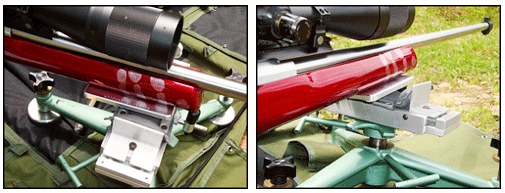
When doing load development for any rifle, it’s nice to be able to shoot from the bench with a stable front pedestal rest. Unfortunately, rifles with narrow fore-ends and ARs with tubular handguards can be somewhat wobbly on front bags. The solution is to attach a forward bag-rider to your rifle. This provides a nice, wide and flat base that sits securely in a benchrest-style front sandbag. A wide bag-rider helps prevent the gun from rocking, steadies your aim, and improves tracking. If you’re handy with tools, you can craft your own bag-rider from metal, wood, or Delrin, but there’s an easier option. Whidden Gunworks offers a nicely-engineered “bolt-on” front plate that will enhance the bench-rested accuracy of any rifle with an accessory rail on the forearm.
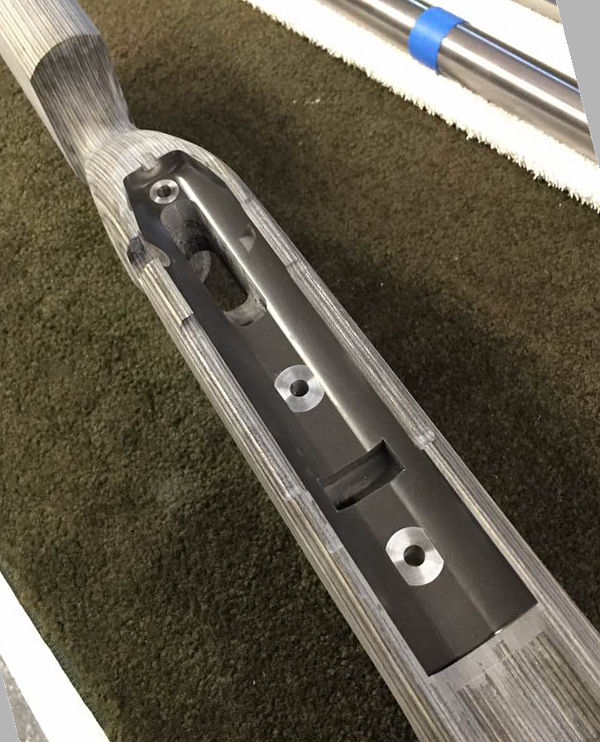
The Whidden Track Plate fits securely in the forearm accessory rail on prone, cross-the-course, and Palma rifles. These guns typically have a narrow and/or rounded fore-end so they rock and wobble when used with a front pedestal rest. The TrackPlate cures that. Once installed it provides a rock-solid, 2.9″-wide platform that mates perfectly with a benchrest-type front sandbag. This gives sling-shooters maximum stability when testing loads or zeroing their sights or scope. Plus you can now shoot F-Class competitively with a prone gun.
The Track Plate is light-weight, has catamaran-style runners to aid tracking and prevent rocking, and can be easily stowed in a range bag. The machined aluminum Track Plate fits BOTH Anschutz-style and American-style recessed forearm rails.
The Track Plate is available from Whidden Gunworks for $40.99 or from Champion’s Choice for $40.00 (item W29P). Plate designer (and National LR Rifle Champion) John Whidden says: “The Plate is great for any rifle with a rail whether it ís smallbore, centerfire, or an air gun. Now you can try F-Class with your favorite prone rifle: the Plate has a perfect low-drag finish for riding a rest or sandbags and is competition legal in all dimensions.”
Front Bag-Rider for AR-15s from EGW
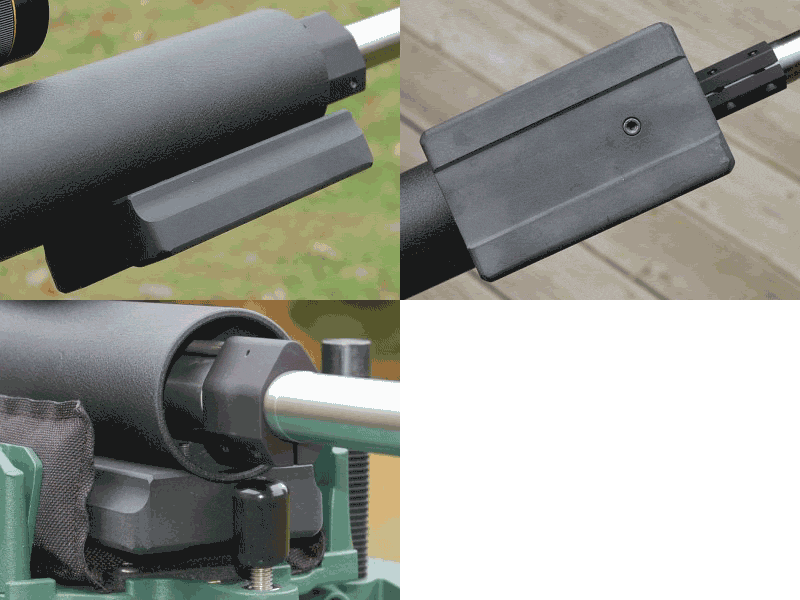
Similar to the Whidden Track Plate is a 3″-wide Delrin bag-rider from Evolution Gun Works (EGW). This was developed expressly to fit the fore-ends of AR15-type rifles with round float tubes. The EGW front bag-rider attaches to a front sling swivel stud anchor. That allows it to mount as easily as a Harris bipod — no rail needed! Just unscrew the swivel stud, put the front bag-rider in place and attach one hex-head machine screw. The front bag-rider is contoured to match the handguard profile so it fits securely with no wobble. Overall, it is a slick system. Front and rear bag-riders can be attached in a couple of minutes. The Delrin blocks slide easily in the bags and make the gun ultra-stable. The gun tracks straight back. The front bag-rider comes in two (2) variants, a $39.99 radiused version (item 32141) that attaches via swivel stud, and a $49.99 version (item 32143) that mounts via a Picatinny-style rail.
EGW AR Front Bag-Rider System
EGW Picatinny Rail-Attached Front Bag-Rider
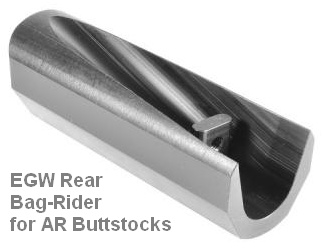
EGW Rear Bag-Rider for AR Buttstocks
EGW also offers a REAR bag-rider that attaches via the sling swivel anchor. The EGW AR Rear Bag-Rider accessory (item 32142), designed to work with A2-style buttstocks, sells separately for $39.99. This rear bag-rider provides a longer, straight “keel” that works very well in rear sandbags, giving the rifle more stability, and improving the tracking.
At the request of our readers, we provide select “Deals of the Week”. Every Monday morning we offer our Bargain selections. Here are some of the best deals on firearms, hardware, reloading components, and shooting accessories. Be aware that sale prices are subject to change, and once clearance inventory is sold, it’s gone for good. You snooze you lose.
The Leica CRF1000-R is an excellent choice for a hunter. The small Leica fits in a shirt pocket, and is easy to hold with one hand. That lets you range a prize buck quickly. This unit can range line-of-sight targets effectively out to 1,000 yards. In addition the CRF1000-R accounts for angle of inclination/declination, to provide Equivalent Horizontal Range (EHR) from as little as 10 yards out to 600 yards. This makes it ideal for many rifle shots taken in steep, mountainous terrain. The waterproof CRF1000-R features a 24mm optical lens with 7X magnification. Field of view at 1000 yards is 347 feet. Europtic’s $449.00 SALE price is the best we’ve found on this unit.
The LabRadar is the most advanced chronograph on the market. When it was first released, you had to wait months to get one of these Doppler Radar units. Now they are in-stock and ready to ship at Bruno Shooters Supply for $559.95. Once you learn how to position and adjust the LabRadar, you should find the machine reliable and versatile. We do recommend getting a separate battery pack. If you are considering purchasing a LabRadar Chronograph, we strongly suggest you read the very thorough and informative LabRadar Review by Ray Gross, Captain of the USA F-TR team. NOTE: If the LabRadar sells out at Bruno’s, you should be able to get it from MidwayUSA, for the same $559.95 price.
3. CDNN Sports — Savage 64 TR-SR, $239.99
Th Savage 64 TR-SR is great for Rimfire Tactical matches or general rimfire cross-training. The tactical-style wood stock features a vertical grip and a low-angle rear toe that works well in a rear bag. The Savage TR-SR comes complete with a Picatinny-style rail for mounting optics, and the muzzle is threaded 1/2-28 for suppressors. This .22 LR rifle, now just $239.99 on sale at CDNN, works well shooting prone from bipod or rest. With this low price you can afford lots of .22 LR ammo for training.
4. Midsouth — Nikon ProStaff Scopes Starting at $149.95
If you need a good, basic zoom scope for a hunting rifle or general-purpose rifle, this deal is hard to beat. Right now Midsouth has Nikon ProStaff scopes on sale started at just $149.95 for a 3-9x40mm. And there’s free shipping to boot! The ProStaff scopes on sale feature Nikon’s patented BDC reticle and are backed by Nikon’s no-nonsense, lifetime warranty. CLICK HERE to see this offer at Midsouth Shooters Supply.
5. Natchez — Special 5 Reloading Press Kit, $199.99
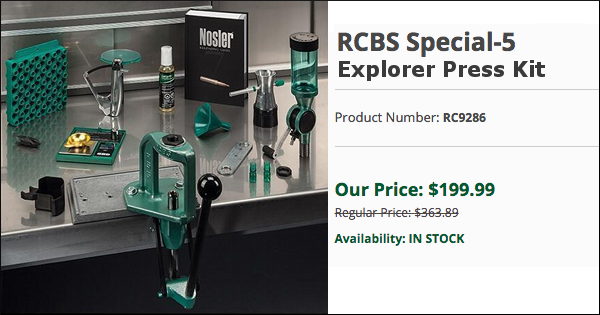
This is an excellent entry-level reloading kit, which is on sale for $199.99 at Natchez Shooters Supplies. We like the relatively compact Special 5 press for most reloading duties. Eventually you may want to add an additional, large heavy press, but this will get the job done. This kit includes an RCBS Powder Measure, Digital Scale, Powder Trickler, Hand Priming Tool, Load Manual, Loading Tray, and more. It’s hard to beat this combination of tools for under $200.00.
6. Amazon — Plano 42″ All-Weather Hard Case, $59.99 Shipped
Here’s a rugged hard case that compares well with a Pelican case, yet is less than half the cost. Plano’s GunGuard All Weather™ 42″ tactical gun case features heavy-duty, dual-stage lockable latches, a user-configurable foam interior, and a watertight/airtight closure with built-in pressure valve. The interior size is 43″ X 13″ X 5″, while the pluckable foam zone is 39.25″ X 10.25″. This is a very tough case that can withstand hard handling. The very attractive $59.99 sale price includes FREE shipping.
7. Grafs.com — MagnetoSpeed Sporter $179.99
If you have been waiting to get a MagnetoSpeed… wait no longer. Priced at just $179.99 at Grafs.com, the MagnetoSpeed Sporter model costs less than half as much as Magnetospeed’s V3 models. This chronograph attaches directly to your barrel so you don’t have to go downrange to position tripods and set up skyscreens. For most people the Sporter Model contains all the features they need. Using MagnetoSpeed’s XFR adapter (sold separately), data can be transferred easily from the display module to your mobile device. READ Magnetospeed Sporter Review.
8. Amazon — RAVPower 22000 mAh Battery Bank, $31.99
This is one of the most powerful, fast-charging USB-type power banks you can buy. Rated at 22000 mAh, it has 50% more “juice” than many units selling for around $35.00. This RAV Power machine charges up quickly and boasts three “intelligent” ports for optimal charging of smartphones, iPads, tablets, and other devices. Your Editor bought this RAVPower 22000 mAh unit to charge his own phone and iPad. It can deliver a total current output of 5.8A (2.4A max per port), allowing it to charge two iPads and one iPhone 6s at optimal charging speeds. This unit can also power a LabRadar Chronograph for a full weekend of shooting (6-7 hours per day). This is a very good deal — the price was just dropped from $39.99 to $31.99 with free shipping on orders over $49.99.
Ever wondered what caused a particular bulge or marking on a case? And more importantly, does the issue make the case unsafe for further use? Sierra Bullets Ballistic Technician Duane Siercks offers some insight into various issues and their causes in this article from the Sierra Blog.
Diagnosing Problems with Cartridge Brass
by Duane Siercks, Sierra Bullets
I was handed a small sample of .223 Rem cases the other day and was asked if I could comment on some marks and appearances that had been noticed as they were sorting through the cases. I will share what was observed and give you what would seem to be a cause for them. These were from an unknown source, so I have no way of knowing what type of firearm they were fired in or if they were factory loaded or reloaded ammunition.
Example ONE: Lake City 5.56, Unknown Year
Case #1 was seen to have a very rounded shoulder and split. Upon first look it was obvious that this round had been a victim of excess pressure. The firearm (perhaps an AR?) was apparently not in full battery, or there was possibly a headspace issue also. While taking a closer look, the primer was very flat and the outside radius of the primer cup had been lost. High pressure! Then I also noticed that there was an ejector mark on the case rim. This is most certainly an incident of excessive pressure. This case is ruined and should be discarded. See photo below.
Example TWO: Lake City Match 1993
Case #2 appears very normal. There was some question about marks seen on the primer. The primer is not overly flattened and is typical for a safe maximum load. There is a small amount of cratering seen here. This can be caused by a couple of situations.
Cratering is often referred to as a sign of excess pressure. With safety in mind, this is probably something that should make one stop and really assess the situation. Being as there are no other signs of pressure seen with this case, I doubt that pressure was unsafe. That leads us to the next possibility. This can also be caused by the firing-pin hole in the bolt-face being a bit larger than the firing-pin, and allowing the primer to flow back into the firing-pin hole causing the crater seen here. This can happen even with less-than-max pressures, in fact it has been noted even at starting loads. Always question whether pressure is involved when you see a crater. In this situation, I lean toward a large firing-pin hole. This case should be safe to reload.
Example THREE: R-P .223 Remington
Case #3 appears normal with one exception. There are two rings seen about one half inch below the base of the shoulder. These rings are around the circumference of the case, one being quite pronounced, and the other being noticeably less.
As we do not know the origin of the firearm in which this case was fired, it does seem apparent that the chamber of the firearm possibly had a slight defect. It could have been that the reamer was damaged during the cutting of this chamber. I would suggest that the chamber did have a couple of grooves that imprinted onto the case upon firing. This firearm, while maybe not dangerous should be looked at by a competent gunsmith. In all likelihood, this case is still safe to use.
Example FOUR: R-P .223 Remington
Case #4 has no signs of excess pressure. There is a bulge in the case just ahead of the case head that some might be alarmed by. This bulge is more than likely caused by this case being fired in a firearm that had a chamber on the maximum side of S.A.A.M.I. specifications. There is actually no real issue with the case. Note that the primer would indicate this load was relatively mild on pressure.
If this case was reloaded and used in the same firearm numerous times there might be a concern about case head separation. If you were going to use this case to load in an AR, be sure to completely full-length re-size to avoid chambering difficulties. This case would be safe to reload.
It is very important to observe and inspect your cases before each reloading. After awhile it becomes second nature to notice the little things. Never get complacent as you become more familiar with the reloading process. If ever in doubt, call Sierra’s Techs at 1-800-223-8799.




 The Whidden