What is Parallax?
Parallax is the apparent movement of the scope’s reticle (cross-hairs) in relation to the target as the shooter moves his eye across the exit pupil of the riflescope. This is caused by the target and the reticle being located in different focal planes.
Why is it Important?
The greater the distance to the target and magnification of the optic, the greater the parallax error becomes. Especially at longer distances, significant sighting error can result if parallax is not removed.
How to Remove Parallax
This Nightforce Tech Tip video quickly shows how to remove parallax on your riflescope.
While keeping the rifle still and looking through the riflescope, a slight nod of the head up and down will quickly determine if parallax is present. To remove parallax, start with the adjustment mechanism on infinity and rotate until the reticle remains stationary in relation to the target regardless of head movement. If parallax has been eliminated, the reticle will remain stationary in relation to the target regardless of eye placement behind the optic.
This Parallax Discussion first appeared in the Nightforce Newsletter. To get other helpful Tech Tips delivered to your mailbox, CLICK HERE to open the Nightforce Newsletter sign-up page.
The Savage A17 in 17 HMR was American Hunter’s 2016 Rifle of the Year. We weren’t surprised. This little rimfire was the first auto-loader engineered from scratch to handle the pressure of the 17 HMR safely and reliably. The A17 also proved to be very accurate and tons of fun to shoot.
If you like the A17’s award-winning delayed-blowback technology, but prefer to shoot a .22 WMR (Winchester Magnum Rimfire) cartridge, you’re in luck. Savage just announced the A22 Magnum, a new rifle that uses an A17-type action (with innovative interrupter lug), to shoot the .22 WMR cartridge.
The A22 Magnum is chambered for .22 WMR and features the same delayed-blowback auto-loading action as the original A17. The A22 Magnum feature a strong steel receiver, chromed bolt, 10-round rotary magazine, and adjustable Savage AccuTrigger. The A22 employs a thread-in headspace system like Savage’s centerfire rifles. This makes it easier to swap in a match-grade barrel down the line. The A22 also comes with two-piece bases for scope mounts
Part No.
Description
Barrel
Weight
MSRP
47400
A22 Magnum semi-automatic, .22 WMR
21″ Barrel
5.5 lbs.
$473.00
Advantages of .22 WMR over 17 HMR
We like both rimfire cartridges, but we understand why some shooters may prefer the older .22 WMR over the newer, speedier 17 HMR. Here are some of the advantages of the .22 Winchester Magnum Rimfire (WMR):
1. .22 Caliber bores are easier to clean than .17 caliber bores. Good .22-Cal cleaning rods are less flexy than .17-cal rods and a greater range of jags and brushes are offered for the larger caliber.
2. The .22 WMR makes a bigger hole — this makes your groups easier to see at longer range, and the bigger hole can give you a scoring edge in rimfire competitions.
3. The .22 WMR offers a wider choice of ammo manufacturers and bullet types. If a hunter desires a heavier, non-fragmenting bullet, the .22 WMR may be a better choice.
Weatherby has a new modular rifle for PRS comps and other tactical disciplines. Called the Vanguard® Modular Chassis (VMC), this rifle features a Modular Driven Technologies (MDT) aluminum stock, Luth AR MBA-1 buttstock, and 22″ heavy barrel. The Weatherby Vanguard action is fitted with an adjustable 2-stage trigger. Priced at $1519.00 MSRP, this rifle can be campaigned in the PRS “Production Class”, which limits complete rifles to $2000.00 without optics. The rifle is offered in three chamberings: .223 Rem, 6.5 Creedmoor, and .308 Winchester.
Weatherby says its Vanguard Modular Chassis tactical rifle is very accurate. To back that claim, Weatherby offers a SUB-MOA accuracy guarantee — Weatherby guarantees the rifle will shoot .99” or smaller 3-shot groups at 100 yards when used with Weatherby® factory or premium ammunition.
Near Half-MOA Accuracy with Factory Ammo
It turns out Weatherby’s accuracy claims are conservative. This tactical rifle is closer to a half-MOA rig than a 1-MOA gun. American Rifleman recently tested a .308 Win version of this rifle and recorded really stellar accuracy — close to half-MOA. What’s more, this rifle is not fussy — with a 1:10″-twist barrel it proved very accurate with six different types of factory ammo.
In fact, the rifle delivered near-half-inch 5-shot groups with two types of Hornady factory ammo, and the worst group (of six ammo types) was 0.76″, still very impressive for factory fodder. With good hand-loads this gun could go well under half-MOA (for five shots).
Vanguard Modular Chassis FIVE-SHOT Test Groups with Factory Ammo:
0.53 inches | Hornady 168gr Match BTHP (2718 fps)
0.55 inches | Hornady 155gr Steel Match (2612 fps)
0.57 inches | Black Hills 168gr BTHP (2608 fps)
0.66 inches | Federal Premium 168gr MatchKing BTHP (2659 fps)
0.70 inches | Hornady 155gr American Gunner (2697 fps)
0.76 inches | Black Hills 175gr BTHP (2603 fps)
NOTE: Group sizes are for 5-shot groups shot from bench at 100 yards with Caldwell pedestal rest and rear sandbag. Pentax Lightseeker 6-24x50mm scope. Velocities in FPS from PACT Chronograph.
The accuracy testing was done by gunwriter Mike Detty, who notes: “My single best group was fired with Hornady’s Match 168-gr. BTHP ammunition. Five shots measured just slightly more than a half-inch. Hornady’s 155-gr. Steel Match ammo wasn’t far behind with a group of .55″. Also accounting for the small groups is the VMC’s wonderful trigger. It is a two-stage affair and the first stage has about 3/8” take up with about a pound of pressure until it reaches the second stage where another 1 ¾ lbs. was required to break the shot.”
PRS Production Class Cost Limits
Production Division combined rifle and scope MSRP as listed on the company’s website shall not exceed $3,000 USD, the rifle shall not exceed $2,000 USD and the optic not exceed $2,000 USD. [Editor: For example, you could have a $2,000 rifle with a $1000.00 scope or vice-versa. The total system cannot exceed $3000. Rifle alone cannot exceed $2000.00 retail sale price.]
Production Division rifles are not permitted to be altered or improved in any way from the original factory configuration.
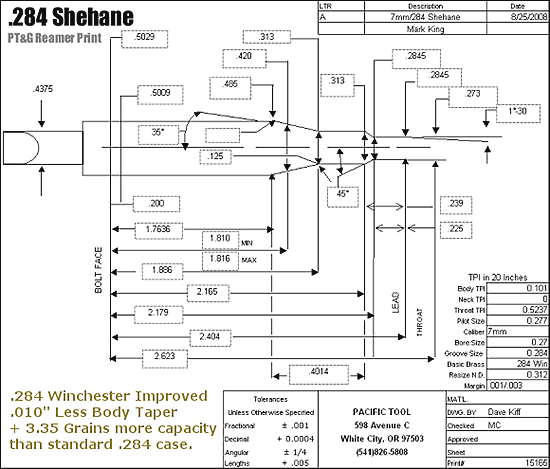
If you look at that 5-round group you might think it was shot with a 6 PPC or maybe a 6mmBR. But no, this was done with heavy 180gr Berger Hybrid bullets and the .284 Shehane, an improved version of the .284 Winchester. In fact, this impressive sub-quarter MOA group was shot while fire-forming with a very well-worn barrel!
Here’s a 5-shot 0.191″ group at 100 yards with my .284 Shehane fireforming loads. This barrel has 2200 rounds through it. It had 2000 as a straight .284 Win and then I set it back to .284 Shehane to form brass with. This was the first five rounds through it after I cleaned it after the last match. [The load was] 180 Hybrids with 54.0 grains of H4831 SC.
Ya, I figured why not I had some old barrels laying around so I just chopped 2″ off the back and 1″ off the front and chambered it up as a Shehane. Had 1000 pieces to fireform and didn’t want to do all that on a brand new barrel.
My fireform loads are going 2765 FPS. I have a 29″ barrel also though since it’s a setback. Once you get it formed I would push it faster than that or I wouldn’t even bother with the Shehane. My old straight .284 load at 2890 fps had ES spread in single digits for 10 shots. I figured if I get it up to 2935-2950 fps that will be a point or two saved in a several day match.
Fellow .284 Shehane shooter Erik Cortina notes that the .284 Shehane has a velocity edge over the straight .284 Win because it holds more powder: “The Shehane has more capacity than the .284 Winchester. Ryan is using 54.0 grains simply as a fire-forming load. Typical load for a Shehane is around 57.0 grains of Hodgdon H4831 SC.” By blowing the sidewalls out 0.010″, the .284 Shehane picks up about 3.3 grains of extra case capacity. That enhancement makes a BIG difference. The extra boiler room is enough to drive the 180s at 2900-2950 fps with H4831sc, with long barrels.
Many folks think the ultra-smooth Bix’N Andy triggers are the best match triggers you can buy. But until now Bix’N Andy trigger units, with their light pull-weights, have been intended primarily for benchrest and F-Class disciplines, where light pull weights are favored by many competitors. Well, Bix’N Andy has just released a new TacSport trigger that can be adjusted to a pull-weight of up to five (5) pounds (combined first and second stages). But remarkably, the same new TacSport trigger can still go down to about one ounce — that way you can adjust the pull weight through a very wide range to suit the application. Length of trigger shoe travel can also be set from zero to 7mm.
This trigger can operate as a single stage or as a two-stage. Each stage can be adjusted independently. Set the trigger at a few ounces for load testing from the bench, then crank it up to 2.5 pounds for a tactical match. Run it as a single stage for the bench or a two-stage for field work. With this flexibility and wide pull-weight adjustment range, the new Bix’N Andy TacSport trigger is well-suited for tactical shooters, hunters, and LEO marksman. The TacSport trigger also comes with a right-side top safety.
The new Bix’N Andy TacSport trigger is now available from BulletCentral.com for $495.00. Yes, that’s pricey, but this trigger offers features and “feel” you can’t find anywhere else.
Product Tip from EdLongrange. We welcome reader submissions.
The first-ever New England CMP Games were held at the Camp Ethan Allen Training Site (CEATS) in Vermont, on September 14-18, 2016. This proved to be a great event at a stunningly scenic facility — a paradise for marksmen. Over 150 rifle and pistol competitors ventured to Vermont to enjoy the CMP’s inaugural New England Games, the latest in the CMP’s popular series of major, regional matches.
Here’s the view from the berm, looking back to the firing line…
The 2016 New England CMP Games included a Small Arms Firing School with expert instruction. Both novice shooters and experienced competitors benefitted from the training sessions.
Also featured at the New England Games was a preview of CMP’s electronic outdoor targets that are able to be transported and assembled across the country. For many shooters, this was the first time they were able to try electronic targets.
Competitors were mightily impressed by the breathtaking natural surroundings at the New England Games. “I was blown away by the facilities at Camp Ethan Allen,” said Steve Cooper, CMP North general manger. “The grounds were neatly manicured, our offices for registration and sales were very convenient and the classrooms were perfect for our clinics.”
He went on to say, “As beautiful as the surroundings were, the people were even better. They truly wanted us there and they enjoyed the matches, clinics, and other activities. It will be a pleasure to return next year for an even bigger and better event.”
Many awards were earned at the 2016 New England Games…
Of course, it wouldn’t be a true CMP Games event without a Rimfire Sporter Match.
The CEATS Pistol Range hosted both centerfire and rimfire matches in a lovely, tree-lined setting.
CLICK HERE for a complete list of New England CMP Games match results. Photos from the event are posted on the CMP’s Zenfolio website. Mark your calendars! Next year’s New England CMP Games are scheduled for September 20-24, 2017.
It’s about darn time … that somebody offered vibration damping in a laser rangefinder (LRF). This “anti-shake” technology has been available in binoculars for years, but now it’s finally available for a laser rangefinder — thanks to Nikon. Nikon’s new MONARCH 7i VR Laser Rangefinder is the world’s first LRF with automated vibration compensation. Nikon’s VR (Vibration Reduction) technology reduces the effect of external vibrations caused by shaking and hand movements. The system steadies the image seen through the 6X viewfinder, while simultaneously aligning/steadying the irradiated laser beam for faster, more precise ranging.
“Vibrations of the image in the viewfinder caused by hand movement (sinusoidal waves) are reduced to approximately one-fifth (or less) based on Nikon’s measurement standards. With the push of a button you’ve just made the world stand still for a fast, precise distance measurement.”
Nikon says its VR technology will “reduce optical vibrations by nearly 80%“. The VR system stabilizes the viewed image AND simultaneously aligns the image with the activated laser beam. This delivers a “rock-solid” view of your target for faster, more precise ranging. Hunters will find that the target mark on the rangefinder remains much more stable, so you can range more quickly and efficiently. Watch this video to see how VR technology works:
Comment: VR technology IS a big deal for the hunter in the field. Bottom line — this anti-shake technology will let hunters range faster and range distant targets more reliably. The difference when ranging small game at long ranges is quite noticeable. Right now Nikon is the only company offering VR technology in rangefinders, but we expect other LRF-makers to follow suit. Surprisingly, the MONARCH 7i VR Laser Rangefinder is quite affordable. MSRP is $399.95.
Instant-On VR Functionality
The VR Function begins immediately when the laser rangefinder is on, meaning there is no extra time spent trying to toggle between settings. Holding down the ranging button allows the user to continuously scan for 8 seconds. A fast measurement is received (in approximately half a second), regardless of the distance, thanks to Nikon’s Hyper Read technology. The MONARCH 7i VR has an effective measurement range of 8-1000 yards and displays measurements in .1-yard increments. In addition, the Nikon’s ID (Incline/Decline) Technology compensates for uphill or downhill shooting angles by providing the true horizontal distance for your ballistics solver.
The MONARCH 7i VR represents a major step in hunting technology by helping alleviate the difficulty of keeping the rangefinder steady enough to range distant objects. This issue is partially due to the compact size of most laser rangefinders, which makes it challenging to brace it against a solid object, such as a tree or the edge of a deer stand. The rangefinder’s small size, combined with a strong wind, unbalanced position, physical exertion or just plain-old “buck fever” can make it virtually impossible to hold the target mark of the rangefinder on target and keep it still long enough to get a distance reading. VR changes all that, and we commend Nikon for making this technology available to sportsmen.
For a prone shooter, particularly on dusty, dirty or sandy ground, muzzle blast is a major bummer. Muzzle blast can be very disturbing — not just for the trigger-puller but for persons on either side of the gun as well. Some muzzle brakes send a huge shockwave back towards the shooter, and others send blast towards the ground, kicking dirt and debris into the prone shooter’s face. If there was a way to illustrate those factors — shockwave and debris — that might help shooters select one brake design over another.
Cal Zant at PrecisionRifleBlog.com applied a unique blend of creativity and resourcefulness to try to answer that question for 20+ muzzle brakes. Using high-speed photography and household products, he captured the blast pattern of 20+ different brake designs for easy side-by-side comparison. Can you figure out how Cal managed to show muzzle brake blasts so clearly? His “hi-viz” solution, revealed in the article, is very clever. See the eye-opening results for 20+ brakes, with illustrative photos, by visiting the Precision Rifle Blog Muzzle Brake Ground Signature Test Page.
The Savage A17 earned honors as American Hunter’s 2016 Rifle of the Year. And now this popular auto-loading 17 HMR is even better. Savage Arms has released two new “Target Sporter” versions with heavier barrels and beefier, laminated wood stocks. We particularly like the new Thumbhole version, shown below. MSRP is $631.00 but ‘street price’ will be much lower.
These new models feature 22″ button-rifled heavy barrels for improved accuracy and Boyds’ gray wood laminate stocks for improved ergonomics. As with all A17s, the new wood-stocked Target Sporter models feature a case-hardened receiver, chromed bolt with large charging handle, 10-round rotary magazine, and user-adjustable AccuTrigger.
Features & Benefits
• First reliable semi-automatic rimfire specifically designed from for 17 HMR
• Delayed-blowback action for safe, reliable cycling
• Hard chrome bolt with oversized bolt handle
• Case-hardened receiver and 22-inch button-rifled barrel
• 10-round rotary magazine
The A17 platform is the first delayed-blowback, semi-auto rimfire designed espressly for the 17 HMR cartridge. The unique delayed-blowback action allows safe, reliable semi-auto cycling with normal 17 HMR loads. We tested the original A17 and it proved accurate and reliable (so long as you made sure the magazine is completely seated). In fact, the A17 we tested flawlessly powered through multiple magazines in rapid-fire. Savage has modified the magazine well slightly to enhance reliability (see below). Now it’s easier the get the mag seated — the key to 100% reliable cycling.
How the A17 Works Using Interrupter Lug
For the A17 series of auto-loaders, Savage engineers invented a new delayed-blowback action that employs an interrupter lug to hold the bolt closed for a few milliseconds. Savage engineers scrapped the standard straight-blowback approach, which ejects spent casings via overpressure during firing. In its place, they opted for an interrupter lug that locks the bolt until peak cartridge pressure has passed. The timing system prevents the bolt from opening prematurely, effectively putting an end to ruptured cases. By doubling as a firing pin block, it also prevents out-of-battery firing with an open action.
The National Shooting Sports Foundation (NSSF) hailed the recent bipartisan introduction of the Export Control Reform Act of 2016 in the U.S. House of Representatives, H.R. 6176, as well as the companion Senate bill, S. 3405, and called on Congress to pass this important legislation.
“The Export Control Reform Act of 2016 seeks to complete what the Obama administration itself began by transferring the export licensing and enforcement oversight of sporting and commercial firearms to the Commerce Department from the State Department,” said Lawrence G. Keane, NSSF senior vice president and general counsel. “We would especially like to thank the sponsors: House Majority Whip Steve Scalise (R-La.); Congressmen Henry Cuellar (D-Texas); Tom Marino (R-Penn.); Gene Green (D-Texas); and Steve Stivers (R-Ohio) for their timely bipartisan leadership as well as Senator Steve Daines (R-Mont.) for sponsoring a companion bill in the Senate.”
In August 2009, with the support of the business community including NSS, the Obama administration launched the Export Control Reform (ECR) Initiative. The Initiative’s purpose is to both improve America’s global competitiveness by reducing unnecessary restrictions on exports of commercial items and enhance national security by focusing the State Department’s attention and resources on guarding truly sensitive defense items and technologies. As former Defense Secretary Robert Gates once said, the ECR Initiative’s purpose is “to build a higher fence around a smaller yard.”
The administration has transferred, or is in the process of transferring, to Commerce from State, export licensing responsibility for virtually all commercial, non-military items. The only remaining items yet to be transferred are sporting and commercial firearms and related products. While we have patiently waited for the administration to make ECR progress on our products, small manufacturers, component parts suppliers, distributors, and exporters in our industry, and even gunsmiths and individuals, have to continue to comply with unnecessary regulations and to pay an annual minimum registration fee of $2,250, regardless of whether they actually export. Under the State Department’s Cold-war era export licensing regime, American companies are unable to compete globally on a level playing field.
“Because the administration has not moved forward in a timely manner to complete its own ECR Initiative, it is now time for Congress to move forward with legislation complete the ECR and reduce unneeded and burdensome regulations while improving our global competitiveness, create American jobs and enhance national security,” Keane said. [Editor’s Note: One goal of the ECR initiative is to reduce the burden of ITAR compliance for gunsmiths who do not export any products. SEE ITAR Registration Requirements Report.]




 1. .22 Caliber bores are easier to clean than .17 caliber bores. Good .22-Cal cleaning rods are less flexy than .17-cal rods and a greater range of jags and brushes are offered for the larger caliber.