NSSF and Retailers File Federal Suit against Massachusetts A.G. Healey’s ‘Enforcement Notice’.
Four federally-licensed Massachusetts firearms retailers and the National Shooting Sports Foundation® (NSSF) filed an action in United States District Court for the District of Massachusetts to challenge on Constitutional grounds the “Enforcement Notice” issued by state Attorney General Maura Healey. The lawsuit, filed September 22, 2016, states that Healey’s office overstepped its legal authority and deprived the retailers of their due process protections guaranteed under the U.S. Constitution. The action seeks declaratory relief and a permanent injunction enjoining enforcement.
The retailers are Pullman Arms Inc. of Worcester; Guns and Gear, LLC of Agawam; Paper City Firearms of Holyoke; and Grrr Gear of Orange.
“Attorney General Maura Healey’s actions were unconstitutional. Firearms retailers in Massachusetts cannot determine the meaning or scope of the Attorney General’s Enforcement Notice and subsequent explanations,” said Lawrence G. Keane, NSSF Senior Vice President and General Counsel. “Because criminal penalties can result due to Attorney General Healey’s unilateral reinterpretation of a state statute done without administrative process or input from affected parties, her office exceeded its lawful authority and retailers were deprived of their due process protections under the Fifth and Fourteenth Amendments.”
“In addition, if the Attorney General’s Enforcement Notice is understood as applying to all semi-automatic firearms, it violates the Second and Fourteenth Amendments to keep and bear arms because it bans the manufacture, sale and possession of a broad range of firearms in common use by the citizens of Massachusetts,” Keane said.
Representing NSSF and the retailers are the Boston-based law firm of Kenney and Sams, and Michael Sullivan of the Ashcroft Law Firm. Sullivan is a former U.S. Attorney for the District of Massachusetts and former Acting Director, U.S. Bureau of Alcohol, Tobacco, Firearms and Explosives.
Today is practice day for the Mid-Range F-Class Nationals, which commence bright and early tomorrow morning in Lodi, Wisconsin. In any shooting competition, you must try to avoid major screw-ups that can ruin your day (or your match). In this article, reigning F-TR National Mid-Range and Long Range Champion Bryan Litz talks about “Train Wrecks”, i.e. those big disasters (such as equipment failures) that can ruin a whole match. Bryan illustrates the types of “train wrecks” that commonly befall competitors, and he explains how to avoid these “unmitigated disasters”.
Urban Dictionary “Train Wreck” Definition: “A total @#$&! disaster … the kind that makes you want to shake your head.”
Success in long range competition depends on many things. Those who aspire to be competitive are usually detail-oriented, and focused on all the small things that might give them an edge. Unfortunately it’s common for shooters lose sight of the big picture — missing the forest for the trees, so to speak.
Consistency is one of the universal principles of successful shooting. The tournament champion is the shooter with the highest average performance over several days, often times not winning a single match. While you can win tournaments without an isolated stellar performance, you cannot win tournaments if you have a single train wreck performance. And this is why it’s important for the detail-oriented shooter to keep an eye out for potential “big picture” problems that can derail the train of success!
Train wrecks can be defined differently by shooters of various skill levels and categories. Anything from problems causing a miss, to problems causing a 3/4-MOA shift in wind zero can manifest as a train wreck, depending on the kind of shooting you’re doing.
Below is a list of common Shooting Match Train Wrecks, and suggestions for avoiding them.
1. Cross-Firing. The fastest and most common way to destroy your score (and any hopes of winning a tournament) is to cross-fire. The cure is obviously basic awareness of your target number on each shot, but you can stack the odds in your favor if you’re smart. For sling shooters, establish your Natural Point of Aim (NPA) and monitor that it doesn’t shift during your course of fire. If you’re doing this right, you’ll always come back on your target naturally, without deliberately checking each time. You should be doing this anyway, but avoiding cross-fires is another incentive for monitoring this important fundamental. In F-Class shooting, pay attention to how the rifle recoils, and where the crosshairs settle. If the crosshairs always settle to the right, either make an adjustment to your bipod, hold, or simply make sure to move back each shot. Also consider your scope. Running super high magnification can leave the number board out of the scope’s field view. That can really increase the risk of cross-firing.
2. Equipment Failure. There are a wide variety of equipment failures you may encounter at a match, from loose sight fasteners, to broken bipods, to high-round-count barrels that that suddenly “go south” (just to mention a few possibilities). Mechanical components can and do fail. The best policy is to put some thought into what the critical failure points are, monitor wear of these parts, and have spares ready. This is where an ounce of prevention can prevent a ton of train wreck. On this note, if you like running hot loads, consider whether that extra 20 fps is worth blowing up a bullet (10 points), sticking a bolt (DNF), or worse yet, causing injury to yourself or someone nearby.
[Editor’s Note: The 2016 F-Class Nationals will employ electronic targets so conventional pit duties won’t be required. However, the following advice does apply for matches with conventional targets.]
3. Scoring/Pit Malfunction. Although not related to your shooting technique, doing things to insure you get at least fair treatment from your scorer and pit puller is a good idea. Try to meet the others on your target so they can associate a face with the shooter for whom they’re pulling. If you learn your scorer is a Democrat, it’s probably best not to tell Obama jokes before you go for record. If your pit puller is elderly, it may be unwise to shoot very rapidly and risk a shot being missed (by the pit worker), or having to call for a mark. Slowing down a second or two between shots might prevent a 5-minute delay and possibly an undeserved miss.
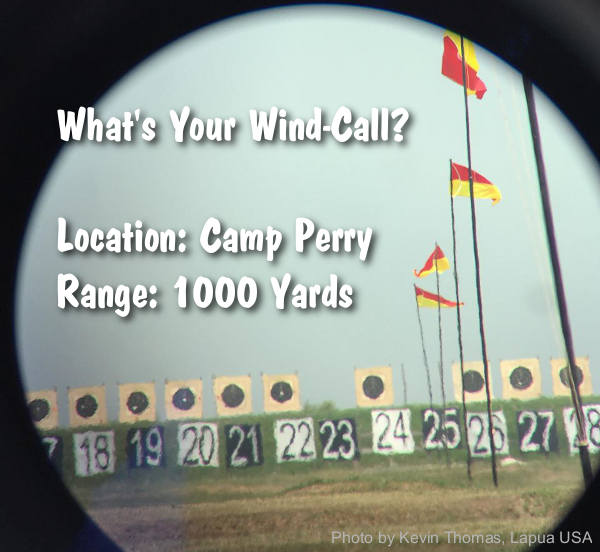
4. Wind Issues. Tricky winds derail many trains. A lot can be written about wind strategies, but here’s a simple tip about how to take the edge off a worse case scenario. You don’t have to start blazing away on the command of “Commence fire”. If the wind is blowing like a bastard when your time starts, just wait! You’re allotted 30 minutes to fire your string in long range slow fire. With average pit service, it might take you 10 minutes if you hustle, less in F-Class. Point being, you have about three times longer than you need. So let everyone else shoot through the storm and look for a window (or windows) of time which are not so adverse. Of course this is a risk, conditions might get worse if you wait. This is where judgment comes in. Just know you have options for managing time and keep an eye on the clock. Saving rounds in a slow fire match is a costly and embarrassing train wreck.
5. Mind Your Physical Health. While traveling for shooting matches, most shooters break their normal patterns of diet, sleep, alcohol consumption, etc. These disruptions to the norm can have detrimental effects on your body and your ability to shoot and even think clearly. If you’re used to an indoor job and eating salads in air-conditioned break rooms and you travel to a week-long rifle match which keeps you on your feet all day in 90-degree heat and high humidity, while eating greasy restaurant food, drinking beer and getting little sleep, then you might as well plan on daily train wrecks. If the match is four hours away, rather than leaving at 3:00 am and drinking five cups of coffee on the morning drive, arrive the night before and get a good night’s sleep.”
Keep focused on the important stuff. You never want to lose sight of the big picture. Keep the important, common sense things in mind as well as the minutia of meplat trimming, weighing powder to the kernel, and cleaning your barrel ’til it’s squeaky clean. Remember, all the little enhancements can’t make up for one big train wreck!
What if you could have a normal-height rear sight that could dispense with the need to align front sight and rear sight? In fact, what if that rear sight could eliminate the need for a front sight altogether?
That’s exactly what the new Meprolight FT Bullseye does. Employing fiber optics and tritium, the FT Bullseye provides a bright aiming dot inside a circle — no front sight is needed. When the dot is centered in the circle, you’re on target. It’s as simple as that! This really is innovative technology, albeit expensive — the FT Bullseye’s MSRP is $199.00 — not cheap.
Traditionally, a shooter aims by aligning the front and rear sights. Meprolight combined the dot and the circle on the rear sight, eliminating the need to use the front sight altogether. This sight is fast on target and works in all light conditions.
Red dot and reflex systems also work without iron sights, but red dots are tall and bulky, and they don’t work well at all for shooters with astigmatism.
Meprolight’s engineers created a sleek, low profile rear sight by combining fiber optics with tritium. For concealed carry, this is better than a bulky red-dot. The low-profile design allows the shooter to draw from holster without worrying about snagging a bulky red dot or reflex sight assembly. To see how the FT Bullseye sight works, watch this video.
The fiber optic technology used in the FT Bullseye was pioneered by Tactical Aiming Systems (T.A.S.) an Israeli company. Meprolight dramatically improved the TAS system, adding tritium and an enhanced dot/circle reticle. The FT Bullseye is also smaller and sleeker than the original T.A.S. rear sight. The FT Bullseye is currently available in red or green dot/circle for all Glock models. Meprolight guarantees the tritium to last 12 years. MSRP is $199.00.
The movie “The Patriot” gave us the phrase “Aim small, miss small”. While that’s a good mantra, aiming strategies for long-range competition are a bit more complicated, as this article explains…
The U.S. Mid-Range and Long Range Nationals kick off tomorrow, September 23rd, in Lodi, Wisconsin. Here are some tips that can help F-TR and F-Open shooters aim more precisely, and achieve higher scores. F-Class ace Monte Milanuk reviews reticle choices and strategies for holding off.
In our Shooters Forum, one newcomer wanted some advice on selecting a reticle for F-Class optics. He wondered about the advantage of Front (first) Focal Plane (FFP) vs. Second Focal Plane scopes and also wondered if one type of reticle was better for “holding off” than others.
In responding to this question, Forum regular Monte Milanuk provided an excellent summary of aiming methods used in F-Class. For anyone shooting score targets, Monte’s post is worth reading:
Aiming Methods for F-Class (and Long-Range) Shooting — by Monte Milanuk
F-Class is a known-distance event, with targets of known dimensions that have markings (rings) of known sizes. Any ‘holding off’ can be done using the target face itself. Most ‘benefits’ of Front (first) focal plain (FFP) optics are null and void here — they work great on two-way ranges where ‘minute of man’ is the defining criteria — but how many FFP scopes do you know of in the 30-40X magnification range? Very, very few, because what people who buy high-magnification scopes want is something that allows them to hold finer on the target, and see more detail of the target, not something where the reticle covers the same amount of real estate and appears ‘coarser’ in view against the target, while getting almost too fine to see at lower powers.
Whether a person clicks or holds off is largely personal preference. Some people might decline to adjust their scope as long as they can hold off somewhere on the target. Some of that may stem from the unfortunate effect of scopes being mechanical objects which sometimes don’t work entirely as advertised (i.e. one or two clicks being more or less than anticipated). Me personally, if I get outside 1-1.5 MOA from center, I usually correct accordingly. I also shoot on a range where wind corrections are often in revolutions, not clicks or minutes, between shots.
Some shooters do a modified form of ‘chase the spotter’ — i.e. Take a swag at the wind, dial it on, aim center and shoot. Spotter comes up mid-ring 10 at 4 o’clock… so for the next shot aim mid-ring 10 at 10 o’clock and shoot. This should come up a center X (in theory). Adjust process as necessary to take into account for varying wind speeds and direction.
Others use a plot sheet that is a scaled representation of the target face, complete with a grid overlaid on it that matches the increments of their optics — usually in MOA. Take your Swag at the wind, dial it on, hold center and shoot. Shot comes up a 10 o’clock ‘8’… plot the shot on the sheet, look at the grid and take your corrections from that and dial the scope accordingly. This process should put you in the center (or pretty close), assuming that you didn’t completely ignore the wind in the mean time. Once in the center, hold off and shoot and plot, and if you see a ‘group’ forming (say low right in the 10 ring) either continue to hold high and left or apply the needed corrections to bring your group into the x-ring.
Just holding is generally faster, and allows the shooter to shoot fast and (hopefully) stay ahead of the wind. Plotting is more methodical and may save your bacon if the wind completely changes on you… plotting provides a good reference for dialing back the other way while staying in the middle of the target. — YMMV, Monte
Readers often ask us: “Is there a decent, easy-to-comprehend book that can help my wind-reading?” Many of our Forum members have recommended The Wind Book for Rifle Shooters by Linda Miller and Keith Cunningham. This 146-page book, published in 2007, is a very informative resource. But you don’t have to take our word for it. If you click this link, you can read book excerpts and decide for yourself. When the Amazon page opens, click the book cover (labeled “Look Inside”) and another screen will appear. This lets you preview the first few chapters, and see some illustrations.
Other books cover wind reading in a broader discussion of ballistics or long-range shooting, such as Applied Ballistics for Long-Range Shooting by Bryan Litz. But the Miller & Cunningham book is ALL about wind reading from cover to cover, and that is its strength. The book focuses on real world skills that can help you accurately gauge wind angle, wind velocity, and wind cycles.
All other factors being equal, it is your ability to read the wind that will make the most difference in your shooting accuracy. The better you understand the behavior of the wind, the better you will understand the behavior of your bullet. — Wind Book for Rifle Shooters
The Wind Book for Rifle Shooters covers techniques and tactics used by expert wind-readers. There are numerous charts and illustrations. The authors show you how to put together a simple wind-reading “toolbox” for calculating wind speed, direction, deflection and drift. Then they explain how to use these tools to read flags and mirage, record and interpret your observations, and time your shots to compensate for wind. Here’s are two reviews from actual book buyers:
I believe this is a must-have book if you are a long-range sport shooter. I compete in F-Class Open and when I first purchased this book and read it from cover to cover, it helped me understand wind reading and making accurate scope corrections. Buy this book, read it, put into practice what it tells you, you will not be disappointed. — P. Janzso
If you have one book for wind reading, this should be it. Whether you’re a novice or experienced wind shooter this book has something for you. It covers how to get wind speed and direction from flags, mirage, and natural phenomenon. In my opinion this is the best book for learning to read wind speed and direction. — Muddler
National Hunting and Fishing Day (NHF Day) takes place on Saturday, September 24, 2016. The annual celebration serves as a reminder that conservation succeeds because of leadership and funding from hunters, shooters and anglers. National, regional, state and local organizations will run thousands of “open house” hunting- and fishing-related events around the country. Events will include Fishing Derbys, Hunting Expos, Wing-shooting tournaments, and much more. Over four million Americans will participate. For information on NHF Day, visit www.nhfday.org. To find NHF Day events in your state, click the links below.
The 31st Annual Gun Rights Policy Conference (GRPC) will be held in Tampa, Florida this weekend, September 24-25, 2016. This important annual conference offers two days of panel discussions and presentations guided by leading figures in the firearms community. More than 75 speakers will cover a wide range of topics, including the upcoming November elections, state legislative activities, working with the news media, and general Second Amendment issues.
Live Streaming of Conference This Weekend
Those who can’t attend the 31st Gun Rights Policy Conference in Tampa this weekend can still “listen and learn”. The GRPC will be live streamed on the conference days – September 24 and 25, 2016. All Americans interested in Gun Rights and the Second Amendment can watch and listen anywhere there is an internet connection. Here are links for the live streams this weekend.
NOTE: Be sure to check the 2016 GRPC Agenda to ensure you won’t miss the most important discussions and presentations.
Notable Conference Speakers
Among the speakers at the GRPC will be Virginia attorney Alan Gura, who argued both the 2008 Heller case and the 2010 case of McDonald v. City of Chicago before the U.S. Supreme Court. Gura will be joined by Alan Gottlieb, founder of the Second Amendment Foundation (SAF); Professor John Lott, author of The War on Guns and a Fox News.com contributor; Tom Gresham, host of nationally-syndicated Gun Talk radio; and self-defense authority Massad Ayoob.
AmmoLand Shooting Sports News will be sponsoring and hosting the LIVE VIDEO feed of the 2016 Gun Rights Policy Conference. Watch it online Sept 24 & 25th 2016.
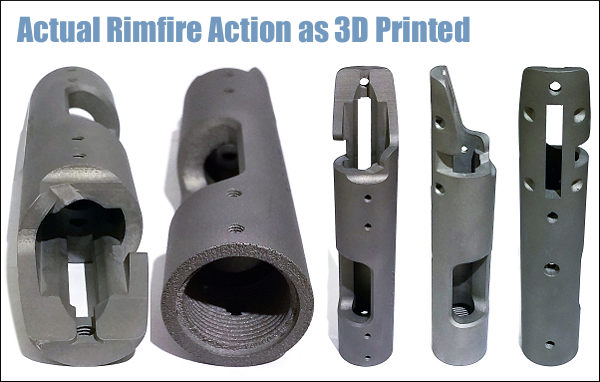
Here’s something truly innovative — a 3D-printed metal rimfire receiver!
Forum member Marcos G. (aka MFP_BOP) has designed and created his own rimfire action. But it’s not machined or forged. This new action was created with a 3D sintered metal printer. A 3D modeler by profession, Marcos has the requisite skill set and access to a very high-tech (and expensive) metal printer. As printed, the actual receiver is shown below. It has just been sent out to be age-hardened to 40 HRC, after which final finish work (e.g. cleaning up tenon threads) will be done. To learn more about this 3D-printing project, read this FORUM Thread.
When most of us think of 3D printing, we think of small plastic parts — nothing as strong as steel. But there are 3D printers that employ sintered metal to build complex metal components. Marcus says the receiver he’s created should have “stated yield and tensile strength similar to investment casting.” The material used for the action is 15-5 PH® Stainless Steel (in sintered form).
The action was designed to use a PT&G 40X rimfire bolt. Marcos notes that “There is an extraction cam inside of the action, something that would be very hard or impossible to do by regular machining and/or EDM.”
Born in Brazil, Marcos now lives in New Zealand. He tell us that: “New Zealand is a very gun-friendly country. I just need my A-CAT license to make [a receiver.]” So there are no special legal restrictions (as might apply in the USA). The printer is EOS270 laser metal sintering machine. Marcos says: “The current price for one of those machines is in five figures, but I am 99.99% sure that in 5-7 years this technology will be readily available to anyone.”
As designed, the receiver was 1.4″ in diameter. Marcos reports it came out of the printer at 1.403″. The designed boltway is .690″ and it came out .687″. Marcos notes: “I haven’t noticed any warping. The threads are rough, really! Interior and exterior finishes are really good though, probably because of the way it’s been printed: upside down (must have gone through tumbling afterwards). I will have to run some taps and single-point-cut the tenon threads to clean them up.”
Marcos says the actual printing process took a lot of time: “I should have asked how long it took to be printed!” But consider this, the 7″-long receiver is created in layers only 20 microns thick, so you can understand why the process took so long.
Reasons to Print a Rimfire Receiver
Marcos 3D-printed his own action basically to save money: “Some may be asking why I printed this receiver. Here’s a little history… I tried different ways to bring a Stiller 2500X action into New Zealand. The final price to my door was NZ $3000.00 (about $2195.00 USD). Designing and making one would be way cheaper, but I felt nobody here could machine the internal abutments with precision. Also printing was still a little cheaper and printing offered the chance to put in it all details I wanted — such as M4 threads, internal cam, and fillets.”
Doug Koenig proved two things this past weekend at the 2016 NRA World Shooting Championship. First, he showed that he is one hell of a shooter, maybe the best action shooter ever. Second he proved that trick, custom race-guns WILL out-perform off-the-shelf firearms. As originally conceived, the WSC has been a multi-discipline match in which competitors shoot an assortment of manufacturer-supplied firearms. But this year, a rule change allowed “BYO” firearms and ammunition in the new Professional Open Division (Pro Open). Koenig’s choice to run in Open Class proved to be a good one — he walked away with a check for $25,000 and the title of 2016 “World Shooting Champion”.
Competing in the Pro Open Division (using his own guns for most stages), Koenig dominated, winning all 12 stages while racking up 3000 points, effectively a “perfect” score. Only a couple shooters competed in Pro Open using their own guns and ammo. Though some say he made it look easy, Koenig, a 17-time Bianchi Cup Champion, insisted this was a tough match. After the awards ceremony, Koenig told Shooting Sports USA: “This was a really great match — and a fun test of all the different shooting disciplines. [The WSC] is without a doubt one of the most difficult matches that I have ever shot. I have a lot of respect for the other disciplines that I have never done before.”
Curiously, only a couple competitors competed in Pro Open, while there were 67 shooters in the regular Pro Class, and 131 Amateurs. Given Koenig’s thorough trouncing of the Pro Stock competitors, one wonders what will happen to the WSC event next year. Will more shooters join the Pro Open ranks? Will there even be a Pro Open Division next year? Koenig served notice that if you want to win the overall title, you better bring your own guns. But that would seem to change the signature theme of the WSC — shooting “normal”, box-stock firearms. One wonders how the other competitors felt about Koenig capturing $25K and the title of “World Champion”, while they shot off-the-shelf hardware.
Nonetheless, Koenig deserves full credit for his superb, 3000-point “perfect” performance. In winning all twelve stages (including some disciplines he had never shot before), Koenig’s 2016 WSC performance was truly one for the ages.
Greg Jordan won the Professional (Stock) Division with a score of 2934. Jordan had a very strong performance with class wins in the 2-Gun, 3-Gun, and America’s Rifle Challenge stages. Pro Stock runner-up, 41 points back, was Mark Yackley with a 2893 score.
Brilliant Performance by Amateur Competitor Nate Dudley
The Top Amateur at the 2016 WSC was Nate Dudley with 2879 points. Dudley’s strong showing would have placed him ahead of all but four of the Pro Stock shooters*. That’s remarkable. Nate beat 63 Pros, including last year’s WSC Champion Bruce Piatt who finished 8th in the Pro (Stock) division.
The Miculeks — America’s First Family of Shooting
Lena Miculek won the Ladies Championship with a score of 2816, and Lena’s mom, Kay Miculek was the second-place lady. Lena’s father, the legendary Jerry Miculek, finished 9th in the Pro Stock Division.
*Fourth-place Pro Ryan Muller scored 2881 points, while fifth-place Pro Nick Atkinson had 2878 points.
At the request of our readers, we provide select “Deals of the Week”. Every Monday morning we offer our Bargain selections. Here are some of the best deals on firearms, hardware, reloading components, and shooting accessories. Be aware that sale prices are subject to change, and once clearance inventory is sold, it’s gone for good. You snooze you lose.
1. Cabela’s — Rem 700 ADL Varmint, $309.99 with 10% Off Coupon and Remington $50.00 Rebate
OK, here’s the deal of the year for hunters. You can get a complete Remington 700 ADL Varmint Rifle in 22-250 or .308 Win for $309.99. That’s less than you might pay for a used Rem 700 action by itself. Here’s how it works. The current Cabela’s Sale Price is $399.99. Use online discount code STOCKUP16 to knock 10% off the price. That brings it down to $359.99. OK, there’s more — now through September 30, 2016, Remington is offering a $50 Mail-in Rebate on Rem 700 ADLs. When you get the $50.00 back from Remington, your net cost for this rifle is $309.99. CLICK HERE for Remington Rebate INFO.
IMPORTANT: Remington $50.00 Rebate valid on purchases made from 8/1/16 through 9/30/16. All Rebate requests must be postmarked by 10/29/16.
2. Midsouth — Alamosa Gun Case for 50″ Scoped Rifle
We’ve been looking for a jumbo, well-padded soft case like this for a long time. Something big enough to hold long-barreled match guns, with enough padding to protect nice finishes and enough room for tall scopes. We are impressed with the new Alamosa Gun Case from Allen Company, which holds guns up to 50″ in length. We measured a 28″-barreled bench gun and this case was just big enough. If you have an adjustable buttplate, muzzle brake, or tuner, you might need a longer case (measure your rifle before ordering the Alamosa case). There’s a lot to like with the Alamosa case. The pockets are large and the shape provides plenty of room for big optics. You can purchase this case from Midsouth for $43.05, or from Amazon.com for $48.46 with free PRIME shipping.
— Extra-wide design to accommodate bi-pods and large scopes
— Multiple External Pockets
— Rugged Endura fabric with soft-knit lining
— Lockable zippers, padded handle
3. Cabela’s — 10% Off Guns & Ammo + Free Shipping ($99 Min)
Cabela’s is having a big Sale on Firearms now, in advance of hunting season. You’ll find very competitive prices on rimfire and centerfire rifles. To make things even better, with a $99 minimum order you can get 10% Off plus FREE shipping with CODE STOCKUP16. This promo applies to ammunition as well (minimum order $99.00). If you need rifle, pistol, or shotgun ammo, the FREE Shipping offer can save you quite a lot. NOTE: This offer expires 10/2/16 at 11:59 p.m. (EDT), so place your orders soon.
4. CDNN Sports — HK 416 .22LR Rimfire Rifle, $379.99
If you are looking for an AR-type .22 LR rifle for cross-training and rimfire tactical matches, the HK 416 is a fine choice. Made by Walther under license, these HK 416 D145RS rimfire rifles are accurate and reliable. This is a good deal at $379.99! The HK 416 normally sells for $550.00 to $600.00. One purchaser writes: “Great .22. I have had this gun a couple of months and have put about 500 rounds of 5 different brands of ammo through it. Not one FTE. I have shot other brands that can’t get through one 30-round mag without a failure.” CLICK HERE for Product Details.
Need quality .22 LR rimfire ammo at an affordable price? Consider Norma. Most folks think Norma only produces centerfire ammo and cartridge brass. As a result, people haven’t been looking for Norma rimfire ammo. Their loss is your gain. Accurate, reliable Norma .22 LR ammunition is in-stock right now at leading online vendors. This is good quality ammo, made in Europe. Bullets.com has Norma Tac-22 ammo in stock at $5.25 per 50-rd box (SKU: BL7819). In addition, Bullets.com offers Norma Match-22 ammunition at $7.50 per 50-rd box (SKU: BL11887).
6. Amazon — RAVPower 22000 mAh Battery Bank, $39.99
This is one of the most powerful, fast-charging USB-type power banks you can buy. Rated at 22000 mAh, it has 50% more “juice” than many units selling for around $35.00. This RAV Power machine charges up quickly and boasts three “intelligent” ports for optimal charging of smartphones, iPads, tablets, and other devices. After looking at a number of competitive battery banks, your Editor bought this RAVPower 22000 mAh unit to charge his own phone and iPad. It can deliver a total current output of 5.8A (2.4A max per port), allowing it to charge two iPads and one iPhone 6s at optimal charging speeds. This unit can also power a LabRadar Chronograph for a full weekend of shooting (6-7 hours per day).
Here is a very good deal on a decent 55-inch-high Stack-On Safe that offers a lot of capacity for the money. The claimed capacity is 24 long guns, that might work for smaller, unscoped rifles or shotguns. For scoped rifles, you might fit a dozen comfortably. There are convertible shelves that can hold handguns, optics, or other valuables. This safe will be delivered to your location — it is not available for in-store pick-up. Shipping surcharge applies. External Safe Dimensions are 55.00″ High x 29.25″ Wide x 20.25″ Deep. Shipping weight is 436 pounds.
For pure plinking fun, it’s hard to beat rimfire shooting at reactive targets. We’ve used this inexpensive Rimfire Spinner target, and it has proven easy to set up and durable. We like the fact that there are three target diameters (3 5/8″, 2 1/4″, 1 5/8″) — that let’s new shooters get their confidence. You can set this spinner target close for pistols or at 50 yards with .22 LR rifles. This Birchwood Casey Target is also offered by Amazon.com for $19.99 with FREE Prime Shipping.


 Train Wrecks (and How to Avoid Them)
 4. Wind Issues. Tricky winds derail many trains. A lot can be written about wind strategies, but here’s a simple tip about how to take the edge off a worse case scenario. You don’t have to start blazing away on the command of “Commence fire”. If the wind is blowing like a bastard when your time starts, just wait! You’re allotted 30 minutes to fire your string in long range slow fire. With average pit service, it might take you 10 minutes if you hustle, less in F-Class. Point being, you have about three times longer than you need. So let everyone else shoot through the storm and look for a window (or windows) of time which are not so adverse. Of course this is a risk, conditions might get worse if you wait. This is where judgment comes in. Just know you have options for managing time and keep an eye on the clock. Saving rounds in a slow fire match is a costly and embarrassing train wreck.


 F-Class is a known-distance event, with targets of known dimensions that have markings (rings) of known sizes. Any ‘holding off’ can be done using the target face itself. Most ‘benefits’ of Front (first) focal plain (FFP) optics are null and void here — they work great on two-way ranges where ‘minute of man’ is the defining criteria — but how many FFP scopes do you know of in the 30-40X magnification range? Very, very few, because what people who buy high-magnification scopes want is something that allows them to hold finer on the target, and see more detail of the target, not something where the reticle covers the same amount of real estate and appears ‘coarser’ in view against the target, while getting almost too fine to see at lower powers.
 Others use a