|
|
November 18th, 2016
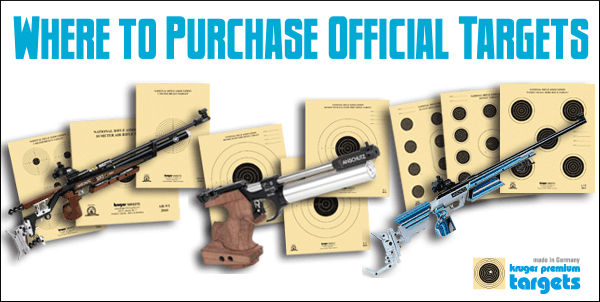
Sources for Official Shooting Competition Targets:
AccurateShooter.com offers dozens of FREE, printable targets for target practice, load development, and fun shooting. We also offer a few of the most popular NRA Bullseye targets. One or more of these printable targets should work for most training purposes. However, some readers have asked: “Where can we get the real targets… exactly like the ones used in NRA, IBS, and NBRSA shooting matches?”
All these vendors carry nearly all the NRA High Power and Smallbore targets, including the new, smaller F-Class targets. Germany’s Kruger Targets sells all the important NRA targets, and international (ISSF) air rifle and smallbore targets too.

Orrville Printing currently sells IBS targets for rimfire (50 yard) benchrest, short-range centerfire Benchrest (100, 200, 300 yards), Hunter BR Rifle (100, 200, 300 yards), plus the official 600-yard and 1000-yard IBS targets. National Target Company also has most of the IBS targets. NBRSA short-range, 600-yard, and 1000-yard benchrest targets are available directly from the NBRSA Business Office. Call (307) 655-7415 to order for the season.
| Available Official Competition Targets |
| Vendor |
NRA High Power |
F-Class |
NRA Smallbore |
Air Rifle/Pistol |
IBS |
NBRSA |
Other |
ALCO Target
Company |
Yes, All |
No |
Yes |
Yes |
No |
No |
Archery, IDPA, IPSC, Police, Realistic, Shoot-N-C, Silhouette, Fun Targets, Pasters. |
American Target
Company |
Yes, All |
Yes |
Yes, All |
Yes |
No |
No |
USBR, Sight-in, Muzzle-Loading, Police Silhouette |
Kruger Premium
Targets |
Yes, All |
Yes |
Yes, All |
Yes |
No |
No |
IDPA, IPSC, Animal Shapes, ISSF, Sight-in, Fun Targets |
National Target
Company |
Yes, Nearly All |
Yes |
Yes, All |
Yes |
Yes* |
No |
IDPA, IPSC, FBI, Police Silhouette, Sight-in, Target Backers, Pasters |
| Pistoleer.com |
Yes |
Yes |
Yes, most and color training |
Yes |
Yes |
No |
Bianchi, FBI, IBS, IDPA, IPSC, Silhouette, Archery, Pasters |
| U.S. Target, Inc. |
Yes |
Yes |
Yes, All |
Yes |
No |
No |
Bianchi, FBI, Police Silhouette, IPSC, Realistic Silhouette, Varmint |
November 17th, 2016

No more High Power Championships at Camp Perry. No, this is NOT an April Fools Day story. The NRA has announced that it is moving the National High Power XTC Rifle Championship, Mid-Range Championship, and Long Range Championship away from Camp Perry, Ohio, starting in 2017. These matches will henceforth be held at Camp Atterbury, Indiana. The CMP Matches will continue to be held at Camp Perry, so we are told. That means if you want to compete in both CMP and NRA rifle matches, you would need to go two different venues, located 280 miles apart, in two different states.

There is a century of tradition at Camp Perry, with the National Matches held there since 1907. It appears that this venue change is going to happen, although one source states that it might be subject to change: “The move was apparently prompted by the director of NRA Competitive Shooting, and will face final approval by the NRA Board of Directors in January 2017. If enough support is garnered among the competition community by then, it could be feasible that it would be reversed, but we doubt that is the case.” Source: The Firearm Blog.
Here is the notice issued by the NRA, as published on Shooting Sports USA.
NRA Moving National High Power Rifle Championships from Camp Perry
In an effort to keep the National High Power Rifle Championships up to the high standards that competitors have enjoyed for over one-hundred years, the NRA will move the Championship from its historic home at Camp Perry, OH, to Camp Atterbury, IN. This change in venue will take effect during the 2017 National Matches, pending approval by the NRA Board of Directors in January 2017.
Dennis Willing, director of NRA Competitive Shooting explained the decision.
“The NRA High Power Rifle Committee met and determined it would be beneficial to all competitors if we moved the Championship from Camp Perry to another site. After much discussion, the range at Camp Atterbury, IN, was selected as the new home of the NRA National High Power Rifle Championships.”
The proposed match schedule (subject to change) is below:
— First Shot Ceremony – July 7
— Welcome BBQ (afternoon) – July 7
— Across the Course – July 8-13
— Mid-Range – July 14-17
— Long-Range – July 18-22
Willing added, “I intend to change the face of High Power Rifle as a discipline, and will be presenting matches that are better than competitors have ever seen before.”
Since Across the Course is scheduled to end on July 13th, there will be sufficient time for competitors to attend the CMP National Trophy Matches.
The NRA Smallbore Prone Championship is scheduled to end with sufficient time for competitors to leave Bristol, IN, and come to Camp Atterbury to compete in Mid-Range Prone and Long-Range Prone. The NRA National Pistol Championship will remain at Camp Perry but will be held July 9-14, 2017, following previous year’s practice.
The Camp Atterbury Joint Maneuver Training Center is administered by the Indiana National Guard, and has just under 35,000 acres of training and maneuver space—plenty of room in case the NRA decides to expand beyond the High Power Rifle Championships. Additionally, Camp Atterbury is home to several active U.S. Army components, including several from the First Army Division East. The site also provides various training and testing sites for military and civilian responders from around the world.


Competitors’ Comments — Pro & Con
Comments on this Venue Change have been both negative and positive.
“Nothing like abandoning over 100 years of tradition. Really stupid idea!” — C.G.
What venue could possibly be better than Camp Perry? It’s not a destination, it’s an experience.” — Stephen B.
“Very disappointing decision. The NRA should have asked shooters for their input instead of decision by committee, and, my bet…some politicians.” — Jeffrey C.
“How about the people that wants to shoot long range and CMP? Keep it Camp Perry or change the dates.” — Kevin G.
“Don’t see how this will help attendance. It doesn’t make sense.” — Alton N.
“It makes beautiful sense! Are you kidding?! Atterbury is a much more modernized facility and is HUGE. The accommodations for sleeping quarters are infinitely better and more extensive than Perry and with Indianapolis only 30 min away or less it will make attendance MUCH easier for so many people. I love Perry but you will see just how superior this facility is when you come. This should have happened a LONG time ago.” — Ron W.
“Atterbury’s ranges are outstanding, and there’s LOTS more housing options available on base if that’s part of the package put together with the base. The carriers are the same as the new ones at Perry (they were installed at Atterbury first).” — W.M.
History of the National Matches at Camp Perry

The National Matches have been held at Camp Perry since 1907. The range is located along the shores of Lake Erie in northern Ohio near Port Clinton. The site was first acquired in 1906, in response to the need for a larger facility for military training and the NRA’s shooting programs. In 1906 Gen. Ammon B. Crichfield, Adjutant General of Ohio, ordered construction of a new shooting facility on the shores of Lake Erie, 45 miles east of Toledo, Ohio. The original land for Camp Perry was purchased in 1906, and the reservation was named after Commodore Oliver Hazard Perry, the American naval commander.
On August 19, 1907, Cpl. L. B. Jarrett fired the first shot at the new Camp Perry Training Site. And that year, 1907, Camp Perry held its first National Pistol and Rifle Championship events. This location has hosted the annual NRA National Matches ever since. Today, over 4,000 competitors attend the National Matches each year, making it the most popular shooting competition in the western hemisphere.
November 17th, 2016

One week after the November Election, Henry Repeating Arms and the NRA pulled off a remarkable display of support for the Second Amendment at the Ben Avery Shooting Facility in Phoenix, Arizona.
On Monday, November 14th, 1000 proud shooters from 16 states stood side-by-side in a line spanning a mile and a half long. Under the supervision of NRA Rangemasters, the 1000 shooters simultaneously fired two shots from Henry Silver Boy .22 LR lever-action rifles.

Anthony Imperato (shown above), President of Henry Repeating Arms, said: “The Henry 1000-Man Shoot was all that I had hoped it would be and more. Looking out at a sea of 1000 participants, their families, and 400 volunteers, was very emotional. There was a tremendous sense of patriotism and I’ll never forget it.”
The record-breaking event was a combined effort between Henry Repeating Arms and the NRA. Henry donated the 1000 commemorative .22 LR rifles. One million dollars is expected to be raised. All proceeds will support NRA initiatives, including Firearms Safety, Youth Shooting Sports, Disabled Shooting programs, Child Safety programs, and NRA efforts to protect Second Amendment rights.

Pete Brownell, first VP of the NRA and CEO of Brownells Inc., said the 1000-Man Shoot served as a statement that Americans would stand up for their freedoms: “As some of you may know, we made history last week,” Brownell told the crowd. Then he encouraged participants to go out and make their own history with the record-setting shoot.
Another 1000-Man Shoot in the Future?
Will there be another 1000-man shoot? Perhaps, but there are few other shooting facilities that can hold 1000 shooters in a single line. According to the NRA’s American Rifleman: “Henry’s Anthony Imperato wasn’t ready to look ahead to a repeat of such a massive undertaking, [but] the shoot was so well-received that it wouldn’t surprise him if follow-up events occur, first because of the fact that the 1,000 slots filled so quickly, and second because he has received so many requests for a similar event in other parts of the country.”
November 17th, 2016

Here’s a great promotion from Creedmoor Sports. Right now, if you purchase any Creedmoor Hardback Heavy Coat in stock, you’ll get a $75.00 gift certificate. This coat is very popular with Service Rifle shooters, Palma competitors, and other sling shooters. These Hardback Coats are high-quality items that will last a lifetime. To see the Hardback shooting coat sizes and colors in stock, CLICK HERE.
These coats are in stock now and ready to ship. Due to the limited inventory of these coats (and specialized sizes), please call 1-800-273-3366 to order. Creedmoor’s inventory spreadsheet will be updated every 24 hours so please call to check real-time inventory levels and sizes. NOTE: This is a limited time offer.
November 16th, 2016

Hodgdon/IMR has released a new family of clean-burning shotshell and pistol propellants utilizing “green” technology. This series of five, fast-burn-rate powders will work with an extremely wide range of shotshell and pistol cartridges. Each powder was designed to match current shotshell bushing charts, so hand-loaders will already have the appropriate bushings available for each load.
IMR notes: “This new technology burns clean [and] all of these powders are REACH compliant*, meaning these propellants are not harmful to the environment.”
IMR TARGET:
The first powder in this new family, IMR Target, is a fast-burning pistol powder. This fine-grained, small-flake propellant meters superbly, providing very precise loads in even the smallest pistol cartridges like the .25 ACP!
IMR RED:
The second powder in this new family was designed to be an efficient, clean-burning, 12-gauge target powder. IMR Red also performs nicely in various lead pistol target loads, such as match competition loads and Cowboy reduced loads.
New IMR Red powder is well-suited for light Cowboy Action loads with lead bullets.

Photo courtesy Uberti.com.
IMR GREEN:
IMR Green, the third in this new family is slightly slower-burning than IMR Red, making it an ideal Trap Handicap powder and soon a favorite with Sporting Clays enthusiasts.
IMR UNEQUAL:
IMR Unequal combines small-sized flakes for uniform metering in all pistol applications and its burn speed accommodates a wide range of shotshell and pistol cartridges.
For loading pistol cartridges on a progressive press, IMR Unequal is a good choice.

Photo courtesy Dillon Precision.
IMR BLUE:
Having the slowest burn speed of the five new propellants, IMR BLUE is well-suited for for heavy 12-gauge 2¾-inch, 3-inch and 3-1/2-inch field loads.
These new IMR powders will be available in January 2017 at quality reloading powder dealers everywhere. IMR Target and IMR Blue will be available in one-pound (1 lb.), four-pound (4 lb.) and eight-pound (8 lb.) containers. IMR Red, IMR Green, and IMR Unequal will be offered in 14-ounce (14 oz.), four-pound (4 lb.) and eight-pound (8 lb.) containers.
Complete load data for these versatile and useful propellants is accessible on the Hodgdon Reloading Data Center at HodgdonReloading.com.
* Registration, Evaluation, Authorization and Restriction of Chemicals (REACH) is a European Union regulation adopted in December 2006. REACH addresses the production and use of chemical substances, and their potential impacts on both human health and the environment.
November 15th, 2016

Our friend Bill at Rifleshooter.com got his hands on some of Sierra’s brand new .30-Cal match bullets, the 195-grain Tipped Match Kings (TMKs). These feature an impressive 0.610 G1 BC above 2000 fps. We predict these new bullets will be popular with F-TR shooters shooting the .308 Winchester cartridge.
To see how the new 195gr TMKs perform, Bill loaded up some .308 Win ammo with IMR 4064, ranging from 40.5 grains up to 42.5 grains. That gave him a velocity range of 2438 FPS at the lowest charge weight, up to 2552 FPS at 42.5 grains. This was with a relatively short, 22-inch barrel. Best five-shot accuracy (and second lowest SD) was at 41.0 grains even, producing a 0.498 MOA five-shot group at 2480 fps (6.1 SD). CLICK HERE for full accuracy results.
I headed to the range on a brisk November day. Targets were 2″ orange dots at 100 yards. All shooting was done prone from a bipod with a rear bag. The Nightforce 3.5-15X scope was set at 15X. All ballistic information was recorded with a MagnetoSpeed barrel-mounted chronograph. Temperature was 54° F. Standard deviation for the loads ranged from 5.3 to 20.5 FPS. Average standard deviation was 12.5 FPS. Five-shot group sizes ranged from .521″ (.498 MOA, ) to 1.057″ (1.010 MOA). Average group size for all ten loads was .692″ (.661 MOA).

New 195gr TMK offers Impressive Long-Range Ballistics

Bill was also interested in how the ballistics of the new 195gr TMKs compared to other .30-cal projectiles. Even with a moderate, 2539 fps velocity, the new 195gr TMK showed less wind drift than other Sierras, thanks to its high 0.610 G1 BC. It also had a flatter trajectory beyond 600 yards than the 175gr and 190gr Sierra MatchKings. (The faster-flying 175gr TMK had slightly less drop at all yardages.)
Bill explains: “For comparison purposes, I selected the 42.0 grain load, with a muzzle velocity of 2,539 feet/second and an SD of 6.9. This load is compared to loads for the 190 SMK, 175 SMK, 175 TMK, and 168 Federal Gold Medal ammunition in the test rifle. In other words, these aren’t maximum loads, but loads that I have developed and would feel comfortable shooting a match with in the rifle shown (you may note the 190 SMK is fairly slow, but this is what the rifle liked). Also note that this rifle has a relatively short 22″ barrel compared to those you might find on a purpose built f-class rifle.”
Bill provides a full write-up on the Rifleshooter.com website complete with target photos and load details. If you are interested in these new 195-grainers, you should read the full report.
November 15th, 2016
Trajectory of Bullet fired at Sea Level
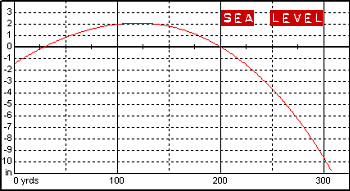 Trajectory of Bullet fired at 20,000 feet

You can do your own experimental calculations using JBM Online Ballistics (free to use). Here is an extreme example, with two printouts (generated with Point Blank software), one showing bullet trajectory at sea level (0′ altitude) and one at 20,000 feet. For demonstration sake, we assigned a low 0.2 BC to the bullet, with a velocity of 3000 fps.
 One of our readers asked “What effect does altitude have on the flight of a bullet?” The simplistic answer is that, at higher altitudes, the air is thinner (lower density), so there is less drag on the bullet. This means that the amount of bullet drop is less at any given flight distance from the muzzle. Since the force of gravity is essentially constant on the earth’s surface (for practical purposes), the bullet’s downward acceleration doesn’t change, but a bullet launched at a higher altitude is able to fly slightly farther (in the thinner air) for every increment of downward movement. Effectively, the bullet behaves as if it has a higher ballistic coefficient. One of our readers asked “What effect does altitude have on the flight of a bullet?” The simplistic answer is that, at higher altitudes, the air is thinner (lower density), so there is less drag on the bullet. This means that the amount of bullet drop is less at any given flight distance from the muzzle. Since the force of gravity is essentially constant on the earth’s surface (for practical purposes), the bullet’s downward acceleration doesn’t change, but a bullet launched at a higher altitude is able to fly slightly farther (in the thinner air) for every increment of downward movement. Effectively, the bullet behaves as if it has a higher ballistic coefficient.
Forum member Milanuk explains that the key factor is not altitude, but rather air pressure. Milanuk writes:
“In basic terms, as your altitude increases, the density of the air the bullet must travel through decreases, thereby reducing the drag on the bullet. Generally, the higher the altitude, the less the bullet will drop. For example, I shoot at a couple ranges here in the Pacific Northwest. Both are at 1000′ ASL or less. I’ll need about 29-30 MOA to get from 100 yard to 1000 yards with a Berger 155gr VLD @ 2960fps. By contrast, in Raton, NM, located at 6600′ ASL, I’ll only need about 24-25 MOA to do the same. That’s a significant difference.
Note that it is the barometric pressure that really matters, not simply the nominal altitude. The barometric pressure will indicate the reduced pressure from a higher altitude, but it will also show you the pressure changes as a front moves in, etc. which can play havoc w/ your calculated come-ups. Most altimeters are simply barometers that read in feet instead of inches of mercury.”
As Milanuk states, it is NOT altitude per se, but the LOCAL barometric pressure (sometimes called “station pressure”) that is key. The two atmospheric conditions that most effect bullet flight are air temperature, and barometric pressure. Normally, humidity has a negligible effect.
It’s important to remember that the barometric pressure reported on the radio (or internet) may be stated as a sea level equivalency. So in Denver (at 6,000 feet amsl), if the local pressure is 24″, the radio will report the barometric pressure to be 30″. If you do high altitude shooting at long range, bring along a Kestrel, or remember to mentally correct the radio station’s pressure, by 1″ per 1,000 feet.”
If you want to learn more about all aspects of External Ballistics, ExteriorBallistics.com provides a variety of useful resources. In particular, on that site, Section 3.1 of the Sierra Manual is reprinted, covering Effects of Altitude and Atmospheric Pressure on bullet flight.
November 15th, 2016
In this video, Anette Wachter (the 30CalGal) offers tips for shooting from bipod.
 Our friend Anette Wachter, aka “30CalGal”, stars in a smart video from NRAWomen.TV. In this episode of Tips & Tactics, Anette talks about the “mental game” in competition. Specifically she explains how to “visualize success”: Our friend Anette Wachter, aka “30CalGal”, stars in a smart video from NRAWomen.TV. In this episode of Tips & Tactics, Anette talks about the “mental game” in competition. Specifically she explains how to “visualize success”:
I have found that a lot of my success in competition has come through what I call a ‘mental rehearsal’. I actually visualize every stage of the match and I visualize the success of the match and winning the match.
I actually visualize that round going downrange into the target, and the target coming up with a dead-center ‘X’. I visualize this over and over. If you visualize success you will achieve success.
|
Visualization is a process of mental preparation that is done before you get to the range. Many of the greatest shooting champions have used this technique to get ready for big matches, and to optimize their performance during record fire. If you want to enhance your “mental game” through pre-match visualization, we strongly recommend Lanny Bassham’s book, With Winning in Mind.
As a competitive smallbore 3P shooter, Bassham developed a mental management system. Using this system, Lanny Bassham won 22 world individual and team titles, set four world records, and captured an Olympic Gold Medal in Montreal in 1976. His techniques have been embraced by professional and Olympic athletes in many sports. With Winning in Mind covers a complete system of “mental management” techniques used by Olympians and elite champions. |
|
About 30CalGal
Life is short. Go Shoot! — Anette Wachter
Along with being a talented competitive shooter, Anette has her own Gun Blog, 30CalGal.com, and she writes for several gun publications including GunUp Magazine, Shooting Sports USA, Sure Shots Magazine, and Wide Open Spaces. She also designs and crafts custom jewelry items, sold through her AW Collections webstore.
November 14th, 2016

At the request of our readers, we provide select “Deals of the Week”. Every Monday morning we offer our Bargain selections. Here are some of the best deals on firearms, hardware, reloading components, and shooting accessories. Be aware that sale prices are subject to change, and once clearance inventory is sold, it’s gone for good. You snooze you lose.
1. Bruno Shooters Supply — 5% OFF Almost Everything

The folks at Bruno Shooters Supply have made it simple. Now through 8:00 PM on November 15th, you can get five percent (5%) off everything in stock (except for actions, gunsmithing, and complete rifles). Save on bullets, brass, powder, scopes, barrels, stocks, triggers and much more. This is a great way to stock up on reloading supplies and get quality components (such as barrels and triggers) for your upcoming rifle builds. NOTE: This 5% discount offer applies to online sales only. And don’t delay — this offer runs out at 8:00 pm MST on Tuesday, November 15, 2016.
2. EuroOptic — Schmidt & Bender PMII 5-25x56mm Scope SALE

Our buddy Jason Baney at EuroOptic.com told us about this hot Schmidt & Bender deal. (S&B makes superb scopes, with the best glass you can buy). Prices have been slashed on all new Schmidt & Bender PMII 5-25x56mm riflescopes. For example, the price on the 5-25x56mm DT P4 version has been cut from $3739.00 to $3200.00, a $539.00 savings.
Chosen by the U.S. Special Operations Command as its Precision Sniper Rifle optic, the Schmidt & Bender PMII 5-25x56mm offers high magnification, reticle illumination, and three elevation turret types each offering 26 MRAD of travel. The standard turret is a double-turn non-locking model with locking and non-locking MTC versions also in stock. Available with reticle in either first or second focal plane, the standard configuration is FFP. Reticles include P4Fine, Gen2XR, MSR, H2CMR, H59 and Horus T2. Colors are Black, Pantone, and RAL8000.
3. Amazon — RCBS Partner Press, $65.99

We own and use the compact RCBS Partner press. Small and easy to transport, the RCBS Partner press is great for loading at the range. It also makes a good secondary press in your loading room for depriming cases or seating bullets. That lets you dedicate your bigger, full-size press for heavy-duty chores such as case sizing. At most vendors, the RCBS Partner Press sells for $80.00 or more. Right now it’s on sale at Amazon.com for just $65.99.
4. Stocky’s Stocks — Composite Stock with Bedding Block, $179.99

Here’s a killer deal on a versatile Stocky’s Long Range Stock with aluminum V-block bedding system. For just $179.99, order this for Rem/Rem Clone long actions or short actions, with either narrow or wide (varmint/tactical) barrel channel. This would be a good choice for a varmint rifle. This is also offered with a matte black, tan, or olive baked-on textured finish for $199.99.
5. Amazon — Lyman Case Prep Xpress $94.99

The Lyman Case Prep Xpress lets you chamfer inside and out, brush your necks, clean/uniform primer pockets, and ream military crimps. On sale at Amazon.com with $94.99 Prime pricing, this is a good deal. Lyman’s Case Prep Xpress sells elsewhere for $130.00 or more. Here is a review from a Verified Purchaser: “The unit is quiet, sturdy, and the attachments do what they are supposed to do. It already has made a difference in my reloading speed, and most importantly, my comfort. I highly recommend this unit.” (Strafer, 4/7/14)
6. CDNN Sports — HK 416 .22LR Rimfire Rifle, $379.99

 If you are looking for an AR-type .22 LR rifle for cross-training and rimfire tactical matches, the HK 416 is a fine choice. Made by Walther under license, these HK 416 D145RS rimfire rifles are accurate and reliable. This is a good deal at $379.99. The HK 416 normally sells for $550.00 to $600.00. And for a limited time, you can get a FREE, 525-ct box of .22 LR ammo with the purchase of an HK 416 (ammo offer expires 11/14/2016). If you are looking for an AR-type .22 LR rifle for cross-training and rimfire tactical matches, the HK 416 is a fine choice. Made by Walther under license, these HK 416 D145RS rimfire rifles are accurate and reliable. This is a good deal at $379.99. The HK 416 normally sells for $550.00 to $600.00. And for a limited time, you can get a FREE, 525-ct box of .22 LR ammo with the purchase of an HK 416 (ammo offer expires 11/14/2016).
One purchaser writes: “Great .22. I have had this gun a couple of months and have put about 500 rounds of 5 different brands of ammo through it. Not one FTE. I have shot other brands that can’t get through one 30-round mag without a failure.” CLICK HERE for Product Details.
7. Grafs.com — Magnetospeed Sporter $179.99

If you have been waiting to get a Magnetospeed… wait no longer. Priced at just $179.99 at Grafs.com, the Magnetospeed Sporter model costs less than half as much as Magnetospeed’s V3 models. This chronograph attaches directly to your barrel so you don’t have to go downrange to position tripods and set up skyscreens. For most people the Sporter Model contains all the features they need. Using Magnetospeed’s XFR adapter (sold separately), data can be transferred easily from the display module to your mobile device. READ Magnetospeed Sporter Review.
8. Midsouth — Roll of 250 Adhesive Benchrest Targets, $14.98
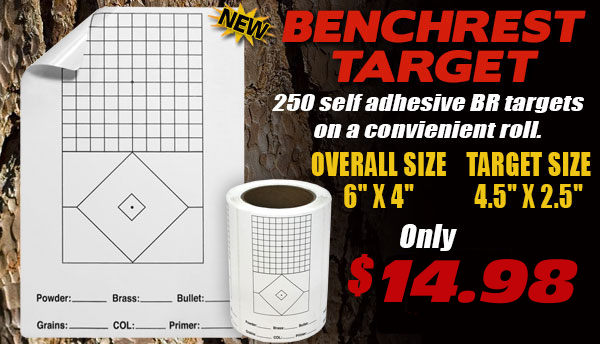
For under $15.00, you can get 250 self-adhesive Benchrest Targets on a convenient roll. Not just for benchrest competitors, these stick-on targets work great for anyone doing load development. Each target offers a precision 1/4″ grid at the top with diamond aiming box below. This is similar to official targets used in Benechrest matches, with the addition of the upper grid lines which allow you to instantly estimate group size. These targets also include an area to list your load components. Midsouth sells the 250-target roll for $14.98.
9. Natchez — 9mm Luger Steel-cased Ammo, $8.79 per 50ct Box

It’s hard to beat this price for new 9mm Luger ammunition. We’ve found this Tulammo 115gr FMJ to be reliable, and good for general training use. At this price, $8.79 per box, you’re paying less than 18 cents per round. At that rate it’s hard to justify hand-loading your 9mm pistol ammo.
November 14th, 2016

 The Civilian Marksmanship Program (CMP) invites young men and women shooters to apply for CMP scholarships for the 2017-2018 school year. The CMP offers $1,000 one-year scholarships to current high school seniors. Since 2005, CMP has awarded over $1 million in scholarship grants. Last year, the CMP received a record-setting number of applications and awarded over $150,000 in scholarship money. Winning scholarship recipients came from JROTC programs, 4-H groups and other shooting clubs. The Civilian Marksmanship Program (CMP) invites young men and women shooters to apply for CMP scholarships for the 2017-2018 school year. The CMP offers $1,000 one-year scholarships to current high school seniors. Since 2005, CMP has awarded over $1 million in scholarship grants. Last year, the CMP received a record-setting number of applications and awarded over $150,000 in scholarship money. Winning scholarship recipients came from JROTC programs, 4-H groups and other shooting clubs.
CMP Scholarships are based on merit. Selected individuals are high school seniors who are currently enrolled in a team or club that is participating in rifle or pistol marksmanship competitions. Applicants must provide rifle or pistol competition history, list of awards, and future goals in the shooting sports. Applicants must also provide academic GPA and an official high school transcript (3.0 Minimum GPA Required).
Applications are Being Accepted Now for 2017-2018
The CMP is now taking scholarship applications for the 2017-2018 freshman college year. Scholarships are one-year awards that may be used to fund any accredited, post-secondary education or vocational program. (Note: Students planning to enroll in a military academy are not eligible).
CMP Scholarship Regulations | 2017-2018 Scholarship Application Form.
The deadline for CMP Scholarship Application is March 20, 2017. Learn more about the program at the CMP Website Scholarship Page. If you have any questions, please contact Kathy Williams at 419-635-2141, ext. 709, or email kwilliams [@] thecmp.org.
|


