Creedmoor Sports has released a series of helpful “how-to” videos in its InfoZone web page. In one InfoZone video Bill Gravatt shows how to seat bullets using L.E. Wilson Hand Dies and an Arbor Press. The basic process is simple, particularly with a micrometer-top seating die. That makes it easy to adjust and set seating depth. Before you start seating bullets, you want to adjust the height of the arbor so the stroke is appropriate to the height of your die.
Bill Gravatt Shows How to Use Hand Seating Dies — Creedmoor INFOZONE
ARBOR PRESS TECHNIQUE: When using an arbor press, smooth is good. You don’t want to slam the handle down quickly. Try to repeat the same motion each time. You can also experiment by seating the bullet part way, then rotate the cartridge (in the die) and do the final seating with a second stroke. If your arbor press has a force gauge, note both the max value of the gauge needle and how it moves as you seat the bullet. If the needle spikes too rapidly, or bounces back and forth irregularly, set that cartridge aside and/or mark it. You could have neck tension issue with that case or some other fault. You might even have a bad bullet. That’s rare, but can happen. The key to success is moving the press arm in a smooth motion every time, maintaining the same down-pressure with each cartridge.
Here Bill Gravatt Offers a Simple Tip for Adjusting Wilson Seating Dies
One of our Forum readers asked “How can I get a custom in-line seater for my new rifle?”. First, we would say that, if you are not shooting an unusual Wildcat, check first to see if L.E. Wilson makes a stainless Micrometer Seater Die for your rifle. These dies are a joy to use, and we’ve found the fit to be exceptionally good with many calibers. Typically priced from $95-$120, Wilson stainless micrometer-top seaters are available for dozens of cartridge types: .204 Ruger, 20 BR, .222 Rem, .223 Rem, 22 PPC, 22 BR, .22-250, .223 WSSM, 6 PPC, 6mmBR, 6XC, 243 Win, .243 WSSM, 25 WSSM, 6.5×47 Lapua, 6.5 Creedmoor, 6.5-284, 26 Nosler, .270 WSM, 7mm-08, .284 Win, 28 Nosler, 7mm RUM, 30 BR, .308 Win, .300 WinMag, .338 Edge (and MORE).
If you do want a custom seater die, the process is relatively simple. Purchase a die blank from Wilson and have your gunsmith run the chambering reamer in. Forum member Gunamonth explains: “I start with a Wilson seating die blank. They’re available from Sinclair and other vendors. Just run the reamer in. For some of my rifles, where I wanted the stainless die with the micrometer adjustment, I bought a smaller die and had the smith ream it with the chamber reamer. That’s how I had my 6 Dasher and 6mm AI seaters made. With the Dasher I stared with a 6mmBR Micrometer die.”
SEATER STEM TIP: If, on your seated bullets, you are seeing a sharp line around the jacket near the ogive, you may want to smooth out the leading edge of the Wilson seater stem (see above left). Do this by putting a little lapping compound on one bullet and manually spin this around in the stem. Without much effort you’ll have a smooth bullet/stem interface.
Micrometer Top Add-on
We really like micrometer tops on a seating die. But what if Wilson doesn’t make a micrometer top seater for your chambering? Don’t despair, Brownells sells a $39.99 Sinclair Micrometer Top that can be added to Wilson standard seaters or to a custom seater die made from a Wilson die blank.
The NRA Blog ran an feature on Silhouette shooting by NRA Silhouette Program Coordinator Jonathan Leighton. Here are selections from Leighton’s story:
NRA Silhouette Shooting
The loud crack from the bullet exiting the muzzle followed by an even louder ‘clang’ as you watch your target fly off the railing is really a true addiction for most Silhouette shooters. There is nothing better than shooting a game where you actually get to see your target react to the bullet. In my opinion, this is truly what makes this game so much fun.
Metallic Silhouette — A Mexican Import
Silhouette shooting came to this country from Mexico in the 1960s. It is speculated that sport had its origins in shooting contests between Pancho Villa’s men around 1914. After the Mexican Revolution the sport spread quickly throughout Mexico. ‘Siluetas Metalicas’ uses steel silhouettes shaped like game animals. Chickens up front followed by rows of pigs, turkeys, and furthest away, rams. Being that ‘Siluetas Metalicas’ was originally a Mexican sport, it is common to hear the targets referred to by their Spanish names Gallina (chicken), Javelina (pig), Guajalote (turkey) and Borrego (ram). Depending on the discipline one is shooting, these animals are set at different distances from the firing line, but always in the same order.
Before Steel There Was… Barbeque
In the very beginnings of the sport, live farm animals were used as targets, and afterwards, the shooters would have a barbeque with all the livestock and/or game that was shot during the match. The first Silhouette match that used steel targets instead of livestock was conducted in 1948 in Mexico City, Mexico by Don Gonzalo Aguilar. [Some matches hosted by wealthy Mexicans included high-ranking politicians and military leaders].
As the sport spread and gained popularity during the 1950s, shooters from the Southwestern USA started crossing the Mexican border to compete. Silhouette shooting came into the US in 1968 at the Tucson Rifle Club in Arizona. The rules have stayed pretty much the same since the sport has been shot in the US. NRA officially recognized Silhouette as a shooting discipline in 1972, and conducted its first NRA Silhouette Nationals in November of 1972.
Great Video of Silhouette Shooting in Canada with Drone Footage
Now There Are Multiple Disciplines
The actual sport of Silhouette is broken into several different disciplines. High Power Rifle, Smallbore Rifle, Cowboy Lever Action Rifle, Black Powder Cartridge Rifle, Air Rifle, Air Pistol, and Hunter’s Pistol are the basic disciplines. Cowboy Lever Action is broken into three sub-categories to include Smallbore Cowboy Rifle, Pistol Cartridge Cowboy Lever Action, and regular Cowboy Lever Action. Black Powder Cartridge Rifle also has a ‘Scope’ class, and Hunter’s Pistol is broken into four sub-categories. Some clubs also offer Military Rifle Silhouette comps.
Where to Shoot Silhouette
NRA-Sanctioned matches are found at gun clubs nation-wide. There are also many State, Regional, and National matches across the country as well. You can find match listings on the Shooting Sports USA website or contact the NRA Silhouette Department at (703) 267-1465. For more info, visit SteelChickens.com, the #1 website dedicated to Silhouette shooting sports.
A Virginia Congressman has introduced legislation which will take suppressors (aka “silencers”) off the NFA list and make them much easier to purchase. That’s a good idea because a quality suppressor can reduce firearm sound levels by 30 decibels (dB) or more. U.S. Rep. Ben Cline’s Hearing Protection Act (H.R. 404) would remove firearm suppressors from the list of restricted items under the 1934 National Firearms Act (NFA). That would reduce costly licensing ($200 per suppressor) and burdensome background checks. Instead, suppressors would be regulated under the 1968 Gun Control Act (GCA) with the same type of background check done with retail firearm purchases. The legislation would also amend statutory suppressor definitions.
Under current law, an individual purchasing a suppressor must locate a regulated NFA Class III retailer, complete a Bureau of Alcohol, Tobacco, Firearms and Explosives (ATF) Form 4 with the model and serial number of the suppressor, and obtain two passport photos and fingerprint cards from a local police department. The local chief law enforcement official must receive a completed copy of the application. Then the form, photographs, and fingerprints must be sent to ATF along with a check to pay the $200 tax. The customer can obtain the suppressor from the NFA Class III retailer upon an additional background check through FBI’s National Instant Criminal Background Check System (NICS).
Congressman Cline’s legislation would eliminate those requirements and make suppressors available with the same type of paperwork and background check required for a firearm. H.R. 404 would also clarify the definition of suppressors, ensuring that components like mounts, baffles and end caps are not erroneously classified as standalone suppressors or “silencers”.
“Congressman Cline’s Hearing Protection Act will have the federal government recognize firearm suppressors for what they are. These are accessories to a firearm that make recreational shooting and hunting a safer experience”, said Lawrence G. Keane, NSSF Senior V.P. and General Counsel. “These safety devices reduce the report of a firearm to a level that won’t cause instant and permanent hearing damage.” There are currently 2.6 million legally owned suppressors in the United States.
See Through Suppressor in Super Slow Motion (110,000 fps) — Click Arrow to Watch:
Suppressors, On Average, Reduce Noise Levels about 30 Decibels
In an article for Ammoland, gunwriter Sam Hoober says that you can expect about 30 decibels (dB) of noise reduction from the average suppressor: “Looking at a few different products, SilencerCo attests their suppressors reduce the sound pressure of a 9mm gunshot to anywhere from 125.7 dB to 131.5 dB, depending on the model. Advanced Armament Co, another popular supplier, attests a 23 dB to 33 dB reduction or down to 127 dB. Liberty Suppressors, another manufacturer, attests a reduction of 24 dB to 38 dB, depending on model and other factors. In short, we can presume something on the order of 30 dB of attenuation as an average.”
Using that 30 dB number you can quickly discern that you’ll still need hearing protection — good hearing protection — when shooting any suppressed firearm (even a .22 LR). “Spikes of 130 dB and more can result in permanent hearing damage instantly”. Source: NRA Blog.
Firearm suppressors (aka “silencers”) reduce the report of a firearm from a level roughly equal to that of a jet taking off which causes instant and permanent hearing loss to one that is safe, but still equal to a jackhammer. That decibel level will not permanently damage hearing. Suppressors work similar to a car’s muffler, redirecting exhaust gases.
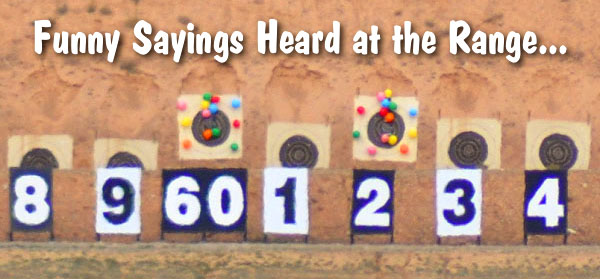
Shooting can be a frustrating sport at times, prompting shooters to say some funny things in the heat of the moment. Here’s a collection of humorous range ripostes, supplied by Shooters’ Forum members (who are listed after each quote). Enjoy.
“I paid to use all of the target and I’m getting value for money on all of the real estate!” (Macropod)
“At 65 years of age, 1000-yard benchrest is better than sex, because a relay lasts 10 minutes!” (The Viper)
“How did I do?” “Well the gun went off and nobody got hurt, we can build on that….” (Mr. Majestic)
“Treat that trigger likes it’s your first date, not like you’ve been married to it for 20 years.” (Jet)
“It’s a good thing broad sides of barns aren’t at many shooting ranges.” (Rocky F.)
Target photo by Forum member RyanJay11.
“It was an 0.2″ group! Well, err, except for that flyer….” (Dsandfort)
“It’s not the arrow, it’s the Indian.” (Rocky F.)
“I can’t understand it. That load worked good in my other barrel”. (Hogpatrol)
“You bakin a biscuit?” Said to me as I was sitting at the bench ready to shoot with a cartridge in the chamber of a hot gun, taking longer than necessary. (Ebb)
“Shooting groups is easy. Just put the last three between the first two.” (Uthink)
Shooter 1: “Hey you cross-fired on my target!”
Shooter 2: “Well you cross-fired on mine first!”
Shooter 1: “Yeah but you could have at least shot an X like I did on yours.” (At Raton — Rocky F.)
“I had a bughole going and my second shot dropped straight down!” (JDMock)
“The nut came loose on the end of my stock.” (TXDan)
“That’s a pretty eight.” (REastman quoting James Crofts)
“I almost shot a record.” (Jay Christopherson)
This article is Copyright 2023 AccurateShooter.com. No reproduction on any other website is allowed.
SHOT Show 2025 kicks off in Las Vegas, Nevada in less than three weeks, starting with Industry Day at the Range on 1/20/25 where new guns can be tested at the Boulder City Rifle & Pistol Club range.
SHOT Show draws visitors from around the world. At SHOT Show 2024, exhibitors, buyers, media, and industry professionals hailed from 50 states and over 115 countries. The 2025 SHOT Show will have more than 2,700 exhibitors on the show floor, including the Suppliers Showcase. Total exhibit space for the 2024 show in these two venues is estimated to be more than 830,000 net square feet –equivalent to more than 18 acres or enough space to park 547 F-16 fighter jets. The SHOT Show boasts 13.9 miles of aisles — a distance more than half a marathon.
Firearms and ammunition are an $8.9 billion industry. The total economic impact of the sporting arms and ammunition industry is more than $90.1 billion, which supports more than 384,000 jobs.
More than 55,400 professionals in the shooting, hunting, outdoor and law enforcement industry attended SHOT Show in 2024. There could be even more this year. The SHOT Show’s website is SHOTShow.org and you’ll find daily reports on the SHOT Show Blog. You can also follow SHOT Show on Twitter @NSSFSHOTShow, on Facebook, LinkedIn, YouTube, and @shotshow on Instagram.
Our friend Dennis Santiago was doing some dry firing practice recently, using a SCATT sensing device. This electro-optical unit shows a trace of barrel/muzzle movement on a computer screen, allowing a shooter to improve his hold and aiming. With practice, you get steadier, and learn to break the shot more perfectly. Top position shooters worldwide use this system. Dennis tells us: “This is my dry fire practice set up. I’m working on my approaches to the target today. You need the SCATT’s traces to see the feedback of what’s going on.” Here is one trace from Santiago’s morning training session:
Dennis trains indoors at his house: “The set-up is in a room with the target about 15 feet away mounted on a scope stand at eye height and aligned. This morning, it’s focus and trigger control. My offhand form is gonna get there bit by bit. There are many details to turn into instincts.”
SCATT MX-02 Training System
The SCATT MX-02 is an electronic shooter training system that is capable of operating outdoors with live, centerfire ammunition, at distances from 25 yards to 600 yards. Tony Chow tested this product for AccurateShooter.com. As fitted to his AR-15 Service Rifle, Tony concludes this is a very useful tool that can help High Power competitors refine their technique and shoot higher scores. FULL REVIEW HERE.
How the SCATT MX-02 Works
The SCATT sensor mounted on the end of the barrel has a digital camera that recognizes the black bullseye in the target, even in broad daylight outdoors. Using the bullseye as a reference, the SCATT software tracks the movement of the muzzle relative to the center of the target. The unit can plot these movements as a continuous trace, which appears on a monitor as a squiggly, colored line. By sensing the exact moment of shot release, the SCATT can also interpolate relative shot placement (for a single shot or series of shots) — but this is not the same as an electronic target which actually records the exact shot impact location on the target.
Pro shooter Kirsten Joy Weiss demonstrates the SCATT MX-02 electronic training system:
The system traces and records valuable information such as hold pattern, shot hold duration, follow-through, recoil pattern, and much more. The latest SCATT MX-02 systems can be used both indoors and outdoors up to 300 meters (and possibly more). READ FULL SCATT MX-02 TEST HERE.
SCATT traces reveal muzzle movements during the aiming process.
This barrel’s shoulder was 0.025″ off the action because Red Locktite had been used on the threads.
Gunsmith Thomas ‘Speedy’ Gonzales offered this interesting report about how NOT to headspace a barrel. Hopefully you never discover something like this…
“A good friend and customer sent this rig in for repair after FedEx damaged the rifle during inbound transport from another smith. After repairing the stock and rebedding it, I decided to re-polish the barrel to make the repair perfect. Well this just added insult to injury as the barrel did not want to come off. After a few choice words, the barrel finally broke free only to reveal something very disturbing. It seems the barrel had been ‘headspaced’ by using RED Loctite to hold it in place.” [Editor: That’s definitely NOT how barrels should be fitted.]
Speedy was not happy: “I hope the smith that did this sees the photos and realized what jeopardy he put my customer in or anyone who shot the rifle for that matter. When cleaned up, the shoulder on the barrel was over 0.0250″ (25 thousandths) away from the face of the receiver.” [Editor: That’s a lot in this business]. Check out the images below to see how much the barrel rotated further inward when cleaned up. The barrel spun in nearly another eighth-turn or more. Not good.
Intro: Ron Dague wanted a new gun that was similar to his trusty .223 Rem rifle, but which fired 6mm bullets. There is a superb choice of bullets in this caliber, and Ron found that the 95gr Berger VLD could be driven to a healthy 2604 FPS by the small .223 Rem case. This 6mm wildcat based on the common .223 Remington offers excellent accuracy and very low recoil — something very important in the cross-the-course discipline. In addition, Ron’s 95gr load with Alliant Reloder 15 delivered an ES of just 4 fps over ten shots. That exceptionally low ES helps achieve minimal vertical dispersion at 600 yards.
By Ron Dague, Sinclair Reloading Tech
From Sinclair’s GunTech Articles Archive
I have watched a change in thinking for NRA High Power across the course in match rifles and calibers. There are several [popular chamberings]: 6mm AR, 6.5 Grendel, 6XC, and 6.5 Creedmoor. I have seen these rifles perform and all have done very well.
When I started this project I was looking for a cartridge that shoots and feeds well from a magazine[.] I had shot the .223 Rem in my 722 Remington and knew it had fed well so I chose the .223 Remington necked up to 6mm.
The 6mm-223 gives me what I have in the standard .223 only with a better selection of bullets. I wanted a better 600-yard bullet with a higher BC than provided by the 80 and 82 grain bullets. I also wanted a 600-yard line bullet with a .500 or better B.C. for those shots that should be 10 ring or better but seem to find the 9 ring no matter how well I held and broke the shot.
Putting the 6mm-233 Project Together
My project started with ordering a 6mm barrel from Bartlein with a 1-8″ twist. I called Pacific Tool and ordered the 6mm-223 reamer. I found a used Remington 700 action at a local gun shop and already had a Remington 40X stock. I then started putting the gun together.
I already had a .223 Remington match rifle, and I wanted the 6mm-223 to be as close to the same as I could make it. I installed the barreled action in a wood 40X stock to work up load data and work out any magazine feeding issues. While I was working on that, I looked for a McMillan Baker Special stock and finally found one to finish this project. I bedded the action and stock, then took the rifle to the range to check zeros on the sights and scope. I was surprised that I didn’t have to change anything on the sights. I thought changing the stock would cause sight changes. The thought went through my head, “Maybe the 40X stock isn’t all that bad”.
Here’s line-up of 6mm bullets. The Berger 95gr VLD is in the middle.
I took the new rifle to the first match of the year, a National Match Course match, and my off-hand score was 83, rapid sitting 95, rapid prone 95, and slow fire prone 197 — for total aggregate 470. This may not be my best work, but on match day the wind was blowing about 15 mph and the temp was around 40° F, with rain threatening. This was a reduced course of fire — we shot at 200 and 300 yards on reduced targets.
I used 70gr Berger bullets for this match, loaded in Remington brass with 25 grains of VihtaVuori N540 and Federal 205M primers. When I worked up loads for this rifle, N540 gave the best accuracy with the best extreme spread — 2,950 fps with an extreme spread of 20 fps on a 10-shot string. The load for 600 yards was with a 95gr Berger VLD bullet, with 23.0 grains of Reloder 15, Lapua cases, and the same Federal 205M primers. This load is 2,604 fps, with an extreme spread of 4 fps over a 10-shot string. I’ve shot this load at several 3×600 yard matches, and the accuracy has proven to be very good. At the last 3×600 match, my scores were as follows: 199-10x and 198-11X with scope, and 193-10X with iron sights. Best 600-yard score so far with iron sights was 198-12X.
6mm-223 Rem Rifle Specifications: 700 BDL action and floor plate, Bartlein 6mm 1:8″ twist, McMillan Baker Special stock in Desert Camo, Centra front and rear sights, Ken Farrell bases with stripper clip guide, Sinclair hand stop, and Jewell trigger. Gunsmith Neil Keller helped me with the metal work and instructed me on the action work and rebarreling.
ZEISS, a world leader in optics, has released two very impressive new 15-power binoculars: the Conquest HDX and Conquest HDX LRP. These can be used with tripod supports for spotting duties, and with 56mm lenses they offer exceptional low-light performance. The all-new ZEISS Conquest HDX LRP 15×56 (LRP stands for “Long-Range Precision”) is an advanced optic developed specifically for use in Precision Rifle Series (PRS) and National Rifle League (NRL, NRL22, NRL Hunter) competition.
Developed with input from top competitors, the Conquest HDX LRP 15×56 incorporates an advanced milliradian reticle etched onto the internal lens. This reticle helps the spotter determine accurate leads for moving targets and evaluate down-range bullet impacts. This reticle also allows the spotter to make better wind calls and assess needed corrections more quickly and accurately if there is a miss. That all works to help secure maximum points in every stage.
CLICK HERE for full details on the impressive new Conquest HDX LRP and its MRAD reticle.
The Conquest HDX LRP 15×56 reticle — a combination of T-style and tree-style designs with a floating center dot — should be familiar to competition PRS/NRL shooters. It matches the reticle pattern commonly used in FFP MilRad riflescopes — especially so with ZEISS LRP riflescopes. That assists with ease of use and making quick calls. The ZEISS HDX LRP reticle design offers a good balance of reference marks and line thickness. The precise, low-center placement of the LRP reticle was selected after extensive testing. It helps reduce eyestrain and curvature distortion.
In this video top PRS competition shooters work with the new Conquest HDX LRP long-range binoculars with MRAD reticle. They show how the reticle can be used to range targets and evaluate shot accuracy to maximize scores during a match.
Also unique to the HDX LRP version are two locking diopter adjustments. One allows for razor-sharp focusing of the reticle. The second allows for an overall sharply focused image of the entire field of view. These adjustments are specific to the individual user’s eyes but are easily changed when necessary.
You’ll want a high-quality tripod for effective use of high-magnification binoculars in PRS/NRL competition. The ZEISS Conquest HDX LRP 15×56 incorporates a 1/4-20 tripod adapter port that allows easy installation of the standard ARCA-Swiss tripod adapter — also included with the HDX LRP model.
The basic 15X Conquest HDX has a retail price of $1,899.99 and is available now. The HDX LRP version with MRAD reticle will be available in mid-February with a retail price of $1,999.99. For more information on all ZEISS Conquest HDX binoculars, visit the ZEISS Conquest HDX INFO Page.
This thought-provoking article is one of the 15 most popular Daily Bulletin features over the last 12 months. We are republishing this story today for readers who may have missed it the first time around…
Here’s a little known fact that may startle most readers, even experienced gunsmiths: your barrel wears out in a matter of seconds. The useful life of a typical match barrel, in terms of actual bullet-in-barrel time, is only a few seconds. How can that be, you ask? Well you need to look at the actual time that bullets spend traveling through the bore during the barrel’s useful life. (Hint: it’s not very long).
Bullet-Time-in-Barrel Calculations
If a bullet flies at 3000 fps, it will pass through a 24″ (two-foot) barrel in 1/1500th of a second. If you have a useful barrel life of 3000 rounds, that would translate to just two seconds of actual bullet-in-barrel operating time.
Ah, but it’s not that simple. Your bullet starts at zero velocity and then accelerates as it passes through the bore, so the projectile’s average velocity is not the same as the 3000 fps muzzle velocity. So how long does a centerfire bullet (with 3000 fps MV) typically stay in the bore? The answer is about .002 seconds. This number was calculated by Varmint Al, who is a really smart engineer dude who worked at the Lawrence Livermore Laboratory, a government think tank that develops neutron bombs, fusion reactors and other simple stuff.
On his Barrel Tuner page, Varmint Al figured out that the amount of time a bullet spends in a barrel during firing is under .002 seconds. Al writes: “The approximate time that it takes a 3300 fps muzzle velocity bullet to exit the barrel, assuming a constant acceleration, is 0.0011 seconds. Actual exit times would be longer since the bullet is not under constant acceleration.”
We’ll use the .002 number for our calculations here, knowing that the exact number depends on barrel length and muzzle velocity. But .002 is a good average that errs, if anything, on the side of more barrel operating life rather than less.
So, if a bullet spends .002 seconds in the barrel during each shot, and you get 3000 rounds of accurate barrel life, how much actual firing time does the barrel deliver before it loses accuracy? That’s simple math: 3000 x .002 seconds = 6 seconds.
Gone in Six Seconds. Want to Cry Now?
Six seconds. That’s how long your barrel actually functions (in terms of bullet-in-barrel shot time) before it “goes south”. Yes, we know some barrels last longer than 3000 rounds. On the other hand, plenty of .243 Win and 6.5-284 barrels lose accuracy in 1500 rounds or less. If your barrel loses accuracy at the 1500-round mark, then it only worked for three seconds! Of course, if you are shooting a “long-lived” .308 Win that goes 5000 rounds before losing accuracy, then you get a whopping TEN seconds of barrel life. Anyway you look at it, a rifle barrel has very little longevity, when you consider actual firing time.
People already lament the high cost of replacing barrels. Now that you know how short-lived barrels really are, you can complain even louder. Of course our analysis does give you even more of an excuse to buy a nice new Bartlein, Krieger, Shilen etc. barrel for that fine rifle of yours.


 One of our Forum readers asked “How can I get a custom in-line seater for my new rifle?”. First, we would say that, if you are not shooting an unusual Wildcat, check first to see if L.E. Wilson makes a stainless Micrometer Seater Die for your rifle. These dies are a joy to use, and we’ve found the fit to be exceptionally good with many calibers. Typically priced from $95-$120, Wilson stainless micrometer-top seaters are available for dozens of cartridge types: .204 Ruger, 20 BR, .222 Rem, .223 Rem, 22 PPC, 22 BR, .22-250, .223 WSSM, 6 PPC, 6mmBR, 6XC, 243 Win, .243 WSSM, 25 WSSM, 6.5×47 Lapua, 6.5 Creedmoor, 6.5-284, 26 Nosler, .270 WSM, 7mm-08, .284 Win, 28 Nosler, 7mm RUM, 30 BR, .308 Win, .300 WinMag, .338 Edge (and MORE).


 The
The 
 Metallic Silhouette — A Mexican Import
 Before Steel There Was… Barbeque




 SHOT Show 2025 kicks off in Las Vegas, Nevada in less than three weeks, starting with


 By Ron Dague, Sinclair Reloading Tech
 Putting the 6mm-233 Project Together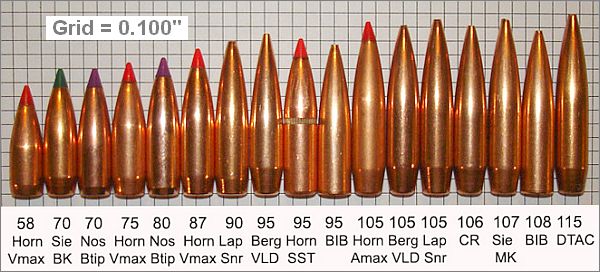


 Gone in Six Seconds. Want to Cry Now?


