Barnes Bullets has started a new Barnes Bullet Points podcast running on YouTube. Hosted by Barnes Bullets’ Marketing Mgr. Dale Evans, this podcast offers a behind-the-scenes look into the design and production of Barnes Bullets products along with use of Barnes Bullets in hunting and shooting sports.
The Barnes Bullet Points podcast will cover a variety of topics, blending technical and educational segments with real-world adventures and conversations with hunters and competitors. You can subscribe to the Barnes Bullets YouTube channel, follow on Spotify or Apple Podcasts. New podcasts will be released weekly. The first two podcasts are live now.
Episode 1: The History of Barnes
Barnes Podcast Number 1, The History of Barnes, was released last week. On the podcast, Evans is joined by Andrew Sparks and Gregg Sloan. The three men discuss Barnes Bullets’ origins, where it is today and what lies ahead. Together, they introduce both Barnes Bullets as a company and explain the Podcast goals.
Episode 2: Deep Dive into the Bullets
Podcast Episode 2 features Barnes bullet families. Listeners will learn more about the design features and performance of popular Barnes bullets. In this 75-minute podcast, Dale Evans is joined by Gregg Sloan and Mitchell Kukson. The three men discuss the features of Barnes TSX, TTSX, and LRX bullets. The podcast discusses how to select the optimal bullet type (for various scenarios), and the experts explain the performance you can expect to see from each. Watch this full 55-minute Podcast below:
“The Barnes Bullet Points podcast is a great resource for our loyal fans and end users to learn more about the brand, the products we offer and the people that help develop them”, said Evans.
SSG Amanda Elsenboss, now with the Pennsylvania National Guard, was the 2021 NRA National High Power Champion and 2019 NRA Long Range National Championship in 2019.
In the archives of On The Mark magazine, DCM Emeritus Gary Anderson, an Olympic Gold medal-winning shooter in his younger years, offers sage advice for competitive shooters.
In his article Ten Lessons I Wished I Had Learned as a Young Shooter, Anderson provides ten important guidelines for everyone involved in competitive shooting. Here are the Ten Lessons, but you should read the full article. Anderson provides detailed explanations of each topic with examples from his shooting career.
LESSON 1 – NATURAL ABILITY WILL NOT MAKE YOU A SHOOTING CHAMPION.
(You also need hard work, training effort and perseverance.)
LESSON 2 – ANGER IS THE ENEMY OF GOOD SHOOTING.
(The key to recovering from a bad shot is to stay cool, no matter what happens.)
LESSON 3 – BAD SHOTS CAN TEACH YOU MORE THAN GOOD SHOTS.
(Today, error analysis is one of the most powerful tools for improving scores.)
LESSON 4 – NEVER GO WITHOUT A SHOT PLAN.
(A shot plan is a detailed breakdown of each of the steps involved in firing a shot.)
LESSON 5 – PRACTICE IN BAD CONDITIONS AS WELL AS GOOD CONDITIONS.
(Most competitions are fired in windy conditions or where there are plenty of distractions.)
LESSON 6 – CHAMPIONS ARE POSITIVE, OPTIMISTIC PEOPLE.
(Negative shooters expect bad results; positive shooters expect to train hard to change bad results.)
LESSON 7 – IT’S NOT ABOUT WHETHER YOU WIN OR LOSE.
(It’s about how hard you try to win.)
LESSON 8 – YOUR DOG WON’T BITE YOU AFTER SHOOTING A BAD SCORE.
(Hopefully your coach, parents and friends won’t bite you either.)
LESSON 9 – YOUR PRESS CLIPPINGS CAN HURT YOU OR HELP YOU.
(Winning can go to our heads. We start thinking we are so good we don’t have to work hard any more.)
LESSON 10 — YOU NEVER SHOT YOUR BEST SCORE.
(Great champions are always looking for ways to improve.)
USAMU shooters on the firing line at the Wa-Ke’-De outdoor range in Bristol, IN. Photo courtesy USAMU.
About Gary Anderson Gary Anderson served as the Director of the Civilian Marksmanship Program (CMP) from 1999-2009, and is now DCM Emeritus. As a Nebraska farmboy, Gary grew up hunting and shooting. Dreams of winning an Olympic Gold Medal in shooting led Gary to the U.S. Army. In 1959, he joined the elite U.S. Army Marksmanship Unit. Just two years later, he won his first national championship.
At the 1962 World Shooting Championships in Egypt, Anderson stunned the shooting world by winning four individual titles and setting three new world records. At the 1964 Tokyo Olympics, Gary won the 300m free-rifle Gold Medal, setting a new world record in the process. At the 1966 World Shooting Championships in Germany, Anderson won three additional world titles. At the 1968 Olympics, Gary won a second gold medal in the 300m free-rifle event.
After his “retirement” from international competition, Gary competed in the National High Power Championships, winning the President’s National Trophy in 1973, 1975 and 1976. Over his competitive career, Anderson won two Olympic Gold Medals, seven World Championships, and sixteen National Championships. He is unquestionably one of the greatest American marksmen ever.
Today, June 20, 2024 is Summer Solstice, the longest day of the year. And right now the Northeast USA is undergoing a major heatwave. That means “peak heat” summer conditions have arrived already. It’s vitally important to keep your ammo at “normal” temps during the hot summer months. Even if you use “temp-insensitive” powders, studies suggest that pressures can still rise dramatically when the entire cartridge gets hot, possibly because of primer heating.
It’s smart to keep your loaded ammo in an insulated storage unit, possibly with a Blue Ice Cool Pak if you expect it to get quite hot. Don’t leave your ammo in the car or truck — temps can exceed 140° in a vehicle parked in the sun.
The way ambient temperatures, barrel heating, and powder warming can affect cartridge pressures (and hence velocities) was covered in a study Pressure Factors: How Temperature, Powder, and Primer Affect Pressure by Denton Bramwell. In that article, the author used a pressure trace instrument to analyze how temperature affects ammo performance. Bramwell’s tests yielded some fascinating results.
For example, barrel temperature was a key factor: “Both barrel temperature and powder temperature are important variables, and they are not the same variable. If you fail to take barrel temperature into account while doing pressure testing, your test results will be very significantly affected. The effect of barrel temperature is around 204 PSI per F° for the Varget load. If you’re not controlling barrel temperature, you about as well might not bother controlling powder temperature, either. In the cases investigated, barrel temperature is a much stronger variable than powder temperature.”
This Editor had the personal experience of 6mmBR hand-loaded ammo that was allowed to sit in the hot sun for 45 minutes while steel targets were reset. The brass became quite warm to the touch, meaning the casings were well over 120° on the outside. When I then shot this ammo, the bullets impacted well high at 600 yards (compared to earlier in the day). Using a Magnetospeed, I then chron-tested the sun-heated ammo. The hot ammo’s velocity FPS had increased very significantly — all because I had left the ammo out in the hot sun uncovered for 3/4 of an hour.
LESSON: Keep your ammo cool! Keep loaded ammo in the shade, preferably under cover or in an insulated container. You can use a SEALED cool pack inside the container, but we do NOT recommend H20 ice packs. And don’t have the container do double duty for food and beverages.
Powder Heat Sensitivity Comparison Test
Our friend Cal Zant of the Precision Rifle Blog has published a fascinating comparison test of four powders: Hodgdon H4350, Hodgdon Varget, IMR 4451, and IMR 4166. The first two are Hodgdon Extreme powders, while the latter two are part of IMR’s Enduron line of propellants.
The testers measured the velocity of the powders over a wide temperature range, from 25° F to 140° F. Hodgdon H4350 proved to be the most temp stable of the four powders tested. [NOTE: New Alliant Reloder TS 15.5 has also proved very temp stable in AccurateShooter’s range tests.]
Over the past 12 months, this article was one of the TOP 20 most-read Daily Bulletin features. We’re reprising it today for those who may have missed it the first time. The above diagram comes from a TiborasurasRex YouTube Video comparing G1 and G7 BC models. CLICK HERE to watch the video.
The better, up-to-date ballistics programs let you select either G1 or G7 Ballistic Coefficient (BC) values when calculating a trajectory. The ballistic coefficient (BC) of a body is a measure of its ability to overcome air resistance in flight. You’ve probably seen that G7 values are numerically lower than G1 values for the same bullet (typically). But that doesn’t mean you should select a G1 value simply because it is higher.
Some readers are not quite sure about the difference between G1 and G7 models. One forum member wrote us: “I went on the JBM Ballistics website to use the web-based Trajectory Calculator and when I got to the part that gives you a choice to choose between G1 and G7 BC, I was stumped. What determines how, or which one to use?”
The simple answer is the G1 value normally works better for shorter flat-based bullets, while the G7 value should work better for longer, boat-tailed bullets.
G1 vs. G7 Ballistic Coefficients — Which Is Right for You?
G1 and G7 refer both refer to aerodynamic drag models based on particular “standard projectile” shapes. The G1 shape looks like a flat-based bullet. The G7 shape is quite different, and better approximates the geometry of a modern long-range bullet. So, when choosing your drag model, G1 is preferable for flat-based bullets, while G7 is ordinarily a “better fit” for longer, boat-tailed bullets.
Drag Models — G7 is better than G1 for Long-Range Bullets
Many ballistics programs still offer only the default G1 drag model. Bryan Litz, author of Applied Ballistics for Long Range Shooting, believes the G7 standard is preferrable for long-range, low-drag bullets: “Part of the reason there is so much ‘slop’ in advertised BCs is because they’re referenced to the G1 standard which is very speed sensitive. The G7 standard is more appropriate for long range bullets. Here’s the results of my testing on two low-drag, long-range boat-tail bullets, so you can see how the G1 and G7 Ballistic coefficients compare:
G1 BCs, averaged between 1500 fps and 3000 fps:
Berger 180 VLD: 0.659 lb/in²
JLK 180: 0.645 lb/in²
The reason the BC for the JLK is less is mostly because the meplat was significantly larger on the particular lot that I tested (0.075″ vs 0.059″; see attached drawings).
For bullets like these, it’s much better to use the G7 standard. The following BCs are referenced to the G7 standard, and are constant for all speeds.
Many modern ballistics programs, including the free online JBM Ballistics Program, are able to use BCs referenced to G7 standards. When available, these BCs are more appropriate for long range bullets, according to Bryan.
[Editor’s NOTE: BCs are normally reported simply as an 0.XXX number. The lb/in² tag applies to all BCs, but is commonly left off for simplicity.]
This article is copyright 2023 AccurateShooter.com. No 3rd Party republication of this article is allowed without advance approval and payment of licensing fees.
Protect Your Hearing — Wear Protection Whenever You Shoot
Noise-induced hearing loss and tinnitus are two of the most common afflictions for recreational shooters and hunters. Everyone knows that gunfire is loud, but very few people understand the repercussions that shooting can have on their hearing until it’s too late.
The better quality suppressors can reduce the noise of a gunshot by 20 to 35 decibels (dB). Good muffs or plugs will reduce sound by 23 to 33 dB. By decreasing the overall sound signature, suppressors help to preserve the hearing of recreational shooters and hunters. Even the most effective suppressors, on the smallest and quietest calibers (.22 LR) reduce the peak sound level of a gunshot to between 110 to 120 dB. To put that in perspective, according to the National Institute for Occupational Safety and Health (NIOSH), that is as loud as a jackhammer (110 dB) or an ambulance siren (120 dB). For normal caliber handguns and rifles, suppressed sound levels routinely exceed 130 dB, just shy of OSHA’s “hearing safe” threshold of 140 dB.
According to Dr. William W. Clark, the current Director of the Washington Univ. School of Medicine’s Audiology/Communication Sciences Program, a “serious threat to hearing comes from recreational hunting or target shooting”. This is in large part due to the fact that many people choose not to use traditional hearing protection devices like earplugs and earmuffs because they want to be able to hear their surroundings. Multiple studies have found that between 70 to 80% of hunters never wear earplugs or earmuffs, and nearly half of all target shooters don’t consistently wear traditional hearing protection. Thus, it should come as no surprise that for every five years of hunting, hunters become seven percent more likely to experience high frequency hearing loss.
This article is based on information from the American Suppressor Association (ASA). Since the ASA’s formation in 2011, three additional states have legalized suppressor ownership and 18 states have legalized suppressor hunting. For more information, visit www.AmericanSuppressorAssociation.com.
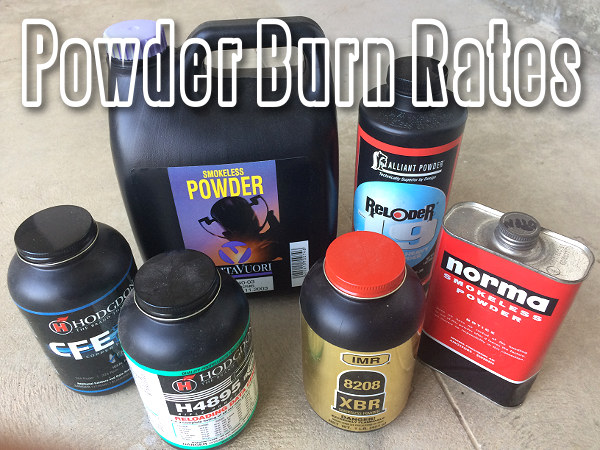
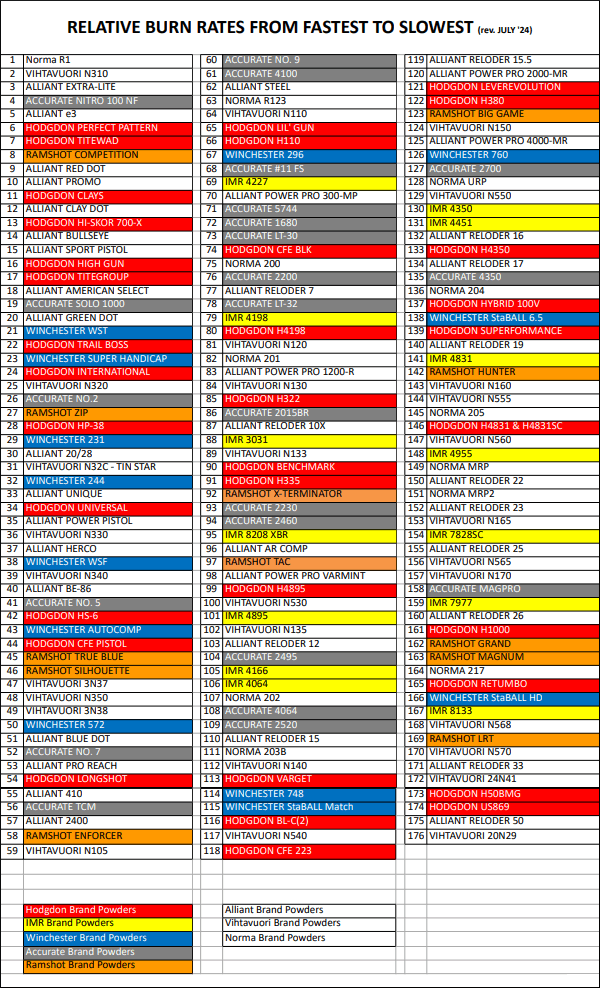
Among AccurateShooter.com’s most-visited web pages have been powder burn rate reference guides ranking powders from fastest to slowest. Here is a new, updated version of the Powder Burn Rate Table. Compiled by Hodgdon Powder Co., this Burn Rate Chart displays the relative burn rates of 176 different powders. Shown below is the latest table, released by Hodgdon in July 2024.
You’ll want to download this Powder Burn Rate Chart PDF. This 176-entry comparison table provides vital information for hand-loaders — with tested burn-rates. Note — this invaluable chart is not limited to Hodgdon and IMR propellants. This burn rate chart includes powders from eight major powder-makers: Accurate, Alliant, Hodgdon, IMR, Norma, Ramshot (Western), Vihtavuori, and Winchester.
This chart (July 2024 version) provides useful information for all hand-loaders. When doing load development, and testing one powder versus another, it’s generally wise to choose propellants that share the same relative burn rate, as least for starters.
NOTE: Hodgdon powders are red, IMR powders are yellow, Winchester powders are blue, Accurate powders are gray, and Ramshot powders are orange. Powders from Alliant, Norma, and Vihtavuori appear on the chart with white background. DOWNLOAD Burn Rate Chart HERE as PDF.
Hodgdon Powder Company (Hodgdon) offers a series of informative, “how-to” instructional videos through its online Reloading Data Center. These 3.5-minute videos present rifle, pistol, and shotshell reloading basics in an easy-to-understand, step-by-step format. These mobile-friendly, informative videos can also be viewed on a smart phone or tablet.
To watch the reloading videos go to the Reloading Data Center at hodgdon.com. Click to the right/left of the displayed video to switch between pistol, rifle, and shotgun videos. Or, for your convenience, we have embedded the Rifle and Pistol videos here. Just click to watch!
Click to Watch Hodgdon Rifle Reloading Video:
Click to Watch Hodgdon Pistol Reloading Video:
In addition to these videos, Hodgdon’s Reloading Data Center (RDC) provides a wealth of information on Hodgdon, IMR, Accurate, Winchester, and Ramshot propellants. Along with reliable load data, you’ll find explanations of reloading basics, safety procedures, plus answers to frequently asked questions (FAQ).
At the request of our readers, we provide select “Deals of the Week”. Every Sunday afternoon or Monday morning we offer our Best Bargain selections. Here are some of the best deals on firearms, hardware, reloading components, optics, and shooting accessories. Be aware that sale prices are subject to change, and once clearance inventory is sold, it’s gone for good. You snooze you lose.
NOTE: All listed products are for sale to persons 18 years of age or older. No products are intended for use by minors.
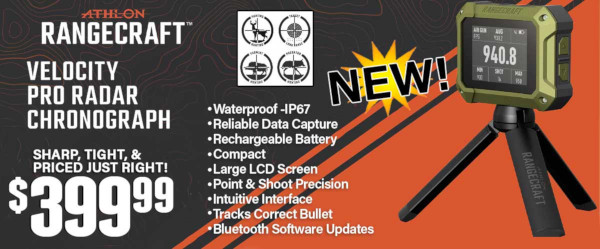
1. Midsouth — Athlon Rangecraft Vel Pro Chronograph, $399.99
⏺️ » impressive new compact radar chrono — competition for Garmin
The new Athlon Rangecraft Velocity Pro Radar Chronograph is an impressive and very affordable compact chrono, now $399.99 at Midsouth. This employs Doppler radar allowing ultra-accurate velocity readings. Since the unit isn’t triggered by a muzzle blast, it can work with suppressors, muzzle brakes, and other muzzle devices. The Rangecraft Vel Pro reads velocities between 65 FPS and 5000 FPS. So far field tests have shown that the Athlon Rangecraft chrono is very reliable and picks up all shots fired with all types of rifles and pistols (even airguns). However the listed velocities may be a few FPS different than a Magnetospeed or Labradar. Athlon also has a good Ballistics Lite App that works with this chrono — see video at 21:45 time-mark. The unit includes a compact tripod.
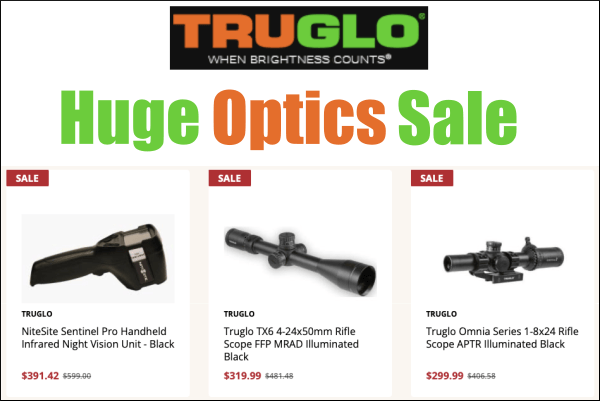
2. Natchez — Truglo Optics Sale, Save up to 34%
⏺️ » Major savings on Truglo scopes — good for hunters and AR shooters
Truglo optics (scopes, red dots), offer notable features and great value. Right now Truglo optics products are on sale at Natchez at crazy low prices. For example the Truglo 4-16x44m EMINUS16 scope with illuminated reticle and scope mount is now just $209.99 — $111.00 off the regular $321.00 price. And for AR shooters the 1-4x24mm OMNIA4 Tactical scope is discounted to $159.99 complete with rugged Aptus-M1 scope mount (with rings) — a $75 savings.
3. Creedmoor Sports — Peterson Brass Sale
⏺️ » Save on good, American-made cartridge brass
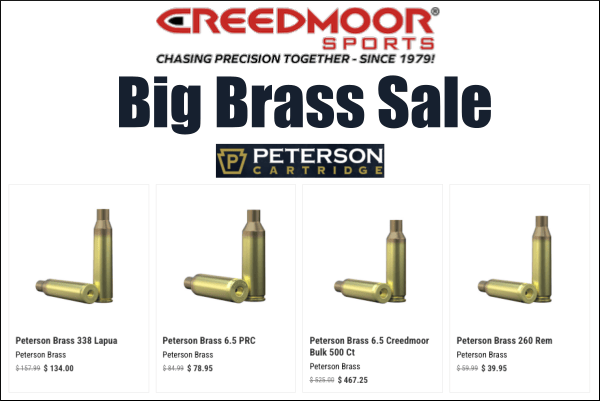
Quality loads demand quality brass. We’ve been impressed with American-made Peterson brass that has performed great for popular cartridge types including 6mm Dasher, 6XC, 6×47 Lapua, 6mm Creedmoor, 6.5 Creedmoor, .308 Win, .300 Norma Mag, .300 WinMag, .338 Lapua, .376 CheyTac and others. Peterson brass is very consistent and holds up well for multiple reload cycles. With the current Peterson sale, there are substantial discounts for: 6.5 Creedmoor, .260 Rem, 6.5 PRC, 7mm-08, 7mm RUM, 30 Nosler, .300 RUM, 33 Nosler, and .338 Lapua.
4. Amazon — VEVOR 50″ Rifle TSA-Compliant Hard Case, $96.38
⏺️ » Good waterproof hard case with wheels — great value
Protecting your firearms requires a good, tough transport case. The VEVOR 50″ Rifle Case (#ad) features three layers of protective foam, solid locking points, wheels, and a IP67 waterproof case. This VEVOR gun case meets TSA gun case requirements, making it a good choice for marksmen and hunters who travel by air. At just $96.38 (29% off) this is a great deal — much cheaper than other sturdy, wheeled rifle cases of similar size. This case is Amazon’s #1 Best Seller among rifle hard cases.
5. MidwayUSA — Umarex Air Rifle Sale
⏺️ » Air rifles offer affordable shooting for many disciplines
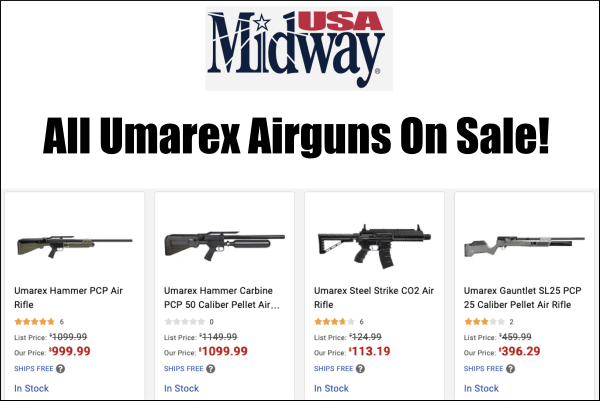
With centerfire and rimfire ammunition costs rising, more people are giving airguns a try. Air rifle shoppers should consider Umarex airguns. These start at well under $200 with the current Umarex Sale at MidwayUSA. For example, the Umarex Synergis Elite Air Rifle just $179.39 on sale, including 3-9x40mm scope. And the impressive Umarex Gauntlet SL22 PCP Air Rifle is now just $389.89, $60 off the regular price. The Umarex lineup includes a wide variety of airguns from $55 to $1100 — for fun shooting or high-level competition. NOTE: For air rifles no FFL is required for transfer in most states.
6. Midsouth — Rifle Basix Trigger Sale, Save 10%
⏺️ » Excellent Triggers for Remington, Howa, CZ, Savage — 10% OFF
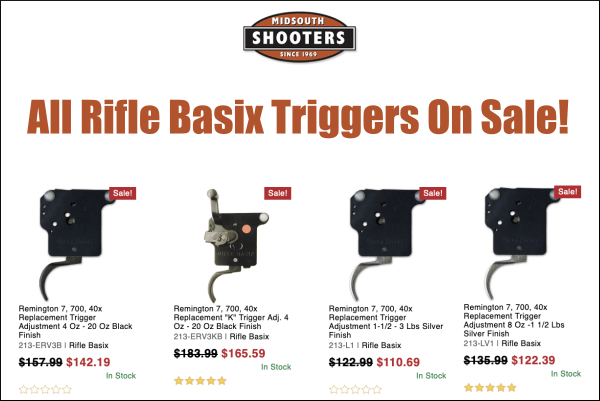
Do you want to upgrade your rifle’s trigger but have a limited budget for the trigger replacement? Consider Rifle Basix Triggers. Offered for many rifle brands including Remington, Savage, Howa, and CZ, Rifle Basix triggers feature crisp breaks and lighter trigger pull weight. Enhanced triggers can translate to better accuracy (and shot consistency) at the range and in the field.
7. Amazon — Frankford Arsenal Universal Seating Die, $67.83
⏺️ » Great, versatile system for seating multiple caliber bullets
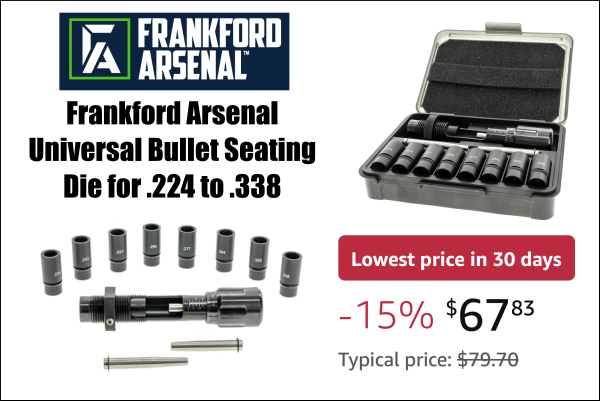
Are you tired of buying another expensive seating die every time you try a new cartridge type? With the unique Frankford Arsenal Universal Bullet Seating Die (#ad) you can have one die that loads multiple cartridge types. This clever bullet-seating system includes 3 different stems and 9 sleeves allowing you to seat .224 to .338-caliber bullets with this one multi-caliber tool. Forum members using this system have praised it. NOTE: the universal seating die comes with the .308-caliber sleeve pre-installed.
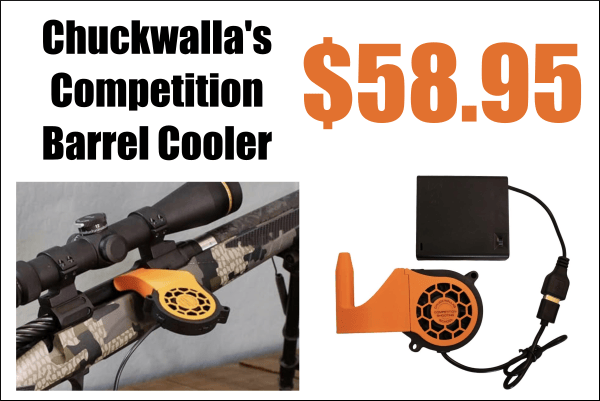
Barrel heat can shorten life and cause erratic testing results. One very good barrel-cooling system is Chuckwalla’s Competition barrel cooler (#ad). This low-profile cooler has a flow tube that fits right-hand bolt-action rifles from .223 REM to .300 WSM. (It can also run in even larger chambers but with a looser fit.) The Chuckwalla’s shape and orange color allows this cooler to serve as a chamber flag. This cooling fan includes a AA battery pack with 8-hour run time and a USB charging connection. NOTE: As the AA batteries are NOT included, we suggest using rechargeable AA batteries.
9. Amazon — Acoway Roll-up Shooting Mat, $17.99
⏺️ » Handy roll-up mat at super-low price — black or green
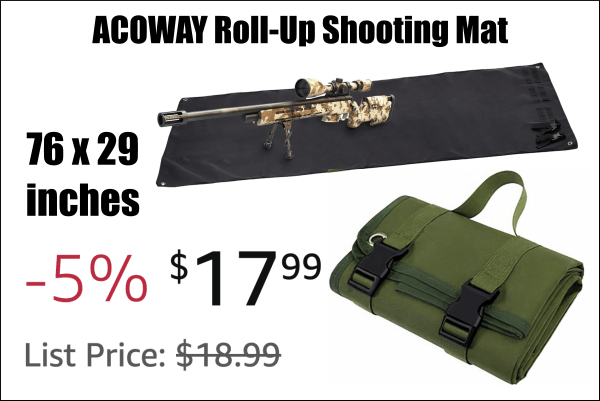
Most rifle shooters can use a good, simple shooting mat that can be easily rolled up and stored. The ACOWAY Roll-Up Shooting Mat (#ad) measures 76″ x 29″ and has a durable, double-layered Nylon outer fabric in Black or Green. This mat provides a protective barrier between you and the ground. The black mat is just $17.99 while the green version is $19.99, both great deals. The mat folds into a handy smaller size, held with attached straps and clips.
As an Amazon affiliate, this site can earn revenues through sales commissions.
California “1-in-30″ Firearm Ban Struck Down in Ninth Circuit Decision
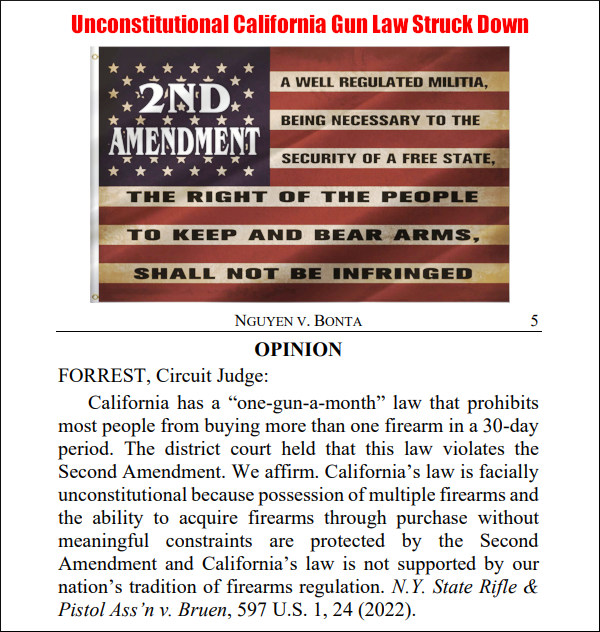
The Ninth Circuit Court of Appeals has ruled that a California law restricting gun purchases to just one every 30 days is absolutely unconstitutional. With a unanimous 3-0 decision, a Ninth Circuit panel held that California’s “one-gun-per-month” gun ban law clearly violates the Second Amendment of the U.S. Constitution. The full Ninth Circuit ruling in Nguyen v. Bonta can be viewed at firearmspolicy.org/nguyen.
“California has a ‘one-gun-a-month’ law that prohibits most people from buying more than one firearm in a 30-day period. The district court held that this law violates the Second Amendment. We affirm. California’s law is facially unconstitutional because possession of multiple firearms and the ability to acquire firearms through purchase without meaningful constraints are protected by the Second Amendment and California’s law is not supported by our nation’s tradition of firearms regulation”, wrote Ninth Circuit Judge Forrest. At the end of the 24-page decision, Judge Forest added: “The Second Amendment expressly protects the right to possess multiple arms. It also protects against meaningful constraints on the right to acquire arms because otherwise the right to ‘keep and bear’ would be hollow.”
Plaintiffs in the case included two FFL gun dealers, the Firearms Policy Coalition (FPC), the Second Amendment Foundation (SAF), San Diego County Gun Owners PAC, and six private citizens including Michelle Nguyen, for whom the case is named.
The Nguyen v. Bonta lawsuit challenged the California statute that only allows for the purchase of one handgun or semi-automatic centerfire rifle, from a licensed dealer within a 30-day period. Plaintiffs secured a summary judgment win at the District Court, which California then appealed to the Ninth Circuit. The Ninth Circuit affirmed the District Court decision, striking down the gun rationing law as impermissible under the Second Amendment.
Firearms Policy Coalition Praises Result
“As this decision shows, the right to keep and bear arms cannot be limited by an arbitrary cap on the number of guns that can be acquired at one time”, explained FPC President Brandon Combs. “We have a right to buy more than one gun at a time just as we have a right to buy more than one bible at a time. FPC is proud to have secured the rights of peaceable people and will continue to fight forward until we eliminate immoral laws like this everywhere.”
Second Amendment Foundation Predicts Progress in Fighting California Gun Laws
“Today’s decision claws back a portion of Second Amendment rights stolen by California’s government”, said SAF Exec. Director Adam Kraut. “California’s one-gun-per-month law was in clear violation of the Second Amendment, as affirmed by the unanimous decision in the Ninth Circuit. This ruling is one step closer to liberating the people of the state from the totalitarian ideals of those in power who believe the right to keep and bear arms is a second-class right.”
“There was no doubt the one-gun-per-month restriction was put in place to circumvent the ability of citizens to exercise their full Second Amendment rights,” said SAF founder and Exec. V.P. Alan M. Gottlieb. “This ruling is a victory for all who believe in the fundamental right to keep and bear arms[.]”
Ace tactical shooter and gunsmith Jim See of Elite Accuracy LLC has tested a Frankford Arsenal rotary brass tumbler. Like the older Thumbler’s Tumblers, this can tumble your cases in a liquid solution. The wet-tumbling process worked very well Jim reports. Posting on Facebook, Jim noted: “I was super impressed with the Frankford Arsenal rotary tumbler and cleaning packs they sent me. I ran 350 pieces of brass for one hour. They now look great.” Jim appreciated not having to deal with dry tumbling media, such as crushed walnut shells. Dry media produces dust and can leave residues or clog flash-holes.
Interestingly, Jim recommends you try wet-tumbling WITHOUT using stainless media. At least give it a try. Tumbling without media simplifies the process and you don’t have to worry about pins stuck in flash-holes or case-necks*. Jim reports: “Stainless steel pins come with the Frankford kit, but mine hit the trash right out of the box. There is no need to clean the inside of your cases 100% and that’s all the pins add to the equation. The brass bumping brass with hot water and Frankford’s liquid cleaner works great all by itself.” One wag stated: “That’s great to hear. Stainless steel pins are a PITA.”
Other Facebook posters concurred with Jim’s evaluation of the Frankford Arsenal Rotary Tumbler:
“I’ve had one for a couple years, and it works well. I usually run about 250-300 Dasher cases at once in it. But I use the pins because I’m OCD about clean brass.” — David W.
“I’ve had one for a year and a half and it definitely works with or without pins.” — Luke C.
“I got one about six months ago and have yet to use any stainless steel media [pins]. I just use some dawn, distilled water, and Lemi Shine®. Turns nasty 5.56 range brass bright and shiny.” — Brian D.
“I don’t use the pins either and use a combination of Dawn soap and Lemi Shine.” — Jon N.G.
This video shows how to assemble and operate the Frankford rotary tumbler. But note, Jim See does NOT feel that it is necessary to use stainless media.
How to Dry Your Brass — Hair Dryer Vs. Machine
The downside of wet tumbling is that you end up with a pile of wet brass at the end of the cleaning cycle. There are many ways to dry brass, from drying in the sun to using a kitchen oven (be careful not to “overcook” your brass). One Facebook poster asked Jim: “What is your drying method for wet brass, and how long does it take?”
Jim See replied: “To start I just drain off the dirty water, and rinse the brass with clean hot water. Then I roll the brass on a towel for 30 seconds and put the brass in a one-gallon bucket. Next I insert a hair dryer in the bucket (with the brass) and let it run for about 5 minutes. With this procedure, the drying process for me is done in less than 10 minutes.”
Jack Lanhart has another method: “I use a food dehydrator. It takes 30 to 45 minutes.”
For those who don’t want to mess with towels and hair dryers, Frankford Arsenal offers a matching Platinum Series Case Dryer that simplifies the process of drying brass. Lyman also makes an excellent Cyclone Case Dryer. These drying machines each cost about $65.00 and both have multiple levels so you can separate different types of cartridge brass. Lyman states that “The forced heated air circulation of the Cyclone will dry your brass inside and out within an hour or two, with no unsightly water spots.” The Lyman dryer can also be used for ultrasonically-cleaned gun parts.
*The Frankford Rotary tumbler does include media separators if you choose to use the provided pins or other media. CLICK HERE for diagram showing how to use media separators.




 In the archives of
 Gary Anderson served as the Director of the Civilian Marksmanship Program (CMP) from 1999-2009, and is now DCM Emeritus. As a Nebraska farmboy, Gary grew up hunting and shooting. Dreams of winning an Olympic Gold Medal in shooting led Gary to the U.S. Army. In 1959, he joined the elite U.S. Army Marksmanship Unit. Just two years later, he won his first national championship.

 The way ambient temperatures, barrel heating, and powder warming can affect cartridge pressures (and hence velocities) was covered in a study Pressure Factors: How Temperature, Powder, and Primer Affect Pressure by Denton Bramwell. In that article, the author used a pressure trace instrument to analyze how temperature affects ammo performance. Bramwell’s tests yielded some fascinating results.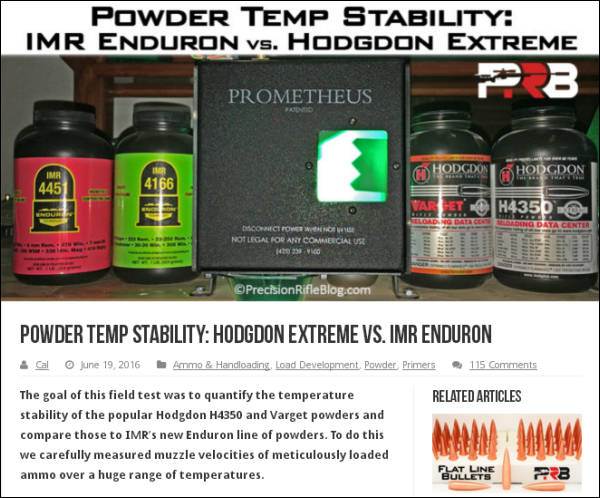

 The better, up-to-date ballistics programs let you select either G1 or G7 Ballistic Coefficient (BC) values when calculating a trajectory. The ballistic coefficient (BC) of a body is a measure of its ability to overcome air resistance in flight. You’ve probably seen that G7 values are numerically lower than G1 values for the same bullet (typically). But that doesn’t mean you should select a G1 value simply because it is higher.
 Drag Models — G7 is better than G1 for Long-Range Bullets