The Individual Palma Match kicked off Friday at the Berger Southwest Nationals. While still mostly calm, conditions were more variable and tricky. James Crofts told us that you had to watch both the mirage AND the flags, because sometimes a change appeared on the flags before you could see anything in the mirage. The top shooters were scanning the range constantly for any velocity or angle change. If you don’t pay attention to the flags, James said, “you’ll be out in the nine ring”.
Watch Video with Highlights from Day 3 of Berger SWN, including James Crofts Interview:
Our good friend John Whidden, a past National Long-Range Champion, brought his “A Game” Friday, topping the Sling Division with 449-33X. Competition was fierce with five sling shooters finishing with the same 449 points, separated only by X-Count: Whidden (33X), Oliver Milanovic (31X), Rick Hunt (25X), Michael Barlow (25X), and Steven Powell (22X).
John Whidden file photo from 2015
In F-Open, the top three shooters for the day were: Ken Padilla (448-25X), John Myers (447-32X), and Kenny Adams (447-24X). In F-TR Dan Lentz topped the Field with 447-24X, followed by Derek Rodgers and Justin Bertino (both at 445-23X). Ryan Pierce noted that Dan Lentz’s performance for the day beat all but three of the F-Open shooters: “Extremely impressive is Dan Lentz 447-24X F-TR score [which] tied Kenny Adams’s third-place F-Open Aggregate. Shooting .308 Win off a bipod and keeping up with the 7mms and 30 Cal magnums is outstanding. Good shooting Dan.”
Interesting Hardware
New Speedy F-Open Stock (Jeff Reed, owner)
F-Open competitor Jeff Reed has a new F-Open rig with the brand new Speedy Gonzales laminated stock. Jeff says he loves the stock, saying it “tracks like a dream”. Jeff also likes the recoil-reduction system fitted at the rear of the stock. This really makes a difference for the big calibers says Jeff. If you’re curious, that’s an IOR Valdada 12-52x56mm scope with a 40mm main tube on top of Jeff’s rifle. It features 25 MOA of elevation in one rotation of the turret.
Spotting Scope Mounted to Front Rest
Gunsmith Richard King of Texas has mounted his spotting scope directly to his Farley front rest. Very clever. This puts the spotter eyepiece just a few inches from his riflescope eyepiece so he can move easily from one optic to the other. This set-up also reduces the amount of gear Richard carries to the line. No separate spotting scope base, stand or horizontal mounting arm is required. This is a simple, elegant solution. We bet, with a little tinkering and design work, a similar system could be mounted to a SEB or Bald Eagle front rest. Note, it may appear that the lens is obscured by the front clamp, but that’s just the camera angle. We looked through the spotting scope and everything is clear.
Here’s good news for suppressor owners in the Great Lakes state. The Michigan legislature has approved the use of suppressors for hunting. On February 11th, Michigan became the 38th state to allow for the use of firearm suppressors while hunting when the Natural Resources Commission (NRC) voted 4 – 1 to approve an amended version of Wildlife Conservation Order Amendment No. 1 of 2016. The measure became effective immediately.
The American Suppressor Association led a coalition working to legalize suppressor hunting in Michigan. Other organizations involved were the National Rifle Association (NRA), the Congressional Sportsmen’s Foundation (CSF), Michigan United Conservation Clubs (MUCC), and Safari Club International (SCI).
“We are incredibly excited that hunters in the great state of Michigan can now use suppressors to help protect their hearing while they’re in the field,” said Knox Williams, President of the American Suppressor Association. “It was a pleasure working to educate the NRC Commissioners and members of the DNR on the realities of suppressor use. We applaud their decision to remove the prohibition on suppressor hunting without the two restrictive provisions. In doing so, they have done their part to ensure that the next generation of hunters does not have to sacrifice their hearing.”
Our friend Paul Phillips (above), is pleased with this change: “With this new Law that passed in Michigan Today, I will be hunting with my GEMTECH arrow silencer. I can’t wait for Spring to start Shooting ELR.”
Here are some of the fine rifles Mike Bryant has smithed. You’ll find dozens more on BryantCustom.com.
Texas-based gunsmith Mike Bryant has decided to start taking work again. It seems that retired life was just a bit too sedate for Mike. This is great news for fans of precision rifles. Mike is an superb smith who has produced many match-winning competition rigs along with fine hunting and varmint rifles.
The services Mike can provide are listed on his “re-activated” website at BryantCustom.com. Mike will still continue to specialize in Rem Action-based and Custom Action-based rifles with customer-supplied parts. He explains his decision to return to the business he does so well: “Retirement was short with what the economy has done in the oil and gas business. I am back at least part time. I am Looking forward to serving my customer’s needs as I have done in the past.”
Welcome back Mike — we wish you success in your “return to the fold”. As before Mike will offer complete custom rifles as well as a full range of gunsmithing services including chambering, barrel-fitting, stocking, and action truing.
Thursday was a Team Competition day at the Berger Southwest Nationals. Conditions were surprisingly calm for most of the day, with flags hanging straight down through most of the morning. But there were still some “ghost winds” that might affect one flag (and cause some unexplained). Mirage was also tricky for some shooters as the day wore on.
Watch Day 2 Match Highlights including Interview With Team Michigan’s Bill Litz and Bryan Litz
Team Michigan won the F-TR competition, followed by The U.S. F-TR Team in second, and Team X-Men in third. Based on the interim results posted, the Sling Division was one by the UK/Scottish Ethnic Fringe Team led by Captain Angus McLeod. It appears that the top F-Open Squad was Team Berger — those senior guys still know their stuff.
USRT Gold Medal Sponsors Kelly McMillan of McMillan Group International and Sean Murphy of Nightforce Optics came out to observe and shoot with the U.S. Rifle Team. Here’s Kelly with his bionic arm.
It was hot, dry, and sunny in Phoenix. You needed lots of water and plenty of sunscreen…
There was plenty of good food on hand for the competitors…
Here’s an interesting rig that combines a spotting scope (on left) with 15×56 binoculars (on right) This allowed the spotter to watch targets as well as mirage elsewhere on the range. Smart…
We met with our friend Erik Cortina at the Berger Southwest Nationals this week. Erik (shown above), had a beautiful new F-Open rifle to show us. This features a new, large-diameter Borden action and a Shurley Brothers fancy maple stock. Erik loves great hardware — whether it comes to actions, stocks, or reloading equipment. One of Erik’s favorite reloading tools is his Forster Co-Ax press.
Cortina has produced a series of YouTube videos about reloading hardware and precision hand-loading. Here is Erik’s video review of the Forster Co-Ax® reloading press. The Co-Ax is unique in both design and operation. It features dual guide rods and a central handle. You don’t screw in dies — you slide the die lock ring into a slot. This allows dies to float during operation.
Erik does a good job of demonstrating the Co-Ax’s unique features. At 1:00 he shows how to slide the dies into the press. It’s slick and easy. At the two-minute mark, Erik shows how sliding jaws clasp the case rim (rather than a conventional shell-holder). The jaws close as the ram is raised, then open as it is lowered. This makes it easy to place and remove your cases.
At the 5:20 mark, Erik shows how spent primers run straight down into a capture cup. This smart system helps keep your press and bench area clean of primer debris and residues.
While many Co-Ax users prime their cases by hand, the Co-Ax can prime cases very reliably. The priming station is on top of the press. Erik demonstrates the priming operation starting at 4:20.
Smart Accessories for the Co-Ax from Inline Fabrications
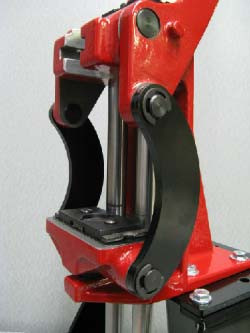
Lapua’s Kevin Thomas also owns a Co-Ax press, which he has hot-rodded with accessories from Inline Fabrications. Kevin tells us: “Check out the add-ons available from Inline Fabrications for the Co-Ax. I recently picked up a riser mount and a set of linkages for mine and love the results. The linkages are curved. When you replace the original straight links with these, the work area opens up substantially and the the press becomes much easier to feed.” CLICK HERE for Co-Ax Accessories.
Inline Fabrications Forster Co-Ax Accessories
Forster Co-Ax Curved Side Linkage (For Better Access)
Our friend Vince Bottomley in the UK has written an excellent article for Target Shooter Magazine. Vince offers “solid-gold” advice for new F-TR and F-Open shooters. Vince reviews the cartridge options, and offers suggestions for a shooter’s first (and hopefully affordable) F-Class rifle. Vince also reviews various bipod choices for F-TR and discusses optics options (from $300 to $3000).
DEAR DADDY. We all draw positive motivation from different sources. This competitor at the Berger SW Nationals gets a lift from his child’s hand-written note: “Dear Daddy, I love you very much. I hope you win the competition. You are the best….”
The Berger SWN competition began in earnest yesterday, with hundreds of shooters taking to the line. Today, it’s more of the same, with the nation’s top F-TR, F-Open, and Sling Shooters competing at the Ben Avery Shooting Facility north of Phoenix.
Blast from the Past: As we get set up in Phoenix for the 2016 Berger Southwest Nationals, we thought we’d revisit one of our more interesting features from a few years back. At the 2010 SHOT Show, we had the unique opportunity to corner three “superstars” of High Power shooting, and solicit their wind-reading secrets. Carl Bernosky, David Tubb, and John Whidden all shared some championship-caliber wind wisdom in video interviews. If you shoot competitively, you’ll want to watch these videos. David’s video is worth watching twice because some of the key points he makes go by pretty quickly.
In the three videos below (in alphabetical order), Carl Bernosky (10-Time Nat’l High Power Champion), David Tubb (11-time Nat’l High Power Champion and 7-time Nat’l Long-Range Champion), and John Whidden (2-Time Nat’l High Power Long-Range Champion) shared some of the wind-doping strategies that have carried them to victory in the nation’s most competitive shooting matches. This is GOLD folks… no matter what your discipline — be it short-range Benchrest or Long-Range High Power — watch these videos for valuable insights that can help you shoot more accurately, and post higher scores, in all wind conditions.
We were very fortunate to have these three extraordinarily gifted champions reveal their “winning ways”. These guys REALLY know their stuff. I thought to myself: “Wow, this is how a baseball fan might feel if he could assemble Babe Ruth, Hank Aaron, and Ted Williams in the same room, and have them each reveal their hitting secrets.” Editor’s Note: These interviews were conducted before Bernosky and Tubb won their most recent National Championships.
Checking conditions at break of day. This week Phoenix will offer cool nights and warm days, with daytime temps in the mid- to high 80s (F).
The Berger Southwest Nationals (SWN), is the biggest, most prestigious long-range shooting match west of the Mississipi. The SW Nationals, which run February 9-14, 2016, kicked off on Tuesday the 9th with a shooting clinic at the Ben Avery 1000-yard Range. This gave competitors a chance to confirm their zeros, study the conditions at Ben Avery, and prep their “mental game” for the upcoming competition. This will be a huge event, with over 370 shooters from all over the USA and many foreign countries. The SW Nationals attracts top F-Class and Sling shooters, lured by the quality of the competition and a huge prize table. This is truly a “world-class” event.
Tuesday’s shooting clinic started with a class on Exterior Ballistics hosted by Bryan Litz. Following the ballistics class, shooters made their way to the firing line for one-on-one instruction with experienced shooters in each discipline (sling, F-TR and F-Open). During this segment of the clinic, champion shooters worked directly with novice and intermediate shooters. Bryan said: “It was great to see the ‘top guns’ sharing their knowledge.”
File photo from 2015.
Nat’l Mid-Range and Long-Range F-TR Champion Bryan Litz instructs during Tuesday’s Clinic at the Ben Avery Shooting Facility.
Eliseo Tubegun with Nightforce Competition scope. These versatile rifle chassis systems are produced by Competition Machine in Cottonwood, Arizona.
Sooner or later you’ll want to clean your rifle brass, even if you aren’t fussy about appearance. You can tumble your cases in a vibratory tumbler with dry media, but that can leave cases with a fine layer of dust, or worse yet, clogged flash holes. As an alternative to tumbling, many shooters are experimenting with ultrasonic case cleaning. Here are three tips to achieve the best results when using ultra-sound to clean your brass:
Try a Commercial Ultrasonic Cleaning Solution
As a companion product to its new ultrasonic cleaning tank, Hornady is selling a citric-acid based One Shot™ Sonic Clean™ Solution, that is claimed to speed up cleaning times, and not leave your brass an odd pinkish color like some “home-brew” solutions. We’ve heard good reports about the One-Shot Solution (cartridge case formula) as well as Citranox®. Both products are economical to use since you dilute them heavily with water. For example, Hornady recommends you mix forty (40) parts water to one part of One Shot Sonic Clean.
Forum member Dave B is a chemist/physicist with decades of experience working with the ultrasound process. Dave tried a variety of solutions and he favors a mix of water and Citranox®. Dave notes: “So far I’ve been very impressed with the Citranox. Once- or twice-fired brass clean up very quickly. The worst cases I tried were 6 Dashers that had been fired ten times with Varget and never cleaned. The worst fouling was in the bottom of the case around the flash hole. They took longer and I used a more concentrated cleaning solution but they did come out clean. The price is reasonable. I paid $35 a gallon and for once- or twice-fired cases I dilute the cleaner 100 to 1. There is much less chemical reaction with the brass than there is with vinegar. No weird colors, just shiny bright. I even used it with hot water, which speeds up the cleaning process. The cleaner is mostly detergents with a little citric acid. Even at a 1:75 ratio my $35 worth of cleaner will make 75 gallons of solution.” The price has gone up a bit since Dave acquired his Citranox, but Amazon.com sells Citranox for $48.00 per gallon.
Another good ultrasonic solution is L&R non-ammoniated Safety Cleaning Solution, sold by Brownells, item #515-000-004. Brownell’s L&R solution is non-toxic and biodegradeable. The strong surfactant in L&R solution helps penetrate the grit so the ultrasonic cavitation can carry the grime away.
De-Gas the Solvent Before Adding Brass
One of our readers, Eddy M. in Glasgow, Scotland writes: “I have read a couple of articles recently about ultrasonic cleaning of cases and not one has mentioned de-gassing the cleaning liquid before starting to clean items. As an engineer who traveled around for ten years servicing ultrasonic tanks I would like to point out that the cleaning liquid when first put into the tank has invisible dissolved air bubbles in it which will absorb ultrasonic energy until the liquid de-gasses. (Ten minutes in a powerful industrial tank — longer in a small hobby tank). You must let the tank run on its own for 20 minutes on the first use of the liquid to allow this to happen. Only after the new liquid or re-introduced liquid has been de-gassed will the tank give good results.”
Apply Dry-Lube Inside Case Necks
Jason Baney has found that Ultrasonic cleaning leaves the inside of the case-necks so “squeaky clean” that there is excess friction when seating bullets. On a fired case that has been cleaned conventionally (no ultra-sound), a thin layer of carbon remains to lubricate the bullet entry and exit. To restore that lubricity in cases cleaned with ultrasound, Jason applies a dry lube to the inside of his case necks. Jason prefers the $10.95 moly dry lube kit from Neconos.com. With this kit, small carbon steel balls transfer moly to the neck when you place your brass nose-down in the container.


 Texas-based gunsmith Mike Bryant has decided to start taking work again. It seems that retired life was just a bit too sedate for Mike. This is great news for fans of precision rifles. Mike is an superb smith who has produced many match-winning competition rigs along with fine hunting and varmint rifles.





 The


 Apply Dry-Lube Inside Case Necks


