Report based on Story inNRABlog.
It’s official — Indiana is IN and Ohio is OUT. The Chief Wa-Ke-De Range in Bristol, Indiana, is now the permanent home of the NRA National Smallbore Rifle Championships. The Smallbore Championships will no longer be contested at the historic Camp Perry facility on the shores of Lake Erie near Port Clinton, Ohio. After the Smallbore Nationals were relocated to Indiana for the past two years to facilitate the 2015 World Long Range Championships, many competitors expected a return to Camp Perry. However, the NRA Smallbore Committee has decided to make Bristol, Indiana the permanent venue for the Smallbore Championships.
Situated about three hours west of Camp Perry, the Wa-Ke-De Range has some advantages over the Camp Perry facility. First, the 100-point firing line is covered in asphalt instead of grass. In addition, the range sits in a large grove of trees that provide a beautiful setting and shelter from the wind — practically the opposite of Camp Perry’s notorious wind and open fields.
Despite this, many smallbore competitors wished for the Nationals to return to Camp Perry. One poll of shooters ran roughly 3:1 in favor of returning to Perry. On his personal website, Bill Dutton has posted an Open Letter to the NRA which states many reasons why the Smallbore Championships should be returned to Camp Perry. Among other things, Bill notes: “The facilities are perfect for a large Regional but The Chief Wa-Ke’-De Rifle Range lacks the grand scale which a Camp Perry provides. Competitors and parents look forward to browsing vendor row at Camp Perry in order to replenish supplies for the coming season… in addition to trying out the latest shooting equipment. The nearest hotel [was] in Elkhart, about 15 minutes away. Camp Perry has sufficient onsite lodging for hundreds of competitors and their families. I personally had a bill for $1,400 for the hotel I and my daughter stayed in. Compared to a Hut at Camp Perry where four people can sleep for $12.50 per night, translating to equivalent cost of $175 per person for two weeks.”
View Photo Gallery from 2014 Smallbore Championships
2016 Championships Scheduled for July 10-18, 2016
The 2016 Smallbore Championships will be held 10-18 July, 2016, with registration opening on April 1, 2016. As before, the Metric and Conventional Position Championships will fall under the umbrella of the NRA Smallbore 3-Position Championship. Note: The Metric Prone Championship was removed but the 50-yard match was added to the NRA Smallbore Prone Championship. From these two main championships (3-Position and Prone), an overall NRA National Smallbore Rifle Champion will be crowned.
Team championships in both position and prone will still be awarded. 3-Position team matches will be shot as “paper matches,” meaning the scores will be taken from a shooter’s individual performance in the 3-Position Championship. Prone team matches will still be shot on their own and will be held following each day’s individual prone matches.
If you enjoy our stories and would like to get daily News Updates and Tech Tips, go to www.facebook.com/accurateshooter and click the “LIKE” button.
We’ve learned that many first-time visitors to AccurateShooter.com may come in via a link to the Daily Bulletin rather than through our home page. As a result, they may not be aware that there is a wealth of other content available to our readers. Our Shooters’ Forum, with nearly 30,000 registered members, is one of the best places on the web to discuss precision shooting and advanced reloading. We also offer FREE Forum Classifieds. On the editorial side, AccurateShooter.com offers hundreds of pages of content, with thousands of photos. Our Cartridge Guides are definitive one-stop resources for popular match calibers, while our Guns of the Week articles spotlight outstanding custom rifles, most with competition pedigrees. In addition, we offer videos, gear reviews, book reviews, gunsmithing tips, and even FREE downloadable targets.
If you’re a new visitor to AccurateShooter.com, you should check out all that we have to offer. There are hundreds of informative articles to read … and they’re all FREE.
The Trijicon Miniature Rifle Optic (MRO), a one-power “red dot” reflex sight, has been named the 2015 “Optic of the Year” by Guns & Ammo Magazine. The “Optic of the Year” is an annual award presented by the Guns & Ammo editorial staff based on performance, versatility, durability, and product value.
“We designed the new MRO to be as rugged and versatile as our renowned ACOG, while offering the features and benefits reflex optic owners desire,” said Chuck Wahr, Marketing VP for Trijicon. “We have been overwhelmed with the positive response from the industry. Being awarded “Optic of the Year” by Guns & Ammo is a great honor for Trijicon.” Users have praised the MRO. One purchaser wrote: “Great FOV, clear dot and glass. Light weight…love it.”
MRO Sells for under $450.00
The American-made MRO features a 2 MOA dot and 25mm objective lens for quick target acquisition. There are handy adjusters with half-MOA click values and 70 MOA total adjustment. Dot intensity is adjusted with a top-located brightness control. Street price for the Miniature Rifle Optic is $449.00 for the basic version, $515.00 with a low mount, and $535.00 for the elevated “co-witness” version.
With the co-witness elevated mount, the MRO allows “see-through” aiming with back-up iron sights.
The CMP Online Auction Program is used to sell very rare or otherwise unique rifles, receivers, and other collectible merchandise/parts. CMP usually has only 6-10 items listed for auction at any time. Items are normally listed for 10-14 days, with the bidding set to close on Sunday afternoons.
Log on to http://cmpauction.thecmp.com to learn more about the auction process and to see the current items up for bid.
Benchrest Hall-of-Famer Thomas “Speedy” Gonzalez has teamed up with the Shurley Brothers on a new ARK series of wood laminate competition stocks. Speedy has combined the best features of various popular F-Class and Long-range Benchrest stocks into new designs to be produced by Shurley Brothers Custom in Austin, Texas. These stocks should be very straight and geometrically correct as they will be crafted on the Shurley Brothers’ new CNC mills. These stocks will be made with new-generation precision technology, not old school duplicating machines.
Initially two models will be offered: the “Hand of God” (HOG) and the “Spear of Destiny” (SOD). Both are designed for multiple shooting disciplines, so they should work well both for benchrest and for prone F-Open shooting. (FWIW, John Myers used a Speedy-crafted stock to win the 2015 Mid-Range National Championship). The forearm is 76mm (2.99″) to comply with F-Open limits. A wide variety of options will be available including adjustable Cheek Piece, adjustable length of pull, carbon fiber inserts, and exotic woods.
We like many aspects of the new stocks. First, the front of the stock is low profile, placing the barrel close to the bags for better tracking (and less hop). However, a deeper (top to bottom) section extends forward of the action — this is important. We have seen some low-profile stocks that suffer from forearm flex/hinging because they don’t leave enough wood under the action area. Speedy’s design eliminates this problem. Another nice feature of this stock is the subtle curve from the back of the action to the buttpad mount. Speedy calls this the “scooped cheek”. This allows the “driver” to shoot without face contact if he prefers, but it also allows for a higher buttpad position — which is useful when shooting heavy recoiling chamberings such as the .300 WSM.
Note how the comb area has a curve to provide clearance. For those shooters who prefer to have face contact on the gun, an adjustable Cheek Piece is offered.
Shurley Brothers Custom says these new ARK stocks are fully customizable for competition shooters with optional carbon fiber, adjustable R.A.D. systems, and many other features. The stocks, uninletted, will run $750.00. CNC-inletting (for action of your choice) is an additional $100.00. Here are some of the many available options:
— Pillar Bed and Inlet: $425.00
— Custom Wood Upgrade (Price Dependent On Wood): $100.00 – $500.00
— Full-length Carbon Fiber Stringers: $200.00
— Cheek Piece Addition: $100.00
— Cooling Ports (Buick Vents): $60.00
— R.A.D. System #2A: $335.00 (plus $100.00 to install)
— 3-Way Butt Plate: Call for Price
— Adjustable Neodymium Magnetic Cheek Piece: Call for Price
— Install Neodymium Magnetic Cheek Piece: $150.00
— Stock Finish & Clear Coat: $350.00
— Carbon Fiber Forearm Tunnel: $300.00
The underside of the forearm is relieved in the center, leaving twin outboard rails. This helps stabilize the rifle and aids tracking. (A conventional, flat forearm without rails tends to rock if there is any hump in the middle of the sandbag). Between the rails is a carbon-fiber stiffening insert.
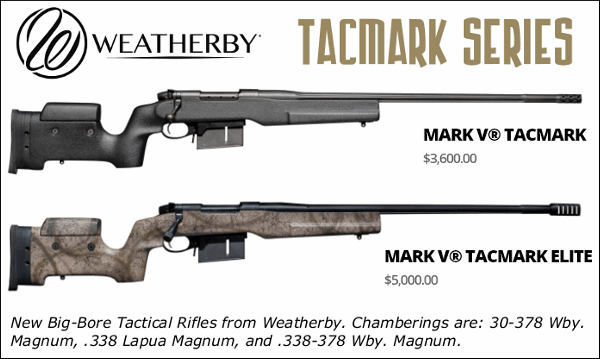
Weatherby’s new TacMark Rifles should be popular with long-range shooters (at least those with plenty of coin). We hope you like recoil — all three chamberings are powerful: .30-378 Wby. Magnum, .338 Lapua Magnum, and .338-378 Wby. Magnum. To handle these powerful cartridge types, TacMark series rifles have a beefy receiver with integral recoil lug, set in a CNC-machined aluminum bedding system. The bolt is interesting — it has nine (9) lugs and a 54-degree bolt throw.
The composite stocks are adjustable for length of pull (13¼ inches to 14¾ inches), drop at comb, and drop at heel. The stock also has a near-vertical pistol grip with a trigger finger depression and a wide, flat-bottom fore-end with a stud for bipod and/or sling. The TacMark (11.25 lbs w/o scope) comes in black while the TacMark Elite (11.75 lbs w/o scope) is finished in High Desert Camo with black accents.
The $5000.00 TacMark Elite features a hand-lapped 28″ Krieger cut-rifled barrel*, fitted with a large muzzle brake. The Range Certified (RC) TacMark Elite is accompanied by an Oehler Ballistic Imaging System printout signed and certified by Ed or Adam Weatherby, verifying the accuracy. The Elite is guaranteed to shoot sub-MOA for three shots (and we suspect it can do a lot better than that).
The less expensive ($3600.00) TacMark also boasts a 28″ barrel — one of the longest barrels currently available on a factory rifle. This should be good for a little extra velocity. Both the TacMark and the TacMark Elite feature Weatherby’s Mark V action and Weatherby’s new LXX trigger, which is user-adjustable for pull weight down to 2.5 pounds. The Mark V TacMark and TacMark Elite rifles will be available through the Weatherby Custom Shop.
* A features list on the Weatherby website shows 26″ barrel length for the Elite. However the actual specifications show the barrel to be 28″ for both TacMark and TacMark Elite. You should verify barrel length before ordering.
Here’s a very interesting spotting scope stand, from Forum member (and ace F-Class shooter) Monte Milanuk. You can see this stable rig can be adjusted super-low for prone shooting. The components are from Italian photography accessory maker Manfrotto (but it’s not as expensive as you might think).
Monte tells us about his spotting scope stand, which is really a conventional photography tripod adjusted to a very low position, with a special head:
This stand has a Manfrotto 322RC2 pistol-grip head to make positioning easier. It actually goes even lower, and much, much higher. Both the head and the tripod are about $170-ish each, so it’s a bit more expensive than a Ray-Vin, a little less than a Creedmoor Polecat, and a whole lot more flexible overall.
This Manfrotto 055XPROB Pro Tripod is actually a little on the big side – probably should have gone with a Manfrotto 190 model (couple inches shorter on the legs) so it can be a bit of a hassle to set up when you have to shoot two-to-a-mound a la Fullbore.
It’s probably not as [expensive] as you might think… a Ray-Vin F-Class stand (without head) is about $170 from Creedmoor Sports. A Ray-Vin stand head is $150, plus the outrigger attachment is another $100+. I’ve got two of them downstairs for when I used to shoot conventional prone[.]
Comments from Facebook Fans: Pretty high end setup, should work well for prone, not sure about other positions. — John T.
An excellent and sturdy Manfrotto stand. I have one that I use not only for a spotting scope but to mount the rifle on when allowed for unknown distance tactical matches.–Dennis Santiago
Thinking of getting started in 3-Gun competition? In this NSSF video, Top Shot Finalist Chris Cerino reviews the hardware you’ll need for multi-gun matches. Chris talks about carbine configurations — including barrel, handguard, and optics options. In reviewing shotguns, Chris discusses shotshell caddies and the high-capacity extended tubular magazines now available. Cerino also demonstrates pistol techniques and explains the key features of a belt/holster rig for 3-Gun competition.
Gun Control — Tips on AR Shooting with Jerry Miculek
In another NSSF video, pro shooter Jerry Miculek provides tips on handling an AR-type rifle in 3-Gun matches. First, Jerry recommends a slightly forward stance, with your nose over your front toe. Second, it is important to have a consistent trigger pull. No matter how good your sight alignment, Jerry cautions, you can miss the target with a sloppy trigger pull. Finally, Miculek recommends placing your non-trigger hand well forward on the handguard. That provides better balance, tames muzzle rise, and gives you better control over the rifle for quick follow-up shots. Some shooters use a low hand position on the magwell, but Jerry says that makes the AR-15 feel top-heavy. Having your support hand out front on the handguard lowers the AR’s perceived center of gravity, allowing faster transitions for better stage times.
Note: The orange-color metal support frame is sold separately.
Reactive targets are fun. This versatily target offers both conventional black on white bullseyes as well as slots for reactive clay targets. Matterhorn Innovations produces the unique ReVersa Target, a heavy paperboard target with large bullseyes on the front, plus pre-cut tabs for clay pigeons on the reverse side. You can start with the black & white side for precision work, and then flip the target over and blast away at a dozen clay birds held in individual tabbed pockets. ReVersa targets cost just $4.99 each at Brownells.com. That price does NOT include the wire target-holders shown in the photos — those sell separately for $19.99.
We expect most ReVersa target buyers will use these 2′ x 3′ cardboard sheets inside 200 yards. However we think the ReVersa targets would also be useful for long-range shooters who want to try reactive targets for a change. We often shoot at clay pigeons at long range, but we either have to set them on the berm, or tape them one by one to a cardboard backer. With the ReVersa target, you can easily position a dozen clays up off the ground where they are more visible. Buyers have been happy with these jumbo-sized, double-sided targets — user feedback on Brownells.com has been all positive. Here are reviews from actual purchasers:
“Five Star. Great quality target. Many areas to shoot on the same target. I can see why this is top rated product. I plan to buy many more in the future.”
“Five Star. These are the best targets I have used. They even stood up good in the wind when my other targets would get blown over. Highly recommend…”
If you want to load ultra-accurate ammo and shoot very small groups, you should read this article, which we are re-publishing by popular demand. Many novice handloaders believe that neck bushing Inside Diameter (ID) size is the only important factor in neck tension. In fact, many different things will influence the grip on your bullet and its ability to release from the case neck. To learn the ins and outs of neck tension, take some time and read this article carefully.
Neck Tension (i.e. Grip on Bullets) Is a Complex Phenomenon
While we certainly have considerable control over neck tension by using tighter or looser bushings (with smaller or bigger Inside Diameters), bushing size is only one factor at work. It’s important to understand the multiple factors that can increase or decrease the resistance to bullet release. Think in terms of overall brass-on-bullet “grip” instead of just bushing size.
Bullet grip is affected by many things, such as:
1. Neck-wall thickness.
2. Amount of bearing surface (shank) in the neck.
3. Surface condition inside of neck (residual carbon can act as a lubricant; ultrasonic cleaning makes necks “grabby”).
4. Length of neck (e.g. 6mmBR neck vs. 6mm Dasher).
5. Whether or not the bullets have an anti-friction coating.
6. The springiness of the brass (which is related to degree of work-hardening; number of firings etc.)
7. The bullet jacket material.
8. The outside diameter of the bullet and whether it has a pressure ridge.
9. Time duration between bullet seating and firing (necks can stiffen with time).
10. How often the brass is annealed
— and there are others…
One needs to understand that bushing size isn’t the beginning and end of neck tension questions, because, even if bushing size is held constant, the amount of bullet “grip” can change dramatically as the condition of your brass changes. Bullet “grip” can also change if you alter your seating depth significantly, and it can even change if you ultrasonically clean your cases.
In our Shooters’ Forum a reader recently asked: “How much neck tension should I use?” This prompted a Forum discussion in which other Forum members recommended a specific number based on their experience, such as .001″, .002″, or .003″. These numbers, as commonly used, correspond to the difference between case-neck OD after sizing and the neck OD of a loaded round, with bullet in place. In other words, the numbers refer to the nominal amount of interference fit (after sizing).
While these commonly-used “tension numbers” (of .001″, .002″ etc.) can be useful as starting points, neck tension is actually a fairly complex subject. The actual amount of “grip” on the bullet is a function of many factors, of which neck-OD reduction during sizing is just one. Understanding these many factors will help you maintain consistent neck tension as your brass “evolves” over the course of multiple reloadings.
Seating Depth Changes Can Increase or Decrease Grip on Bullet
You can do this simple experiment. Seat a boat-tail bullet in your sized neck with .150″ of bearing surface (shank) in the neck. Now remove the bullet with an impact hammer. Next, take another identical bullet and seat it with .300″ of bearing surface in another sized case (same bushing size/same nominal tension). You’ll find the deeper-seated bullet is gripped much harder.
Neck-Wall Thickness is Important Too
I have also found that thinner necks, particularly the very thin necks used by many PPC shooters, require more sizing to give equivalent “grip”. Again, do your own experiment. Seat a bullet in a case turned to .008″ neckwall thickness and sized down .003″. Now compare that to a case with .014″ neckwall thickness and sized down .0015″. You may find that the bullet in the thin necks actually pulls out easier, though it supposedly has more “neck tension”, if one were to consider bushing size alone.
In practical terms, because thick necks are less elastic than very thin necks, when you turn necks you may need to run tighter bushings to maintain the same amount of actual grip on the bullets (as compared to no-turn brass). Consequently, I suspect the guys using .0015″ “tension” on no-turn brass may be a lot closer to the guys using .003″ “tension” on turned necks than either group may realize.
Toward a Better Definition of Neck Tension
As a convenient short-cut, we tend to describe neck tension by bushing size alone. When a guy says, “I run .002 neck tension”, that normally means he is using a die/bushing that sizes the necks .002″ smaller than a loaded round. Well we know something about his post-sizing neck OD, but do we really have a reliable idea about how much force is required to release his bullets? Maybe not… This use of the term “neck tension” when we are really only describing the amount of neck diameter reduction with a die/bushing is really kind of incomplete.
My point here is that it is overly simplistic to ask, “should I load with .001 tension or .003?” In reality, an .001″ reduction (after springback) on a thick neck might provide MORE “grip” on a deep-seated bullet than an .003″ reduction on a very thin-walled neck holding a bullet with minimal bearing surface in the neck. Bushing ID is something we can easily measure and verify. We use bushing size as a descriptor of neck tension because it is convenient and because the other important factors are hard to quantify. But those factors shouldn’t be ignored if you want to maintain consistent neck tension for optimal accuracy.
Consistency and accuracy — that’s really what this all about isn’t it? We want to find the best neck tension for accuracy, and then maintain that amount of grip-on-bullet over time. To do that you need to look not only at your bushing size, but also at how your brass has changed (work-hardened) with time, and whether other variables (such as the amount of carbon in the neck) have changed. Ultimately, optimal neck tension must be ascertained experimentally. You have to go out and test empirically to see what works, in YOUR rifle, with YOUR bullets and YOUR brass. And you may have to change the nominal tension setting (i.e. bushing size) as your brass work-hardens or IF YOU CHANGE SEATING DEPTHS.
Remember that bushing size alone does not tell us all we need to know about the neck’s true “holding power” on a bullet, or the energy required for bullet release. True bullet grip is a more complicated phenomenon, one that is affected by numerous factors, some of which are very hard to quantify.


 We’ve learned that many first-time visitors to

 “We designed the new MRO to be as rugged and versatile as our renowned ACOG, while offering the features and benefits reflex optic owners desire,” said Chuck Wahr, Marketing VP for Trijicon. “We have been overwhelmed with the positive response from the industry. Being awarded “Optic of the Year” by Guns & Ammo is a great honor for Trijicon.” Users have praised the MRO. One purchaser wrote: “Great FOV, clear dot and glass. Light weight…love it.”

 The
The 




 In our
  Neck-Wall Thickness is Important Too


