The Kestrel weather meter is an invaluable tool for shooters. While the standard model Kestrels can record wind and atmospheric conditions, the advanced Kestrel 4500 Shooter’s Weather Meter with Applied Ballistics incorporates a built-in ballistics program developed by Bryan Litz of Applied Ballistics. This is a very powerful tool, but it can be a bit complicated to program at first.
In this detailed 22-minute video, John McQuay of 8541 Tactical shows how to input firearm specs, MV, and BC into a Kestrel 4500 NV (Applied Ballistics model). This handy unit combines a Kestrel Weather meter with a full-fledged ballistics computer.
Step-by-step the video shows how to set up all the important variables. The video shows how to input Muzzle Velocity, Bullet BC (G1 or G7), Zero Distance and the other key ballistics variables. In addition, the video explains how to input gun-specific data such as bore height, barrel twist rate, and barrel rifle twist direction (right-hand vs. left-hand). (Twist direction comes into play in long range spin drift calculations).
If you own a Kestrel 4500 NV (Applied Ballistics), we think you’ll find this video helpful — particularly when it comes to setting up some of the lesser-known data items. The video also offers tips on navigating through the menus most efficiently.
Based on its external appearance, a modern riflescope may seem simple. It’s just a tube with two or three knobs on the outside right? Well, looks can be deceiving. Modern variable focal-length optics are complex systems with lots of internal parts. Modern scopes, even ‘budget’ optics, use multiple lens elements to allow variable magnification levels and parallax adjustment. We had a chance to look inside a riflescope thanks to a product display from ATK, parent of Alliant Powder, CCI, Federal, RCBS, Speer, Weaver Optics. ATK sliced open a Weaver Super Slam scope so you can see the internal lens elements plus the elevation and windage controls. We thought readers would like to see the “inner workings” of a typical modern rifle scope, so we snapped some pictures. The sectioned Super Slam scope was mounted inside a Plexiglas case, making it a bit hard to get super-sharp images, but you can still see the multiple lenses and the complex windage and elevation controls.
Old eyes not up to the task of inspecting your brass and bullets anymore? Need a magnified view so you can check bullet meplats and polymer tips for defects? Want to very carefully inspect a reamer before you run it into an expensive new barrel blank? Well then you can use this handy gadget — a high-resolution microscope that can be plugged into a laptop or tablet computer. It costs only $35.00 — about the same as a box of match bullets.
The Plugable Digital Microscope is Amazon’s #1 Best Seller among digital microscopes. This $35.00 unit offers 10X to 250X magnification — more close-up power than you’ll ever need in your reloading room. Surrounding the “viewing” lens is LED halo light with convenient brightness adjustment control. This built-in light is very handy when inspecting the innards of complex parts.
This Digital Microscope works with Windows, Apple (iOS), and Linux operating systems. It can plug in to the vast majority of modern computers and mobile devices via a standard USB 2.0 port. The Plugable Microscope uses an industry-standard webcam chipset and sensor, so you can probably run the unit without needing to install software. However, if you have an older operating system, drivers are available free from www.Plugable.com”. Free third-party software is also available that lets you capture still pictures and video.
Hodgdon Powder Company, distributor of IMR powders, issued the following PRODUCT SAFETY WARNING AND RECALL NOTICE for six (6) lots of IMR 4007 SSC powder on September 2, 2015:
IMR Legendary Powders is officially announcing a product safety warning and recall notice for IMR 4007SSC on the six lot numbers listed below.
IMR has received reports that this particular powder in 1-lb and 8-lb containers may have become unstable due to possible rapid deterioration. Use of this product from these lot numbers may result in spontaneous combustion, fire damage or possible serious injury.
What to do (with Affected Lots of IMR 4007 SSC):
1. Stop using this product immediately! Fill the powder container with water which will render the product inert and safe for disposal.
2. Mail, email or fax a copy of the powder label showing the lot number to the contact information below to include your name, address, phone and email.
3. Replacement choice of any other IMR smokeless powder product will be shipped to you for no charge.
4. If you have loaded the powder subject to this recall into ammunition, we recommend that you pull the bullets, remove the powder and wet the powder with water for safe disposal.
IMR deeply regrets any inconvenience this may cause, but we believe in safety first. Contact information: IMR Powder Company, 6430 Vista Drive, Shawnee, KS 66218, email help@imrpowder.com, imrpowder.com, call 1-800-622-4366 or 913-362-9455 and fax 913-362-1307.
Legendary shooter Jerry Miculek holds multiple world records, and has amassed over 80 major championship titles. He is considered “one of the fastest trigger fingers” on the planet. In this video, Jerry puts his skills to the test, using a Barrett m82A1 .50 BMG in a timed speed run. Watch the video, starting at the 1:20 mark, to see this amazing speed run.
Watch Miculek Shoot .50 BMG Offhand. Action Starts at 1:20:
Jerry shoots six (6) .50 BMG rounds in under one second (0.98 to be precise). And Jerry did that standing (offhand) without a rest. What can you say… the man is a beast.
If you look carefully, in this frame you can see a .50-Cal bullet in flight forward of the muzzle brake.
Jerry was a bit apprehensive at first: “This is by far the most horsepower I’ve had in my hands ever in my life. So the learning curve is going to be kind of really abrupt.” But as he shoulders the big Barrett and gets ready to punch six rounds on the clock, Jerry gets enthusiastic: “This is going to be fun guys … six rounds .50 BMG … Time to rock and roll!”
After filming this video, Jerry did more drills with the Barrett and he actually brought down his split times. Jerry reports: “I managed to get it down to 0.16 splits and I outran the bolt a few times. You can actually see that in the closing slow-motion footage. You just can’t expect such a massive gun to cycle as quick as a 1911 or your M&P/ Glock type pistols unfortunately.”
Here’s a great tip from Forum member Greg C. (aka “Rem40X”). Greg has created a trajectory table with windage and elevation data for various distances and wind speeds. Greg prints out a compact version of his drop chart to place on his rifle. While many shooters tape a ‘come-up’ table on their buttstock, Greg has a better solution. He tapes the trajectory table to the outside of his front flip-up scope cover. This way, when he flips up the cover, his data is displayed for easy viewing right in front.
With your ‘come-up’ table on the flip-up cover you can check your windage and elevation easily without having to move up off the rifle and roll the gun over to look at the side of the stock. Greg tells us: “Placing my trajectory table on the front scope cover has worked well for me for a couple of years and thought I’d share. It’s in plain view and not under my armpit. And the table is far enough away that my aging eyes can read it easily. To apply, just use clear tape on the front objective cover.”
We saw some interesting gear at a 600-yard IBS match at the Piedmont Gun Club (Rutherfordton, NC). On display were a variety of hand-made wood cleaning cradles designed to fit on table tops. These typically employ a box-style design, with layer of cloth or other padding to cushion the underside of the stock. On display were both single-rifle cleaning cradle/boxes and dual-rifle rigs. This is a good do-it-yourself project that can be built with simple tools.
Click Photos to View Large Versions
Notice that these cradle-boxes feature an extended lower section in the rear. This lower “lip” butts up against the edge of the table so the whole assembly stays in place. In the photo above it appears that the lower section may actually be cut from a rubber block, but we’re not sure.
Hunting season is right around the corner. Here’s a good deal if you need a reliable, accurate hunting rifle with a proven pedigree. The Tikka T3 is popular with game hunters around the globe. Right now when you buy any new Tikka rifle you’ll get $150 in Beretta Bucks to apply towards the purchase of Beretta gear, Tikka and Sako accessories, and even Sako ammunition. This offer ends October 31, 2015. Visit www.Tikka.fi for complete details and redemption instructions.
All Tikka rifles are included in this promotion — pick whichever model you prefer, from the basic T3 Hunter with wood stock all the way up to the T3 Sporter with accessory rail and adjustable cheek-piece and buttplate. Other popular models include the T3 Lite and the T3 Super Varmint (shown above). If you’re wondering how Tikka rifles perform in the field, here is a detailed BushBrothersNZ video review of the T3 Lite. This review spotlights the T3’s controls and functions, with particular attention to the operation of trigger, safety, and bolt.
New Zealand Video Review of Tikka T3 Lite Rifle
*Eligible guns include all Tikka rifle models bought at retail, in the United States, between the dates of August 1, 2015 and October 31, 2015. Offer limited to one (1) $150 credit per Tikka rifle purchased. $150 credit will be issued in the form of Beretta Bucks for online redemption only at www.BerettaUSA.com. Beretta Bucks must be redeemed by April 30, 2016. No substitutions or exchanges permitted.
People are still complaining that affordable .22 LR rimfire ammo can’t be found. Well folks, we found some. Just call Bullets.com or Midsouth Shooter’s Supply and get yourself some Norma Tac-22 or Match-22. This is good stuff, at reasonable prices. Check out this review of Tac-22 by rimfire specialist .22 Plinkster. This Norma ammo won’t win rimfire benchrest matches, but it is plenty good enough for fun shooting, offhand practice, and tactical rimfire games.
.22 Plinkster Review of Norma Tac-22 Ammunition
Summary by .22 Plinkster (see 4:30 time mark): “I’m pretty impressed with it … I think it’s a really good deal. For six dollars and fifty cents [per box] you can’t go wrong with a box of this ammo. Out of a good bolt gun, this ammo will drive tacks.”
With all the talk about the new Norma Dasher brass coming in the fall from Bullets.com, we thought it was time to feature a special rifle chambered for the 6mm Dasher wildcat. This gun has a great story behind it. Forum member Bob A. (aka “Killshot”) used his “Forum Classifieds Special” to beat all comers in the F-Class Division in the American-Canadian Match and the Long Range Regional Match in 2013 in Sacramento, CA. Bob’s 6mm Dasher sports a blue-printed Rem 700 action. Who says you need a high-dollar custom action to run with the big dogs? In fact, this same gun, built with components sourced from AccurateShooter Forum Classified Ads, set a Sacramento F-Class range record of 200-17X a few years back. In this story, Bob talks about the build, and he explains his methods for loading ultra-accurate Dasher ammo.
Bob’s Budget-Build Dasher F-Classer
I wanted to build a proper rifle for F-Open but needed to keep it simple and, well, cheap. I found a solid “base” to build on in the form of a Dave Bruno-built, “pre-owned” 6-6.5×47 Lapua that I located in the AccurateShooter Forum classifieds in late 2011. The base action was a trued and blue-printed Remington 700 receiver circa 1971 with a spiral-fluted bolt. It was in a Shehane ST1000 stock painted sky blue and had a Jewell 1.5-oz BR trigger. I sent the bolt to Greg Tannel (Gretanrifles.com) to have the firing pin hole bushed and sleeved, the ejector removed and the hole filled and the face trued. I ugraded to Tannel’s Light Steel firing pin assembly while it was out.
Having the working bits completed, I needed a barrel. So I went to the AccurateShooter classifieds again and found a 1:8″-twist, 30″ x 1.25″ (diam.) Bartlein with a 0.236″-land bore. I called Dave Kiff and explained my pursuit and he recommended his PT&G “world record” 6 Dasher reamer (.2704″ no-turn neck and .104″ freebore). A month or so later the reamer and gauges arrived.
I had the barrel chambered by Marc Soulie of Spartan Precision Rifles (510-755-5293, Concord, CA). Marc is a great builder and I’m pleased to call him a friend.
The rifle got its good looks from a Pennsylvania artist named Kenny Prahl. His Prahl Designs shop (724-478-2538) added the white ghost-flames over the existing sky blue metallic paint.
Looks Great, Shoots Better
Fire-forming showed great promise — ten-shot groups of half an inch at 200 yards were typical. I lost only one case to a split neck and the “blow lengths” are good and consistent. This was followed up with load development which saw 100-yard, five-shot groups in the .1s and .2s as the rifle showed its preference for Reloder 15 over Varget powder, and for CCI 450s over all other primers. The bullet of choice was the ever-popular Berger 105gr Hybrid Target.
In February 2012 I began shooting the Dasher in monthly club matches at the Sacramento Valley Shooting Center, the home range of a number of excellent F-Class, Benchrest and High Power shooters. Using a Farley Coaxial rest up front (also picked up from a WTB ad on AccurateShooter’s Forum) and an Edgewood bag in the back, I gradually improved my gun-handling to the point where I could shoot a respectable score. This was very different from the bipod shooting I’d done in the past in F/TR.
Dasher Loading Tips
My chamber is set up for blue box Lapua 6mmBR brass. My case preparation is straight-forward. I fire-form with virgin cases right out of the box. I don’t size them but I will give the primer holes a good look and clean up the flash hole with a .058″ bit in a pin vise. To fire-form, I seat a Berger 108gr BT .030″ into the lands over a standard 6mmBR load of Varget.
For match loads, I use Alliant Reloder 15. While Varget is less sensitive to temp changes, RL15 has given me lower extreme spreads and better long range control. [Bob acknowledges that every barrel is unique, so a different powder might work better for you.]
I clean my fired cases with stainless steel media in a Thumler’s rotary tumbler after every firing. I anneal after every other firing using a Bench-Source machine which is very well made and easy to operate. I use a Whidden full length bushing die with Redding bushings for sizing.


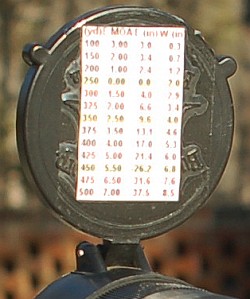 Here’s a great tip from Forum member Greg C. (aka “Rem40X”). Greg has created a trajectory table with windage and elevation data for various distances and wind speeds. Greg prints out a compact version of his drop chart to place on his rifle. While many shooters tape a ‘come-up’ table on their buttstock, Greg has a better solution. He tapes the trajectory table to the outside of his front flip-up scope cover. This way, when he flips up the cover, his data is displayed for easy viewing right in front.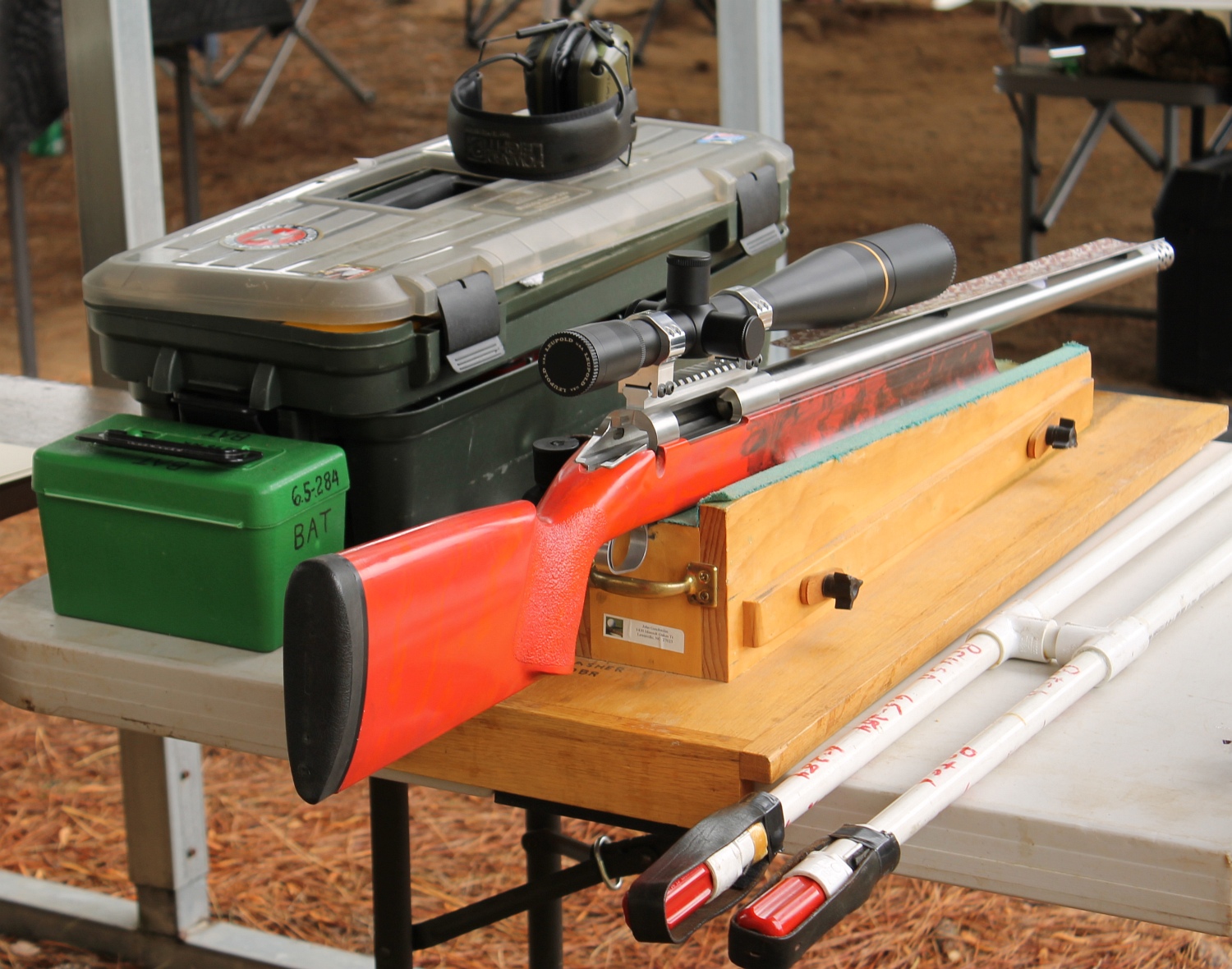


 Dasher Loading Tips


