Brass jags perform well for their intended purpose — with one hitch. Strong copper solvents can actually leech metal from the jag itself, leaving the tell-tale blue tint on your patches. This “false positive” can be frustrating, and may lead shooters to over-clean their barrels.
Gunslick Nylon Spire-Point Jags
There are now some good alternatives to brass jags. The best may be the Gunslick® Nylon Snap-Lock™ jags shown at right. These never leave a “false positive”. A while back, Larry Bartholome, past USA F-Class Team Captain told us: “The best spear-type jags I have used are the GunSlick black nylon tips. I have used the model 92400 for the last couple years in my 6BR and 6.5-284s. Unlike the white plastic jags, these are strong and there’s no brass to worry about.” You can purchase these nylon jags directly from GunSlick just $1.49 each. At that price, they’re worth a try.
#92400 for 22 through 270 calibers: $1.49
#92421 for 30 through 375/8mm calibers: $1.49
#92423 for 38 through 38/9mm calibers: $1.49
Tipton Nickel-Coated Jags
If you prefer a metal jag, consider the Tipton Nickel-coated Ultra Jags, sold both individually and as a boxed set. All Tipton nickel-plated jags have 8-32 thread, except for the .17 caliber jag which has a 5-40 thread. The vast majority of user reviews have been very positive. A few guys have complained that the nickel-plated Tipton jags run oversize, but we use a .22-caliber jag in our 6mms anyway, so this hasn’t been a problem for us. Both the .22 cal and the .243/6mm cal nickel-plated jags cost $3.08 each at Midsouth. The complete 12-jag set, covering .17 to .45 calibers, including a flip-top carry case, is offered by Midsouth Shooters Supply for $17.62 (Midsouth item 094-500012).
Tipton also makes a nickle-plated 12-Jag Kit in a flat version with a see-through top. Sold by MidwayUSA for $16.99, this features an easy-to-use, clear-topped fitted caddy that can lie flat on your bench, or be attached vertically (to save space).
Clear-Coating Your Brass Jags
If you’re reluctant to give up your collection of brass jags (after all they’ve worked pretty well so far), try covering the jag itself with a thin, transparent coating. Forum Member BillPA says: “I give the brass jags a coat of clear lacquer or acrylic; that works for me”. You may need to experiment to find a coating that stands up to your favorite solvent. BillPA says: “The only solvent I’ve found that eats the lacquer off is TM Solution. Butch’s, Shooter’s Choice, or Wipe-Out don’t seem to bother it. Most of the time I use rattle-can clear lacquer”. If you’re feeling creative, you could even color-code your jags by adding tints to the clear-coat.
Put the same load in a variety of barrels (with the same length and chamberings) and you’ll see a wide variance in muzzle velocity. In fact, it’s not unusual to see up to 100 fps difference from one barrel to the next. We demonstrated this with a comparison test of Lapua factory ammo.
Chron Testing Lapua Factory Ammo
At our Southern California test range, we chronographed Lapua 105gr 6mmBR factory ammo in three different 8-twist barrels of similar length. The results were fascinating. Lapua specs this ammo at 2790 fps, based on Lapua’s testing with its own 26″ test barrel. We observed a speed variance of 67 fps based on tests with three aftermarket barrels.
Brand ‘S’ and Brand ‘PN’ were pre-fit barrels shot on Savage actions. Brand ‘K’ was fitted to a custom action. All test barrels were throated for the 100-108 grain bullets, though there may have been some slight variances in barrel freebore. With a COAL of 2.330″, the rounds were “jumping” to the rifling in all barrels. Among the four barrels, Brand ‘PN’ was the fastest at 2824 fps average — 67 fps faster than the slowest barrel. Roughly 10 fps can be attributed to the slightly longer length (27″ vs. 26″), but otherwise this particular barrel was simply faster than the rest. (Click Here for results of 6mmBR Barrel Length Velocity Test).
Results Are Barrel-Specific, Not Brand-Specific
These tests demonstrate that the exact same load can perform very differently in different barrels. We aren’t publishing the barrel-makers’ names, because it would be wrong to assume that ‘Brand X’ is always going to be faster than ‘Brand Y’ based on test results from a single barrel. In fact, velocities can vary up to 100 fps with two identical-spec barrels from the SAME manufacturer. That’s right, you can have two 8-twist, 26″ barrels, with the same land-groove configuration and contour, from the same manufacturer, and one can be much faster than another.
Don’t Demand More Than Your Barrel Can Deliver
We often hear guys lament, “I don’t get it… how can you guys get 2900 fps with your 6BRs and I can only get 2840?” The answer may simply be that the barrel is slower than average. If you have a slow barrel, you can try using more powder, but there is a good chance it may never run as fast as an inherently fast barrel. You shouldn’t knock yourself out (and over-stress your brass) trying to duplicate the velocities someone else may be getting. You need to work within the limits of your barrel.
Factory Ammo Provides a Benchmark If you have a .223 Rem, 6BR, .243 Win, 6.5×47 Lapua, 6.5×55, .308 Win, 30-06, or 300 WM Rifle, we recommend you buy a box of Lapua factory-loaded ammo. This stuff will shoot great (typically around half-MOA), and it can give you a baseline to determine how your barrel stacks up speedwise. When you complete a new 6BR rifle, it’s wise to get a box of the factory ammo and chronograph it. That will immediately give you a good idea whether you have a slow, average, or fast barrel. Then you can set your velocity goals accordingly. For example, if the factory 6BR ammo runs about 2780-2790 fps in your gun, it has an average barrel. If it runs 2820+ in a 26″ barrel (or 2835 fps in a 28″), you’ve got a fast tube.
If you want to see how a muzzle brake really works, definitely watch this remarkable slow-motion video compiled by Proof Research.
This amazing video features a variety of firearms: suppressed 9mm pistol, .338 Norma rifle, .300 WinMag rifle, 12ga comp’d shotgun, plus an AR15 and AR10.
This Must-Watch Video Has Some Amazing Ultra-Slow-Motion Segments
Watch the ultra-slow motion segment at the 2:55 mark and you can actually see a .30-cal bullet spin its way through the muzzle brake, leaving trail of flame that blows out the ports. Interestingly, at the 3:10 mark, you can also see a bright “afterburn” ball of fire that forms a few inches ahead of the muzzle milliseconds after the bullet has left the barrel. Perhaps this is late ignition of unburned powder?
Proof Research (PR) sells high-grade hunting and tactical rifles built with PR-made actions and carbon-wrapped barrels. For more information, visit ProofResearch.com.
Credit Steve of TheFirearmBlog.com for this YouTube video. Footage by JNZ for Proof Research.
Given the high cost of reloading components, and how difficult it is to find rimfire ammo these days, many shooters are looking seriously at air rifles, at least for short-range training and plinking. Air rifle shooting is quiet and fun. Plus there is a virtually inexhaustible supply of free air on the planet. Airguns are increasing in popularity for many reasons including cost factors, powder and ammo shortages, and tighter restrictions on centerfire guns. How popular have airguns become? Consider this — it is estimated that over TEN MILLION airguns will be purchased in the U.S. in 2015. That’s a huge number.
If you’re interested in air-gunning, there’s a new resource that covers air-gunning from A to Z. Hard Air Magazine is a new, one-stop destination for everything airgun related. The free online magazine is devoted entirely to airguns and associated products. Unlike other airgun media, Hard Air Magazine is not tied to one distributor or manufacturer. “We cover the entire spectrum of products through objective editorial, illustration and videos,” says Hard Air founder Stephen Archer.
Team of Expert Airgunners Provide Product Reviews
Many consumers research their airgun purchases on the Internet. Helping consumers make smart purchases is the mission of Hard Air Magazine. Archer explains: “Our goal with Hard Air Magazine is to offer balanced, instructive information to people purchasing airguns and accessories. Fact-based, detailed product reviews are at the heart of Hard Air Magazine. We’ve put together a phenomenal team of product testers with over 100 years of combined experience in airgun shooting. These are genuine enthusiasts who have spent their lifetimes shooting airguns and truly understand what makes one better than another.”
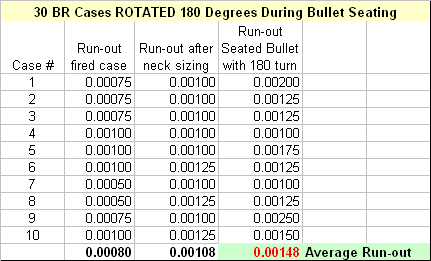
Here is a simple technique that can potentially help you load straighter ammo, with less run-out. It costs nothing and adds only a few seconds to the time needed to load a cartridge. Next time you’re loading ammo with a threaded (screw-in) seating die, try seating the bullet in two stages. Run the cartridge up in the seating die just enough to seat the bullet half way. Then lower the cartridge and rotate it 180° in the shell-holder. Now raise the cartridge up into the die again and finish seating the bullet.
Steve, aka “Short Range”, one of our Forum members, recently inquired about run-out apparently caused by his bullet-seating process. Steve’s 30BR cases were coming out of his neck-sizer with good concentricity, but the run-out nearly doubled after he seated the bullets. At the suggestion of other Forum members, Steve tried the process of rotating his cartridge while seating his bullet. Steve then measured run-out on his loaded rounds. To his surprise there was a noticeable reduction in run-out on the cases which had been rotated during seating. Steve explains: “For the rounds that I loaded yesterday, I seated the bullet half-way, and turned the round 180 degrees, and finished seating the bullet. That reduced the bullet runout by almost half on most rounds compared to the measurements from the first test.”
Steve recorded run-out measurements on his 30BR brass using both the conventional (one-pass) seating procedure, as well as the two-stage (with 180° rotation) method. Steve’s measurements are collected in the two charts above. As you can see, the run-out was less for the rounds which were rotated during seating. Note, the change is pretty small (less than .001″ on average), but every little bit helps in the accuracy game. If you use a threaded (screw-in) seating die, you might try this two-stage bullet-seating method. Rotating your case in the middle of the seating process won’t cost you a penny, and it just might produce straighter ammo (nothing is guaranteed). If you do NOT see any improvement on the target, you can always go back to seating your bullets in one pass. READ Forum Thread….
Story based on report by Lars Dalseide forNRABlog
A strong argument can be made that Robert Vadasz is the greatest law enforcement pistol shooter of all time — in this galaxy or any other. This past week Border Patrolman Vadasz captured an unprecedented sixth NRA National Police Shooting Championship (NPSC). That’s five in a row for Robert, and six titles in the last seven years. How do you spell dominance? V-A-D-A-S-Z.
Robert Vadasz Blazes his Way to a Sixth NPSC Title.
This year Robert had to overcome a jammed pistol in one of his relays, but he still managed to shoot top score for the day and finished with the highest Grand Aggregate, 56 points ahead of the next-best competitor. The NPSC involves a variety of timed, action shooting events for revolvers, semi-automatic pistols, and police shotguns.
400+ Competitors at NPSC
The competition began on September 14th and wrapped up yesterday (the 18th) with the team championships. Shooters vying for the overall title take part in sixteen different individual matches in four separate categories: Open Class Revolver, Open Class Semi-Automatic Pistol, Individual Service Pistol, and Law Enforcement Shotgun. More than 400 law enforcement officers from across the globe gathered in Albuquerque, New Mexico to take part in the competition.
Vadasz shot well in all the different events. For example, in the Open Class Revolver Championship, Vadasz scored 1498 out of 1500 possible points, a near perfect performance. That score, along with his 1495 total from the Open Class Semi-Automatic Championship, gave the Border Patrol Agent another title — the Open Class 3000.
Think Vegas in January, baby — yes, we’re talkin’ about SHOT Show (Jan. 20-23, 2015). Registration for the National Shooting Sports Foundation’s 2015 SHOT Show is now open for all attendees. Register now at Shotshow.org. The SHOT Show hotel booking system is also active. It’s a good idea to reserve rooms early to get the best rates. SHOT Show organizers have negotiated deeply discounted rates at dozens of Las Vegas hotels, with prices as low as $45 per night.
Scheduled for January 20-23 in Las Vegas, the big gun industry convention is just four months away. While registering, attendees can add Industry Dinner tickets, enroll in SHOT Show University, and/or sign up for other educational offerings. Registration for members of the press will open later this week.
Report by Dick Grosbier for IBS
Over the weekend of September 13-14, 2014, the Ashe County Wildlife Club of Laurel Springs, North Carolina hosted the 44th annual IBS 100/200 Score Nationals. Sixty-two shooters were on the line for the event, including many record holders and major match winners.
The shooters traveled from as far away as Florida, Wisconsin, and Maine. Considering the miserable weather forecast for Saturday it was really a pretty nice day. We did have rain but thanks to the way the roof overhangs the firing line (photo below) the competitors stayed dry, only the target crew got wet. In spite of this they did an excellent job — they were fully prepared as the forecast was for a very high percentage chance of rain. Saturday got into the high 70s and actually got a little muggy. Sunday was overcast cooler and little if any rain fell.
This was my third visit to Ashe County this year and I must say it gets better each time. They have a great crew of people and a wonderful facility. There are 30 covered benches located next to a very large (40’x160’) reloading, scoring, dining, and clubhouse facility. The entire range is built on the side of a big hill. They have literally moved thousands of cubic yards of dirt (50,000+) to build this facility.
Breeden Busts Record — 1000-59X Two-Gun Total May Be Best Ever!
This year’s IBS Score Nationals saw a performance for the ages. Dean Breeden put together one of the most impressive feats of score shooting in history. Dean’s Two-Gun total score (for VFS and Hunter) was a stunning 1000-59X. This is a pending new Two-Gun IBS world record. Think about that — this means that Dean did not drop a single point through twenty (20) total matches (i.e. 20 targets), while alternating between two different rifles, one with a puny 6-power scope! That’s 100 “Tens” in a row on 100 Bullseyes, without fail. That’s really a remarkable achievement. As least Dean does not have to console the old record-holder, because the pre-existing record, 1000-52X, was set by (you guessed it), Mr. Dean Breeden. In besting his own record by seven Xs, Breeden won the Two-Gun award at this year’s IBS Score Nationals and earned a new entry in the record books. Congrats to Dean!
Bullet-maker Randy Robinett was amazed at Breeden’s 1000-59X performance. “Some years ago, I held the Two-Gun score record with a 999-52X. What Dean has accomplished with his 1000-59X is truly noteworthy — this really is a BIG deal. Let me tell you, getting 1000 points is really hard to do. You have to switch between two different rifles, and adjust from a high-power scope to a 6X scope, changing rests and equipment all the time. This is very tough.”
Looking at the Equipment List (Editor’s Comment)
The Equipment List from the 2014 IBS Score Nationals is quite revealing. As you’d expect, this match was very much a 30-caliber affair, but we were surprised to see such dominance by cut-rifled barrels, and Hodgdon H4198 powder.
1. All of the Top 15 VFS shooters ran cut-rifled barrels. There were mostly Bartleins and Kriegers, with two Brux barrels and one Rock Creek.
2. Hodgdon H4198 is definitely the powder of choice, used by 14 of the Top 20 VFS shooters. Federal 205M primers were used by at least 13 of the Top 20 shooters.
3. Randy Robinett’s BIB bullets were the most popular, used by four of the Top 10 shooters.
4. Every VFS shooter and every Hunter Class shooter was running a 30-caliber cartridge. Most VFS shooters ran 30BRs, but the 30×47 cartridge was favored by half the Hunter shooters.
5. Two gunsmiths smithed six of the Top 10 rifles. Three were by Mike Niblett and three were by Sid Goodling (who also smithed #11 and #12).
6. BAT Machine actions are still #1. BAT actions were used by 14 of the Top 20 shooters.
Mike Niblett (above) had a typical VFS rig: BAT action, Krieger cut-rifled barrel, with a Nightforce 12-42X scope. Mike used H4198 of course, but he shot Hill bullets in his 30BR, rather than BIBs.
Many 250s with 20 or more Xs Shot on Saturday
Saturday, at 100 yards, it was the Kevin and K.L. show. Kevin Donalds Sr. and K.L. Miller took the lead in Varmint For Score, and Hunter classes respectively all day long. Kevin turned in a fine score of 250-22X followed closely by Dean Breeden with 250-21X. Dean was just barely short of the win all weekend in both classes. Mike Niblett was third with 250-20X, ahead of five other 250-20X scores based on tie-breaker. There were four 19X and eight 18X scores. K.L. Miller turned in a fine 250-18x score in Hunter Class followed closely by Peter Hills and Frank McKee (both with 250-16Xs). It was moderately windy and switchy all day and since the Nationals involve shooting each record match from a different bench you essentially faced a new set of conditions each time you came to the line.
‘Top Guns’ at the Score Nationals: Kevin Donald Sr., K.L. Miller, and Dean Breeden.
Sunday it was overcast and cooler but not as rainy. Anthony Isner stepped up and took the lead in VFS class turning in a fine 250-16X score. Second place went to, you guessed it, Dean Breeden. Dean’s 250-15X was followed closely by Kevin Donalds Sr. also with 15X. In Hunter class it was Randy Jarvais’s turn to win an Aggregate. Randy’s 250-9X score beat out Dean’s 250-8X and Miller’s 250-7X scores.
In the VFS Grand Aggregate, Kevin Donalds Sr. topped the field with 500-37X, followed by Dean Breeden with 500-36X, and Anthony Isner with 500-34X. K.L. Miller won the Hunter Grand Agg handily — his 500-25X easily topped Dean’s 500-23X and Randy’s 500-20X totals. The IBS 2-Gun award went to Dean Breeden with a record score of 1000-59X. This is a potential new 2-Gun record as he bested his own record by seven Xs.
Praise for the Match Organizers and Staff
All in all it was a very well run match at a great new facility. This was the first Nationals event to be held there but it will not be the last. Hats off to E.T. Weaver and his helpers. The target crew deserves special mention. They were very good and very fast. A match with full bench rotation can be a nightmare for any target crew but these guys handled it like old pros even though it was their first-ever attempt. Well done guys and gals!
The Ashe County Wildlife Club put on a great event, complete with delicious country Barbecue.
RifleShooter Magazine released a list of the Ten Greatest Lever Guns of All Time. Writing for RifleShooter, Brad Fitzpatrick examined a wide selection of lever guns produced in the past 150 years, and came up with this short list of ten “all-star” lever action rifles:
Savage Model 99
Winchester Model 1873/73
Winchester Model 1888/88
Winchester Model 1892/92
Winchester Model 1894/94
As with all “Top 10″ lists, this will be controversial. Where is the Winchester model 1866 “Yellowboy”, the favorite of Native Americans? Where is the iconic Winchester model 1895, the beloved gun Teddy Roosevelt called “Big Medicine”? But other choices are hard to fault. The Henry Rifle, the first popular cartridge lever gun, surely belongs on the list. And, believe it or not, the Winchester Model 94 is the best-selling sporting rifle of all time in the USA, according to RifleShooter.
So what do you think of RifleShooter’s Top 10 list? Does it make sense, or did RifleShooter magazine get it wrong? If you go to the RifleShooter website, you can vote for your favorite lever gun among the ten candidates listed above. (Scroll to bottom of page for poll.)
Fitzpatrick writes: “The lever action played a very legitimate role in America’s westward expansion. It could bring meat to your table or protect your land and assets against rustlers.
Nostalgia aside, the lever gun is an effective hunting tool for those willing to live within its limitations. While it can’t beat a bolt gun with a light trigger and free-floated barrel in a long-range shooting competition, a lever action in the right hands can be rather accurate, especially given new advancements in rifle design and bullet technology.”
Have you ever wondered how a cut-rifled barrel is made? This process, used by leading barrel-makers such as Bartlein, Border, Brux, Krieger, and Obermeyer, can yield a very high-quality barrel with a long useful life. Cut-rifled barrels have been at the top in short- and long-range benchrest competition in recent years, and cut-rifled barrels have long been popular with F-Class and High Power shooters.
You may be surprised to learn that cut-rifling is probably the oldest method of rifling a barrel. Invented in Nuremberg around 1520, the cut-rifling technique creates spiral grooves in the barrel by removing steel using some form of cutter. In its traditional form, cut rifling may be described as a single-point cutting system using a “hook” cutter. The cutter rests in the cutter box, a hardened steel cylinder made so it will just fit the reamed barrel blank and which also contains the cutter raising mechanism.
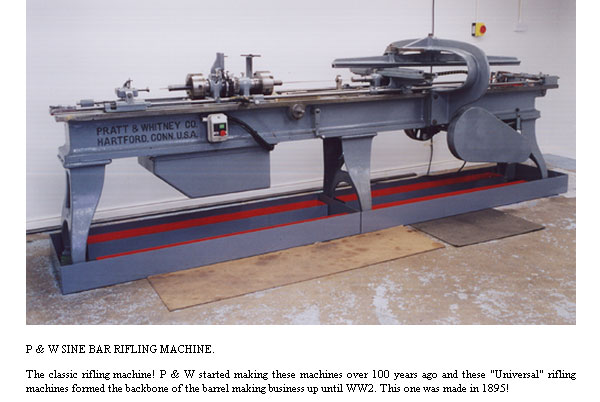
Above is a computer animation of an older style, sine-bar cut-rifling machine. Some machine features have been simplified for the purposes of illustration, but the basic operation is correctly shown. No, the cut-rifling machines at Krieger don’t use a hand-crank, but the mechanical process shown in this video is very similar to the way cut-rifling is done with more modern machines.
Read About Cut-Rifling Process at Border-Barrels.com
Read About Cut-Rifling Process at Border-Barrels.com
To learn more about the barrel-making process, and cut-rifling in particular, visit FirearmsID.com. There you’ll find a “must-read” article by Dr. Geoffrey Kolbe: The Making of a Rifled Barrel. This article describes in detail how barrels are crafted, using both cut-rifling and button-rifling methods. Kolbe (past owner of Border Barrels) covers all the important processes: steel selection, hole drilling, hole reaming, and rifling (by various means). You’ll find a very extensive discussion of how rifling machines work. Here’s a short sample:
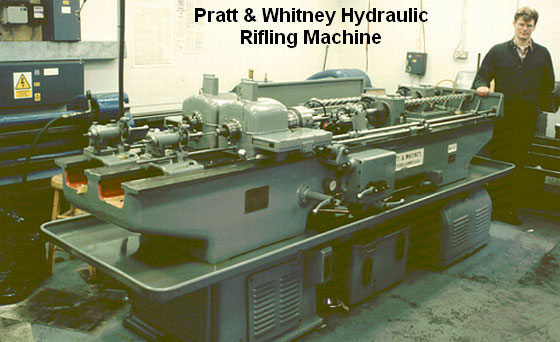
“At the start of World War Two, Pratt & Whitney developed a new, ‘B’ series of hydraulically-powered rifling machines, which were in fact two machines on the same bed. They weighed in at three tons and required the concrete floors now generally seen in workshops by this time. About two thousand were built to satisfy the new demand for rifle barrels, but many were broken up after the war or sold to emerging third world countries building up their own arms industry.
Very few of these hydraulic machines subsequently became available on the surplus market and now it is these machines which are sought after and used by barrel makers like John Krieger and ‘Boots’ Obermeyer. In fact, there are probably less of the ‘B’ series hydraulic riflers around today than of the older ‘Sine Bar’ universal riflers.
The techniques of cut rifling have not stood still since the end of the war though. Largely due to the efforts of Boots Obermeyer the design, manufacture and maintenance of the hook cutter and the cutter box have been refined and developed so that barrels of superb accuracy have come from his shop. Cut rifled barrel makers like John Krieger (Krieger Barrels), Mark Chanlyn (Rocky Mountain Rifle Works) and Cliff Labounty (Labounty Precision Reboring)… learned much of their art from Boots Obermeyer, as did I.” — Geoffrey Kolbe
Video find by Boyd Allen. Archive photos from Border-Barrels.com. In June 2013, Birmingham Gunmakers Ltd. acquired Border Barrels. Dr. Geoffrey Koble continues to work for Border Barrels, which maintains operations in Scotland.


 Gunslick Nylon Spire-Point Jags
 Tipton Nickel-Coated Jags


 If you have a .223 Rem, 6BR, .243 Win, 6.5×47 Lapua, 6.5×55, .308 Win, 30-06, or 300 WM Rifle, we recommend you buy a box of
 If you want to see how a muzzle brake really works, definitely watch this remarkable slow-motion video compiled by


 Here is a simple technique that can potentially help you load straighter ammo, with less run-out. It costs nothing and adds only a few seconds to the time needed to load a cartridge. Next time you’re loading ammo with a threaded (screw-in) seating die, try seating the bullet in two stages. Run the cartridge up in the seating die just enough to seat the bullet half way. Then lower the cartridge and rotate it 180° in the shell-holder. Now raise the cartridge up into the die again and finish seating the bullet.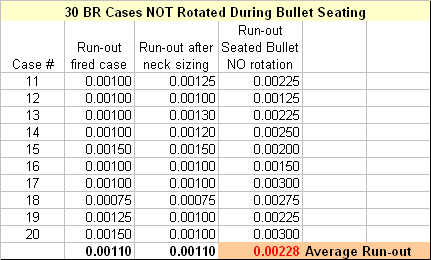

 400+ Competitors at NPSC