|
|
September 26th, 2014
If you haven’t visited the Norma website recently, you should click over to www.norma.cc/en/ (the ‘en’ is for English version). There you will find Norma’s “Ammo Academy”, a technical resource that provides information on: Ballistics, Powder Storage, Barrel Wear, and Bullet Expansion. In addition, the Ammo Academy now links to Norma’s Reloading Data Center, where you’ll find loads for nearly 70 cartridge types including: .223 Rem, .22-250, 6mmBR Norma, 6XC, 260 Rem, 6.5-284, 6.5×55, 7mm-08, .270 Win, .284 Win, .308 Win, .30-06, 300 Win Mag, .338 Lapua Mag and dozens more.

The Ammo Academy’s Ballistics section contains some fascinating technical facts:

- After the trigger is pulled, it takes around 0.005 seconds before the firing pin reaches the primer.
- From the firing of the primer it takes 0.0015-0.002 seconds until the bullet exits the muzzle.
- When the bullet leaves the muzzle, the hot gases surround and overtake the bullet, continuing the acceleration for a few centimeters.
- Because the barrel is always angled slightly upwards, the bullet’s flight starts about 3-5 cm below the line of sight.
Norma also offers some good advice about Powder and Cartridge Storage:
To maintain the product quality for as long as possible, you have to keep the powder in a suitable place under suitable conditions. Where possible, store the powder at a constant temperature, ideally between 12 and 15°C (54°F to 59°F), and a relative humidity of 40–50%. If the air is too dry, it will dry out the powder, which will cause the pressure to be higher, thus affecting performance. Also make sure that you close the powder container properly afterwards. Cartridges should be stored under the same ambient conditions to maintain their quality.
For more info on Norma products, CLICK HERE to access Norma’s Catalog Download Page.
Story Tip by EdLongrange. We welcome submissions from our readers.
September 26th, 2014
 So, you want to put five shots through one hole at 100 yards? That may be asking a bit much, but with the right rifle, the right technique, and the right load, you might just be able to shoot “in the ones” (i.e. a group measuring 0.1 to 0.199 MOA). You could consume a lot of time and money trying to achieve this level of precision. Or you could learn from “the man”, Tony Boyer, unquestionably the most successful shooter in the history of short-range benchrest competition.
You can literally “go inside Boyer’s brain” by reading his 323-page treatise, The Book of Rifle Accuracy. First published in 2010, this is a beautiful book, full of color photos from cover to cover. Every serious benchrest shooter should read Tony’s book. He has dominated registered benchrest in a fashion that will never be duplicated. Tony Boyer has 164 U.S. Benchrest Hall of Fame points. The next closest shooter, Lester Bruno, has 48 Hall of Fame points. (Totals current 9/21/13).
The full-color book is 323 pages long, with color photos or color illustrations on nearly every page. The hard-cover edition costs $42.50, while the soft cover version is $34.50. Purchase from Amazon.com, or you can buy directly the publisher by visiting www.RifleAccuracyBook.com. The Boyer books are also available from Bruno Shooters Supply, 1-800-455-0350.
| Paperback Edition
|
 |
Hard-Back Edition
|
The Book Of Rifle Accuracy, By Tony Boyer

September 25th, 2014
Here’s a humorous illustration that pokes fun at golf. We posted this on Facebook recently. To our surprise this generated 356 shares, and reached 22,000+ readers, making this the most popular AccurateShooter Facebook post ever. “Golf — the willful misuse of a perfectly good rifle range.”

So, what do you think — should golf courses be converted to shooting ranges? Is golf truly a “good [shoot] spoiled”? This photo was shared by our shooting buddy Jim de Kort from Holland.
 CLICK HERE to follow us on Facebook.
Click the LIKE button to get regular updates.
Here are some comments from our Facebook fans:
“Actually golf and shooting are similar sports. Trying to shoot a small object into a small hole from long range.” — Eric A.
“You can hit a golf ball 300 yards, but I can hit a golf ball AT 1000 yards.” — Zach S.
“The game should be changed. You should hit the ball out as far as possible, then get your rifle out and hit the golf ball. The most golf balls hits… with the rifle wins!” — Hui H.
September 25th, 2014
“How do silencers work?” We hear that question often. Now, thanks to Silencerco.com, we can answer that question. Here’s a helpful infographic that illustrates the features of a suppressor (aka “silencer”, “can”, or “sound moderator”). Silencers reduce gunshot noise by providing a contained space where hot gases can dissipate and cool before exiting. Silencers are typically divided into multiple, internal expansion chambers. A quality suppressor can reduce gunshot noise by 30 decibels (db) or more. See the chart for comparative firearm noise levels (suppressed vs. un-suppressed).
In the United States, suppressors have become much more popular in recent years. In fact, the number of licensed silencers has doubled since 2011. Over 571,750 suppressors are now lawfully registered in the USA. Firearm sound moderators can now be purchased legally in 39 states, provided one obtains the requisite Federal tax stamp. (Texas is the leading suppressor state.) Seven European countries also allow suppressor ownership.
CLICK IMAGE to Load Larger Version.

 Suppressors Featured in Modern Shooter
Legal for private ownership in 39 states, suppressors are more popular than ever (though many gun owners are still not aware that silencers can be acquired without much difficulty). The Fall 2014 issue of Modern Shooter focuses on the popularity of today’s suppressors and sound-moderating technology available for handguns, rifles, and shotguns. This entire issue is dedicated to suppressors and their benefits. This comprehensive guide explains how suppressors work and how gun owners can easily (and lawfully) purchase them. The issue includes a detailed history of the suppressor, which was first patented in 1909 by the son of the inventor of the machine gun. There is also a feature story on hunting with suppressors in Europe. Modern Shooter is available on newsstands and as a digital download at GunDigestStore.com.
September 24th, 2014
If you’re one of those folks who doesn’t wear eye protection, you need to check out the LuckyGunner Labs Eye Protection Test. For those who DO wear safety glasses — don’t assume that everything is OK. Just because you purchased name-brand “safety glasses” doesn’t mean that you are getting truly effective protection. In fact, many forms of protective eyewear sold today are flimsy, or poorly made. Consequently, they won’t stop even low-energy, slow-velocity fragments.
CLICK HERE to Read Complete Eyewear Test Report by LuckyGunner Labs.
 Two years ago, LuckyGunner Labs conducted very extensive field tests of 28 types of eyewear, ranging in price from $7 to $220. Remarkably, some of the most expensive safety eyewear performed no better than $10 items. Many of the products failed shockingly — with the lenses coming right out of the frames when hit with pellets. LuckyGunner recorded these kind of failures even with ANSI Z87-“approved” eyewear. The reason is that the Z87 test is not tough enough: “The basic ANSI standard is referred to as Z87, and you’ll see this marked in a number of locations on most eye protection marketed to shooters. However, the Z87 impact standard involves a .25″ steel ball traveling at 150 fps — this is fine for protecting eyes from debris that might fall or be thrown, but is not extremely relevant to shooters, who are dealing with objects traveling at much higher velocities.”
| Standard |
Impact speed |
Caliber/Size |
ANSI Z87.1-2003
High Velocity |
150 feet/second
45 meters/second |
0.25″ diameter steel ball
(25 caliber) |
Mil-PRF-31013
Vo ballistic test |
640-660 feet/second
195 meters/second |
0.15 inch diameter steel projectile (15 caliber) |
The testers recommend you select eyewear that meets military specification (above and beyond ANSI Z87). The MIL-PRF-31013 Standard covers projectiles up to 650 feet per second. This is much more stringent. Additionally, you want to replace often-used protective eyewear every year or so. Long-term exposure to UV radiation can weaken polycarbonate and lessen its ability to withstand impacts.
SUMMARY — What to Look for in Protective Eyewear
THE GOOD — Eyewear Protects Against Direct Hit with .22 Short Bullet
APEL Revision Sawfly eyewear was shot with a .22 Short, pushing a 29 grain bullet at 710 fps. That’s not powerful by modern firearm standards, but this might be fairly representative of a ricochet bullet fragment. The Sawfly lens stopped this 29gr bullet with minimal damage to the cheek area.

THE BAD — Remington Eyewear Lenses Separate. Right Lens Enters Eye Socket
The most gruesome example was the cheap Remington eyewear which shed both lenses back towards the eyes, one of which embedded itself into the eye socket. The real-world implications of this action are disturbing to say the least.

THE UGLY — Prescription Glasses Failed Miserably
Many ranges don’t see any need for protective eyewear beyond prescription glasses. However, most prescription lenses offer little if any protection. If the prescription lenses are glass, this can create more problems. As shown below, these prescription glasses offered no ballistic protection, and, in fact, proved more dangerous to the eyes due to the flying glass shards.

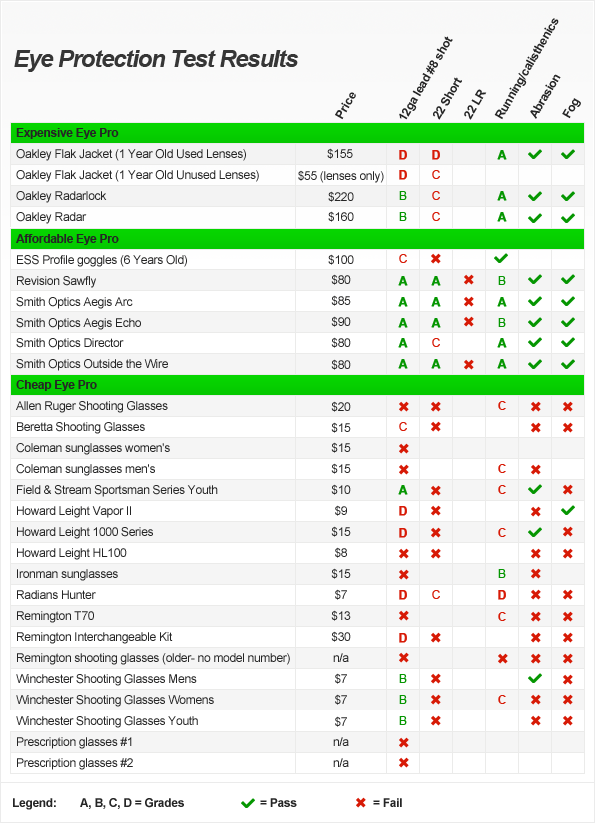
Results Chart, Video Clips, and Photos copyright Luckygunner.com.
Summary and Conclusions:
For faster-moving projectiles such as ricochet fragments, you need high quality, tested eye protection. LuckyGunner recommends eyewear with a single (one-piece) lens for any activity where your face might be struck by small, fast-moving objects. Individual lenses detach from the frames once a certain level of force is reached, and they are driven back into the eye sockets, where considerable damage may be done. There are good examples of protective eyewear with two separate lenses, but a broad, one-piece lens distributes force much better.
 A wide, comfortable, and preferably soft rubber nosepiece is critical. Along with good “arms”, this will serve to keep the eye protection in place and will also reduce the chances of the lens being driven down or back into the face with enough force to damage the orbital bones.
A frame that connects across the top of the lens, not individual arms which attach to the outside corners of the lens, is recommended. This will reduce the chances of the lens detaching from the frame under impact (it’s still possible, just less likely). Some types of eye protection actually use the frame to absorb impact and distribute force.
NOTE: Andrew, the author of the LuckyGunner Eyewear report, was a former Navy Corpsman. Accordingly, he is familiar with health and safety matters.
September 24th, 2014
 Over the past three decades, a quiet revolution has been taking place across the country. We’re talking about the expansion of “right-to-carry” or “shall issue” laws allowing citizens to carry concealed firearms. If you look at the animated map below, you’ll see that the vast majority of states now allow citizens to obtain carry permits on a “shall-issue” basis. That typically means than a citizen can obtain a carry permit after fulfilling basic requirements, such as a background check, safety class, and finger-printing.
As recently as the mid-1990s, most states disallowed carry permits, or allowed such permits only at the discretion of local law enforcement officials. Over the past 30 years states have migrated to less restrictive alternatives. The map below shows how most states have gone from “No-Issue” (Red) or “May-Issue” (Yellow) status to “Shall Issue” (Blue).

Opponents of right-to-carry legislation argued that the passage of “shall issue” laws would increase gun violence. In fact, the opposite occurred. The level of violent gun crime has declined in recent decades. A study by the Bureau of Justice Statistics (BJS) showed a 39% decline in gun murders from 1993 to 2011 plus a 69% drop in non-fatal gun crimes during that period.
All 50 states have now passed laws allowing citizens to carry certain concealed firearms in public, either without a permit or after obtaining a “shall-issue” or “may-issue” permit from local law enforcement. Illinois had been the last state without such a provision — but its long-standing ban on concealed weapons was overturned in a federal appeals court, on Constitutional grounds. Illinois was required by the court to draft a concealed carry law by July 9, 2013 at which time the Illinois legislature, over-riding the amendatory veto of the governor who had sought to impose many restrictions, approved concealed carry to begin January 2014, at the latest.
September 24th, 2014
The shooting sports are thriving in the USA. Target shooting participation levels have increased 19% over a recent 4-year period, from 34.4 million shooters in 2009 to 40.8 million in 2012. That means 6.4 million more Americans are shooting. By contrast, golf and some other hobby activities have seen their participant base decline by millions. Despite pressures to close shooting ranges and the high cost of ammunition and reloading components, more people than ever before are enjoying target shooting. The increase in target shooting has been driven by an influx of new shooters.
Demographic Changes in Ranks of Target Shooters
Compared to those who took up shooting 20 or 30 years ago, these new shooters represent a generational change. Newcomers — defined as those who have taken up target shooting in the last five years — are trending younger and female. Also, more new shooters are city and suburban dwellers (compared to older shooters who typically live in rural areas). In these ways, the demographic profile of new shooters is different than that of established participants.

Although they may be different in age, gender, and geo-location, newcomers share one important thing with established participants — their passion for firearms ownership and the shooting sports. The traditional pastimes of handgun, rifle and shotgun target shooting continue to have a broad appeal to new generations of Americans.
September 23rd, 2014

The 2014 IBS 600-Yard Benchrest Nationals will take place this upcoming weekend in Memphis, Tennessee at the Memphis Sport Shooting Assn. (MSSA) Range. The match runs Friday, September 26th through Saturday, September 27th. Set-up and practice sessions will be held on Wednesday and Thursday. The for-record matches will commence with the Light Gun division at 8:05 am on Friday. Heavy Gun matches will be held on Saturday.
IMPORTANT — You can still join in the fun. It’s not too late to register for this event. You can register at the range up to 6:00 pm on Thursday, September 25th. Mike Moses is the Match director. The MSSA Range is located about 25 miles northeast of Memphis, TN. Click here for directions and hotel links.
 IBS 600-YARD NATIONALS – 2014
Memphis Sport Shooting Association
9428 Old Brownsville Road
Lakeland, TN 38002
Light Gun Competition – Friday, Sept. 26th.
Sign in by 7:30 A.M. Firing will begin 8:05 A.M.
Relays will fire in sequential order #1, #2, #3 & #4.
Heavy Gun Competition – Saturday, Sept. 27th.
Sign in by 7:30 A.M. Firing will begin 8:05 A.M.
Relays will fire in the order of #3, #4, #1 & #2.
Practice and Set-Up Sessions:
Wednesday Sept. 24th – 12:00 Noon until 6:00 pm
Thursday, Sept. 25th – 8:05 am until 6:00 pm
Registration and Fees
The current Match Registration fee is $200. (This includes lunch for both days). Registration deadline is 6:00 pm, Thursday, September 25th.
If you will register on site, fees may be paid to Mike Moses (Match Director). The organizers say: “If a competitor is delayed en route and is not pre-registered, please let us know as early as possible! We’ll make every effort to allow a late entry.”
Mike Moses, Match Director
Phone: 901-493-1687
Email: ashlinmetalworks [at] bellsouth.net
4224 Coleman Rd.
Memphis, TN 38128
10-year-old Rory Jacobs competed at last year’s IBS 600-yard Nationals in St. Louis, Missouri.

Event tip by Samuel Hall. We welcome reader submissions.
September 23rd, 2014
 National Hunting and Fishing Day (NHF Day) takes place on Saturday, September 27, 2014. The annual celebration serves as a reminder that conservation succeeds because of leadership and funding from hunters, shooters and anglers. National, regional, state and local organizations will run thousands of “open house” hunting- and fishing-related events around the country. Events will include Fishing Derbys, Hunting Expos, Wing-shooting tournaments, and much more. Over four million Americans will participate. For information on NHF Day, visit www.nhfday.org. To find NHF Day events, click the link below.
National Hunting and Fishing Day Events (Listed by State)
September 23rd, 2014
 If you’re looking for loaded ammunition at affordable prices, WikiArms.com can help you find a good deal. WikiArms constantly searches the listings of ammo vendors across the web. Then WikiArms ranks the offerings by cost per round, low to high. This way you can instantly compare prices from multiple vendors including Ammoland, Brownells, Cabelas, Lucky Gunner, MidwayUSA, Natchez, Sinclair Int’l, Slickguns, Sportsmans Guide, and Wideners. Search bots refresh pricing constantly so listed prices are normally current within five minutes. WikiArms even displays the amount of product currently in stock for each vendor.

Using WikiArms is easy. Just click your choice of caliber (such as 9mm, .22LR, or .308 Win) on the navigation bar, or hit the Good Deals link to see a variety of cartridge types all at one time. WikiArms is fast, and it is FREE to use. Check it out.
|


