This past weekend, Forum member Ron Boyd shot a 1.462″ five-shot Light Gun group at 1000 yards in an IBS benchrest match at the MidWest Benchrest Club in Yukon, Missouri. Ron shot a 6mm Dasher with Bartlein barrel and PR&T stock. Ron’s 1.462″ group is 0.065″ off the existing IBS 1000-yard Light Gun record. Ron’s group also happens to be .011″ smaller than the current NBRSA 1K Light Gun record, 1.473″ shot by Bill Schrader in 2002. (But this is not counted by the NBRSA since Ron shot in an IBS match.) Ron’s group was shot in the first relay of the day, in good conditions. The group had three (3) shots clustered in under one-third inch (0.03 MOA)!
This is truly a spectacular achievement. We think this has to been one of the smallest five-shot groups ever shot at 1000 yards, and probably the smallest ever with a 6mm cartridge. At 1000 yards, 1 MOA is 10.47″. This means that Ron’s group measured in at 0.1396 MOA! To give you an idea of how small Ron’s group really was, at left is a 1.462″ circle shown at 100% scale, along with a quarter at 100% scale.* The circle represents the center-to-center distance of Ron’s five shots at 1000 yards. Total vertical dispersion was just under 1.2″ for five shots. The vertical for the top four shots (measured with OnTarget software) was just 0.398″! Shown below is a flat-bed scan of the actual target. Notice the tight cluster of 3 shots touching. That’s a dime in the photo added for scale.
Ron Boyd’s 6mm Dasher Load Ron loaded a stout charge of Long Range Match surplus powder with Spencer 103gr bullets seated about .010″ OFF the lands. The bullets were “right out of the box”, NOT pointed. This powder has burn-rate characteristics very similar to Alliant Reloder 15, and Ron used his regular RL15 charge, adjusted by half a grain or so. Ron was using no-neck-turn “brown-box” Lapua 6BR brass formed into the 40° improved 6mm Dasher case. The unturned, loaded case necks measure about 0.2695″, yielding .0015″ total clearance in a 0.271″ chamber. The brass used for the 1.462″ group had seven previous firings. Ron anneals his brass after every firing using a Benchsource annealing machine. Ron told us: “The Benchsource is the greatest annealing machine there is, as far as I’m concerned.” Ron ultrasonically cleans his brass and then tumbles his brass after the ultrasound process. He does NOT use an internal neck lubricant. He does NOT uniform his primer pockets and he does NOT ream his flashholes. Ron believes this load was running “right around 3000 fps”, but he has not chron’d it yet using the new Bartlein barrel.
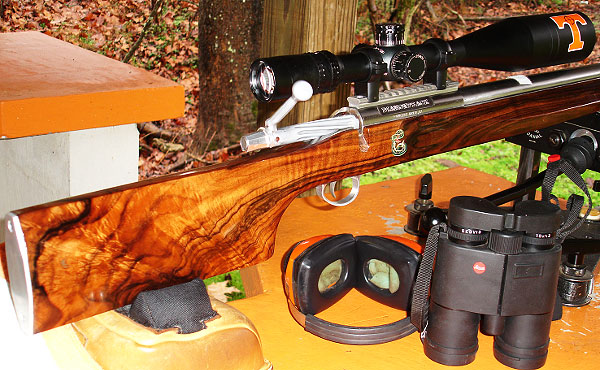
Ron Boyd’s 6mm Dasher Light Gun
Ron’s 17-lb Light Gun featured a BAT SV Action, Bartlein 30″ 1:8″ twist, 0.237″ land barrel, and Precision Rifle & Tool “Hammerhead” benchrest stock with 5″-wide wings in front. This stock weighs 4 lbs 1 oz. with an aluminum butt plate and is about 36.5″ long with integrated rails on the bottom of the “wings”. Ron’s friends Rich Griffin and Jerry Kloeppel did the chambering and bedding. Ron recently put the Bartlein barrel on the gun. Ron estimates that the barrel had only 40 rounds through it when it produced the 1.462″ group. Ron tells us: “This new barrel is great, and the 5″ PR&T stock really works. I luckily pulled the trigger at the right time.” Ron told us that this rifle shot in the high ones/low twos at 100 yards during testing.
PR&T Hammerhead Stock (catalog photo)
*The circle and quarter should appear “true size” when viewed at the most common monitor resolution. If you are running a higher resolution on your monitor, the illustration will appear small than actual size.
Eleven-Time NRA National High Power Champion David Tubb knows a bit about long-range shooting. One of the key factors in long-range accuracy is making sure that the tilt/cant of your rifle does not change throughout your shot string. In the clip below, the first in McMillan’s Master Class Video series, David Tubb explains the importance of keeping your rifle level. He explains that, at 1000 yards, your Point of Impact can change dramatically by canting the rifle either right or left. David states that, when shooting at 1000 yards, if your rifle is level and your shot is centered-up on a 72″ (six-foot) square target, you can actually put your next shot OFF PAPER by canting your rifle. That means you can move Point of Impact (POI) three feet or more, just by canting your rifle! Bryan Litz confirms Tubb’s observation. Bryan tells us that, as a general rule of thumb (for common cartridges), a 1° cant will produce five (5) inches of lateral displacement at 1000 yards. Thus, if you cant your rifle just 8°, the POI would move 40″ from the center of the target, putting the shot off the edge of a 72″-wide target.
David explains that, after one of his students has made two or three 1000-yard, X-Ring hits with a LEVEL rifle, “then I’ll have him take his rifle, and cant it to the right. I’ll have him shoot a shot. He will MISS the six-foot-square frame off to the right. Then I’ll have him cant his gun to the left and shoot another shot. He will miss the six-foot-square frame to the left.”
Rifle Hold and Canting — Consistency Counts Remember that you must maintain the exact same amount of rifle cant from shot to shot. Yes, some iron sights shooters do tilt their rifle slightly to achieve a better hold or to index their sights better. However, these shooters do not change the tilt from shot to shot — the amount of cant remains the same on every shot.
When shooting prone with a scoped rifle it’s probably best to keep the rifle dead level, with the scope’s vertical crosshair straight up and down. Use a rifle-mounted bubble level to maintain a level hold, and avoid canting the gun either to the left or to the right. Affordable bubble levels that mount to your scope or scope rail can be purchased from Brownells and other vendors, starting at about $15.00.
In our latest AccurateShooter.com feature story, we cover the quest of Forum member VolDoc to nail a Prairie Dog at 1000+ yards with a .20-caliber rifle. If you’re a fan of the “Terrific 20s”, or have an interest in ultra-long-range varminting, you’ll enjoy this story. VolDoc, a dentist by trade, is a seasoned Prairie Dog Hunter who has made many trips to the P-Dog fields in Colorado with his hunting buddies. But until recently he had never managed to nail a P-Dog at 1000 yards with a .20-caliber rifle. Nor, as far as we can determine, had any one else. But VolDoc did it — accomplishing a verified Prairie Dog kill at 1032 yards, possibly the longest recorded with a .20-Caliber rifle.
Modified Hart-Barreled 20BR Savage Does the Job
Shooting Prairie Dogs at extreme long range takes highly specialized equipment. To make his 1032-yard kill shot, VolDoc used a modified Dual-Port Savage chambered in 20 BR. The stock was geometrically-uniformed and pillar-bedded by smith Kevin Rayhill, who fitted a 28″ Hart barrel with a Rayhill muzzle brake. VolDoc loaded his 20BR with 55gr Berger BT LR Varmint bullets (0.381 G1 BC) pushed by a stout charge of Hodgdon Varget.
It took good conditions, and patience to make the successful 1000+ yard shot. Voldoc explains:
“We were out on the Colorado prairie at daylight and the conditions were perfect. The sunrise was at my back and we had about a 10 mph tailwind. I looked through my Leica Geovid Rangefinder Binos and the Prairie Dogs were out for breakfast. I quickly ranged the targets and found a group at about 1,050 yards.
My first shot was very, very close. I added about four clicks up and a couple of clicks left for windage and let another go. That shot threw dirt all over, but the dog didn’t even flinch. On the fourth shot, I saw the dog go belly up and kick its final throws. My quest for the 20-Caliber 1,000-yard Prairie Dog had become a reality. We confirmed the distance with our lasers at 1,032 yards.”
Voldoc’s Accurate Arsenal
In our report on VolDoc’s successful 1K Prairie Dog quest, we spotlighted two of VolDoc’s other accurate varmint guns. First, fans of fine wood will love VolDoc’s switch-barrel, drop-port Stiller Diamondback rifle. The wood on this gun is stunning. The custom stock was crafted from 40-year-old English Walnut to match the profile of a Shehane ST-1000. The rifle has three barrels with three different chamberings: 6BR Brux 1:8″-twist HV; 6BRX Krieger 1:8″-twist HV, and 6mm Dasher Krieger 1:8.5″-twist fluted straight contour (no taper). The scope is a Nightforce 12-42x56mm, with 2DD reticle.
VolDoc’s “Go-To” Prairie Dog Rifle — Big Orange Crush Dasher
Next, check out VolDoc’s “Big Orange Crush” rifle. This features a stainless Nesika ‘J’ action in a painted fiberglass Shehane ST-1000 stock. Originally a 6BR, the gun is now chambered as a 6mm Dasher with a .271″ no-turn neck. The barrel is a 1:12″-twist Krieger fited with Vais muzzle brake. Big Orange Crush shoots 87gr V-Maxs into bugholes at 3,400 fps, according to VolDoc. He tells us that “The barrel now has more than 3,000 rounds down the tube and exhibits little throat fire-cracking and no loss of accuracy. I can’t explain why, it just hasn’t deteriorated yet. This rifle is my best-ever ‘go-to’ Prairie Dog rifle.”
Serious shooters dream of having a backyard range where they can practice, test loads, and shoot for fun with friends. For most of us, having even a 50-yard backyard range is impossible. And those lucky shooters who do have their own range can typically go out to 100 yards, but that’s it. It takes plenty of open land to set up even a 200-yard range, and then you still need the side of a mountain for a backstop, or many acres of additional clear land behind the berm, for safety reasons.
Mother of All Backyard Ranges
AccurateShooter Forum member J.R. (aka Huntinco) has put us all to shame. He is building the “mother of all backyard ranges” at a secret location in northern Utah. How long is J.R.’s range going to be? 500 yards? Nope — think WAY longer. J.R. has laid out a facility that is a full 1600 yards from firing line to the final target bay. Plus there are pits every 100 yards out to 1600 yards.
J.R.’s range is not just a strip of vacant land with a few target stands. The range will boast a full-featured shooting facility when it’s completed. J.R. is constructing a finished, covered “all-weather” shooting house with seven indoor shooting stations (and more benches outside). He explains: “I poured a 12×90 pad. I’m enclosing 45 feet and just putting a roof over the other 45 feet. On the enclosed part there are six, 6′-wide shooting stalls, with one on the end that’s 12′ wide. Shooting windows are 5′ wide and 4′ high. One small problem is that, the way the property lays out, only the 12′-wide stall can shoot 100 yards. All the rest will start at 200 yards.”
Interior Finishing Suggestions Are Welcome
J.R. hasn’t finished the interior of his shooting facility yet, so he is soliciting ideas as to how the inside should be laid out: “I need your input because I have never been to a range. I just shoot here on my place. Please help me with [your input] on the inside layout.”
Those of you who have suggestions for J.R., please place a comment here. And no, we won’t reveal where this beautiful range is being built. But we do give J.R. a hearty pat on the back for making his “dream range” a reality. CLICK HERE to view more photos.
UPDATE — Here are photos of the Shooting house, interior and exterior. Nice job J.R.!
The White Horse Center Range near Peeltree, West Virginia, will host the 2011 National IBS 1000-Yard Nationals from September 3-5, 2011. The good news is that the match directors have lowered the fees in response to the week economy and high gas prices. If you register before August 8th, the match fee is only $80.00 per gun.
Match Schedule and Fees
The 1K Nationals will be a 3-target Aggregate match for both Light Gun (LG) and Heavy Gun (HG) with six (6) targets total. Membership in the IBS, NBRSA, or Williamsport organizations is required — bring your membership card. The match will run Saturday, Sunday, and MONDAY, September 3, 4, and 5. Practice and Sight-in will be available Wednesday (8/31), Thursday (9/1) and Friday (9/2), starting daily at 8:00 am. NOTE: There will be a $10.00 per target fee during practice days and the shooter must furnish his/her own target puller.
Match fees for the Nationals are $80 per gun ($40 per gun for Juniors), if post-marked before August 8, 2011. Thereafter fees go to $90 per gun ($45 per gun for juniors). All registrations MUST be received by 3:00 pm Friday, September 2nd. No walk-up registrations will be accepted on match days.
How to Get There
The Center is located 9.7 miles south on State Route 20 from I-79, exit 115 or 10.1 miles north of Route 20 from Buckhannon. Look for a brown and yellow Dept. of Natural Resources sign on Route 20. Take Crouse Road to the next sign, turn right at the sign, and proceed up the hill to the Center. Map coordinates are: 39°, 7′, 11″ North latitude; 80°, 13′, 4″ West longitude. The White Horse Center website has information on area hotels and campgrounds.
Story Tip by EdLongrange. We welcome submissions from our readers.
Last weekend, the first annual Father’s Day Fun Match and Egg Shoot was held at the Original PA 1000-yard Benchrest Club in Williamsport. One of the challenges was hitting hard-boiled eggs placed on the berm at 1040 yards. Most “egg shoots” are conducted at considerably shorter distances — but at Williamsport, “fun begins at 1000″.
The video below shows the egg “shoot-off” at 1040 yards. The eggs were suspended with fishing line so they bounce a bit — adding to the challenge.
Near the end of the video, at the 1:06″ mark, you can see a hit on the #7 egg target. (That’s our Asst. Editor Jason Baney calling the hit — the shooter was using a 6mmBR). It all goes to show that, with enough rounds downrange, a good shooter can nail an egg at 1000 yards.
The Original PA 1000-Yard Benchrest Club in Williamsport, PA, will hold a Father’s Day Fun Shoot with cash prizes on Saturday June 18, 2011 (starting at 8:00 am). This will be the first-ever match of its kind at Williamsport, the first and largest 1000-Yard Benchrest Club in the country. Entry is open to everyone. All net proceeds from this match are going directly to pay off the massive pit rebuild Williamsport recently completed. There will be 50% payback of fees to shooters, as well as door prizes. CLICK HERE for entry Form (Pre-registration recommended).
Father’s Day Fun Shoot and 1000-Yard Scramble
50% payback to top 10% of shooters in each class; there will also be door prizes.
Free lunch for every paid shooter (hot dog and drink)
Relays picked at 8am (random drawing). Match Starts at 9:00 am.
Pit crew will be provided, shooters need not pull pits.
Dinner will be provided for $7 if desired. Other concessions available.
THREE Classes – Light Gun, Heavy Gun, and Factory
Light-Gun and Heavy-Gun per Williamsport rules. Factory class rifles must include: factory barrel and receiver and stock. (Rechamber, trigger, re-crown, brake etc. are OK.)
ROUND COUNT: The total round count (per rifle) is 50-75 rounds.
ENTRY FEE: $75 per gun (each shooter may enter up to 1HG, 1LG and 1 factory)
Williamsport Father’s Day Fun Shoot — Course of Fire:
Stage 1: 3-Shot and 5-Shot Groups at 1000 yards.
– Shot in one sitting with a short break between groups.
– 12 shooters per relay, with points given for each group and score.
– Approx. 18 rounds, 48 points possible.
Stage 2: 10-Shot Group at 1000 yards
– Same scoring as Stage 1.
– Approx. 18 rounds, 24 points possible.
Stage 3: Clay Birds at 1000 Yards.
– Three targets each: rabbit/skeet/mini clay-birds for each shooter in 3×3 arrays.
– Shooters have 2-3 minutes to break as many as you can (no shot limit).
– Approx. 10-20 rounds, 36 possible points.
Grand Finale – “Scrambled Eggs”
– Top 12 scorers from EACH CLASS go to final relay to shoot eggs on the bank at 1040 yards. Note: this is shot in the evening for the best conditions.
– Factory class will shoot eggs at 600 yards.
– Two-minute sighters on bank at skeet, then 2 minutes to try and break eggs.
– Cash prizes awarded for breaking the egg (separate from the 50% payback).
– Approx 10-15 rounds.
What’s a “wallet group”? It’s a singularly spectacular proof target that entitles its bearer to bragging rights. The wallet group may or may not have been shot in competition, and, by definition, it may not be repeatable. But it exists as incontrovertible proof that, at least once, the stars aligned, and the wind gods smiled on the shooter.
Five Shots in 0.178 MOA at 1000 Yards
A couple seasons back, Forum member and F-Class shooter Gary Wood was testing his 6.5-284 rifle at the 1000-yard range in Coalinga, California, getting ready for an up-coming long range match. In practice, Gary nailed a witnessed 1.859″ five-shot group, with four of the five shots well under an inch. Use this as proof to win those club-house arguments about whether it is possible to shoot “in the ones” at 1000 yards. Gary’s group worked out to 0.178 MOA!
Gary reports: “I was load testing with 5-shot groups. Each group was shot on a new F-Class center and pulled by Ret. Master Chief Jerry Pullens and spotted by an other long-range shooter. The second 5-shot load group looked really small … by our reckoning four out of five shots measured under an inch. I was amazed. What’s more, when I shot the group, the 4th shot blew the spindle out of the 3rd shot. My spotter saw that in his scope and Jerry Pullens told me about it afterwards”.
As measured with the OnTarget Software, using a scan of the target, Gary plotted the group size at 1.859″ total for five shots, or 0.178 MOA. Gary noted: “I had everyone sign the target which I saved and photographed.” Yes, Gary, this may be the wallet group to end all wallet groups. You should have that target framed.
Gary’s Load and 6.5-284 Rifle Specs
Gary’s load was 48 grains of Hodgdon H4350 and CCI BR-2 primers, pushing 142gr Sierra MKs, in Lapua 6.5-284 brass. The rifle features an F-class, single-shot Surgeon action with a Bartlein 5R barrel chambered with a no-turn neck. Gary says “The barrel only has 70 rounds through it… yep, I think it will shoot.” Gary did all of the gunsmithing and barrel work himself.
Did Gary have any special reloading tricks? Apparently not: “Other than weighing the cases and the powder very carefully, there really were no magical reloading secrets used. The Sierra 142s were moly-coated straight from the box of 500, but they were not weighed or checked for bearing surface. The powder was dropped with a RCBS ChargeMaster then checked with an Acculab scale (to under a tenth). The Lapua cases were not neck-turned, but I did weight-sort them. The five cases for the small group weighed: 195.05, 195.03, 195.03, 195.03, 195.01.”
The .308 Winchester, a shortened version of the .30-06, has almost completely replaced the .30-06 in NRA competition. The .308 is required for Palma shooting, so it is also used by many Palma competitors in other long-range and mid-range prone matches. However, with the exception of M1 Garand matches, you won’t see many .30-06 rifles on the firing lines. Does that mean the .30-06 is obsolete? Is the .308 Win really much more accurate? Or does it just offer the advantages of reduced recoil and reduced powder consumption?
Cartridge photos courtesy Deuce45s.com, a leading source of specialized military cartridges.
In his Sibling Rivalry: .308 vs. .30-06 article on the Rifleman’s Journal site, German Salazar argues that the .30-06 remains a viable competition cartridge, particularly for the long-range game. This isn’t just a subjective opinion. German has data to back up the argument that the .30-06 can still do the job.
German compares the actual scores produced by his .308 Win rifles with the scores from his .30-06 rifles. German analyzes scores, over a two-year period, shot by “matched pair” rifles (one in each caliber) with similar actions, stocks, sights, and barrels. For comparison purposes, German also includes score data from his 6XC, a modern low-recoil chambering.
RESULTS: .308 Has Small Edge at Middle Distance, But .30-06 Is Better at Long Range
Surprisingly, the .30-06 performed nearly as well as the .308 at middle distances. The .30-06 delivered 99.2% of max possible scores vs. 99.5% for the .308 Win. Notably, at 1000 yards, the .30-06 racked up 97.7% of max scores vs. 97.3% for the .308 Win. So, at 1000 yards, the .30-06 actually proved superior to the .308 Win. German explains: “This isn’t too surprising when one considers [the .308’s] limited case capacity for the bullet weights typically used in Long-Range shooting. They just run out of steam and dip perilously close to the transonic range as they approach 1000 yards of flight. The extra 150 fps or so that can be safely obtained from the .30-06 case really pays off at 1000 yards.”
Mid-Range Comparison
In NRA Mid-Range matches (500 and 600 yards), the average score and percentage of possible score for each cartridge was as follows:
If we look at the score averages, the .308 comes out on top at the Mid-Range distances… by 0.3% of the possible score. By the way, notice that the 6XC, as good as it is, simply straddles the .30 caliber cartridges; it is not the winner.
Long-Range Comparison
German rarely shoots the .308 in matches that are only 1000 yards; most of his 1000-yard .308 shooting is done in Palma matches which include 800, 900 and 1000 yards. To make the comparison useful, the Long-Range results are presented only as a percentage of the possible score and the 800- and 900-yard stages of Palma matches were NOT included.
In NRA Long-Range and Palma matches, the average percentage of possible score for each cartridge at 1000 yards was as follows:
Editor’s Note: Among the three cartridges German studied, the 6XC actually proved best at 1000 yards, delivering 98.9% of the maximum possible scores. The .30-06 was second-best with 97.7%, slightly better than the .308 Win at 97.3%.
You’ll want to read German’s full Sibling Rivalry article, which includes an interesting history of the .30-06 and .308 in High Power shooting, along with tables showing German’s actual scores with his .30-06, .308 Win, and 6XC rifles.
If you want to learn how to shoot accurately at very long-range, one of the very best places to learn is the Williamsport 1000-Yard Benchrest School. The next School session runs May 20, 21, & 22, 2011. Classes are held at the Original Pennsylvania 1000-Yard Benchrest Club Range, one of the best 1K ranges in the country. Classes are taught by top 1K shooters, including our Asst. Editor, Jason Baney.
While these Benchrest schools typically sell out, there were still eight (8) student slots available as of April first. If you want to grab one of the remaining slots for the 3-day school, don’t hesitate. To see what the 1K Benchrest school is like, watch the slide show/video below, produced by Sebastian Reist, an alumnus of the 2009 Williamsport 1000-yard BR school. Sebastian, a talented professional photographer, captured the highlights of his Williamsport 1K training weekend:
For more information or to sign up for the 2011 1000-Yard Benchrest Class this May, contact School Director Frank Grappone, or visit the Williamsport website, PA1000yard.com.


 This past weekend, Forum member Ron Boyd shot a 1.462″ five-shot Light Gun group at 1000 yards in an IBS benchrest match at the MidWest Benchrest Club in Yukon, Missouri. Ron shot a 6mm Dasher with Bartlein barrel and PR&T stock. Ron’s 1.462″ group is 0.065″ off the existing IBS 1000-yard Light Gun record. Ron’s group also happens to be .011″ smaller than the current NBRSA 1K Light Gun record, 1.473″ shot by Bill Schrader in 2002. (But this is not counted by the NBRSA since Ron shot in an IBS match.) Ron’s group was shot in the first relay of the day, in good conditions. The group had three (3) shots clustered in under one-third inch (0.03 MOA)!
 This is truly a spectacular achievement. We think this has to been one of the smallest five-shot groups ever shot at 1000 yards, and probably the smallest ever with a 6mm cartridge. At 1000 yards, 1 MOA is 10.47″. This means that Ron’s group measured in at 0.1396 MOA! To give you an idea of how small Ron’s group really was, at left is a 1.462″ circle shown at 100% scale, along with a quarter at 100% scale.* The circle represents the center-to-center distance of Ron’s five shots at 1000 yards. Total vertical dispersion was just under 1.2″ for five shots. The vertical for the top four shots (measured with OnTarget software) was just 0.398″! Shown below is a flat-bed scan of the actual target. Notice the tight cluster of 3 shots touching. That’s a dime in the photo added for scale.
 Ron Boyd’s 6mm Dasher Load
 Ron loaded a stout charge of Long Range Match surplus powder with Spencer 103gr bullets seated about .010″ OFF the lands. The bullets were “right out of the box”, NOT pointed. This powder has burn-rate characteristics very similar to Alliant Reloder 15, and Ron used his regular RL15 charge, adjusted by half a grain or so. Ron was using no-neck-turn “brown-box” Lapua 6BR brass formed into the 40° improved 6mm Dasher case. The unturned, loaded case necks measure about 0.2695″, yielding .0015″ total clearance in a 0.271″ chamber. The brass used for the 1.462″ group had seven previous firings. Ron anneals his brass after every firing using a Benchsource annealing machine. Ron told us: “The Benchsource is the greatest annealing machine there is, as far as I’m concerned.” Ron ultrasonically cleans his brass and then tumbles his brass after the ultrasound process. He does NOT use an internal neck lubricant. He does NOT uniform his primer pockets and he does NOT ream his flashholes. Ron believes this load was running “right around 3000 fps”, but he has not chron’d it yet using the new Bartlein barrel.

 Remember that you must maintain the exact same amount of rifle cant from shot to shot. Yes, some iron sights shooters do tilt their rifle slightly to achieve a better hold or to index their sights better. However, these shooters do not change the tilt from shot to shot — the amount of cant remains the same on every shot.




 The White Horse Center Range near Peeltree, West Virginia, will host the 2011 National IBS 1000-Yard Nationals from September 3-5, 2011. The good news is that the match directors have lowered the fees in response to the week economy and high gas prices. If you register before August 8th, the match fee is only $80.00 per gun.
 Match Schedule and Fees
 Last weekend, the first annual Father’s Day Fun Match and Egg Shoot was held at the Original PA 1000-yard Benchrest Club in Williamsport. One of the challenges was hitting hard-boiled eggs placed on the berm at 1040 yards. Most “egg shoots” are conducted at considerably shorter distances — but at Williamsport, “fun begins at 1000″.


 Five Shots in 0.178 MOA at 1000 Yards


