For today’s Saturday at the Movies special, we provide a selection of videos showcasing rifle and pistol cartridge types — from tiny .17 caliber cases to huge 20mm cases. Two of the videos use advance computer animation to provide 3D views of dozens of cartridge types. Then there are some expert commentaries by Jerry Miculek and Ron Spomer discussing the characteristics and performance of various cartridge types. Finally, we provide two videos that discuss rimfire cartridges and show how .22 LR rounds are produced in a modern CCI factory.
90 Different Rifle Cartridge Types in Computer Animation
In this rifle ammunition comparison animation there are 90 different cartridge types, from very small (.22 Flobert) to very, very big (20mm Vulcan). This video employs sophisticated, 3D CAD animation to showcase 90 different rifle cartridges, one after the other, in sequence. It covers from .17 Caliber up to 20mm. Obviously a lot of time and effort went into this video, but it really is cool to see so many different cartridge types in one 3.5-minute video.
After the full line-up is complete at 1:41, the video then provides other smaller comparison, such as multiple large hunting cartridges (2:15) and .22 Caliber cartridges (2:45, see above). All the cartridge models are made using Autodesk Inventor software, and then the “line-up” animation was completed with Autodesk Showcase.
Cartridge Types Included (in Caliber Order, then Metric Order):
1) .17 HM2
2) .17 HMR
3) .204 Ruger
4) .218 Bee
5) .22 Flobert
6) .22 Hornet
7) .22 LR
8) .22 Magnum
9) .22 PPC
10) .22 Short
11) .220 Jaybird
12) .223 Rem/5.56x45mm
13) .223 WSSM
14) .224 Weatherby Magnum
15) .225 Winchester
16) .240 Weatherby Magnum
17) .243 Winchester
18) .25 Remington Auto
19) .250 Savage
20) .25-06 Remington
21) .256 Winchester Magnum
22) .257 Roberts
23) .260 Remington
24) .264 Winchester Magnum
25) .270 Weatherby Magnum
26) .270 Winchester
27) .280 British
28) .280 Remington
29) .284 Winchester
30) .30 Carbine
31) .300 H&H Magnum
32) .300 Rem Ultra Magnum
33) .300 Savage
34) .300 Winchester Magnum
35) .300 Win Short Mag (WSM)
36) .30-06 Springfield
37) .303 British
38) .30-30
39) .308 Norma Magnum
40) .308 Winchester
41) .32 Winchester Special
42) .325 WSM
43) .338 Lapua Magnum
44) .35 Whelen
45) .350 Remington Magnum
46) .375 H&H Magnum
47) .376 Steyr
48) .408 Cheyenne
49) .416 Remington Magnum
50) .416 Weatherby Magnum
51) .444 Marlin
52) .450 Marlin
53) .450 Nitro Express
54) .458 Win Magnum
55) .45×70
56) .460 Weatherby Magnum
57) .465 H&H Magnum
58) .470 Nitro Express
59) .50 BMG / 12.7×99 NATO
60) .500 jeffery
61) .505 Gibbs
62) .577 Nitro Express
63) .577 Tyrannosaur
64) .600 Nitro Express
65) .700 Nitro Express
66) .950 JDJ
67) 4.6×30 mm
68) 4.6x30mm
69) 5.6×50 Magnum
70) 5.7x28mm
71) 5mm/SMc
72) 6mm LEE
73) 6.5×55 Swedish
74) 6.5×6 mm Schuler
75) 6.8mm Remington SPC
76) 6mm PPC
77) 6×45 mm
78) 7mm Weatherby Magnum
79) 7mm Remington Magnum
80) 7mm Rem Ultra Magnum
81) 7.62×39 mm FMJ
82) 7.7×58 Arisaka
83) 7.95×57 Mauser
84) 8mm Remington Magnum
85) 9.3×62 mm
86) 9.3×64 Brenneke
87) 14.5×114 mm
88) 20mm Vulcan
89) 25mmx137mm
90) 30mmx173 mm
Ammunition Size Line-Up — from Tiny to Massive
This animation video shows the size comparison of ammunition from a 2.34mm rimfire caliber to the massive 800mm caliber shell of the Schwerer Gustav railway cannon used by German forces in World War II. This video includes many common rifle and pistol cartridges/calibers, but also includes large artillery ammunition. This video has very good CGI Graphics. Below is part of the line-up from the .17 Remington Fireball (far left) to the famed .50 BMG (far right):
Ammunition Types Showcased in this video:
2.34mm rimfire
2.7mm Kolibri
3mm Kolibri
4.25 mm Liliput
.17 Hornady Mach 2
.17 Remington Fireball
.17 Hornady Magnum Rimfire
.22 Long Rifle
.22 Winchester Magnum Rimfire
HK 4.6×30mm
4.6×36 Loffelspitz
5.45mmx18 MPTs
5.7×28mm SS190
.280 British 7×43
.297/230 Morris Short
.297/230 Morris Long
.30 Pedersen 7.65×20mm
7.92×33mm Kurz
.300 Winchester Short Magnum
8×50mmR Mannlicher
.499 LWR
.577/450 Martini–Henry
.600 Nitro Express
.470 Nitro Express
.50 Beowulf
.50 BMG
20×102 M55A3
25×137 M793
Popular Cartridges/Calibers for Self-Defense and Hunting
This video focuses on popular calibers/cartridges used for self-defense and hunting. It provides a quick but informative overview of the capabilities (and intended uses) of many types of pistol, rifle, and shotgun ammunition. The video discusses the pros/cons of various cartridge types and explains how you would select ammo for a particular purposes (e.g. skeet loads vs. defense shotshells). If you are considering buying a carry pistol and are undecided about caliber choice, this is a good video to watch.
Flattest-Shooting Cartridges by Caliber (Ron Spomer)
In this 15-minute video, hunting expert Ron Spomer examines a variety of standard and wildcat cartridges from .17 caliber all the way to .338 caliber. For each caliber, Ron picks a flat-shooting “winner” and provides some ballistics comparison tables. This video is quite popular, with over 550,000 views on YouTube.
Ammo Types and Calibers — Jerry Miculek Explains the Basics
In this video, legendary shooter Jerry Miculek talks about popular types of pistol and rifle ammunition and the various bullet options used for plinking, competition, and self-defense. Jerry, one of the greatest pistol shooters on the planet, provides useful insights on cartridge selection and bullet choices. Jerry notes: “There are a TON of different types of ammunition” so he explains the basics. And Jerry answers common questions such as: “What is the difference between ball and hollow-point bullets?” and “What type of gun takes rimmed cartridge versus rimless?”.
.22 Caliber Rimfire Cartridges — Some Key Facts Revealed
We recommend all .22 rimfire shooters watch this video from Old English Outfitters. It explains some important facts and clarifies some common misconceptions about to .22 caliber ammunition. To learn more about modern .22 LR rimfire ammo, we also recommend the video below, which shows how CCI .22 LR ammunition is manufactured, start to finish.
BONUS Video — How .22 LR Ammunition Is Made
YouTube host 22Plinkster toured the CCI/Speer production facility in Lewiston, Idaho. While touring the plant, 22Plinkster was allowed to capture video showing the creation of .22 LR rounds from start to finish. This is a fascinating video, well worth watching.
This revealing video shows all phases of .22 LR ammo production including cupping, drawing, annealing, washing, drying, head-stamping, priming, powder charging, bullet seating, crimping, waxing, inspection, and final packaging. If you’ve got ten minutes to spare, we really recommend you watch the video from start to finish. You’ll definitely learn some new things about rimfire ammo.
With loaded centerfire ammo in short supply, and primers almost impossible to find at reasonable prices, more shooters are turning to .22 LR rimfire shooting to maintain their skills and have fun. Check AmmoSeek.com regularly for currently available .22 LR rimfire ammo.
A fast-cycling, semi-auto .22 LR rifle like the Savage A22 is great for shooting reactive targets.
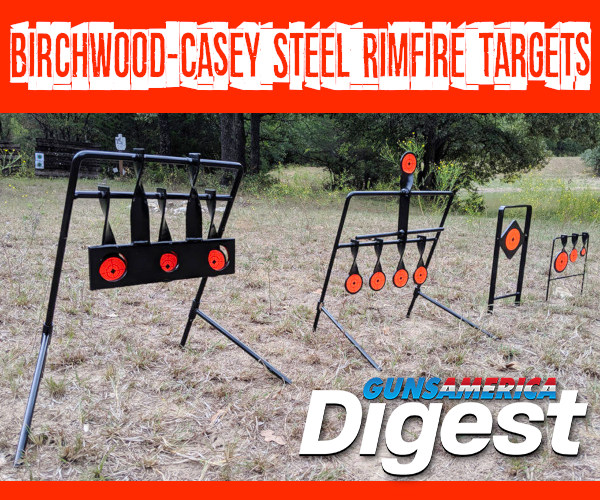
While shooting paper targets is enjoyable, we like to include REACTIVE TARGETS during a trip to the range with our .22s. Rimfire plinking with reactive targets is FUN and affordable. Decent .22 LR rimfire ammo is not expensive, and a wide variety of very affordable steel targets are available. Rimfire steel is much less costly than the AR500 steel plates used for centerfire rounds. In fact, Birchwood Casey makes a wide variety of reactive steel rimfire targets that retail for under $50.00. These offer great “Bang for the Buck”.
GunsAmerica Digest has reviewed a variety of reactive rimfire target systems from Birchwood Casey. We recommend you read this detailed article Little Targets, Big Fun, by Jordan Michaels. He acquired four different steel target systems and tested them at his Texas range. Michales was impressed: “At $30-$55 a pop, Birchwood-Casey’s targets are small enough to be challenging and cheap enough to buy four or five for the price of one centerfire-rated target. They’re also light, portable, reactive, and easy to set up.”
B/C Gallery
B/C Back Drop
B/C Qualifier Spinner
B/C King of Diamonds
Check out how these Birchwood Casey steel targets perform. These animated GIFs show actual shooting sessions with .22 LR rifles and pistols. The targets hold up well, though the black paint comes off. The reviewer notes: “You shouldn’t worry about durability as long as you stick to .22 LR. I shot the heck out of these targets with rifles and handguns using both standard and high-velocity cartridges, and I didn’t notice any denting or cracking. If the targets are going to be kept outside, however, keep an eye out for rust – the black paint comes off immediately.”
Safety Considerations with Steel Reactive Targets
The tester said the targets worked best with a .22 LR ammo with at least 1000 fps MV at the targets. He tested with .22 LR pistols as close as 7 yards, and .22 LR rifles out to 100 yards. Be advised — when shooting steel targets at relatively close ranges ALWAYS wear full-coverage eye protection because ricochets and splash-backs are definite risks. Also comply with all range rules.
AccurateShooter.com may earn an affiliate commission on Amazon sales.
“22 Plinkster” is an avid shooter who has produced a number of entertaining videos for his YouTube Channel. In the video below, he tackles the question “Why Do Misfires Occur in .22 LR Rimfire Ammunition?” This is the most common question posed to 22 Plinkster by his many viewers. He identifies four main issues that can cause .22 LR misfires or faulty ignition:
1. Damaged Firing Pin — The dry firing process can actually blunt or shorten the firing pin, particularly with older rimfire firearms. Use of snap caps is recommended.
2. Poor Ammunition — Some cheap brands have poor quality control. 22 Plinkster recommends using ammo from a manufacturer with high quality control standards, such as CCI and Federal.
3. Age of Ammunition — Rimfire ammo can function well for a decade or more. However the “shelf life” of rimfire ammunition is not infinite. You ammo’s “lifespan” will be shortened by heat, moisture, and humidity. You should store your rimfire ammo in a cool, dry place.
4. Mishandling of Ammunition — Tossing around ammunition can cause problems. Rough handling can cause the priming compound to be dislodged from the rim. This causes misfires.
Preventing misfires is essential if you want to succeed in NRL22 competition and other rimfire competition disciplines run “on the clock”.
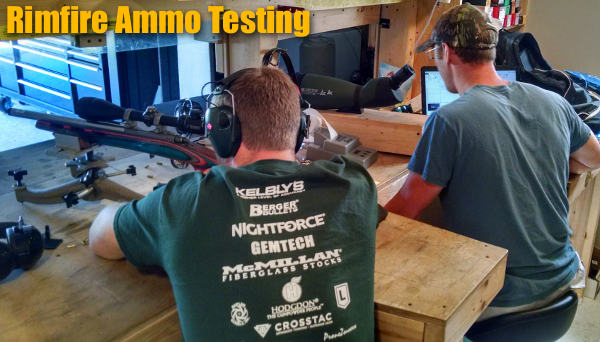
Photo shows Bryan Litz (on right) and tester Mitchell Fitzpatrick. Bryan said: “Only 2,445 rounds to go! We’re testing over 50 ammo types in five different twist barrels… science can be exhausting!”
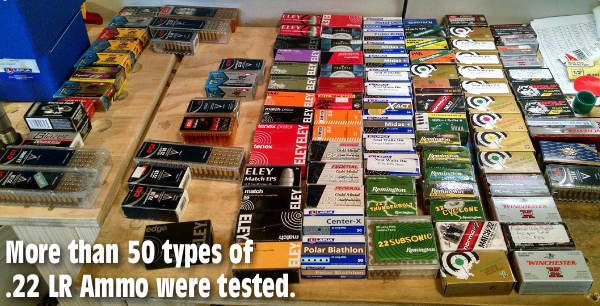
Do you know the actual BC (Ballistic Coefficient) of your rimfire ammunition? Well Applied Ballistics has the data, thanks to a comprehensive, marathon ammo testing session. Some years back, in an effort to determine the “real world” BCs of various rimfire ammo types, Bryan Litz and his team at Applied Ballistics did an extraordinary, in-depth shooting test. Litz and company tested over fifty types of .22 LR ammo, using five different twist-rate barrels. This was one of the most comprehensive and through rimfire ammo tests ever done.
Bryan tolds us: “We tested many types of .22 rimfire ammo for the 2nd Edition of the Ballistic Performance of Rifle Bullets book. We used a pair of Oehler chronographs to measure velocity at the muzzle (MV) and velocity at 100 yards.” With these numbers (average and SD) Bryan can calculate G1 BCs for all the 50+ types of rimfire ammo. What’s more, because every sample is shot through five different barrels (each with a different twist rate) Bryan can also determine how velocity is affected by twist rate.
The tests are primarily to determine velocities for BC calculations — this was not an accuracy test. Bryan explains: “Our tests are not really looking at accuracy, mainly because that’s so subjective to different rifles. Our testing is primarily focused on measuring the BC of rimfire rounds from different twist-rate barrels. The MVs and BCs from the different twist test barrels was then published by Applied Ballistics in print books. Bryan Litz told us: “The .22 LR Rimfire data was originally published in Ballistic Performance of Rifle Bullets, 2nd Edition, which is now out of print. The 3rd Edition of that book doesn’t have rimfire data. The rimfire testing results and data were re-published in Modern Advancements in Long Range Shooting – Volume II (along with many other topics).
Bringing Science to the Rimfire World
Bryan’s goal with this project was to increase the rimfire knowledge base: “We hope to give the world of .22 LR rimfire a good dose of science. How is the BC of .22 rimfire ammo affected by barrel twist? Do subsonic rounds have more consistent BCs than supersonic or transonic rounds? What brands have the highest BCs? What brands have the most consistent MVs?”
Data from two Oehler chronographs is recorded in a computer. Ammo samples were tested in five (5) different barrels (of varying twist rates). Give credit to Dane Hobbs who supplied a test rifle, multiple barrels, and most of the ammo types for the test.
.22 LR at 300 Yards?
Bryan also conducted some longer range rimfire tests. His interesting findings have appeared in the Modern Advancements in Long Range Shooting book series. Bryan notes: “While .22 rimfire isn’t typically considered ‘long range’, we were able to consistently hit a two-MOA steel target at 300 yards with the trajectory predicted by AB software and the measured BC of some standard .22 LR rimfire ammo. The info we’’re generating may make it possible to push the range of target engagement for a round that’s not seen much advancement in many decades.”
In 2019 CCI introduced a new type of .22 LR rimfire ammunition. CCI’s innovative Clean-22 Ammo features polymer-coated bullets. This is actually a pretty important development. The bullet coating on CCI’s Clean-22 ammo provides three main benefits:
1. Copper fouling in the barrel is greatly reduced.
2. Lead fouling in the barrel is greatly reduced.
3. Lead build-up in suppressors is reduced by 60-80%.
CCI now offers three versions of Clean-22 rimfire ammunition: High Velocity (#944CC, 40gr, 1235 FPS MV), Subsonic (#934CC, 40gr, 1070 FPS MV), and Suppressor (#980CC, 45gr, 1000 FPS). These all feature lead bullets with polymer coatings. The High Velocity ammo has red-coated bullets, the Subsonic has blue-coated bullets, and the Suppressor version has black-coasted bullets. MSRP is $12.99 for 100 rounds of Subsonic, $11.99 for 100 rounds of Hi-Vel, and $35.99 for 200 rounds of Suppressor variant. There is also a special 400rd Christmas pack of Clean-22 Hi-Vel ammo with Red and GREEN coated bullets. List price is $48.99 for item #946XMAS.
Clean-22 High Velocity: 1235 FPS | Clean-22 Subsonic: 1070 FPS
Clean-22 Ammo with Polymer-Coated Bullets
Clean-22 uses an exclusive polymer bullet coating to greatly reduce copper and lead fouling in the barrel without leaving a residue. It also cuts lead buildup in suppressors 60 to 80 percent. Both the Sub-Sonic and High Velocity loads feature a 40-grain round nose lead bullet with geometry that’s been optimized for accuracy. With dependable CCI priming and consistent propellant, Clean-22 provides reliable cycling through semi-automatics and all 22 LR firearms.
Over the past 18 months, popular ammo types, such as .223 Rem and 9mm, have been hard to find at reasonable prices. The high cost of .223 Rem centerfire ammo has driven more folks to shooting .22 LR rimfire ammo, both for fun and practice. This Sunday we look at a smart solution that allows you to shoot .22 LR ammo from your existing .223/5.56 AR-15 platform rifle. This is great because it allows low-cost training with no change in rifle balance, ergonomics, and/or optics.
The CMMG Bravo .22 LR Conversion Kit provides a replacement bolt/bolt carrier along with three 25-round magazines with special .22 LR-fitted followers and ammo slots. This allows you to shoot rimfire ammo from any AR-15 chambered for the .223 Rem (5.56×45). The CMMG Bravo has an integrated extension that fits into your current chamber. The rimfire bullet passes through this extension and then enters the barrel.
The CMMG Bravo conversion Kit comes with blowback-operated .22 LR bolt carrier, rubber protector for bolt carrier tip, and three 25-round polymer magazines. To use, simply replace the rifle’s .223 Rem bolt and carrier with the Bravo .22 LR conversion unit and load up the included magazine(s) with rimfire ammo.
To use the CMMG Kit, simply remove the centerfire bolt/bolt carrier, and replace it with the CMMG silver colored bolt shown above. CMMG states: “For best performance use a round-style hammer as notched hammers can cause function issues.” Testers have stated that high-velocity .22 LR ammo works best, and CMMG notes that “36gr plated-nose bullets have proven to be the best choice for function.” The copper-plated bullets help reduce fouling.
Ultimate Reloader Tests CMMG .22 LR Conversion Kit
Our friend Gavin Gear of UltimateReloader.com recently tested the CMMG .22 LR AR Conversion Kit. He observed that installation was very straight-forward and the CMMG magazines worked well. He and fellow tester Travis Fox shot the unit both slow-fire and rapid-fire successfully.
Gavin and Travis found the CMMG Kit easy to install and fun to use. With an AR that can shoot both .223 Rem and .22 LR, it’s like having “two guns in one”. Travis was impressed with the ease of use: “It is so simple to change over to the CMMG .22 LR AR kit! It took me about 68 seconds the very first time I tried. Each time after that it took me about 40 seconds — it’s that simple. It takes longer to fully load one of the mags than it does to switch over from .223/5.56 to .22 LR and back.”
The AR shot very well with the higher-velocity ammo types. 100% functioning was achieved with both 40gr Federal Game Shok ammo and American Eagle High Velocity 38gr Copper-plated HP ammo. NOTE: CMMG does recommend high-velocity Copper-plated rimfire ammunition.
Maintenance Tip — After converting back to your centerfire .223 Rem (5.56), Travis says “make sure to clean the gas tube and components as .22 LR tends to run dirty”. READ Full Test on UltimateReloader.com.
CMMG Bravo Conversion Kit Gets Thumbs Up from Gavin and Travis
“Does this conversion kit get the Ultimate Reloader stamp of approval? Absolutely! In these times of ammunition/component scarcity this gives options to shooters. Finding bulk .22 LR can sometimes be easier than 223/5.56. This kit gives that option at a great price. Any chance to keep skills up and familiarize new shooters to a platform is a good thing. Basically two rifles for a lot less than another rifle.”
How to Install CMMG Bravo .22 LR Conversion Kit
The Brownells video below shows the installation process step-by-step:
In this instructional video, a Brownells gunsmith demonstrates (step by step) how to install, disassemble, clean, lubricate, and reassemble the CMMG AR-15 .22 LR Conversion Kits. Clear the rifle and make safe before you start the conversion. Separate the upper and lower, remove the standard bolt carrier group. You then install the conversion bolt and connect the upper and lower as normal.
Details of CMMG .22 LR Conversion Kit
“For years I’ve had a CMMG conversion kit. It’s a drop-in system that’s … very reliable and it’s accurate. The [CMMG conversion] has lower recoil [and is] great for training. Even though ammo prices have gone through the roof, .22 LR is still cheaper to shoot than anything else.” — SootchGear
This SootchGear video shows how to install the CMMG Bravo unit. The video also compares the original CMMG .22 LR bolt assembly with the latest integrated CMMG Bravo at 2:00-3:50. The older unit had a brass adapter and separate chamber insert. The host also tests a CMMG-equipped AR with various types of ammo. Watch a rapid-fire sequence starting at 1:48 time-mark.
Field Test with Two ARs — Rapid Fire .22 LR Testing
The video below demonstrates rapid-fire .22 LR performance with two different ARs using CCI Mini-Mag ammo. The CMMG conversion is fast and easy: “In a matter of seconds you go from 5.56 to .22 LR”. Watch rapid-fire at 5:40 with CCI Mini-Mags in red/black rifle. Then the tester shoots a variety of ammo in a .223 Wylde-chambered all-black AR, starting at 9:40. The Mini-Mags worked flawlessly, but there were a couple fail-to-cycle sequences in extreme rapid-fire with cheaper “bulk” ammo. The lesson here is use good quality, high-velocity ammo.
NOTE: This 2018 video shows an earlier CMMG .22 LR conversion bolt that features a brass adapter and separate chamber insert. The current CMMG Kit has unitized bolt without a separate adapter or insert.
Interestingly, the Mini-Mag .22 LR ammo shot fine in the .223 Wylde-chambered AR. However, CMMG cautions: “Since .223 WYLDE is NOT a mil-spec chamber, we cannot guarantee fit or function with our 22LR conversion kits.”
Reviews from CMMG Bravo .22 LR Rimfire Conversion Kit Purchasers:
“Get it. Bought this for my Rock River AR. Bolt system goes in [easily] and fits perfectly. Took it to the range and put over 150 rounds through, only failing to feed/fire two rounds. I most definitely recommend this product to anyone looking to shoot their standard AR-15 .223 rifle on a budget.” — Pew P.
“I got this just yesterday and in two days time I have put a couple thousand rounds through it and no hick-ups. I have no complaints.” — Seth
“Best buy for anyone during this ammo crisis. Ammo is extremely expensive and hard to find. It was a ‘no-brainer’ once I found this kit. Ran 200 rounds to break it in for about $20 and had maybe 3 failures. Accurate up to 50 yards (I haven’t tried further) without optic adjustments.” — Joshua M.
“Purchased one of these in January. Took it to the range shortly after for my daughters to try out. We have three ARs and this thing functioned flawlessly. We practiced swapping out the 5.56 carrier with this back and forth, flawless. Enjoyed it so much now I’m purchasing another one.” — J.B.
“Great product. I bought this due to the high cost of ammo. I wanted to still shoot my AR and this was an alternative. This thing works great… works flawless with different types of .22 LR, from premium CCI to the cheap stuff. I recommend this to anyone thinking about getting one.” — Thom
* You can get also CMMG Conversion Kits from Brownells with one (1) 25rd mag for $219.99, or with three (3) 25rd mags for $249.99. There is also a CMMG kit with three (3) 10-rd mags for $249.99 for areas with capacity restriction.
20-Year-Old William Shaner just won the USA’s second Gold Medal at the 2021 Tokyo Olympics. The University of Kentucky marksman captured Gold in the 10-meter (10m) Air Rifle, setting an Olympic record in the process. Shaner scored 251.6 points in the 10m final to set a new Olympic Record that’s just 1.2 points shy of the world record. Will scored 10.5 or above on 13 of his 24 shots in the final. At the Tokyo Games, William was shooting a Walther Air Rifle.
William hails from Colorado Springs, Colorado. He started his shooting career at age nine in a 4H program in the appropriately named town of Rifle, Colorado.
Watch Will Shaner capture Gold with a stellar shooting performance, broadcast by NBC Sports:
CLICK HERE for Yahoo News Video about William Shaner Gold Medal in 10M Air Rifle.
Young Will Shaner Was Calm After Record-Setting Victory USA Today reported: “Will Shaner reacted like someone who could not wrap his head around the idea he’d won a Gold Medal. There were no yells, no fist pumps, no jumping, as Shaner captured U.S. Shooting’s first-ever Gold Medal in the men’s 10 meter air rifle. Hardly a wave, even. If he was smiling, you couldn’t tell, as a massive Nike Team USA mask covered almost his entire face.
“Still trying to believe it”, he said afterward. “It’s been a long time, though, growing up in the sport, progressing. To finally have (the gold medal), it’s amazing.”
“Yesterday, [was] a little bit of a slow start for everyone,” he said, as Team USA went without a medal on the first day of competition for the first time in nearly 50 years. “Today, to (help) finally get it moving, it’s amazing. It’s really an honor.”
Will Shaner Becomes Social Media Star After Winning Gold Medal
Team USA Tweeted news of Shaner’s Gold Medal-winning performance to fans around the world. Because Will set a new Olympic Record, one respondent called him the “GOAT” (greatest of all time). Well, that may be hyperbole, but Shaner did achieve the greatest 10m Air Rifle final score in Olympics history.
20-year-old Will Shaner earned the second Gold Medal of the Tokyo Olympics for the United States. Will, who hails from Colorado Springs, CO, won the men’s 10-meter air rifle on Sunday with a final round score of 251.6 at the Asaka Shooting Range, edging out China’s Sheng Lihao, 16, by 0.7. China’s Yang Haoran took the bronze medal, finishing just 0.4 behind Sheng.
— Shaner set a new Olympic record with a score of 251.6
— The 20-year-old is a mechanical engineering student at the University of Kentucky
— The silver medal winner, Sheng Lihao of China, is only 16 years old
— Shaner’s victory was the first Gold Medal ever won in this 10m event by the United States
— Shaner first started his marksmanship training at Age 9 at a 4H Program in Rifle, Colorado
Watch Shaner Win Gold and stand on podium on NBC4 New York: CLICK PHOTO to watch video on NBC 4 New York.
Will Shaner — From Colorado, to Kentucky, to Olympic Glory
William is one of two University of Kentucky (UK) Rifle athletes competing in the Tokyo Olympics. As one of the nation’s top prospects coming into college, he was named NCAA Rookie of the Year his freshman year and was an All-American First Team member in air rifle and smallbore. William finished second in the NCAA Air Rifle individual championship in addition to winning the team gold with Kentucky his sophomore year. He repeated this exact feat with again with UK his junior year.
Will has done well in international competition. Shooting Sports USA noted: “Foreshadowing his Olympic performance … earlier this year Shaner won a gold medal at the ISSF World Cup Croatia.”
William started in shooting sports when he was 9 years old at a small 4-H program in Rifle, Colorado. From there, he moved on to shooting monthly preliminary tryout (PTO) events at the Olympic and Paralympic Training Center until he could start qualifying for major matches. He won his first Junior Olympic Gold Medal at age 11 in 50m prone and made the Junior National Team at age 14 which propelled him into the international circuit. Fast forward less than a decade and William is, according to known USAS records, the youngest U.S. Men’s Olympic Rifle Qualifier.
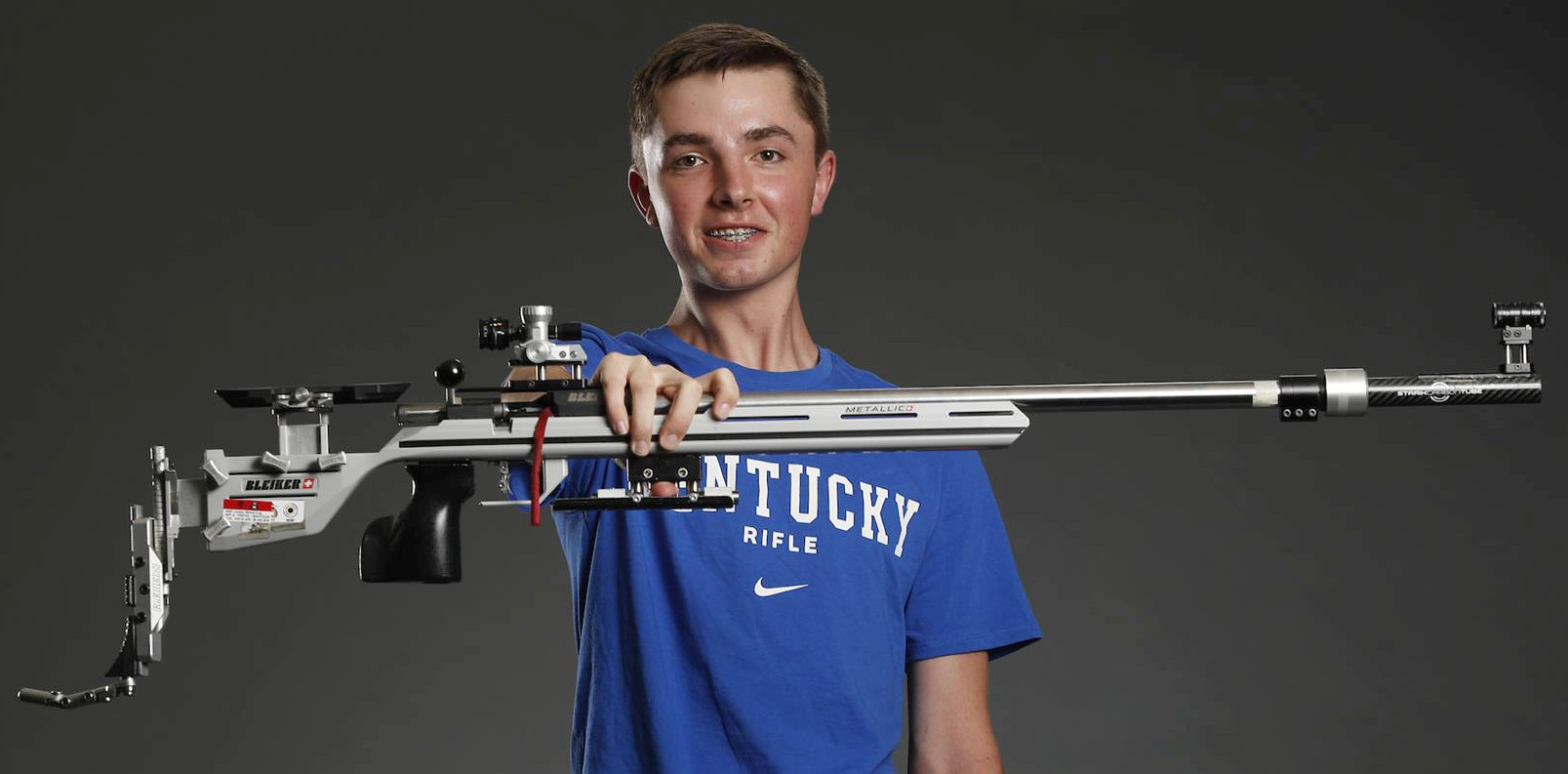
William Shaner also shoots Smallbore Rifle (.22 LR) for the University of Kentucky: CLICK PHOTO to view full-screen image of Shaner with Bleiker .22 LR Rifle.
Driven by the pursuit of perfection and appreciation for his small-town roots, Will strives to be a role model for the next generation of shooting athletes. He credits his successes to coaches and support from the National Training Center Shooting Club (NTCSC), USA Shooting, and the University of Kentucky.
Team USA Rifle Shooters at 2021 Tokyo Olympics
USA Shooting has sent 20 Olympians to the Tokyo Olympic Games to represent the United States in the able-bodied shooting sports (there is a separate Paralympic shooting team). Our athletes have earned 8 quotas for the shotgun disciplines, 8 quotas for the rifle disciplines, and 6 quotas for the pistol disciplines (22 total). Here are the 8 Rifle Competitors, the four Air Rifle shooters and four Smallbore shooters:
S&W Model 617 now has a 10-round cylinder, but early models were six-shooters.
Over the past year and a half, the ranks of first-time gun buyers have grown dramatically. Millions of Americans have purchased their first-ever handgun. With so many handgun options (from derringers to Desert Eagles) many first-time buyers have trouble making a choice. What should those millions of new gun buyers have acquired first? Perhaps it should have been a rimfire revolver. Here is why…
The Argument for a Rimfire Revolver
Some years back, a close relative contacted this Editor. Wanting to get started in handgunning, he sought my advice on purchasing his very first handgun. “Should I get a Glock?”, he asked. “No” was my response. “Well how about an M&P?” he inquired. “Better ergos” I said, “but ‘No’ is still my reply.” “OK, how about a KelTec, they’re cheap…” “Absolutely not”, I replied.
I could tell he was getting annoyed, when he said “OK, Mr. know-it-all, so what handgun should I get?” Calmly, I replied: “Get a .22-caliber rimfire revolver. You will never out-grow it. You will learn sight alignment and trigger control. You can practice with inexpensive ammunition. A good .22 revolver will be considerably more accurate than 90% of the self-loading pistols you could buy. If you get a Smith & Wesson, you will keep the gun for the rest of your life and pass it on to your kids. If you or your heirs ever wear out the barrel or cylinder, Smith & Wesson will replace the parts for free, forever.”
First Handgun Choice — Consider a .22 LR Wheelgun
A very good choice for a first handgun is a Smith & Wesson .22 LR revolver, such as the S&W Model 617. The model 617 is extremely accurate, with a crisp trigger and good sights. Choose either a 4″ or 6″ barrel. The current model has a handy, 10-round cylinder.
This Editor’s first really accurate handgun was a .22 LR Smith & Wesson Model 617 that could easily stack ten shots in a dime at 10 yards. It remains my favorite and most-used handgun. What can we say about the Model 617? The single-action trigger pull is superb, and the accuracy surpasses most any semi-auto rimfire pistol, except for a few, very expensive target pistols. We like the 6″ version for the longer sight radius, but the 4″-barrel 617 is also very accurate, and it balances better.
You can learn all the fundamentals with this ultra-reliable handgun, shooting inexpensive .22 LR ammo. The model 617 is rugged, durable, and can give you a lifetime of shooting fun. Once you have mastered the basics of shooting with a .22 LR, you can move on to larger caliber handguns suitable for self-defense. Below is a slide-show illustrating a S&W model 617 ten-shot, with 6″ barrel. S&W also makes a 4″-barrel version of this revolver. (See: Shooting Demo Video with 4″ model 617.)
Another .22 Revolver Option, the Smith & Wesson Model 63
The current S&W Model 63 is a J-Frame .22 LR with 3″ barrel and fiber optic front sight. The Model 63 is compact enough for comfortable carry and well-balanced. The older Model 63, aka the “Kit Gun”, is an appreciating classic.
This article was originally written by noted rimfire gunsmith Bill Myers. Sadly, Bill passed away in May 2010, but his legacy lives on. He pioneered many advancements in rimfire gunsmithing and Myers-built guns still win matches in benchrest competition.
Crafting competitive rimfire benchrest rifles is considered an art as much as a science. The smith must understand subtle, yet critical aspects of vibration control, barrel tuning, and rifle balance. In the United States, only a handful of gunsmiths consistently turn out rimfire BR rifles that consistently run at the front of the pack at major matches. Bill Myers was one of those master craftsmen. In this article Bill discussed the process of building a winning rimfire BR rig. He reveals some interesting secrets, including his procedures for testing bedding performance and his barrel indexing system. Bill’s methods obviously work, as the Suhl-actioned rifle featured here won a truckload of trophies in its very first match.
Building a Match-Winning Rimfire Benchrest Rig
by Bill Myers
In my opinion, a winning rimfire benchrest rifle is probably twice as difficult to build as a competitive centerfire rifle. The relatively slow .22 LR bullets stay in the barrel much longer than centerfire bullets. This means that vibration control is critical. Likewise bedding is critical. Bore finish and lapping are very important. The amount of bore taper or “choke” can have a huge effect on accuracy. Ignition is also very important and above all, rimfire BR rifles need a very stable stock that tracks perfectly. A rimfire that shoots great is a complete marriage of all components and of the shooter’s need to be aware of everything possible.
Click Photo to Zoom
The rifle featured in this article was built from scratch with attention to all the details that go into accuracy. The goal was to build a gun that could win from the get-go. This would be a “Spec Gun”, meaning a rifle that was personally tested and tuned by me for optimum performance before it went out to the customer.
The Suhl trigger is as good as it gets so no change was needed. It easily adjusts down to about 2 ounces.
Baer Stock in Bubinga Wood
There are many choices when you start to build a complete rifle. It has to shoot well and it has to catch ones eye, or it’s just another rifle on the line. I prefer wood stocks on rimfires for two reasons: they are very stable if the right wood is used and they have a certain traditional appeal to many shooters. I chose Bubinga wood for this particular gun because it is very stable and heavy, it has a very dense grain and a very pronounced figure with a natural red color. The Bubinga is a very forgiving wood to work with.
Gerry and Bruce Baer in Pennsylvania do all my stock blanks. I do all my own inletting and bedding. The blank weighed 4.5 pounds when it came off of Bruce Baer’s duplicator. This Bubinga wood is so hard that it did not need pillars, but I put them in anyway. I bed all my stocks with Loctite Steel Bed liquid and add filler to desired thickness. The final bedding is done with an aircraft tooling epoxy that does not deteriorate over time. The stock has an ebony butt plate and six (6) coats of automotive clear, polished to a “high buff” finish.
Suhl 150-1 Action Accurized and BN-Nickel Plated
I used a new, unfired Suhl 150-1 action. As explained in the sidebar below, the Suhl 150 actions were originally crafted in East Germany for position rifles. They have a very fast lock-time and come with an outstanding trigger. However, they need some work when adapted to a modern BR gun. The action needed to be accurized and threaded. I have a special tool that I use to accurize actions. It uses two sets of spiders for dialing-in the bolt raceway. After the bolt raceway is running true, one can thread and true up all bearing surfaces so that everything is in perfect alignment with the action raceway bore.
BN-Nitride Plating on Action
I decided to plate the action and all bolt parts with Boron Nitride nickel plating. I bough the BN Electroless Nickel Kit from Caswell Plating and did the job myself. I started by bead-blasting the action so that it would end up with a “satin” finish. The plating material is then applied in a tank. The Boron Nitride goes directly into the plating solution, but you need to use a pump to keep the solution agitated so the BN distributes evenly.
Once the action is completely ready (the metal must be perfectly prepped, with no contaminants), the process goes easily and can be completed in about half an hour. The end result is a very slick, low-friction finish, that is .0002″ (two ten-thousandths) thick and hard as glass. The Boron Nitride makes everything very smooth. After the plating job, the action was noticeably slicker than before.
The cone breech (photo below) permits the barrel to be INDEXED (rotated around bore axis) to any position on the clockface. You then test various rotation settings to find the best accuracy. The system does work. Some barrels shoot best in a particular rotational setting. E.g. with index mark at 3 O’clock vs. 12 O’clock.
Fitting and Chambering the Barrel
As for a barrel, I had two good choices: one Shilen 1:16″-twist, 4-groove ratchet and one Benchmark 1:16″-twist, 3-groove. Both barrels were very accurate and at the end, I decided to leave the Shilen on the rifle because I wanted to put the Benchmark on another Suhl I’ve set aside for myself. I chambered the barrel for Eley flat nose EPS. We’ve found the gun also shoots the new Lapua X-ACT ammo very well.
The barrel finished at 25″ long and features a tuner by the Harrell brothers of Salem, Virginia. I use a flat 90° crown–it’s the most accurate and its gives a good seal against the tuner. I also use a 45°, 12-flute cutter that leaves no burr when cutting the crown. This chamfer protects the crown when cleaning the barrel. There is no sharp edge for the brush or jag to hit on the return stroke. The barrel was headspaced at .043″ and I use a tapered reamer ground by Dave Kiff of Pacific Tool & Gauge in Oregon. The chamber leade area is lightly polished to remove reamer burrs. The breech end of the barrel is machined with a 1/2″ ball end mill to produce what I call a “Myers cone breech.” Technically, it has a sloping radius as you can see, rather than a straight-sided cone. Finishing the breech in this fashion facilitates indexing the barrel, as the barrel can be rotated to any position (on the clockface), without requiring new extractor cuts.
Barrel Indexing — Finding the “Sweet Spot”
When indexing a barrel, one rotates it to different clockface positions relative to the action. Imagine marking a barrel at TDC or 12 o’clock, and then rotating it so the mark is at 3 O’clock, 6 )’clock, 9 O’clock and so on. At each position one shoots groups to determine at which index setting best accuracy is achieved.*
I know that barrel indexing is controversial. I don’t want to get into a lengthy debate other than to say that I believe that careful and thorough testing can reveal a “preferred” index position for a good barrel. With the barrel set in that particular position relative to the action I believe the barrel can yield optimal performance.
I perform the indexing tests indoors at 50 yards. I use a rail-gun with floating action. The barrel is held in place with a clamping fixture similar to an Anschutz 2000-series action. Basically, two vertically-stacked metal blocks clamp around the barrel. I can index the barrel this way simply by unclamping the barrel blocks, rotating the barrel and then re-clamping the system. I have a special system so the action can stay in the same position, even as the barrel is rotated.
It takes time and effort to get solid indexing results. Normally I shoot at least 400 rounds of ammo in 3-4 indexing sessions. Shooting a handful of groups is not enough. You may think you’ve identified the best index position, but you need to shoot many more rounds to verify that. Also, in a very good barrel, the effects of indexing may be subtle, so it will take many groups to confirm the optimal position. In my experience, really good “hummer” barrels do not benefit as much from indexing as an “average” barrel.
Accuracy Testing with Both Barrels
I tested the rifle indoors at 50 yards at the Piney Hill Benchrest Club range. There was no finish on the stock, but it shot well in my one-piece rest with the Benchmark 16-twist, 3-groove barrel and no added weight on the tuner. I shot 30 rounds of Eley Match EPS Black Box (1064 fps) and had 25 Xs and five 10s on the IR 50/50 style target. Not too shabby for a new barrel with no special break-in.
When the Shilen barrel arrived, I installed it on the rifle. By this time the stock had been clear-coated and finished, and the action had been polished and plated. I shot the Shilen barrel outside since it was too hot in the building. The first target was a 250-19X with a new lot of Eley Match EPS Black Box (1054 fps). The gun shot well. My friend Tony Blosser asked to shoot the gun, and he drilled a 250-20X in a steady wind using the same Eley ammo. See target at right.
Advanced Procedures — Vibration Control and Tuner Position
Barrel Tuning Using 2-Way Electronic Indicators
Before competing with this rifle, I put it in a firing fixture I use to tune the barrel. I employ a pair of very expensive Swiss 2-way electronic min/max hold indicators. These measure both up movement and down movement of the barrel as the gun is fired. I can measure the actual vertical travel of the barrel at any position from the front of the receiver to the tuner. I can also tell how long the barrel vibrates, time-wise. Using this fixture I found that the Shilen barrel was very consistent in readings and seemed to work well with no additional weight on the tuner. No barrel ever stops vibrating completely — but this was close, showing less than .002″ of total movement.
Bedding and Vibration Control
I have found that measuring the actual movement of the barrel during firing tells me a lot about the quality of the bedding. I have learned that if I see very big movements (e.g. .010″ up and .005″ down), then there may be a problem with the bedding. I saw this kind of big swing on a rifle with bedding that had not cured properly.
Another pattern I watch for is uneven vertical movement. For example, if the barrel vibrates .008″ up but only .002″ down, that tells me the bedding has issues. As noted above, I look for minimal vibration travel (after the tuner is fitted and optimized), and I also want that travel to be relatively equal both up and down. Good rimfire gunsmiths agree that proper bedding has an important influence on vibration control and tuning. By measuring actual barrel movement during firing, we can, to an extent, quantify how well the bedding is working. At a minimum, we can see if there’s a serious bedding problem.
Trial by Fire — Shooting the Gun in Competition
After semi-gluing in the action, the rifle was shooting great. So, I decided to take it to the Maryland State Unlimited Championship to see if it was truly competitive — whether it could “run with the big dogs”. As it turns out, the Bubinga Suhl was more than just competitive. The rifle won three of the six cards and won the meters championship. In the photo below you can see all the trophies the gun won in its very first match. One of the other competitors in Maryland, dazzled (and perhaps a bit daunted) by the Bubinga Suhl’s stellar performance, told me: “Sell that gun Bill. Whatever you do, just get that darn rifle out of here.” Confident that this was a rifle capable of winning major matches, I packed up the rifle and shipped it to Dan Killough in Texas. Killough has shot some impressive scores with the gun.
Suhl Target Rifles — East Germany’s Legacy
Suhl 150 rifles were manufactured in former East Germany (GDR) by the Haenel firearms factory in the town of Suhl. This region has a long history in arms production. In 1751, Sauer & Sohn founded the first German arms factory in Suhl. Following WWII, Suhl 150s were produced for Communist Bloc marksmen, including East German Olympic shooters. Prior to German unification, the East German national shooting arena was located at Suhl and hosted many top-level competitions including the 1986 ISSF World Championships.
Superb Rifles with Amazing Triggers
As a product of East Germany, the “mission” of the Suhl 150 was to rival the accuracy of the Anschütz, Walther and other premium match rifles built in the West. East German shooting teams wanted to finish on top of the podium, so they needed a rifle with superb inherent accuracy. The Suhl 150s have an outstanding trigger that can be adjusted down to about two ounces. The Suhl 150 action, like the Anschütz 54, boasts an extremely fast lock-time — an important factor in a position rifle. And Suhl barrels were legendary for accuracy.
Suhl 150 Benchrest Conversions
Many of the first used Suhl 150s that made it to America were converted to Benchrest rifles because the action/trigger/barrel combination was unbeatable for the price. Some of the barrels on these “surplus” Suhls were phenomenal — as good as any custom barrels available today. It was not unknown for a Suhl 150 barreled action, transplanted into a benchrest-style stock, to win BR matches with the original barrel. Today, however, most of the Suhl benchrest conversions end up with modern, American-made barrels. While some older Suhl barrels can “shoot with the best of ‘em”, new barrel designs optimized for use with tuners have an edge, at least in benchrest circles. That’s why builders such as Bill Myers swapped out the Suhl barrel with something like a Benchmark reverse-taper two-groove.
Today Suhl 150 rifles are very hard to find in North America. In 2006, a used Suhl 150, even without sights, might fetch $1200.00 or more. Then, in 2007 through early 2008, hundreds of Suhl match rifles were imported. This drove prices down, and those “in the know” snapped up complete Suhl 150s at prices ranging from $450 to $850 (see 2007 advert at right), depending on condition.
Many of these rifles were left “as built” and used successfully in prone competition. Others were converted into benchrest and silhouette rifles, “parted out” for the actions and triggers. If you were able to grab one of those imports at a good price–consider yourself lucky.
* Bill Myers actually created his own clamping rimfire action to facilitate barrel indexing. CLICK HERE for Myers Rimfire Action. To index the barrel, Myers simply loosened three clamping-bolts and rotated the barrel in the action. Because there is no thread to pull the barrel in or out, the headspace stays the same no matter how much the barrel is rotated. With a threaded action, you might have to use shims to test different rotational positions, or otherwise re-set the shoulder with each change.
Rimfire benchrest rifle of Forum member Peebles24.
With the variety of rimfire disciplines, from cowboy action to Olympic three-position smallbore, there are countless different rimfire designs on the market — bolt guns, lever guns, single-shots, toggle-links and more. These may shoot the same ammo, but they certainly vary in looks and ergonomics. This is testimony to human creativity.
In our Shooters’ Forum, you’ll find a long-running thread showcasing rimfire rifles for plinking, hunting, 3P Target Shooting, Silhouette, Rimfire F-Class, NRL22 and more. Here are some of the notable rifles in that Forum thread, with brief build/component details.
Anschutz BR-50 Benchrest Rifle with Upgrades
This is member BHarvey’s rare Anschutz 2013 BR50, with upgrades. This is actually a factory BR-50 stock, but the owner fitted a custom Benchmark barrel, along with a Fudd barrel tuner. That massive butt-plate is three POUNDS of custom-crafted copper, which helps with balance. This rifle was also featured in our popular Guns of the Week collection.
Rimfire F-Class Rig with Curly Maple Stock
This handsome, ultra-accurate Smallbore F-Class rig belongs to member RMist of Team Pro-Shot Products. It has a Holeshot (Stiller) 2500X, stunning Cerus Curly Maple wood stock, Nightforce scope. Up front is the joystick co-axial SEB Joy-Pod.
How does this impressive rimfire F-Classer shoot? Amazingly well. That target at right shows TEN (10) rounds fired at 100 yards. Most centerfire rifles would have trouble beating that level of accuracy.
Rimfire Tactical Rig with CZ Action and McRees Precision Chassis
Here’s a modern chassis rig built with a CZ 455 action. Forum member A-Rob upgraded the CZ 455 with a SCAR 2-stage trigger. This rifle features a Keystone Accuracy-fitted glue-in barrel, Athlon 10-40x scope and McRees Precision chassis. As you can see from the target, it shoots great. Note: CZ has replaced its 455s with the new CZ 457 series with available metal chassis precision model. CLICK HERE to see full target sheet with six 5-shot groups at 50 yards, averaging 0.270″.
IR 50/50 Sporter with 2500 XS Action and Muller 7R Barrel
Here is member doclu60’s Holeshot Arms (Stiller) 2500XS IR 50/50 Sporter. It features a polished action, barrel, rings/bases, trigger guard, and bolt knob. There are premium components: Bix ‘N Andy trigger, Peightal stock, and Muller 7R barrel. The optic is a Leupold Custom Shop VX3i 6.5-20x40mm wearing Rick Averill custom leather scope caps.
Rampro .22 LR Pistol by Gre-Tan
This is a very rare .22 LR bolt-action silhouette pistol. It is a RamPro 22 LR single-shot crafted by Greg Tannel of Gre-Tan Rifles. Member Tonedaddy says this is the only .22 LR Rampro bolt-action pistol built by Gre-Tan in existence. Not the beautifully-figured wood stock.
Benchrest Rimfire with Turbo V3 Action and Owner-Crafted Stock
Member J.J. Coe reports: “Here is a little side project I recently finished. It features a
Turbo V3 action, Benchmark 3-groove barrel chambered by Mark Penrod, Jewell trigger, and Leupold 40X barrel in Harrell’s offset rings.” Notably, J.J. made the 5-piece laminate stock himself. Nice work! Yes this gun is very accurate as you can see from the match target. Below that is another one of J.J.’s rimfires, an Anschutz 54 in another handsome stock he made himself. This guy has talent!
SAKO P94S Rimfire Trio
This trio of SAKO P94S rimfire rifles belongs to Forum member “Thomasconnor”. He tells us: “The one in the middle is probably the most accurate .22 LR rifle I’ve owned. It was about 6 pounds (without the scope or rings) before I made a heavy buttplate for it. In its current configuration it’s under 8 pounds with a giant scope and steel rings. It now has a Jewell trigger, Benchmark barrel, oversized action screws, and Alex Sitman stock”.
Springfield Model 1922s
Member SnapDraw posted: “Here are my Springfield Model 1922s. One is an M1 I got from a shooting club back East. It has an NRA stock with upgraded M2 bolt and Lyman super target spot 15X scope. And the other (below) is an unmolested (except front sight) M2 with military stock. Both are amazing shooters!”
Benchrest Modified Anschutz 2013
Member Esk308 Picked up this pre-owned rifle in the summer of 2020. Along with the Anschutz 2013 action it features a 27″ Lilja barrel, laminated Shehane stock, and Nightforce 15-55x52mm scope in Kelbly rings. On the end of the barrel is a Harrels tuner with Don Blue tube. Esk308 now uses a John Loh front rest with SEB Bigfoot rear bag.
Anschutz 2013 in M. Werks Stock
Here is another Anschutz model 2013, but in a completely different configuration. This is a rimfire prone match rifle upgraded with a Bartlein gain-twist barrel and an M. Werks tuner stock. Note how the barreled action is secured. This handsome rig belongs to Forum member Jeffrey.
Factory-Class Ruger with Big Bipod
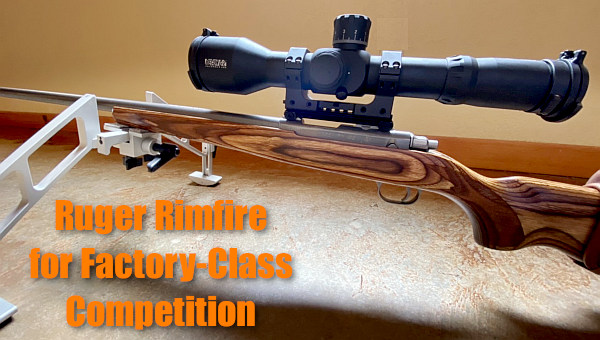
Forum member DavidJoe from Texas put together this rig for a local factory-class rimfire series. He reports: “There’s a discipline where a factory rifle under $1000.00 gets to shoot at a bigger-ringed target. I’m going to try out this new Ruger combination in those limited matches, weighed down with an enormous Valdada scope on a Sinclair bipod.”
Wood-Stocked Trio — Two Remingtons and a Kimber
Here are three .22 LR rigs belonging to member Alamo308. Note the competition iron sights on the middle rifle, a Remington M37 which features a Custom Birdseye Maple stock. The Kimber 82G was sold directly by the CMP as a training rifle. These CMP Kimbers were often extremely accurate.
Marlin 980S Custom with Owner-Crafted Stock
The rifle is based off a Marlin 980S action with a Green Mountain 20″ fluted barrel. The action was bedded with a one-piece aluminum bedding block and Devcon 10110. Owner Kakotoch tells us: “Trigger is a Rifle Basix I took down to just over 16 oz. by using a different pull weight screw. The scope is a Japanese-made Tasco 36x that I picked up NIB for $100 and is surprisingly clear. The stock was my winter project — it’s laminated carbon fiber and walnut, finished with Tru-Oil. I cut, shaped, and polished the buttplate by hand.”




 Bryan tolds us: “We tested many types of .22 rimfire ammo for the 2nd Edition of the


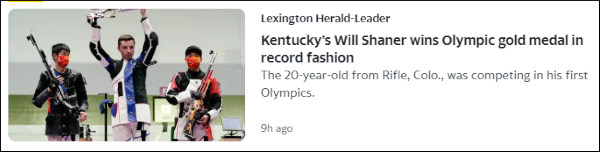
 20-year-old Will Shaner earned the second Gold Medal of the Tokyo Olympics for the United States. Will, who hails from Colorado Springs, CO, won the men’s 10-meter air rifle on Sunday with a final round score of 251.6 at the Asaka Shooting Range, edging out China’s Sheng Lihao, 16, by 0.7. China’s Yang Haoran took the bronze medal, finishing just 0.4 behind Sheng.



 Accurized and BN-Nickel Plated
 BN-Nitride Plating on Action
 Fitting and Chambering the Barrel
 Accuracy Testing with Both Barrels


 Today Suhl 150 rifles are very hard to find in North America. In 2006, a used Suhl 150, even without sights, might fetch $1200.00 or more. Then, in 2007 through early 2008, hundreds of Suhl match rifles were imported. This drove prices down, and those “in the know” snapped up complete Suhl 150s at prices ranging from $450 to $850 (see 2007 advert at right), depending on condition.


 This handsome, ultra-accurate Smallbore F-Class rig belongs to member RMist of Team Pro-Shot Products. It has a Holeshot (Stiller) 2500X, stunning Cerus Curly Maple wood stock, Nightforce scope. Up front is the joystick co-axial SEB Joy-Pod.