|
|
October 2nd, 2015

IBS Report by Randy Jarvais
The 2015 IBS 100/200 Score Nationals were held August 22-24 in Augusta, Maine at the Capitol City Rifle and Pistol Club. By all accounts, the 2015 Score Nationals event was another success. Fifty-three guns participated in this year’s Score Nationals, with 38 Varmint for Score (VFS) and 15 Hunter rifles registered. Nine shooters competed for the 2-Gun award. Mike Niblett shot great to win the Varmint for Score (VFS) Grand Agg, while finishing first at 200 yards and second at 100 yards. Mike’s impressive 500-39X Grand Agg total was just one point shy of the current IBS record. Kudos to Mr. Niblett! Dean Breeden won Hunter Class with Randy Jarvais in second — and that was also the result for the 2-Gun Grand Agg (Breeden first, Jarvais second).

Equipment Report
Among the Top 10 VFS shooters, nine shot a 30 BR, while the 10th campaigned an unidentified 30-caliber cartridge. Six of the Top 10 VFS shooters used Hodgdon H4198 powder, three used Vihtavuori N130, and one loaded with Hodgdon H322. Krieger barrels were used by five of the Top 10, with two Bruxes, two Liljas, and one Rock Creek. There were a wide variety of bullet choices. VFS Winner Mike Niblett used a Hillbilly 118-grainer while 2-Gun winner Dean Breeden used 115gr “10X” bullets in both his rifles (VFS and Hunter).
CLICK HERE to download Full Equipment List (XLS Spreadsheet)
Southerners Shine in Augusta
From a Maine perspective, every USA destination is south, but the true South was well represented in both number and quality of shooters. To illustrate, in the 100-yard leg of VFS class only one person north of the Mason/Dixon line was able to crack the top seven positions, and he had the home field advantage. For match One, five shooters shot 5X targets, but from then on it was the Jerry Powers show. Powers, from North Carolina, put together a string of three 5X targets before faltering with a 3X during match four. Undaunted, Powers finished strong with another 5X. He needed to, as his 23Xs were but one better than both Mike Niblett of Kentucky and Jim Cline of South Carolina.
Eight VFS Shooters Post 500-Point 100/200 Grand Aggregates
CLICK HERE for full Results (XLS Spreadsheet)


At the Capitol City Range, the 100-yard targets are downhill, while the 200-yard targets are near level with the benches. While the benches are covered there is little covered area aft for equipment in waiting. With the prospect of showers for the entire weekend, Club members rigged tarps, hoping to provide a dry haven if needed. For the most part, ‘Tarp City’ worked sufficiently well. Fortunately, after Friday’s rain, the remainder of the weekend was mostly free of any heavy precipitation.
Score Nationals competitors line up for the Rifle Weigh-In process. The blue tarps provided a little extra protection from the elements.

Thunder and Lightning, then Drizzle on Sunday
Although the weather was very nice while shooting the 100, shortly thereafter the sky opened up with an impressive display of thunder and lightning. Although that front passed, Sunday’s weather started as overcast with drizzle and showers, but no lightning. Winds started mild but as the day unfolded and the sun was able to break through, so did the wind — it became down right gnarly during some relays. The wind was gusty, and constant switching from 11:30 to 12:30 was problematic, creating vertical issues. Even so, nine shooters were able to shoot 250s at 200 yards on Sunday, all from the VFS class.
Tough Competition in Hunter Division
In IBS, Maine is the last stronghold of hunter classification shooters, thus it was no surprise that the Hunter class was the National’s largest in recent memory. At 100 yards, five Hunter shooters shot perfect 250s on Saturday. Dean Breeden nailed a 250-19X followed by Randy Jarvais with 250-18X. Third place went to K.L. Miller who out-dueled Peter Hills and Tim O’Mara who were the other two 6-power shooters to shoot the coveted 250.
In the 6-power Hunter class, the battle between Breeden and Jarvais continued on Sunday. Breeden started better and maintained a 2X lead through match three. Skip Plummer, a long-time 6-power shooter (with a very “stock”-locking rig), shot three straight 50-point targets (on targets 2, 3, and 4) to threaten the two leaders.

Breeden shot a 50-1X on his fifth and final 200-yard target and watched through his spotter, while Jarvais dropped one point on his very last shot for record at 200. The order of finish for the five-target, 200-yard leg was Breeden (249-6X), Jarvais (248-5X) and Plummer (247-8X). Sweeping both the 100- and 200-yard legs gave Breeden (499-25X) the Hunter Grand Agg with Jarvais (498-23X) placing second.
Breedan Wins 2-Gun Aggregate… Again
The 2-Gun is a recent award and as yet has been contested but a few times. That doesn’t diminish the feat that there has been but one winner of the award, Dean Breeden. Prior to match 5 on Sunday, Jarvais had the Xs to dethrone Breeden from the 2-gun award, but this is a score game. Match 5 is now a nightmare memory for Jarvais, losing the last shot with each gun. So close yet so far! Breeden on the other hand proved again why he is the competitor to beat. With all the chips on the table, Dean did what he needed to do — dropping just a single point in the entire match. Breedan finished with 999-50X (for both guns) to secure another 2-Gun title, followed by Randy Jarvais (997-55X) two points back. That was tough for Randy, but as Orland Bunker observed: “All the Xs in the world means nothing if you don’t have the points.”
Every Shooter Was a Winner
The Capitol City Rifle and Pistol Club offered a rich prize table. Thirty Benchrest vendors donated nearly $9000.00 worth of hardware and shooting supplies. That generosity allowed each shooter to receive a door prize. In addition, a Nightforce Competition scope was raffled off, with the proceeds earmarked for new concrete benches. Wyatt Fox of New Hampshire was the lucky winner of the Nightforce.

All shooters received a door prize. Lucky Wyatt Fox (above right) received a Nightforce scope.
September 19th, 2014
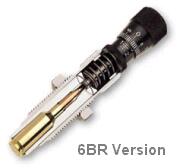 Here is a simple technique that can potentially help you load straighter ammo, with less run-out. It costs nothing and adds only a few seconds to the time needed to load a cartridge. Next time you’re loading ammo with a threaded (screw-in) seating die, try seating the bullet in two stages. Run the cartridge up in the seating die just enough to seat the bullet half way. Then lower the cartridge and rotate it 180° in the shell-holder. Now raise the cartridge up into the die again and finish seating the bullet. Here is a simple technique that can potentially help you load straighter ammo, with less run-out. It costs nothing and adds only a few seconds to the time needed to load a cartridge. Next time you’re loading ammo with a threaded (screw-in) seating die, try seating the bullet in two stages. Run the cartridge up in the seating die just enough to seat the bullet half way. Then lower the cartridge and rotate it 180° in the shell-holder. Now raise the cartridge up into the die again and finish seating the bullet.
Steve, aka “Short Range”, one of our Forum members, recently inquired about run-out apparently caused by his bullet-seating process. Steve’s 30BR cases were coming out of his neck-sizer with good concentricity, but the run-out nearly doubled after he seated the bullets. At the suggestion of other Forum members, Steve tried the process of rotating his cartridge while seating his bullet. Steve then measured run-out on his loaded rounds. To his surprise there was a noticeable reduction in run-out on the cases which had been rotated during seating. Steve explains: “For the rounds that I loaded yesterday, I seated the bullet half-way, and turned the round 180 degrees, and finished seating the bullet. That reduced the bullet runout by almost half on most rounds compared to the measurements from the first test.”
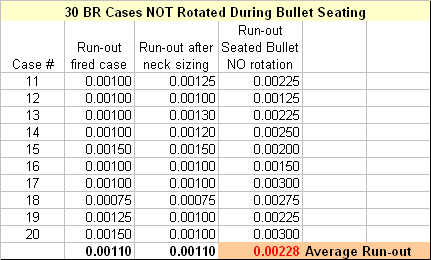
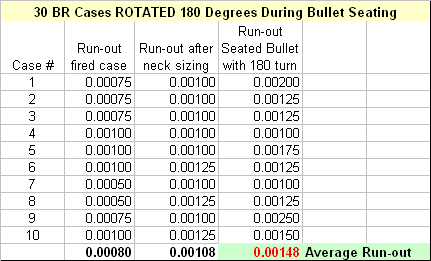
Steve recorded run-out measurements on his 30BR brass using both the conventional (one-pass) seating procedure, as well as the two-stage (with 180° rotation) method. Steve’s measurements are collected in the two charts above. As you can see, the run-out was less for the rounds which were rotated during seating. Note, the change is pretty small (less than .001″ on average), but every little bit helps in the accuracy game. If you use a threaded (screw-in) seating die, you might try this two-stage bullet-seating method. Rotating your case in the middle of the seating process won’t cost you a penny, and it just might produce straighter ammo (nothing is guaranteed). If you do NOT see any improvement on the target, you can always go back to seating your bullets in one pass. READ Forum Thread….
September 18th, 2014
Report by Dick Grosbier for IBS
Over the weekend of September 13-14, 2014, the Ashe County Wildlife Club of Laurel Springs, North Carolina hosted the 44th annual IBS 100/200 Score Nationals. Sixty-two shooters were on the line for the event, including many record holders and major match winners.
Click Photo for full-screen version

CLICK HERE for Match Results Spreadsheet | CLICK HERE for Competitors’ Equipment List
The shooters traveled from as far away as Florida, Wisconsin, and Maine. Considering the miserable weather forecast for Saturday it was really a pretty nice day. We did have rain but thanks to the way the roof overhangs the firing line (photo below) the competitors stayed dry, only the target crew got wet. In spite of this they did an excellent job — they were fully prepared as the forecast was for a very high percentage chance of rain. Saturday got into the high 70s and actually got a little muggy. Sunday was overcast cooler and little if any rain fell.

This was my third visit to Ashe County this year and I must say it gets better each time. They have a great crew of people and a wonderful facility. There are 30 covered benches located next to a very large (40’x160’) reloading, scoring, dining, and clubhouse facility. The entire range is built on the side of a big hill. They have literally moved thousands of cubic yards of dirt (50,000+) to build this facility.
Breeden Busts Record — 1000-59X Two-Gun Total May Be Best Ever!
This year’s IBS Score Nationals saw a performance for the ages. Dean Breeden put together one of the most impressive feats of score shooting in history. Dean’s Two-Gun total score (for VFS and Hunter) was a stunning 1000-59X. This is a pending new Two-Gun IBS world record. Think about that — this means that Dean did not drop a single point through twenty (20) total matches (i.e. 20 targets), while alternating between two different rifles, one with a puny 6-power scope! That’s 100 “Tens” in a row on 100 Bullseyes, without fail. That’s really a remarkable achievement. As least Dean does not have to console the old record-holder, because the pre-existing record, 1000-52X, was set by (you guessed it), Mr. Dean Breeden. In besting his own record by seven Xs, Breeden won the Two-Gun award at this year’s IBS Score Nationals and earned a new entry in the record books. Congrats to Dean!

Bullet-maker Randy Robinett was amazed at Breeden’s 1000-59X performance. “Some years ago, I held the Two-Gun score record with a 999-52X. What Dean has accomplished with his 1000-59X is truly noteworthy — this really is a BIG deal. Let me tell you, getting 1000 points is really hard to do. You have to switch between two different rifles, and adjust from a high-power scope to a 6X scope, changing rests and equipment all the time. This is very tough.”
Looking at the Equipment List (Editor’s Comment)
The Equipment List from the 2014 IBS Score Nationals is quite revealing. As you’d expect, this match was very much a 30-caliber affair, but we were surprised to see such dominance by cut-rifled barrels, and Hodgdon H4198 powder.
1. All of the Top 15 VFS shooters ran cut-rifled barrels. There were mostly Bartleins and Kriegers, with two Brux barrels and one Rock Creek.
2. Hodgdon H4198 is definitely the powder of choice, used by 14 of the Top 20 VFS shooters. Federal 205M primers were used by at least 13 of the Top 20 shooters.
3. Randy Robinett’s BIB bullets were the most popular, used by four of the Top 10 shooters.
4. Every VFS shooter and every Hunter Class shooter was running a 30-caliber cartridge. Most VFS shooters ran 30BRs, but the 30×47 cartridge was favored by half the Hunter shooters.
5. Two gunsmiths smithed six of the Top 10 rifles. Three were by Mike Niblett and three were by Sid Goodling (who also smithed #11 and #12).
6. BAT Machine actions are still #1. BAT actions were used by 14 of the Top 20 shooters.

Mike Niblett (above) had a typical VFS rig: BAT action, Krieger cut-rifled barrel, with a Nightforce 12-42X scope. Mike used H4198 of course, but he shot Hill bullets in his 30BR, rather than BIBs.
Many 250s with 20 or more Xs Shot on Saturday
Saturday, at 100 yards, it was the Kevin and K.L. show. Kevin Donalds Sr. and K.L. Miller took the lead in Varmint For Score, and Hunter classes respectively all day long. Kevin turned in a fine score of 250-22X followed closely by Dean Breeden with 250-21X. Dean was just barely short of the win all weekend in both classes. Mike Niblett was third with 250-20X, ahead of five other 250-20X scores based on tie-breaker. There were four 19X and eight 18X scores. K.L. Miller turned in a fine 250-18x score in Hunter Class followed closely by Peter Hills and Frank McKee (both with 250-16Xs). It was moderately windy and switchy all day and since the Nationals involve shooting each record match from a different bench you essentially faced a new set of conditions each time you came to the line.
‘Top Guns’ at the Score Nationals: Kevin Donald Sr., K.L. Miller, and Dean Breeden.

Sunday it was overcast and cooler but not as rainy. Anthony Isner stepped up and took the lead in VFS class turning in a fine 250-16X score. Second place went to, you guessed it, Dean Breeden. Dean’s 250-15X was followed closely by Kevin Donalds Sr. also with 15X. In Hunter class it was Randy Jarvais’s turn to win an Aggregate. Randy’s 250-9X score beat out Dean’s 250-8X and Miller’s 250-7X scores.
In the VFS Grand Aggregate, Kevin Donalds Sr. topped the field with 500-37X, followed by Dean Breeden with 500-36X, and Anthony Isner with 500-34X. K.L. Miller won the Hunter Grand Agg handily — his 500-25X easily topped Dean’s 500-23X and Randy’s 500-20X totals. The IBS 2-Gun award went to Dean Breeden with a record score of 1000-59X. This is a potential new 2-Gun record as he bested his own record by seven Xs.


Praise for the Match Organizers and Staff
All in all it was a very well run match at a great new facility. This was the first Nationals event to be held there but it will not be the last. Hats off to E.T. Weaver and his helpers. The target crew deserves special mention. They were very good and very fast. A match with full bench rotation can be a nightmare for any target crew but these guys handled it like old pros even though it was their first-ever attempt. Well done guys and gals!


The Ashe County Wildlife Club put on a great event, complete with delicious country Barbecue.

Photos Courtesy Clint Johnson and Dick Grosbier.
September 5th, 2013
 IBS Report and photographs by Dick Grosbier IBS Report and photographs by Dick Grosbier
Over Labor Day weekend the Union County Sportsmans Club (Weikert, PA) hosted the 43rd annual IBS 100/200 Score Nationals. This club has a reputation for hosting fine events, and this match certainly lived up to that reputation. With 63 guns on the line, this year’s Score Nationals was well-attended. All in all this was as good a Score Nationals as I have attended in quite a while. I tip my hat to the Union County crew for running an excellent match. Weather was warm and a little muggy both days. I do not believe we ever had a drop of rain (despite a 30% chance of rain forecast). Mirage was very minimal as it was overcast both days. Winds started out very calm and slowly increased all day long both days.
2013 IBS Score Nationals Results (PDF) | 2013 IBS Score Nationals Results (XLS)
View IBS Score Nationals Full Photo Gallery (100 pictures)

Left to Right: IBS Score 2-Gun Winner Dean Breeden, Varmint For Score Grand Agg Winner Herb Llewellyn, Hunter Class Grand Agg Winner Gary Long.


On Saturday, Herb Llewellyn started out on a tear in Varmint For Score (VFS) class and stayed hot, finishing the 100-yard event with a 250-25X score. We witnessed some really fine shooting in less-than-perfect conditions. Junior Shooter Kevin Donalds Jr. (photo below) laid down a fine 250-24X to finish second. Kevin, who turns a ripe old 13 years of age in a few days, shot a remarkable 250-25X Aggregate a few months back. To the best of my memory those are the only two 250-25X scores in IBS this year. A.R. Edwards was third with 23X.

In Hunter Class Dean Breeden shot 250-17X beating more than 50% of the VFS shooters, and for those of you who do not fully understand Hunter Class, the big thing to remember is they shoot 6-power scopes. Peter Hills from Maine also shot a 250 in HTR with 9X.

Sunday the shooters lined up for the 200-yard event. Shooting his 6 PPC, Hal Drake shot a 250-14X, proving that a PPC can still win in a Score match (at least at the longer ranges). Second place (as at 100 yards) went to a Kevin Donalds, but this time it was Kevin Donalds Senior who was the runner-up, posting a 250-13X. Third place honors went to Dean Breeden also with 250-13X. In Hunter Class, veteran shooter Gary Long shot 248-5X to beat K.L. Miller under Creedmoor tie-breaker rules. Dave Thomas was third with 247-7X.
You may have noticed that nobody in the top three on Saturday was in the top three on Sunday. This led to some interesting results in the VFS Grand Aggregate. Top Man was Herb Llewellyn, with a 500-36X. Herb’s victory at the Nationals pretty much puts the last nail in the coffin of anybody trying to catch Herb in the Score Shooter Of the Year race.
Second in the Grand was Herb’s lovely wife Kim with a 500-34X. Third place went to Randy Jarvais who learned the hard way to not drop the first X! Randy tied with Kim for total score all weekend but Kim shot a 5X on the first target and Randy got a 4X. Fourth in the Grand went to 200-yard winner Hal Drake with 500-33X, and Ricky Read rounded out the Top Five with 500-32X.
Gary Long won the Hunter Grand division with 497-22X, Dean Breeden was second with 496-20X, and third was Dave Thomas with 496-14X. It was great to see Dave back shooting again. Dean Breeden put in a repeat performance as IBS Score 2-Gun winner with a 996-51X score, Larry Feusse was second with 990-46X and Dudley Pierce was third with 987-44X.
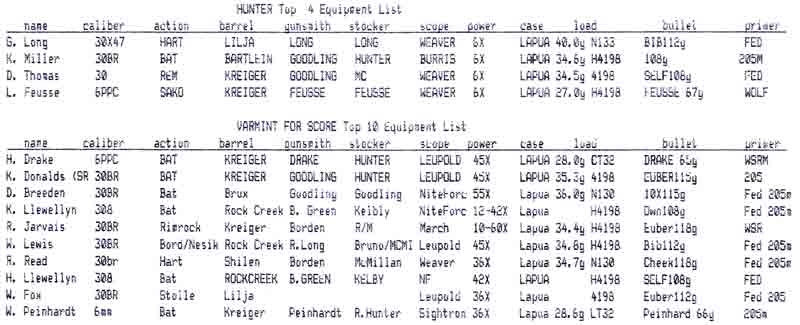
IBS 43rd Annual 100 / 200 Yard Score Nationals
Union County Sportsman’s Club — August 31st to September 1st, 2013



CLICK Equipment Lists Below to See LARGE Versions
 |
 |

Praise for the Match Crew and Kitchen Crew
I cannot say enough good things about the target crew and range officer Mark Trutt. They ran a very efficient match. I do not recall a single delay all weekend from loose- or erroneously-hung targets. We started promptly at 9:00 am and finished around 2:00 pm both days. Range officer Mark Trutt did an outstanding job when confronted with a tricky situation regarding IBS Score 2-Gun shooters. The range has 40 benches and we had a very nice turnout of 63 guns on the line but it simply was not justified to run a third relay so Mark judiciously added around 10 minutes between each relay to allow 2-gun shooters some time to reload. I don’t think the time would even have been noticed but the target crew was speedy and efficient, so we ended up with a little extra time on the line. I personally felt it made for a very nice, laid-back pace for competitors shooting only one gun. Scoring was fast and efficient for the most part.
The Kitchen crew deserves praise for the fine breakfasts and lunches. In good Weikert tradition, we were treated to “Mama Trutt’s” fresh-baked cookies each afternoon. — Dick Grosbier
June 2nd, 2013
Well it looks like there’s some real talent in the next generation of IBS Benchrest shooters. Watch out for those young guns — they can give seasoned veterans a run for their money — and then some. Young Kevin Donalds Jr. fired a perfect 250-25X score to win a 100-yard IBS score match at the Thurmont, Maryland range on May 18th, 2013. At just 12 years of age, Kevin is already showing he has the focus, talent, and determination to win. And, yes he managed to beat his proud father Kevin Donalds (Sr.) who finished second with a 250-23x. Like father, like son. It’s great to see a father and son who shoot together — and share the podium together.

Above, 12-year-old Kevin, match winner, is shown flanked on his left by his father (second place), and on his right by third place finisher Larry Fritz. Young Kevin was shooting a 30BR (no surprise), with a BAT action, Krieger barrel, and an affordable Sightron 8-32X scope (about $860). The rifle was smithed by Sid Goodling and stocked by Roy Hunter. The load was a stout charge of Hodgdon H4198, fired by Federal primers, pushing BIB 112gr bullets.

For more information on this Match and other IBS competitions, visit InternationalBenchrest.com and the IBS News Magazine Archive.

Story Tip from EdLongrange. We welcome reader submissions.
July 7th, 2010
As word spreads of Jackie Schmidt’s historic 0.1118″ 5-target 100-yard Heavy Varmint Aggregate, many readers have inquired about Jackie’s gear and loading procedures. Interestingly, Jackie tells us that he selected the 30 BR “on a whim” for the Heavy Varmint stage of the Midland tournament, after he couldn’t get his 6 PPC Light Varmint gun to shoot up to his standards. With the PPC, he was getting some erratic vertical, with one shot popping up to spoil the group. Jackie turned to his trusty 30 BR, and, as they say, “the rest was history”. Jackie says his 30 BR “held perfect tune all day long”, with “absolutely no vertical”. Here are some other interesting facts about Jackie’s amazing 0.1118″ 5x5x100 Agg and the 30 BR he steered to the pending NBRSA record.
Jackie Free Recoils his 30 BR
Unlike many 30 BR shooters who shoulder their guns, Jackie shoots his 30 BR totally free recoil: “The only thing I touch is the trigger. I try to keep my body out of the equation. Free recoiling a 30 BR isn’t that difficult with a true 13.5-lb rifle.”

30 BR file photo. Jackie Schmidt does not shoot Moly bullets normally.
Jackie Didn’t Clean During Record Agg
Jackie shot his entire 100-yard HV Aggregate (25 rounds plus sighters) without cleaning his 30 BR rifle. Jackie told us: “I never cleaned the rifle until the end of the day. In fact I never took the gun out of the bags.” Jackie tells us that shooting a full Agg without cleaning has become standard practice with 30 BRs: “We’ve all learned that you don’t have to clean them. It’s a phenomenon of the 30 calibers. They shoot just as good on the last shot as the first shot.” When he does clean, Jackie uses patches soaked with Butch’s Bore Shine, followed by 10 strokes with a wet brush, then dry patches. Jackie adds: “For the past few years, I’ve never put any solvent but Butch’s in my bores.”
 Jackie Used 100% Case Capacity Charge Jackie Used 100% Case Capacity Charge
Jackie loaded a “100% usable case capacity charge” of Hodgdon H4198 (Extreme) in his rounds. His 112gr BIB bullets are “just kissing” the top of the powder column. To achieve that fill level, Jackie uses an 8″ drop tube. “That’s an old PPC-loader’s trick,” Jackie tells us. He added that his lot of H4198 is slower than most. He’s found that “some guys can reach the 3000 fps mark using nearly a full grain less powder than me.” But we wonder if loading at 100% of case capacity helps with accuracy? Folks with a faster lot of H4198 might not be able to reach 100% case capacity.
Jackie Schmidt’s ‘Snubber’ Tuner — The Inside Engineering
Everyone wants to know about Jackie’s “snubber” tuner, shown in the photo below. The Tuner is made from aluminum and brass and weighs 5.5 ounces. The tuner is 2 5/8″ long and extends past the true crown 5/8″. The inner cylinder is aluminum while the outer section is a marine bearing consisting of a brass shell with hard rubber vulcanized to the inside diameter. (These brass/rubber marine bearings are used for propeller shaft seals). The sandwiched brass/rubber bearing is then pressed on to the central aluminum shaft. The hard rubber helps dampen vibration. The tuner screws on and then is “locked” in place with a split clamp (the last 2″ of the barrel is threaded).

Unlike most tuners which have a fixed base and forward, rotating ring, Jackie’s tuner is one integrated unit. To adjust tune, Jackie’s “snubber” tuner is unclamped at the base and the whole assembly is screwed in or out on the threaded barrel. Jackie machined a very tight-pitched barrel thread so a full rotation of the tuner produces only .028″ of fore and aft movement. Jackie tells us that, once the basic position is set for a barrel, it doesn’t take much rotation to set the tune. He can usually optimize the barrel tune with less than 1/2 turn of the tuner. After the tune position is set, the split clamp at the inboard end is tightened. This way the tuner is basically locked in place while shooting.
Despite numerous requests, Jackie does not sell his tuners commercially. But someone with good machine skills could build a clone tuner. Team USA benchrest shooter Gene Bukys crafted a similar snubber-type tuner which he used successfully at the 2009 World Championships in South Africa.
The “25 Shots Heard Round the World”
Even people outside the Benchrest community are excited about Jackie’s 0.1118 Aggregate. Jackie’s achievement was noted by Michael Bane and broadcast on the Downrange TV Weekly Video Podcast.
July 4th, 2010
 Texan Jackie Schmidt, using a 13.5-lb 30BR Heavy Varmint rifle, has shot a pending NBRSA world record 5-target, 5-shot-per-target Aggregate at 100 yards. Jackie’s 5x5x100 Agg measured 0.1118! How small is that? To help our readers visualize this, the illustration at right shows what a SINGLE 0.111″ 5-shot group (with .30-cal holes) would look like. Jackie’s actual measured group sizes for his five-target Aggregate were: .153, .093, .120, .100, and .093. Texan Jackie Schmidt, using a 13.5-lb 30BR Heavy Varmint rifle, has shot a pending NBRSA world record 5-target, 5-shot-per-target Aggregate at 100 yards. Jackie’s 5x5x100 Agg measured 0.1118! How small is that? To help our readers visualize this, the illustration at right shows what a SINGLE 0.111″ 5-shot group (with .30-cal holes) would look like. Jackie’s actual measured group sizes for his five-target Aggregate were: .153, .093, .120, .100, and .093.
If this record is certified, it will be the best 5×5 100-yard Agg ever shot in history by a bag gun in competition. Jackie’s Agg may also beat the “Unlimited” (Rail Gun) 5x5x100 records, but we’re still researching that. Remarkably, Jackie shot his 0.1118″ Agg with a stout-recoiling 30 BR (not a PPC), he did it in howling winds, and he did it with brass that had been fired 30 times! He also shot the entire Agg without cleaning his barrel.
We know it may be difficult for some readers to understand how hard it is to average 0.1118 for 25 shots on FIVE targets. To help demonstrate this, we’ve created an illustration that shows a SINGLE 0.111″ five-shot group. Jackie shot five groups that averaged this size. And he wasn’t “machine-gunning”. He took 6-7 minutes to shoot each target, firing on a “angle transition” in the conditions. Jackie explained: “The wind was switching, but I wasn’t shooting the dominant condition. I would wait for the transition and then shoot when the flags came around to about 15 degrees.”
Jackie gave credit to his rifle: “Though I usually use this rifle for score shoots, this 30BR is the most accurate rifle I have in terms of shooting small groups. I was lucky and hit the perfect tune. There was absolutely no vertical. You can’t shoot [an Agg] like this unless you have a rifle tuned to the hilt.” Jackie recognizes that this performance was a “once in a lifetime type experience.” He told us: “Today everything was right. The rifle was shooting impeccably, I had a good handle on the conditions, and just didn’t make a mistake.” Jackie added: “These days are few and far between — you just have to cherish the moment.”
Jackie’s 5-target Agg was so good that many experts predict it will stand as a record for a long time. On Benchrest Central, respected BR gunsmith Mike Bryant wrote: “The current record … was still Rex Reneau’s .1399 Agg from 1982. With Jackie’s Agg, I’m sure that it will easily beat Rex’s record when measured by the records committee. It’s just too far under the current record for it not to hold up… [and] to do it with a .30 BR is even more amazing. That should put to rest the notion that the .30 BR is a score cartridge only.”
Many people are surprised this pending Agg record was shot with a 30BR rather than a 6 PPC. When asked if he thinks the 30 BR can rival the 6PPC in group competition, Jackie told us: “In the 13.5-lb Heavy Varmint class, a good 30 BR is every bit as accurate as a good PPC, and possesses an equal Agging capability.” It’s different in the 10.5 classes, Jackie acknowledged: “in the LV/Sporter 10.5-lb classes, the 30 BR can get a little aggravating over the course of a match due to its greater recoil.”
Jackie’s Aggregate May Be Best in Benchrest History
Shooting in a Midland, Texas BR for group match, Jackie battled shifty, 15-20 mph winds in what may well be the greatest single-day display of “pure accuracy” in the history of the shooting sports. To put this accomplishment in perspective, Jackie’s 5-target Agg was better than any other 5×5 100-yard Aggregate ever shot in a registered benchrest match by a bag-gun. And according to the published records we could find on file with the NBRSA and IBS, Jackie’s 0.1118″ also beats even the existing rail-gun 5x5x100 Aggs. So, this could potentially be the smallest 5-target Agg ever shot in history, by any gun, in any registered match, at any time. Below are the current IBS and NBRSA World records listed on the Internet:
| Current Benchrest 100-yard World Records (5 Targets, 5 shots per target) |
| 5-5-100 Aggregate (NBRSA)
Unlimited: .1283″ Steve Kostanich 8/10/2003
Heavy Varmint: .1399″ Rex Reneau 9/6/1982
Light Varmint: .1500″ Jeff Fowler 6/11/1994
Sporter: .1573 (na) Dick Katchmar 4/14/1985 |
5-5-100 Aggregate Records (IBS)
Unlimited HB: .1386 (na) R. Howell 12/3/04
Heavy Varmint: .1407″ Tony Boyer 8/3/07
Light Varmint: .1599″ B. Goad 8/13/08
Sporter: .1592″ R. Boop 8/13/08 |
 Gun Specs: Jackie was shooting a 13.5-lb 30 BR that he chambered and assembled himself. The barrel is a 4-groove, 1:18″ twist, HV-taper Krieger, fitted with a 5.5-oz. “snubber” barrel tuner made by Jackie. The action is a cast Farley, “glued and screwed” into the stock and fitted with a Jewell trigger. The stock is a Robertson Composites BRX, built with extra weight to make the gun a dedicated 13.5-pounder. The scope is a 50-power March. Gun Specs: Jackie was shooting a 13.5-lb 30 BR that he chambered and assembled himself. The barrel is a 4-groove, 1:18″ twist, HV-taper Krieger, fitted with a 5.5-oz. “snubber” barrel tuner made by Jackie. The action is a cast Farley, “glued and screwed” into the stock and fitted with a Jewell trigger. The stock is a Robertson Composites BRX, built with extra weight to make the gun a dedicated 13.5-pounder. The scope is a 50-power March.
Record Load: Jackie was running a stout load of Hodgdon H4198 powder, Federal 205M primers, and BIB (Robinette) 112gr flat-base bullets seated about .003″ into the lands. Load is “tuned for 3020 fps”. Cases are formed from Lapua 6mmBR brass using a dedicated forming barrel that blows the necks out to 0.330″ in one step. Trim length is 1.540″, longer than most 30 BRs. Jackie turns the necks for a total of .002″ clearance.
September 19th, 2009
The 2009 200-300 Yard IBS Score National Championship was held September 12-13 at the Thurmont Conservation & Sportsmans’ Club in Thurmont, Maryland. Competition was fierce with the combined yardage winners taking one-point victories in two of the three classes. Shooting a 498-17X, Wayne France won the 200/300 combined in the Varmint for Score (VFS) class, followed by Al Weaver (497-17X), and Hal Drake (497-10X). In Hunter Class, Gary Long (491-10X) took top honors for the combined yardages, followed by Frank McKee (487-5X), and David Apple (484-11X). Finally, in Varmint Hunter Class, David Thomas (494-11X) edged Eddie Harren (493-12X), with Sara Haran finishing third with 484-5X.

During the match, there were four perfect 250s shot at 200 yards: Curtis Nelson (250-12X) and Fred Ridgway (250-11X) in VFS, Gary Long (250-6X) in Hunter Class, and David Thomas (250-8X) in Varmint Hunter Class. Wayne France nailed the best score overall at 300 yards, an impressive 249-7X in VFS class. Congratulations to the winners and to all the competitors.
2009 200/300 IBS Score Nationals Equipment List (Partial)

March 7th, 2009
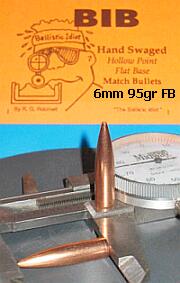
Randy Robinett, maker of the popular and super-accurate BIB bullets, now has an updated website. With a little help from Ryan Ware and the folks at the BenchTalk Forum, Randy has expanded his website to include very comprehensive information on all the bullets he produces.
On Randy’s new product page, you’ll find everything you want to know about his bullets: BCs, recommended twist rates, ogive number, meplat size, and diameters of pressure rings and shanks. Here’s a sample of the info for Randy’s 6mm bullets:
| BIB 6mm Bullets
6mm – 65gr FB, BC = .27. Made in Niemi carbide dies, 8.5 ogive/.055″ meplat, .2435 pressure ring; .2433 shank: a 1:14″ twist is ideal.
6mm – 67.0gr FB, BC = .28. Made in Niemi carbide dies, 8.5 ogive/.055″ meplat, .2435 pressure ring; .2433 shank: ideal twist for the 67gr FB is 1:13.5″.
6mm – 95gr FB, BC = .45. Made in Niemi carbide dies; 11 ogive/.052″ meplat; .2435 pressure-ring; .2433″ shank. Ideal twist: 1:10″ twist; works well in twist rates as fast as 1:8″.
6mm – 108gr FB, BC = .51. Made in Niemi carbide dies; 11 ogive/.052″ meplat; .2435 pressure-ring; .2433″ shank. Ideal twist rate: 1:9″; faster twists not recommended. |
 |
For more information on Robinett’s .22, .25, 6mm, and 30-Caliber bullets, visit www.BIBullets.com. You can also email Randy at bibrob [at] netins.net, or phone him at (515) 438-4010.
|


