Shown is the Smith & Wesson M&P 9mm model. The M&P 45 is the same except for chambering.
You’ll hear some shooters complain loudly about the (perceived) lack of accuracy of their handguns. Well, sometimes the problem IS the gun, but other times the problem is “driver error”. At the range, we often hear guys blame their gun for poor accuracy, when in fact the real problem is lack of operator skill. This saga, posted a while back on Facebook, is a case in point.
Here’s the story. A gentleman attending an armorer’s course at Smith & Wesson was loudly dissing a S&W M&P 45, claiming it could not shoot. Very loudly he tells the instructor, “the M&P 45 one of our officers is carrying is sh*t”. He then trash-talks the gun, saying that both he and his officer couldn’t get the gun to shoot decent groups, either with FMJ or duty ammo.
Well it seems that Gregory Grutter, S&W’s Chief Firearms Instructor, happened to overhear these vociferous complaints, so Grutter asked to test-fire the M&P 45 pistol. Grutter put a couple of his business cards up at 15 yards, then shot one with Winchester Ranger SXT and the other with Winchester White Box ammo. Grutter’s best group was about half an inch, measured with OnTarget. Check it out:
We’re told that, after hearing the litany of complaints, Grutter walked over to the loud-mouthed grumbler and asked: “Hey Sir, can I shoot it?
“Have at it, I don’t want that POS back!” said Mr. Negative.
Kharma time baby… In Grutter’s hands the M&P performed superbly. Here are Grutter’s two 5-shot groups, each shot at 15 yards with the .45 ACP Smith & Wesson pistol. Pretty darn impressive:
After seeing this, the complainer asked: “Why did you shoot your cards — Ain’t got no targets?”
Grutter smiled and replied: “Nah… in case you or your officer want to learn how to shoot [this way] you will have the numbers to call.” Badda Bing!
Here is a stunning highlight reel created by Bullet Theory Films, a Los Angeles-based production company that specializes in capturing action that is too quick for the human eye to see. Using ultra-high-speed cameras, these talented film-makers have captured blindingly fast phenomena — things that happen in micro-seconds. The resulting video imagery can be used for R&D, scientific analysis, product marketing, or (of course) entertainment.
We recommend you watch this video full-screen in High-Definition:
This impressive slo-mo “sizzle reel” features many notable sequences, including:
00:18: .45 ACP leaving m1911 muzzle
00:27: Rifle bullet penetrating barrier with explosive ejecta
00:33: M1A cycling 7.62×51 cartridges
00:38: Pistol bullet disintegrating on steel
00:40: Huge muzzle flame from 12ga shotgun and lead shot on steel
00:45: 5.56 bullet in ballistics gelatin with secondary explosion
01:07: Handgun flame ring from muzzle
01:11: Massive shotgun blast with slug in midair
About the Film-Makers
Bullet Theory Films Co-Founders Matt Novello and Matt Drake first met on the set of History Channel’s highly successful competition reality show TOP SHOT. Throughout five seasons, the show set a benchmark in the art of capturing firearms and live ammunition in action, which has yet to be surpassed.
Utilizing the latest digital high speed technology, Bullet Theory Films offers a full range of production services; from concept development, to the final delivery of your vision. For more information, visit BulletTheoryFilms.com.
Progressive reloading presses offer shooters speed and efficiency in producing custom-tailored rifle and pistol ammunition. However, there is a wide choice of Progressive Presses and a bewildering array of options to consider. In this video, the 6.5 Guys and UltimateReloader.com’s Gavin Gear provide an overview of the leading Progressive Presses on the market along with key considerations for precision rifle shooters. If you are considering getting a Progessive for rifle ammo reloading, you should watch this informative, 25-minute video.
10 Tips for Reloading Rifle Ammo on a Progressive Press:
1. Make sure the brass is very clean. Don’t mix old range pick-up brass with newer brass.
2. Apply a thin, spray lube to all cases before the sizing/loading cycle.
3. Consider priming your brass separately (with a hand or bench tool) before the operation. Then inspect the primers before loading powder and bullets.
4. Always wear eye protection when loading with the Progressive, particularly if you are priming cases.
5. With masking tape, mark the powder measure/dropper with the powder type and cartridge charge weight. Check the charge mass multiple times (see below).
6. Cycle a few cases, sizing and adding powder but NOT seating bullets. Weigh the powder charges to ensure the powder measure is dispensing the correct charge. Sometimes this will change a couple tenths as it “settles down” after the first few charges.
7. Check the brass for shoulder bump and bullet seating depth carefully for the first few rounds, then check again periodically.
8. Try to maintain a steady pace and operate the handle the same way every time.
9. Visually inspect the powder charge in each case (before bullet seating), and use a lock-out die if your Progressive Press has enough stations.
10. Never, ever mix pistol and rifle powders! If you have previously loaded pistol ammo with your Progressive, make sure ALL the powder (every flake and kernel) is removed from all parts of the powder-dropping system before you add rifle powder.
Visit these sites for more Reloading and Precision Shooting Videos:
Shown is the Smith & Wesson M&P 9mm model. The M&P 45 is the same except for chambering.
You’ll hear some shooters complain loudly about the (perceived) lack of accuracy of their handguns. Well, sometimes the problem IS the gun, but other times the problem is “driver error”. At the range, we often hear guys blame their gun for poor accuracy, when in fact the real problem is lack of operator skill. This saga, posted a while back on Facebook, is a case in point.
Here’s the story. A gentleman attending an armorer’s course at Smith & Wesson was loudly dissing a S&W M&P 45, claiming it could not shoot. Very loudly he tells the instructor, “the M&P 45 one of our officers is carrying is sh*t”. He then trash-talks the gun, saying that both he and his officer couldn’t get the gun to shoot decent groups, either with FMJ or duty ammo.
Well it seems that Gregory Grutter, S&W’s Chief Firearms Instructor, happened to overhear these vociferous complaints, so Grutter asked to test-fire the M&P 45 pistol. Grutter put a couple of his business cards up at 15 yards, then shot one with Winchester Ranger SXT and the other with Winchester White Box ammo. Grutter’s best group was about half an inch, measured with OnTarget. Check it out:
We’re told that, after hearing the litany of complaints, Grutter walked over to the loud-mouthed grumbler and asked: “Hey Sir, can I shoot it?
“Have at it, I don’t want that POS back!” said Mr. Negative.
Kharma time baby… In Grutter’s hands the M&P performed superbly. Here are Grutter’s two 5-shot groups, each shot at 15 yards with the .45 ACP Smith & Wesson pistol. Pretty darn impressive:
After seeing this, the complainer asked: “Why did you shoot your cards — Ain’t got no targets?”
Grutter smiled and replied: “Nah… in case you or your officer want to learn how to shoot [this way] you will have the numbers to call.” Badda Bing!
The Pew Pew Tactical website has interesting article on rifle and pistol cartridges and bullet types. This contains a large selection of interesting photographs and illustrations. If you load and/or shoot for a wide variety of cartridge types, you’ll find that article well worth reading. It has nearly 50 photographs and more than a dozen short videos. READ FULL Article.
The article shows all types of pistol bullets, along with a variety of rifle projectiles. It even illustrates multiple types of shotshell cartridges.
The article also explains the basic components of modern cartridges –bullet, case, powder, and primer:
Photo courtesy Ammunitiontogo.com which sells ammo from many leading brands.
Popular Cartridge Types Profiled
The article provides quick summaries of popular ammunition types including 9mm Luger (9x19mm), .357 Magnum, .40 SW, .45 ACP, .223 Rem, and .308 Winchester. The author’s favorite pistol round is the 9mm Luger: “9mm is my personal favorite and if there was a “Goldilocks” round, this would be it. The very first gun I bought was a 9mm. They’re fun at the range. They’re good for defense. It is the standard round for NATO countries and the majority of police forces around the world. It is mild shooting, can vary in weight from 115 to 147 grains, and has varying stopping power based on the type of bullet.”
This Pew-Pew Tactical guide to cartridge types also provides a quick explanation of cartridge ignition — both centerfire and rimfire: “The rimfire’s primer is built into the rim while the centerfire cartridge has the primer in the center. Pro tip — if you can see a circle in the middle…it’s a centerfire cartridge.”
There are two common types of centerfire primers — Boxer and Berdan. This helpful Wikipedia illustration shows how Boxer, Berdan, and rimfire primers ignite the powder in the cartridge:
This centerfire and rimfire ignition animation is by BBODO – Own work, CC BY-SA 3.0 licensed under the Creative Commons Attribution-Share Alike 3.0 license.
Here is a stunning highlight reel created by Bullet Theory Films, a Los Angeles-based production company that specializes in capturing action that is too quick for the human eye to see. Using ultra-high-speed cameras, these talented film-makers have captured blindingly fast phenomena — things that happen in micro-seconds. The resulting video imagery can be used for R&D, scientific analysis, product marketing, or (of course) entertainment.
We recommend you watch this video full-screen in High-Definition:
This impressive slo-mo “sizzle reel” features many notable sequences, including:
00:18: .45 ACP leaving m1911 muzzle
00:27: Rifle bullet penetrating barrier with explosive ejecta
00:33: M1A cycling 7.62×51 cartridges
00:38: Pistol bullet disintegrating on steel
00:40: Huge muzzle flame from 12ga shotgun and lead shot on steel
00:45: 5.56 bullet in ballistics gelatin with secondary explosion
01:07: Handgun flame ring from muzzle
01:11: Massive shotgun blast with slug in midair
About the Film-Makers
Bullet Theory Films Co-Founders Matt Novello and Matt Drake first met on the set of History Channel’s highly successful competition reality show TOP SHOT. Throughout five seasons, the show set a benchmark in the art of capturing firearms and live ammunition in action, which has yet to be surpassed.
Utilizing the latest digital high speed technology, Bullet Theory Films offers a full range of production services; from concept development, to the final delivery of your vision. For more information, visit BulletTheoryFilms.com.
Progressive reloading presses offer shooters speed and efficiency in producing custom-tailored rifle and pistol ammunition. However, there is a wide choice of Progressive Presses and a bewildering array of options to consider. In this video, the 6.5 Guys and UltimateReloader.com’s Gavin Gear provide an overview of the leading Progressive Presses on the market along with key considerations for precision rifle shooters. If you are considering getting a Progessive for rifle ammo reloading, you should watch this informative, 25-minute video.
10 Tips for Reloading Rifle Ammo on a Progressive Press:
1. Make sure the brass is very clean. Don’t mix old range pick-up brass with newer brass.
2. Apply a thin, spray lube to all cases before the sizing/loading cycle.
3. Consider priming your brass separately (with a hand or bench tool) before the operation. Then inspect the primers before loading powder and bullets.
4. Always wear eye protection when loading with the Progressive, particularly if you are priming cases.
5. With masking tape, mark the powder measure/dropper with the powder type and cartridge charge weight. Check the charge mass multiple times (see below).
6. Cycle a few cases, sizing and adding powder but NOT seating bullets. Weigh the powder charges to ensure the powder measure is dispensing the correct charge. Sometimes this will change a couple tenths as it “settles down” after the first few charges.
7. Check the brass for shoulder bump and bullet seating depth carefully for the first few rounds, then check again periodically.
8. Try to maintain a steady pace and operate the handle the same way every time.
9. Visually inspect the powder charge in each case (before bullet seating), and use a lock-out die if your Progressive Press has enough stations.
10. Never, ever mix pistol and rifle powders! If you have previously loaded pistol ammo with your Progressive, make sure ALL the powder (every flake and kernel) is removed from all parts of the powder-dropping system before you add rifle powder.
Visit these sites for more Reloading and Precision Shooting Videos:
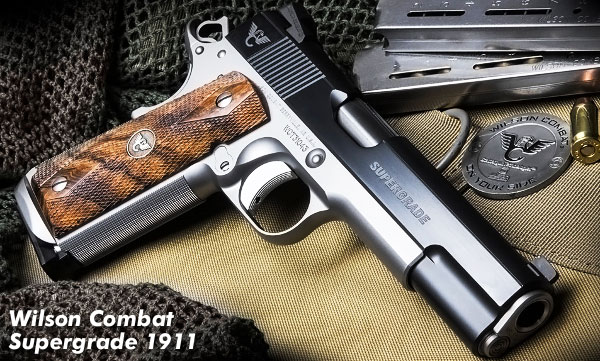
There’s an interesting thread in our Shooters Forum right now — all about good choices for a .45 ACP handgun. If you’re considering getting your first .45 ACP pistol, you should read that thread. If you already own one or more .45 ACP handguns, this article offers some good tips on handloading options.
Good Powder Choices for the .45 ACP
We know that many of our readers own .45 ACP handguns and load for this extremely accurate “classic” cartridge. When selecting a powder for the .45 ACP, there are many good options. All the major powder manufacturers make propellants with appropriate density and burn rate characteristics for the .45 ACP. Popular choices include: AA #5 (Accurate Powder); Bullseye (Alliant); Clays, HP-38, and Titegroup (Hodgdon); VV N310 and N320 (Vihtavuori); and WW 231 and WST (Winchester). We’ve tried all those powders in a variety of .45 ACP handguns. When we consider all the factors that make for a good pistol powder, we think Vihtavuori N320 is one of the best available propellants for the .45 ACP.
Vihtavuori N320 is very accurate, it meters well, and it burns clean, with minimal smoke and flash. If you haven’t tried VV N320 yet, you should.
Pros and Cons of Different Powders for the .45 ACP
This Editor has personally tried out eight or more different powders for the .45 ACP. Bullseye works but it is very dirty (both smoke out the barrel and sooty powder fouling on case). Though it otherwise burns clean, Titegroup leaves a singular (and nasty) high-temp flame streak on your brass that is hard to remove. AA #5 is a good choice for progressive press newbies as you use more powder so a double charge will (usually) be obvious. I like AA #5 but N320 was more accurate. Clays burns clean but some powder measures struggle with flake powders like this. WW 231 offered excellent accuracy and metered well, but it kicked out sparks with little pieces of debris that would hit me in the face. Who wants that?
I personally tried all the powders listed above with lead, plated, and jacketed bullets. After testing for accuracy, consistency, and ease of metering, I selected VV N320 as the best overall performer.
Vihtavuori N320
No powder tested was more accurate (WW 231 was equally accurate).
Meters very well in all kinds of powder measures.
Produces very little smoke from muzzle.
Does not put nasty burn streak on brass like Tite-Group does.
Low Flash — you don’t get particles and sparks flying out like WW 231.
Cases come out from gun very clean — so you can tumble less often.
Forum member and gunsmith Michael Ezell agrees that N320 is a good choice for the .45 ACP. Mike has also found that WW 231, while accurate, produces sparks and a large flash. Mike writes: “I first started using N320 after my first night shoot, while shooting IDPA/IPSC matches. It was astonishing how much of a fireball the WW 231 created. I was literally blinded by the flash while trying to shoot a match. As you can imagine, that didn’t work out very well. I went from WW 231 to N320 and never looked back…and the flash from it was a fraction of what a kid’s sparkler would give off. I have nothing but good things to say about [N320] after using both. Night shoots are a real eye-opener! When it comes to a personal protection… there is, statistically, a very high chance that if you ever have to use a gun to protect yourself or your family, it’ll be in the darkness[.] Being blinded by muzzle flash (and deafened by the noise) are things that should be considered, IMO.”
This Editor owns a full-size, all-stainless S&W 1911. After trying numerous powders, I found VV N320 delivered the best combination of accuracy, easy metering, consistency, clean burning qualities, and low muzzle flash. My gun has proven exceptionally accurate using N320 with bullets from 180 grains to 230 grains — it will shoot as accurately as some expensive customs I’ve tried. At right is 5-round group I shot offhand at 10 yards with my 5″ S&W 1911.
NOTE: The bullet hole edges are sharp because I was using semi-wad-cutters, and the target paper is thick. Rounds were loaded with Vihtavuori N320 and 200-grain SWCs from Precision Bullets in Texas. We shoot Precision’s coated bullets in many of our pistols. These projectiles are accurate and they seem to reduce fouling in our pistol barrels. You can learn about them in this video:
Todd Jarrett is one of the world’s best handgun shooters. A multi-time World Champion, Todd knows a thing or two about semi-auto pistols, particularly 1911s and 1911-based raceguns. Jarrett holds four World titles, nine National titles and has won more than 50 Area championships, as well as many other action shooting events. Jarrett is the only USPSA Triple Crown Winner and he holds four USPSA National titles: Open, Limited, Production, and Limited-10. Jarrett revealed in an interview that between 1988 and 2001 he shot about 1.7 million rounds during practice: “I had a gun in my hand for two hours every day for 10 years to develop my skill level”.
In the video below, Todd explains how to get the proper grip on your handgun, and how to employ a proper stance. We’ve watched many videos on pistol shooting. This is one of the best handgun instructional videos we’ve seen. Todd explains, in easy-to-understand terms, the key elements of grip and stance. One very important point he demonstrates is how to align the grip in your hand so that the gun points naturally — something very important when rapid aiming is required. If you watch this video, you’ll learn valuable lessons — whether you shoot competitively or just want to have better control and accuracy when using your handgun defensively.
Related Article: Thumbs-Forward Shooting Grip for 1911s
“Shooting semiautomatic pistols using the thumbs-forward method really becomes useful … where speed and accuracy are both needed. By positioning the thumbs-forward along the slide (or slightly off of the slide) you are in essence creating a second sighting device: wherever your shooting thumb is pointing is where the pistol is pointing. This makes it incredibly fast to draw the pistol, get your proper grip, and press forward to the target without needing to hunt around for the front sight.” — Cheaper Than Dirt Blog.
Today we showcase five YouTube videos that explain basic reloading processes. This article primarily focuses on the .45 ACP cartridge because this a very good choice for hand-loaders getting started. The .45 ACP is one of the easier cartridges to reload, because it has a large case diameter and large primer pocket, and because it operates at relatively low pressures (compared to rifle rounds).
We recommend that new reloaders consider starting with the .45 ACP cartridge. There are many reasons why the .45 ACP is a good choice for those just getting started in hand-loading:
1. The case is fairly short but has a relatively large diameter (and minimal taper), so it is easy to see inside the case. That helps you quickly check powder levels.
2. Many good powders (for the .45 ACP) will fill the case over 60%, so you will have an obvious overflow if you double-charge by accident.
3. The .45 ACP round runs at relatively low pressures, but delivers excellent accuracy.
4. Good .45 ACP brass lasts a long time, is easy to size, and is good for many reloads.
5. Along with 1911s, there are fine .45 ACP revolvers that shoot the round with moon clips.
6. The vast majority of .45 ACP brass uses large pistol primers (although there ARE some small primer pocket varieties*). We find that large primers are easier to pick up and handle if you are using a single primer tool.
The .45 ACP (Automatic Colt Pistol) cartridge is a rimless straight-walled handgun cartridge originally developed in 1904 by John Moses Browning for use in his prototype Colt semi-automatic pistol. After successful military trials, it was adopted as the standard chambering for Colt’s M1911 pistol.
For reloading, there are many good powder choices. We recommend Vihtavuori N320. This is very accurate and burns cleaner than some otherwise good powders, such as Accurate (AA) No. 5 and Unique.
Basic Reloading for the .45 ACP Cartridge
This is the most-viewed .45 ACP reloading video on YouTube. It is directed primarily for the novice or prospective reloader. It covers the basic processes: case inspection, cleaning, trimming, sizing, priming, powder filling, bullet seating, and crimping. The video creator notes: “Trimming pistol/revolver brass is optional and usually not necessary. it was included because that is what I did when I first began reloading, before I found out that handgun brass does not stretch as much as bottleneck rifle brass.”
How To Reload .45 ACP Start to Finish — Tutorial for Newer Reloaders
This is a detailed 20-minute video that shows the reloading process start to finish. The video shows how to clean the cases, deprime, and check them before loading.
In this video the cases are sized and bullets seated using a single-stage RCBS press. The cases are primed using an RCBS hand-priming tool which keeps multiple primers in a tray (see 8:55 time-mark). For efficiency, we recommend seating with a hand tool (or bench-mounted tool) vs. seating primers using the priming system on the press itself. The hand seating tool also gives you a better “feel” for setting the primers.
Safety First When Loading All Cartridges
Along with the first two instructional videos above, we include two important videos focused on reloading safety. In the first video, UltimateReloader’s Gavin Gear explains how to check your cartridge during the loading process to eliminate squib loads and other defects. In the second video, Starline Brass tech Hunter Pilant explains how to avoid double charges.
Load .45 ACP Safely — Avoid Squib Loads and Overcharges
You need to check the powder level of EVERY round you load. Do this visually BEFORE seating a bullet. (Or, with a progressive press, use a lock-out die that monitors powder levels). This is very important because a squib load (with little or no powder) can leave a bullet lodged in the barrel. A subsequent full, live round can cause a Kaboom with dire consequences.
Preventing Double Charges — Use a Case-filling Powder with .45 ACP
IMPORTANT TIP: Use a bulky powder that fills your case more than half way with a correct charge. “This will over-fill the case if it is double-charged, making it impossible to load. This is one safeguard that can keep you from making a big [mistake]” (Hunter Pilant, Starline). A bulky powder with high fill level will also be easier to see inside the case.
The Progressive Option — Loading .45 ACP on the Dillon 550B
Once you have mastered the basics of reloading for the .45 ACP, if you require large quantities of ammo, you may want to consider getting a progressive press. Progressive presses can significantly increase your ammo output, but there are also important safety considerations. You need to be careful about powder levels and priming. In this video, Gavin Gear explains how to reload safely with a Dillon 550B progressive press. The equivalent current model is the Dillon 550C.
.45 ACP Ammunition Loading Guide — Nosler Data
If you “roll your own” .45 ACP cartridges, there are many good powder choices. Our favorites are Vihtavuori N320, AA No. 5, and Hodgdon TiteGroup, but there are many other good choices. You’ll find these three recommended powders (plus many others) in the .45 ACP Load Data Charts from Nosler. Shown below are the Nosler Guides for 185gr bullets and 230gr bullets. Right-click each image below to access/download printable PDF files.
Click for PDF File
Click for PDF File
* However, be aware that CCI and other companies are now manufacturing .45 ACP brass with SMALL PRIMER POCKETS. Whenever you get new brass, be sure so check ALL the cases for primer size, and segregate large and small in two groups. Attempting to push a large primer into a small primer hole can lead to jams, or worse, dangerous detonation. Be CAREFUL!


 Popular Cartridge Types Profiled


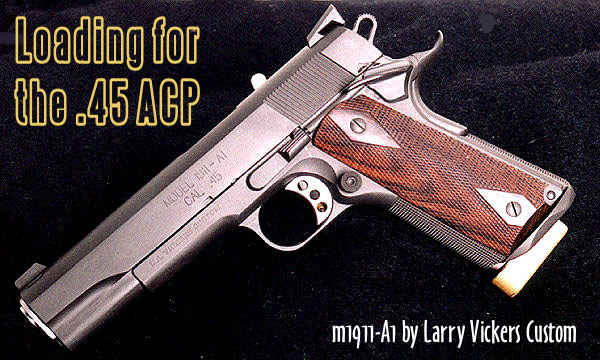
 Good Powder Choices for the .45 ACP
 This Editor owns a full-size, all-stainless S&W 1911. After trying numerous powders, I found VV N320 delivered the best combination of accuracy, easy metering, consistency, clean burning qualities, and low muzzle flash. My gun has proven exceptionally accurate using N320 with bullets from 180 grains to 230 grains — it will shoot as accurately as some expensive customs I’ve tried. At right is 5-round group I shot offhand at 10 yards with my 5″ S&W 1911.


 This is a detailed 20-minute video that shows the reloading process start to finish. The video shows how to clean the cases, deprime, and check them before loading.


