Here’s an item of interest to hunters (and maybe a few F-Open shooters). Nosler has just introduced a new magnum-type cartridge, the 30 Nosler. Sharing the same parent case as the 26 and 28 Nosler® cartridges, the 30 Nosler® has the case capacity to launch big 30-caliber bullets at impressive velocities (3000 FPS for a 210-grainer). Nosler says the 30 Nosler combines the best qualities of other 30-cal magnums: “The 30 Nosler® easily meets the velocity of the 300 Weatherby, headspaces on the shoulder like a 300 RUM, has an efficient powder column like the 300 WSM and fits in the same standard length action of a 300 Winchester Magnum.” 30 Nosler Will Function in a Standard Length Action
The 30 Nosler has a C.O.A.L. of 3.340″ allowing this cartridge to be operated in a standard length action for lighter weight and shorter bolt throw when compared to magnum-length actions.
The 30 Nosler is a SAAMI-standardized cartridge so there will be standardized dimensions for brass, dies, and chamber reamers. Nosler will support this new cartridge with Nosler Brass, Trophy Grade™ Ammunition and a series of M48 hunting rifles. The initial offerings in Nosler’s Trophy Grade™ Ammunition will be:
Nosler® Trophy Grade™ Ammunition: 180gr AccuBond® 3200 fps
Nosler® Trophy Grade™ LR Ammunition: 210gr AccuBond® LR 3000 fps
At the request of our readers, we have launched a “Deals of the Week” feature. Every Monday morning we offer our Bargain Selections. Here are some of the best deals on hardware, reloading components, and shooting accessories. Be aware that sale prices are subject to change, and once clearance inventory is sold, it’s gone for good. You snooze you lose.
1. 6mmAR.com — Easy-Change Front Bag-Rider for ARs
Here’s a great product from our friend Robert Whitley at 6mmAR.com. This new device is a 3″-wide, flat-bottomed, front bag-rider that mounts to your AR in seconds, without tools. The bag-rider (aka “sled”) really works — stabilizing your AR when shooting from a front pedestal rest. We recommend using the front sled during load development and whenever shooting from the bench. The bag-rider attaches to your AR’s handguard with a Velcro strap, indexing on the bipod stud. Right now the Easy-Change Bag-Rider has an introductory price of $55.00. If you own an AR, you should get one.
2. Target Sports — Federal .22 LR Ammo, 325 Rounds for $24.90
Need good quality rimfire ammo at a low price? This TargetSportsUSA.com deal — 325 rounds for $24.90 — is a very good value. We’re pleased to see rimfire ammo prices become affordable again. Purchases are limited to five (5) 325-round boxes per customer. This is better than most “bulk-box” rimfire ammo. Another good deal right now is the Federal AutoMatch Bulk Pack, 325 rounds for $20.99 at Natchez Shooters Supply (but you are limited to two boxes).
3. Precision Reloading — Forster 2-Die Sets with Ultra Seater
Precision Reloading has Forster two-die reloading sets on clearance now. For $75-$80 per set you can get a precision full-length sizing die plus an Ultra micrometer-top seater. These are good dies — your Editor uses these very same dies for my .223 Rem reloading. Die sets for numerous popular chamberings are on sale now including: 220 Swift, 222 Rem, 22 PPC, 6mmx45, 6mm PPC, 6mm Rem, 243 WSSM, 257 Roberts, 25 WSSM, 7mm BR Rem, 280 Rem, 7mm WSM, 7×57 Mauser, 7mm RUM, 303 British, 30-378 Wby and more.
4. Home Depot — 72″ Wood Workbench for $70.25
This patented Home Depot workbench assembles in a few minutes. Simply unfold the legs, pop in the shelf, and you are ready to start your project. Made from Premium 2×4 Hemlock fastened with glue and screws, this workbench is a great value. The bench (72″ wide x 35″ high x 22″ deep) can easily be stored when not in use. NOTE: The wood is unfinished (can be painted or stained).
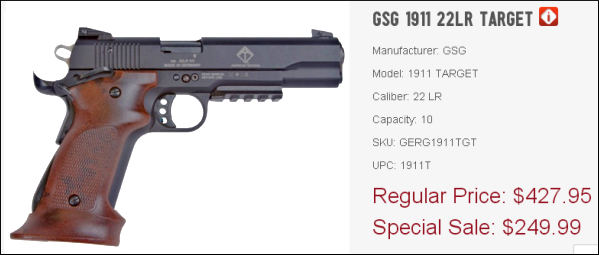
5. CDNN Sports — 1911-Type .22 LR Target Pistol
Everyone should have an accurate .22 LR target pistol. This German-made GSG 1911 22LR pistol shares the look, feel, and ergonomics of J.M. Browning’s classic model 1911 so it’s good for cross-training. We’ve tried this pistol and the trigger is pretty darn good — though don’t expect it be be as nice as a S&W Model 41. But consider that the GSG costs just $249.99. By contrast, MSRP on a new Model 41 is a steep $1369.00. For cross-training and target work the GSG is a very good value.
6. Stocky’s Stocks — Composite Stock with Bedding Block
Here’s a killer deal on a versatile Stocky’s Long Range Stock with aluminum V-block bedding system. For just $199.99, order this for Rem/Rem Clone long actions or short actions, with either narrow or wide (varmint/tactical) barrel channel. This would be a good choice for a varmint rifle. This is also offered with a matte black, tan, or olive baked-on textured finish for $229.97.
7. Natchez — Nikon Hunting Scopes on Close-out
Natchez Shooters Supplies is running a big sale on Nikon optics with Camo finishes. Prices have been reduced as much as 43%. If you’re looking for an inexpensive, name-brand optic for your hunting or varmint rifle, check out these Nikon bargains. This scopes all carry full Nikon factory warranty.
8. Amazon – Frankford Arsenal Master Tumbler Kit
This Master Tumbler Kit contains everything you need to tumble rifle or pistol brass. Now on sale for $64.40 with free shipping, this Kit contains: Vibratory Tumbler, Rotary Media Separator, Plastic Bucket, 3 lbs. Cleaning Media, and 4 oz. Brass Polish.
This important video shows what really happens when loaded ammunition burns. You will probably be surprised. Contrary to Hollywood notions, the ammo doesn’t ignite in a massive explosion. Far from it… basically the rounds “cook off” one by one, and the bullets release at relatively low velocity. We’ve featured this SAAMI research project before, but it is worth reprising for those who have not yet seen the burn tests.
A couple years back, SAAMI released an important video concerning ammo and fire. With professional fire-fighters standing by, over 400,000 rounds of ammo were incinerated in a series of eye-opening tests. If you haven’t had the chance to view this video yet, you should take the time to watch it now
The Sporting Arms and Ammunition Manufacturers’ Institute (SAAMI) has produced an amazing 25-minute video that shows what actually happens to sporting ammunition involved in a fire. This video shows the results of serious tests conducted with the assistance of professional fire crews. We strongly recommend you watch this video, all the way through. It dispels many myths, while demonstrating what really happens when ammunition is burned, dropped, or crushed.
Watch SAAMI Ammunition Testing Video
Video Timeline
2:10 Impact Test (ignited outside firearm)
3:40 65-foot Drop Test
5:08 Bullet Impact (.308 Win firing)
7:55 Blasting Cap Attacks
9:55 Bulldozer and Forklift Tests
12:20 Boxed Ammo Bonfire
15:37 Bonfire without Packaging
17:21 Retail Store Simulation Burn
20:55 Truck Trailer Burn
Over 400,000 rounds of ammunition were used in the tests. Some of the footage is quite remarkable. Testers built a bonfire with 28,000 rounds of boxed ammo soaked in diesel fuel. Then the testers loaded five pallets of ammo (250,000 rounds) in the back of a semi-truck, and torched it all using wood and paper fire-starting materials doused with diesel fuel.
The video shows that, when ammo boxes are set on fire, and ammunition does discharge, the bullet normally exits at low speed and low pressure. SAAMI states: “Smokeless powders must be confined to propel a projectile at high velocity. When not in a firearm, projectile velocities are extremely low.” At distances of 10 meters, bullets launched from “cooked-off” ammo would not penetrate the normal “turn-out gear” worn by fire-fighters.
We are not suggesting you disregard the risks of ammo “cooking off” in a fire, but you will learn the realities of the situation by watching the video. There are some amazing demonstrations — including a simulated retail store fire with 115,000 rounds of ammo in boxes. As cartridges cook off, it sounds like a battery of machine-guns, but projectiles did not penetrate the “store” walls, or even two layers of sheet-rock. The fire crew puts out the “store fire” easily in under 20 seconds, just using water.
Additional Testing: Drop Test, Projectile Test, Crush Test, Blasting Cap Test
Drop Test
The video also offers interesting ammo-handling tests. Boxes of ammo were dropped from a height of 65 feet. Only a tiny fraction of the cartridges discharged, and there was no chain-fire. SAAMI concludes: “When dropped from extreme heights (65 feet), sporting ammunition is unlikely to ignite. If a cartridge ignites, it does not propagate.”
Rifle Fire Test
SAAMI’s testers even tried to blow up boxes of ammunition with rifle fire. Boxes of loaded ammo were shot with .308 Win rounds from 65 yards. The video includes fascinating slow-motion footage showing rounds penetrating boxes of rifle cartridges, pistol ammo, and shotgun shells. Individual cartridges that were penetrated were destroyed, but adjacent cartridges suffered little damage, other than some powder leakage. SAAMI observed: “Most of the ammunition did not ignite. When a cartridge did ignite, there was no chain reaction.”
Bulldozer Crush Test
The test team also did an amazing “crush-test” using a Bulldozer. First boxes of loaded ammo, then loose piles of ammo, were crushed under the treads of a Bulldozer. A handful of rounds fired off, but again there was no chain-fire, and no large explosion. SAAMI observed: “Even in the most extreme conditions of compression and friction, sporting ammunition is unlikely to ignite. [If it does ignite when crushed] it does not propagate.”
Blasting Cap Test
Perhaps most amazingly, the testers were not able to get ammunition to chain-fire (detonate all at once), even when using blasting caps affixed directly to live primers. In the SAAMI test, a blasting cap was placed on the primer of a round housed in a large box of ammo. One cartridge ignited but the rest of the boxed ammo was relatively undamaged and there was no propagation.
Rodney Wagner shot the smallest 5-shot, 600-yard group in the history of competitive rifle shooting. First measured at a mere 0.349″, then certified on the IBS Record books at 0.336″, Rodney’s group is mind-blowingly small — and it was centered for a 50 score. This amazing group shows what can be done with a great gun, a talented shooter, and superb hand-loaded ammunition. Today’s Tech Tip reveals some of Rodney’s reloading methods that helped him put five shots you could cover with a dime into a target 600 yards away.
Creating Ultra-Accurate Benchrest Ammunition
Rodney takes great care in loading his brass, and he employs a few tricks to get superior consistency.
Fire-Forming — To prepare his cases for fire-forming, Rodney starts by turning his Lapua brass to just past where the new neck-shoulder junction will be: “I just cut enough for the 6mm Dasher neck. A little bit of the cut shows on the shoulder after forming.” Then Rodney runs a .25-caliber K&M mandrel through the whole neck, expanding the neck diameter. After the entire neck is expanded, Rodney re-sizes the top section with a Wilson bushing, creating a false shoulder. Then, as further insurance that the case will be held firmly in place during fire-forming, Rodney seats his bullets long — hard into the lands. When fire-forming, Rodney uses a normal 6mmBR load of 29.8 grains of Varget: “I don’t like to stress my brass before it has been hardened. I load enough powder to form the shoulder 95%. Any more than that is just wasted.” Rodney adds: “When fire-forming, I don’t want to use a super-hard primer. I prefer to use a Federal 205, CCI 200, or Winchester — something soft.” Using a softer primer lessens the likelihood that the case will drive forward when hit by the firing pin, so this helps achieve more consistent “blow lengths”.
Ammo Loading — Rodney is fastidious with his brass and weighs his charges very precisely. Charges are first dispensed with an RFD manual powder measure, then Rodney trickles kernel by kernel using a highly-precise Sartorius GD-503 laboratory scale. He tries to maintain charge-weight consistency within half a tenth of a grain — about two kernels of Varget powder.
One important technique Rodney employs is sorting by bullet-seating force. Rodney batch-sorts his loaded rounds based on seating force indicated by the dial gauge on his K&M arbor press: “I use a K&M arbor press with dial indicator strain gauge. When I’m loading I pay lots of attention to seating effort and I try to batch five rounds that feel the same. For record rounds I try to make sure I get five of the same number (on the dial). When sorting based on the force-gauge readout, you need to go slow. If you go too fast the needle will spike up and down before you can see it.”
In practice, Rodney might select five rounds with a gauge value of 25, then another five with a gauge read-out of 30 and so on. He places the first five like-value rounds in one row of his ammo caddy. The next like-value set of five will go in the next row down. By this method, he ensures that all five cartridges in a five-round set for a record target will have bullets seated with very consistent seating force.
Unlike some top shooters, Rodney does not regularly anneal his cases. However, after every firing, he does tumble his Dasher brass in treated corncob media. After sizing his brass, before seating the bullets, he runs a nylon brush in the necks: “The last thing I do before firing is run a well-worn 30 caliber nylon brush in the necks, using a small 6-volt drill for power. This is a quick operation — just in and out the neck”. Sometimes, at the end of the season, he will anneal, but Rodney adds: “If I can get 10 firings out of the case I’ve done good.” He usually makes up new brass when he fits a new barrel: “If it is a good barrel (that I may shoot at the Nationals), I’ll usually go ahead and prepare 200 pieces of good brass.”
Tips for 600-Yard Shooters New to the Game
In the course of our interview with Rodney, we asked if he had any tips for shooters who are getting started in the 600-yard Benchrest Game. Rodney offered some sensible advice:
1. Don’t try to go it alone. Find an old-timer to mentor you. As a novice, go to matches, watch and ask questions.
2. Go with a proven cartridge. If you are shooting 600 yards stick with a 6mmBR or one of the 6BR improveds (BRX or Dasher). Keep it simple. I tried some of the larger cartridges, the 6XC and 6-6.5×47 Lapua. I was trying to be different, but I was not successful. It wasn’t a disaster — I learned something. But I found the larger cases were not as accurate as a 6BR or Dasher. Those bigger cartridges are competitive for score but not for group.
3. You don’t have to spend a fortune to be competitive. Buy a used rifle from somebody and find out if you like the sport. You can save a lot with a used rifle, but do plan on buying a new barrel immediately.
4. Don’t waste weeks or months struggling with a barrel that isn’t shooting. My best barrels, including this record-setting Brux, started shooting exceptionally well right from the start.
Rodney’s record group was measured at 0.349″ at the match, then IBS record-certified at 0.336″.
Who wouldn’t like to find a nice, wooden crate of rimfire ammo under the Christmas tree? Here’s a Limited Edition Winchester Ammo Special offered by Cabelas.com for the holidays. The crate contains 500 rounds of Winchester Super-X Hi-Vel .22 LR ammo, loaded with 36gr copper-plated, hollow-point bullets. This ammo is rated at 1,280 fps velocity, making it good for small varmints as well as plinking. The Winchester ammo comes packaged in a premium, limited-edition wooden box. We think this would make a great end-of-year gift for a 4H Club Team, or Boy Scouts youth shooting program.
With 500 rounds at $39.99, that works out to just 8 cents a rounds — the equivalent of four bucks for a 50-round box. Thats a very good deal when you consider what rimfire ammo cost just a year ago. Also if you add another item to raise your total order to at least $49.00, you can get FREE Shipping with Code 5JOLLY. The Winchester Ammo Special is limited to one crate per customer per day, but you can add a second, different product to qualify for free shipping.
BIG news in the shooting sports industry — Ruger has entered the ammo business. Ruger now offers high-tech handgun ammunition, using licensed polymer-composite, lead-free bullet technology. According to the Shooting Wire: “Ruger’s new lead-free ammunition will be produced under a licensing agreement with Savannah, Georgia-based PolyCase Ammunition.”
Ruger’s new ARX line of lead-free ammo features injection-molded bullets that are much lighter than conventional projectiles, caliber by caliber: 56 grains for .380 ACP, 74 grains for 9x19mm, 107 grains for .40 SW, and 114 grains for .45 ACP. The lighter bullets fly faster, but ARX ammo still offers reduced perceived recoil.
Ruger ARX Ammo with Injection-Molded Matrix Bullets
The fluted projectiles are injection-molded from a copper/polymer matrix. This offers many advantages. First, being completing lead-free, these bullets can be used at indoor facilities that prohibit lead-based ammo. Second, because the composite bullets weigh 30% less than comparable lead-based projectiles, shooters experience noticeably less recoil (even though velocities are higher). Third, the composite matrix bullet has low-ricochet properties. When these bullets strike metal, they are designed to disintegrate (into a powder), rather than ricochet. This makes them well-suited for indoor use, or use with metal plates.
Shooting Wire Editor Jim Shepherd reports that ARX ammo delivers on its low-recoil promise: “Having spent time testing the PolyCase ammunition (largely in Ruger firearms), I know the reduction in felt recoil isn’t just hype. While firing PolyCase ARX ammunition in calibers ranging from .380 in small concealed carry pistols (including a Ruger’s LCP) up to .458 SOCOM in modern sporting rifles, the lessened felt recoil was noticeable.”
PolyCase Molded Bullet Design Technology
For over a century most bullets have been mass-produced with a process called cold-forming. Lead and copper were shaped with brute force in punches and dies to create projectiles. While this is still a viable and effective way to produce bullets, other manufacturing methods are now available. By applying injection-molding technology, Polycase has developed a new type of bullet that has many advantages, as least for handgun applications. Bullets weigh approximately 70% as much as lead bullets with similar profiles. Lighter weight means higher velocities and less recoil. In addition, PolyCase bullets are lead-free, and low-ricochet — two qualities important for indoor and close-range training. The injection-molding process also reduces weight variations (compared to cast lead bullets), and ensures excellent concentricity. Molding also allows unique shapes that are impossible to produce with conventional bullet-making methods (see photo).
Every week Brownells Merchandise Manager Paul Levy hosts a video featuring new products. We’ve seen these vid clips before, but three products in this week’s video really caught our attention. We like the new MTM Ammo Crate, and the new Durablue coating offers a great option for gun-owners who want a traditional-looking finish that is also durable. And for AR-10 owners, the gold-tone Titanium Nitride Bolt Carrier group promises smoother running with easier cleaning.
Products featured in this week’s video include:
MTM Ammo Crate. Wide, flat polymer box features O-ring seal for water resistance, and stackable shape for convenient storage. Integral handle makes for easy transport. Holds up to 85 lbs. of ammo, magazines, and any other type of supplies or gear. Available in 4½”- and 7¼”-deep models.
Titanium Nitride is an extremely robust, durable coating, and now it’s available on an AR-10 bolt carrier group. The new Prime Weaponry .308AR Titanium Nitride Bolt Carrier Group drops into AR-10 type .308 AR uppers. The tough gold-tone finish resists wear and corrosion, plus the slick surface speeds up the cleaning process.
Duracoat DuraBlue is a new spray-on coating that provides a deep, glossy finish like traditional bluing but without the worry of rust, scratches, or high cost. DuraBlue comes in an aerosol can or liquid form (for application with sprayer) in both glossy black and traditional blue. DuraBlue can be used on on all kinds of metal, even stainless steel and aluminum.
Every summer weekend, there are probably 400 or more club “fun matches” conducted around the country. One of the good things about these club shoots is that you don’t have to spend a fortune on equipment to have fun. But we’ve seen that many club shooters handicap themselves with a few common equipment oversights or lack of attention to detail while reloading. Here are SIX TIPS that can help you avoid these common mistakes, and build more accurate ammo for your club matches.
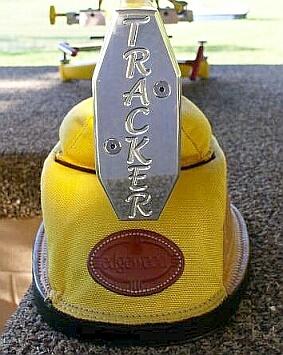
1. Align Front Rest and Rear Bags. We see many shooters whose rear bag is angled left or right relative to the bore axis. This can happen when you rush your set-up. But even if you set the gun up carefully, the rear bag can twist due to recoil or the way your arm contacts the bag. After every shot, make sure your rear bag is aligned properly (this is especially important for bag squeezers who may actually pull the bag out of alignment as they squeeze).
Forum member ArtB adds: “To align my front rest and rear bag with the target, I use an old golf club shaft. I run it from my front rest stop through a line that crosses over my speed screw and into the slot between the two ears. I stand behind that set-up and make sure I see a straight line pointing at the target. I also have a piece of tape that I’ve placed on the golf shaft that indicates how far the back end of the rear bag should be placed from the front rest stop. Don’t have an old golf shaft? Go to Home Depot and buy an inexpensive piece of wood dowel.”
2. Avoid Contact Interference. We see three common kinds of contact or mechanical interference that can really hurt accuracy. First, if your stock has front and/or rear sling swivels make sure these do NOT contact the front or rear bags at any point of the gun’s travel. When a sling swivel digs into the front bag that can cause a shot to pop high or low. To avoid this, reposition the rifle so the swivels don’t contact the bags or simply remove the swivels before your match. Second, watch out for the rear of the stock grip area. Make sure this is not resting on the bag as you fire and that it can’t come back to contact the bag during recoil. That lip or edge at the bottom of the grip can cause problems when it contacts the rear bag. Third, watch out for the stud or arm on the front rest that limits forward stock travel. With some rests this is high enough that it can actually contact the barrel. We encountered one shooter recently who was complaining about “vertical flyers” during his match. It turns out his barrel was actually hitting the front stop! With most front rests you can either lower the stop or twist the arm to the left or right so it won’t contact the barrel.
3. Weigh Your Charges — Every One. This may sound obvious, but many folks still rely on a powder measure. Yes we know that most short-range BR shooters throw their charges without weighing, but if you’re going to pre-load for a club match there is no reason NOT to weigh your charges. You may be surprised at how inconsistent your powder measure actually is. One of our testers was recently throwing H4198 charges from a Harrell’s measure for his 30BR. Each charge was then weighed twice with a Denver Instrument lab scale. Our tester found that thrown charges varied by up to 0.7 grains! And that’s with a premium measure.
4. Measure Your Loaded Ammo — After Bullet Seating. Even if you’ve checked your brass and bullets prior to assembling your ammo, we recommend that you weigh your loaded rounds and measure them from base of case to bullet ogive using a comparator. If you find a round that is “way off” in weight or more than .005″ off your intended base to ogive length, set it aside and use that round for a fouler. (Note: if the weight is off by more than 6 or 7 grains you may want to disassemble the round and check your powder charge.) With premium, pre-sorted bullets, we’ve found that we can keep 95% of loaded rounds within a range of .002″, measuring from base (of case) to ogive. Now, with some lots of bullets, you just can’t keep things within .002″, but you should still measure each loaded match round to ensure you don’t have some cases that are way too short or way too long.
5. Check Your Fasteners. Before a match you need to double-check your scope rings or iron sight mounts to ensure everything is tight. Likewise, you should check the tension on the screws/bolts that hold the action in place. Even with a low-recoiling rimfire rifle, action screws or scope rings can come loose during normal shooting.
6. Make a Checklist and Pack the Night Before. Ever drive 50 miles to a match then discover you have the wrong ammo or that you forgot your bolt? Well, mistakes like that happen to the best of us. You can avoid these oversights (and reduce stress at matches) by making a checklist of all the stuff you need. Organize your firearms, range kit, ammo box, and shooting accessories the night before the match. And, like a good Boy Scout, “be prepared”. Bring a jacket and hat if it might be cold. If you have windflags, bring them (even if you’re not sure the rules allow them). Bring spare batteries, and it’s wise to bring a spare rifle and ammo for it. If you have just one gun, a simple mechanical breakdown (such as a broken firing pin) can ruin your whole weekend.
What’s the next best thing to a stockpile of gleaming, freshly-loaded ammo? How about a movie showing gleaming, freshly-loaded ammo being made — from start to finish? The five-minute video below shows the ammunition production process at the Lake City Army Ammunition Plant, a division of ATK. Lake City is the largest producer of small arms ammunition for the U.S. military, producing roughly four MILLION small-caliber rounds every day.
This promotional video does go a bit overboard at times in a self-congratulatory sense. But the video is definitely worth watching — it is fascinating to watch the process of creating cartridges — from the drawing (or extrusion) of raw brass into casings to the placement of projectiles and primers.
Quick History of Lake City Ammunition Plant Lake City Army Ammunition Plant (LCAAP) is a 3,935-acre government-owned, contractor-operated facility in Independence, Missouri that was established by Remington Arms in 1941 to manufacture and test small caliber ammunition for the U.S. Army. The facility has remained in continuous operation except for one 5-year period following World War II. As of July 2007, the plant produced nearly 1.4 billion rounds of ammunition per year. Remington Arms operated the plant from its inception until 1985, when operations were taken over by Olin Corporation. From April 2001 through the present, it has been operated by Alliant Techsystems (ATK), which in February 2015 split into two separate companies, Orbital ATK and Vista Outdoors.
You probably know by now that the ATF is seeking comments on a proposed regulation that would ban the importation and sale of M855 steel-core 5.56x45mm ammunition. The ATF has proposed banning this “green-tip” ammo (and similar products) on the grounds that it is “armor piercing”.
Nobody knows whether the proposed ban will actually go into effect. The ATF is solicting comments through March 16, 2015. The mere possibility of a ban has spurred a feeding frenzy of ammo sales. If you are looking for genuine M855-type Green Tip ammo, suitable for use in AR-platform rifles, Creedmoor Sports recently obtained a large supply. Creedmoor just located quantities of Lake City-produced, American Eagle-brand XM855 in cardboard boxes: “Our team found another source for 5.56 mm XM855F Federal Lake City Green Tip Ammo. This ammo is becoming almost impossible to source the closer we get to the [March 16th end] of the ATF comment period.”
Lake City M855 5.56 62gr Green Tip Ammunition (300 Rounds)
Product Description
High-quality 5.56x45mm ammo made in the USA by Lake City. This is “XM855″ ball ammo with a steel penetrator in the core, surrounded by a copper jacket. The projectile is color-coded with a green-painted tip as is traditional with US-made M855.
Product Specifications:
* Manufacturer: Federal / Lake City
* Model: XM855
* Caliber: 5.56 NATO (5.56x45mm)
* Grain Weight: 62 Grains
* Type: Full Metal Jacket with Penetrator
* Units per Case: 300 (in two 150ct boxes)




 The Sporting Arms and Ammunition Manufacturers’ Institute (
 We are not suggesting you disregard the risks of ammo “cooking off” in a fire, but you will learn the realities of the situation by watching the video. There are some amazing demonstrations — including a simulated retail store fire with 115,000 rounds of ammo in boxes. As cartridges cook off, it sounds like a battery of machine-guns, but projectiles did not penetrate the “store” walls, or even two layers of sheet-rock. The fire crew puts out the “store fire” easily in under 20 seconds, just using water.

 One important technique Rodney employs is sorting by bullet-seating force. Rodney batch-sorts his loaded rounds based on seating force indicated by the dial gauge on his K&M arbor press: “I use a K&M arbor press with dial indicator strain gauge. When I’m loading I pay lots of attention to seating effort and I try to batch five rounds that feel the same. For record rounds I try to make sure I get five of the same number (on the dial). When sorting based on the force-gauge readout, you need to go slow. If you go too fast the needle will spike up and down before you can see it.”


 1. Align Front Rest and Rear Bags. We see many shooters whose rear bag is angled left or right relative to the bore axis. This can happen when you rush your set-up. But even if you set the gun up carefully, the rear bag can twist due to recoil or the way your arm contacts the bag. After every shot, make sure your rear bag is aligned properly (this is especially important for bag squeezers who may actually pull the bag out of alignment as they squeeze).
 3. Weigh Your Charges — Every One. This may sound obvious, but many folks still rely on a powder measure. Yes we know that most short-range BR shooters throw their charges without weighing, but if you’re going to pre-load for a club match there is no reason NOT to weigh your charges. You may be surprised at how inconsistent your powder measure actually is. One of our testers was recently throwing H4198 charges from a Harrell’s measure for his 30BR. Each charge was then weighed twice with a Denver Instrument lab scale. Our tester found that thrown charges varied by up to 0.7 grains! And that’s with a premium measure.
 5. Check Your Fasteners. Before a match you need to double-check your scope rings or iron sight mounts to ensure everything is tight. Likewise, you should check the tension on the screws/bolts that hold the action in place. Even with a low-recoiling rimfire rifle, action screws or scope rings can come loose during normal shooting.
 What’s the next best thing to a stockpile of gleaming, freshly-loaded ammo? How about a movie showing gleaming, freshly-loaded ammo being made — from start to finish? The five-minute video below shows the ammunition production process at the Lake City Army Ammunition Plant, a division of ATK. Lake City is the largest producer of small arms ammunition for the U.S. military, producing roughly four MILLION small-caliber rounds every day.


