A Kestrel Wind Meter will record wind speed with its impeller wheel. However, to get the most accurate wind velocity reading, you need to have your Kestrel properly aligned with the wind direction. To find wind direction, first orient the Kestrel so that the impeller runs at minimal speed (or stops), and only then turn the BACK of the Kestrel into the wind direction. Do NOT simply rotate the Kestrel’s back panel looking for the highest wind speed reading — that’s not the correct method for finding wind direction. Rotate the side of the Kestrel into the wind first, aiming for minimal impeller movement. The correct procedure is explained below by the experts at Applied Ballistics.
How to Find the Wind Direction with a Kestrel Wind Meter
Here is the correct way to determine wind direction with a Kestrel wind meter when you have no environmental aids — no other tools than a Kestrel. (NOTE: To determine wind direction, a mounted Wind Vane is the most effective tool, but you can also look at flags, blowing grass, or even the lanyard on your Kestrel).
Step 1: Find the wind’s general direction.
Step 2: Rotate the Wind Meter 90 degrees, so that the wind is impacting the side (and not the back) of the wind meter, while still being able to see the impeller.
Step 3: Fine-tune the direction until the impeller drastically slows, or comes to a complete stop (a complete stop is preferred). If the impeller won’t come to a complete stop, find the direction which has the lowest impact on the impeller.
Step 4: Turn the BACK of the Kestrel towards the direction from which the wind is blowing. Then press the capture button, and record your wind speed.
Do NOT simply point the Kestrel’s back into the wind until you get the highest wind speed — that’s not the correct method.
After the success of its winter Ballistics seminar in Michigan, Applied Ballistics has taken its show on the road. Right now Bryan Litz and his team are running a seminar in Texas, and there will be two (2) more seminars this year — one in Michigan and one in North Carolina. These seminars cover a wide range of topics, with the primary focus on basic to advanced ballistics principles as applied to long-range shooting. Bryan uses a multi-media approach: “Everyone learns in different ways — some by reading, others process graphics better. The Applied Ballistics seminars offer a chance to engage industry professionals directly in person, and to ask your questions directly, in live conversation. This format is the best way for many shooters to learn the science of accuracy.”
AUDIO FILE: Bryan Litz Reports from the Ballistics Seminar in Texas on May 23rd. (Sound file loads when you click button).
To learn about upcoming seminars, watch a preview video, or get more information, CLICK THIS LINK. NOTE: If you want to get involved, places still remain for the summer and fall seminars. SEE Registration links below:
Full House in Texas — Ballistics Seminar is a Big Success
As you can see, this week’s seminar has been hugely popular, with over 130 shooters in attendence. Bryan Litz tells us: “Engagement at the Dallas seminar is great. With so many participants (130+), there’s a lot to discuss! Our content covers a lot of the aspects of long range ballistics, and the guys take the conversation into various applications such as hunting, competition shooting, and Military/LE applications as well. On Day One we covered basic and advanced trajectory features, Ballistic Coefficients, and laser rangefinder performance — all before lunch. In the afternoon we discussed wind from academic and practical standpoints. The afternoon session included a briefing by former USAMU team coach Emil Praslick, one of the best wind coaches in the world. After dinner there were informal break-out sessions with myself and guest speakers. Day Two (Tuesday) will be just as full — we’ll cover a lot of ground.”
There’s an all-new book from Applied Ballistics. Modern Advancements in Long Range Shooting – Volume II, is now available for pre-order from the Applied Ballistics eStore. This 356-page hardcover resource is chock full of information, much of it derived through sophisticated field testing. The pre-order price is $34.95, $5.00 off the regular $39.95 price. The books are expected to ship in July, 2016.
AUDIO FILE: Bryan Litz Talks about Modern Advancements in Long Range Shooting, Volume 2. (Sound file loads when you click button).
Volume II of Modern Advancements in Long Range Shooting contains all-new content derived from research by Applied Ballistics. Author Bryan Litz along with contributing authors Nick Vitalbo and Cal Zant use the scientific method and careful testing to answer important questions faced by long range shooters. In particular, this volume explores the subject of bullet dispersion including group convergence. Advanced hand-loading subjects are covered such as: bullet pointing and trimming, powder measurement, flash hole deburring, neck tension, and fill ratio. Each topic is explored with extensive live fire testing, and the resulting information helps to guide hand loaders in a deliberate path to success. The current bullet library of measured G1 and G7 ballistic coefficients is included as an appendix. This library currently has data on 533 bullets in common use by long range shooters.
Bryan tells us that one purpose of this book is to dispel myths and correct commonly-held misconceptions: “Modern Advancements in Long Range Shooting aims to end the misinformation which is so prevalent in long range shooting. By applying the scientific method and taking a Myth Buster approach, the state of the art is advanced….”
Bullet Dispersion and Group Convergence
Part 1 of this Volume is focused on the details of rifle bullet dispersion. Chapter 1 builds a discussion of dispersion and precision that every shooter will benefit from in terms of understanding how it impacts their particular shooting application. How many shots should you shoot in a group? What kind of 5-shot 100 yard groups correlate to average or winning precision levels in 1000 yard F-Class shooting?
Chapter 2 presents a very detailed investigation of the mysterious concept of group convergence, which is the common idea that some guns can shoot smaller (MOA) groups at longer ranges. This concept is thoroughly tested with extensive live fire, and the results answer a very important question that has baffled shooters for many generations.
Part 2 of this Volume is focused on various aspects of advanced hand-loading. Modern Advancements (Vol. II) employs live fire testing to answer the important questions that precision hand loaders are asking. What are the best ways to achieve MVs with low ES and SD? Do flash hole deburring, neck tension, primer selection, and fill ratio and powder scales sensitivity make a difference and how much? All of these questions are explored in detail with a clear explanation of test results.
One of the important chapters of Part 2 examines bullet pointing and trimming. Applied Ballistics tested 39 different bullet types from .224 through .338 caliber. Ten samples of each bullet were tested for BC in each of the following configurations: original out of the box, pointed, trimmed, pointed and trimmed. The effect on the average BC as well as the uniformity in BC was measured and tabulated, revealing what works best.
Part 3 covers a variety of general research topics. Contributing author Nick Vitalbo, a laser technology expert, tested 22 different laser rangefinders. Nick’s material on rangefinder performance is a landmark piece of work. Nick shows how shooters can determine the performance of a rangefinder under various lighting conditions, target sizes, and reflectivities.
Chapter 9 is a thorough analysis of rimfire ammunition. Ballistic Performance of Rifle Bullets, 2nd Edition presented live fire data on 95 different types of .22 rimfire ammunition, each tested in five different barrels having various lengths and twist rates. Where that book just presented the data, Chapter 9 of this book offers detailed analysis of all the test results and shows what properties of rimfire ammunition are favorable, and how the BCs, muzzle velocities and consistency of the ammo are affected by the different barrels.
Chapter 10 is a discussion of aerodynamic drag as it relates to ballistic trajectory modeling. You will learn from the ground up: what an aerodynamic drag model is, how it’s measure and used to predict trajectories. Analysis is presented which shows how the best trajectory models compare to actual measured drop in the real world.
Finally, contributing author Cal Zant of the Precision Rifle Blog presents a study of modern carbon fiber-wrapped barrels in Chapter 11. The science and technology of these modern rifle barrels is discussed, and then everything from point of impact shift to group sizes are compared for several samples of each type of barrel including standard steel barrels.
After the success of its recent winter Ballistics seminar in Michigan, Applied Ballistics has decided to take its show on the road, offering additional Ballistics seminars in three different states (Texas, Michigan, and North Carolina). These three seminars will cover a wide range of topics, with the primary focus on basic to advanced ballistics principles as applied to long-range shooting. Registration is now open for the three (3) upcoming Ballistics Seminars:
This video explains the subjects covered by Applied Ballistics Seminars:
Ballistician (and current F-TR National Mid-Range and Long-Range Champion) Bryan Litz will be the primary speaker at the spring, summer, and fall seminars. He will present material from his books and the Applied Ballistics Lab, and he will discuss his experience shooting in various disciplines. The seminar will feature structured presentations by Bryan and other noted speakers, but a great deal of time will be alloted for questions and discussion. By the end of the seminar, participants should have a much better understanding of how to apply ballistics in the real world to hit long-range targets. Along with Bryan, other respected experts will include:
Emil Praslick III – Head coach of the U.S. Palma team and retired head coach of the U.S. Army Marksmanship Unit. Emil will discuss tactics, strategy, and mindset for successful wind-reading.
Eric Stecker – Master Bulletsmith and President of Berger Bullets. Eric will be presenting on precision bullet making technology.
Nick Vitalbo – Owner of nVisti Tactical Innovations and chief engineer for Applied Ballistics. Nick will discuss the state of the art in laser rangefinders and wind reading devices.
Mitch Fitzpatrick – Applied Ballistics intern and owner of Lethal Precision Arms. Mitch specializes in Extended Long Range (ELR) cartridge selection and rifle design.
Ballistic Solvers – How they work, best practices, demos.
Weapon Employment Zone (WEZ) Analysis – How to determine and improve hit percentage.
Optics and Laser Technology – State of the Art.
The seminars costs $500.00. But consider this — each seminar participant will receive the entire library of Applied Ballistics books and DVDs, valued at $234.75, PLUS a free copy of Applied Ballistics Analytics software, valued at $200.00. So you will be getting nearly $435.00 worth of books, DVDs, and software. In addition, a DVD of the seminar will be mailed to each attendee after the seminar concludes.
Are you looking to improve your long-range shooting? Doubtless you’ve been thinking about upgrading your rifle or optics, but wonder what to buy (and how to get the best “bang for your buck”). In this video, Bryan Litz of Applied Ballistics offers “solid gold” advice on equipment selection for mid-level shooters (i.e. those who are somewhere between “newbie” and “Master of the Universe”). Bryan explains the logical first step is a barrel upgrade — a new tube from a top-barrel maker can make a huge difference. Then you should research the best factory ammo for your rifle, or get started in precision hand-loading. Bryan also offers advice on choosing a scope and optics accessories.
Equipment Upgrades: Barrel, Optics, Ammoby Bryan Litz
Every equipment element can be upgraded. You can run that factory rifle for a period of time, but the barrel eventually is going to be what holds you back. The twist rate probably won’t be fast enough to stabilize the high-BC bullets that you want to shoot at long range. So, the first thing you want to upgrade on your factory rifle is probably going to be the barrel. [With a new custom barrel] you’re going to get a fast twist rate, you’re going to get a chamber that’s optimized with a throat for your … bullet. And a good quality custom barrel is going to be easier to clean, won’t foul out as much, and it’s going to improve to overall accuracy and precision of your shooting. Barrel swaps are very common and routine thing for gunsmiths to do.
The next thing is improving your scope. If you don’t have a quality optic it’s going to hold you back. The job of the scope is to precisely and perfectly delineate [the target] within a half a degree (from 100 to 1000 yards is only a half a degree). The scope has got to put you on the money within that half a degree. So, it’s not a piece of equipment you want to go cheap on.
The other big factor is your ammunition. Getting into hand-loading is meticulous and it takes a long time to learn, but ultimately you’ll be making ammunition that is tailored for your rifle, and there simply won’t be anything better for your rifle than what you can develop through individual handloads.
So that’s typically the upgrade path: Get your factory rifle re-barreled, don’t skimp on a scope (or anything that attaches to it), improve your ammunition (whether by upgrading to better factory ammo or hand-loading on your own). All through this process is continuous learning… Once you have the best equipment (and it doesn’t get any better), the process of learning and education never ends. That is something you build on every single time you go to the range, and it’s what going to allow you to continually improve your skills.”
No matter what kind of rifle you shoot, whether it be an AR or a brenchrest rig, the principles are the same — develop a good load, learn the gun, hone your wind-reading skills, and practice in all conditions. Making a video of a practice session can help you identify and correct bad habits.
Bryan Litz says “don’t skimp on your scope”. Purchase a quality scope, rings, and scope level. Successful long-range shooting all begins with your view of the target.
Even with a top-of-the-line F-TR rig like this, you still have to practice diligently, putting in the “trigger time” needed to improve your game.
We will be interviewing Bryan Litz of Applied Ballistics tomorrow at SHOT Show in Las Vegas. As a sneak preview of some of the topics we’ll cover, here are some highlights of some important, original research conducted by Bryan and his Applied Ballistics team. Bryan wanted to know how much velocity was altered by twist rate. The “real world” test results may surprise you….
The Applied Ballistics team tested six (6) same-length/same-contour Bartlein barrels to observe how twist rate might affect muzzle velocity. This unique, multi-barrel test is featured in the book Modern Advancements in Long Range Shooting. That book includes many other fascinating field tests, including a comprehensive chronograph comparison.
Barrel Twist Rate vs. Velocity — What Tests Reveal by Bryan Litz
When considering barrel twist rates, it’s a common belief that faster twist rates will reduce muzzle velocity. The thinking is that the faster twist rate will resist forward motion of the bullet and slow it down. There are anecdotal accounts of this, such as when someone replaces a barrel of one brand/twist with a different brand and twist and observes a different muzzle velocity. But how do you know the twist rate is what affected muzzle velocity and not the barrel finish, or bore/groove dimensions? Did you use the same chronograph to measure velocity from both barrels? Do you really trust your chronograph?
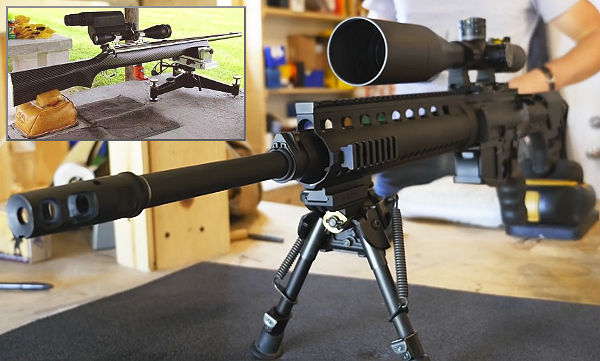
Savage Test Rifle with Six Bartlein Barrels
Most shooters don’t have access to the equipment required to fully explore questions like this. These are exactly the kinds of things we examine in the book Modern Advancements in Long Range Shooting. In that book, we present experiments conducted in the Applied Ballistics lab. Some of those experiments took on a “Myth Buster” tone as we sought to confirm (or deny) popular pre-conceptions. For example, here’s how we approached the question of barrel twist and muzzle velocity.
Six .308 Win Barrels from Bartlein — All Shot from the Same Rifle
We acquired six (6) barrels from the same manufacturer (Bartlein), all the same length and contour, and all chambered with the same reamer (SAAMI spec .308 Winchester). All these barrels were fitted to the same Savage Precision Target action, and fired from the same stock, and bench set-up. Common ammo was fired from all six barrels having different twist rates and rifling configurations. In this way, we’re truly able to compare what effect the actual twist rate has on muzzle velocity with a reasonable degree of confidence.
Prior to live fire testing, we explored the theoretical basis of the project, doing the physics. In this case, an energy balance is presented which predicts how much velocity you should expect to lose for a bullet that’s got a little more rotational energy from the faster twist. In the case of the .30 caliber 175 grain bullets, the math predicts a loss of 1.25 fps per inch-unit of barrel twist (e.g. a 1:8″ twist is predicted to be 1.25 fps slower than a 1:9″ twist).
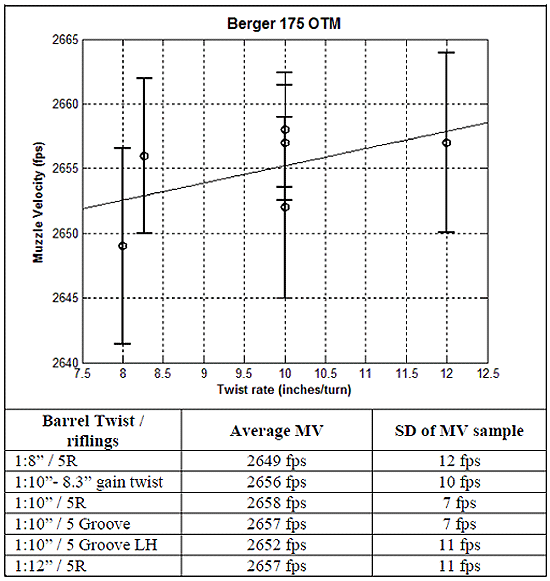
Above, data shows relationship between Twist Rate and Muzzle Velocity (MV) for various barrel twist rates and rifling types. From fast to slow, the three 1:10″ twist barrels are: 5R (canted land), 5 Groove, 5 Groove left-hand twist.
We proceeded with the testing in all 6 barrels from 1:8” to 1:12”. After all the smoke cleared, we found that muzzle velocity correlates to twist rate at the rate of approximately 1.33 fps per inch of twist. In other words, your velocity is reduced by about 5 fps if you go from a 1:12” twist to a 1:8” twist. [Editor: That’s a surprising number — much less than most folks would predict.] In this case the math prediction was pretty close, and we have to remember that there’s always uncertainty in the live fire results. Uncertainty is always considered in terms of what conclusions the results can actually support with confidence.
This is just a brief synopsis of a single test case. The coverage of twist rates in Modern Advancements in Long-Range Shooting is more detailed, with multiple live fire tests. Results are extrapolated for other calibers and bullet weights. Needless to say, the question of “how twist rate affects muzzle velocity” is fully answered.
Other chapters in the book’s twist rate section include: · Stability and Drag – Supersonic
· Stability and Drag – Transonic
· Spin Rate Decay
· Effect of Twist rate on Precision
Other sections of the book include: Modern Rifles, Scopes, and Bullets as well as Advancements in Predictive Modeling. This book is sold through the Applied Ballistics online store. Modern Advancements in Long Range Shooting is also available in eBook format in the Amazon Kindle store.
iPhone owners rejoice. The much-awaited iOS Ballistics App for the Kestrel LiNK Weather Meter is now available. Now you can sync your 5700 Series Kestrel wirelessly with your iPhone, iPod, or iPad. With Apple iOS devices being so popular among serious shooters, this is an important software release. Bryan Litz of Applied Ballistics was proud to announce the new development: “Kestrel LiNK Ballistics is now available for iOS! It has been available for Android, and was also recently updated to fix some issues. Android users should be on version 1.67 by now. We say thank you to those who have been patiently waiting for the iOS version”. The software is a FREE download from the Apple App Store. For supporting info and Users’ Guides for both iOS and Android versions, visit the Applied Ballistics Resource Site.
This App is designed to work with the new 5700-series Kestrel Elite Weather Meter (5700AL) or Kestrel Sportsman Weather Meter (5700SL) with LiNK, powered by Bluetooth Smart.
Christmas Day is just a week away. Books have always been popular holiday gifts. If you haven’t completed your holiday shopping, here are some recommended titles that should please the serious shooters and firearms enthusiasts on your shopping list. For shooting clubs, books also make great end-of-season member awards. Most of us would rather have a useful book than one more piece of wood to toss in a box in the closet.
Here Are TEN TITLES Recommended for Serious Shooters:
If you’re a serious long-range shooter, consider adding this book to your library. Relying on extensive ballistics testing, Modern Advancements contains some fascinating research results, including the effects of twist rate on muzzle velocity, BC, and precision. Other sections detail the evolution of modern rifle, bullet, and optics designs. And there is an important comparison test of chronographs. Laser rangefinders and wind measurement devices are explained in detail by contributing author Nick Vitalbo. This book is a valuable resource for anyone who wants to understand the current “state of the art” in today’s shooting world. There is a ton of “hard science” in this book — not just opinions.
This book should be on the shelf of every short-range benchrest shooter. (Shooters in other disciplines will find the book helpful as well.) Butch Lambert says Mike’s book is “far and away the best Benchrest book written. Very comprehensive, it touches on every aspect of our game.” Mike’s 368-page book is dedicated to getting the most from modern rifle accuracy equipment with an emphasis on shooting 100-200-300 yard group benchrest tournaments. This book covers the most popular hardware plus new equipment offerings are covered, including external mount scopes, actions, triggers, stocks, wind flags, and more. Also covered are rifle handling techniques, note taking, tuning, bullet selection, goals, and match strategies. Mike provides many tips that will help active competitors update their own competitive program.
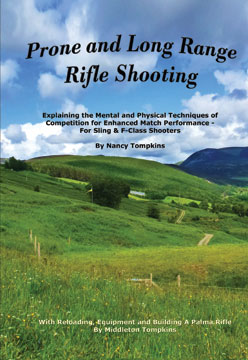
Nancy Tompkins is one of the greatest long-range shooters in American history. She has won five National Long-range Championships. Tompkins’ treatise is a must-read for serious Palma, F-Class, and High Power shooters. The revised Second edition includes F-Class equipment and techniques, and newly updated information. Color pictures. Topics include Mental & Physical training, Reading Wind & Mirage Shooting Fundamentals, International Competition, and Loading for Long Range. Nancy Tompkins is a 4-time winner of the National Long Range Championships, and has won countless other major events. Nancy has been on six Palma Teams (as both a shooter and a coach).
Tony Boyer, the most successful shooter in the history of short-range benchrest competition, shares many of his match-winning tips in this 323-page book. The book covers all aspect of the benchrest discipline: loading, windflags, rest set-up, addressing the rifle, and match strategies. This is a high-quality publication, filled with valuable insights. Every serious benchrest shooter should read Tony’s book. Boyer has dominated registered benchrest in a fashion that will never be duplicated, having amassed 142 U.S. Benchrest Hall of Fame points. The next closest shooter, Allie Euber, has 47 Hall of Fame points. This handsome, full-color book is 323 pages long, with color photos or color illustrations on nearly every page.
This book by 11-time National High Power Champion David Tubb focuses on position shooting and High Power disciplines. Section One covers fundamentals: position points, natural point of aim, breathing, triggering mechanics and follow-through, sling selection and use, getting started, getting better, avoiding obstacles. Section Two covers mechanics of offhand, sitting, and prone positions. Section Three covers shooting skills, including wind reading and mental preparation. Section Four covers the technical side of shooting, with extensive disuctions of rifle design, load development, reloading barrel maintenance, and rifle fitting. We consider this book a “must-read” for any sling shooter, and there is plenty of good advice for F-Class shooters too.
Many of our Forum members have recommended The Wind Book for Rifle Shooters by Linda Miller and Keith Cunningham. This 146-page book, published in 2007, is a very informative resource. But you don’t have to take our word for it. If you click this link, you can read book excerpts on Amazon.com. This lets you preview the first few chapters, and see some illustrations. Other books cover wind reading in a broader discussion of ballistics or long-range shooting. But the Miller & Cunningham book is ALL about wind reading from cover to cover, and that is its strength. The book focuses on real world skills that can help you accurately gauge wind angle, wind velocity, and wind cycles.
Rifle Accuracy Facts by Harold R. Vaughn, (Softcover and Hardcover, Used Price Varies)
Decades after it was written, Vaughn’s work remains a seminal treatise on accuracy. Vaughn was a serious scientist, working for the Sandia National Laboratories. Many “gun writers” toss out hunches about rifle accuracy. Vaughn, by contrast, did serious empirical testing and statistical analysis. Vaughn wondered why some guns shot well while seemingly identical rifles did not. Rifle Accuracy Facts covers a wide variety of topics, including internal ballistics, chamber design, barrel vibration, bullet imbalance, external ballistics, scope design and more. Writer Boyd Allen notes: “If you are serious about precision shooting, Vaughn’s book belongs in your library.”
The Accurate Rifle by Warren Page, $14.95 (Softcover), $20.99 (Hardcover)
We include this book in our list because it is an older classic that has been out of print for a while. Warren Page was the shooting Editor of Field & Stream magazine for 24 years. Long out of print, this seminal work on rifle accuracy was republished in 1996 with an updating chapter by Dave Brennan, long-time Editor of Precision Shooting magazine. If you are interested in the progress of rifle accuracy, it is worth reading this book to see how technology has developed over time (and what older methods still work today). This would make a great gift for an older shooter who grew up reading Warren Page articles in Field & Stream.
Steven Boelter’s 352-page book is a comprehensive study of all types of rimfire ammunition (including 17s and 22 mags), with over 600 photos. In a remarkable undertaking, Steven Boelter fired every brand and sample of rimfire ammo he could acquire (including .22 LR, 17 Mach 2, 17 HMR and .22 WMR), and recorded all the results. In all, Steven tested 11 brands and 137 different rimfire rounds, firing over 32,000 test rounds.
Always controversial, Bill Calfee is nonetheless a major player in the world of rimfire accuracy. Calfee-built rimfire rifles have set many records and won many titles. He harbors strong opinions about what works and what doesn’t, but if you are involved in rimfire competition you should read this book. This work covers all aspects of rimfire gunsmithing and accurizing: barrels, tuners, chambering, triggers, stock design, bedding, action design and much more. He examines each aspect of rimfire accuracy discussing all of the components and their contribution to the improved accuracy. We don’t agree with all of Calfee’s theories about accuracy, but this book still remains a “must-read” for those serious about precision rimfire shooting.
This past weekend, Bryan Litz of Applied Ballistics LLC, topped a field of great shooters to win the 2015 NRA F-TR Mid-Range National Championship. Bryan shot very well, mastering conditions that were tricky and sometimes bewildering, particularly at the shortest range, 300 yards. Consider this, Lou Mudica had the top score on Day Two (all 600 yards), yet he was way down at 41st position on Day One (300/500/600 yards). Finishing Second Overall was Scott Harris. Bryan’s Michigan team-mate Jim Grissom was third, while Bryan’s father (and MI team-mate) Bill Litz was fourth.
F-TR Top Ten at Mid-Range National Championship
Bryan was using a low-profile, carbon/composite-stocked rifle built by John Pierce. Bryan told us: “This was the same rifle and almost the same load with which I won the Midwest Palma match in the summer of 2014. (Story HERE.) My gear consisted of Pierce rifle, Bartlein barrel, Nightforce scope, Berger bullets, Lapua brass, Hodgdon powder (All those companies are sponsors of the USA F-TR team as well as the Michigan F-TR team.) My load for the Mid-Range Nationals was 43.0 grains of Varget with the Berger 215gr Hybrid bullet seated 0.005″ off the rifling.”
Click Image for Full-Size Version:
A lot of wind shooting strategy isn’t just about knowing exactly where to hold at any given point in time. A big part of it is recognizing periods of predictable readable conditions versus UNpredictable unreadable conditions and avoiding shooting in them. — Bryan Litz
At the Mid-Range Nationals, wind conditions at the shorter yardages caught many competitors by surprise. As a result, many shooters, including 2014 F-TR National Champion James Crofts, shot better at 600 yards than at 300. That seems surprising… but there is a reason. Bryan Litz explains that conditions at shorter distances are sometimes more difficult to read than at 1000 yards.
Bryan Litz Talks about Mid-Range Wind-Reading Strategies
Mid-Range is marked by more uncertainty than long range shooting. At long range you can see more flags, more mirage, and conditions tend to be more readable although they have a greater effect. At mid range, the closer you are to the target the less readable the conditions tend to be. Often times at 300 yards there is no mirage and very sparse flags to get a read on. You can still get blown out at 300 yards! 500 yards can be a little better and at 600 sometimes you can get a pretty good read on it, but the majority of strategy for shooting Mid-Range is managing the uncertainty. What is your plan for shooting blind?
Suppose you’re shooting along pretty well centered up in the 10 Ring. Suddenly you shoot a 9 out the side and can’t see an indicator that explains why. Stop! Clearly something is going on which is not readable. It’s likely to be around for a period of time. Its best just to wait for that uncertainty to blow through and start shooting again when things settle out again. How do you know when things have settled out? When everybody else is pretty much back into the 10 Ring for a little while, then you know that a stable condition has settled back in. Take your best guess and get back into it.
A lot of wind shooting strategy isn’t just about knowing exactly where to hold at any given point in time. A big part of it is recognizing periods of predictable readable conditions versus UNpredictable unreadable conditions and avoiding shooting in them. Good equipment is a must, and ballistic performance matters, but when it comes to winning a match versus placing in the top 10, it all comes down to who employs the winning strategy for the various different conditions. It can be more like a chess game then shooting. Competitive judgment is key.
Bryan Litz didn’t do too badly in the Mid-Range Team Match either, shooting a 200-10X. Bryan’s team-mate John Pierce shot a brilliant 200-15X. Looks like those low-profile Pierce-built rigs really hammer:
John Pierce (left) and Bryan Litz, who is holding his Pierce-built F-TR rifle.
The Kestrel weather meter is an invaluable tool for shooters. While the standard model Kestrels can record wind and atmospheric conditions, the advanced Kestrel 4500 Shooter’s Weather Meter with Applied Ballistics incorporates a built-in ballistics program developed by Bryan Litz of Applied Ballistics. This is a very powerful tool, but it can be a bit complicated to program at first.
In this detailed 22-minute video, John McQuay of 8541 Tactical shows how to input firearm specs, MV, and BC into a Kestrel 4500 NV (Applied Ballistics model). This handy unit combines a Kestrel Weather meter with a full-fledged ballistics computer.
Step-by-step the video shows how to set up all the important variables. The video shows how to input Muzzle Velocity, Bullet BC (G1 or G7), Zero Distance and the other key ballistics variables. In addition, the video explains how to input gun-specific data such as bore height, barrel twist rate, and barrel rifle twist direction (right-hand vs. left-hand). (Twist direction comes into play in long range spin drift calculations).
If you own a Kestrel 4500 NV (Applied Ballistics), we think you’ll find this video helpful — particularly when it comes to setting up some of the lesser-known data items. The video also offers tips on navigating through the menus most efficiently.


 Part 2 of this Volume is focused on various aspects of advanced hand-loading. Modern Advancements (Vol. II) employs live fire testing to answer the important questions that precision hand loaders are asking. What are the best ways to achieve MVs with low ES and SD? Do flash hole deburring, neck tension, primer selection, and fill ratio and powder scales sensitivity make a difference and how much? All of these questions are explored in detail with a clear explanation of test results.






 iPhone owners rejoice. The much-awaited iOS Ballistics App for the Kestrel LiNK Weather Meter is now available. Now you can sync your 5700 Series Kestrel wirelessly with your iPhone, iPod, or iPad. With Apple iOS devices being so popular among serious shooters, this is an important software release. Bryan Litz of