Applied Ballistics has created a new series of YouTube videos about precision long range shooting. Featuring ace long-range shooter and professional ballistician Bryan Litz, these videos address various topics of interest to long-range marksmen. In this week’s video, the second in the series, Bryan Litz examines the most common causes of ballistics shooting errors at Long Range.
Watch Applied Ballistics Video about Common Mistakes in Long Range Shooting:
Bryan Litz of Applied Ballistics often hears the question: “What are the main reasons people miss their target at long range?” To answer that question, in this video, Bryan explains the most important variables in Long Range shooting. Bryan says: “Probably the number one thing is range — you have to have a [precise] range to your target because your bullet is dropping, and to hit the target you need to correct for bullet drop.” Distance may be indicated on the target bay (or berm), but for open ranges you should ascertain distance-to-target with a quality laser rangefinder. Even when the distance to target is shown with a sign or marker, you may want to confirm the distance with your rangefinder. (You may be surprised — we’ve seen marked target distances at commercial ranges off by 25+ yards!) Bryan says: “Get a good laser range to the target and you’ll be within a couple yards”.
After distance to target, the most important variable is the wind. This is the most challenging factor because the wind is constantly changing. Bryan explains: “After 300 or 400 yards, the wind [will] move your shots off the target if you don’t correct for it. The best way to account for the wind is to measure it at your location with a Kestrel. The Kestrel can give you the speed and direction of the wind at your location, which can baseline your wind call for your long-range shot.” Bryan acknowledges that there will still be variables: “The wind isn’t always blowing the same downrange as at your location… and the wind is always changing”. Bryan notes that you need to account for variances in wind between the time you gauge the wind angle and velocity and the time you actually you take your shot.
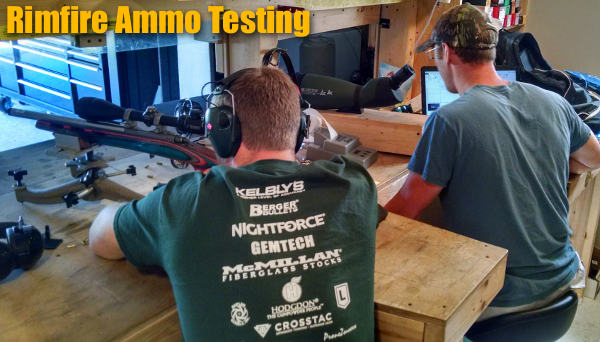
Photo shows Bryan Litz (on right) and tester Mitchell Fitzpatrick. Bryan said: “Only 2,445 rounds to go! We’re testing over 50 ammo types in five different twist barrels… science can be exhausting!”
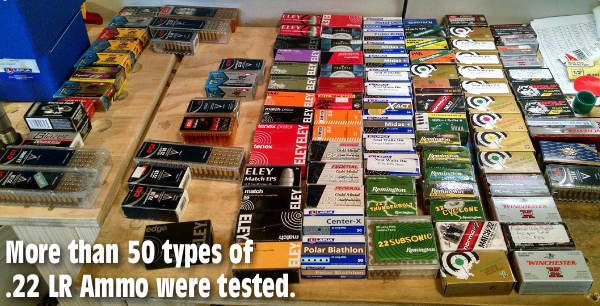
Do you know the actual BC (Ballistic Coefficient) of your rimfire ammunition? Well Applied Ballisitics will soon have answers for you. Bryan Litz and his team of testers have been working on a Herculean project. They’ve been testing over fifty types of .22 LR ammo, using five different twist-rate barrels.
Here’s an important technology for ranges concerned with over-flight risks. Regular Bulletin readers will recall that we recently warned of the dangers of bullets launched with a high trajectory. (READ Article.) With a muzzle elevation of just 5°, a conventional bullet can fly over 3000 yards, retaining enough energy to kill. General Dynamics has come up with a solution for live-fire training programs that don’t require long-range target engagements. General Dynamics’ Short Stop® ammunition launches bullets that literally drop out of the air within 600 meters. What’s the secret to the short flight? Read on…
Short Stop 5.56x45mm and 7.62x51mm Ammunition Trajectory
This illustration shows the trajectories of 5.56 and 7.62 Short Stop bullets (yellow zone) compared to conventional rifle projectiles (black lines). You can see the “flight cycle” is completely different.
Short Stop ammunition employs advanced polymer/copper composite bullets with molded “fins”. The bullets sort of look like the end of a Phillips screwdriver (except the fins have a slight twist near their base). This “twisted fin” design causes the bullets to yaw, and that, in turn induces aerodynamic drag — a lot of drag. The molded bullets are also much lighter than conventional bullets (of the same caliber). The reduced weight/density gives them less momentum, so they lose velocity more readily than normal bullets. The combination of the low mass and high drag makes these bullets drop from the air within 600m or so, living up to their “Short Stop” designation.
In an interview with NRABlog.com, General Dynamics Bus. Dev. Manager Ruben Regalado explained how the Short Stop ammunition works. With this design, he says, “You can do a lot of the training you would do with a ball round with no fear of overflight. It’s the fin that does it. Due to the nature of its composition [the bullet] is lighter than the standard projectile, but the magic is in the fin.”
There are many potential applications for Short Stop rounds according to NRABlog Editor Lars Dalseide: “Where do these rounds come into play? Anywhere. Anywhere there’s military training, law enforcement training, or basic target shooting taking place. And with the encroachment of communities surrounding your favorite neighborhood range, [projectiles] that drop out of the air at 600 meters means the risk of overflight is significantly reduced.” The polymer-composite bullets are also frangible, so there is less penetration of objects and less chance of ricochet.
“Smurf” Bullets for .50 Caliber AA Rifles
Bryan Litz of Applied Ballistics has seen ammo similar to Short Stops used in .50-caliber rifles for training purposes. Bryan tells us: “Similar rounds have been available for .50 cal for many years. We find [the spent bullets] on the range at Camp Grayling (a Michigan National Guard training facility where we hold 1000-yard matches). The .50 cal rounds use blunt plastic things (we call them ‘Smurf’ bullets) and they use them for practicing anti-aircraft shooting. Instructors put up an RC target drone and the Guardsmen shoot at it with the .50s using the short range ammunition.”
Bryan says these “short flight” bullets have an important purpose, though the applications remain limited. “These kind of projectiles are a good tool for applications where an adequate SDZ (Surface Danger Zone) cannot be secured for the range location. I just hope the application remains confined to only those places where it’s necessary, i.e. where the SDZ presents a problem. I would hate to see our bullet options be limited to something like this under the guise of ‘range safety’, where the SDZ is properly secured.”
AccurateShooter.com has added something NEW to our Shooter’s Forum. We recently launched a new Ballistics & Bullets Board, with Bryan Litz as the “Guru in Residence”. Bryan and his team at Applied Ballistics will help answer your questions about bullet trajectories, wind drift, BC values, bullet sorting methods, meplat trimming/pointing, and other general ballistics matters. This is your chance to get your questions answered by Bryan, a expert ballistician, and an ace long-range shooter. In addition, our new Ballistics Forum area features free excerpts from Applied Ballistics’ respected publications, including Applied Ballistics for Long Range Shooting, and Bryan’s new book, Modern Advancements in Long Range Shooting. CLICK HERE for FREE Samples.
If you have a ballistics question, or are simply curious about subjects such as bullet pointing, trajectory prediction, ballistics programs, ballistic coefficients, etc., then visit our Shooters’ Forum and join the discussion in our new Ballistics & Bullets Board.
Get $5.00 Off Applied Ballistics Books
As a special benefit for AccurateShooter.com Forum members, Applied Ballistics is offering $5.00 off Books and DVDs. If you haven’t acquired one of Bryan’s books yet, here’s a way to get with the program and save five bucks in the process. CLICK HERE for $5.00 discount info.
Get Answers from the Man Who Literally
‘Wrote the Book’ on Ballistics…
As an aerospace engineer, Bryan worked six years for the government on air-to-air missile designs. He is now owner of Applied Ballistics and Chief Ballistician for Berger Bullets. Bryan is also a champion long range shooter, so he brings a great deal of practical knowledge and experience to the table regarding the science of accuracy.
A Place to Share Knowledge and Advance the Science of Ballistics Applied Ballistics is pleased to sponsor AccurateShooter.com’s new Ballistics & Bullets Board: “The new Ballistics Forum area provides an established place for shooters go and discuss ballistics-related issues in general. In addition to this basic objective of connecting shooters to each other, the staff of Applied Ballistics will frequent the Forum to provide expert advice on ballistics, and the use of ballistics programs. Bryan Litz will regularly visit the ballistics Forum, looking for ways to help shooters with ballistics questions. Beyond that, we’re eager to take suggestions on what kinds of tests we might consider for the AB Laboratory. We’re here to advance the science of ballistics, and we’d like to do that in ways that benefit the greatest amount of people. The ballistics forum gives us a place to explore these questions. We can answer the questions that we know, and formulate tests to explore those questions we don’t understand as well, then share the results online for everyone to see.”
How to Find the Ballistics & Bullets Board
To join in the discussions, visit our Shooters’ Forum. Scroll down until you see “Ballistics & Bullets Board, Presented by Bryan Litz and Applied Ballistics”. Just click on the orange title and you’re “in like Flynt”.
Guests can read all the topics. However, if you want to post or start a thread you’ll need to REGISTER with our Forum. There’s no charge (membership is FREE), and registration only takes a few minutes.
Applied Ballistics has just announced Ballistic Performance of Rifle Bullets. This new book is chock full of “mission critical” data on hundreds of popular projectiles. This latest reference book from Bryan Litz contains live fire test data on 400 modern rifle bullets. The data pages contained in this book are similar to the 225 bullet data pages found in Applied Ballistics for Long Range Shooting. The Ballistic Coefficient data is based on live fire testing methods which are repeatable within +/- 1%. If you’re looking for “rock-solid” info on the ballistic performance of today’s most popular rifle projectiles, this work is the definitive print resource. Scroll down to see a sample page from the new book.
Visit the Applied Ballistics Online Store to pre-order your copy and save $5. Note: Pre-orders are expected to ship and arrive at USA destinations in time for Christmas. Retail price is $54.95, with a $5.00 pre-order discount.
More about the Book
“Modern rifles have reached an unprecedented level of accuracy. In many cases, the weak link in the chain of hitting targets is the trajectory modeling, which is based on bullet performance,” stated author Bryan Litz. Unfortunately, shooters can’t always rely on advertised Ballistic Coefficients (BCs) being accurate. Slight errors in BC modeling can be the cause of missing your target. Furthermore, a meaningful apples-to-apples comparison of bullet performance is not possible when the BCs are determined differently by various brands.
This book provides highly accurate ballistic performance data for 400 modern long range bullets from .224 to .408 caliber. By employing a common testing method for bullets of all brands, shooters are provided with consistent and accurate performance data which can be used to compare and select bullets, as well as to calculate accurate trajectories which put your shots on target at long range. It is claimed that the BC data is accurate (and repeatable) to +/- 1% for all bullets tested.
Detailed stability data is also included which can be used to determine suitable twist rates for bullets in various environments.
View Sample Page from Ballistic Performance of Rifle Bullets:
NOTE: This is a reference book which contains mostly data pages. There is a single chapter in the beginning which talks about how to use the data. For a more thorough understanding of the science of external ballistics, readers are referred to: Applied Ballistics for Long Range Shooting (2d Edition).
In discussions of ballistics, you’ll see references to “tangent” and “secant” bullet shapes. We know that, for many readers, these terms can be confusing. To add to the confusion, bullet makers don’t always identify their projectiles as secant or tangent designs. This article provides a basic explanation of tangent and secant designs, to help you understand the characteristics of both bullet shapes.
Tangent vs. Secant vs. Hybrid
Most match bullets produced today use a tangent ogive profile, but the modern VLD-style bullets employ a secant profile. To further complicate matters, the latest generation of “Hybrid” projectiles from Berger Bullets feature a blended secant + tangent profile to combine the best qualities of both nose shapes. The secant section provides reduced drag, while the tangent section makes the bullet easier to tune, i.e. less sensitive to bullet seating depth position.
Berger Bullets ballistician Bryan Litz explains tangent and secant bullet ogive designs in a glossary section of his Applied Ballistics website, which we reprint below. Bryan then explains how tangent and secant profiles can be combined in a “hybrid” design.
How Bullet Ogive Curves are Defined
While the term “ogive” is often used to describe the particular point on the bullet where the curve reaches full bullet diameter, in fact the “ogive” properly refers to the entire curve of the bullet from the tip to the full-diameter straight section — the shank. Understanding then, that the ogive is a curve, how is that curve described?
LITZ: The ogive of a bullet is usually characterized by the length of its radius. This radius is often given in calibers instead of inches. For example, an 8 ogive 6mm bullet has an ogive that is a segment of a circular arc with a radius of 8*.243 = 1.952”. A .30-caliber bullet with an 8 ogive will be proportionally the same as the 8 ogive 6mm bullet, but the actual radius will be 2.464” for the .30 caliber bullet.
For a given nose length, if an ogive is perfectly tangent, it will have a very specific radius. Any radius longer than that will cause the ogive to be secant. Secant ogives can range from very mild (short radius) to very aggressive (long radius). The drag of a secant ogive is minimized when its radius is twice as long as a tangent ogive radius. In other words, if a tangent ogive has an 8 caliber radius, then the longest practical secant ogive radius is 16 calibers long for a given nose length.”
Ogive Metrics and Rt/R Ratio
LITZ: There is a number that’s used to quantify how secant an ogive is. The metric is known as the Rt/R ratio and it’s the ratio of the tangent ogive radius to the actual ogive radius for a given bullet. In the above example, the 16 caliber ogive would have an Rt/R ratio of 0.5. The number 0.5 is therefore the lowest practical value for the Rt/R ratio, and represents the minimum drag ogive for a given length. An ogive that’s perfectly tangent will have an Rt/R ratio of 1.0. Most ogives are in between an Rt/R of 1.0 and 0.5. The dimensioned drawings at the end of my Applied Ballistics book provide the bullets ogive radius in calibers, as well as the Rt/R ratio. In short, the Rt/R ratio is simply a measure of how secant an ogive is. 1.0 is not secant at all, 0.5 is as secant as it gets.
Hybrid Bullet Design — Best of Both Worlds?
Bryan Litz has developed a number of modern “Hybrid” design bullets for Berger. The objective of Bryan’s design work has been to achieve a very low drag design that is also “not finicky”. Normal (non-hybrid) secant designs, such as the Berger 105gr VLD, deliver very impressive BC values, but the bullets can be sensitive to seating depth. Montana’s Tom Mousel has set world records with the Berger 105gr VLD in his 6mm Dasher, but he tells us “seating depth is critical to the best accuracy”. Tom says a mere .003″ seating depth change “makes a difference”. In an effort to produce more forgiving high-BC bullets, Bryan Litz developed the hybrid tangent/secant bullet shape.
Bryan Litz Explains Hybrid Design and Optimal Hybrid Seating Depths
Berger Bullets is now in the ammo business, offering high-quality, loaded ammunition for competition, hunting, and tactical applications. Berger will sell ammo through its new company, Applied Ballistics Munitions (aka “ABM” or “ABM Ammo”). See ABM’s ammunition offerings at www.abmammo.com.
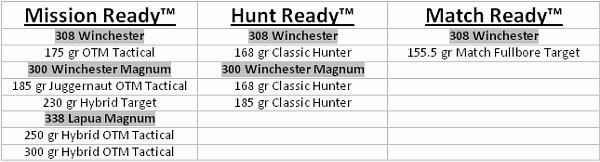
ABM Ammo will offer precision rifle ammunition for three popular cartridge types: .308 Winchester, .300 Winchester Magnum, and .338 Lapua Magnum. There are three product lines. The “Mission Ready” line is designed for military and tactical use. In addition, ABM will offer “Hunt Ready” ammo for precision hunters and “Match Ready” ammunition for target shooters.
Each product line is loaded with the Berger bullet that best fits a given application. Each of the bullets used have been proven performers among the hand loading community for years and in some cases, decades. The chart below shows the current bullet selections for each of the three product lines:
ABM Ammo Components are Tested Lot by Lot
ABM uses high quality components and tooling to produce the most consistent ammunition possible. In a process developed by ballistics expert Bryan Litz, ABM ammo has been engineered and tested in the Applied Ballistics laboratory. ABM actually tests each individual lot of components used in the loaded cartridges to ensure quality and consistency.
Eric Stecker, President of Applied Ballistics Munitions relays, “Launching an ammunition company in today’s firearm market environment has been a challenging experience. The product will speak for itself among the shooters as to why it is so important that we pursue this effort.” To learn more about Applied Ballistics Munitions, visit www.abmammo.com.
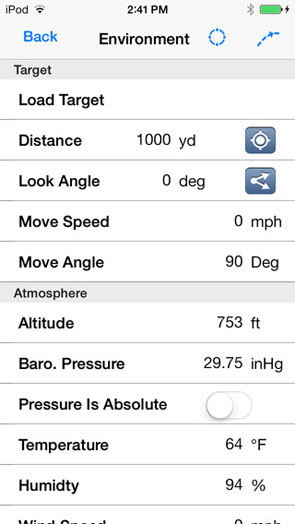
iPhone and iPad users rejoice. The Apple iOS version of the Applied Ballistics Mobile App is now available. It has all the features of the much-loved Applied Ballistics Android App with full Apple functionality. This mobile App will run on iPhones, iPods, and iPads.
The new iOS mobile App accounts for all major and minor trajectory variables that a shooter could encounter. Conveniently, the App displays single-shot solutions in HUD View or Reticle View.
Real-World Calibration — Shooters can enter their observed drops and the program will calibrate and “true” the predictions based on actual bullet impact. This is done by incorporating muzzle velocity and drop-scaling over various segments of the trajectory.
Sync to Web — A web-sync feature allows you to store your rifle and ammunition libraries online. And you can backup all the profiles online or restore them to a device.
Forum member Snuggie308, who acquired the new iOS App, gives it a thumbs up: “I bought it last night. It is a great tool. There’s a massive data base … built into it. You can’t find a better [mobile ballistics app] in my opinion.” Snuggie308 also reports that the new iOS is iPad friendly, and fills the iPad screen so it is easy to use all the features.
The Applied Ballistics iOS Mobile App runs the state-of-the-art Point Mass ballistic solver. This solver, along with the built-in library of ballistic coefficients, makes this the most accurate, precise, and complete mobile ballistics app available for iOS devices.
Ballistician (and former missile design engineer) Bryan Litz wrote this solver. The program integrates the equations of ballistic motion numerically, using a 4th-order Runge-Kutta method, the preferred method of solving dynamic equations for aircraft and missiles. The application also comes with G1 and G7 BCs for over 1,300 bullet types.
Bryan Litz tells us: “We have worked extensively on this product. With the success of the Android version of the application, released two years ago, the demand for the iOS version has been high. We are excited to now offer a full-featured iOS version that runs on iPhones, iPods, and iPads.”
Available now through iTunes, the Applied Ballistics Mobile App costs $29.99, and requires iOS 7.0 or later for proper functionality. Compatible with iPhone, iPad, and iPod touch devices, this App is optimized for the iPhone 5 series of smart phones.
Ballistics books have gone digital. Bryan Litz’s Applied Ballistics For Long-Range Shooting (2nd Edition), the leading treatise on the subject, is now available in digital eBook format. This new eBook version contains all the text of the print version, all the charts, all the diagrams, and all the photos. You get all this in an easy-to-read, easy-to-search format that can be viewed on a variety of devices*. You can access the book on your home computer, on your laptop, on a tablet, on a smartphone, or on a lightweight, portable Kindle e-Reader. And yes, iPad users can use the Kindle app to read the book on an iPad.
NOTE: After clicking this link to go to Amazon.com, click on the blue book image labeled “Look Inside”. This will launch a preview window. Alternatively, Kindle users can click the “Send Sample Now” button.
Advantages of the eBook Edition
The eBook release of Bryan Litz’s most popular and comprehensive ballistics book is a big deal, in our opinion. There are many advantages to the digital format. First you can quickly search for any term or reference, or click from table of content entries to desired chapters. Second, you can highlight text and bookmark pages for future review. Third, you can easily change the font size to enhance reading for older eyes. Fourth, you can zoom in the charts, diagrams, and photos for a better view. Last but not least, you can easily carry the entire text in the field on the same digital device that holds your ballistics solver software.
Highlights of eBook Edition
The eBook version of Applied Ballistics for Long-Range Shooting (2d Ed.) is available now on Amazon.com. Since its release in 2011, the second edition (hardcopy) of Applied Ballistics for Long Range Shooting has sold over 10,000 copies. It’s the modern ‘go to’ book on the subject of ballistics for long range shooters. The Second Edition of the book includes two additional chapters covering extended long-range shooting and monolithic bullets.
200 Bullet Types Tested. In this eBook edition, Bryan Litz includes data from his own personal field tests with over 200 bullet types. Performance data (G1 and G7 BCs confirmed by live-fire testing) is presented along with 2-D drawings for hundreds of long range bullets.
Ballistic Program Included. eBook buyers can receive the Point Mass Ballistics Solver 2.0 for no extra charge. The software comes on a CD with the hardcopy. With the eBook, there are two ways to access the ballistics program. First, you can access the free AB online ballistics solver through embedded links in the eBook and run directly from your eReader. Alternatively, you can request the PM Solver program to be emailed to you for running on a PC.
“Our mission at Applied Ballistics is to be the complete and unbiased source of external ballistics information for long range shooters,” stated Bryan Litz, author and owner of Applied Ballistics, LLC. “We’re constantly testing new claims, products and ideas and dispensing the marketing hype which can make it difficult for shooters to master the challenging discipline of long range shooting. We developed the original hard copy of the book in order to provide shooters of all capabilities with this knowledge. The release of the eBook will not only provide readers with the same knowledge, but do so in a more accessible and mobile way.”
Sample Page from eBook
* Installation of FREE eReader software may be required for viewing on desktop computers, laptops, tablets, and smartphones. This only takes a minute or so.
Two months ago, the Daily Bulletin featured Six Shooting Tips by Bryan Litz. That article was hugely popular with our Bulletin readers and Facebook fans. In that article, as his Competition Tip Number Three, Bryan told readers to “Actively avoid major train wrecks”. In other words, you must avoid the big disasters (such as equipment failures) that can ruin a whole match. In this follow-up article, Bryan illustrates the types of “train wrecks” that commonly befall competitors, and he explains how to avoid these “unmitigated disasters”.
Urban Dictionary “Train Wreck” Definition: “A total @#$&! disaster … the kind that makes you want to shake your head.”
Success in long range competition depends on many things. Those who aspire to be competitive are usually detail-oriented, and focused on all the small things that might give them an edge. Unfortunately it’s common for shooters lose sight of the big picture — missing the forest for the trees, so to speak.
Consistency is one of the universal principles of successful shooting. The tournament champion is the shooter with the highest average performance over several days, often times not winning a single match. While you can win tournaments without an isolated stellar performance, you cannot win tournaments if you have a single train wreck performance. And this is why it’s important for the detail-oriented shooter to keep an eye out for potential “big picture” problems that can derail the train of success!
Train wrecks can be defined differently by shooters of various skill levels and categories. Anything from problems causing a miss, to problems causing a 3/4-MOA shift in wind zero can manifest as a train wreck, depending on the kind of shooting you’re doing.
Below is a list of common Shooting Match Train Wrecks, and suggestions for avoiding them.
1. Cross-Firing. The fastest and most common way to destroy your score (and any hopes of winning a tournament) is to cross-fire. The cure is obviously basic awareness of your target number on each shot, but you can stack the odds in your favor if you’re smart. For sling shooters, establish your Natural Point of Aim (NPA) and monitor that it doesn’t shift during your course of fire. If you’re doing this right, you’ll always come back on your target naturally, without deliberately checking each time. You should be doing this anyway, but avoiding cross-fires is another incentive for monitoring this important fundamental. In F-Class shooting, pay attention to how the rifle recoils, and where the crosshairs settle. If the crosshairs always settle to the right, either make an adjustment to your bipod, hold, or simply make sure to move back each shot. Also consider your scope. Running super high magnification can leave the number board out of the scope’s field view. That can really increase the risk of cross-firing.
2. Equipment Failure. There are a wide variety of equipment failures you may encounter at a match, from loose sight fasteners, to broken bipods, to high-round-count barrels that that suddenly “go south” (just to mention a few possibilities). Mechanical components can and do fail. The best policy is to put some thought into what the critical failure points are, monitor wear of these parts, and have spares ready. This is where an ounce of prevention can prevent a ton of train wreck. On this note, if you like running hot loads, consider whether that extra 20 fps is worth blowing up a bullet (10 points), sticking a bolt (DNF), or worse yet, causing injury to yourself or someone nearby.
3. Scoring/Pit Malfunction. Although not related to your shooting technique, doing things to insure you get at least fair treatment from your scorer and pit puller is a good idea. Try to meet the others on your target so they can associate a face with the shooter for whom they’re pulling. If you learn your scorer is a Democrat, it’s probably best not to tell Obama jokes before you go for record. If your pit puller is elderly, it may be unwise to shoot very rapidly and risk a shot being missed (by the pit worker), or having to call for a mark. Slowing down a second or two between shots might prevent a 5-minute delay and possibly an undeserved miss.
4. Wind Issues. Tricky winds derail many trains. A lot can be written about wind strategies, but here’s a simple tip about how to take the edge off a worse case scenario. You don’t have to start blazing away on the command of “Commence fire”. If the wind is blowing like a bastard when your time starts, just wait! You’re allotted 30 minutes to fire your string in long range slow fire. With average pit service, it might take you 10 minutes if you hustle, less in F-Class. Point being, you have about three times longer than you need. So let everyone else shoot through the storm and look for a window (or windows) of time which are not so adverse. Of course this is a risk, conditions might get worse if you wait. This is where judgment comes in. Just know you have options for managing time and keep an eye on the clock. Saving rounds in a slow fire match is a costly and embarrassing train wreck.
5. Mind Your Physical Health. While traveling for shooting matches, most shooters break their normal patterns of diet, sleep, alcohol consumption, etc. These disruptions to the norm can have detrimental effects on your body and your ability to shoot and even think clearly. If you’re used to an indoor job and eating salads in air-conditioned break rooms and you travel to a week-long rifle match which keeps you on your feet all day in 90-degree heat and high humidity, while eating greasy restaurant food, drinking beer and getting little sleep, then you might as well plan on daily train wrecks. If the match is four hours away, rather than leaving at 3:00 am and drinking five cups of coffee on the morning drive, arrive the night before and get a good night’s sleep.”
Keep focused on the important stuff. You never want to lose sight of the big picture. Keep the important, common sense things in mind as well as the minutia of meplat trimming, weighing powder to the kernel, and cleaning your barrel ’til it’s squeaky clean. Remember, all the little enhancements can’t make up for one big train wreck!



 This illustration shows the trajectories of 5.56 and 7.62 Short Stop bullets (yellow zone) compared to conventional rifle projectiles (black lines). You can see the “flight cycle” is completely different.
 “Smurf” Bullets for .50 Caliber AA Rifles


 In discussions of ballistics, you’ll see references to “tangent” and “secant” bullet shapes. We know that, for many readers, these terms can be confusing. To add to the confusion, bullet makers don’t always identify their projectiles as secant or tangent designs. This article provides a basic explanation of tangent and secant designs, to help you understand the characteristics of both bullet shapes.
 Hybrid Bullet Design — Best of Both Worlds?
 ABM Ammo will offer precision rifle ammunition for three popular cartridge types: .308 Winchester, .300 Winchester Magnum, and .338 Lapua Magnum. There are three product lines. The “Mission Ready” line is designed for military and tactical use. In addition, ABM will offer “Hunt Ready” ammo for precision hunters and “Match Ready” ammunition for target shooters.





 Train Wrecks (and How to Avoid Them)
 4. Wind Issues. Tricky winds derail many trains. A lot can be written about wind strategies, but here’s a simple tip about how to take the edge off a worse case scenario. You don’t have to start blazing away on the command of “Commence fire”. If the wind is blowing like a bastard when your time starts, just wait! You’re allotted 30 minutes to fire your string in long range slow fire. With average pit service, it might take you 10 minutes if you hustle, less in F-Class. Point being, you have about three times longer than you need. So let everyone else shoot through the storm and look for a window (or windows) of time which are not so adverse. Of course this is a risk, conditions might get worse if you wait. This is where judgment comes in. Just know you have options for managing time and keep an eye on the clock. Saving rounds in a slow fire match is a costly and embarrassing train wreck.


