One of the most radical black rifles ever created wowed the crowd at the SHOT Show Range Day back in 2019. At the Boulder Rifle & Pistol Club outside Las Vegas, Battle Arms Development showcased a true “UltraLight AR”. With Titanium and carbon fiber components, the Battle Arms OIP Gen 2 AR-platform rifle weighs just 3.8 pounds unloaded. Compare that to 7.5 pounds (or more) for a typical AR-15.
Battle Arms 3.8-Lb Titanium/Carbon OIP 2 — World’s Lightest AR
At the Boulder City Range GunsAmerica Digest Managing Editor True Pearce talked with one of the Battle Arms gun designers who helped created this unique rifle, claimed to be the world’s lightest AR (yes it is lighter than ARs with polymer lowers). READ GunsAmerica Battle Arms OIP 2 Review HERE.
In the video below, True Pearce shows the key features of the $3290.00 Battle Arms OIP 2. Then he tests its function shooting offhand at steel targets. Despite its low mass, and exotic components, the Battle Arms OIP 2 AR carbine performed flawlessly.
The video above features the Battle Arms OIP GEN 2 AR that weighs just 3.8 pounds. To save weight, this carbine features a carbon fiber handguard and various titanium parts including a Titanium muzzle brake. Look carefully at how even small controls have been modified to save ounces.
GunsAmerica reported: “Battle Arms has done a lot of work to find all the ounces that can be spared to make this gun as light as possible.” Even at just 3.8 pounds, the gun is very controllable during rapid fire. Despite a steep $3290.00 MSRP, the first run of Battle Arms’ sub-4-lb GEN 2 OIP sold out. That proves that “light is right”, as least in the AR carbine market.
Pew-Pew Tactical Review of Battle Arms OIP 2
The team at Pew-Pew Tactical also field-tested the Battle Arms OIP Gen 2 rifle. The reviewers were impressed, finding that felt recoil was very manageable, even given the rifle’s very low 3.8-lb weight:
Pew-Pew Tactical Battle Arms OIP Gen 2 Review
The Concept Behind the OIP — Why Go Ultra-Light
Recoil Magazine featured an earlier model OIP rifle back in 2016 (Issue 21). This design was later refined into the current OIP Gen 2 version. Recoil’s writers explained the concept behind this unique design:
Battle Arms OIP Rifle — How Low Can You Go…
“The OIP had its genesis as a simple idea to build a lightweight gun that just plain worked. Dave Lake and Matt Babb of Bentwood Gunsmithing spent years perfecting the concept, incorporating the latest components where they existed and working with companies to customize parts that didn’t. They wanted a well-balanced gun with an optimized operating system and literally no excess — to be as light as humanly possible.
Bentwood didn’t want to utilize polymer receivers and worked with Battle Arms Development to develop a super lightweight receiver set with intricate machining to shave as much weight as they could. They investigated some more exotic material choices, but found them to be prohibitively expensive.”
— Source: RecoilWeb.com
Battle Arms OIP 2 Owner’s Review on TFB
Last year, The Firearm Blog (TFB) published an extensive review of the Battle Arms OIP 2. TFB writer/tester Rusty S. had purchased this OIP 2 rig with his own funds — making a serious $3290.00 investment.
After using the rifle in the field, Rusty concluded: “Objectively, the Battle Arms Development OIP 2 is a very well put together, reasonably accurate and very lightweight rifle. It has proven to be reliable, durable, and soft shooting despite its lightweight configuration. Subjectively, the OIP 2 has proven to be the rifle I most often bring with me into the backcountry with the exception of during deer and elk hunting season. It’s nice to have a 500-yard-capable rifle with me that weighs so little. All that being said, the amount that the OIP2 will lighten one’s wallet by will be a real sticking point for most prospective buyers.” Rusty added: “At this price point, I would appreciate some sort of ultra lightweight flip-up iron sights. I also don’t think the rear of the buttstock is as ergonomically optimal as it could be.”
Product Description from Battle Arms
[The Battle Arms OIP 2 is] the lightest, purpose-built, no compromise, production ultralight survival carbine[.] It took years in R&D, engineering and multiple U.S. Patents to create the most robust and reliable lightweight AR platform on the market. Building something that is not only lightweight but all the while not sacrificing strength and performance is the ultimate secret of the Battlearms OIP.
Every component, shy of a few detents and springs, are custom built and designed to work together as a complete system. No, you will not find a parts gun here….The OIP utilizes a patented OIP buffer system in conjunction with a lightweight titanium bolt carrier with ArmorTi finish for durability. It is balanced with a custom mid-length gas system and a specially designed titanium THUMPER compensator.
New in Gen 2 is the user-configurable M-LOK carbon fiber handguard and a carbon-fiber pistol grip that weighs barely one ounce. A new titanium billet CNC-machined bolt catch and a lightweight single-side Clutch charging handle are just a couple more of the new upgrades to the OIP. The rifle was designed to be an optics-ready carbine, providing a single stretch of Picatinny rail in the optimal spot for a red dot sight while eliminating the unnecessary weight of the rail elsewhere. The patented, lightweight 7075-T6 billet aluminum receivers are not simply skeletonized and hollowed out but is carefully engineered with structural consideration. The technology and engineering that foes into the OIP® Ultralight Rifle bring forth the next evolution of the AR platform.
Want to learn more? Check out this review of the Battle Arms OIP 2 Carbine on DefenseReview.com.
Three Shots Standing at 400 Yards in 4.37 Seconds Could you hit a silhouette target at 400 yards, shooting offhand? Probably, with a little practice. Now try doing that three times in just 4.37 seconds, including picking up/mounting the rifle! Not possible? Watch the legendary Jerry Miculek do that in this impressive demonstration of rapid-fire rifle shooting.
Jerry Miculek — that name is synonymous with revolvers. But Jerry is also one heck of a rifleman, as he demonstrates in this video. Grabbing his AR rifle from the top of an oil drum, Miculek proceeds to put shots on three different steel targets at 400 yards — all in under 4.4 seconds. Most of us would be lucky to make one successful shot in that time limit. Watch the successful 3-shot sequence starting at 2:19 time-mark in the video.
In this video, Jerry hits not one but THREE c-zone targets at 400 yards. And he does this in under 4.4 seconds starting with his rifle laying on a support. It took Jerry two tries (on his first run he hit 2 out of 3 in 4.65 seconds). On the second attempt (see video starting at 2:19), it takes Jerry just 4.37 seconds to shoulder his rifle, aim, and fire three shots, each hitting a separate steel target. Wow. That’s truly remarkable. Most of us would need ten seconds (or more) just to get the scope on the first target.
Trust us folks, this ain’t easy. It takes remarkable marksmanship skills to shoot with this kind of precision at this kind of pace. As Jerry would say himself, “Not bad for an old guy who needs glasses”.
A while back, our friend Dennis Santiago was conducting training for a Southern California Police Department. During a training session one of the unit’s AR15s stopped functioning. The problem — the bolt in the AR rifle broke in half. Dennis states: “They ran the gun dry, broke for lunch, shot it again. They don’t like that. I personally like to flood the bolt wet with lube on training days. It prevents stuff like this. Given that, it’s a simple remove-and-replace fix.”
Here are some of the more interesting comments about this parts failure — an AR bolt that literally sheared in half:
“If I was a betting man [the steel] wasn’t made by Carpenter Steel. They are one of the few companies that use the correct [milspec-steel, C-158] called out on the drawing which they coincidentally developed. Most of the other companies that make [AR Bolts] use different steel with the same heat treat specification as what is called out which gives them the potential of being a little on the brittle side at the upper end of the tolerance. When it comes to the AR platform, bolts are probably the only part of the entire gun where I must admit to being a little bit of a brand snob.” David O’N.
[Editor’s Note: Actually Carpenter Steel does not make AR bolts. They are a steel supplier, and yes Carpenter did develop the original C-158 steel for AR bolts. Here is a contrary view, claiming that AISI 9310 Steel is actually stronger than milspec Carpenter C-158: 9310 Steel for AR Bolts.]
“Dry bolt and carrier shouldn’t cause that. Looks like a big pressure spike. What kind of ammo…?” Guy G.
Reply from Dennis: “55gr factory ammo. Piles of it.”
“Is that the new two-piece bolt everyone’s been talking about LOL?” — Darren R.
“Let me guess…the PD called you in cause they didn’t know why it stopped going ‘pew pew’?” — Jim O.
Reply from Dennis: “I was there today for qualifications. It broke during the rifle phase. Simple enough to fish the bolt parts out of the action. The training didn’t miss a beat. I have an armory full of the things.”
AR-platform rifles are fun and versatile, but the standard, mil-spec triggers leave much to be desired. They tend to be gritty, with creep and heavy pull weight. One of the easiest, most effective AR upgrades is a trigger group swap. An improved fire control group makes a huge difference. There are many aftermarket trigger options for the AR platform rifles. Choose single-stage or two-stage, either standard trigger assembly or unitized “drop-in” trigger, such as those made by Timney or Triggertech.
When upgraded with a precision trigger and match barrel, AR-platform rigs work great in NRA High Power competitions (Photo from NRA Blog, at Camp Perry).
Two-Stage vs. Single-Stage Triggers
Two-stage triggers have two separate movements. The first stage offers a light, spring-loaded pressure that works against the shooter’s pull until stopping at the second stage – this is called “take-up”. If there is no spring pressure, it is known as “slack”. Should the shooter continue to pull the trigger once he’s arrived at the second stage, the mechanism will operate like a single-stage trigger from there until engaging the sear and firing the gun. Some shooters prefer a two-stage trigger because it allows a mental preparation (first stage) before the final decision to “break the shot”.
Single-stage triggers feature no take-up or slack, as they begin engaging the sear as soon as the shooter begins pulling the trigger. Some competitive shooters prefer the two-stage trigger because of the feedback it provides during its first stage, while other shooters, including those using their rifle in tactical scenarios, may want the surety of a single-stage trigger, ready to engage and fire once their finger is inside the trigger guard. Regardless of preference, a good trigger will feature minimal creep and should be free of grittiness, providing a smooth, even break.
Drop-In Trigger Assembly vs. Standard Trigger Group
Once you decide between a single-stage or two-stage trigger, you can choose between standard and drop-in trigger groups. Standard trigger groups feature all the fire control group parts separated, and need to be pieced together and installed much like a mil-spec trigger, while drop-in trigger are pre-assembled and contained within a casing that simply drops in to the receiver and accepts the pins, hence the name.
After-Market Trigger Comparison
Some shooters prefer drop-in triggers due to the ease of installation, while others opt for standard groups so they can access the components individually for cleaning adjustment or replacement. If one piece of a drop-in trigger fails, you’ll need to either replace the entire unit or send it to the manufacturer for repair, whereas you may be able to simply replace the broken component of a standard trigger without needing a whole new trigger set.
Trigger Terminology — “Creep”, “Stacking”, “Overtravel”
“Creep” or “travel” is the distance the trigger moves between the end of take-up and when the trigger breaks to fire the fun. Too much creep can affect accuracy, but no creep can be unsafe, as the shooter may not be prepared to fire. “Stacking” occurs when the trigger weight actually increases during travel — this shouldn’t happen. Lastly, “overtravel” is the distance the trigger continues moving back after the gun fires.
This article is based on a longer story in the NRA Blog.
Retro is back — at least in the CMP’s Standard Modern Military Rifle AR class. Though Service Rifle competition has evolved to allow optics and heavy barrel profiles, the Standard Modern Military Rifle (AR category) is truly a “blast from the past”. Overall weight is limited to 7.5 pounds, and the rifle must be equipped with iron sights (Rule 5.2.3). In addition, the rifle “be based on the M-16 rifle or be based on an AR design” with “exterior configuration similar [to] the original military or military-type rifle”. See Rules.
With this in mind our friend Dennis Santiago recently put together his own AR-platform Standard Modern Military Rifle for matches run under CMP Competition Rules. This is not quite a classic AR, as it has a metal free-float handguard (vs. plastic handguards), but it IS light (7.3 pounds), and it does have iron sights — a key requirement for Standard Modern Military class rifles.
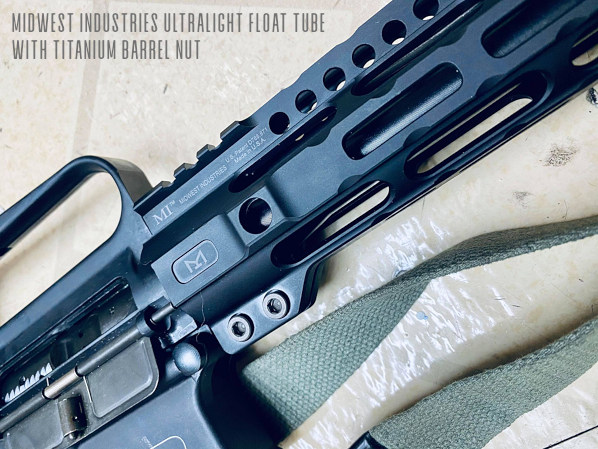
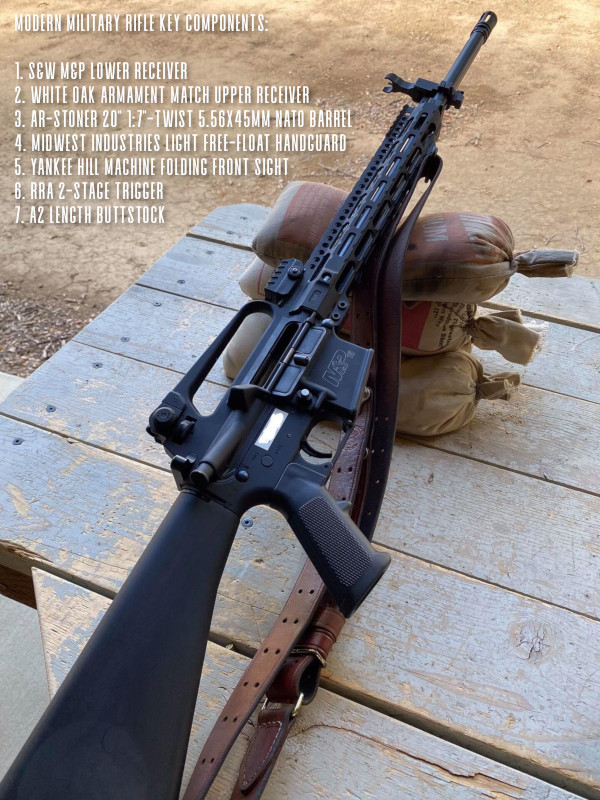
Here is Santiago’s CMP Modern Military Rifle (Standard Class) with an ultralight free float tube that has a titanium barrel nut, and mechanical, center-able front sight. The barrel is an AR-Stoner brand 20″-long 1:7″ Government contour chambered in 5.56×45 NATO. Dennis says: “This makes the 7.5-lb weight limit with a few ounces to spare. We’ll see how well it drives soon enough.”
Dennis explains: “The Standard Modern Military (AR) is a category of military-style rifle that shoots the 200-yard, 30- or 50-shot courses alongside the M1 Garands, Springfields, Vintage, and M1 Carbines. This one boasts a Midwest Industries (MI) ultralight Free-float Handguard and a Yankee Hill folding front sight. Any Government contour or thinner profile rifle-length gas tube barrel with a 0.750″ gas block will work.” Colt makes a suitable Government Contour 20″-long, 1:7″-twist barrel, sold by MidwayUSA.
To test the accuracy of his rifle, Dennis fitted a Mantis-X unit on the top of the float tube. The Mantis-X records the movement of the rifle to interpolate shot placements. Dennis reports: “I spent some extra time at the range grabbing a decent zero for my Modern Military rifle. I stuck a Mantis-X on it to record a few shots shooting offhand at the plates at 200 yards. It drives very easily even with no shooting coat or glove.” The Mantis-X is attached just forward of the carry handle, on top of the MI free-float handguard. The Mantis-X works with live fire as well as dry fire. It communicates via BlueTooth to a smartphone App.
Rifle Shoots Well with 77gr Sierra MatchKings
The gun is presently zeroed with 77gr Sierra MatchKing ammunition. Dennis reports his rifle “can easily hold the X-Ring on an SR target for both 100-yard and 200-yard CMP Modern Military Games matches. And it’s fun to shoot!”
CMP Standard Modern Military Rifle (AR Class)
This rifle is built from carefully selected and fitted parts to conform to the CMP’s 7.5-pound weight limit iron-sighted rifle rule. Officially, this is a CMP Standard Modern Military Rifle, Class “A” (AR type).
1. S&W M&P lower receiver
2. White Oak Armament match upper receiver with 1/4×1/4-MOA pinned rear sights
3. AR-Stoner 20″ 1:7″-twist 5.56x45mm NATO Government contour barrel from MidwayUSA*
4. MidWest Industries ultralight free-float handguard with a Titanium barrel nut
5. Yankee Hill Machine folding front sight with a 0.072″ square front pin
6. RRA 2-stage trigger
7. A2 length buttstock
Easy Rifle Build Using Mostly Existing AR Parts, Plus New Barrel and Free-Float Handguard
Dennis was able to put his Modern Military AR together using components he had collected over the years: “Most of these parts were already in my bin of old AR parts available to be recycled. The barrel and free-float handguard were the only new acquisitions.” And with the AR’s modular format, this was an easy build: “Assembly time was about 30 minutes. I’ve done these parts swaps so many times now.”
Key Rules for Standard Modern Military Rifle (AR Type)
Dennis Santiago’s new AR rifle was built as a “Standard U.S. Modern Military Rifle”, Class A (AR Type), as specified in the CMP Competition Rules.
5.2.3 Standard U.S. Modern Military Rifles, Class A
Category A Standard Modern Military Rifles must comply with these requirements:
a) Rifles must be based on the M-16 rifle or be based on an AR design;
b) Rifles must be manufactured by a USA manufacturer;
c) Rifles must be equipped with issue-type metallic front and rear sights; rear sights with adjustments finer than one minute of angle are permitted;
d) Total rifle weight, with sights and without sling, may not exceed 7.5 pounds;
e) Rifles may be fitted with a float tube or free-floating handguard. A nonadjustable sling swivel may be attached to the forward end of the handguard; and…
f) The rifle must be chambered for the 5.56x45mm or .223 Remington cartridge.
Also, from Rule 5.2.2:
a) The exterior configuration of the rifle must be the similar to that of the
original military or military-type rifle;
b) The trigger pull may not be less than 4.5 lbs.;
Comments from other Modern Military Rifle Shooters:
“I built a Modern Military [Standard]. It was tough getting below the 7.5-lb [limit]. I had to carve off a bunch of the 20″ barrel diameter but wanted to stay with it for sight radius (over a 16″). I would just as soon shoot that little iron-sighted rifle at 200 yards as my 15-lb Nightforce-scoped Service Rifle. I love that little rifle.” — Kenneth S.
“I’m building one of these that will make 7.5-lb [Standard Modern Military] weight limit, with the long barrel and long sight radius. This has been on my list this winter.” — Tom K.
“We found that turning down a National Match barrel and taking a few inches off of it made a very accurate rifle.” — Jack A.
“My old (complete) A2 upper has been sitting forlorn on a shelf for a couple of years now. Perhaps I need to do a [Standard Modern Military] build of my own.” — Derek D.
Dennis Santiago replied: “Derek — that’s the reason I was attracted to this. I had bought a brand new WOA A2 pin upper receiver to make a new upper then the scope rule was adopted and it was all flat tops. This gives new purpose to the old parts.”
CMP Rules Defining Modern Military Rifles
Standard vs. Unlimited, Class A vs. Class B
There are actually two different classes of Standard Modern Military Rifles, Class A for AR-type rifles and Class B for other military-style rifles, such as the M1A and FN-FAL. Ok, got that? Now, in addition, there is also a second division for UNLIMITED Modern Military Rifles, again with two classes (Class A — AR-type and Class B — other military rifles). These unlimited rifles can have optics, heavier weights, modern-design adjustable-length stocks, and other upgrades. Here is Rule 5.2.2 from the current CMP Games Rifle and Pistol Competition Rules:
Does your Black Rifle have a sloppy upper/lower fit? That can be annoying; what’s more, loose fit can limit accuracy potential. Here’s a clever solution for poor-fitting AR-15 and AR-10 upper and lower receivers. The new JP MicroFit takedown pins can improve even the sloppiest ARs, providing a rock-solid upper/lower receiver fit.
MicroFit pins come in three sizes and two types: standard (“mean”), oversized, and undersized, with types for both front and rear of the receivers. The mean pins match standard takedown pin sizes while the over- and under-sized vary by slightly more than .001″ (+/-) from the standard diameter. NOTE: Although most poor-fitting receivers are loose, some are too tight. Very tight receivers, such as post-Cerakote, can be remedied with the undersized pins.
Shown is JP Enterprises’ PSC-12™ upper assembly with LRP-07™ lower assembly.
“An AR with a loose upper/lower receiver… will not reach its accuracy potential. That was the goal with our original JP Tension Pin, but MicroFit™ pins provide the same result without tool-assisted takedown. The MicroFit pins require no modification to the receiver. They simply replace your current pins”, stated JP Enterprises founder John Paul.
JP’s MicroFit pins feature a polished black finish with a hard, durable QPQ coating. This provides smooth insertion/removal plus excellent corrosion resistance. All pins feature a two-faceted punch or bullet capturing recess. This allows the user to apply force to the pins safely without risking scratching the receiver. JP’s MicroFit pins are sold as both as individual pins and as replacement sets.
Do you own an AR-platform pistol, or are you considering purchasing one? Then you should read the Special Notice issued on 12/18/2020 by the Bureau of Alcohol, Tobacco, Firearms and Explosives (“ATF”) concerning features of these firearms. Basically, the ATF is considering reclassifying many of these guns as “short-barreled rifles” because the attached braces effectively function like a rifle buttstock. For decades short-barreled rifles have been a registered item under ATF rules requiring an application and tax stamp. The ATF is now looking at multiple factors to consider the status of AR Pistols. These factors are listed in the ATF’s recent Special Notice: Objective Factors for Classifying Weapons with “Stabilizing Braces”.
Here is text taken from the ATF’s notice in the Federal Register. Take heed — this is only a partial section of the document. You should read theFULL DOCUMENT (PDF Version).
ATF has observed that the development and production of firearms with arm braces has become more prevalent in the firearms industry and, relatedly, that requests for classifications for this kind of firearm design have also increased. Therefore, ATF is publishing this notice to aid the firearms industry and public in understanding the objective design features that FATD (Firearms and Ammunition Technology Division) considers when evaluating firearm samples submitted with a stabilizing brace or similar attachment.
The objective design features ATF considers in determining whether a weapon with an attached “stabilizing brace” has been “designed or redesigned, made or remade, and intended to be fired from the shoulder” include, but are not limited to:
Type and Caliber. The type and caliber of firearm to which the stabilizing brace or similar item is installed. A large caliber firearm that is impractical to fire with one hand because of recoil or other factors, even with an arm brace, is likely to be considered a rifle or shotgun. Weight and Length. The weight and length of the firearm used with the stabilizing brace. A firearm that is so heavy that it is impractical to fire or aim with one hand, or so long that it is difficult to balance the firearm to fire with one hand, is likely to be considered a rifle or shotgun. Length of Pull. The “length of pull” refers to the distance from the trigger to the point at which a stock meets the shoulder. This is a measurement for rifles and shotguns used to accommodate shooters of different sizes. Because an arm brace need only reach the forearm, the distance between the trigger and the back of the brace is generally expected to be shorter than the distance between the trigger and the back of a stock on a weapon designed and intended to be fired from the shoulder. This measurement is not necessarily determinative of the intent of the manufacturer but is used in making an evaluation of the firearm. If a brace is of a length that makes it impractical to attach to the shooter’s wrist or forearm, then that may demonstrate that it is not designed as brace but rather for shoulder fire. Attachment Method. The method of attachment of the stabilizing brace, to include modified stock attachments, extended receiver extensions, and the use of spacers. These items extend the distance between the trigger and the part of the weapon that contacts the shooter, whether it is a stock or stabilizing brace. Use of these items indicates that the weapon is designed and intended to be fired from the shoulder because they extend a stabilizing brace beyond a point that is useful for something other than shoulder support. Stabilizing Brace Design Features. The objective design features of the attached stabilizing brace itself are relevant to the classification of the assembled weapon, and include:
— The comparative function of the attachment when utilized as a stabilizing brace compared to its alternate use as a shouldering device;
— The design of the stabilizing brace compared to known shoulder stock designs;
— The amount of rear contact surface area of the stabilizing brace that can be used in shouldering the weapon as compared to the surface area necessary for use as a stabilizing brace;
— The material used to make the attachment that indicates whether the brace is designed and intended to be pressed against the shoulder for support, or actually used on the arm;
— Any shared or interchangeable parts with known shoulder stocks; and
— Any other feature of the brace that improves the weapon’s effectiveness from the shoulder-firing position without providing a corresponding benefit to the effectiveness of the stability and support provided by the brace’s use on the arm.
Aim Point. Appropriate aim point when utilizing the attachment as a stabilizing brace. If the aim point when using the arm brace attachment results in an upward or downward trajectory that could not accurately hit a target, this may indicate the attachment was not designed as a stabilizing brace. Secondary Grip. The presence of a secondary grip may indicate that the weapon is not a “pistol” because it is not designed to be held and fired by one hand. Sights and Scopes. Incorporation of sights or scopes that possess eye relief incompatible with one-handed firing may indicate that the weapon is not a “pistol” because they are designed to be used from a shoulder-fire position and are incompatible for the single-handed shooting that arm braces are designed and intended. Peripheral Accessories. Installation of peripheral accessories commonly found on rifles or shotguns that may indicate that the firearm is not designed and intended to be held and fired with one hand. This includes, but is not limited to, the installation of bipods/monopods that improve the accuracy of heavy weapons designed and intended to be fired from the shoulder; or the inclusion of a magazine or drum that accepts so many cartridges that it increases the overall weight of the firearm to a degree that it is impractical to fire the weapon with one hand even with the assistance of a stabilizing brace.
The ATF concludes: “These factors are based on known stabilizing braces and similar attachments. No single factor or combination of factors is necessarily dispositive, and FATD examines each weapon holistically on a case-by-case basis. …. Moreover, in addition to the objective design features of a submitted sample, FATD also considers the marketing of both the item and the firearm to which it is attached, compared to the manufacturer’s stated intent when submitting an item.”
AR-Platform Pistols — Current Options on the Market
If you are interested in learning more about AR-platform pistols with short barrels, PewPewTactical.com has published a useful article entitled: Six Best AR-15 Pistols [2020 Complete & Build List]. That article quickly covers the legal status of such firearms, at least before the recent ATF Guidance document:
So, what exactly is an AR pistol? If you want the complex legal definition of a pistol Check ATF’s Website.
“The short version is: An AR Pistol is an AR-15 that was built from the start to be a pistol — it also has a barrel less than 16 inches in length and does not have a stock. Generally, an AR-15 Pistol will have a stabilizing brace instead of a stock, but that isn’t required.”
ATF Changes May be Coming — And You Must Consider State Laws As Well
However, PewPewTActical notes that: “The ATF is reevaluating its stance on stabilizing braces. Pew Pew Tactical is monitoring the situation and will update our readers if there are any legal changes in the future.” And… the article further cautions: “Double check your state law before embarking on this kind of build, what federally qualifies as a ‘firearm’ or ‘pistol’ might be an ‘assault pistol’ in your state.” SOURCE: PewPewTactical.com
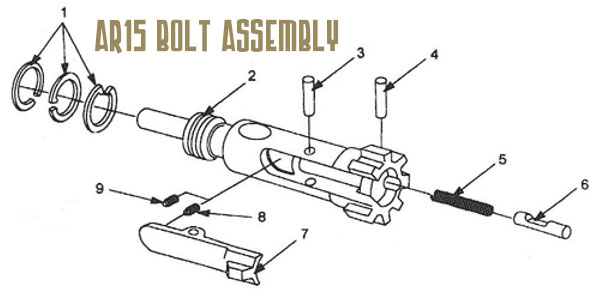
AR-platform rifles can be maintenance-intensive beasts. But some AR owners make the situation worse by not regularly cleaning important small parts, or by using too much oily/greasy lubricants in the wrong places. A properly maintained and lubricated AR15 can shoot hundreds of rounds (between cleanings) without a problem. If you learn where (and where not) to apply lubricant, you’ll find that your AR will run more reliably and the task of cleaning the bolt and bolt carrier will be less of a burden.
Here is a good video that explains AR-15 Cleaning and Maintenance. In this 30-minute NSSF video, Gunsite Academy instructor and gunsmith Cory Trapp discusses the proper way to clean and maintain the AR-15 carbine. Very knowledgeable, Trapp provides rock-solid advice for AR owners. Along with cleaning procedures, this video explains how to inspect key components and how to function-test your AR before each shooting session.
If you want to keep your black rifle running smoothly and reliably, you must clean it regularly and follow the correct maintenance procedures. Here’s another good video that explains how to properly disassemble and clean AR-platform rifles.
Take-Down and Full Cleaning of AR15 by Jerry Miculek
Here ace shooter Jerry Miculek takes down and cleans an AR-platform rifle belonging to his daughter Lena. This is a good video because Lena’s rifle was “run hard and packed up dirty” so you can see where carbon and grease build up. This 35-minute video is very thorough. Jerry is one of the nation’s top action carbine shooters, so listen carefully to his advice on cleaning and lubrication.
In these trying times, with violence in our cities, and the Democratic Presidential candidate calling for the outright banning of mag-fed, semi-auto rifles, we know that many readers are seeking to purchase defensive firearms (while a citizen still can). If you are looking for a black rifle and/or a defensive pistol, check out Palmetto State Armory (PSA). This company, one of American’s largest Black Rifle retailers, maintains a large inventory of complete ARs, AR lowers, AR uppers, and handguns — all at very competitive prices. PSA also sells triggers and optics. And yes, PSA has ammunition in stock at fair prices.
Right now PSA is running a big Labor Day Sale. The sale has started, so you can enjoy significant savings for the next few days.
Black Rifles and Rifle Components on Sale
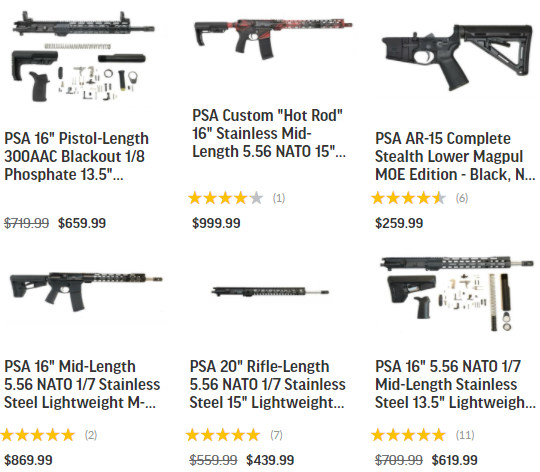
Whether you want a complete AR-platform rifle, a complete upper, or components for uppers and lowers, PSA has what you need. PSA also carries aftermarket triggers, sights, magazines, and other Black Rifle accessories. Here are some of the complete rifles, uppers, and lowers currently on sale at PSA. CLICK HERE for AR-Platform rifles, components, and accessories
Handguns on SALE at PSA
With the record-breaking volume of gun sales in recent months, many smaller gunshops have very limited inventory of handguns, particulary compact pistols suitable for CCW. However, PSA has a large supply of pistols, including popular carry guns from S&W, Ruger, Springfield Armory and other leading brands. Here’s a small sample of handguns in stock today at PSA.
PSA Ammunition on SALE
This is a small sample of the ammunition available now. This is in-stock now, ready to ship. Go to PSA’s Ammo Page to find other cartridge types on sale, including .40 SW, .357 Magnum, .308 Win, and .22 LR.
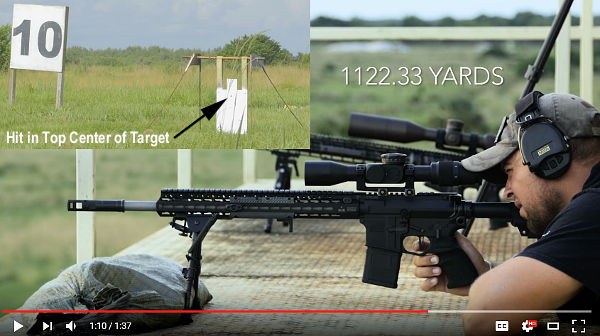
Many of our readers have never had a chance to shoot much past 600 yards. How far away does a 1000-yard+ target really seem to the naked eye? Well this short video answers that question. Gorilla Ammo, the video’s producers, used a camera-carrying aerial drone to fly downrange from the firing line all the way out to 1122 yards (and back again). Watch the drone footage at 0:00-0:07 and especially 0:48-1:03. The “bird’s-eye view” really gives you a sense of the distance. The “fly-back” at 0:48-1:03 time-mark is what makes this video worth watching.
The video features prone shooting at steel targets placed at 750 and 1122 yards. We do apologize for the lame, “oh so serious” voice-over which attempts to make this rather ordinary range session seem like some kind of life-changing experience. (Frankly, you may just want to turn the sound off — it’s that annoying.) It’s really not that big a deal to hit steel at 750 yards with a quality AR-15, chambered in .223 Rem, shooting Sierra 77 grain MatchKings.
Hitting Steel at 1122 Yards with 2540 FPS Ammo Can Be Challenging
The 1122-yard hits are a bit more impressive. Gorilla Ammo lists a relatively sedate 2540 fps Muzzle Velocity for its .223 Rem 77gr SMK ammunition. According to JBM Ballistics, at 1125 yards, that 2540 fps load has 68.3 MOA of drop from a 100-yard zero (firing at sea level and 80° F ambient). Morever the bullet goes trans-sonic around 750 yards (losing stability) and is traveling just 933 fps at impact. And the wind’s the killer — at 1125 yards, with this bullet/load, a mere 2 mph, full-value wind change can move the Point of Impact over three feet!