Let’s face it, AR-platform rifles run dirty, at least compared to typical bolt-action rifles. The AR15 works by piping gas from the barrel back into the bolt carrier, causing the bolt to unlock and the carrier to move the bolt backward. The “exhaust gas” from the barrel contains soot and carbon. The carbon will form hard deposits on the bolt. In addition, the carbon can combine with lube on the bolt carrier to make a nasty, paste-like sludge. This can be particularly problematic when the black paste pollutes the ejector and extractor recess.
This Editor has inspected dozens of ARs over the years. Other than mag-related malfunctions, the most common cause of AR cycling problems I found was oily gunk in the extractor and ejector areas. Many AR owners overlook these critical areas. Look at an AR that hasn’t been cleaned properly and you’ll probably find black gunk (and small brass shavings) in the ejector and extractor recesses.
If you want to keep your black rifle running smoothly and reliably, you must clean it regularly and follow the correct maintenance procedures. Here are three videos that explain how to properly disassemble and clean AR-platform rifles.
Take-Down and Full Cleaning of AR15 by Jerry Miculek
Here ace shooter Jerry Miculek takes down and cleans an AR-platform rifle belonging to his daughter Lena. This is a good video because Lena’s rifle was “run hard and packed up dirty” so you can see where carbon and grease build up. This 35-minute video is very thorough. Jerry is one of the nation’s top action carbine shooters, so listen carefully to his advice on cleaning and lubrication.
How to Clean Your AR-Platform Rifle
This is a good basic video that shows the take-down and cleaning procedure for a typical AR15. It uses some fast-motion sequences to speed up the story. Check out this video if you don’t have the time to sit through the Miculek video above.
Cleaning and Lubricating AR15 Bolt Carrier Group
This video offers very specific advice on the bolt carrier group, which receives the dirty gas directly from the barrel. Be sure to check the extractor and ejector recesses. That’s where old lube, brass shavings, and carbon accumulate. Follow the directions in this video for lubrication, and don’t over-lubricate the bolt carrier — that will only capture more carbon.
Can you buy a new firearm for fifty bucks? Yes you can, when the “firearm” is a stripped lower receiver, the key component of an AR15-type rifle. With an AR lower, you can build your own “black rifle” project, which could be a gun for Service Rifle competition, or a specialized varmint-slayer, or a rig for 3-Gun matches — the choice is yours. Once you have the serialized lower (which must be transferred through an FFL dealer), you can build your own project as you see fit, with the trigger, barrel, stock, handguards, and sighting system of your choice.
Right now Sportsman’s Guide is offering a great deal on Anderson stripped lower receivers. You can purchase the lower for just $49.99 ($44.99 for Buyer’s Club Members). These are good-quality lowers, with correct mil-spec dimensions, and precision-machined to ensure drop-in installation of aftermarket components. Crafted from 7075-T6 aircraft-grade aluminum forgings, the made-in-USA Anderson lowers have a hard-anodized black finish. The take-down pin has a standard 0.250″ diameter.
NOTE: Despite the “BLK” in the name, this is a NOT a black powder substitute. This is a modern smokeless powder suitable for a wide variety of popular cartridges.
Hodgdon has announced a new “faster” variant of its popular CFE 223 powder. That’s good news for shooters of small varmint cartridges. Hodgdon’s new CFE BLK (named after the .300 AAC Blackout cartridge) has a faster burn rate than the original CFE 223. That makes CFE BLK ideal for small cartridges such as the .17 Hornet and .221 Fireball. The original CFE 223 propellant was formulated for reduced copper fouling (“CFE” in the name refers to “Copper Fouling Eraser”). New CFE BLK shares this reduced fouling technology which was developed originally for the U.S. military. Many of our Forum members have tried CFE 223 and confirmed that is performs “as advertised” — with less copper fouling that most other propellants. That’s a big benefit for varmint shooters, who may put hundreds of rounds through a barrel in a single day on the varmint fields.
Optimized for the .300 AAC Blackout cartridge, CFE BLK works great for .300 Blackout loads in AR-type rifles throughout the range of bullet weights. Moreover, CFE BLK is perfect for subsonic, reduced loads. In addition, Hodgdon reports that CFE BLK performs superbly in many smaller-capacity cartridges, in particular varmint cartridges such as the .17 Hornet, .17 Ackley Hornet, .218 Bee, .221 Fireball. CFE BLK is also well-suited for the 6.8 Remington SPC and the 7.62X39 Russian cartridge.
CFE BLK Meters Well and Burns Clean
CFE BLK is a spherical (ball) powder. Hodgdon reports the CFE BLK meters well, allowing reloaders to throw very consistent charges every time: “This fine powder meters like a dream and leaves no copper residue, extending accuracy for longer shooting periods, and making clean-up quick and easy.”
CFE BLK Should Be on Dealers’ Shelves in January 2017
Starting in January, 2017, CFE BLK powder will be available in both one-pound (1-lb.) and eight-pound (8-lb.) containers. Check with leading vendors such as Bruno’s, Midsouth, and Powder Valley. By the end of 2016, you should find complete load data for CFE BLK on the Hodgdon Reloading Data Center at www.HodgdonReloading.com.
If you missed out on some steller deals this past Friday, fret not. Brownells.com still has many products on sale through the end of the weekend. What’s more, you can save an additional 10% by using Code LCX for purchases of $150.00 or more. Today’s daily bargain is an Aero Precision AR upper for $69.99. That’s a steal. Combine that with a $199.99 assembled Bushmaster Lower Receiver (with stock) for a very affordable package. If you don’t own an AR platform rifle, this is a great way to get started.
The NRA America’s Rifle Challenge (ARC) is a new short-range rifle discipline designed to develop practical shooting skills using modern sporting rifles such the AR-15. NRA-ARC is designed for shooters of all skill levels. With all targets positioned at 100 yards or less, almost any outdoor centerfire range is capable of hosting ARC matches. No pits or swinging target holders are required.
The ARC is a close-range, action-oriented discipline. The course of fire features targets placed from seven yards to 100 yards. Some stages also incorporate magazine changes and the use of barricades. ARC matches involve movement, as competitors transition into multiple shooting positions: standing, kneeling/sitting, and prone.
NRA-ARC is NOT limited to AR-15s. Any semi-automatic detachable magazine-fed rifle can be used. There will be three classes of firearms: Iron Sights, Optics Limited (with one non-magnified optical sight), and Optics Open (maximum two optical sights, one of which may be magnified).
In our Shooters’ Forum, one member recently asked: “What makes an AR accurate? What parts on an AR can really affect accuracy — such as free-floating handguards, barrels, bolts, bolt carriers?” He wanted an honest, well-informed answer, not just sales pitches. Robert Whitley posted a very comprehensive answer to this question, based on his experience building and testing dozens of AR-platform rifles. Robert runs AR-X Enterprises, which produces match-grade uppers for High Power competitors, tactical shooters, and varminters.
Building an Accurate AR — What is Most Important
by Robert Whitley
There are a lot of things that can be done to an AR to enhance consistent accuracy, and I use the words “consistent accuracy” because consistency is a part of it (i.e. plenty of guns will give a couple great 5-shot groups, but won’t do a very good 10- or 20-shot groups, and some guns will shoot great one day and not so good on others).
Here are 14 key things we think are important to accuracy.
1. Great Barrel: You’ll want a premium match-grade barrel, well-machined with a good crown and a match-type chambering, true to the bore and well cut. The extension threads must also be cut true to the bore, with everything true and in proper alignment.
2. Rigid Upper: A rigid, heavy-walled upper receiver aids accuracy. The typical AR upper receiver was made for a lightweight carry rifle and they stripped all the metal they could off it to make it light to carry (which is advantageous for the military). The net result are upper receivers that are so thin you can flex them with your bare hands. These flexible uppers are “strong enough” for general use, but they are not ideal for accuracy. Accuracy improves with a more rigid upper receiver.
How’d you like to run AR-15 Mags in your Rem 700 bolt gun? Sound far-fetched? Well think again. Pacific Tool and Gauge has developed a unique bottom metal system for Rem 700 short actions that works with standard AR-15 mags, providing reliable function with .223 Rem (5.56x45mm) rounds. The AR-mag compatible Rem 700 Bottom Metal costs $129.00 by itself, or $149.00 with a C-Products 10-round magazine.
The system works with straight 5-round, 10-round, and 20-round metal mags as well as larger, angled 30-round metal mags. (Because they are thicker, Magpul mags and other polymer magazines do not work with this PT&G bottom metal system.)
At SHOT Show, Dave Kiff showed us the AR-Mag compatible bottom metal. “It took a lot of time to get the geometry just right, but we’re proud of this product”, Dave said. A PT&G exclusive, this special bottom metal as been designed to fit in all Remington 700 standard factory stocks right off the shelf with minimal inletting. This bottom metal features a handy mag release button incorporated into the side of the bottom metal (this is more reliable and secure than a mag release in the trigger guard).
Slight Modification Required During Installation
Customers purchasing this bottom metal will need to modify their Rem 700 actions very slightly, to create a little extra clearance. The Feed Bevel (left photo) needs to be opened to 0.660″, while the mag well needs to be opened to 0.900″.
Product tip from EdLongrange. We welcome reader submissions.
Many of our readers use AR-type rifles for Service Rifle matches, varmint hunting, 3-Gun competition, or defensive use. AR-platform rifles can be configured in a multitude of ways to suit the application. But if you plan to put together your own purpose-built AR rifle, how do you get started?
For AR Do-It-Yourselfers, we suggest reading Glen Zedicker’s book, the Competitive AR15 Builders Guide. Following Zedicker’s New AR-15 Competitive Rifle (2008), the Builders Guide provides step-by-step instructions that will help non-professional, “home builders” assemble a competitive match or varmint rifle. This book isn’t for everyone — you need some basic gun assembly experience and an aptitude for tools. But the AR-15 Builders’ Guide provides a complete list of the tools you’ll need for the job, and Zedicker outlines all the procedures to build an AR-15 from start to finish.
Along with assembly methods, this book covers parts selection and preparation, not just hammers and pins. Creedmoor Sports explains: “Knowing how to get what you want, and be happy with the result, is truly the focus of this book. Doing it yourself gives you a huge advantage. The build will honestly have been done right, and you’ll know it! Little problems will have been fixed, function and performance enhancements will have been made, and the result is you’ll have a custom-grade rifle without paying custom-builder prices.”
The Competitive AR-15 Builders Guide is not available from most large book vendors. However, Amazon still has a few copies in stock. CLICK HERE to order.
TECH TIP by Robert Whitley,AR-X Enterprises LLC
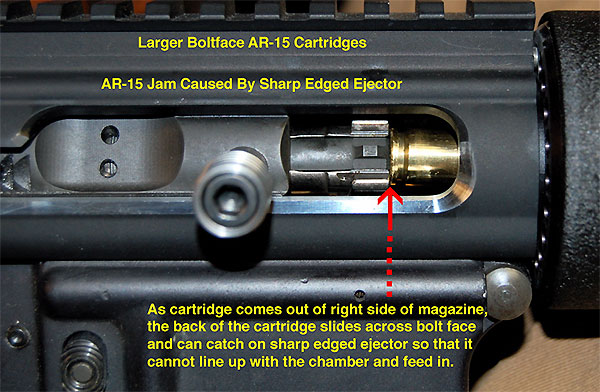
Over the years, while working with various AR-15 cartridges that require a larger bolt-face bolt (i.e. bigger than a 5.56 NATO/.223 Rem bolt-face, like those cartridges that use a 6.8 SPC bolt or the bolt face suitable for the 6.5 Grendel-based cartridges), I have found that there is an increased potential for a certain type of jam if a modification to the standard “Mil-Spec”, square-edged ejector is not made.
The original AR-15 square-edged ejector design was made for a much smaller-diameter bolt face and the smaller diameter 5.56 NATO/.223 Rem case, and it works perfectly in that application. However, as people have adapted the AR-15 platform to shoot bigger cartridges, some parts have been modified to accept the larger cartridges (i.e. bigger bolt-face bolts for the 6.8 SPC and the 6.5 Grendel, and different extractors), yet other parts have been all but ignored. One of these “ignored” parts has been the ejector. Most of the larger-bolt-face AR-15 bolts still use the standard “Mil-Spec”, square-edged 5.56 NATO/.223 Rem. ejector. That’s the problem. But there is a simple, reliable fix!
Chamfering AR Ejector for Improved Reliablity with 6mm, 6.5mm and 6.8mm Cartridges
With the larger bolt face and the larger-diameter AR cases, the old-style “Mil-Spec” ejector can cause infrequent but still annoying jams if the ejector is not modified. The jam can occur when a cartridge case feeds up and out of the right side of the magazine, and as it does so, the back of the case must slide across the bolt face and sideways over top of the ejector if it is to center up to the chamber and feed in. If the side of the case catches on the sharp-edged ejector you can get a jam. (See picture above).
Fortunately there is an easy fix for this. One way is to take the ejector out and spin it in a lathe or cordless drill and machine or grind it and round or chamfer the sharp edge. (See picture of rounded ejector next to square edged ejector).
Quick Fix Alternative — Bevel Your Ejector
Another “quick fix” is to leave the ejector in the bolt and chamfer the sharp edge with something like a Dremel tool. (See picture). This fix is easy to do and permanently resolves this potential feeding jam issue. There are no downsides to this modification if done right and I would recommend this modification for the ejectors in all larger bolt-face AR-15 bolts.
This gunsmithing tip provided by Robert Whitley of AR-X Enterprises LLC, 199 North Broad Street, Doylestown, PA 18901. Phone: (215) 348-8789. Website: 6mmAR.com.
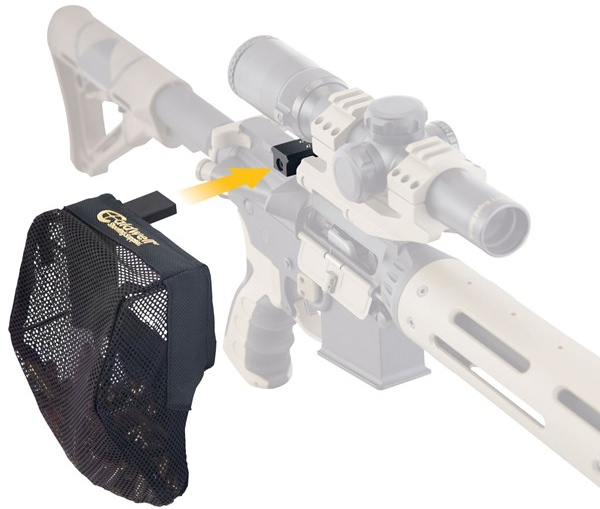
Hate chasing brass ejected from your AR platform rifle? Well here’s a clever new accessory — a brass catcher that mounts easily to the Picatinny rail on top of your upper receiver. There are other types of brass-catching rigs on the market, but this is one of the best products we’ve seen for ARs with Picatinny rails. Caldwell’s AR Pic Rail Brass Catcher mounts easily with a quick-detach aluminum clamp. Both the clamp and wire frame are adjustable so they won’t interfere with your scope or scope mounts.
We like the quick-detach feature. This lets you quickly check and/or clear your chamber, or inspect the bolt. The bag itself, made from heat-resistant mesh fabric, will hold approximately one hundred .223 Rem cartridge cases. And here’s another nice feature — the bag has a zipper on the bottom so you can quickly dump your spent brass without having to remove the brass-catcher from your rifle.
Brass Catcher Features:
– Captures fired casings before they hit the ground.
– Quick-detach system mounts securely — no fumbling with straps.
– Compatible with most Picatinny rail-equipped AR-10s as well.
– Heat-resistant mesh bag holds 100 pieces of brass.
– Fully adjustable — can be placed at any point on Picatinny rail.
If you shoot an AR and reload your own ammo, you should get some kind of brass-catching device. With a $39.19 “street price” ($49.99 MSRP), this is one of the more affordable options. Once you use a rig like this and no longer have to pick up brass from the ground, you may get spoiled. Moreover, a brass-catcher like this will earn you “Brownie Points” with other shooters at your range who no longer have to dodge your hot brass.
Product Tip from EdLongrange. We welcome reader submissions.


 How’d you like to run AR-15 Mags in your Rem 700 bolt gun? Sound far-fetched? Well think again.


 Many of our readers use AR-type rifles for Service Rifle matches, varmint hunting, 3-Gun competition, or defensive use. AR-platform rifles can be configured in a multitude of ways to suit the application. But if you plan to put together your own purpose-built AR rifle, how do you get started?