For decades, Shooting USA has been a leading video resource for the shooting sports and hunting. This popular cable TV show covers shooting matches, and provides expert information on precision shooting, gun maintenance, optics, and defensive firearms use. Here are five interesting videos all worth watching. Learn about wind-reading, gun maintenance, and optics.
1. Reading the Wind — SGT Sherri Jo Gallagher of USAMU
Sergeant Sherri Jo Gallagher formerly of the U.S. Army Marksmanship Unit (USAMU) shows us how to read the wind in given conditions, and how to apply your wind assessment when aiming down-range. During her time with the USAMU, Sherri won the National High Power Championship, and was the first woman in history to earn the U.S. Army “Soldier of the Year” honors. Sherri comes from a legendary family of shooters — she was raised by Ace Marksman Mid Tompkins and mother Nancy Tompkins, the first female to win the NRA National High Power Championship.
2. Field-Stripping and Cleaning AR-Platform Rifles
Let’s face it — Black Rifles run dirty. On AR-platform rifles, the gas system blows carbon and powder residues back into the action and bolt carrier group. Accordingly, you need to clean ARs early and often, and you should fully disassemble the bolt carrier to access parts and recesses which accumulate greasy lube and hard carbon. This helpful video shows how to field-strip and clean AR-platform rifles. If you own an AR, this is definitely worth viewing. With over 2.7 million views, this is the second most-watched video on Shooting USA’s YouTube Channel.
2. MOA Defined — Jim Scoutten Explains Minute of Angle
Minute of Angle (MOA) — this is the most common measurement of group size, and hence rifle accuracy. You hear about shooters hoping to shoot 1 MOA or “half-MOA”, but many folks could not give you a precise definition. In fact MOA is an angular measurement that equates to one-sixtieth of one degree of Arc. In this video, host John Scoutten defines MOA. He then demonstrates how MOA translates to accuracy on target. He demonstrates one-half-MOA accuracy with a Les Baer Custom rifle. This company offers a three-shot, half-MOA guarantee for its rifles.
4. How to Adjust for Parallax
Most precision rifle scopes have parallax adjustment, typically a knob on the left side of the scope. but what exactly is “Parallax” and why do you need to adjust optics to ensure the parallax setting is optimal? In this Shooting USA video, John Paul of JP Rifles defines parallax and explains why you need to set parallax correctly for the distance to your target. The video then shows how to adjust parallax correctly, a process which should start with the scope’s ocular focus.
5. How to Mount a Riflescope
When mounting a scope you want to use quality rings, and ensure that the scope is leveled properly. In addition, you need to adjust the fore/aft position of the scope so that eye relief is correct. Ideal scope position may be different when shooting from the bench vs. shooting prone. In this Shooting USA video John Paul of JP Rifles reviews scope mounting basics.
Do you plan to use factory ammo in your hunting rifles? Perhaps you buy bulk centerfire ammo for your AR15s or varmint rifles. And you’ll certainly consider using factory ammo in all your rimfire guns. Then this book can definitely benefit you.
If you ever shoot factory ammo, you should consider getting Ammo & Ballistics 6. This resource lists over 2,600 different loads for 200+ cartridge types from .17 Mach 2 up to .700 Nitro Express, including the most popular centerfire and rimfire cartridges (both rifle and handgun). In this updated-for-2020 Sixth Edition, there are over 3,000 tables covering virtually every caliber and every load for all commercially-loaded hunting ammunition sold in the USA. Tables include velocity, energy, wind drift, bullet drop, and ballistic coefficients up to 1,000 yards.
Ammo & Ballistics 6 helps you select ammo for a hunt — quickly compare the velocity and knock-down power of various commercial ammo. This book can also help you choose a caliber/chambering for your next hunting rig.
Verified Book Purchaser Reviews
“Outstanding reference guide for shooters and ballistic enthusiasts alike. Has data on velocity, energy delivered, Taylor KO index, windage and elevation on numerous loadings for hundreds of [cartridge types]. Each cartridge has all dimensions labeled (i.e rim, case length, neck, etc.), and has an informative description of the cartridges history/relevance.” — S. Step, 2017
“Great heaps of data! This volume has pages and pages of new data for .22 LR like the hot Velocitor, and also on the .22 WMR from 30 grains up into the 50s. Most importantly there is lots of range data, drop, windage, kinetic energy, etc. — Terrific reference guide….” — E. Svanoe
Ammo & Ballistics 6 contains data and illustrations on virtually every sporting cartridge sold in the USA. This latest edition covers 200-plus cartridge types from .17 Mach 2 up to .700 Nitro Express.
Photos and Facebook post by Tactical Rifle Shooters
Yet another .300 Blackout disaster. Unfortunately, that .300 Blackout cartridge can fit in a .223 Rem chamber. Shooting a .308-caliber bullet in .223 bore is a recipe for disaster.
The .300 AAC Blackout aka “300 BLK”, is a compact 30-caliber cartridge designed to work in AR-15 rifles. It has a shorter cartridge case to accommodate the bigger 30-caliber bullet while still fitting in a standard AR-15 magazine. Unfortunately, that’s the danger. A careless shooter can toss a .300 Blackout cartridge in with .223 Rem rounds without noting. And because the case-head size is the same as the .223 Rem (5.56×45) the rifle’s bolt assembly will happily chamber and fire the .300 BLK round. Problem is, that forces a .308 diameter bullet down an undersized .223-caliber bore. Not good!
This images were provided by Tactical Rifle Shooters on Facebook. The message was clear: “Don’t try to run 300 Blackout in your .223/5.56mm. It won’t end well. The problem is identical rifles and identical magazines but different calibers.”
Image from Accurate Shooter Forum. Cutaway shows the jammed .30-Cal bullet:
For those who MUST have a .300 Blackout, here are some things you can do:
1. Use different colored magazines for .300 Blackout vs. .223 Rem.
2. Fit all your uppers with caliber-labeled ejection port covers.
3. Mark .223 Rem upper handguards with the caliber in bright paint.
4. Mark all .300 BLK Rounds with heavy black marker.
Comments by Folks Who Viewed these .300 Blackout Disaster Photos:
“The .300 Blackout is simply a badly-designed round. A properly-designed round would have had a feature in the shape that would have prevented cross loading in the first place.” — D. Santiago
“I almost made that mistake… I had a magazine of 300 BLK inserted in my .223/5.56 all night. Fortunately, I never pulled the trigger. Once I realized the mistake, I almost got ill. [After that incident] I no longer own a 300 BLK.” — B. Welch
“Happened to me hog hunting from a helo. Gun exploded in my face.” — B. Hood
“Fire-forming projectiles [is] so wrong in centerfire!” — M. Stres
“Had some dude come into the store the other day wanting .300 Blackout ammo to shoot in his 5.56 AR. It took 15 minutes of explaining for him to understand you got to have a .300 Blackout Upper!” — R. Williams
If you want to use an AR-platform rifle in the varmint fields, consider getting a 20-caliber barrel chambered for the efficient, low-recoil 20 Practical cartridge. The 20 Practical is simply a .223 Remington necked down to 20 caliber. The parent .223 Rem cartridge of course works great in an AR, but the 20 Practical offers some notable advantages for high-volume varmint shooters. The 20 Practical delivers very high velocity with very low recoil while still providing outstanding accuracy. The 20 Practical is great option for folks who favor “fast and light” — smaller, lower-mass bullets traveling at very high velocities. This little cartridge can launch 40-grainers at over 3900 fps, and 32-grainers even faster. This makes the 20 Practical a great choice for an AR-based varmint rifle.
20 Practical Ultimate Varminter
A decade ago, as a “proof-of-concept”, AccurateShooter.com created a 20 Practical AR15 Ultimate Varminter with a custom 20-caliber upper from Robert Whitley of AR-X Enterprises, LLC. That project rifle was ultra-accurate — every 5-shot group out of the gun was less than the size of a dime. That gun was auctioned off, but Robert Whitley continues to produce custom 20 Practical AR15 uppers. (The 20 Practical cartridge is simply the .223 Rem necked down to 20 caliber — you can use standard .223 brass and load with standard.223 Rem dies. Just swap in a smaller expander and use smaller neck bushings.)
Robert learned that the accuracy of the first 20 Practical AR15 was no fluke. After building six (6) more 20 Practical uppers, he tested them for accuracy and they all shot great. These uppers feature DPMS low-pro receivers with side-charging handles. They are fitted with PacNor 1:11″ twist, 3-groove stainless barrels.
Robert reports: “We have been making more 20 Practical AR15 uppers and I have to say I am astounded by the accuracy of these things. For shooting little tiny groups out of an AR15 with bullets going 3500+ fps, it’s hard to beat the 20 Practical. Today I test-fired six more uppers, all with 11-twist barrels. Three of the uppers had 24″ barrels, two had 20″ barrels, and one had an 18″ barrel (we call it ‘Stubby’).
In four of these uppers I shot re-sized Winchester brass using 25.3 grains of WC844 powder with Berger 40gr BTHP bullets loaded at 2.225″ OAL (about .015″ off the lands). WC844 is inexpensive military surplus powder that is nearly identical to H335. I tried three different primers and the choice did not seem to matter (CCI BR4, Rem 7 1/2s and Win Small Rifle — the old silver ones). All these four uppers shot great.”
Below is an animated GIF with targets from uppers #6, 10, and 11. All groups are mag-fed, 5-shot groups shot at 100 yards using a front rest and rear bag.
Targets Shot with Three Different 20 Practical AR Uppers
For more INFO visit www.6mmAR.com, or email: rcw3 [at] erols.com.
20 Practical Shooters Explain Why They Love this Little Cartridge
A current thread in our Shooters’ Forum focuses on favorite variants of the .223 Rem cartridge. The thread asks: “What is your favorite and most versatile round that you have made from a .223 Rem parent case?” Many cartridges were named, but the wildcat cartridge cited most often was the 20 Practical. Here are some comments by Forum members, who explain the appeal of this great little 20-caliber cartridge:
“The 20 Practical is just a hoot to shoot. Outstanding precision, minimal recoil, easy case forming and inexpensive to shoot. What’s not to like? It’s a great way to introduce kids to centerfire, too.” — JLT
“The 20 Practical for me. Never had as much fun shooting a rifle as I did with the 20 Practical. Also, [it is] the easiest wildcat to form. Just get cases, a couple of bushings to get the right neck tension, and you are shooting.” — NMKid
“Favorite .223 Rem Wildcat? The 20 Practical hands down for me. I have two of them built on Savage actions right now. One has a 20″ BHW barrel and the other has a 26″ Criterion. It is my go-to caliber for shooting up a Prairie Dog town and the ones I have are insanely accurate. Here are some typical 100- and 200-yard groups with my 20 Practicals.” — IA_Shooter
“My favorite was and is the 20 Practical. No fire-forming, no neck-turning, and with the increased BC of the 20 Cal bullets, it’s hard to wipe the smile off your face in a prairie dog town[.]” — Region Rat
“20 Practical and the [original] .223 Rem are my favorites. Accurate, cheap to shoot. The 20 Prac allows you to see your hits and it’s fast.” — Alguapo
“20 Tactical or 20 Practical. Both very easy to reload and/or form from .223 brass. And they are accurate, reach out on varmints at surprising ranges.” — Bill K
Smart Tips on Forming 20 Practical Cases
Varmint ace Warren B, aka “Fireball” in our Forum, explains how to form 20 Practical Cases. “Forming 20 Practical cases is very easy and no fire-forming is required. Start with any good quality .223 Rem brass. One can simply run the case into your bushing die with the appropriate bushing and call it done. I however like to make it a little more involved by doing the neck reduction in steps. I find that taking steps doesn’t overwork the brass as much as one step does. Also, if you resize the neck in too large of a step, sometimes, depending on the neck thickness, the neck will not be dimensionally what you would expect when finished. This is especially important towards the last step when one is getting close to the final required neck diameter.
For my cases the first thing I did was to run them into an old RCBS .223 Rem full length die with the decapping assembly removed. This will take care of any dented necks on the raw cases and bring the necks down to around 0.243″. Since all standard full-length dies oversize the necks way too much, starting with a .223 FL die actually reduces the neck diameter quite a bit–and obviates the need to buy an extra bushing for the first step. I then use my Redding Type-S die with two bushing sizes to get down to where I need to be. In other words, I start with the FL sizer, then move to a Type-S with a 0.233″ bushing and finish with a 0.228″ bushing. Notice how, as I get to the final step, I use progressively smaller increments in size between the reductions.” (Note: Depending on your brass your final bushing size may be different.)
20 Practical vs. 20 Tactical
Varminter Kevin Weaver, who shoots both the 20 Practical and 20 Tactical, states that: “Both the 20 Tactical and the 20 Practical are fine .20 caliber cartridges. However, my favorite would be the 20 Practical. The 20 Practical gives the SAME performance as the 20 Tactical without fire-forming, or having to buy expensive forming dies.
So with the 20 Practical you do less work, you shell out a lot less money, yet you give up nothing in performance. What’s not to like? To create 20 Practical cases, just buy a .223 Rem Redding Type “S” Bushing Die set with a .230 or .228 bushing and have fun with this great little cartridge.
The 20 Practical and the 20 Tactical are almost identical cartridges. There are only slight differences in case outside diameter, shoulder angle, and case body length. Neck length on the 20 Tactical is a bit longer, but there is still plenty of neck on the 20 Practical to grip the popular bullets, such as the 32gr V-Max.”
Do you own or shoot an AR-platform “black rifle”? Then you know these rifles run dirty, and have some unusual maintenance requirements. On the other hand, the AR “Modern Sporting Rifle” is fun and versatile with a vast range of options among buttstocks, barrels, handguards, and grips. You can assemble a simple 16″ barrel .223 Rem rig for home defense, or build a long-barreled 6mm ARC rifle with bag-rider buttstock and high-magnification optic for long range target work. The choice is up to you.
To help with your black rifle journey, here are eight helpful videos from Brownells. These will help ensure your AR rifle cycles reliably and runs longer, with reduced wear. Brownells also explains how to choose the optimal barrel twist rate. CLICK HERE to order AR parts, accessories, and ammo from Brownells.
AR Bolt/Bolt Carrier Lubrication — Smarter Methods
This video shows the proper way to lubricate an AR-15 bolt-carrier assembly. The video identifies the key metal-on-metal friction points where you actually need lubrication: the rails on the underside of the carrier, shiny wear points on top, and just a dab on the cam pin. How much oil/lubricant should you use? The AR-15 is pretty forgiving on that point. Some spots work best with grease, others work best with a lighter oil. Just keep it out of the combustion areas. Those little holes in the carrier are gas vent holes, NOT oil holes!
AR Maintenance — General Cleaning Procedures
Let’s face it, ARs with the original gas system tend to run dirty. You’ll need to regularly clean the bolt carrier and bolt. In addition you should regularly clean the chamber area and the inside of the upper. Also make sure to clean the lower (see video 3:15) and ensure the trigger assembly is properly maintained. This video covers general cleaning and maintenance of AR-platform rifles. We highly recommend that all new AR owners watch this video. NOTE: When cleaning the bolt, don’t forget the extractor recess and ejector recess. The majority of ARs we’ve seen that did not function properly had gunk (lube, carbon, brass shavings) clogging these areas.
AR Barrel Twist Rates — What You Need to Know
AR barrels can be ordered with a variety of twist rates from 1:12″ to 1:7″. Basically, the longer/heavier the bullet you plan to shoot, the faster the twist rate you need. For example, Sierra recommends a 1:7″ twist rate for the 90gr SMK. A 1:12″ could work with the small lightweight bullets up to 55 grains. The 1:9″ barrel will stabilize the light and mid-weight bullets up to about 77 grains. We recommend a 1:8″ or 1:7″ twist rate for the best versatility. You’ll find a detailed discussion of AR twist rates on PewPewTactical.com.
How to Install an AR15 Trigger Assembly
One of the most common AR upgrades done by black rifle owners is swapping out the trigger for a better unit (perhaps a two-stage). Trigger replacements on ARs can be done fairly easily with basic tools. But there are some recommended procedures to ensure the trigger group swap goes easily. You’ll want to have a proper mount to secure the lower, and tools that fit the pin diameters on your lower.
Must-Have Spare Parts for AR-Platform Rifle
With 350,000 views, this is one of the most-watched AR videos on the Brownells YouTube Channel. Brownells Gun Techs Steve and Caleb list key spare parts AR owners should have. Top of the list are bolt gas rings, which wear out through normal use. Also you’ll want a spare extractor spring and pin, because these both can fail. The cotter pin and cam pin can break, but more often they get lost when the Bolt Carrier Group is disassembled for cleaning. Additionally, the large buffer springs wear out with time, so have a spare. Downstairs on the lower receiver, keep spare springs and detents for the pivot and takedown pins. Finally, if you’ve upgraded your trigger, keep the original one as a backup spare.
Checking Headspace on ARs
In this Tech Tip, Brownells gun tech Steve Ostrem walks users step-by-step through the process of checking headspace on their AR-15 rifles, both new and used. It is very important to have proper headspace to ensure proper feeding and extraction, and to ensure good brass longevity (with less risk of dangerous case separation). Starting at 2:10, this video explains how to check headspace with go/no-go gauges and maximum headspace gauge. Ostrem notes: “If you have an AR that closes on a no-go gauge, we recommend taking it to a gunsmith before heading to the range.”
Excessive headspace in AR platform rifles can lead to dangerous case separation.
Setting Up Gas Tube Systems
This Tech Tip examines AR-platform gas systems, and shows how to select the proper length gas tube, and how to configure multiple tube systems if you change your barrel to different lengths. This is worth watching for anyone re-barreling an AR.
Barrel Gas Block Alignment — Key to Reliable Cycling
In this video, Brownells gun tech Steve Ostrem explains surefire methods to align your gas block. The most common problem with AR builds is poor cycling, commonly caused by misalignment between the gas block and the barrel’s gas port.
Do you use an AR15 for service rifle, 3-Gun, or tactical competitions? Then you should consider dry-fire training. Many top competitors spend an hour (or more) dry-firing for every minute they shoot live cartridges in competition. The allows effective training without spending a fortune on live ammunition (which can run $1.00 per round or more).
There is a handy new system that resets the trigger on AR-platform rifles — the Mantis Blackbeard (see videos below). This permits you to make multiple successive shots without having to alter your grip and manually recycle the charging handle. This two-part system employs a replacement bolt carrier/bolt and replacement magazine. With these two components installed, your AR can automatically reset the trigger instantly after you pull the trigger. It works, it’s effective, and it’s affordable at $219.00 MSRP.
The Blackbeard system is used by the U.S. Marine Corps and U.S. Army (including Special Forces), so you know it works. During training the Mantis Blackbeard allows unlimited, repetitive Dry Firing without resetting the charging handle. That eliminates a tedious task that requires altering your hold on the rifle.
No Gun Modifications
Same Trigger Weight, Break, and Reset
Installs in under a minute
Up to 10 shots per second
Up to 100,000 Shots per Charge
Save on Ammunition Costs
In the video below Top Shot Champion Dustin Ellermann shows how to use the Mantis Blackbeard. He vividly demonstrates the clear advantage of the Blackbeard compared to manually pulling the charging handle over and over (See 00:02 – 00:20 time).
Dustin Ellermann Review of Mantis Blackbeard Trigger Reset System
This next video, from the manufacturer Mantis, shows how to install the Mantis Blackbeard, how to set the zero, and how to operate the unit with your AR-platform rifle.
The easy-to-install-Mantis Blackbeard replaces your bolt carrier and magazine in less than a minute, allowing easy training transitions. The magazine battery pack is good for 100,000 shots per charge and the Blackbeard is rated to reset as quickly as 10 shots per second, allowing rapid fire training for 3-Gun and tactical competitions.
Americans love AR-platform rifles. However, they can be maintenance-intensive, as hot gasses are directed right back into the action to operate the bolt. Because ARs have a somewhat unique (and dirty) semi-auto operating system, we think all AR owners should learn how their rifles operate — from the inside out. This feature provides an “inside look” at the AR, with X-Ray and Cutaway views created through advanced 3D computer modeling.
AR15 Functions Revealed with 3D Computer Animation
Ever wondered how the parts inside an AR15 work together? Just exactly how does the reciprocating bolt carrier feed rounds from the magazine? How do the elements in the trigger group work and reset after each shot? How does the gas system bleed gas from the barrel and operate the bolt carrier? These and other questions are answered in this eye-opening video from 45Snipers. Using “cutaway” 3D computer animation, this 5-minute video shows all features of an AR15 inside and out. This fascinating firearms animation allows the viewer to look inside the upper and lower receivers, into the bolt carrier, chamber, barrel, and magazine.
This video starts off slow and has annoying background music, but it is well worth watching if you own or shoot any AR-platform rifle. It illustrates all the key operations during the charging, loading, firing, and ejection processes. The cutaway animation shows how rounds are stripped from the magazine and then chambered. It then shows how every part of the trigger group works, and how the firing pin strikes the primer. You can even watch the bullet move down the barrel before the empty shell casing is removed from the chamber and tossed out the ejection port. Here are sample frames from the video:
How AR-Platform Rifles Work — General Introduction
To help reader understand the general operation of AR-type rifles, this video shows the control functions of an AR and how the upper and lower sections work together.
Cutaway 3D Animation of AR15/M16 Action — Watch Video
Here is an excellent “cutaway” animation by Thomas Schwenke that shows how an AR-15 functions — how the entire loading cycle works from start to finish.
AR platform rifles are semi-automatics version of the M16. These feature distinctive upper and lower receivers which can be readily separated via front and rear pins. The upper includes the barrel, handguard, forward gas tube, and bolt assembly, while the lower contains grip, trigger group, fire selector, and mag well. In addition the lower is attached to the stock which encloses the buffer assembly.
The original ArmaLite AR-15 was a select-fire, air-cooled, gas-operated, magazine-fed rifle designed by American gun manufacturer ArmaLite in 1956. It was based on Armalite’s AR-10 rifle chambered for the 7.62×51 NATO (.308 Win). In 1959, ArmaLite sold its rights to the AR-10 and AR-15 to Colt. Some key modifications were made — most notably, the charging handle was re-located from under the carrying handle to the rear of the receiver. The redesigned rifle was adopted by the U.S. military as the M16 carbine, which went into production in March 1964.
Brownells is continuing its popular Black Rifle Friday promotion through this entire weekend. Now through midnight on Sunday 11/28/21, enjoy big savings on uppers, lowers, barrels, buttstocks, rimfire conversion kits, AR optics, magazines and much more. Along with the attractive sale prices, you can save on nearly all Brownells products with special Black Friday weekend Discount Codes. NOTE: These codes are NOT limited to AR stuff — you can save on most products in stock.* But don’t delay, the codes expire soon.
Code RFA: 11% Off $200 | Code RFB: 12% Off $300 | Code RFC: 13% Off $700
Most Sale Prices Good Through 11/28/2021 at 11:59 pm CST. The special Discount Codes expire on 11/29/2021 at 11:59 pm CST.
*Promo Code Exceptions
Promo Codes are NOT valid on these brands: B&T, Bighorn Arms (Zermatt Arms), Crimson Trace, FN USA, Franklin Armory, Galco Int’l, Glock, Holosun, Kahles, LabRadar, Leica, Leupold, Nightforce, Raven Concealment, Ruger, SIG Sauer, Swarovski, Trijicon, and Zenith Firearms. Also Promo Codes are NOT valid on these product types (and more): barrel blanks, barrels (chambered), barreled receivers, bullets, case tumblers, cleaning rods, progressive presses, reloading kits, rifle stocks, shot, shotshell presses, ultrasonic case cleaners. See ALL Exceptions.
In the face of growing online censorship across many popular social media sites (such as YouTube), Brownells has launched a new online resource to help customers build their own AR-15 rifles at home. Hosted at Brownells.com/HowToBuild, the new web page features step-by-step, interactive videos. Featuring Brownells Gun Tech Caleb Savant, the videos show the AR-15 build process with easy-to-follow directions and expert advice. There are currently four AR Build videos: Introduction, How to Build Your Lower, How to Build Your Upper, and Troubleshooting Guide. See all videos at: Brownells.com/HowToBuild.
Each of the videos have an easy search button on the upper left-hand corner, allowing viewers to navigate to specific parts of the video. This will help viewers access key parts of each video and find the information they need. For example, the Lower Video has specific sections on trigger and buttstock installation. There is also a video on how to properly test fire and troubleshoot an AR-15 once it’s built.
In addition to the instructional videos, Brownells’ AR Builder Site also provides links to all the parts, tools, and accessories required to build an AR-15 rifle. There are specific links to uppers, lowers, triggers, grips, buttstocks, bolt carrier groups, handguards, barrels, gas blocks, muzzle brakes and more.
“Several social media platforms have banned videos and other content showing how to build firearms,” said Brownells V.P. of Marketing Ryan Repp. “Because of Brownells’ long-time support of the Second Amendment and individual freedom, it made sense for us to create a professionally-produced video and resource center to assist rifle builders of all skill levels make the rifle of their dreams in the comfort of their own home or workshop.”
Colt has issued a Recall for certain Colt AR-type rifles made in 2021. Here is the official Recall Notice:
COLT’S Manufacturing LLC (“Colt”) has recently discovered a potential safety issue with certain Modern Sporting Rifles (“MSRs”). Colt is voluntarily initiating a recall to protect the safety of its customers because, under certain conditions, it is possible that some of these MSRs may discharge a second round when the trigger is released when there is a live round in the chamber.
Colt is committed to the highest standards of quality and customer satisfaction. In keeping with that commitment, during routine quality testing, Colt discovered that hammers that do not meet Colt’s specifications were installed in certain MSRs that were manufactured beginning on March 5, 2021. The issue will be corrected by replacing the hammers in affected MSRs.
The recall only covers a portion of MSRs manufactured beginning on March 5, 2021, and includes the following models: AR15A4, CR6700A4, CR6920, CR6920-EPR, CR6920MPS-B, CR6921, CR6921-EPR, CR6933, CR6933-EPR, CR6960, LE6920-EPR, LE6920MPS-B, LE6920-OEM1, LE6920-OEM2, LE6920-R, LE6933-EPR, SP633784, LE6920SOCOM.
Chart lists all the serial numbers for those models that may potentially be subject to the recall:
To prevent the possibility of death or serious personal injury, Colt advises anyone who has purchased a Colt MSR since March 5, 2021 to stop using it immediately and visit ColtRepairMSR.com or call Customer Service at 1-800-971-3216 to see if your specific MSR is affected. Please note: Not all MSRs within the serial number range in the above chart are subject to this recall and this website offers easy, step-by-step instructions to determine if a particular MSR is affected.
Customer service agents will assist anyone who needs additional help. Our expert craftsmen are ready to upgrade all affected MSRs at our West Hartford, CT headquarters.


 The
The 


 20 Practical Ultimate Varminter
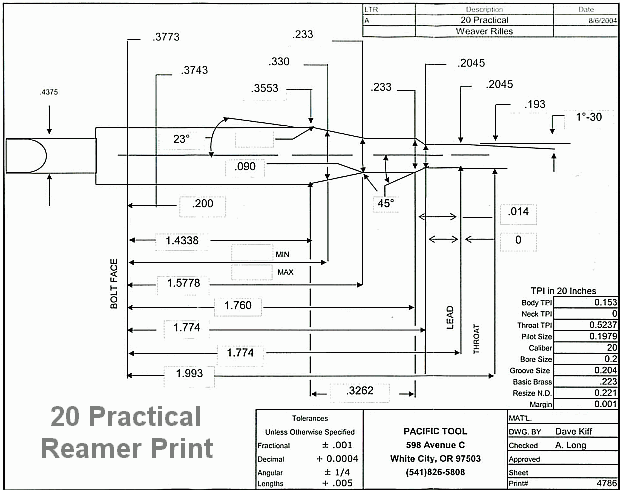


 Varminter Kevin Weaver, who shoots both the 20 Practical and 20 Tactical, states that: “Both the 20 Tactical and the 20 Practical are fine .20 caliber cartridges. However, my favorite would be the 20 Practical. The 20 Practical gives the SAME performance as the 20 Tactical without fire-forming, or having to buy expensive forming dies.