Bryan Litz has produced an informative new video on the subject of bullet stability. The video explains how stability is related to spin rate (or RPM), and how RPM, in turn, is determined by barrel twist rate and velocity. For long-range shooting, it is important that a barrel have a fast-enough twist rate to stabilize the bullet over its entire trajectory.
Detailed Bullet Stability Article
To complement the above video, Bryan has authored a detailed article that explains the key concepts involved in bullet stabilization. Bryan explains: “Bullet stability can be quantified by the gyroscopic stability factor, SG. A bullet that is fired with inadequate spin will have an SG less than 1.0 and will tumble right out of the barrel. If you spin the bullet fast enough to achieve an SG of 1.5 or higher, it will fly point forward with accuracy and minimal drag.”
There is a “gray zone” of marginal stability. Bryan notes: “Bullets flying with SGs between 1.0 and 1.5 are marginally stabilized and will fly with some amount of pitching and yawing. This induces extra drag, and reduces the bullets’ effective BC. Bullets in this marginal stability condition can fly with good accuracy and precision, even though the BC is reduced. For short range applications, marginal stability isn’t really an issue. However, shooters who are interested in maximizing performance at long range will need to select a twist rate that will fully stabilize the bullet, and produce an SG of 1.5 or higher.”
Berger Twist-Rate Stability Calculator
On the updated Berger Bullets website you’ll find a handy Twist-Rate Stability Calculator that predicts your gyroscopic stability factor (SG) based on mulitiple variables: velocity, bullet length, bullet weight, barrel twist rate, ambient temperature, and altitude. This very cool tool tells you if your chosen bullet will really stabilize in your barrel.
LIVE DEMO BELOW — Just enter values in the data boxes and click “Calculate SG”.
Top photo with bullet by Werner Mehl, www.kurzzeit.com, all rights reserved.
You’ve heard the rumors of a new ultra-high BC 7mm bullet from Berger. Well the rumors are true. Berger is now shipping test samples of its new 195-grain 7mm Elite Hunter Bullet, part # 28550. This bullet boasts jaw-droping 0.755 G1 and 0.387 G7 Ballistic Coefficients. Those are stunningly high numbers. Compare that to 0.674 G1 and 0.345 G7 BCs for the previous BC king amoung 7mm projectiles, Berger’s own 180 gr Match Hybrid Target.
We’re certain the “orange box” 195gr Elite Hunter will soon see use by F-Open competitors. This ultra-high BC projectile could be a “game-changer” in long-range shooting when used in cartridges such as the 7mm RSAUM, 7mm WSM and even bigger 7mm magnums. Recommended barrel twist rate is 1:8.3″, with a stated “minimum” twist of 1:9″.
We ran some numbers through the JBM Ballistics program*, comparing the new 195-grainer with Berger’s popular 180gr Hybrid. The results were eye-opening. The projected drop is significantly less. Most importantly, this new 195gr bullet moves a LOT less in the wind at 1000 yards. This should translate into higher scores for F-Class shooters — that wide ‘9’ shot may stay in the ’10’ ring. In fact, based on the JBM trajectory calculation, with a 10 mph 90° crosswind, the 195gr bullet will have over SEVEN INCHES less wind drift at 1000 yards than the 180-grainer (46.0″ vs. 53.1″). That’s a big deal, a very big deal…
Drop at 800 yards: 135.5″
Windage at 800 yards: 28.0″
Drop at 800 yards: 140.9″
Windage at 800 yards: 32.2″
Drop at 1000 yards: 237.9″ Windage at 1000 yards: 46.0″
Drop at 1000 yards: 250.0″ Windage at 1000 yards: 53.1″
Drop at 1200 yards: 380.1″
Windage at 1200 yards: 69.6″
Drop at 1200 yards: 404.2″
Windage at 1200 yards: 81.2″
* Variables were set to 55.4° F, 1000′ elevation, standard Atmosphere at Altitude, 2950 fps muzzle velocity. You can use JBM Ballistics to compare at different MVs.
UPDATE from Berger
After we broke this story, Berger Bullets wanted to clarify some points. Berger explained:
“This bullet is in the testing phase and has not been officially launched. We sent this bullet out for some public testing to make sure that we had positive feedback before we moved forward with an official launch.
We want to see how it performs in multiple rifles and different chamberings.
This bullet was made for hunting purposes, we realize there are shooters who would like to take these out for target shooting, like F-Class. However, we are not certain how they will perform. If things are successful we would like to eventually launch a target version.”
The information on the label you have pictured on your article has been updated.
Twist Rates
Minimum: 1:9″
Optimum: 1:8.3″
Ballistic Coefficients
G7 BC: .387
G1 BC: .754
How to Get Berger’s 195gr Elite Hunter Bullets
These bullets are so new you won’t find them on the Berger Bullets website yet. As Berger explained above, these bullets are still in a final testing phase. Most of the early production runs have been sent out for testing purposes. If you have specific questions, you can send an email to Berger via this CONTACT PAGE. Otherwise you can phone Berger, Mon-Fri, at 714-441-7200. Please try the email option first.
As far as we can tell, the first-ever formal benchrest shooting match took place in 1944 at the Tacoma Rifle & Revolver Club in Tacoma, Washington. Known today as the “Sniper King Competition”, this is still a popular event, drawing top shooters from around the country.
Our friend Lou Murdica bested the competition this year to win the Sniper King competition and Benchrest shooting’s oldest trophy. Take a look at that target. That’s a TEN-Shot group at TWO hundred yards. That works out to 0.1299 MOA for ten shots. That’s might impressive…
We have to give Lou credit for his shooting skills and loading spectacularly accurate ammo. Lou was running a Kelbly action, Shilen Barrel, and March scope. He loaded 6mm Berger 65gr BT bullets driven by Accurate LT 30 powder.
Have you ever shot a smaller TEN-shot group, even at 100 yards? If so, tell us about that, by posting a comment below.
Forum member XmarksSpot has been shooting a wicked fast varmint cartridge that has broken the 5000-fps barrier using Berger 30gr varmint bullets. That’s some serious velocity! The parent case is a 6mmBR, which is then improved and necked down to .224 caliber. XmarksSpot reports:
Some people think 5000+ fps is mythical. Well just thought I’d let you guys know that I got 5239 fps a couple weeks ago shooting 30-grainers with my 224 McDonald, a wildcat cartridge based on an improved 6BR case necked down to 224. (This case is very similar to a 22 Dasher.) The bullet used is the 30gr Berger. (The 40s run fast too — about 4800 fps.) The rig is a Rem 700 with a 30″ Hart barrel. Below is the case before and after forming. As you can see it has a 40° shoulder and far more case capacity than a 22 BR (a 22 Dasher case holds about 41.0 grains H20). My most accurate loads are with 50-52gr bullets, with bugholes the norm at 4200 fps. The 40gr bullets will do 4800+ fps.
This 224 McDonald wildcat was originally developed by Charles McDonald. He has been developing and chambering custom cartridges for years. Editor’s Note: Many folks may not be aware of the little .224-caliber 30gr Berger varmint bullet, Berger item # 22301. This bullet is not on Berger’s current production list but some vendors may still have “old stock” inventory. The little 30-grainer has an 0.119 G1 BC and will work in 1:15″ or faster twist barrels. For more info, visit BergerBullets.com.
Many tactical shooters have adopted the .260 Remington as an alternative to the heavier-recoiling .308 Winchester. The .260 Rem has also performed well in the hands of long-range High Power shooters such as SSG Sherri Jo Gallagher, past National High Power Champion. The .260 Remington is basically the .308 Win necked down to .264 (6.5 mm) caliber. It can launch very high-BC 130-142 grain projectiles at impressive velocities. The ballistics of the .260 Rem allow it to shoot flatter, with less wind drift, than typical .308 Win loads.
For fans of the .260 Remington, very high-quality factory ammo is now available. ABM Ammo, a division of Berger Bullets just announced that it will produce two varieties of .260 Remington ammo.
ABM’s 260 Remington 140gr Berger Match Hybrid Target ammo is designed for class-leading ballistic and superior accuracy. Using the highest-BC 6.5 mm caliber bullet offered by Berger, the 140gr Hybrid, this load features less wind deflection and more energy on target than the competition. ABM claims that this Match Hybrid ammo is “unrivaled as a long-range 260 Remington factory ammo option.” Since it pushes a higher-BC bullet than other .260 Rem factory ammo, we’d have to agree with that statement.
Performance based on a 26″ barrel and sea level conditions.
Mission Ready .260 Rem OTM Tactical Load for Mag-Fed Rifles
ABM Ammo also offers .260 Rem factory ammo loaded with the NEW 130gr AR Hybrid bullet. The .260 Rem 130gr Berger Match AR Hybrid OTM Tactical load is optimized for the AR-10 platform or any magazine-fed rifle. Berger’s 130gr AR Hybrid bullet offers a 0.290 G7 BC. That’s very close to the 0.317 BC of the longer 140gr Hybrid. This, combined with a 2847 FPS muzzle velocity, provides excellent performance in a shorter COAL that feeds perfectly from box magazines.
In fact, if you run the ballistics (using JBM) using ABM’s published MVs, you’ll find that you give up nothing with the shorter bullet. At 600 yards, the 130gr “Mission Ready” load has 78.8″ (12.5 MOA) of drop. By comparison, the “Match Ready” load with 140-grainers has 80.3″ (12.8) MOA of drop at 600 Yards (That’s not a mistake — the smaller bullet has LESS drop because it has a higher MV to start.) At 1000 yards, the “Mission Ready” load is virtually identical to the “Match Ready” load: The 130gr ammo has 304.6″ (29.1 MOA) of drop at 1000 vs 303.4″ (29.0 MOA) for the 140gr ammo at the same distance. (These calculations are based on standard conditions at sea level, with ABM supplied MVs.)
Because the ballistics are so close, you may want to try both loads in your .260 Rem rifle, even if you single-load and are not restricted by mag length. Some barrels may have a preference for one bullet over the other.
Product Tip from EdLongRange. We welcome reader submissions.
ABM Ammo, a division of Berger Bullets, has introduced new, high performance .308 Winchester factory ammunition, loaded with the high-BC, 185gr Berger Juggernauts. The long-loaded “Match Ready” version of this ammo is designed for Palma (Full-bore) and F-TR shooters. A “Mission Ready” version, loaded shorter to mag length, is designed for tactical and military applications. These two new offerings should “raise the bar” for long-range performance with factory .308 Win ammo.
Offering a high Ballistic Coefficient (0.560 G1, 0.283 G7), the 185-grain .308-caliber Juggernaut bullet is designed to remain stable even in the transonic zone. This way it offers good performance at extended distances, contributing to higher hit percentages at longer ranges.
Berger Twist-Rate Stability Calculator
On the updated Berger Bullets website you’ll find a handy Twist-Rate Stability Calculator that predicts your gyroscopic stability factor (SG) based on mulitiple variables: velocity, bullet length, bullet weight, barrel twist rate, ambient temperature, and altitude. This very cool tool tells you if your chosen bullet will really stabilize in your barrel.
LIVE DEMO BELOW — Just enter values in the data boxes and click “Calculate SG”.
Berger Bullets has just announced a new 6.5 mm (.264 caliber) 130gr Hybrid projectile. Optimized for magazine-length seating (and AR10-friendly), the new 130gr bullets should be ideal for tactical comps and the PRS series. We expect this new bullet to work great when loaded in modern mid-size cartridges such as the 6.5×47 Lapua and 6.5 Creedmoor. Berger’s new 6.5mm 130gr Match AR Hybrid OTM Tactical bullet (could Berger come up with a longer name?) will soon be released to the public. Berger says this new 130-grainer is the first of many new bullet designs to be introduced in the next few years. Here is a run-down on the new bullet from its designer, Bryan Litz of Applied Ballistics.
NEW 130gr Hybrid — Behind the Design
by Bryan Litz, Berger Chief Ballistician
Intelligent bullet design and selection begins with an understanding of application constraints. For bullets that will be used in unlimited rifles, there are few constraints and performance can truly be maximized. However, many shooting applications have realistic constraints such as magazine feeding of loaded rounds. In constrained applications, you need to ask the question: “What’s the best bullet that will work within the constraints of my shooting application?”
The new Berger 6.5mm 130 grain AR Hybrid OTM Tactical bullet is specifically optimized for maximum performance in magazine-length ammo.
6.5mm cartridges are the second most common cartridges used by top shooters in many of the Precision Rifle Series (PRS) matches, with 6mm being the most common. These kinds of tactical matches all have stages that require repeating rifles — either AR-10 platforms or bolt guns — so magazine feeding is a must. Recognizing that Berger did not have an option that was truly optimized for this particular application, we went to work and the latest 6.5mm Hybrid is the result.
SUMMARY
The new Berger 6.5mm 130 grain AR Hybrid OTM Tactical bullet is specifically optimized for use in loaded ammo with COAL constraints for magazine feeding. This bullet maximizes overall performance through BC as well as achievable muzzle velocity in mid-capacity 6.5mm cartridges fed from AR-length magazines.
What makes this bullet optimal for magazine length ammo? To start with, the nose of the bullet is constrained in length so that when it’s loaded to mag length in 6.5mm cartridges such as the 6.5mm Creedmoor, 260 Remington and 6.5×47 Lapua, the nose of the bullet won’t be pushed below the case mouth. This can be an issue with some of the heavier 6.5mm bullets like the 140s. Furthermore, the hybrid ogive design is not sensitive to jump distance like some other designs such as the VLD.
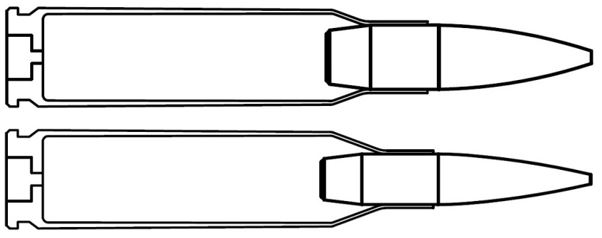
Another consideration of length-constrained ammo is how much of the bullet is pushed down into the case. The inside of the case is for powder, and the more space you take up with bullet, the less powder you can fit in. Less powder means less total energy available, and muzzle velocity is depressed. A bullet weight of 130 grains is an optimal balance between external ballistic performance (BC) and internal case capacity considerations which translate into muzzle velocity. Further to this objective, the AR Hybrid has a minimal air gap in the front of the nose, which allows the bullet to have an even shorter OAL. When dealing with length-constrained designs, you need to pack as much bullet into as little length as possible< to optimize overall performance. Another advantage of making the bullet shorter is that stability, including transonic stability, is improved.
Although this design is length-constrained, the combination of a hybrid ogive and 7 degree Boat Tail produce a very respectable G7 form factor of 0.920 which is within 1% of the popular 6mm 105 grain Hybrid. See below for full live fire ballistic performance data.
The 6.5mm 130 grain AR Hybrid will be barely stable from a 1:9″ twist, and reaches full stability from a 1:8″ twist which is common for many 6.5mm rifles. Visit the Berger Bullets twist rate calculator to get more detailed stability information on your specific barrel twist, muzzle velocity and environment.
Cartridge Selection for Magazine Length Constraint — Advanced Analysis
The trend to smaller calibers in magazine-fed rifles is happening for a very good reason. For a .308 Winchester round, you only have 2.37 calibers of nose length available for the bullet to protrude from the case. Such a short nose will have relatively high drag for the caliber. By contrast, smaller calibers such as 6.5mm and 6mm have proportionally more length available for the nose to protrude from the case and still fit in the same COAL constraint. Proportionally longer noses mean lower drag. Proportionally longer bullets mean higher sectional density. Combine an elevated sectional density with lower drag, and you get higher BC bullets. For example, consider a 175 grain .30 caliber bullet commonly used in .308 Winchester M118LR-type ammo. These 175 grain bullets have G7 BCs in the neighborhood of .243 to .260. Neck the .308 down to 6.5mm (260 Remington) or 6mm (.243 Winchester) and now look at the BCs of the bullets available in these calibers which work within the same magazine length constraint. The 6.5mm 130 grain AR Hybrid has a G7 BC of 0.290, and the 6mm 105 grain Hybrid has a G7 BC of 0.278 — both of which are higher than the .30 cal 175 grain bullet BC. Furthermore, you get hundreds of feet per second more velocity with the necked-down cartridges as well.
All of the above translates into higher hit percentage. See the caliber comparison chart below* which is an excerpt taken from the book: Modern Advancements in Long Range Shooting which addresses this and many other topics in even more detail.
*The Weapon Employment Zone (WEZ) analysis shown above is for a 1000-yard shot on a standard IPSC silhouette in an uncertain environment having: +/- 2 mph wind, +/- 1 yard range, Muzzle Velocity SD of 10 fps, and a rifle shooting 1 MOA groups.
Ever wondered how a modern, jacketed bullet is made? Thanks to Berger Bullets, here’s a short video clip that shows how bullets are crafted. In this short sequence filmed at Berger’s factory, you can see machinery that forms the jacket, inserts the core, and then forms the final shape.
Walt Berger, a living legend in the benchrest world, was honored this past weekend at the Ben Avery Range outside Phoenix, AZ. At the start of the 2015 Cactus Classic Benchrest match, a “surprise” ceremony was held. Berger President Eric Stecker announced to the crowd that the 100/200-yard benchrest facility was being dedicated to Walt Berger, founder of Berger Bullets. Walt was genuinely surprised and moved by the special ceremony, which featured a color guard, and a fly-over. In the photo above, Walt is flanked by his grandson David Hamilton (left) and Eric Stecker (right).
As part of the range dedication ceremony, four vintage, WWII-era Warbirds flew over the range in diamond formation, streaming red, white, and blue smoke.
Shortly after the ceremony, the competitors got down to business…


 Berger Twist-Rate Stability Calculator


 Proportionally longer noses mean lower drag. Proportionally longer bullets mean higher sectional density. Combine an elevated sectional density with lower drag, and you get higher BC bullets. For example, consider a 175 grain .30 caliber bullet commonly used in .308 Winchester M118LR-type ammo. These 175 grain bullets have G7 BCs in the neighborhood of .243 to .260. Neck the .308 down to 6.5mm (260 Remington) or 6mm (.243 Winchester) and now look at the BCs of the bullets available in these calibers which work within the same magazine length constraint. The 6.5mm 130 grain AR Hybrid has a G7 BC of 0.290, and the 6mm 105 grain Hybrid has a G7 BC of 0.278 — both of which are higher than the .30 cal 175 grain bullet BC. Furthermore, you get hundreds of feet per second more velocity with the necked-down cartridges as well.


