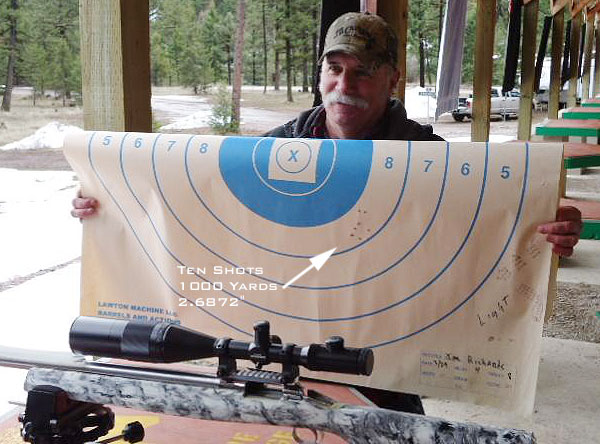
Ten shots… 1000 yards … 2.6872″. Think about that. Ten shots you could cover up with a coffee cup. That’s some amazing shooting. Is this a world record? Consider this — we believe this is the smallest 10-shot group ever shot at 1000 yards in any form of rifle competition, by anyone, anywhere, anytime. It is smaller than the existing Williamsport Light Gun and Heavy Gun 1K records. The IBS and NBRSA do not shoot 10 rounds for Light Gun, but this 2.6872″ group is smaller than the current IBS (3.044″) and NBRSA (4.322″) ten-shot HEAVY GUN records.
This amazing group was shot by Jim Richards at the Deep Creek Range outside Missoula, Montana during the 4th Light Gun Relay of a 1000-yard match. Jim was shooting the small 6mm Dasher cartridge with 105gr Berger bullets. Fellow Deep Creek Shooter Tom Mousel says this should be a new world record. The Deep Creek Range shoots under Williamsport rules, with ten shots for Light Gun. The current Williamsport Light Gun record (as listed) is 3.835″ by Cody Finch in 2006, but we’re told that Paul Martinez shot a 3.505″ at Williamsport last year. If approved at 2.6872″, Jim Richards’ new record is 23% smaller than the 3.505″ previous record. That’s remarkable — Jim Richards utterly demolished the previous mark. (As measured, Jim’s group is also smaller than the current Williamsport Heavy Gun record, 2.815″ by Matt Kline in 2010.)
The Record-setting rifle features a Borden action, Shehane ST 1000 fiberglass stock, and Nightforce Benchrest scope. The Krieger barrel was chambered by King Machine for the 6mm Dasher, with a 0.269″ neck and 0.103″ freebore. Jim Richards was running Berger 105gr Hybrid bullets.
The rifle was purchased used from Tim Claunch. We suspect Tim wishes he had not parted with it! Any gun that can put ten shots under three inches at 1000 yards is a “keeper”, that’s for sure.
Forum member Wayne B. says: “I am really happy for Jim. He has asked 1000 questions, slept in his pickup, upgraded his equipment, bought a rifle from another friend of mine and now he is a world record-holder. The men and women who shoot at Deep Creek in Missoula Montana are the best group of shooters in the world bar none! They will give you all the info you need to win and if you don’t have what you need they will loan it to ya, up to and including a rifle and ammo.”
The wind gods smiled on the shooters at the Berger Southwest Nationals on Thursday. For most of the day, the wind flags were hanging straight down or barely moving. Many shooters managed to go through the 800-yard stage without dropping a point. Conditions got tougher for the 900-yard and 1000-yard stages but it was still a day of low winds and high scores.
Team Grizzly made the most of the good conditions in the F-Open Division. Coached by Trudie Fay, and anchored by 2013 World Champion Kenny Adams, the four-person team shot brilliantly, scoring 1786 with 104 Xs. That beats the existing 800/900/1000 Palma course National record by five (5) points and ten Xs. The previous record, 1781-94X, was set by Team Berger in 2008.
During the match we had a chance to chat with Shiraz Balolia as he was getting his .300 WSM ready for the 1000-yard stage. Since stepping down as the captain of the USA F-Open Team, Shiraz had told us that he planned to shift his priorities, and devote more time to non-shooting activities. But here he was, back in the thick of competition. Shiraz smiled and said “You’re right, I was planning to get away from shooting a bit. But I just couldn’t miss this match … I guess I have the bug”. When a man’s this good at long-range shooting, you can’t keep him away from the firing line for long. Shiraz serves as Captain of Team Grizzly.
The Berger Southwest Nationals (SWN) have kicked off at the Ben Avery Range in Phoenix, Arizona. Overall attendance has been impressive for this important shooting event. Approximately 275 shooters have registered. On Wednesday (February 5th) roughly 200 shooters competed in a 600-yard Mid-Range event, with three 20-shot matches. The wind clinic on Tuesday the 4th was also well-attended with 130 or so participants.
In addition to the rifle competition (continuing through Sunday), there will be other fun events. On Friday, after the 1000-yard match, there will be a SWAP meet.On Saturday, there will be a Banquet dinner at the Ben Avery Indoor Range.
The Mid-Range match was tightly fought. We don’t have official results yet, but we’re told that Jim Murphy was at the top in F-TR, followed by Lige Harris, Gerry Wiens, Grant Ubl, and Eric Stecker.
Next up is a 4-person Team match (800, 900, 1000 yards) starting bright and early on Thursday. AccurateShooter.com will be reporting directly from the match. Watch the Daily Bulletin for photos from the match and interviews with the shooters.
To learn more about the Berger Southwest Nationals, watch this video featuring footage from the 2013 event. Helpful interviews with last year’s competitors provide useful insights into conditions at Ben Avery. One regular shooter at Ben Avery told us: “On a typical day, when the wind builds it is pretty gradual and progressive. But when it starts to die, it can drop off quickly, with a pretty big change from shot to shot.”
Watch Berger SW Nationals Preview Video
Berger SWN Events Schedule (Thursday – Sunday)
The remaining action starts at 9:00 am each morning, Thursday through Sunday.
Thursday, 6 February 2014, 9:00 AM 4-Man Palma Team Match: 15 shots for record at 800, 900 and 1000 yards.
(Divisions – Palma, F-Open, F-TR)
Practice available to those not shooting with a team.
Friday, 7 February 2014, 9:00 AM – Start of Grand Agg Individual Palma Match: 15 shots for record at 800, 900 and 1000 yards.
(Divisions – Palma, F-Open, F-TR)
Swap Meet – after conclusion of fire at 1000-yard line.
Saturday, 8 February 2014, 9:00 AM Individual 1000 Yard Matches: Two 20-shot matches at 1000 yards. Any Rifle-Iron Sight (Any sight for F-Class shooters). (Divisions – Palma, Any Rifle-Iron Sight, F-Open, F-TR) 4 Man Team Match: 20 shots at 1000 yards. Any Rifle-Iron Sight (Any sight for F-Class shooters). (Divisions – Palma, Any Rifle-Iron Sight, F-Open, F-TR
Sunday, 9 February 2014, 9:00 AM Individual 1000 Yard Matches: Two 20 shots matches at 1000 yards. Any Rifle-Any Sight (Any sight for F-Class shooters). (Divisions – Palma, Any Rifle-Any Sight, F-Open, F-TR)
With the Berger Southwest Nationals kicking off February 4, 2014 in Phoenix, Arizona, we thought our readers might enjoy a very interesting interview with the top decision-makers at Berger Bullets, namely company founder Walt Berger, plus Eric Stecker, Berger’s Executive Vice President.
This interview covers a wide range of topics in seven (7) separate segments. We’ve embedded the first two interview sections in this article, with links for the other five below.
Sinclair Int’l has released a 7-part series of video interviews with Walt Berger (founder of Berger Bullets) and Eric Stecker (Berger’s Exec. VP and Master Bulletsmith). The series is hosted by Bill Gravatt (who was Sinclair’s President at the time the interview was filmed). You can watch Parts 1 and 2 of the interview here, and we’ve provided links to the remaining Parts 3 through 7. All seven interview segments offer interesting material. Part 6 mentions the Berger Reloading Manual (many years in the making). Part 7, over 13 minutes long, contains interesting discussions of bullet testing and the hunting performance of Berger VLDs.
NOTE: You can view this entire video series (and many other videos) on Sinclair’s YouTube Channel Page.
The Berger Southwest Nationals, one of the biggest shooting events west of the Mississippi, kicks off next week at the Ben Avery Range near Phoenix, Arizona. The event begins with a Shooting Clinic on Tuesday, February 4, and concludes with 1000-yard Matches on Sunday the 9th. The host Desert Sharpshooters Club, and the staff at Berger Bullets, are working very hard to make this the best SW Nationals ever. And if you are interested, there is still time to register. Berger tells us: “It’s not too late to sign up for the 2014 Southwest Nationals! The match runs from Feb. 4-9 at the Ben Avery Shooting Facility. We have a great schedule and prizes.” The weather will be good (it was 74° in Phoenix yesterday), and there will be thousands of dollars of gear on the Prize Table. If you want to join the fun, download the entry form below, and, as soon as you can, send an email to michelle.gallagher [at] bergerbullets.com.
The Berger Southwest Long Range Nationals are held every February at the Ben Avery Shooting Facility just north of Phoenix, Arizona. Berger has partnered with the Desert Sharpshooters Rifle Club and the Arizona Game and Fish Department, resulting in a “must attend” event for long range shooters around the world.
Ben Avery is a truly world-class facility, with 98 firing points, carefully maintained firing lines and plenty of wind flags. As the match sponsor, Berger provides the “extras” – ice chests full of drinks on the firing line, a banquet on Saturday night and awards to the winners, including over $3,500 in cash prizes and over 30,000 bullets in awards.
Berger’s customers said “Make more bullets!”, and the company listened. Over the next few months Berger will more than double its capacity, by adding SIX new bullet-making machines, up from five at the beginning of 2013. You can do the math: 5 + 6 = 11. That means that Berger will have more than twice as many machines turning out bullets for the yellow and orange boxes. Bringing six new machines online represents a major commitment by Berger to increased production. This has been the “number one priority” for the company according to Berger ballistician Bryan Litz.
Bryan explained that Berger has already increased its output in recent months. In 2013 Berger produced 45% more bullets than in 2012. That’s a big boost. But, Bryan added, even with that 45% greater output, demand was out-stripping supply. So Berger determined the best long-term solution was to increase production capacity… and that meant acquiring new bullet-making machines. So 2014 will mark the “Rise of the Machines” at Berger, and that’s good news for fans of Berger Bullets. Within a few months you should see much greater availability of Berger bullets at gun stores and online vendors.
Bryan Litz Explains That Berger is Doubling Production Capacity This Year (SHOT Show Report)
Unlike Cracker Jack, there’s not a “prize in every box”. But you just might find a little something special in one of your yellow (or orange) boxes of Berger Bullets. That’s right, Berger Bullets has included some Free Bullets Coupons in randomly selected boxes of bullets. You might be a lucky fellow and score some free bullets. Forum member Ron B (aka “Snakepit”), found a nice surprise recently in a box of Berger 6mm 105gr Hybrids:
“I just opened up a new box of Berger Bullets and inside was a yellow tag that said ‘~WINNER~ You have won FREE Berger Bullets’. I called the number on the tag and gave them the Validation Code. The representative said I’d won three (3) boxes of the Berger Bullets of my choice. He said I had one of the best coupons Berger put in the boxes at random. So I now have three, 100-ct boxes of 6mm 105gr Hybrid Target Bullets coming to me from Berger’s next production run. Thank You Berger!”
Praise for Berger Bullets Prize Promotion
Forum member AndyT likes the Prize Program: “Nice to hear that some reloading companies are thinking of the civilian shooters. Well done Berger — keep it up and nice one to the winners.”
Fellow Forum member agr516 agrees: “Good to see a company who has all the demand in the world to sell their products think enough of their customers to give them something back to show their appreciation. Well done, Berger!”
As a member of the World Champion Team USA F/TR squad, Paul Phillips regularly competes (and wins) at 1000 yards. Paul is also a long-range hunter. Here’s his story about developing his ultimate long-range hunting rifle. Chambered for the .338 Lapua Magnum, this rig is accurate out to 1800 yards.
The Long-Range ChallengeBy Paul Phillips
Being an avid big game rifle hunter, my goal was to build the most accurate long-range hunting rifle possible that would still be light enough to carry. My thought was to use the same type of high-quality components as what I used on my US F/TR Team Rifle, except in a bigger caliber — a caliber that would have plenty of knock-down power at very long ranges. After extensive research, including both ballistic data analysis, as well as discussion with top gunsmiths and champion long-range shooters, I chose the .338 Lapua Magnum. My past experience from being a member of a USMC Scout Sniper Platoon and a shooting member of two World Champion U.S. F-Class F/TR teams, I knew that this rifle was more than capable of performing the task. After establishing that the rifle had half-MOA accuracy at 600 yards, we wanted to see how far the rifle could maintain sub-MOA accuracy, to see what the cartridge and rifle could achieve. Could this gun shoot sub-MOA at a mile? That was our challenge.
Rifle Components and Gunsmithing
My rifle was built on a Stiller Tac-338 single-shot action. It has a 30″, 1:10″-twist Brux barrel, a McMillan A-5 stock with Magnum fill, a Sinclair Bipod, and a Remington X-Mark trigger set at two pounds. The rifle wears a Nightforce NXS 8-32x56mm scope in Nightforce rings on a +40 MOA rail. I chose David Tooley to install the barrel, custom brake, apply a Cerakote dark earth finish and bed the stock. After speaking with Mr. Tooley in great length, I chose his no-neck-turn match .338 Lapua chamber specifically designed for the 300 grain Berger Bullet. This rifle weighs 17 pounds and, with the muzzle brake, it recoils like a standard .308 Winchester.
Load Development and Accuracy Testing
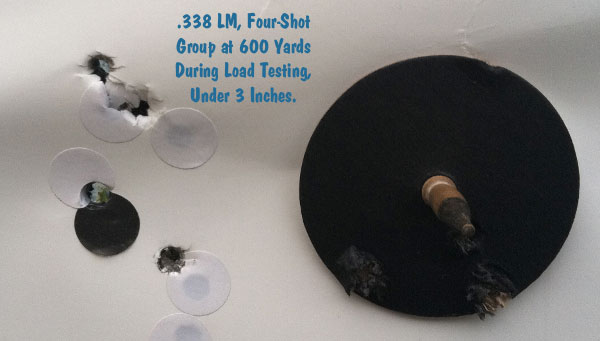
I used the 600-yard range at the Midland County Sportsman’s Club. If I was going to have any chance of hitting small targets at a mile, I would need to find a load that could produce half-minute (0.5 MOA) or better accuracy. I found an accurate load that gave me consistent half-minute groups that chronographed at 2825 FPS. My load consisted of Lapua brass, Federal 215M Primer, Alliant Reloder 25, and Berger 300gr Hybrid OTM bullet. With the Berger 300-grainer’s listed 0.419 G7 BC, this load would be good enough to reach 1880 yards before going subsonic. This load’s calculated energy at one mile is 960 ft/pounds. This is similar to a .44 magnum pistol round at point-blank range.
With my +40 MOA scope rail, my 100-yard zero ended up with the elevation at the bottom of the tube and the windage just 2 MOA left of center. This left a full 65 Minutes of Elevation — enough to get out to 1800 yards. This gave me the capability to aim and shoot from 100 yards to 1800 yards with a projectile that is still supersonic at 1800.
Hitting a 10″ Balloon at One Mile
For a one-mile target, I chose a balloon inflated to 10″ in diameter. The balloon would be a challenging, reactive target that would show up well on video. I teamed up with a fellow long-range shooter, John Droelle and friend Justin Fargo to attempt this feat. Using my known 600-yard Zero, my ballistics program showed my come-up for 1783 yards to be 53 MOA. After two sighters that measured 4 inches apart, I adjusted up one minute from my spotter shot and nailed my 10″ balloon at one mile. This video was recorded with my iPhone attached to my 25-power Kowa spotting scope, so it may seem a lot closer than it really is. Below is a video of the shot. Needless to say I achieved my goal and was very excited.
Watch Hit on 10″-Diameter Balloon at One Mile with .338 Lapua Magnum
After my balloon shot, I let my friend Justin Fargo, a novice shooter, try his skills. Justin told me that he had never shot past 100 yards using a common deer rifle. Surprisingly, Justin not only kept all his shots under 1 MOA, he hit the 9-inch white circle in the middle of the target. This bullet hole measured only 4.3 inches from the center of where he was aiming. Truly amazing! The target below shows Justin’s shots at one mile. Note that All the hits are located within the 24-inch black circle.
What I Learned — With the Right Equipment, Even a Novice Can Make Hits at a Mile
The above results demonstrate that even a novice shooter with a high-quality, custom rifle and match-grade ammo can make extreme long range shots with great accuracy. It is very important to understand the ballistics of the bullet and the effect of wind drift to make precision, first-shot hits on your target. It is also important that you know your target, backstop and beyond when making these shots. To date, I have shot approximately 40 shots at a mile in calm conditions while averaging 3-shot groups between ½ to 1 MOA (1 MOA is about 18.5″ at that distance). My next experiment is to see how well these bullets perform traveling at subsonic speeds out to 1.5 – 2 miles. Stay tuned!
Special thanks to the following people that helped out with this project: Geoff Esterline, David Tooley, Dick Davis, John Droelle, Ray Gross and Bryan Litz.
Editor’s Comment: The point of this article is to show the kind of accuracy a precision rifle system can achieve, consistently, at extreme long range. Though this rifle will do duty as a hunting arm, Phillips is not advocating that a .338 LM be used to harvest animals at the full limit of its supersonic range. Because winds are hard to predict at extreme long range in a hunting situation, Phillips cautions that the practical distance at which he would shoot game with a rig like this is much, much shorter.
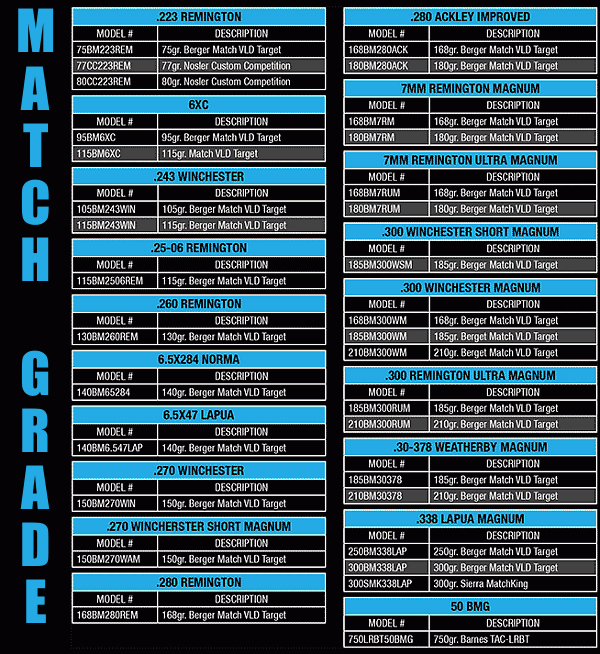
A new ammunition manufacturer has started up in Stevensville, Montana. ProGrade Ammunition will be offering a wide spectrum of ammo products, with components selected for particular types of shooting. Prograde will eventually offer nine separate types of pistol and rifle ammunition: Defense Grade, Varmint Grade, Cowboy Grade, Hunter Grade, Bear Grade, Range Grade, Match Grade, Safari Grade and Tactical Grade. Our readers will probably be most interested in the “Match Grade” and “Varmint Grade” lines. The Match Grade ammo features mostly Berger bullets (with some Noslers and Sierras), while Varmint Grade ammo is loaded with Barnes, Hornady, and Nosler bullets.
Click Images to Load Full-Size Images (with larger type)
We have no idea whether ProGrade Ammunition will shoot well and prove reliable. We don’t know what brass, powders, or primers ProGrade will be using. In a recent press release, ProGrade touts its Match Grade products: “Match Grade rounds are all hand-loaded in the United States and use premium components that are held to higher standards of consistency, leaving little room for inaccuracy. Match Grade means every element is made to be as uniform as possible in weight, primer pocket and neck size. This means everything — from bullet weight and powder weight to brass thickness and case length — is as precise as possible.”
Time (and rounds on target) will determine if ProGrade ammo is good stuff. But in this period of shortages, with ammunition of all kinds being hard to find, it is good to see a new domestic ammo-maker getting into the business, and producing cartridges with high-quality projectiles. We wish the folks at ProGrade success in their endeavor. To learn about ProGrade’s full line of ammunition, call (435) 865-5995, or visit www.progradeammo.com.
Back in May, IBS shooter Rodney Wagner shot a 0.349″ (50-2X) 5-shot group that became the talk of the shooting community. This was the smallest 600-yard group shot in the history of recorded rifle competition. Rodney’s group cuts the existing IBS 600-yard record in half. Rodney put five shots under the size of a dime at the distance of six football fields. Just pause and think about that…
News of this amazing feat spread like wildfire via the internet. People were amazed at what Rodney accomplished. Here are some actual comments posted on various shooting forums:
308Nut: Simply Astounding.
Coues Sniper: That’s insanity.
PapaJohn: I strut around like a peacock if my rifles will shoot under a half-inch at 100 yards. His group was better than that at six times the distance… that’s just unfathomable. I don’t see anyone breaking that record for a loooooooooooong time!
Given the spectacular (and historic) nature of Rodney’s 600-yard group, many folks wanted to learn more about Rodney’s equipment and his shooting techniques. For that reason, we’ve compiled this follow-up report. Rodney was kind enough to provide a short video showing his equipment and shooting technique. In his video demonstration, Rodney runs off a 5-shot group in about 19 seconds. When he actually shot the 0.349″ group, Rodney estimates he got the five shots down-range in 12-15 seconds. (He slowed down a bit for the video!)
Watch Rodney Wagner Fire Five Shots in Under 20 Seconds
Rodney comments: “You’ll notice I hold the stock with my left hand while working the bolt to keep it from losing its ‘track’ (that slows me down a lot). I have just gotten into the habit of doing that because I feel tracking is one of the most important things not to take for granted. With this technique I don’t have to ‘saw’ the stock into the bags as much when I get on to the record target.”
Record-Setting Load: Varget Powder, CCI Primers, and Berger 108s Jumped
Rodney’s record 0.349″ group works out to 0.055 MOA at 600 yards. To shoot a “zero” group at 600 yards you need the finest components and insanely good reloading techniques (not to mention the grace of God.) As he does with all his 600-yard ammo, Rodney pre-loaded before the match. This particular ammo had been loaded 5-6 days before the match. Here are specs on Rodney’s load:
32.5 Grains of Hodgdon Varget Powder and CCI 450 Primers.
108gr Berger BT Match bullets seated 0.020″ away from the lands.
Lapua 6mmBR brass fire-formed to 6 Dasher and turned to 0.265″ loaded round for a 0.268″-neck chamber.
Neck-sized with a 0.262″ Redding bushing.
Note that Rodney was using Berger 108s, not the 105gr VLDs or Berger’s popular 105gr Hybrids. Rodney found his Brux barrel shot best with the 108s: “I’d get really nice 4-shot groups with the VLDs, but it seemed there would be four together and one out. The 108s seem to have less fliers.” Rodney experimented with seating depths before he settled on a .020″ jump: “I shot them for a long time 3 to 5 thousandths in the lands, just barely in the lands. But I knew Sam Hall had really good luck jumping. So I went to .020″ jump and it all came together. The 108s have shot good like that in three different Brux barrels (all chambered with the same reamer) so I just start at that setting now — twenty off the lands.”
Record-Setting Equipment
Rodney was shooting a 17-lb Light Gun. It features a BAT Machine ‘B’ action, and a 29″ Brux barrel chambered for the 6mm Dasher with a 0.268″ neck. The 0.236″-land, 4-groove barrel was fairly new when the record group was shot — it had about 300 rounds through it, and had shot 30 rounds since its last cleaning. Rodney chambered the barrel himself. The stock is a Shehane ST-1000 fiberglass tracker, inletted and bedded by Tom Meredith. A March 10-60x52mm scope is held in Burris Signature Zee rings on a +10 MOA rail. These rings are inexpensive, but they work just fine, notes Rodney: “With the inserts I can align the scope mechanically and keep the windage pretty much centered in its travel.”
Supporting his rifle, Rodney used a Farley co-axial rest up front (on Super-Feet) and a Protektor Doctor bag in the rear. The Farley features a Borden top carrying an Edgewood bag. Rodney notes: “In the front, I use the black diamond blasting sand, because it doesn’t pack as hard as regular sand. You can buy it at tractor supply stores in the welding section. It’s not as heavy as heavy sand.”
In the rear, Rodney runs a flat-top Protektor Doctor bag with Cordura ears. Rodney uses Sinclair heavy sand in his rear bag. He says “it’s got some squish — not much but just a little — call it a medium-hard fill”. Interestingly, Rodney sets up the bag so that the flat on the bottom of the stock rides on the stitches between the ears: “I like the stock to touch the top of the bag between the ears — I don’t like to see daylight.”
Conditions for the Record — You May Be Surprised
Many folks who have commented on Rodney’s 0.349″ group have wrongly assumed that the 0.349″ group was shot in “perfect” zero-wind conditions. Not so. There were switchy 5 mph winds with gusts to 10 mph. Rodney notes that on his second target of the day, he had to hold in three different places to manage a decent-sized group. So for those who think the group was shot in miraculous conditions, we have to say that wasn’t the case.
Creating Ultra-Accurate 6mm Dasher Ammunition
Rodney takes great care in loading his brass, and he employs a few tricks to get superior consistency.
Fire-Forming — To prepare his cases for fire-forming, Rodney starts by turning his Lapua brass to just past where the new neck-shoulder junction will be: “I just cut enough for the 6mm Dasher neck. A little bit of the cut shows on the shoulder after forming.” Then Rodney runs a .25-caliber K&M mandrel through the whole neck, expanding the neck diameter. After the entire neck is expanded, Rodney re-sizes the top section with a Wilson bushing, creating a false shoulder. Then, as further insurance that the case will be held firmly in place during fire-forming, Rodney seats his bullets long — hard into the lands. When fire-forming, Rodney uses a normal 6mmBR load of 29.8 grains of Varget: “I don’t like to stress my brass before it has been hardened. I load enough powder to form the shoulder 95%. Any more than that is just wasted.” Rodney adds: “When fire-forming, I don’t want to use a super-hard primer. I prefer to use a Federal 205, CCI 200, or Winchester — something soft.” Using a softer primer lessens the likelihood that the case will drive forward when hit by the firing pin, so this helps achieve more consistent “blow lengths”.
Ammo Loading — Rodney is fastidious with his brass and weighs his charges very precisely. Charges are first dispensed with an RFD manual powder measure, then Rodney trickles kernel by kernel using a highly-precise Sartorius GD-503 laboratory scale. He tries to maintain charge-weight consistency within half a tenth of a grain — about two kernels of Varget powder.
One important technique Rodney employs is sorting by bullet-seating force. Rodney batch-sorts his loaded rounds based on seating force indicated by the dial gauge on his K&M arbor press: “I use a K&M arbor press with dial indicator strain gauge. When I’m loading I pay lots of attention to seating effort and I try to batch five rounds that feel the same. For record rounds I try to make sure I get five of the same number (on the dial). When sorting based on the force-gauge readout, you need to go slow. If you go too fast the needle will spike up and down before you can see it.”
In practice, Rodney might select five rounds with a gauge value of 25, then another five with a gauge read-out of 30 and so on. He places the first five like-value rounds in one row of his ammo caddy. The next like-value set of five will go in the next row down. By this method, he ensures that all five cartridges in a five-round set for a record target will have bullets seated with very consistent seating force.
Unlike some top shooters, Rodney does not regularly anneal his cases. However, after every firing, he does tumble his Dasher brass in treated corncob media. After sizing his brass, before seating the bullets, he runs a nylon brush in the necks: “The last thing I do before firing is run a well-worn 30 caliber nylon brush in the necks, using a small 6-volt drill for power. This is a quick operation — just in and out the neck”. Sometimes, at the end of the season, he will anneal, but Rodney adds: “If I can get 10 firings out of the case I’ve done good.” He usually makes up new brass when he fits a new barrel: “If it is a good barrel (that I may shoot at the Nationals), I’ll usually go ahead and prepare 200 pieces of good brass.”
Shooting Techniques — Piloting a 600-yard Group into the Zeros Gun-handling and Rate of Fire — As you can see from the video, Rodney shoots with very minimal contact on the rifle. He normally shoots a string fast, but he remains calm and steady — almost machine-like. In the video he runs five shots in about 19 seconds, but he figures he shot the 0.349″ group in 12-15 seconds. Rodney says: “I’m not quite as fast as Sam Hall but I can usually run ‘em under fifteen seconds, sometimes closer to 10 on a good day. But when I shot the 0.349″ I couldn’t see the flags for the last shot so I dipped the joystick down between 4th and 5th shots, and that took a couple seconds. The flags had not changed, so I kept the same point of aim for 4th and 5th shot. I’d been watching that flag all morning, so to satisfy my curiosity I kind of dipped down for a second.”
Aiming for the Nine — To shoot ultra-small at long range, you must aim very, very precisely. When shooting at 600 yards, Rodney lines up his cross-hairs on the white number “9” in the blue field above the ten ring. This is visible through his rifle-scope at 600 yards, and it provides an aim point smaller than the center “X”.
Rodney explains: “I always aim for the number 9 up in the blue field. It provides for a smaller aim point. I noticed a difference when I started doing that. I learned that from some guys from South Dakota. It made sense so I’ve been doing it ever sense.”
Tips for 600-Yard Shooters New to the Game
In the course of our interview with Rodney, we asked if he had any tips for shooters who are getting started in the 600-yard Benchrest Game. Rodney offered some sensible advice:
1. Don’t try to go it alone. Find an old-timer to mentor you. As a novice, go to matches, watch and ask questions.
2. Go with a proven cartridge. If you are shooting 600 yards stick with a 6mmBR or one of the 6BR improveds (BRX or Dasher). Keep it simple. I tried some of the larger cartridges, the 6XC and 6-6.5×47 Lapua. I was trying to be different, but I was not successful. It wasn’t a disaster — I learned something. But I found the larger cases were not as accurate as a 6BR or Dasher. Those bigger cartridges are competitive for score but not for group.
3. You don’t have to spend a fortune to be competitive. Buy a used rifle from somebody and find out if you like the sport. You can save a lot with a used rifle, but do plan on buying a new barrel immediately.
4. Don’t waste weeks or months struggling with a barrel that isn’t shooting. My best barrels, including this record-setting Brux, started shooting exceptionally well right from the start.




 The Berger Southwest Long Range Nationals are held every February at the Ben Avery Shooting Facility just north of Phoenix, Arizona. Berger has partnered with the Desert Sharpshooters Rifle Club and the Arizona Game and Fish Department, resulting in a “must attend” event for long range shooters around the world.

 Unlike





 Back in May, IBS shooter Rodney Wagner shot a 0.349″ (50-2X) 5-shot group that became the talk of the shooting community. This was the smallest 600-yard group shot in the history of recorded rifle competition. Rodney’s group cuts the existing IBS 600-yard record in half. Rodney put five shots under the size of a dime at the distance of six football fields. Just pause and think about that…


 One important technique Rodney employs is sorting by bullet-seating force. Rodney batch-sorts his loaded rounds based on seating force indicated by the dial gauge on his K&M arbor press: “I use a K&M arbor press with dial indicator strain gauge. When I’m loading I pay lots of attention to seating effort and I try to batch five rounds that feel the same. For record rounds I try to make sure I get five of the same number (on the dial). When sorting based on the force-gauge readout, you need to go slow. If you go too fast the needle will spike up and down before you can see it.”

 Aiming for the Nine — To shoot ultra-small at long range, you must aim very, very precisely. When shooting at 600 yards, Rodney lines up his cross-hairs on the white number “9” in the blue field above the ten ring. This is visible through his rifle-scope at 600 yards, and it provides an aim point smaller than the center “X”.


