|
|
November 19th, 2012
 Precision Reloading is now running a Clearance Sale on select Berger Bullets, with prices reduced up to 25%. Precision Reloading is now running a Clearance Sale on select Berger Bullets, with prices reduced up to 25%.
These are all normal-quality bullets, not “blems”. However, some of these bullet designs are being “phased out” by Berger (as we reported last week). If you have tried these bullets and they shoot well in your gun(s) you might want to pick up a supply before they are sold out. For example, one of our friends has had great luck shooting the BG30403 .308 125-grainers in his 30BR, winning local matches with them.

17 Cal (.172) 20 Gr Match Varmint (200 ct)
Code: BG17304 – Price: $56.79 $46.69
17 Cal (.172) 30 Gr Match Varmint (200 ct)
Code: BG17310 – Price: $53.39 $39.06
17 Cal (.172) 25 Gr Match Target (200 ct)
Code: BG17407 – Price: $48.19 $39.51
20 Cal (.204) 30 Gr Match Varmint (100 ct)
Code: BG20302 – Price: $28.39 $20.17
20 Cal (.204) 50 Gr Match Varmint BT (100 ct)
Code: BG20305 – Price: $29.79 $20.02
22 Cal (.224) 30 Gr Match Varmint (100 ct)
Code: BG22301 – Price: $24.39 $19.88
6mm (.243) 60 Gr Match Varmint (100 ct)
Code: BG24301 – Price: $31.99 $25.20
6mm (.243) 65 Gr Match Target (100 ct)
Code: BG24405 – Price: $27.09 $21.29
6mm (.243) 100 Gr Match BT Bullets (100 ct)
Code: BG24432 – Price: $35.69 $29.42
25 Cal (.257) 87 Gr Match Target (100 ct)
Code: BG25407 – Price: $46.99 $37.20 |
25 Cal. (.257) 115 Gr Match Target VLD (100 ct)
Code: BG25413 – Price: $40.29 $31.66
6.5mm (.264) 100 Gr Match Target BT (100 ct)
Code: BG26408 – Price: $47.59 $38.73
7mm (.284) 180 Gr Match Target BT (100 ct)
Code: BG28404 – Price: $47.99 $40.35
7mm (.284) 175 Gr Match Target XLD (100 ct)
Code: BG28408 – Price: $47.49 $38.87
30 Cal (.308) 110 Gr Match Target FB (100 ct)
Code: BG30401 – Price: $40.89 $33.40
30 Cal (.308) 125 Gr Match Target FB (100 ct)
Code: BG30403 – Price: $43.79 $34.28
30 Cal (.308) 135 Gr Match Target FB (100)
Code: BG30405 – Price: $47.59 $37.53
30 Cal (.308) 168 Gr Match Target BT (100 ct)
Code: BG30411 – Price: $45.99 $35.12
30 Cal (.308) 190 Gr Match Target VLD (100 ct)
Code: BG30414 – Price: $47.99 $38.69 |
November 10th, 2012
Berger Bullets recently announced that it is discontinuing a variety of bullet types in eight different calibers from .17 to .30. These bullet designs are being phased out, and many will be replaced with updated products in similar weight ranges. Though some bullet types are being discontinued, these projectiles might still perform great in your rifle(s). You should check the list of discontinued Berger Bullets below. If you are already using some of these, and find that they shoot well in your rifle(s), you may want to consider picking up a supply before they’re all gone. In our reloading-for-accuracy game, sometimes a “sure thing” is the best option.

Berger explains: “We are hearing about increased orders on both firearms and components. In preparation for the coming months, we are discontinuing several of our bullet designs which are not big sellers. This will give us more production capability for our more popular bullets and new releases, ensuring that you receive your bullets as quickly as possible. Also, this help us move forward on several new bullet designs for target, hunting, varmint and tactical applications.”
November 16th Deadline to Purchase Discontinued Designs
Berger has declared that “all existing orders for these bullets will be filled. Any additional orders must be placed by Nov 16, 2012. These bullets will no longer be available after November 16, 2012.”
| Berger Bullets Discontinued After November 16, 2012 |
| Part Number | Description
.17 Caliber
17304 17 CAL 20 GRAIN MATCH FB VARMINT
17310 17 CAL 30 GRAIN MATCH FB VARMINT
17407 17 CAL 25 GRAIN MATCH FB TARGET
.20 Caliber (.204)
20302 20 CAL 30 GRAIN MATCH FB VARMINT
20305 20 CAL 50 GRAIN MATCH BT VARMINT
.22 Caliber (.224)
22301 22 CAL 30 GRAIN MATCH FB VARMINT
22307 22 CAL 50 GRAIN MATCH FB VARMINT
22426 22 CAL 90 GRAIN MATCH BT TARGET
6mm (.243)
24301 6MM 60 GRAIN MATCH FB VARMINT
24405 6MM 65 GRAIN MATCH FB TARGET
24432 6MM 100 GRAIN MATCH BT TARGET |
Part Number | Description
.25 Caliber (.257)
25407 25 CAL 87 GRAIN MATCH FB TARGET
25413 25 CAL 115 GRAIN MATCH VLD TARGET
6.5mm (.264)
26408 6.5MM 100 GRAIN MATCH BT TARGET
7mm (.284 Cal.)
28404 7MM 180 GR MATCH BT TARGET
28408 7MM 175 GRAIN MATCH XLD TARGET
.30 Caliber
30401 30 CAL 110 GRAIN MATCH FB TARGET
30403 30 CAL 125 GRAIN MATCH FB TARGET
30405 30 CAL 135 GRAIN MATCH FB TARGET
30411 30 CAL 168 GRAIN MATCH BT TARGET
30414 30 CAL 190 GRAIN MATCH VLD TARGET |
 Story tip by EdLongrange. We welcome reader submissions.
September 22nd, 2012
  Bryan Litz, chief Ballistician for Berger Bullets (and a trained rocket scientist) has authored an impressive new book: Accuracy and Precision for Long Range Shooting. Bryan’s new book is a companion to his successful treatise, Applied Ballistics for Long-Range Shooting. Now in its Second Edition, Litz’s Applied Ballistics book has become the “go-to” Ballistics book for precision shooters worldwide. Bryan Litz, chief Ballistician for Berger Bullets (and a trained rocket scientist) has authored an impressive new book: Accuracy and Precision for Long Range Shooting. Bryan’s new book is a companion to his successful treatise, Applied Ballistics for Long-Range Shooting. Now in its Second Edition, Litz’s Applied Ballistics book has become the “go-to” Ballistics book for precision shooters worldwide.
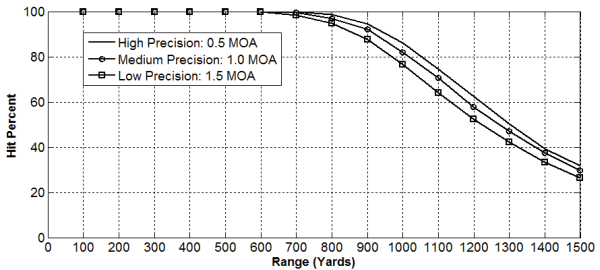
While Bryan’s first book covers the science of ballistics and trajectory calculation, his new book examines practical issues involved in long-range accuracy. Bryan explains: “In a nutshell, this book focuses on the uncertainties of practical shooting which affect hit percentage on various size targets. In other words, classic ballistics teaches you how to calculate windage and elevation corrections. This book will help you understand what your chances are of hitting a target under certain conditions, and how to improve those chances through training and design.
Practical Examples
Does a low ES/SD really make a difference at long range? Absolutely. In Chapter 6, you can see that reducing muzzle velocity variation from 20 fps Standard Deviation (SD) to 10 fps SD improves hit percentage on a 5″ circle at 500 yards from 83% to 93%.
Ever wonder how much spin drift, Coriolis affect, or using G1 vs. G7 BC’s affect your chances of hitting a target? In Chapter 10 for example, you’ll learn that ignoring spin drift in ballistic calculations reduces hit percentage on a 10″ target from 21% to 15% at 900 yards for a specified environment and cartridge.
The new book is divided into three main sections.

Part 1 focuses on Precision, which explores how hit percentage is related group size. Litz explains the variable that affect group size: muzzle velocity variation, range estimation error, wind estimation error, and inherent rifle precision
Part 2 focuses on Accuracy, which is how well the group is centered around the aim-point. Topics include: leveling your sights, trajectory modeling and secondary effects, calibrating ballistic solutions, and live fire verification.
Part 3 focuses on Weapon Employment Zone (WEZ) analysis. WEZ evaluates firearm effectiveness in terms of hit percentage. The author applies WEZ in the contexts of score shooting, varmint and big game hunting, and tactical shooting. WEZ is also used to compare hit percentage for the 300 Win Mag vs. .338 Lapua Mag.
Book is 300-page, Hard-Cover Format
Accuracy and Precision for Long Range Shooting is a 6″x9″ hardcover book with 300 pages, and retails for $34.95. The book is currently at the printers, and should begin shipping by October 15, 2012. In the mean time, you can pre-order and save $5 off the regular $34.95 retail price.
September 17th, 2012
 Berger Bullets has announced a new series of “Classic Hunter” Hybrid bullets designed to fit and feed in magazines and perform well in barrels with SAAMI standard chambers. Berger’s Eric Stecker explains: “For the first time in Berger’s history we’ve purposefully designed Hybrid-shaped hunting bullets that comply with the restrictive dimensional standards set by SAAMI. We did this so that hunters can shoot ammo loaded with Berger Hunting bullets in their factory rifles while feeding through a magazine.” Berger Bullets has announced a new series of “Classic Hunter” Hybrid bullets designed to fit and feed in magazines and perform well in barrels with SAAMI standard chambers. Berger’s Eric Stecker explains: “For the first time in Berger’s history we’ve purposefully designed Hybrid-shaped hunting bullets that comply with the restrictive dimensional standards set by SAAMI. We did this so that hunters can shoot ammo loaded with Berger Hunting bullets in their factory rifles while feeding through a magazine.”
Berger came up with a new hunting bullet design because SAAMI standard dimensions significantly limit the length of the nose (negatively affecting external ballistics performance) in two ways. First, the length from the end of the neck to the tip of the bullet of SAAMI standard ammo is typically so short that to make an ogive that will allow bearing surface to be forward of the neck it must be blunt and therefore have a low BC. The other way SAAMI limits nose length is by specifying longer throat lengths than are optimal. Stecker notes: “When you have a long throat, the nose can’t be too long or the jump to the rifling is considerable. This is typically bad for precision and accuracy. So what you end up with is stubby nose bullets with low BC and poor external ballistics performance.”
|
To overcome SAAMI-imposed design contraints, Berger’s Bryan Litz designed Hybrid hunting bullets with noses short enough to conform to SAAMI dimensional standards. These bullets should be popular among those who hunt with factory rifles and feed their ammo through a magazine. The bullets use a dual-curve ogive design. As you move forward along the bearing surface, the ogive curve starts as a tangent tangent curve (which is forgiving of seating depth). As you continue forward on the nose the tangent curve transitions into a secant curve. Secant ogives are known to be more efficient in the wind (VLD bullets are pure secant ogives).
 When you combine these two shapes you get the best of both worlds (less sensitivity to seating depth differences and improved external ballistics performance). Since these new Berger Classic Hunter bullets must have a nose length that is short enough to comply with SAAMI standards we get the most external ballistics performance possible by making the nose with Bryan’s Hybrid design. When you combine these two shapes you get the best of both worlds (less sensitivity to seating depth differences and improved external ballistics performance). Since these new Berger Classic Hunter bullets must have a nose length that is short enough to comply with SAAMI standards we get the most external ballistics performance possible by making the nose with Bryan’s Hybrid design.
Eric Stecker is enthusiastic about the new Hybrid Hunting Bullets: “We know that this bullet design works [well] because we tested it not only in media but also on game. I took these bullets with me to New Zealand to test them on several animals of various sizes and at various ranges. I know from firsthand experience that hunters who try this bullet in the field will be happy that they did.” |


Product Tip by EdLongrange. Product Photos by Robert Whitley, 6mmAR.com.
May 26th, 2012
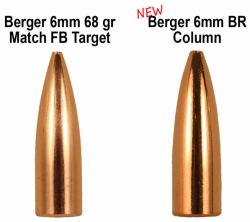 If you purchased Berger’s “6mm BR Column” bullets recently, check your lot number on the box. Berger Bullets has recalled lot number 4192 of 6mm BR Column bullets (Berger item #24407). If you have this lot number please contact Berger at (714) 447-5425, and Berger will ship you high-quality replacement bullets. We are not sure why these bullets are being recalled, but rest assured that Berger will provide high-quality replacements promptly. Note: It is known that part of lot number 4192 was originally shipped to Powder Valley. If you purchased Berger’s “6mm BR Column” bullets recently, check your lot number on the box. Berger Bullets has recalled lot number 4192 of 6mm BR Column bullets (Berger item #24407). If you have this lot number please contact Berger at (714) 447-5425, and Berger will ship you high-quality replacement bullets. We are not sure why these bullets are being recalled, but rest assured that Berger will provide high-quality replacements promptly. Note: It is known that part of lot number 4192 was originally shipped to Powder Valley.
About the 6mm BR Column Bullet Design
Berger’s “6mm BR Column” bullets were created for short-range (100-300 yards) benchrest applications. This name does not mean the bullet is designed just for the 6mm BR cartridge. Rather it is designed for all 6mm short-range benchrest (BR) rifles, most of which are 6 PPCs (for group shooting at least). The “Column” in the name comes from the fact that Berger optimized the height of the lead core column inside the bullet. Testing revealed that bullets which had very uniform core column heights shot more accurately and were also easier to tune. Berger says the new 6mm BR ‘Column’ projectiles started shipping in mid-March, 2012.
May 4th, 2012
 Berger Bullets has released a new, 250-grain .338 caliber Hybrid OTM Tactical bullet. This is a slippery projectile, with an impressive .349 G7-model Ballistic Coefficient (.682 G1 BC). This new bullet gives Berger TWO heavyweight .338-cal bullets in its line-up — Berger already offered a 300gr OTM Tactical Hybrid with a .419 G7 BC, and a whopping .818 G1 BC. Berger tells us: “The .338-Cal 250gr and 300gr Hybrid OTM Tactical bullets were optimized for use in the .338 Lapua Magnum cartridge, but will work great in other cartridges as well.” Berger Bullets has released a new, 250-grain .338 caliber Hybrid OTM Tactical bullet. This is a slippery projectile, with an impressive .349 G7-model Ballistic Coefficient (.682 G1 BC). This new bullet gives Berger TWO heavyweight .338-cal bullets in its line-up — Berger already offered a 300gr OTM Tactical Hybrid with a .419 G7 BC, and a whopping .818 G1 BC. Berger tells us: “The .338-Cal 250gr and 300gr Hybrid OTM Tactical bullets were optimized for use in the .338 Lapua Magnum cartridge, but will work great in other cartridges as well.”
The new .338 cal, 250gr Hybrid was designed by Bryan Litz. The new 250-grainer’s Hybrid design blends a tangent ogive with a secant ogive. These blended shapes yield outstanding ballistic performance, yet the blended Hybrid design is normally less “finicky” about seating depth position than are secant-ogive, VLD-style bullets. Hence less load tuning should be required with the Hybrids compared to VLD designs. According to Bryan, these thick-jacket OTM Tactical bullets have been optimized for specific cartridges. They should be successful at either magazine-feedable lengths or loaded long for single-shot firing situations, which can allow for more powder capacity and higher velocities.
 .338 Cal Hybrids for Long-Range Hunting? .338 Cal Hybrids for Long-Range Hunting?
While Berger officially says that the new 250gr Hybrid and its larger 300gr cousin are “not recommended for hunting”, large .338-caliber bullets with similar construction, such as the Sierra 300gr Match King, have been used successfully by long-range hunters for many years. One experienced hunting guide told us: “This combination of bullet diameter and bullet weight has proven to be a very effective on elk and other large game.” Berger’s 250gr and 300gr OTM Hybrids offer a higher BC option than other bullets in this caliber and weight ranges. Berger does plan, in the future, to offer .338 caliber 250-grain and 300-grain Hybrid Hunting bullets.
Loaded Ammo with new .338 Hybrids Available from Bryan Litz
Bryan Litz’s ammunition business, Applied Ballistics Munitions, now offers loaded .338-caliber ammo for two cartridges: .338 Edge and .338 Lapua Magnum. This ammo (for both cartridge types) is offered with your choice of either the 300gr OTM Hybrid or the new 250gr and 300gr OTM hybrid. If you’re not familiar with the .338 Edge, this is a 300 Remington Ultra Magnum necked-up for the .338 bullet. The .338 Edge has become popular with long-range hunters.
Story tip from EdLongrange. We welcome reader submissions
May 1st, 2012
 They have been on the market for nearly a year, but you may not know that Redding sells a line of Micrometer Seater assemblies, which can be used to upgrade Redding’s standard ½-20 thread seater dies. These replacements allow you to enjoy the ease-of-use and precision of a micrometer seater, without buying a whole new die. Redding states that “the new Bullet Seating Micrometers are a direct [retro-fit] replacement for the original seating plugs and can easily be changed from one die to another.” Unfortunately, these add-on micrometer stems haven’t started shipping yet, and Redding has not provided a firm delivery date (or price). We are hoping the products will start arriving by mid-summer. They have been on the market for nearly a year, but you may not know that Redding sells a line of Micrometer Seater assemblies, which can be used to upgrade Redding’s standard ½-20 thread seater dies. These replacements allow you to enjoy the ease-of-use and precision of a micrometer seater, without buying a whole new die. Redding states that “the new Bullet Seating Micrometers are a direct [retro-fit] replacement for the original seating plugs and can easily be changed from one die to another.” Unfortunately, these add-on micrometer stems haven’t started shipping yet, and Redding has not provided a firm delivery date (or price). We are hoping the products will start arriving by mid-summer.
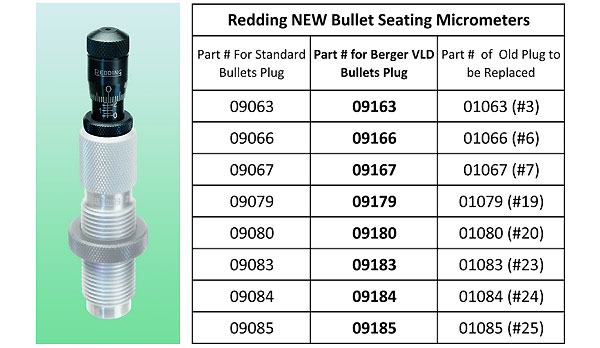
NOTE: the seater assemblies are a component of the bullet seating die. These are not the dies themselves. It is the top portion of the die that contains the plunger, which pushes the bullet into the case. And here is something important: these new Bullet Seating Micrometers are available for both traditional tangent ogive bullet shapes as well as for VLD (secant ogive) bullets.
 That’s right, Redding now offers micrometer seater assemblies made specifically for Berger VLD bullets. These Seating Micrometers allow you to convert a standard seater to a Micrometer seater optimized for VLDs. That’s great news for VLD fans. Eric Stecker of Berger Bullets tells us: “We have confirmed with Redding that each of the new micrometer plugs in the VLD group were designed based on Berger VLD bullets. We provided all of our VLD bullets to Redding, from which they took deliberate measurements and made these new plugs.” That’s right, Redding now offers micrometer seater assemblies made specifically for Berger VLD bullets. These Seating Micrometers allow you to convert a standard seater to a Micrometer seater optimized for VLDs. That’s great news for VLD fans. Eric Stecker of Berger Bullets tells us: “We have confirmed with Redding that each of the new micrometer plugs in the VLD group were designed based on Berger VLD bullets. We provided all of our VLD bullets to Redding, from which they took deliberate measurements and made these new plugs.”
New VLD-specific Seater Stems Improve Bullet Seating Depth Consistency
Stecker explains how the new VLD-specific seater assemblies produce better, more accurate ammo: “Many shooters have problems getting the VLD bullets to shoot because of the bullet seater die they are using. VLD bullet noses are so long and sharp that, in many dies, the bullet tip bottoms out in the bullet seater stem instead of touching on the side of the ogive like it should. Seating depth inconsistencies up to .025″ can occur if the seater stem bottoms out on the bullet tip. The worst part is that many shooters have no idea that this is the root cause of their poor performance. This new product can help turn a frustrating shooting experience into an enjoyable one.”
Story tip from Edlongrange. We welcome submissions from our readers.
February 28th, 2012
Berger Bullets has released a new 6mm (.243 caliber) bullet for short-range (100-300 yards) benchrest applications. The new bullet (shown below right), is called the “6mm BR Column”. This name does not mean the bullet is designed just for the 6mm BR cartridge. Rather it is designed for all 6mm short-range benchrest (BR) rifles, most of which are 6 PPCs (for group shooting at least). The “Column” in the name comes from the fact that Berger has optimized the height of the lead core column inside the bullet. Testing revealed that bullets which had very uniform core column heights shot more accurately and were also easier to tune. Does the new “Column” bullet work? Well, noted benchrest shooter Lou Murdica has already used them to win a Two Gun Agg in Florida against “big name” competition. Thankfully, you won’t have to wait long to try these bullets out — Berger says the new 6mm BR ‘Column’ projectiles will be available in mid-March, 2012. Call Berger at (714) 447-5422 to order.

Bullet Characteristics — Accurate and Easy to Tune
Berger’s Ballistician and lead bullet designer Bryan Litz says this new ‘Column’ bullet should be less sensitive to seating depth: “We worked very hard to produce a bullet that has a wider ‘tuning window’ for peak accuracy. This means there may be several seating depths where it shoots well. We also expect that it can shoot well at different speed nodes, but this will be dependent on your barrel.” The estimated G1 BC for these bullets is 0.277. The meplat is 0.062″, typical of benchrest bullets in this weight class. There is a small pressure ring in the bullet. Recommended twist rate is 1:13.5″ but the bullet should stabilize in a 1:14″ twist-rate barrel.
Berger’s Eric Stecker tells us: “There have been benchrest bullets in the past which were well-known for achieving consistently small groups over a wide tune range in many rifles and loads. One example of this was the Euber bullet. The seemingly ‘magical’ performance of these bullets has been attributed to special dies, stars aligning, owl feathers, or some other unknown influence. However, Bryan Litz has found that there are specific mass balance and aerodynamic properties which allow a bullet to mitigate dispersion and shoot precisely over a wide range of imperfect launch dynamics.”
Dispersion Mitigation in Bullet Design — Bryan Litz Explains
 The science of dispersion-mitigating bullets is understood, but until now, no one has ever deliberately designed a bullet that has these specific attributes. There have been other bullets which have accidentally achieved the partial effect and the resulting bullets became very well known. Three key things are required to develop an effective dispersion-mitigating bullet: The science of dispersion-mitigating bullets is understood, but until now, no one has ever deliberately designed a bullet that has these specific attributes. There have been other bullets which have accidentally achieved the partial effect and the resulting bullets became very well known. Three key things are required to develop an effective dispersion-mitigating bullet:
1. The knowledge required to design a dispersion mitigating bullet.
2. A bullet-maker with the ability to fabricate the design precisely.
3. The means by which to test the bullets extensively to determine optimal configuration.
Berger’s 6mm ‘Column’ bullet is specifically designed to mitigate the component of dispersion related to alignment. Variables related to bullet/bore axis alignment include tight necks, turning necks, bullet jump, chamber concentricity, powder charge, and so on. These are all variables which will be less critical for the new Berger 6mm ‘Column’ bullet.
To be realistic, these new bullets only mitigate dispersion effects related to axis alignment, NOT aiming error, wind deflection, or poor shooting.
 Four Years of Prototype Testing Four Years of Prototype Testing
Yields Superior Bullet Design
Using his knowledge of design factors that mitigate (reduce) dispersion, Berger’s bullet designer Bryan Litz went to work creating a bullet design that had a wide, forgiving tune range. This means that the bullet shoots well with a wide variety of loads and seating depths. Bryan came up with three different shapes. Then for each of these three bullet profiles, Berger tested three different core column heights to identify the truly optimal design. Over the next four years, Lou Murdica shot thousands of test rounds in the data capture phase of the project. When testing concluded, one bullet proved to be head and shoulders above the others in its ability to shoot well at the widest variety of loads and seating depths.
The prototype bullet design that shot best in Berger’s tests has entered production as the new Berger 6mm BR ‘Column’. You’ll notice that there is no listed weight. Berger doesn’t list weight because Berger learned that the bullet’s mass is not as important as the overall balance of the bullet, which is achieved with a specific internal lead column height. Due to slight variations in copper and lead material batches, one lot may weigh 64.8 gr while another lot might weigh 65.1 grains or 64.6 grains. Berger says: “So long as the column of lead is the correct height to achieve the desired balance” the bullets should perform, no matter what the average weight of a given lot of ‘Column’ bullets may be. That said, when loading for a match, you’ll want to load all your ammo with bullets from the same lot.
Berger is now accepting orders for the new 6mm BR ‘Column’ bullets. The first lots should be available around March 16, 2012. Call Berger at (714) 447-5422 for pricing info or to place an order.
February 14th, 2012
Report by German Salazar
The 2012 Berger Bullets Southwest Long Range Nationals fired last week at Phoenix’s Ben Avery Shooting Facility left competitors from all over the US and Canada smiling and ready to return for next year’s event. With over 200 competitors from 40 states and several Canadian provinces, this was truly a national level event and the scores reflected that intensity. However, it wasn’t just about the shooting; as at any large rifle match, renewing old friendships, seeing friends from the AccurateShooter Forum and enjoying time and a few meals with them are just as important.
Complete Individual and Team Match Results will be linked here as soon as available.
F-Open Individual Grand Aggregate (RTF) | Palma Team Results (interim) (PDF)

The week began on Tuesday with a wind reading clinic by Mid Tompkins who knows more about how air moves across a rifle range than just about anyone. Next in line was Wednesday’s 600-yard match, a nice warm-up for the long-range shooting to come. Thursday we got down to business with a Palma team match. The sling winners were the US National Team composed of Trudie Fay, Bryan Litz, Justin Skaret and Peter Church. In F-Open, the winning team was Team Norma/Berger composed of Larry Bartholome, John Brewer, Danny Biggs, and Jim Murphy. The winning F-TR team was the Arizona State Rifle & Pistol Assn. squad, with Warren Dean, John Chilton, Steve Lockwood and German Salazar.

Individual shooting resumed on Friday, Saturday and Sunday as well as one more team match at 1000 yards. Conditions throughout the week were picture perfect as cool mornings gave way to afternoons in the mid 70’s. One of the Canadian shooters mentioned that it was 35 below at home on Saturday while we were in shirt sleeves! The wind was challenging without ever being as vicious as it can be on certain days in Phoenix. More than one Eastern shooter was heard to comment that they had never seen wind as switchy as this. Overall, it tested one’s ability without reaching a level of frustration — just perfect. Trudie Fay was the overall winner in the sling category, Jim Murphy in F-Open and James Croft in F-TR, but many other shooters won cash and bullets from our generous sponsor Berger Bullets as well as many door prizes at the barbeque from Nightforce, Krieger, Leupold, Sierra and many others.
Put this match on your list for next year, it’s well worth the effort. We have 100 firing points (check out the photo below) and we’re ready to put them all to use!

All-Star Instructors Lead Clinic
 A training clinic was held on Feb. 7th (Day 1), with a true all-star cadre of instructors. The clinic started with Nancy Tompkins instructing sling shooters on proper position/shooting style, while Darrell Buell and Larry Bartholome did the same for F-TR and F-Open shooters. Mid Tompkins then conducted a lengthy wind clinic which featured a series of drills at 1000 yards to observe specific wind trends. Many shooters commented on the benefits of the exercise as well as the opportunity to get some ‘trigger time’ before the main event. Finally, Bryan Litz (photo right) gave a class on long-range ballistics. A training clinic was held on Feb. 7th (Day 1), with a true all-star cadre of instructors. The clinic started with Nancy Tompkins instructing sling shooters on proper position/shooting style, while Darrell Buell and Larry Bartholome did the same for F-TR and F-Open shooters. Mid Tompkins then conducted a lengthy wind clinic which featured a series of drills at 1000 yards to observe specific wind trends. Many shooters commented on the benefits of the exercise as well as the opportunity to get some ‘trigger time’ before the main event. Finally, Bryan Litz (photo right) gave a class on long-range ballistics.

November 9th, 2011
 Recently, Berger released two new .30 caliber Hybrid Target bullets, a 215-grainer and a 230-grainer. With this new pair of projectiles, Berger now offers .30 Cal Hybrids in weights of 155 gr, 168 gr, 185 gr, 200 gr, 215 gr, and 230 grains. These bullets use a Hybrid nose designed by Bryan Litz to optimize long-range performance and enhance “tunability”. The Hybrid nose starts with a tangent shape and transitions into a secant shape. This allows these bullets to be much less seating-depth sensitive (than the VLD) while at the same time the secant portion reduces drag (for a higher BC). Berger’s Eric Stecker: “It is my understanding that each of these [new Hybrid] bullets has the highest BC of any bullets in their weight class. Combine this with being easier to tune and what you get is six new projectiles that raise the performance bar for .30 cal rifles.” Recently, Berger released two new .30 caliber Hybrid Target bullets, a 215-grainer and a 230-grainer. With this new pair of projectiles, Berger now offers .30 Cal Hybrids in weights of 155 gr, 168 gr, 185 gr, 200 gr, 215 gr, and 230 grains. These bullets use a Hybrid nose designed by Bryan Litz to optimize long-range performance and enhance “tunability”. The Hybrid nose starts with a tangent shape and transitions into a secant shape. This allows these bullets to be much less seating-depth sensitive (than the VLD) while at the same time the secant portion reduces drag (for a higher BC). Berger’s Eric Stecker: “It is my understanding that each of these [new Hybrid] bullets has the highest BC of any bullets in their weight class. Combine this with being easier to tune and what you get is six new projectiles that raise the performance bar for .30 cal rifles.”

Berger Rolled Out 11 New Bullet Designs in 2011
This has been a busy year for Berger Bullets. It has introduced eleven (11) all-new projectile designs. In addition, Berger re-labeled two of its popular bullets. Here’s a summary of the new offerings:
- 6mm 105 gr Hybrid Target
- .30 cal 155 gr Hybrid Target
- .30 cal 168 gr Hybrid Target
- .30 cal 185 gr Juggernaut Target (Name change — this was formerly called the 185 gr Long Range BT.)
- .30 cal 185 gr Hybrid Target
- .30 cal 200 gr Hybrid Target
- .30 cal 215 gr Hybrid Target
- .30 Cal 230 gr Hybrid Target
- .22 Cal 77 gr OTM Tactical (Name change — this is the same bullet as the .22 cal 77 gr BT Target, but it’s new to the Tactical line).
- .30 Cal 175 gr OTM Tactical (designed for .308 Win to be a transonic-stable option.)
- .30 Cal 185 gr Juggernaut OTM Tactical (designed as a transonic-stable option for the 300 Win Mag.)
- .30 Cal 230 gr Hybrid OTM Tactical (designed as a supersonic option for the 300 Win Mag.)
- .338 Cal 300 gr Hybrid OTM Tactical (this is the redesigned Gen 2 version.)
|


