Hornady plans to start producing .50 BMG ‘Match Grade’ Cartridge Brass. MSRP is $131.99 for twenty (20) cases (Item #8772). Hornady claims the new brass will have very uniform case wall thickness, and very consistent case weight and internal capacity. Hornady has not stated when its .50 BMG brass will start shipping. When the Hornady .50 BMG brass (Item #8772) does hit the market, we expect it will be in high demand. Our friends at the Fifty Caliber Shooters Association (FCSA) tell us that it is “getting harder and harder to get your hands on good .50 Cal brass these days.”
Grafs.com lists the new Hornady .50 BMG brass in its catalog at $101.99 for 20 cases, but inventory (Item HRN8772) is not yet in stock. CLICK HERE to check for updates.
Product tip from EdLongrange. We welcome reader submissions.
Reloaders Rejoice! There’s a new source for bullets, brass, powder, and primers, as well as loaded ammunition. The all-new Bullets.com website offers all these products, plus reloading tools and dies, barrels, gun stocks, scopes, rings, shooting rests, range bags and much more. Primers, you need primers you say? Yes, Bullets.com currently has some types of CCI, Federal, and Remington primers in stock, including the hard-to-find CCI 450 small rifle magnum primers.
You definitely want to include Bullets.com among the vendors you visit when you need components and gun hardware. The new Bullets.com webstore will carry 8,000+ shooting-related products from over 50 top brands such as Lapua, Norma, Federal, CCI, Berger, Sierra, Berry’s, Bald Eagle, Bushnell, Hodgdon, Alliant, Nightforce, Kowa, Vortex, Winchester, MTM, Magpul and many more! Check out the website at www.bullets.com or call 1-800-235-0272 to get a free 60-page color catalog.
POWDERS IN STOCK — Among the popular powders in stock at Bullets.com today are:
Bullets.com carries projectiles from the leading bullet-makers including Berger, Lapua, Sierra, Speer, and Berrys. Yes Bullets.com has premium bullets in stock right now, including the hard-to-find Berger 6mm 105gr Hybrid, and 7mm 180gr Hybrid. Grab ‘em while you can boys!
Along with reloading components, factory ammo, and reloading dies, you’ll find the hardware you need to build a complete rifle. Bullets.com caries Bartlein barrels (in a wide range of calibers and contours), laminated gun stocks, and a full line of optics, including Nightforce, Kowa, and Vortex rifle-scopes and spotting scopes.
Who Are Those Guys? About Bullets.Com Bullets.com was launched as a result of the intense passion for shooting by its President, Shiraz Balolia. Shiraz has been shooting pistols, rifles and shotguns for almost 40 years and has been involved in long range rifle shooting at the National and International level for almost 10 years. He served as the Captain of the U.S. F-Class Open Rifle Team for the 2013 World Championship and was a member of the 4-man team that won the 2013 Nat’l 1,000-yard Championship. He has won numerous gold medals in long range shooting and has set several National records.
Bullets.com is a division of Grizzly Industrial that was started by Mr. Balolia in 1983. During those 30 years, Grizzly became a powerhouse in the metalworking and woodworking machinery industry serving over a million regular customers and growing its warehouses with 1.2 million square feet of space in three states (WA, PA, MO).
In a world where too many companies have down-graded product quality and durability, we’re lucky there are some fanatical Finns who build great stuff for shooters. For serious handloaders, the cartridge brass of choice is made by Lapua in Finland. Lapua brass lasts longer than most other brands of cartridge brass, with industry-leading case-to-case uniformity. How do the Finns manage to make such good brass and loaded ammo? This informative video provides insights into Lapua’s “passion for precision”. This “must watch”, 12-minute video contains a surprising amount of “hard” info on Lapua products, with segments showing Lapua brass and rimfire ammo being produced. Watch carefully and you’ll see most of the processes used for forming and loading brass. Another short segment shows a Lapua technician inspecting a case for run-out.
The video spotlights some of the important American and international records set with Lapua ammo. You’ll see top 300m and Olympic rifle shooters in action, and there are also short comments from many champions, including American Benchrest legend Tony Boyer.
NOTE: This is long video — you may need to let it buffer (pre-load) for 10 seconds before playback. If that doesn’t work, let the entire video load, then hit the replay button. Please enable Javascript and Flash to view this VideoPress video.
Yes, this video is first and foremost a marketing tool, but that doesn’t lessen that fact that it is fascinating to watch. Lapua’s video also does a great job making our sport seem important and exciting — NRA take note! We suspect many of you will want to save the video to your computer for future viewing. That’s easy to do. Just click on the link below. (Note: After downloading, we suggest that PC users play it back through Windows Media Player. You can then drag the Media Player corners to expand the video viewing size.)
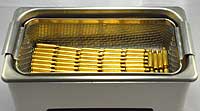
If you’ve read our feature story on Ultrasonic Cleaning by Jason Baney, you’ve seen the remarkable results that can be achieved with this method. Ultrasonic cleaning has many advantages over traditional tumbling methods of case cleaning. There is no dust or media residue to remove from the brass, and when done right, the cases come out clean and shiney, inside and out, even the primer pockets.
In its Benchtalk Archives, Brownell’s has an excellent article discussing Ultrasonic Case Cleaning. Brownell’s staff compares results, with measured dwell times from 5 to 75 minutes, using both Mpro-7 and HCS 200 cleaning solutions. Tests are performed with once-fired and 5X-fired Tactical 20 (Tac20) cases, as well as once-fired .260 Rem Cases. The article also compares the results from ultrasonic cleaning vs. tumbling in walnut media. Below are Brownell’s results for Tac20 cases with the HCS 200 (non-acidic solution). Go to Brownell’s article for MPro7 results and Rem 260 results.
HCS 200 Cleaning Solution Test
Procedure — Solution was de-gassed for 15 minutes, then 63 Tac20 cases were placed in a single layer, in stainless steel mesh basket. The temperature of the starting solution was 102° F. When the cases were removed the temperature was 110° F.
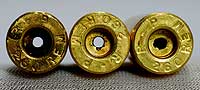
Once-Fired Tactical Twenty Cases (HCS 200) — Observations 5 minutes: The exterior of the cases are not significantly brighter/cleaner. The primer pockets and case interiors are still dirty. 10 minutes: Exterior of the cases are brighter. 70% of the cases show some degree of cleaning of the primer pockets. Little difference seen inside the case, but case mouths are cleaner. 15 minutes: Case brightness is about the same. Still only 70% of the primer pockets are clean, but a larger portion of each is cleaner. A Q-tip swabbed inside the cases shows that carbon/powder residues are loosening up. 20 minutes: Case exteriors are brightening up. 80-85% of the primer pockets are about 90% clean. The insides of the cases and case mouths are cleaner. 25 minutes: Cases are brighter/cleaner than even new brass. 80-85% of the cases have almost completely clean primer pockets. The inside of the cases are 80-90% clean. 30 minutes: The insides of the cases and case mouths appear to be completely clean. 87% of the primer pockets are virtually 100% clean. 13% of the cases had stubborn primer pocket residue that could not be completely removed. 60 minutes: Eight cases (13%) were placed in the tank for another 30 minutes to try to remove the remaining residue in their primer pockets. Six out of the eight cases were completely clean.
Five-Times Fired Tac20 Cases — Observations 30 minutes: Based on the above observations, I didn’t begin to observe these 5-time fired cases until after 30 minutes: The exterior cases are bright/clean. Brighter than new cases. The primer pockets on 75% of the cases are 75% clean. The remaining cases had primer pockets that were only 25% clean. The inside of the cases appear to be clean. 65 minutes: 25% of the primer pockets were 95% clean, 25% of the primer pockets were 90% clean, 25% of the primer pockets were 85% clean; and 25% were 80% clean. 75 minutes: 75% of the primer pockets were 90% clean.
How Does Ultrasonic Cleaning Work? The Brownell’s article explains: “Ultrasonic cleaning uses high-frequency sound waves (generally between 20-80 kHz) to remove a variety of contaminants from objects immersed in a liquid. The result of these high-frequency sound waves is a process called cavitation. These high frequency bursts of ultrasonic energy produce a three-dimensional wave of alternating positive and negative pressure areas as the sound wave passes through the solution. During negative pressure, microscopic cavitation bubbles form and will continue to grown until they reach resonant size. As the positive sound wave passes, the pressure rises rapidly and implodes these tiny bubbles. Before these minuscule bubbles implode they store a tremendous amount of energy. These bubbles can be as hot as 10,000 degrees and have as much as 50,000 lbs per square inch of pressure. This sounds alarming, but you have to remember that these bubbles are microscopic in nature and pose no harm to anything, unless you are a carbon /powder residue deposit on a cartridge case!
When this cavitation bubble implodes near your brass case, it transforms the bubble into a jet about 1/10th of its size. This jet of energy can travel as fast as 400 km/hour. At 43 kHz, as is the frequency for our L & R HCS 200 ultrasonic cleaner, this is happening 43,000 times per second. This micro-burst of extreme energy is responsible for removing contaminants from the surface of your cartridge brass. Ultrasonic cleaning can reach into crevices and inaccessible areas and remove surface debris that can’t be cleaned by any other process.”
Using ultrasound in a liquid solution, you can clean your cartridge brass inside and out. Ultrasonic cleaning is nothing new — we described this process years ago. But with the increased cost of brass, more and more shooters are turning to this effective process to get their cases clean.
Now RCBS offers an affordable Ultrasonic Cleaning Machine with some great features. The new RCBS machine boasts a 3-liter capacty, user-friendly keypad, and a built-in 100-watt heater with four settings. The unit also includes a handy drain valve and drain tube.
Ultrasonic cleaning works fast, without the long processing time (and dust) of conventional tumbling. Cleaning cases with ultrasonic machines has become very popular, as the ultrasonic process reliably removes caked-on carbon and grime from brass cases inside and out, even in the primer pocket. We do recommend that, after ultrasonic cleaning, you consider using a dry neck lube to restore lubricity to your necks for the first and second firings.
The new RCBS ultrasonic cleaner features a large 3-liter capacity, 60 watt transducer, and 100 watt ceramic heater. ‘Street Price’ for the RCBS ultrasonic machine is under $150.00, and this unit qualifies for RCBS Rebates ($10 off $50 purchase or $50 off $300.00 purchase). RCBS also sells 32 oz. bottles of cleaning concentrate that will make up to 10 gallons of Ultrasonic Solution.
by GS Arizona, Riflemans Journal
Neck turning isn’t a once-in-a-while operation at my reloading bench. I shoot a lot, go through a fair amount of brass and neck-turn every piece of brass I use. I like the K&M neck turner, it’s well designed, well made, affordable if you like to have more than one caliber permanently set up and so that’s what I use. The only flaw in the K&M is that the tool itself is small enough that holding it for long and frequent session of neck turning is literally a pain. If you happen to have arthritis, it’s even more so.
Pendergraft Holder for K&M Neck-Turner Joel Pendergraft makes a great tool holder for the K&M that does away with the pain as it gives a much larger and more comfortable gripping surface. The tool holder is made from aluminum, nicely machined and knurled for a good grip. I thought it was well worth the price of $48.00 delivered in the USA (Price may have gone up since this story was written). Switching the tool holder from one K&M turner to another is a matter of loosening the set screw on the side, slipping out one turner, inserting the other and re-tightening. The Pendergraft tool-holder is simple, well-made, fairly priced and a real joy to use. Who could ask for more?
If you have questions or want to order the K&M tool holder, contact Joel Pendergraft via email: joelpend@bellsouth.net .
He who dies with the most toys wins — right? Well Sinclair has another interesting gadget you can add to your reloading bench. The Sinclair Case Neck Sorting Tool lets you quickly sort brass by neck-wall thickness. For those who shoot “no-turn” brass, this can improve neck-tension consistency. Large variances in neck-wall thickness can cause inconsistent neck “grip” on the bullet. Generally, we’ve found that more consistent neck tension will lower ES and (usually) improve accuracy. We know some guys who shoot no-turn 6mmBR brass in competition with considerable success — but their secret is pre-sorting their brass by neck-wall thickness. Cases that are out-of-spec are set aside for sighters (or are later skim-turned).
Watch Case Neck Sorting Tool Operation in Video
How the Case Neck Sorting Tool Works
Here’s how the Sinclair tool works. Cases are rotated under an indicator tip while they are supported on a case-neck pilot and a support pin through the flash hole. The unit has a nice, wide base and low profile so it is stable in use. The tool works for .22 through .45 caliber cases and can be used on .17- and .20-caliber cases with the optional carbide alignment rod. The MIC-4 pin fits both .060 (PPC size) and .080 (standard size) flash holes. Sinclair’s Case Neck Sorting Tool can be ordered with or without a dial indicator. The basic unit without dial indicator (item 749-006-612WS) is currently ON SALE for $49.95, marked down from $64.95 — a 23% savings! You can also buy the tool complete with dial indicator (item 749-007-129WS) for $86.99. IMPORTANT: This tool requires caliber-specific Sinclair Case Neck Pilots which must be ordered separately.
Editor’s Comment: The purpose of this Sinclair tool is rapid, high-quantity sorting of cartridge brass to ascertain significant case-neck-wall thickness variations. Consider this a rapid culling/sorting tool. If you are turning your necks, you will still need a quality ball micrometer tool to measure neck-wall thickness (to .0005) before and after neck-turning operations.
This article by Corey Swantz originally appeared in The Reloading Press, the Sinclair Int’l Blog.
Much less precision is required to get good scores in 3-gun competition than in strictly accuracy-oriented disciplines like F-Class or Benchrest. In 3-gun, [the game is] about hitting targets in the shortest amount of time, not how close to the center of the target you can get or how small the group can be. Ammunition that’s accurate to 1-2 MOA is more than sufficient for 3-gun competition, as the targets tend to be 4-6 MOA in size.
For my personal 3-gun load testing, I used three powders: Varget, IMR 8208 XBR, and Accurate 2230. All three powders gave me good results, but the 8208 XBR was the leader of the pack. I settled on a moderate charge that pushes a 73gr Berger BTHP at about 2,500 fps through my 16″-barreled AR15. While I’m sure I could obtain a higher velocity with these bullets, this speed yielded the best accuracy results in my initial testing with fully prepped brass.
With the high volume of ammunition that I need for 3-gun matches and practice, I wanted to eliminate as many case prep steps as possible and still end up with ammunition that was accurate enough for 3-gun. I fully prepped some once-fired brass from primer pocket to case mouth and everything in between. I also took some once-fired cases that had simply been trimmed to length, and loaded them without doing any other prep work. With these loads in hand, I headed out to the range to shoot some groups. Below are the results from my 200 yard group tests:
Prepped Brass Delivered Higher Score on Bullseye Target
As you can see from the photos, the groups yielded results along the lines of what I expected. The fully-prepped brass produced five 10s , whereas the un-prepped brass produced only two 10s, and both of those just touched the outer edge of the 10-ring.
However, the un-prepped brass kept all the shots inside the 8-ring, which is plenty precise for shooting the large targets used in 3-gun matches.
National Defense Match at Camp Perry
I decided to further test my un-prepped brass loads by shooting them in the National Defense Match (NDM) at Camp Perry and the Rockcastle 3-Gun Pro-Am Championship. At the NDM, the target used in the longer-range stages was a standard-size NRA Tombstone target, similar to the targets used in most 3-gun matches. Using the un-prepped brass loads, I was able to keep all my shots on the tombstone targets from 100-300 yards, and had only one miss from the 400-yard line. That one miss was my fault, as I jerked the trigger on the last shot, pulling it off to the left. Un-prepped brass held up quite well under Camp Perry NDM conditions.
Un-Prepped Good Enough for Class Win at Rockcastle 3-Gun Pro-Am Championship
Two weeks after the NDM, I traveled to Kentucky for the Rockcastle 3-Gun Pro-Am Championship. There were seven stages in this match, two of which required long-range rifle shots with my AR15. The longest stage of the match had eight steel targets sized from 4″ to 10″ in diameter, placed from 75 to 265 yards. My ammunition proved accurate enough at these distances to neutralize all the steel targets with single shots, something few other shooters were able to do. I finished over two seconds ahead of the nearest competitor on this stage and ended up winning the event. Clearly un-prepped brass was plenty good for the Rockcastle 3-Gun Pro Am, too!
Because of the results I’ve gotten on the practice range, and two very solid performances in competition last year, I feel confident that my loading process for the upcoming 3-Gun Nation Semi-Pro Series will consist of simply sizing and trimming brass, then loading it with my preferred recipe. While the fully prepped brass was indeed more accurate, the un-prepped brass loads were accurate enough to allow me to hit 3-gun targets . Now, I can take the time I save in the reloading room and spend it out on the practice range.
Norma announced that Paul-Erik Toivo will take over as CEO of Norma Precision AB, replacing Torb Lindskog who is retiring after 17 years at Norma’s helm. Toivo is a well-respected executive with decades of international industrial experience. He has held senior positions within Cloetta, and the SAKO- Metso- and latest the Isku concerns. Toivo states that Norma, a division of RUAG, is looking to expand its market in the United States: “We will intensify the efforts to grow in the world, and especially in the US. The cooperation with our sister company within RUAG Ammotec will also be strengthened”
Torb Lindskog retires after leading Norma for 17 years. “I am very grateful for these fantastic years at Norma, together with wonderful colleagues and I now look forward to a somewhat less hectic routine, even though I will be part of the Norma board, and keep my Presidency of AFEMS (Assoc. of European Mfgs. of Sporting Ammunition) until 2015. I wish both Norma and Paul-Erik all the best for the future.”
Norma Precision AB, which is part of the Swiss RUAG concern, has annual revenues of 270 Million Swedish Kroner ($41,068,890 USD). With a workforce of 190 employees, Norma markets cartridge brass, bullets, powders, and loaded ammunition. All production, from raw material to finished product, takes place in Åmotfors of Värmland, Sweden.
News Tip by EdLongrange. We welcome reader submissions.
We had a chance to try out the new power case trimmer head from Little Crow Gunworks. Dubbed the “World’s Finest Trimmer” (WFT) by its inventor, Dale Hegstrom, this device proved fast, precise, and easy to use. When compared to a Hornady Lock ‘N Load hand-crank trimmer, the WFT processed cases twice as fast, and delivered a more uniform cut length with our test brass.
The WFT features a steel shell-holder, aluminum body, and steel drive shank. You can chuck it into any electric drill or power device that can handle the 3/8″ shank. Unlike most case trimming tools, the WFT indexes off the shoulder datum. This permits you to trim cases very quickly, without fiddling around with rim-grabbing collets, or shell-holders. Watch the videos to see the WFT in action.
WFT is Fast and User-Friendly
Mark LaFevers, our tester, was easily able to trim five (5) cases in under 30 seconds. It took quite a bit longer to trim five cases with the Hornady trimmer he used for comparison. Mark noted that, after just a 20 or so manually-trimmed cases, his arm would start to fatigue. By contrast, he could effortlessly trim 100 or more cases with the WFT. For older folks with a bit of arthritis, the WFT makes life easier. Mark observed that the WFT produces a “nice, square, clean cut”, while offering a “very fast cycle rate”. He tells us, “once you get the hang of it, you probably can trim your brass two, if not three times as fast.”
Mark really liked the WFT tool, and a WFT will be replacing his hand trimmer for big jobs. One downside is that, currently, the WFT is cartridge specific — you normally need to have a different tool for each cartridge type you trim. And there are no swappable inserts allowing you to trim different cartridge types with the same tool. However some WFT versions WILL trim different cartridge types within the same “family”, such as .270 Win and .30-06.*
Hi-Rez Video Shows “Trim-Off” Challenge between WFT and Hornady Trimmer
You should definitely watch the five-minute video below. Mark trims five cases with the WFT, and then five more with the Hornady tool. He times the operation of each device and then measures the trimmed cases. The total variation (in length) of the WFT-trimmed cases was .001. With the Hornady tool, there was a much larger spread: .007″ (seven thousandths). Mark cautioned: “Normally the Hornady tool does a bit better than this — the variance won’t be so large. But getting better results (with the Hornady) might require trimming, measuring, then trimming again. In the video I was trying to move pretty quickly and the measurements were all taken after the initial trim. Possibly, if I slowed down when using the Hornady trimmer, the OAL measurements would have been more consistent. But that just further reinforces the point that the WFT is faster.”
NOTE: If you have a fast connection, we suggest you select 720p (HiRez) and expand to full screen.
In the video below, WFT creator Dale Hegstrom demos his device and shows how quickly it can trim a large quantity of brass. Note how the WFT is attached to a common rechargeable power drill.
“World’s Finest Trimmer” Costs $69.95
The Little Crow Gunworks “World’s Finest Trimmer is available for $69.95 from various vendors including Creedmoor Sports. WFTs index off the shoulder, not the base. The case fits tightly into a steel bearing which has been machined to a specific caliber. This decouples the stationary case from the spinning cutting blade and body, giving you a smooth, exact cut each time. While the WFT makes a nice, square cut, we do recommend chamfering inside and outside after the brass is trimmed to length.
*Most WFTs are cartridge specific. Available sizes include: .204 Ruger, .223 Rem, 22-250, 6mmBR, 6.5 Grendel, 6.5×47 Lapua, 6.5 Creedmoor, 6.5-284 (and 6mm-284), 6.8 SPC, 270 WSM, 7mm Rem Mag (and 300 Win Mag), .308 Win, 300 WSM, .338 Lapua Magnum. There is a ‘5 in 1′ WFT unit that will handle .17 Rem, .221 Fireball, .222, .223 Rem, and .222 Mag. The 6mmRem unit also works with .257 Roberts and 7×57 Mauser. The .30-06 WFT will trim .270 Win, .280 Rem, and .25-06 as well. And the WFT for Ultramags works with 7mm, 300, and .338 Ultramags.


 Hornady plans to start producing .50 BMG ‘Match Grade’ Cartridge Brass. MSRP is $131.99 for twenty (20) cases (Item #8772). Hornady claims the new brass will have very uniform case wall thickness, and very consistent case weight and internal capacity. Hornady has not stated when its .50 BMG brass will start shipping. When the Hornady .50 BMG brass (Item #8772) does hit the market, we expect it will be in high demand. Our friends at the Fifty Caliber Shooters Association (FCSA) tell us that it is “getting harder and harder to get your hands on good .50 Cal brass these days.”


 Bullets.com was launched as a result of the intense passion for shooting by its President, Shiraz Balolia. Shiraz has been shooting pistols, rifles and shotguns for almost 40 years and has been involved in long range rifle shooting at the National and International level for almost 10 years. He served as the Captain of the U.S. F-Class Open Rifle Team for the 2013 World Championship and was a member of the 4-man team that won the 2013 Nat’l 1,000-yard Championship. He has won numerous gold medals in long range shooting and has set several National records.
 In a world where too many companies have down-graded product quality and durability, we’re lucky there are some fanatical Finns who build great stuff for shooters. For serious handloaders, the cartridge brass of choice is made by
  If you’ve read our feature story on
  The Brownell’s article explains: “Ultrasonic cleaning uses high-frequency sound waves (generally between 20-80 kHz) to remove a variety of contaminants from objects immersed in a liquid. The result of these high-frequency sound waves is a process called cavitation. These high frequency bursts of ultrasonic energy produce a three-dimensional wave of alternating positive and negative pressure areas as the sound wave passes through the solution. During negative pressure, microscopic cavitation bubbles form and will continue to grown until they reach resonant size. As the positive sound wave passes, the pressure rises rapidly and implodes these tiny bubbles. Before these minuscule bubbles implode they store a tremendous amount of energy. These bubbles can be as hot as 10,000 degrees and have as much as 50,000 lbs per square inch of pressure. This sounds alarming, but you have to remember that these bubbles are microscopic in nature and pose no harm to anything, unless you are a carbon /powder residue deposit on a cartridge case!
 When this cavitation bubble implodes near your brass case, it transforms the bubble into a jet about 1/10th of its size. This jet of energy can travel as fast as 400 km/hour. At 43 kHz, as is the frequency for our L & R HCS 200 ultrasonic cleaner, this is happening 43,000 times per second. This micro-burst of extreme energy is responsible for removing contaminants from the surface of your cartridge brass. Ultrasonic cleaning can reach into crevices and inaccessible areas and remove surface debris that can’t be cleaned by any other process.”
 Using ultrasound in a liquid solution, you can clean your cartridge brass inside and out. Ultrasonic cleaning is nothing new — we described this process years ago. But with the increased cost of brass, more and more shooters are turning to this effective process to get their cases clean.


 Joel Pendergraft makes a great tool holder for the K&M that does away with the pain as it gives a much larger and more comfortable gripping surface. The tool holder is made from aluminum, nicely machined and knurled for a good grip. I thought it was well worth the price of $48.00 delivered in the USA (Price may have gone up since this story was written). Switching the tool holder from one K&M turner to another is a matter of loosening the set screw on the side, slipping out one turner, inserting the other and re-tightening. The Pendergraft tool-holder is simple, well-made, fairly priced and a real joy to use. Who could ask for more?
 He who dies with the most toys wins — right? Well Sinclair has another interesting gadget you can add to your reloading bench. The Sinclair
 This article by Corey Swantz originally appeared in The Reloading Press, the Sinclair Int’l Blog.


 “World’s Finest Trimmer” Costs $69.95


