Applied Ballistics has just launched a great, new online resource for shooters: The Science of Accuracy Academy. This subscription-based website is launching with nearly 30 podcast episodes, with many more planned, as well as video content, Zoom classes, and much more.
The main goal of this new online resource is to adapt and modernize the delivery of content coming from Applied Ballistics LLC. In past years, books, DVDs, and seminars were the primary avenues for delivering information. Modern technology has evolved, and the delivery of information can be done in more efficient ways such as streaming videos, podcast discussions of book and seminar content. In addition to being a more modern delivery platform, The Science of Accuracy Academy allows for more frequent updates than traditional books and DVDs.
Bryan Litz, owner of Applied Ballistics LLC tells us: “I’m very excited about this avenue to share what we’re learning in the Applied Ballistics lab. I think many shooters will benefit from the podcasts, which contain very insightful discussions and can be enjoyed in your car, or as you work. We look forward to publishing more of our research thru the Science of Accuracy Academy”.
About the Science of Accuracy Academy Content and Programs
Below, Bryan Litz comments about the Academy’s new podcast offerings and other interactive content. Bryan notes: “We’ve benefited a great deal from practicing the scientific method, and we want to share what we’ve learned.”
Book Content via Podcasts — Many of the podcast episodes are specific reviews of Applied Ballistics book chapters. I’ll sit with Mitch or Francis (both experienced, champion shooters) and discuss the chapter, what it was like to do the tests. We will also discuss behind the scenes problems, as well as what we’ve learned since publishing the books. This lets subscribers get knowledge from the books. And, as a podcast, you can listen while driving, working out, or whatever.
The World of Doppler Radar — In recent years we have spent considerable time visiting shooting matches with the AB Mobile Lab and running Doppler radar. Between that and some of the government contracting work, we’ve built up a lot of experiences and it’s been a long time since a book was published. This Academy is a great outlet for us to update the shooting world on what we’ve been doing and learning.
Ballistics Science and Precision Loading — We’ve been doing hardcore ballistic science for the past few years and have a lot to share. We’ve come to see some aspects of handloading and shooting in a fundamentally different way. For example, understanding the statistical nature of precision has caused us to re-shape how we make decisions in the handloading process. As a result, we now better understand cause-effect relationships and can make deliberate, reliable progress as a result.
Bryan Litz Announces the New Science of Accuracy Academy
The Lighter Side — Bryan told AccurateShooter.com: “Some of the podcast episodes are much less serious! We have fun arguing about which shooting disciplines are harder. For example, Mitch Fitzpatrick and I talk with Francis Colon and Chad Heckler about PRS vs. ELR shooting. We discuss what we like and dislike about the different sports, what we would like to see changed, and what competition shooting has meant for us as individuals. This open-ended format explores long range shooting from the technical to the personal and everything in-between.”
Are you curious about bullet stabilization? Do you understand why bullets can tumble or become unstable if the velocity gets too low or if the twist rate is inadequate. Here is an excellent video from Gunwerks that explains Bullet Stabilization.
This animated video starts by showing the design/shape differences between an older-style rifle bullet and a newer VLD-style bullet with higher BCs (Ballistic Coefficients). Generally speaking, the longer a bullet gets relative to diameter, the more RPM is required for stability. And to achieve that higher RPM you need more barrel twist and/or more RPM. The video illustrates where the Center of Gravity and the Center of Pressure are located. These are farther apart (in relative terms) for a VLD or Hybrid-style, long-nose bullet.
When the bullet is in flight there is an angle of attack. This is exaggerated in the animation for illustration purposes, but it is important to understand the the attack angle affect stability. The rotation rate (Revolutions Per Minute) is a function of bullet velocity as it leaves the muzzle and the twist rate of the barrel. Since long VLD-style bullets need more stability, the barrel twist rate needs to be higher than with shorter, fatter bullets. This is pretty much try for all calibers.
The importance of adequate barrel twist rates for bullet stabilization is further discussed in this next video featuring Bryan Litz of Applied Ballistics:
Bullet Stability and Twist Rates
In this video, Bryan Litz talks about bullet in-flight stability and how to calculate barrel twist-rate requirements for long-range bullets. Bryan explains that bullet stability (for conventional projectiles) is basically provided by the spinning of the bullet. But this spin rate is a function of BOTH the nominal twist rate of the barrel AND the velocity of the projectile. Thus, when shooting the same bullet, a very high-speed cartridge may work with a slower barrel twist rate than is required for a lower-speed (less powerful) cartridge. For match bullets, shot at ranges to 1000 yards and beyond, Bryan recommends a twist rate that offers good stability.
Want to learn more about Long Range Shooting? Check out the NSFF “Elements of Long Range Shooting” videos hosted by ballistics guru Bryan Litz of Applied Ballistics. In this multi-part series, Bryan covers a variety of topics of interest to precision shooters. For today’s Saturday at the Movies special, we feature seven of Bryan’s videos. Watch other informative Long Range Shooting and Ballistics videos with Bryan Litz on the NSSF YouTube Channel.
Atmospherics and Density Altitude
Bryan Litz explains: “An important element in calculating an accurate firing solution for long-range shooting is understanding the effects of atmospherics on a projectile.” Atmospherics include air pressure, air temperature, and humidity. Bryan notes: “Temperature, pressure, and humidity all affect the air density… that the bullet is flying through. You can combine all those factors into one variable called ‘Density Altitude’.” Density Altitude is used by the ballistic solver to account for variables that affect bullet flight.
Bullet Ballistic Coefficients
A bullet’s ballistic coefficient (BC) basically expresses how well the bullet flies through the air. Higher BC bullets have less aerodynamic drag than lower BC projectiles. You will see BCs listed as either G1 and G7 numbers. These correspond to different bullet shape models. Generally speaking, the G7 model works better for the long, boat-tail bullets used for long-range shooting. Notably, a bullet’s drag is NOT constant in flight. The true BC can vary over the course of the trajectory as the bullet velocity degrades. In other words, “BC is dynamic”. That said, you can make very accurate drop charts using the BCs provided by major bullet-makers, as plugged into solvers. However, long-range competitors may want to record “real world” drop numbers at various distances. For example, we’ve seen trajectories be higher than predicted at 500 yards, yet lower than predicted at 1000.
Transonic Range
When considering your rifle’s long-range performance, you need to understand the limit of your bullet’s supersonic range. As the bullet slows below the speed of sound, it enters the transonic zone. This can be accompanied by variations in stability as well as BC changes. Bryan explains “once your bullet slows done below supersonic and you get into transonic effects, there are a lot more considerations that come into play. The drag of the bullet becomes less certain, the stability of the bullet can be challenged, and things related to long times of flight, such as Coriolis and Spin Drift, come into play. So whenever you are shooting long range you need to where your bullet slows down to about 1340 fps.”
Ballistics Solvers — Many Options
Bryan Litz observes: “When we talk about the elements of long range shooting, obviously a very important element is a getting a fire solution, using a ballistic solver. There are a lot of ballistic solvers out there… Applied Ballistics has smartphone Apps. Applied Ballistics has integrated the ballistic solver directly into a Kestral, and the same solver runs (manually) on the Accuracy Solutions Wiz-Wheel. The point is, if it is an Applied Ballistics device it is running the same solutions across the board.”
Bullet Stability and Twist Rates
In this video, Bryan Litz talks about bullet in-flight stability and how to calculate barrel twist-rate requirements for long-range bullets. Bryan explains that bullet stability (for conventional projectiles) is basically provided by the spinning of the bullet. But this spin rate is a function of BOTH the nominal twist rate of the barrel AND the velocity of the projectile. Thus, when shooting the same bullet, a very high-speed cartridge may work with a slower barrel twist rate than is required for a lower-speed (less powerful) cartridge. For match bullets, shot at ranges to 1000 yards and beyond, Bryan recommends a twist rate that offers good stability.
Scope Tracking — Tall Target Test
Have you recently purchased a new scope? Then you should verify the actual click value of the turrets before you use the optic in competition. While a scope may have listed click values of 1/4-MOA, 1/8-MOA or 0.1 Mils, the reality may be slightly different. Many scopes have actual click values that are slightly higher or lower than the value claimed by the manufacturer. The small variance adds up when you click through a wide range of elevation. In this video, Bryan Litz shows how to verify your true click values using a “Tall Target Test”. The idea is to start at the bottom end of a vertical line, and then click up 30 MOA or so. Multiply the number of clicked MOA by 1.047 to get the claimed value in inches. For example, at 100 yards, 30 MOA is exactly 31.41 inches. Then measure the difference in your actual point of impact.
Coriolis Effect
The Coriolis Effect comes into play with extreme long-range shots. The rotation of the earth actually moves the target a small distance (in space) during the long duration of the bullet’s flight. Bryan Litz notes that, in most common shooting situations inside 1K, Coriolis is not significant. At 1000 yards, the Effect represents less than one click (for most cartridge types). Even well past 1000 yards, in windy conditions, the Coriolis Effect may well be “lost in the noise”. But in very calm conditions, when shooting at extreme ranges, Bryan says you can benefit from adjusting your ballistics solution for Coriolis: “The Coriolis Effect… has to do with the spin of the earth. The consequence of that is that, if the flight time of the bullet gets significantly long, the bullet can have an apparent drift from its intended target. The amount [of apparent drift] is very small — it depends on your latitude and azimuth of fire on the planet.”
About Bryan Litz
Bryan began his career as a rocket scientist, quite literally. He then started Applied Ballistics, the leading company focusing on ballistics science for rifle shooting. A past F-TR Long-Range National Champion and Chief Ballistician for Berger Bullets, knows his stuff. His Applied Ballistics squad was the winning team at the 2017 King of 2 Miles event, and Applied Ballistics has earned major U.S. defense contracts.
Here’s a smart tip from Bryan Litz, explaining how damage to a bullet jacket can harm the projectile’s Ballistic Coefficient (BC). This tip is posted on Bryan’s new Bryan Litz Ballistics Facebook page. We recommend you subscribe to that page to access Bryan’s latest informative posts.
Bryan notes: “If the case mouth scratches the bullet when you seat it, the damage can cause the BC to be inconsistent, which shows up as vertical dispersion at long range.
We see this sometimes when running Doppler Radar for competitors at Applied Ballistics Mobile Lab events. If someone is shooting a bullet that typically has a very consistent BC (1% or less) but they’re seeing a higher BC variation, it can be due to the bullets being damaged in the loading process.”
The lead photo above shows the badly-scratched jacket of a bullet seated in a rough-mouthed case. To prevent such jacket damage, one should chamfer, deburr, and smooth case mouths after trimming.
Below is a recorded Doppler radar result showing excessive BC variation. Such variation can increase vertical disperson at long range. This can result in larger group sizes and lower scores.
Applied Ballistics (AB) has announced the deployment schedule for the Applied Ballistics Mobile Laboratory during the 2022 shooting season. The Applied Ballistics Crew will be driving the Mobile Lab Truck and Trailer to a number of important shooting events in 2022. At these events you can get a Personal Drag Model (PDM) for your rifle/load based on Doppler Radar testing. The first deployment will be at the Bomber Run match in Indiana on February 18, 2022, just two weeks away. Here is the overall 2022 schedule:
The Applied Ballistics Mobile Lab trailer carries a vast array of equipment including computers, sensors, and advanced Doppler Radar equipment. The Doppler Radar is employed to create custom ballistic profiles (aka “Personal Drag Models”) for shooters at major matches.
Personal Drag Models (PDMs) provide shooters with exact, precise ballistics data for their preferred ammo as fired in their match rifles. This is especially important for rimfire ammo which may start supersonic, then go transonic, and finish well subsonic during much of its flight. Bryan Litz explains: “The Doppler Radar system allows us to track the bullet’s velocity as it flies down-range. As the bullet’s velocity decays, that’s what tells you the ballistic coefficient, the drag, and [other factors].”
About the Applied Ballistics Mobile Lab
Q: What is the basic purpose of the Applied Ballistics Mobile Lab?
Mitchell Fitzpatrick: The Mobile Lab allows us to effectively carry out ballistics testing in the field and at events. It has most of the capabilities of our normal lab, but on wheels.
Q: What hardware and electronics are carried in the Mobile Lab? What are its capabilities?
Bryan Litz: The Mobile Lab will transport most everything that’s in the main lab including the Doppler radar. This rig is new and we haven’t fully outfitted it yet. The load-outs will be somewhat flexible depending on the venue we are supporting.
The online video format is a superior method of presenting information on reloading techniques, rifle maintenance, marksmanship skills, scope operation and much more. But with millions of videos on YouTube, it can be hard to cherry-pick the best videos for serious shooters and competitors. That’s why we offer this Saturday at the Movies Series. Each week we will select a variety of very informative videos by knowledgeable shooters and handloaders. Here are our first five Saturday Select videos for 2022.
Reading the Wind — How to Determine Wind Speed
Keith Glasscock is a top-tier F-Class shooter who has finished second at the F-Class Nationals multiple times. Keith is also a highly-respected wind coach with a background in commercial aviation — so he really understands wind and weather. In this video Keith explains the best techniques for reading the speed of the wind. He notes that you can’t simply rely on the Kestrel in your hand because the wind speed can vary significantly between the firing line and the targets. Keith shows how to look at multiple signs (including flags, grass movement, and mirage) to better understand wind velocity. See more of Keith’s videos on his Winning in the Wind YouTube channel.
Rodzilla T-Rex Front Rest Review — State-of-the-Art Beast
In this video our friend F-Class John reviews the impressive T-Rex front rest from Rodzilla.This recently-introduced joystick front rest from Rodzilla really represents significant innovation. The new T-Rex offers impressive capabilities based on the innovative design by creator Rod Brackage (the “Rod” in Rodzilla”> that can truly take your shooting experience to the next level. F-Class John used this rest in F-Open competition and really likes it. CLICK HERE for John’s full review with three videos and many more photos.
How BAT Actions Are Made and BAT Factory Tour
Note: This has loud music as the start — lower volume if at work.
Ultimate Reloader’s Gavin Gear is a skilled and respected video producer. This Ultimate Reloader video shows how top-end BAT rifle actions are crafted with modern CNC machinery. This is one of Gavin’s most popular videos, with 763,000+ views. If you are interested in accurate rifles for benchrest, F-Class, Long Range, or PRS/NRL you should definitely watch this video. Visit Gavin’s YouTube Channel to see dozens of other informative, well-made videos.
Protect Your Dog’s Hearing with Mutt Muffs
Do you take your dog(s) hunting, or to the shooting range? Well dogs need hearing protection too! Loud gunshots from pistols, rifles, or shotguns can cause permanent hearing damage to your canine. Prevent canine hearing loss with Mutt Muffs — protective earmuffs designed especially for dogs. In the Precision Riflecraft video, the host shows how to fit Mutt Muffs to your dogs and help your canines tolerate the muffs in place. Available in five sizes (XS, S, M, L, XL), these cost under $60 on Amazon.
How to Use Ballistics Solvers — Bryan Litz Lesson
A past national F-TR champion, Bryan Litz is a brilliant engineer and trained rocket scientist. He is also the founder of Applied Ballistics LLC (AB), the world’s leading source of ballistics software. AB software now comes integrated into some Kestrel handheld wind-reading units, with accompanying Applied Ballistics Apps that run on your mobile devices. In this short video Bryan explains how to use ballistics solvers to determine your bullet’s drop and drift at long range. If you don’t have the AB App on your smartphone you can also use the excellent JBM Ballistics Solver, available FREE on the internet.
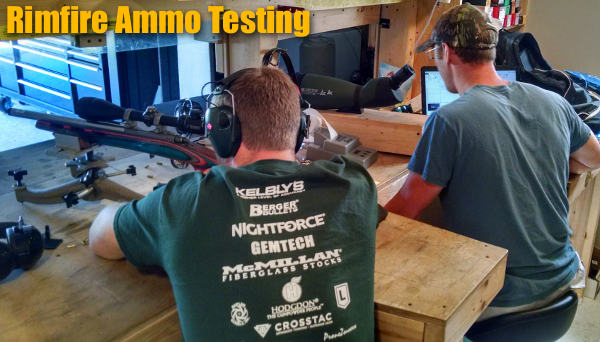
Photo shows Bryan Litz (on right) and tester Mitchell Fitzpatrick. Bryan said: “Only 2,445 rounds to go! We’re testing over 50 ammo types in five different twist barrels… science can be exhausting!”
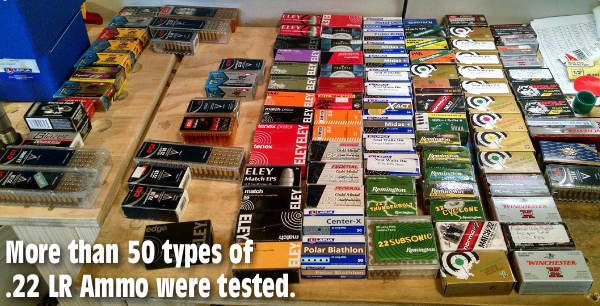
Do you know the actual BC (Ballistic Coefficient) of your rimfire ammunition? Well Applied Ballistics has the data, thanks to a comprehensive, marathon ammo testing session. Some years back, in an effort to determine the “real world” BCs of various rimfire ammo types, Bryan Litz and his team at Applied Ballistics did an extraordinary, in-depth shooting test. Litz and company tested over fifty types of .22 LR ammo, using five different twist-rate barrels. This was one of the most comprehensive and through rimfire ammo tests ever done.
Bryan tolds us: “We tested many types of .22 rimfire ammo for the 2nd Edition of the Ballistic Performance of Rifle Bullets book. We used a pair of Oehler chronographs to measure velocity at the muzzle (MV) and velocity at 100 yards.” With these numbers (average and SD) Bryan can calculate G1 BCs for all the 50+ types of rimfire ammo. What’s more, because every sample is shot through five different barrels (each with a different twist rate) Bryan can also determine how velocity is affected by twist rate.
The tests are primarily to determine velocities for BC calculations — this was not an accuracy test. Bryan explains: “Our tests are not really looking at accuracy, mainly because that’s so subjective to different rifles. Our testing is primarily focused on measuring the BC of rimfire rounds from different twist-rate barrels. The MVs and BCs from the different twist test barrels was then published by Applied Ballistics in print books. Bryan Litz told us: “The .22 LR Rimfire data was originally published in Ballistic Performance of Rifle Bullets, 2nd Edition, which is now out of print. The 3rd Edition of that book doesn’t have rimfire data. The rimfire testing results and data were re-published in Modern Advancements in Long Range Shooting – Volume II (along with many other topics).
Bringing Science to the Rimfire World
Bryan’s goal with this project was to increase the rimfire knowledge base: “We hope to give the world of .22 LR rimfire a good dose of science. How is the BC of .22 rimfire ammo affected by barrel twist? Do subsonic rounds have more consistent BCs than supersonic or transonic rounds? What brands have the highest BCs? What brands have the most consistent MVs?”
Data from two Oehler chronographs is recorded in a computer. Ammo samples were tested in five (5) different barrels (of varying twist rates). Give credit to Dane Hobbs who supplied a test rifle, multiple barrels, and most of the ammo types for the test.
.22 LR at 300 Yards?
Bryan also conducted some longer range rimfire tests. His interesting findings have appeared in the Modern Advancements in Long Range Shooting book series. Bryan notes: “While .22 rimfire isn’t typically considered ‘long range’, we were able to consistently hit a two-MOA steel target at 300 yards with the trajectory predicted by AB software and the measured BC of some standard .22 LR rimfire ammo. The info we’’re generating may make it possible to push the range of target engagement for a round that’s not seen much advancement in many decades.”
Wind effects are complex. In trying to access wind speeds and angles, you’ll want to watch multiple indicators — mirage, dust, wind-flags, grass movement, and more. You’ll also need to be concerned about wind cycles. In the video below, Bryan Litz talks about variable wind speed along a bullet’s flight path. A respected ballistics guru, Bryan is the founder of Applied Ballistics and a designer of Berger’s Hybrid Match projectiles. He is also a past F-TR National Champion and a High Master Palma ace.
In this video, Bryan discusses how wind effects can vary in intensity at different points along the bullet’s flight path to the target. Sometimes the firing line is sheltered, and the strongest winds come into effect in the middle of the trajectory. Bryan concludes: “Wind matters everywhere … but the best thing you can do is try to get a handle on the wind [velocity and angle] where you are. That may or may not represent the wind down-range — that’s when you have to look downrange and make a judgment[.]”
Litz Competition Tip: Select your wind shooting strategy carefully. For beginners and veterans, most points are typically lost to wind. Successful shooters put a lot of thought into their approach to wind shooting. Sometimes it’s best to shoot fast and minimize the changes you’ll have to navigate. Other times it’s best to wait out a condition which may take several minutes. Develop a comfortable rest position so you have an easier time waiting when you should be waiting.
More Wind Tips from Wind Wizard Emil Praslick
In these two short videos, Emil Praslick III, former coach of the USAMU and USA National long range teams, explains how to find the wind direction and how to confirm your no-wind zero. Praslick is widely considered to be one of the best wind coaches in the USA.
When Winds Are EXTREME — Near Gale Force at Ben Avery
This video shows INSANE winds at NBRSA 100/200 Benchrest Nationals. This was filmed at the Ben Avery Range in Phoenix, AZ during the recent NBRSA 100/200 yard National Championships. Extreme to say the least. Based on what we’re seeing here, there are 20-25 mph crosswinds, with gusts to 35 mph — near Gale Force. Video by Hall-of-Fame Benchrest competitor Gene Bukys, whom we sadly lost to COVID last year. RIP Gene.
Texas gunsmith Mike Bryant reports: “This video shows the Unlimited Class 200 at the Nationals in Phoenix. I had three 10-shot groups in the low 2″ range with a 2.228″ being my big group and was glad they weren’t bigger. Thursday and Friday were the worst of the windy days. Unfortunately those were the days for the UL 200 and it was about as windy through most all of the Sporter 200.”
Excellent Wind Reading Resource
The Wind Book for Rifle Shooters covers techniques and tactics used by expert wind-readers. The authors provide a wind-reading “toolbox” for calculating wind speed, direction, deflection and drift. They explain how to read flags and mirage, record and interpret your observations, and time your shots to compensate for wind. Here are two reviews:
This is a must-have book if you are a long-range sport shooter. I compete in F-Class Open and when read it from cover to cover, it helped me understand wind reading and making accurate scope corrections. Buy this book, read it, put into practice what it tells you, you will not be disappointed. — P. Janzso
If you have one book for wind reading, this should be it. It covers how to get wind speed/direction from flags, mirage, and natural phenomenon. This is the best book for learning to read wind speed and direction. — Muddler
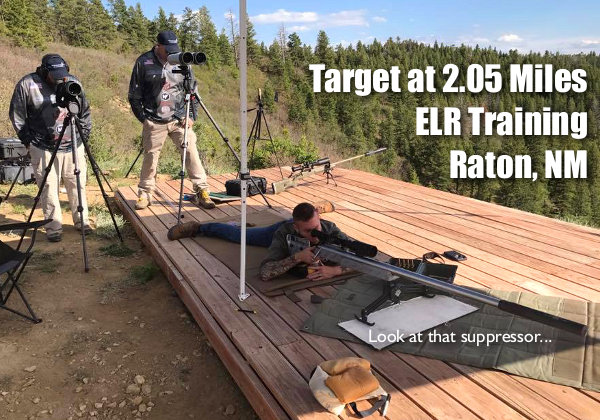
The 2021 King of 2 Miles ELR competition officially commenced yesterday at the Whittington Center in Raton, New Mexico. This unique event, the “Olympics” of Extreme Long Range (ELR) shooting, attracts many of the best marksmen on the planet, campaigning rifles capable of mind-blowing accuracy at extreme distances. The bullet, barrel, and optics technology on display was impressive — as was the amazing marksmanship. Ryan Cheney is leading the KO2M Qualifications after Day 1&2, shooting perfect 3-for-3s without a miss at 1692, 2097, and 2376 yards, and getting one hit at the most distant 2550-yard target. SEE Day One and Two Results.
Here are some of the cartridges used in ELR Competition. With these high-capacity cartridges, many competitors are using ultra-precision lathe-turned solid bullets.
Big ELR Cartridges left to right: .460 Steyr, .416 Barrett, .375 CheyTac, 33XC, .338 Lapua Magnum, and .300 Remington Ultra Magnum.
Top Results in 2021 Qualifications
Here are the sixteen highest-scoring shooters at the 2021 KO2M match, after two days of qualifications. The Top 16 advance to the Finals tomorrow.
Watch K02M Run from 2019 with 360-degree Views
Here is Bryan Litz Shooting K02M in 2019. NOTE, you can slide left/right to get a 360-degree view of the firing line — give it a try! View on Facebook, if 360° movie does not appear on your device.
Here are Target Distances and Angles
Paul Phillips, 2019 K02M Champion, posted: “I’m very happy with Clay Rhoden with Longshot Cameras and James Devoglaer with KVR Ranch. They performed very well today in qualifications. They hit every plate out to 2550 yards [after the cold bore target]. [This was] their first time at King of 2 Miles!”
Shown below is the ammunition Paul Phillips loaded for his Global Precision Group team using Cutting Edge lathe-turned bullets:
Applied Ballistics Brings High-Tech Gear to the KO2M Competition
The Applied Ballistics Team arrived early in Raton to do testing with their high-tech Doppler Radar equipment. This can provide very precise custom ballistics profiles for the ELR rifles. When you’re shooting at these extreme ranges, your come-up tables have to be perfect.
“Goooooood Moooooorning New Mexico! It’s a BEAUTIFUL day on the range! We’re setting up the Mobile Lab on the Cooper Range at the NRA Whittington Center and we’ll be hanging out in this gorgeous place.”
No this isn’t the King of 2 Miles ELR event. But it is the rimfire equivalent — the King of 0.28 Miles (roughly 500 yards). Every year in Minnesota a challenging rimfire match is held at the scenic Rush Lake Range. This combines PRS-style stage shooting out to 300+ yards, along with prone rimfire ELR shooting out to the full “point28 miles”. The 2021 King of point28 Miles match kicked off on August 27, 2021, and concludes today, August 29, 2021. CLICK HERE for LIVE Video from 8/29/21 match, courtesy Applied Ballistics LLC.
The King of point28 Miles match features custom-painted steel targets
Here is an interesting rimfire rig with a unique front end.
Video from 2019 Match (Don’t mind the distorted first frame — the video is excellent!)
Tactical Rimfire and .22 LR Rimfire ELR
As conducted in recent years, the King of point28 Miles has been a unique “hybrid” type of competition. The match begins with multiple tactical-style stages with steel targets at various distances. Many of the steel targets are custom-painted, some with elaborate faces. Some stages included PRS/NRL-style barricades or support structures. In past years there have been some specialty targets such as the Accushot One-Shot Challenge (see right) which uses playing cards.
After the shorter stages, there is the namesake “point28 Miles” competition, with dozens of competitors lined up prone shoot distant targets — starting at about 300 yards and moving out progressively to targets 0.28 miles away (about 500 yards). How challenging is that? Consider this — at 500 yards a .22 LR rimfire cartridge may be only traveling 610 fps while a 10mph 90-degree wind can deflect the bullet 8.75 feet off point-of-aim!*
Competitor in Long-Range prone event with Masterpiece Arms (MPA) Chassis rifle.
Custom Personal Drag Models (PDMs) for Rimfire Competitors
The Team from Applied Ballistics was on hand for the King of point28 match. They brought the AB Mobile Lab trailer with its computers, sensors, and advanced Doppler Radar equipment. The Doppler Radar was employed to create custom ballistic profiles (aka “Personal Drag Models”) for 90+ shooters.
Personal Drag Models (PDMs) provide shooters with exact, precise ballistics data for their preferred ammo as fired in their match rifles. This is especially important for rimfire ammo which may start supersonic, then go transonic, and finish well subsonic during much of its flight. Bryan Litz explains: “The Doppler Radar system allows us to track the bullet’s velocity as it flies down-range. As the bullet’s velocity decays, that’s what tells you the ballistic coefficient, the drag, and [other factors].”
Prizes Galore for King of point28 Miles Competitors
With a big list of sponsors, the King of point28 Miles Match always has an impressive prize table. Vudoo Gunworks and Accurate Rifle Systems also provided a Match Charity Rifle.
Interesting 4-wheeled range carts from sponsor Range Tactical Gear. Carts are priced from $395 to $650.
* Trajectory calculated with JBM Ballistics based on .22-cal 40gr bullet with 1150 fps muzzle velocity and 0.125 G1 BC. With that BC and MV, the drop at 500 yards from 100-yard zero is 20.1 MOA. Rimfire bullets launched at higher MVs, or which have higher BCs, will exhibit less drop and less wind drift.






 Bryan tolds us: “We tested many types of .22 rimfire ammo for the 2nd Edition of the


 Paul Phillips, 2019 K02M Champion, posted: “I’m very happy with Clay Rhoden with


 Tactical Rimfire and .22 LR Rimfire ELR


