Want to improve your understanding of Ballistics, Bullet Design, Bullet Pointing, and other shooting-related tech topics? Well here’s a treasure trove of gun expertise. Applied Ballistics offers dozens of FREE tech articles on its website. Curious about Coriolis? — You’ll find answers. Want to understand the difference between G1 and G7 BC? — There’s an article about that.
“Doc” Beech, technical support specialist at Applied Ballistics says these articles can help shooters working with ballistics programs: “One of the biggest issues I have seen is the misunderstanding… about a bullet’s ballistic coefficient (BC) and what it really means. Several papers on ballistic coefficient are available for shooters to review on the website.”
Credit Shooting Sports USA Editor John Parker for finding this great resource. John writes: “Our friends at Applied Ballistics have a real gold mine of articles on the science of accurate shooting on their website. This is a fantastic source for precision shooting information[.] Topics presented are wide-ranging — from ballistic coefficients to bullet analysis.”
Here are six (6) of our favorite Applied Ballistics articles, available for FREE to read online. There are dozens more, all available on the Applied Ballistics Education Webpage. After Clicking link, select Plus (+) Symbol for “White Papers”, then find the article(s) you want in the list. For each selection, then click “Download” in the right column. This will send a PDF version to your device.
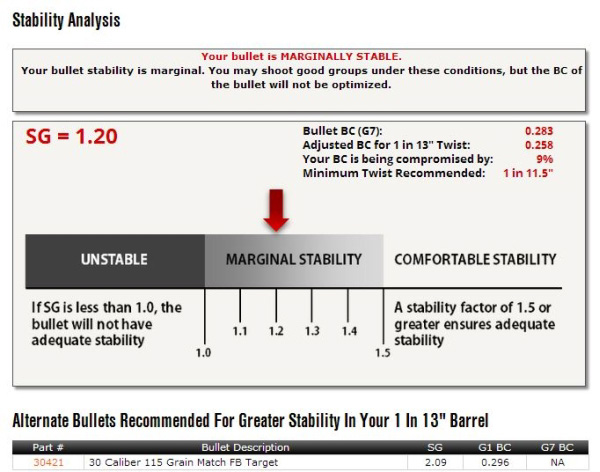
Berger Twist-Rate Stability Calculator On the Berger Bullets website you’ll find a handy Twist-Rate Stability Calculator that predicts your gyroscopic stability factor (SG) based on mulitiple variables: velocity, bullet length, bullet weight, barrel twist rate, ambient temperature, and altitude. This cool tool tells you if your chosen bullet will really stabilize in your barrel.
How to Use Berger’s Twist Rate Calculator
Using the Twist Rate Calculator is simple. Just enter the bullet DIAMETER (e.g. .264), bullet WEIGHT (in grains), and bullet overall LENGTH (in inches). On its website, Berger conveniently provides this info for all its bullet types. For other brands, we suggest you weigh three examples of your chosen bullet, and also measure the length on three samples. Then use the average weight and length of the three. To calculate bullet stability, simply enter your bullet data (along with observed Muzzle Velocity, outside Temperature, and Altitude) and click “Calculate SG”. Try different twist rate numbers (and recalculate) until you get an SG value of 1.4 (or higher).
Gyroscopic Stability (SG) and Twist Rate
Berger’s Twist Rate Calculator provides a predicted stability value called “SG” (for “Gyroscopic Stability”). This indicates the Gyroscopic Stability applied to the bullet by spin. This number is derived from the basic equation: SG = (rigidity of the spinning mass)/(overturning aerodynamic torque).
If you have an SG under 1.0, your bullet is predicted not to stabilize. If you have between 1.0 and 1.1 SG, your bullet may or may not stabilize. If you have an SG greater than 1.1, your bullet should stabilize under optimal conditions, but stabilization might not be adequate when temperature, altitude, or other variables are less-than-optimal. That’s why Berger normally recommends at least 1.5 SG to get out of the “Marginal Stability” zone.
In his book Applied Ballistics For Long-Range Shooting (3rd Ed.), Bryan Litz (Berger Ballistician) recommends at least a 1.4 SG rating when selecting a barrel twist for a particular bullet. This gives you a safety margin for shooting under various conditions, such as higher or lower altitudes or temperatures.
Story idea from EdLongrange. We welcome reader submissions.
For those headed to the Nationals, we are sharing some smart tips from a past F-Class Champion who is both a great shooter AND a ballistics wizard. In 2015, Bryan Litz won the F-TR Mid-Range AND Long-Range National Championships hosted at Ben Avery. And at the 2014 Berger SW Nationals (SWN), Bryan took top honors among all sling shooters. If you only know Bryan Litz from his Applied Ballistics Books and DVDs, you may not realize that this guy is a also great marksman along with being an actual rocket scientist!
Given his impressive track record in both F-Class and Palma (Fullbore) out to 1000 yards, we asked Bryan if he had any advice for other long-range competitors.
First Bryan provided three tips concerning Ballistics, his special area of expertise. Next Bryan offered three more general tips about long-range competition — how to analyze your shooting, how to choose your ‘wind strategy’, and how to avoid the most costly mistakes, i.e. how to avoid the “train-wrecks”.
Bryan Litz won the 2015 F-TR Mid-Range and Long-Range Championships with this sleek rig:
Litz Ballistics Tips
Ballistics TIP ONE. If you’re having trouble getting your ballistic software to match actual drops, you need to look at a number of possible reasons. Here are some common issues that can cause problems.
Click Values Are Not Exact. Scopes and iron sights don’t always produce accurate adjustments. In other words, if your ballistics program predicts 30 MOA of drop, and you dial 30 MOA but hit low, it might be that your sight actually only moved 28 MOA (for example). To see if your sight is adjusting accurately, shoot a tall target at 100 yards and measure group separation when dialing your sight.
Barometric vs. Station Pressure. This is a commonly misunderstood input to ballistics programs. You can avoid this pitfall by remembering the following: station pressure is the actual measured pressure at your location, and you don’t need to tell the program your altitude when using station pressure. Barometric pressure is corrected for sea level. If you’re using barometric pressure, you also have to input your altitude.
Muzzle Velocity. Chronographs are not always as accurate as shooters think they are — your true MV may be off by 10-20 fps (or more). If your drop is different than predicted at long range, it might be because your muzzle velocity input is wrong.
Mixing Up BC (G1 vs. G7). Knowledgeable long range shooters know that the G7 standard is a more representative standard for modern LR bullets. However, using G7 BCs isn’t just a matter of clicking the ‘G7′ option in the program. The numeric value of the BC is different for G1 and G7. For example, the G1 BC of the Berger 155.5 grain Fullbore bullet is .464 but the G7 BC is .237. If you were to enter .464 but click on G7, the results would be way off.
Ballistics TIP TWO. A properly installed level is absolutely essential for long range shooting. Without a good level reference, your long range wind zero will be off due to minor canting of the rifle from side to side. You can verify that your level is installed correctly on a 100-yard ‘tall target’. Draw a plumb line straight up the target and verify that your groups track straight up this line as you go up in elevation.
Ballistics TIP THREE. If your long range ballistic predictions aren’t tracking, always come back and verify your 100-yard zero. Sometimes a simple zero shift can be misconstrued as errors in long range ballistics predictions.
Litz Competition Shooting Tips
Competition TIP ONE. Improving your scores in long range competition is a constant process of self-assessment. After each match, carefully analyze how you lost points and make a plan to improve. Beginning shooters will lose a lot of points to fundamental things like sight alignment and trigger control. Veteran shooters will lose far fewer points to a smaller list of mistakes. At every step along the way, always ask yourself why you’re losing points and address the issues. Sometimes the weak links that you need to work on aren’t your favorite thing to do, and success will take work in these areas as well.
Competition TIP TWO. Select your wind shooting strategy carefully. For beginners and veterans, most points are typically lost to wind. Successful shooters put a lot of thought into their approach to wind shooting. Sometimes it’s best to shoot fast and minimize the changes you’ll have to navigate. Other times it’s best to wait out a condition which may take several minutes. Develop a comfortable rest position so you have an easier time waiting when you should be waiting.
Competition TIP THREE. Actively avoid major train wrecks. Sounds obvious but it happens a lot. Select equipment that is reliable, get comfortable with it and have back-ups for important things. Don’t load on the verge of max pressure, don’t go to an important match with a barrel that’s near shot out, physically check tightness of all important screws prior to shooting each string. Observe what train wrecks you and others experience, and put measures in place to avoid them.
The .375 EnABELR cartridge is slightly shorter than a .375 CheyTac so it allows the round to mag-feed. Applied Ballistics is currently using brass made by Peterson. The .375 EnABELR has achieved impressive velocities — 2990 FPS — with prototype Berger 379-grain solid bullets fired from a 1:7″-twist 30″ barrel. Applied Ballistics may also test 1:8″-twist and 1:9″-twist barrels. READ Bullet Testing Report.
The .375 EnABELR cartridge was designed to offer .375 CheyTac performance in a slightly shorter package: “The problem with the .375 CheyTac is that, when loaded with the highest performance .375 caliber bullets (379-407 gr Berger Solids, and the 400-425 grain Cutting Edge Lazers) the round is not magazine feed-able in any action that’s sized for CheyTac cartridges.
“Knowing the .375 CheyTac produced substantial performance, and that it was just too long for magazine feeding, made it easy to converge on a design for the .375 EnABELR. We just had to make the case short enough to achieve magazine length with the desired bullets, while adding a little more diameter to keep the case capacity similar to the .375 CheyTac. The resulting basic shape is quite similar in proportions to the successful .338 Norma Magnum Cartridge which, interestingly, was selected as the cartridge for General Dynamics Lightweight Medium Machine Gun (LWMMG).”
Here is Mitchell Fitzpatrick, shooting the 375 EnABELR in an ELR Competition.
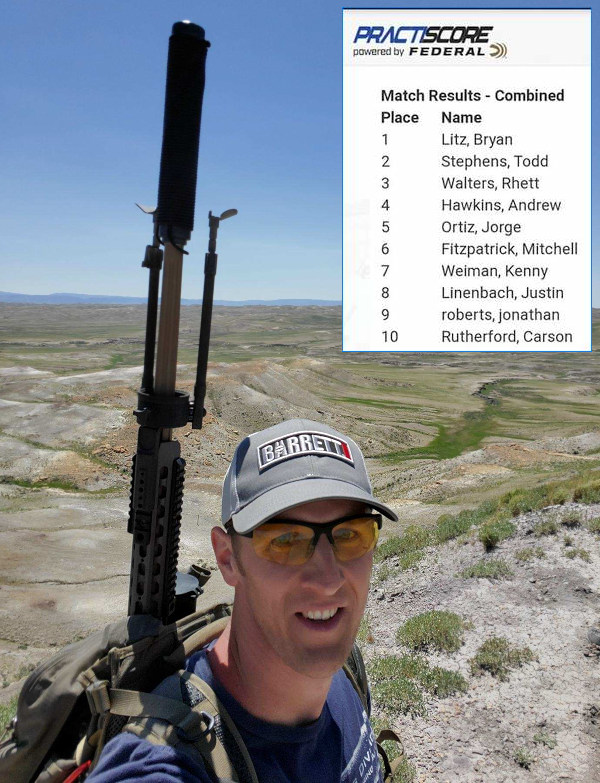
A major ELR match took place this past weekend in Wyoming, the Nightforce ELR Steel Challenge. A familiar name finished first — Applied Ballistics founder Bryan Litz. Bryan had a convincing victory over some 220 other shooters. Bryan earned praise from his colleague and past K02M winner Mitchell Fitzpatrick: “Congrats to Bryan Litz on winning the 2021 Nightforce ELR Steel Challenge! This match is tough, and winning it is no small feat… especially considering there were 221 competitors this year. Bryan and I were both shooting Barrett MRADs in .300 Norma with Nightforce 5-25 ATACR scopes, shooting Berger Bullets 245gr Elite Hunters pushed by VV N565. Absolutely killer combination.”
The match was held June 12-13 2021, at the Tillard 55 Ranch near Casper, Wyoming. This major ELR competition feature some amazing terrain, plus targets out to 2100 yards.
After the match, Bryan told us: “I learned a lot shooting this match last year. Came back with a better plan and more suitable equipment (stock Barrett MRAD in .300 Norma Magnum, Berger 245gr Hybrids, Vihtavuori N565). I also got a lot of great advice from my team-mates who are more experienced in this kind of competition. For ballistics I ran the Garmin Tactix with the Personal Drag Model (PDM) from Radar testing on Friday — it was SPOT ON.
Thanks to Scott Satterlee and his awesome crew of ROs. This match takes a lot of work to set up. Also thank Nick Setting and all the sponsors… especially title sponsor Nightforce. Looking forward to coming back next year!”
Here’s Bryan taping data to his rifle — a tip he got from Chase Stroud.
Personal Drag Models Set with Doppler Radar
Bryan Litz wasn’t just there to compete. Prior to the match Bryan and his Applied Ballistics Team helped competitors develop custom Long Range Ballistics curves for their loads and rifles. This was done with sophisticated Doppler Radar units. As Bryan noted: “Doesn’t get any better than a [ballistics] model built from a Radar track of YOUR bullets from YOUR rifle, the day before the match.”
During Personal Drag Model testing, participants would shot 10 rounds under the Radar. Once the PDM data was gathered, Bryan explained to the testers how to use the custom curve with Applied Ballistics software.
Match Was a Sell-Out with Huge Prize Table
Was this a popular event? Does this ELR stuff generate interest among commercial sponsors?
Absolutely. With 221 shooters, the event was a “sell-out”, with many folks who had to be turned away. The list of sponsors is staggering — over 60 companies — so the prize tables were over-flowing with gear. With great scenery and this treasure trove of prizes, we understand why the match is so popular.
2021 Nightforce ELR Steel Challenge Sponsors
Accuracy International USA
Alamo Precision Rifles
American Precision Arms
American Rifle Company, Inc.
Applied Ballistics LLC
BadRock Rifles
Barrett
Bartlein Barrels, Inc
Bison Tactical
Bix’n Andy USA
Blue Mountain Precision
Brux Barrels
Bullet Central
Burris Optics
Cole-Tac
Cutting Edge Bullets
Defiance Machine
Elite Iron
Foundation Stocks
Garmin
GRAYBOE
Gunwerks
Hawkins Precision
Hawk Hill Custom
Hornady
H-S Precision
Impact Shooting
Kahles North America
Kelbly’s Actions
Kestrel Ballistics
KMW Long Range Solutions
Kreiger Barrels
Leupold Optics
Lilja Precision Rifle Barrels
Lone Peak Arms
Magnetospeed LLC
Modular Driven Technologies – MDT
Mile High Shooting Accessories
Nightforce Optics
Precision Rifle Works
PROOF Research
Really Right Stuff SOAR
Reasor Precision
Sako
Sawtooth Rifles
SilencerCo
SPUHR
SWAROVSKI OPTIK Hunting
Revic
Terminus Actions
Tikka
Timney Triggers
Triggertech
U.S. Optics
Vapor Trails
Warhorse Development
Warner Tool Company
West Texas Ordnance
WieBad.com
XLR Industries
Zermatt Arms
ZRO Delta
Figure 1. When the bullet is seated farther out of the case, there is more volume available for powder. This enables the cartridge to generate higher muzzle velocity with the same pressure.
Effects Of Cartridge Over All Length (COAL) And Cartridge Base To Ogive (CBTO) – Part 1 by Bryan Litz forBerger Bullets.
Many shooters are not aware of the dramatic effects that bullet seating depth can have on the pressure and velocity generated by a rifle cartridge. Cartridge Overall Length (COAL) is also a variable that can be used to fine-tune accuracy. It’s also an important consideration for rifles that need to feed rounds through a magazine. In this article, we’ll explore the various effects of COAL, and what choices a shooter can make to maximize the effectiveness of their hand loads.
Sporting Arms and Ammunition Manufacturers’ Institute (SAAMI)
Most loading manuals (including the Berger Manual), present loading data according to SAAMI (Sporting Arms and Ammunition Manufacturers’ Institute) standards. SAAMI provides max pressure, COAL and many other specifications for commercial cartridges so that rifle makers, ammo makers, and hand loaders can standardize their products so they all work together. As we’ll see later in this article, these SAAMI standards are in many cases outdated and can dramatically restrict the performance potential of a cartridge.
Bullet seating depth is an important variable in the accuracy equation. In many cases, the SAAMI-specified COAL is shorter than what a hand loader wants to load their rounds to for accuracy purposes. In the case where a hand loader seats the bullets longer than SAAMI specified COAL, there are some internal ballistic effects that take place which are important to understand.
Effects of Seating Depth / COAL on Pressure and Velocity
The primary effect of loading a cartridge long is that it leaves more internal volume inside the cartridge. This extra internal volume has a well known effect; for a given powder charge, there will be less pressure and less velocity produced because of the extra empty space. Another way to look at this is you have to use more powder to achieve the same pressure and velocity when the bullet is seated out long. In fact, the extra powder you can add to a cartridge with the bullet seated long will allow you to achieve greater velocity at the same pressure than a cartridge with a bullet seated short.
When you think about it, it makes good sense. After all, when you seat the bullet out longer and leave more internal case volume for powder, you’re effectively making the cartridge into a bigger cartridge by increasing the size of the combustion chamber. Figure 1 illustrates the extra volume that’s available for powder when the bullet is seated out long.
Before concluding that it’s a good idea to start seating your bullets longer than SAAMI spec length, there are a few things to consider.
Geometry of a Chamber Throat
The chamber in a rifle will have a certain throat length which will dictate how long a bullet can be loaded. The throat is the forward portion of the chamber that has no rifling. The portion of the bullet’s bearing surface that projects out of the case occupies the throat (see Figure 2).
The length of the throat determines how much of the bullet can stick out of the case. When a cartridge is chambered and the bullet encounters the beginning of the rifling, known as the lands, it’s met with hard resistance. This COAL marks the maximum length that a bullet can be seated. When a bullet is seated out to contact the lands, its initial forward motion during ignition is immediately resisted by an engraving force.
Seating a bullet against the lands causes pressures to be elevated noticeably higher than if the bullet were seated just a few thousandths of an inch off the lands.
A very common practice in precision reloading is to establish the COAL for a bullet that’s seated to touch the lands. This is a reference length that the hand loader works from when searching for the optimal seating depth for precision. Many times, the best seating depth is with the bullet touching or very near the lands. However, in some rifles, the best seating depth might be 0.100″ or more off the lands. This is simply a variable the hand loader uses to tune the precision of a rifle.
A lot of folks use a Kestrel Wind Meter every time at the range. That’s a good thing. However, many Kestrel owners may not be employing the Kestrel properly when seeking wind direction.
A Kestrel Wind Meter will record wind speed with its impeller wheel. However, to get the most accurate wind velocity reading, you need to have your Kestrel properly aligned with the wind direction. To find wind direction, first orient the Kestrel so that the impeller runs at minimal speed (or stops), and only then turn the BACK of the Kestrel into the wind direction. Do NOT simply rotate the Kestrel’s back panel looking for the highest wind speed reading — that’s not the correct method for finding wind direction. Rotate the side of the Kestrel into the wind first, aiming for minimal impeller movement. The correct procedure is explained below by the experts at Applied Ballistics.
How to Find the Wind Direction with a Kestrel Wind Meter
Here is the correct way to determine wind direction with a Kestrel wind meter when you have no environmental aids — no other tools than a Kestrel. (NOTE: To determine wind direction, a mounted Wind Vane is the most effective tool, but you can also look at flags, blowing grass, or even the lanyard on your Kestrel).
Step 1: Find the wind’s general direction.
Step 2: Rotate the Wind Meter 90 degrees, so that the wind is impacting the side (and not the back) of the wind meter, while still being able to see the impeller.
Step 3: Fine-tune the direction until the impeller drastically slows, or comes to a complete stop (a complete stop is preferred). If the impeller won’t come to a complete stop, find the direction which has the lowest impact on the impeller.
Step 4: Turn the BACK of the Kestrel towards the direction from which the wind is blowing. Then press the capture button, and record your wind speed.
Do NOT simply point the Kestrel’s back into the wind until you get the highest wind speed — that’s not the correct method.
On the Applied Ballistics Facebook page a few seasons ago, Ballistician Bryan Litz posed a “Tuesday Trivia” question about ballistics. This being Tuesday we thought we’d bring back this interesting brain-teaser — a true/false question about bullet stabilization. On shooting forums you often find heated arguments about “over-stabilization”. Bryan wants readers to consider the issue of over-stabilization and answer a challenge question…
Is This Statement TRUE or FALSE?
“The problem with ‘over-stabilizing’ a bullet (by shooting it from an excessively fast twist rate) is that the bullet will fly ‘nose high’ on a long range shot. The nose-high orientation induces extra drag and reduces the effective BC of the bullet.”
True or False, and WHY?
Click the “Post Comment” link below to post your reply (and explain your reasoning).
Bullet Movement in Flight — More Complicated Than You May Think
Bullets do not follow a laser beam-like, perfectly straight line to the target, nor does the nose of the bullet always point exactly at the point of aim. Multiple forces are in effect that may cause the bullet to yaw (rotate side to side around its axis), tilt nose-up (pitch), or precess (like a spinning top) in flight. These effects (in exaggerated form) are shown below:
Yaw refers to movement of the nose of the bullet away from the line of flight. Precession is a change in the orientation of the rotational axis of a rotating body. It can be defined as a change in direction of the rotation axis in which the second Euler angle (nutation) is constant. In physics, there are two types of precession: torque-free and torque-induced. Nutation refers to small circular movement at the bullet tip.
Applied Ballistics Founder Bryan Litz and Former USAMU and Team USA coach Emil Praslick III share their wisdom in an informative Guns Magazine Podcast. Along with being a true ballistics guru, Bryan Litz is an outstanding competitive shooter, having won F-TR National Championships, and both Sling and F-TR divisions at the Berger SW Nationals, along with many other matches. Emil is considered one of the world’s great wind-readers and team coaches, having coached 20+ championship teams.
Guns Magazine podcast host Brent Wheat asks Bryan and Emil about multiple topics including: exterior ballistics, bullet design, wind reading, ballistic solvers, BC myths, and more.
Brent reports: “Together, Bryan and Emil understand what happens from the time a bullet leaves the muzzle until it impacts the target, including the atmospheric affects along the way. Grab a pencil, listen in, and get ready to take notes.”
This Long Range Grad School podcast features Berger’s Chief Ballistician, Bryan Litz, and Berger’s Emil Praslick. Both have extensive long range competitive shooting experience, with championship titles (as shooter and/or coach) in a multitude of long range disciplines. CLICK arrow below to start podcast audio:
Emil Praslick (left) confers with Bryan Litz (right) at King of 2 Miles ELR Event.
In this Video Emil Praslick explains his methods for determining wind direction.
Bryan Litz coaching Team USA in Canada using a WIND PLOT.
Bryan Litz at 2011 World Long Range (Palma) Championships in Brisbane, Australia
Have you recently purchased a new scope? Then you should verify the actual click value of the turrets before you use the optic in competition (or on a long-range hunt). While a scope may have listed click values of 1/4-MOA, 1/8-MOA or 0.1 Mils, the reality may be slightly different. Many scopes have actual click values that are slightly higher or lower than the value claimed by the manufacturer. The small variance adds up when you click through a wide range of elevation.
In this video, Bryan Litz of Applied Ballistics shows how to verify your true click values using a “Tall Target Test”. The idea is to start at the bottom end of a vertical line, and then click up 30 MOA or so. Multiply the number of clicked MOA by 1.047 to get the claimed value in inches. For example, at 100 yards, 30 MOA is exactly 31.41 inches. Then measure the difference in your actual point of impact. If, for example, your point of impact is 33 inches, then you are getting more than the stated MOA with each click (assuming the target is positioned at exactly 100 yards).
How to Perform the Tall Target Test
The tall target test determines if your scope is giving you the proper amount of adjustment. For example, when you dial 30 MOA, are you really getting 30 MOA, or are you getting 28.5 or 31.2 MOA? The only way to be sure is to verify, don’t take it for granted! Knowing your scopes true click values insures that you can accurately apply a ballistic solution. In fact, many perceived inaccuracies of long range ballistics solutions are actually caused by the scopes not applying the intended adjustment. In order to verify your scope’s true movement and calculate a correction factor, follow the steps in the Tall Target Worksheet. This worksheet takes you thru the ‘calibration process’ including measuring true range to target and actual POI shift for a given scope adjustment.
NOTE: When doing this test, don’t go for the maximum possible elevation. Do NOT max out the elevation knob, running it to the top stop. Bryan Litz explains: “It’s good to avoid the extremes of adjustment when doing the tall target test. I don’t know how much different the clicks would be at the edges, but they are not the same.”
Tall Target Test For Milrad Scopes with B2B Target
This Precision Rifle Network video shows how to do a scope-tracking test using the pre-printed Sniper’s Hide Tall Target from Box to Bench Precision (B2B). With the primary line divisions in MILs, this printed target is perfect for Milliradian scopes. From bottom of the vertical line to the top there are 10 mils (36 inches) of travel. The markings are high contrast to make the testing easier.
In this video, there are some very helpful tips on setting up the target frame correctly and making sure the Tall Target is perfectly vertical. A plumb line can help. In this video the vertical tracking of a Burris XTR III 5.5-30x56mm scope is tested. Actual testing begins at 7:20 time-mark. The Precision Rifle Network has many other informative videos, with a new video released every week.
Should You Perform a WIDE Target Test Too?
What about testing your windage clicks the same way, with a WIDE target test? Bryan Litz says that’s not really necessary: “The wide target test isn’t as important for a couple reasons. First, you typically don’t dial nearly as much wind as you do elevation. Second, your dialed windage is a guess to begin with; a moving average that’s different for every shot. Whereas you stand to gain a lot by nailing vertical down to the click, the same is not true of windage. If there’s a 5% error in your scope’s windage tracking, you’d never know it.”
Verifying Scope Level With Tall Target Test
Bryan says: “While setting up your Tall Target Test, you should also verify that your scope level is mounted and aligned properly. This is critical to insuring that you’ll have a long range horizontal zero when you dial on a bunch of elevation for long range shots. This is a requirement for all kinds of long range shooting. Without a properly-mounted scope level (verified on a Tall Target), you really can’t guarantee your horizontal zero at long range.”
NOTE: For ‘known-distance’ competition, this is the only mandatory part of the tall target test, since slight variations in elevation click-values are not that important once you’re centered “on target” at a known distance.



 The
The 




 Effects Of Cartridge Over All Length (COAL) And Cartridge Base To Ogive (CBTO) – Part 1

 On the


 Verifying Scope Level With Tall Target Test


