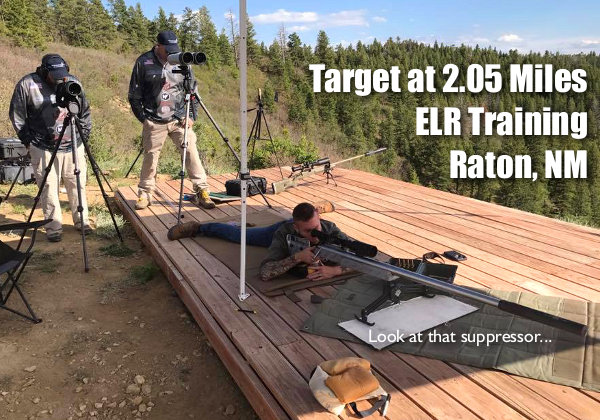
Photo by Werner Mehl, www.kurzzeit.com, all rights reserved.
Most serious shooters can tell you the muzzle velocity (MV) of their ammunition, based on measurements taken with a chronograph, or listed from a manufacturer’s data sheet. (Of course, actual speed tests conducted with YOUR gun will be more reliable.)
Bullet RPM = MV X 720/Twist Rate (in inches)
However, if you ask a typical reloader for the rotational rate of his bullet, in revolutions per minute (RPM), chances are he can’t give you an answer.
Knowing the true spin rate or RPM of your bullets is very important. First, spin rate, or RPM, will dramatically affect the performance of a bullet on a game animal. Ask any varminter and he’ll tell you that ultra-high RPM produces more dramatic hits with more “varmint hang time”. Second, RPM is important for bullet integrity. If you spin your bullets too fast, this heats up the jackets and also increases the centrifugal force acting on the jacket, pulling it outward. The combination of heat, friction, and centrifugal force can cause jacket failure and bullet “blow-ups” if you spin your bullets too fast.
Accuracy and RPM
Additionally, bullet RPM is very important for accuracy. Nearly all modern rifles use spin-stablized bullets. The barrel’s rifling imparts spin to the bullet as it passes through the bore. This rotation stabilizes the bullet in flight. Different bullets need different spin rates to perform optimally. Generally speaking, among bullets of the same caliber, longer bullets need more RPM to stabilize than do shorter bullets–often a lot more RPM.
It is generally believed that, for match bullets, best accuracy is achieved at the minimal spin rates that will fully stabilize the particular bullet at the distances where the bullet must perform. That’s why short-range 6PPC benchrest shooters use relatively slow twist rates, such as 1:14″, to stabilize their short, flatbase bullets. They could use “fast” twist rates such as 1:8″, but this delivers more bullet RPM than necessary. Match results have demonstrated conclusively that the slower twist rates produce better accuracy with these bullets.
On the other hand, Research by Bryan Litz of Applied Ballistics has shown that with long, boat-tailed bullets, best accuracy may be achieved with twist rates slightly “faster” than the minimum required for stabilization. The reasons for this are somewhat complex — but it’s something to consider when you buy your next barrel. If, for example, the bullet-maker recommends a 1:8.25″ twist, you might want to get a true 1:8″-twist barrel.
Calculating Bullet RPM from MV and Twist Rate
The lesson here is that you want to use the optimal RPM for each bullet type. So how do you calculate that? Bullet RPM is a function of two factors, barrel twist rate and velocity through the bore. With a given rifling twist rate, the quicker the bullet passes through the rifling, the faster it will be spinning when it leaves the muzzle. To a certain extent, then, if you speed up the bullet, you can use a slower twist rate, and still end up with enough RPM to stabilize the bullet. But you have to know how to calculate RPM so you can maintain sufficient revs.
Bullet RPM Formula
Here is a simple formula for calculating bullet RPM:
MV x (12/twist rate in inches) x 60 = Bullet RPM
Quick Version: MV X 720/Twist Rate = RPM
Example One: In a 1:12″ twist barrel the bullet will make one complete revolution for every 12″ (or 1 foot) it travels through the bore. This makes the RPM calculation very easy. With a velocity of 3000 feet per second (FPS), in a 1:12″ twist barrel, the bullet will spin 3000 revolutions per SECOND (because it is traveling exactly one foot, and thereby making one complete revolution, in 1/3000 of a second). To convert to RPM, simply multiply by 60 since there are 60 seconds in a minute. Thus, at 3000 FPS, a bullet will be spinning at 3000 x 60, or 180,000 RPM, when it leaves the barrel.
Example Two: What about a faster twist rate, say a 1:8″ twist? We know the bullet will be spinning faster than in Example One, but how much faster? Using the formula, this is simple to calculate. Assuming the same MV of 3000 FPS, the bullet makes 12/8 or 1.5 revolutions for each 12″ or one foot it travels in the bore. Accordingly, the RPM is 3000 x (12/8) x 60, or 270,000 RPM.
Implications for Gun Builders and Reloaders
Calculating the RPM based on twist rate and MV gives us some very important information. Number one, we can tailor the load to decrease velocity just enough to avoid jacket failure and bullet blow-up at excessive RPMs. Number two, knowing how to find bullet RPM helps us compare barrels of different twist rates. Once we find that a bullet is stable at a given RPM, that gives us a “target” to meet or exceed in other barrels with a different twist rate. Although there are other important factors to consider, if you speed up the bullet (i.e. increase MV), you MAY be able to run a slower twist-rate barrel, so long as you maintain the requisite RPM for stabilization and other factors contributing to Gyroscopic Stability are present. In fact, you may need somewhat MORE RPM as you increase velocity, because more speed puts more pressure, a destabilizing force, on the nose of the bullet. You need to compensate for that destabilizing force with somewhat more RPM. But, as a general rule, if you increase velocity you CAN decrease twist rate. What’s the benefit? The slower twist-rate barrel may, potentially, be more accurate. And barrel heat and friction may be reduced somewhat.
Just remember that as you reduce twist rate you need to increase velocity, and you may need somewhat MORE RPM than before. (As velocities climb, destabilizing forces increase somewhat, RPM being equal.) There is a formula by Don Miller that can help you calculate how much you can slow down the twist rate as you increase velocity.
That said, we note that bullet-makers provide a recommended twist rate for their bullets. This is the “safe bet” to achieve stabilization with that bullet, and it may also indicate the twist rate at which the bullet shoots best. Though the RPM number alone does not assure gyroscopic stability, an RPM-based calculation can be very useful. We’ve seen real world examples where a bullet that needs an 8-twist barrel at 2800 FPS MV, would stabilize in a 9-twist barrel at 3200 FPS MV. Consider these examples.
MV = 2800 FPS
8-Twist RPM = 2800 x (12/8) x 60 = 252,000 RPM
MV = 3200 FPS
9-Twist RPM = 3200 x (12/9) x 60 = 256,000 RPM
Of course max velocity will be limited by case capacity and pressure. You can’t switch to a slower twist-rate barrel and maintain RPM if you’ve already maxed out your MV. But the Miller Formula can help you select an optimal twist rate if you’re thinking of running the same bullet in a larger case with more potential velocity.
The digital archives of Shooting Sports USA magazine (SSUSA) features an Expert Forum on Wind Reading. This outstanding article on wind reading starts off with a section by ballistics guru Bryan Litz, author of Applied Ballistics for Long-Range Shooting. Then four of the greatest American shooters in history share their personal wind wisdom. Lanny Basham (Olympic Gold Medalist, author, Winning in the Wind), Nancy Tompkins (Past National HP Champion, author, Prone and Long-Range Rifle Shooting), David Tubb (11-Time Camp Perry National Champion), and Lones Wigger (Olympic Hall of Fame) all offer practical wind-reading lessons learned during their shooting careers.
Whether you shoot paper at Perry or prairie dogs in the Dakotas, this is a certified “must-read” resource on reading the wind. Here is a sample selection from the article:
Shooting Sports USA magazine (SSUSA) has a modern, mobile-friendly website with tons of great content. Log on to www.ssusa.org. There you’ll find current news stories as well as popular articles from the SSUSA archives. The SSUSA website also includes match reports, gear reviews, reloading advice, plus expert marksmanship tips from the USAMU.
Christmas is coming soon. Books have always been popular holiday gifts. If you haven’t completed your holiday shopping, here are some recommended titles that should please the serious shooters and firearms enthusiasts on your shopping list. For shooting clubs, books also make great end-of-season member awards. Most of us would rather have a useful book than one more piece of wood to toss in a box in the closet. Check out these twelve titles — for yourself or your shooting buddies.
Here Are TWELVE BOOKS Recommended for Serious Shooters:
If you’re a serious long-range shooter, consider adding this book to your library. Relying on extensive ballistics testing, Modern Advancements Volume II is a great successor to Volume I that contains some fascinating research results. UK gun writer Laurie Holland notes: “Volume II of the Modern Advancements series is as fascinating as Volume I and if anything even more valuable given a series of ‘mythbusters’ tests including: case fill-ratio, primer flash-hole uniforming, neck tension, annealing, and much more. The work also addresses that perennial discussion of a bullet ‘going to sleep’ and shooting smaller groups (in MOA) at longer distances than 100 yards.” The amount of testing done for this Volume II work, with a staggering amount of rounds sent downrange, makes this book unique among shooting resources. There is a ton of “hard science” in this book — not just opinions.
Glen Zediker’s latest book, Top-Grade Ammo, is a great resource for all hand-loaders — beginners through advanced. This 314-page guide covers every aspect of the reloading process — component sorting, priming, sizing, bullet seating and more. With 430 photos, Top-Grade Ammo is a richly-illustrated, step-by-step guide to producing high-quality handloads. Unlike many reloading books, Top-Grade Ammo is current and up-to-date, so it covers modern practices and the latest precision reloading tools. While Zediker focuses on producing match-grade ammo for competition, this book will also help novice reloaders on a budget. This book features a special “lay-flat” binding so it’s easy to use as a benchtop reference. To view Chapter List and sample pages visit ZedikerPublishing.com.
Thinking of getting started in the Practical/Tactical shooting game? Looking for ways to be more stable when shooting from unconventional positions? Then you may want to read Marcus Blanchard’s Practical Shooter’s Guide (A How-To Approach for Unconventional Firing Positions and Training). Unlike almost every “how to shoot” book on the market, Blanchard’s work focuses on the shooting skills and positions you need to succeed in PRS matches and similar tactical competitions. Blanchard provides clear advice on shooting from barricades, from roof-tops, from steep angles. Blanchard says you need to train for these types of challenges: “I believe the largest factor in the improvement of the average shooter isn’t necessarily the gear; it’s the way the shooter approaches obstacles and how they properly train for them.”
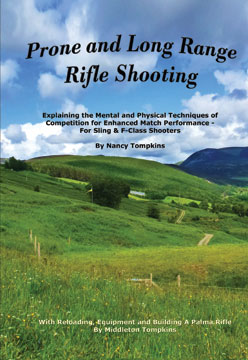
Nancy Tompkins is one of the greatest long-range shooters in American history. She has won five National Long-range Championships. Tompkins’ treatise is a must-read for serious Palma, F-Class, and High Power shooters. The revised Second edition includes F-Class equipment and techniques, and newly updated information. Color pictures. Topics include Mental & Physical training, Reading Wind & Mirage Shooting Fundamentals, International Competition, and Loading for Long Range. Nancy Tompkins is a 4-time winner of the National Long Range Championships, and has won countless other major events. Nancy has been on six Palma Teams (as both a shooter and a coach).
Ryan Cleckner is noted for his ability to explain complex topics in an easy-to-comprehend manner. Now Cleckner has authored a book, the Long Range Shooting Handbook, which expands on the topics covered in Cleckner’s popular NSSF video series. The Long Range Shooting Handbook is divided into three main categories: What It Is/How It Works, Fundamentals, and How to Use It. “What It Is/How It Works” covers equipment, terminology, and basic principles. “Fundamentals” covers the theory of long range shooting. “How to Use It” gives practical advice on implementing what you’ve learned, so you can progress as a skilled, long range shooter. You can view Sample Chapters from Ryan’s Book on Amazon.com.
Tony Boyer, the most successful shooter in the history of short-range benchrest competition, shares many of his match-winning tips in this 323-page book. The book covers all aspect of the benchrest discipline: loading, windflags, rest set-up, addressing the rifle, and match strategies. This is a high-quality publication, filled with valuable insights. Every serious benchrest shooter should read Tony’s book. Boyer has dominated registered benchrest in a fashion that will never be duplicated, having amassed 142 U.S. Benchrest Hall of Fame points. The next closest shooter, Allie Euber, has 47 Hall of Fame points. This handsome, full-color book is 323 pages long, with color photos or color illustrations on nearly every page.
This book should be on the shelf of every short-range benchrest shooter. (Shooters in other disciplines will find the book helpful as well.) Butch Lambert says Mike’s book is “far and away the best Benchrest book written. Very comprehensive, it touches on every aspect of our game.” Mike’s 368-page book is dedicated to getting the most from modern rifle accuracy equipment with an emphasis on shooting 100-200-300 yard group benchrest tournaments. This book covers the most popular hardware plus new equipment offerings are covered, including external mount scopes, actions, triggers, stocks, wind flags, and more. Also covered are rifle handling techniques, note taking, tuning, bullet selection, goals, and match strategies. Mike provides many tips that will help active competitors update their own competitive program.
This book by 11-time National High Power Champion David Tubb focuses on position shooting and High Power disciplines. Section One covers fundamentals: position points, natural point of aim, breathing, triggering mechanics and follow-through, sling selection and use, getting started, getting better, avoiding obstacles. Section Two covers mechanics of offhand, sitting, and prone positions. Section Three covers shooting skills, including wind reading and mental preparation. Section Four covers the technical side of shooting, with extensive disuctions of rifle design, load development, reloading barrel maintenance, and rifle fitting. We consider this book a “must-read” for any sling shooter, and there is plenty of good advice for F-Class shooters too.
Rifle Accuracy Facts by Harold R. Vaughn, (Softcover and Hardcover, Used Price Varies)
Decades after it was written, Vaughn’s work remains a seminal treatise on accuracy. Vaughn was a serious scientist, working for the Sandia National Laboratories. Many “gun writers” toss out hunches about rifle accuracy. Vaughn, by contrast, did serious empirical testing and statistical analysis. Vaughn wondered why some guns shot well while seemingly identical rifles did not. Rifle Accuracy Facts covers a wide variety of topics, including internal ballistics, chamber design, barrel vibration, bullet imbalance, external ballistics, scope design and more. Writer Boyd Allen notes: “If you are serious about precision shooting, Vaughn’s book belongs in your library.”
Many of our Forum members have recommended The Wind Book for Rifle Shooters by Linda Miller and Keith Cunningham. This 146-page book, first published in 2007, is a very informative resource. But you don’t have to take our word for it. If you click this link, you can read book excerpts on Amazon.com. This lets you preview the first few chapters, and see some illustrations. Other books cover wind reading in a broader discussion of ballistics or long-range shooting. But the Miller & Cunningham book is ALL about wind reading from cover to cover, and that is its strength. The book focuses on real world skills that can help you accurately gauge wind angle, wind velocity, and wind cycles. NOTE: The new Hardback Edition will release in February 2019, but you can pre-order now.
Bullseye Mind (Mental Toughness for Sport Shooting) by Dr. Raymond Prior, $14.00 (Softcover).
Having a Bullseye Mind means thinking in ways that create confidence and consistency, even under pressure. A “must-read” for competitive shooters, Bullseye Mind is a mental training book written specifically for the shooting sports. The book is well-organized, with handy highlighted lists and key “talking points”. Each chapter concludes with examples from a world-class shooters such as: Matt Emmons, 2004 Olympic Gold Medalist; Vincent Hancock, 2-time Olympic Gold Medalist; Jamie Corkish, 2012 Olympic Gold Medalist; Petra Zublasing, 2014 World Champion/ISSF Shooter of the Year; and Nicco Campriani, 2012 Olympic Gold Medalist, 2010 World Champion. This book has earned rave reviews from competitive shooters who found it really helped their “Mental Game”. One recent purchaser states: “This book is as though you had a coach in your back pocket…”
Cartridges of the World (15th Edition, 2016), belongs in every serious gun guy’s library. This massive 680-page reference contains illustrations and basic load data for over 1500 cartridges. If you load for a wide variety of cartridges, or are a cartridge collector, this book is a “must-have” resource. The latest edition includes 50 new cartridges and boasts 1500+ photos. The 15th Edition of Cartridges of the World includes cartridge specs, plus tech articles on Cartridge identification, SAAMI guidelines, wildcatting, and new cartridge design trends. In scope and level of detail, Cartridges of the World is the most complete cartridge reference guide in print. Cartridges of the World now includes a 64-page full-color section with feature articles.
Many guys getting started in long range shooting are confused about what kind of scope they should buy — specifically whether it should have MIL-based clicks or MOA-based clicks. Before you can make that decision, you need to understand the terminology. This article, with a video by Bryan Litz, explains MILS and MOA so you can choose the right type of scope for your intended application.
You probably know that MOA stands for “Minute of Angle” (or more precisely “minute of arc”), but could you define the terms “Milrad” or “MIL”? In his latest video, Bryan Litz of Applied Ballitics explains MOA and MILs (short for “milliradians”). Bryan defines those terms and explains how they are used. One MOA is an angular measurement (1/60th of one degree) that subtends 1.047″ at 100 yards. One MIL (i.e. one milliradian) subtends 1/10th meter at 100 meters; that means that 0.1 Mil is one centimeter (1 cm) at 100 meters. Is one angular measurement system better than another? Not necessarily… Bryan explains that Mildot scopes may be handy for ranging, but scopes with MOA-based clicks work just fine for precision work at known distances. Also because one MOA is almost exactly one inch at 100 yards, the MOA system is convenient for expressing a rifle’s accuracy. By common parlance, a “half-MOA” rifle can shoot groups that are 1/2-inch (or smaller) at 100 yards.
What is a “Minute” of Angle?
When talking about angular degrees, a “minute” is simply 1/60th. So a “Minute of Angle” is simply 1/60th of one degree of a central angle, measured either up and down (for elevation) or side to side (for windage). At 100 yards, 1 MOA equals 1.047″ on the target. This is often rounded to one inch for simplicity. Say, for example, you click up 1 MOA (four clicks on a 1/4-MOA scope). That is roughly 1 inch at 100 yards, or roughly 4 inches at 400 yards, since the target area measured by an MOA subtension increases with the distance.
MIL vs. MOA for Target Ranging
MIL or MOA — which angular measuring system is better for target ranging (and hold-offs)? In a recent article on his PrecisionRifleBlog.com website, Cal Zant tackles that question. Analyzing the pros and cons of each, Zant concludes that both systems work well, provided you have compatible click values on your scope. Zant does note that a 1/4 MOA division is “slightly more precise” than 1/10th mil, but that’s really not a big deal: “Technically, 1/4 MOA clicks provide a little finer adjustments than 1/10 MIL. This difference is very slight… it only equates to 0.1″ difference in adjustments at 100 yards or 1″ at 1,000 yards[.]” Zant adds that, in practical terms, both 1/4-MOA clicks and 1/10th-MIL clicks work well in the field: “Most shooters agree that 1/4 MOA or 1/10 MIL are both right around that sweet spot.”
If you buy one book about Long Range Shooting, this should be it. Based on sophisticated testing and research, this 356-page hardcover from Applied Ballistics offers important insights you won’t find anywhere else. Modern Advancements in Long Range Shooting – Volume II, the latest treatise from Bryan Litz, is chock full of information, much of it derived through sophisticated field testing. As Chief Ballistician for Berger Bullets (and a trained rocket scientist), author Bryan Litz is uniquely qualified. Bryan is also an ace sling shooter and a past F-TR National Champion. Moreover, Bryan’s company, Applied Ballistics, has been a leader in the Extreme Long Range (ELR) discipline.
AUDIO FILE: Bryan Litz Talks about Modern Advancements in Long Range Shooting, Volume 2. (Sound file loads when you click button).
Volume II of Modern Advancements in Long Range Shooting ($39.95) contains all-new content derived from research by Applied Ballistics. Author Bryan Litz along with contributing authors Nick Vitalbo and Cal Zant use the scientific method and careful testing to answer important questions faced by long range shooters. In particular, this volume explores the subject of bullet dispersion including group convergence. Advanced hand-loading subjects are covered such as: bullet pointing and trimming, powder measurement, flash hole deburring, neck tension, and fill ratio. Each topic is explored with extensive live fire testing, and the resulting information helps to guide hand loaders in a deliberate path to success. The current bullet library of measured G1 and G7 ballistic coefficients is included as an appendix. This library currently has data on 533 bullets in common use by long range shooters.
Bryan tells us that one purpose of this book is to dispel myths and correct commonly-held misconceptions: “Modern Advancements in Long Range Shooting aims to end the misinformation which is so prevalent in long range shooting. By applying the scientific method and taking a Myth Buster approach, the state of the art is advanced….”
Bullet Dispersion and Group Convergence
Part 1 of this Volume is focused on the details of rifle bullet dispersion. Chapter 1 builds a discussion of dispersion and precision that every shooter will benefit from in terms of understanding how it impacts their particular shooting application. How many shots should you shoot in a group? What kind of 5-shot 100 yard groups correlate to average or winning precision levels in 1000 yard F-Class shooting?
Chapter 2 presents a very detailed investigation of the mysterious concept of group convergence, which is the common idea that some guns can shoot smaller (MOA) groups at longer ranges. This concept is thoroughly tested with extensive live fire, and the results answer a very important question that has baffled shooters for many generations.
Part 2 of this Volume is focused on various aspects of advanced hand-loading. Modern Advancements (Vol. II) employs live fire testing to answer the important questions that precision hand loaders are asking. What are the best ways to achieve MVs with low ES and SD? Do flash hole deburring, neck tension, primer selection, and fill ratio and powder scales sensitivity make a difference and how much? All of these questions are explored in detail with a clear explanation of test results.
One of the important chapters of Part 2 examines bullet pointing and trimming. Applied Ballistics tested 39 different bullet types from .224 through .338 caliber. Ten samples of each bullet were tested for BC in each of the following configurations: original out of the box, pointed, trimmed, pointed and trimmed. The effect on the average BC as well as the uniformity in BC was measured and tabulated, revealing what works best.
Part 3 covers a variety of general research topics. Contributing author Nick Vitalbo, a laser technology expert, tested 22 different laser rangefinders. Nick’s material on rangefinder performance is a landmark piece of work. Nick shows how shooters can determine the performance of a rangefinder under various lighting conditions, target sizes, and reflectivities.
Chapter 9 is a thorough analysis of rimfire ammunition. Ballistic Performance of Rifle Bullets, 2nd Edition presented live fire data on 95 different types of .22 rimfire ammunition, each tested in five different barrels having various lengths and twist rates. Where that book just presented the data, Chapter 9 of this book offers detailed analysis of all the test results and shows what properties of rimfire ammunition are favorable, and how the BCs, muzzle velocities and consistency of the ammo are affected by the different barrels.
Chapter 10 is a discussion of aerodynamic drag as it relates to ballistic trajectory modeling. You will learn from the ground up: what an aerodynamic drag model is, how it’s measure and used to predict trajectories. Analysis is presented which shows how the best trajectory models compare to actual measured drop in the real world.
Finally, contributing author Cal Zant of the Precision Rifle Blog presents a study of modern carbon fiber-wrapped barrels in Chapter 11. The science and technology of these modern rifle barrels is discussed, and then everything from point of impact shift to group sizes are compared for several samples of each type of barrel including standard steel barrels.
In discussions of ballistics, you’ll see references to “tangent”, “secant”, and “hybrid” bullet shapes. We know that, for many readers, these terms can be confusing. To add to the confusion, bullet makers don’t always identify their projectiles as secant or tangent designs. This article provides a basic explanation of tangent, secant, and hybrid ogive bullet designs, to help you understand the characteristics of these three basic bullet shapes.
Tangent vs. Secant vs. Hybrid
Most match bullets produced today use a tangent ogive profile, but the modern VLD-style bullets employ a secant profile. To further complicate matters, the latest generation of “Hybrid” projectiles from Berger Bullets feature a blended secant + tangent profile to combine the best qualities of both nose shapes. The secant section provides reduced drag, while the tangent section makes the bullet easier to tune, i.e. less sensitive to bullet seating depth position.
Berger Bullets ballistician Bryan Litz explains tangent and secant bullet ogive designs in a glossary section of his Applied Ballistics website, which we reprint below. Bryan then explains how tangent and secant profiles can be combined in a “hybrid” design.
How Bullet Ogive Curves are Defined
While the term “ogive” is often used to describe the particular point on the bullet where the curve reaches full bullet diameter, in fact the “ogive” properly refers to the entire curve of the bullet from the tip to the full-diameter straight section — the shank. Understanding then, that the ogive is a curve, how is that curve described?
LITZ: The ogive of a bullet is usually characterized by the length of its radius. This radius is often given in calibers instead of inches. For example, an 8 ogive 6mm bullet has an ogive that is a segment of a circular arc with a radius of 8*.243 = 1.952”. A .30-caliber bullet with an 8 ogive will be proportionally the same as the 8 ogive 6mm bullet, but the actual radius will be 2.464” for the .30 caliber bullet.
For a given nose length, if an ogive is perfectly tangent, it will have a very specific radius. Any radius longer than that will cause the ogive to be secant. Secant ogives can range from very mild (short radius) to very aggressive (long radius). The drag of a secant ogive is minimized when its radius is twice as long as a tangent ogive radius. In other words, if a tangent ogive has an 8 caliber radius, then the longest practical secant ogive radius is 16 calibers long for a given nose length.”
Bryan Litz Explains Hybrid Design and Optimal Hybrid Seating Depths
Ogive Metrics and Rt/R Ratio
LITZ: There is a number that’s used to quantify how secant an ogive is. The metric is known as the Rt/R ratio and it’s the ratio of the tangent ogive radius to the actual ogive radius for a given bullet. In the above example, the 16 caliber ogive would have an Rt/R ratio of 0.5. The number 0.5 is therefore the lowest practical value for the Rt/R ratio, and represents the minimum drag ogive for a given length. An ogive that’s perfectly tangent will have an Rt/R ratio of 1.0. Most ogives are in between an Rt/R of 1.0 and 0.5. The dimensioned drawings at the end of my Applied Ballistics book provide the bullets ogive radius in calibers, as well as the Rt/R ratio. In short, the Rt/R ratio is simply a measure of how secant an ogive is. 1.0 is not secant at all, 0.5 is as secant as it gets.
Hybrid Bullet Design — Best of Both Worlds?
Bryan Litz has developed a number of modern “Hybrid” design bullets for Berger. The objective of Bryan’s design work has been to achieve a very low drag design that is also “not finicky”. Normal (non-hybrid) secant designs, such as the Berger 105gr VLD, deliver very impressive BC values, but the bullets can be sensitive to seating depth. Montana’s Tom Mousel has set world records with the Berger 105gr VLD in his 6mm Dasher, but he tells us “seating depth is critical to the best accuracy”. Tom says a mere .003″ seating depth change “makes a difference”. In an effort to produce more forgiving high-BC bullets, Bryan Litz developed the hybrid tangent/secant bullet shape.
One recent trend in F-TR competition is the use of low-profile, benchrest-type stocks shot with a light hand-hold and little or no face contact. For this method of F-TR shooting to work, you need the right equipment, and practice a “minimalist” shooting technique. One of the pioneers in this style of F-TR shooting is action-maker John Pierce of Pierce Engineering. Above you can see John shooting one of his F-TR rifles at the 2015 Canadian F-Class Championships. Note the straight-line stock and see how the adjustable bipod is set quite low to the ground (in fact the bipod’s arms are almost straight out).
Members of the Michigan F-TR Team, including Bryan Litz, have used similar rigs with success. Bryan said it took a while to adapt his shooting technique to this kind of rig, but there is a pay-off. Armed with a Pierce-built F-TR rifle, Bryan won his first-ever F-TR Match. Bryan explains the technique he uses when shooting this kind of rifle:
“Coming over from sling shooting, I knew there would be unique challenges to F-TR which I wanted to learn prior to (not during) a major tournament. I learned a new shooting position which doesn’t involve drawing the right knee up. For F-TR I get more straight behind the gun rather than at an angle. I found that the rifle shoots best with very light cheek, shoulder and grip pressure, approaching free recoil. This is how Eric Stecker shot his similar rifle into second place in the SW Nationals [with high X-Count by a large margin]. I learned the rifle’s sensitivity to different bipod and rear bag supports, and found the best buttplate position to allow the rifle to track and stay on target after recoil. This set-up shot best with a mostly free-recoil approach, that means ‘hovering’ over the comb, rather than resting your head on the stock. This took some ‘getting used to’ in terms of neck and back muscle tone. These are the kind of details I think it’s important to focus on when entering a new discipline.”
Bryan’s Pierce-built F-TR rig is a tack-driver: “I can certainly vouch for this set-up! In [a 2015] mid-range State Championship in Midland, MI, I shot my Pierce rifle into first place with a 598-44X (20 shots at 300, 500 and 600). Once you get used to the positioning and way of shooting these rifles, they just pour shots through the center of the target.”
Pierce F-TR Rifles with Scoville Stocks
Shown below are three complete Pierce F-TR rifles, along with a barreled action for comparison. The carbon-fiber/composite stocks are built by Bob Scoville. These Scoville stocks are very light, yet very strong and very stiff.
Want to learn more about Long Range Shooting? Check out the “Elements of Long Range Shooting” videos from the National Shooting Sport Foundation (NSSF). In this multi-part series, Bryan Litz of Applied Ballistics covers a variety of topics of interest to precision shooters. Today we feature three of these videos. There are five other videos in this series. Watch the entire 8-video “Elements of Long Range Shooting” series on the NSSF YouTube Channel.
Atmospherics and Density Altitude
Bryan Litz explains: “An important element in calculating an accurate firing solution for long-range shooting is understanding the effects of atmospherics on a projectile.” Atmospherics include air pressure, air temperature, and humidity. Bryan notes: “Temperature, pressure, and humidity all affect the air density… that the bullet is flying through. You can combine all those factors into one variable called ‘Density Altitude’.” Density Altitude is used by the ballistic solver to account for air density variables that affect bullet flight.
Bullet Ballistic Coefficients
A bullet’s ballistic coefficient (BC) basically expresses how well the bullet flies through the air. Higher BC bullets have less aerodynamic drag than lower BC projectiles. You will see BCs listed as either G1 and G7 numbers. These correspond to different bullet shape models. Generally speaking, the G7 model works better for the long, boat-tail bullets used for long-range shooting. Notably, a bullet’s drag is NOT constant in flight. The true BC can vary over the course of the trajectory as the bullet velocity degrades. In other words, “BC is dynamic”. That said, you can make very accurate drop charts using the BCs provided by major bullet-makers, as plugged into solvers. However, long-range competitors may want to record “real world” drop numbers at various distances. For example, we’ve seen trajectories be higher than predicted at 500 yards, yet lower than predicted at 1000.
Ballistics Solvers — Many Options
Bryan Litz observes: “When we talk about the elements of long range shooting, obviously a very important element is a getting a fire solution, using a ballistic solver. There are a lot of ballistic solvers out there… Applied Ballistics has smartphone Apps. Applied Ballistics has integrated the ballistic solver directly into a Kestral, and the same solver runs (manually) on the Accuracy Solutions Wiz-Wheel. The point is, if it is an Applied Ballistics device it is running the same solutions across the board.”
About Bryan Litz
Bryan began his career as a rocket scientist, quite literally. He then started Applied Ballistics, the leading company focusing on ballistics science for rifle shooting. A past F-TR Long-Range National Champion and Chief Ballistician for Berger Bullets, knows his stuff. His Applied Ballistics squad was the winning team at the 2017 King of 2 Miles event, and Applied Ballistics recently received a major U.S. defense contract to to execute Phase 1 of the Extreme Sniper Strike Operations (ESSO) project.
SIG Sauer and Applied Ballistics showed off impressive new electro-optical technology at the NRA Show in Dallas. Bryan Litz says “SIG Sauer’s Ballistics Data Exchange (BDX) is game changer. Imagine lazing a long range target, and having your exact fire solution (hold-over) automatically projected into your scope based on your ballistic profile.”
BDX takes target range info from a SIG Sauer Laser Rangefinder, calculates a ballistic solution using Applied Ballistics software, then displays the hold-over info directly in the optic (via a wireless BlueTooth connection). Just dial and shoot. Put the calculated BDX dot on the target and shoot. This ground-breaking BDX technology enables key ballistic hold-over information to be exchanged wirelessly among BDX-enabled Electro-Optics products.
You can buy this as a package with scope and LRF, starting at just $700.00 for scope and rangefinder. To our surprise, these scopes have a normal form factor. They look completely “normal”, with no clunky receiver boxes or extra turrets. BDX riflescopes aren’t bulky or heavy even though they include built-in electronics, level, and inclination detection.
“Rangefinding riflescopes of the past have had two major shortcomings: they are either big, boxy and heavy, or extremely expensive. The … BDX system packs advanced ballistics technology into a simple platform that looks just like the rangefinder and riflescope [hunters use] today. It is extremely simple to use. Range a target, put the digital ballistic holdover dot on target, pull the trigger — just connect the dot.” — Andy York, President, SIG Sauer Electro-Optics.
SIG Sauer’s Ballistics Data Exchange (BDX) is an integrated system of devices that talk seamlessly to each other, sharing data. Applied Ballistics says this system be expanded in the months ahead. “This system will be comprised of scopes, rangefinders, binoculars, and more. BDX will even be able to ‘talk’ to Kestrels and Garmins as well as SIG Sauer smart-scopes. This is only the start, over the next year you will see increasing levels of tech becoming available.”
How BDX (Ballistics Data Exchange) Functions — Software and Hardware
How does BDX work? First download the SIG BDX App for Android or iOS. Then pair the KILO BDX rangefinder and SIERRA3BDX riflescope, and set up a basic ballistic profile. Once you are in the field, range your target as you normally would, and the KILO BDX rangefinder will utilize onboard Applied Ballistics Ultralight™ to instantly send your dope to the scope via Bluetooth. Using your basic ballistic profile, the ballistic solution is calculated for your target and will instantly illuminate on the BDX-R1 Digital Ballistic Reticle with windage and elevation holds in the SIERRA3BDX riflescope. A blue LED on the riflescope power selector indicates that the BDX system is paired, and when the reticle has received new ballistic holdover and windage data from the rangefinder.
We want to congratulate Bryan Litz and his talented team at Applied Ballistics LLC. We have followed Bryan’s career as a bullet designer, ballistician, author, software product developer, and ELR pioneer. His team leads the world in advancing the science of long range shooting. And it looks like all the hard work has paid off — Applied Ballistics has secured a major contract to develop extreme long-range sniper capability for the U.S. Military.
Applied Ballistics LLC, a Michigan-based tech company, has been awarded a $1,300,000 contract by the Combating Terrorism Technical Support Office (CTTSO) to execute Phase 1 of the Extreme Sniper Strike Operations (ESSO) project.
Phase 1 of the ESSO project is focused on advancing the predictive capabilities of modern ballistic solvers by performing Doppler radar measurement and modeling of current service rounds at Extreme Long Range (ELR) as a function of gyroscopic stability, and refining the models of secondary ballistic effects such as spin rate decay and spin drift at ELR. Phase 1 will conclude with the ballistic modeling enhancements being integrated into the existing Applied Ballistics ecosystem of electronic devices which are currently deployed by numerous U.S. and allied armed forces around the world. Phase 1 is scheduled for completion in late 2018.
Phase 2 of the ESSO project is a potential follow on (2019) that focuses on the development and fielding of an advanced ELR sniper rifle system designed to drastically increase first-round hit probability at ELR on man-sized targets. The Applied Ballistics Weapons Division is currently conducting research and development on weapons platforms, as well as new cartridge and bullet options, that will maximize ELR ballistic performance from lightweight, practical, magazine-fed systems.
Bryan Litz, owner of Applied Ballistics LLC, said: “Our team of Aerospace, Mechanical, Electrical and Computer Science Engineers, and Technicians will apply our combined experience including years of testing and competing in ELR Shooting to the successful completion of the ESSO program objectives. This means extending the maximum effective range of U.S. and allied snipers, achieving decisive overmatch on the battlefield. I can’t imagine a better application of Applied Ballistics’ collective efforts.”
Applied Ballistics has developed ballistics software for mobile Apps. AB’s software has been integrated into numerous products including Kestrels, Laser Rangefinders, and “Smart” optics.
Applied Ballistics Seminar in Utah, June 2-3, 2018
Applied Ballistics will offer a Ballistics Seminar June 2 and 3, 2018 at the Snowbird Cliff Lodge, Salt Lake City, Utah. This will include two full days of instruction with lectures plus Q&A sessions. The $625 cost of the seminar includes all 5 AB books, both AB DVD sets, AB Analytics, and Swag Bag.
CLICK HERE to Register. NOTE: Through April 17th, get $100 Off with discount code ABSEM100.
About Applied Ballistics, LLC:
Applied Ballistics’ mission is to be a complete and unbiased source of external ballistics information for long range shooters. We believe in the scientific method and promote mastery through understanding of the fundamentals. The results of our work are passed on to the government and shooting communities through clear and helpful instructional materials, as well as easy-to-use ballistic software running on many products.


 Implications for Gun Builders and Reloaders






 Part 2 of this Volume is focused on various aspects of advanced hand-loading. Modern Advancements (Vol. II) employs live fire testing to answer the important questions that precision hand loaders are asking. What are the best ways to achieve MVs with low ES and SD? Do flash hole deburring, neck tension, primer selection, and fill ratio and powder scales sensitivity make a difference and how much? All of these questions are explored in detail with a clear explanation of test results.

 Hybrid Bullet Design — Best of Both Worlds?