|
|
March 4th, 2010
Southwick Associates compiles statistics for the hunting/shooting industry and public wildlife agencies. Based on 2009 survey results, Southwick has ranked the most popular shooting/hunting brands and products. These rankings were based on HunterSurvey.com and TargetshootingSurvey.com online polls completed by nearly 45,000 hunters and shooters. The polls asked the hunters and shooters to list the outdoor products they purchased most often.
 There were some interesting results among rifle shooters. Remington is still the #1 rifle-maker, and Remington also leads the way in rifle ammunition. Hodgdon is the top reloading powder vendor with 36.5% of reported purchases. Top bullet-maker is Hornady with 30%, but remember this is for hunting AND target shooting. CCI makes the most popular rifle primers. We were somewhat surprised to see that the top scope brand for all firearms was Bushnell, which held a 17.3% share. There were some interesting results among rifle shooters. Remington is still the #1 rifle-maker, and Remington also leads the way in rifle ammunition. Hodgdon is the top reloading powder vendor with 36.5% of reported purchases. Top bullet-maker is Hornady with 30%, but remember this is for hunting AND target shooting. CCI makes the most popular rifle primers. We were somewhat surprised to see that the top scope brand for all firearms was Bushnell, which held a 17.3% share.
Southwick Associates’ HunterSurvey.com also measured buying activities over time. As you might expect, hunters spent the most money on gear in November. However the peak month for target shooters was June. We would have figured most of the spending would have taken place earlier in the spring — at least for rifle shooters who reload.

Rifle Shooting & Hunting
• Top rifle brand: Remington (16.5% of all purchases)
• Top muzzleloader brand: Thompson Center (29.5% of all purchases)
• Top scope for firearms: Bushnell (17.3% of all purchases)
• Top rifle ammunition brand: Remington (28.8% of all purchases)
• Top reloading bullet brand: Hornady (30.2% of all purchases)
• Top reloading powder brand: Hodgdon (36.5% of all purchases)
• Top reloading primer brand: CCI (36.0% of all purchases)
• Top shooting target brand: Shoot-N-C (38.9% of all purchases)
Shotguns
• Top shotgun brand: Remington (22% of all purchases)
• Top shotgun ammunition brand: Winchester (32.0% of all purchases)
• Top clay brand: White Flyer (34.3% of all purchases)
• Top balls, bullets, or shot brand: Hornady (26.2% of all purchases)
Handguns
• Top handgun brand: Sturm Ruger (16.6% of all purchases)
• Top handgun ammunition brand: Winchester (22.0% of all purchases)
• Top holster brand: Uncle Mike’s (21.4% of all purchases)
• Top blackpowder brand: Pyrodex (51.5% of all purchases)
Hunting Gear
• Top binocular brand: Bushnell (19.5% of all purchases)
• Top knife brand: Buck (16.7% of all purchases)
• Top scent or scent covering brand: Scent-A-Way (24.5% of all purchases)
• Top game call brand: Primos (34.8% of all purchases)
February 28th, 2010
 While in Southern California recently I couldn’t pass up the invitation to spend some time with my friend Michelle Gallagher, the Marketing Coordinator for Berger Bullets. After my obligatory visit to Disneyland, Michelle offered me a tour of the Berger Bullets factory. That is something even a Sierra guy knows not to pass up! While in Southern California recently I couldn’t pass up the invitation to spend some time with my friend Michelle Gallagher, the Marketing Coordinator for Berger Bullets. After my obligatory visit to Disneyland, Michelle offered me a tour of the Berger Bullets factory. That is something even a Sierra guy knows not to pass up!
The machines now run 24 hours a day to keep up with market demands. To increase production, Berger recently started a third shift, allowing the machines to run at maximum capacity. We walked into the factory to the sound of a machine pressing out bullet jackets: “ca-chung, ca-chung, ca-chung.” It is so loud that hearing protection is worn by the operator. Copper is fed into the jacket-making machine from a large coil. Then a series of sequentially deeper, narrower punches create one complete bullet jacket for every revolution of the machine’s huge crankshaft. The operator monitors the whole cycle, selecting jackets at random to test for dimensional accuracy.
After the jackets are formed, lead is placed into the jackets. As with the copper jacket material, the lead is fed into a large machine from a coil. Lead cores are then cut to length and given an approximate shape, a process called swaging. This particular core-forming machine has been in use since before WWII! Michelle said “these machines still work great so there is no reason to switch to anything else”.
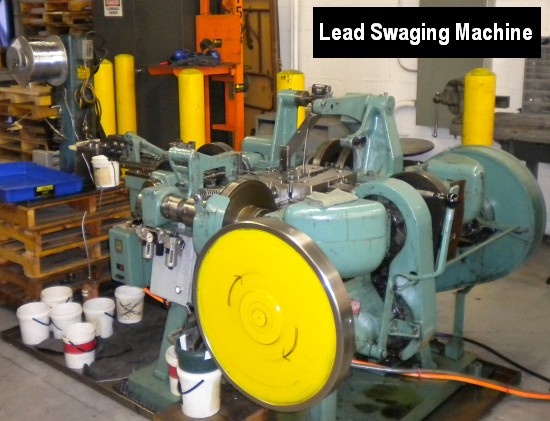
Next the copper jackets and lead cores are combined and shaped using a successive series of precision dies. The bullets are swaged (squished really) from the bottom up once the lead is inserted into the jacket via a tube feeder. This ensures there are no air bubbles between the lead core and copper jacket. I watched as one such machine was set up and calibrated. It was started then tested and adjusted a number of times before it was left to run automatically. Even then, handfuls of bullets are frequently tested for weight, concentricity, and dimensional accuracy. I was told that if any lot is found to be bad — for whatever reason — the entire lot is just thrown away! Sorry, but this means no boxes of seconds or “blems” at bargain prices from the Berger factory.
Some details of Berger’s operation surprised me. A number of tasks that I assumed would be automated are still done by hand, ensuring both accuracy and consistency. Bullets are weighed, packaged, and checked by hand. I overheard one employee say that they had a few thousand bullets to weight-sort before they could be packaged because they feared something may have been slightly off during production. That was a time-consuming task, but they did weight-sort bullet by bullet to make sure nothing had gone wrong.
 New Product Packaging New Product Packaging
Berger is now offering “quantity packaging” for the most popular bullets in a number of different calibers. I was also surprised to see boxes in colors other than yellow on Berger’s shelves. Michelle explained to me that the yellow boxes are retained for match or target bullets. The thinner-jacketed hunting bullets now go in orange boxes while moly-coated bullets are packed in black boxes.
One last point worth noting is that if, like me, you (foolishly) wear a Sierra shirt to a tour of Berger Bullets, you will promptly be given a Berger shirt and hat to wear during the visit.
Michelle, thanks so much for the tour! — Kelly Bachand
February 7th, 2010
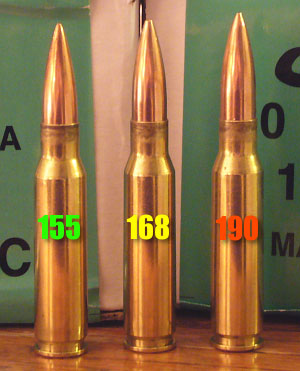 In December, we published the rules controlling choice of caliber and bullet weight for Palma competition. (CLICK HERE to Read.) In the USA, some events are still limited to 156gr or lighter bullets for .308-caliber shooters. But where such restrictions don’t exist, many shooters are using heavy 175-190gr bullets in their .308s. Is the heavier bullet always better? What considerations favor the lighter 155gr-class bullets in Palma competition? Top Palma shooter Kelly Bachand addresses these questions in today’s commentary. In December, we published the rules controlling choice of caliber and bullet weight for Palma competition. (CLICK HERE to Read.) In the USA, some events are still limited to 156gr or lighter bullets for .308-caliber shooters. But where such restrictions don’t exist, many shooters are using heavy 175-190gr bullets in their .308s. Is the heavier bullet always better? What considerations favor the lighter 155gr-class bullets in Palma competition? Top Palma shooter Kelly Bachand addresses these questions in today’s commentary.
Factors That Favor the 155s
by Kelly Bachand
It is clear that 155gr bullets are adequate. In the Palma game, more matches have been won and more 450 scores have been shot with 155gr bullets than with any other weight projectile. With the NRA allowing heavier bullets in Palma matches, many shooters prefer to shoot the longer, heavier bullets when possible. With their higher BCs, the longer bullets would seem to offer a ballistic advantage. There may be an edge, but in my opinion, it comes at a high cost.
Shooting a heavier bullet adds complications. You’ll probably need a different powder and new load development will have to be done. New zeroes must be calculated and confirmed on the range. An expensive new barrel with a faster twist rate may be needed to stabilize the heavier bullets. And unless you’re lucky, there’s a chance that the new barrel is less accurate than your existing barrel. (If you’ve got a “hummer” barrel for the 155s, what are the odds of getting another one as good for the 190s?) For a shooter who only competes domestically and who has plenty of time and money, this does not pose much of a problem, as he can work up multiple loads and acquire multiple barrels, or even build up a second complete rifle. But shooting BOTH the 155s and the heavy bullets (which may require a new barrel) certainly adds to the cost of competing, and the time required to work up loads. One who also competes internationally has much more to worry about, since you’ll likely be switching between the heavy bullets for most domestic matches and the 155s for most international matches.

Consider the challenges you’ll encounter switching between a heavy-bullet domestic load and a 155gr international load. Will changing between two different loads (with very different recoil levels) alter your gun-handling and follow-through? Will having two loads (with different ballistics) create confusion when making wind calls? And if you DO shoot both 155s and 190s, should you have two different barrels, or should you stick to one barrel which is adequate for both bullet weights, but perhaps not optimal for either? The heavier bullets typically have a better BC which means they should be less bothered by the wind. At the same time the heavier bullets travel at a much slower velocity. Does this negate the ballistic advantage? You need to check the ballistic tables carefully, looking at BOTH BC and velocity.
As a person who prefers to keep things simple and stick with what works, it’s no surprise I continue to shoot 155gr bullets exclusively in Palma competitions. But I understand this is just one viewpoint. A Palma shooter reading this should survey competitors who are consistently putting themselves in the winner’s circle. Talk to top shooters and then make your own rational, informed decision about which bullets to use. Good luck and keep them in the center.
January 21st, 2010
 We had a long chat with Eric Stecker, Berger Bullet’s Master Bulletsmith. Eric had some interesting revelations. First he noted that Berger’s production in 2009 was up 50% compared to the previous year. Berger is now running 24-hour shifts to meet demand. And Berger isn’t resting on its laurels. A new .338 bullet is going into production, and Berger now has the means to produce .416s and even 50-caliber bullets. Berger also has multiple new prototype long-range bullets in development. Eric let me look at them and hold them but he requested that we NOT publish photos as the bullet profiles are somewhat radical. Eric revealed that a new series of short-range 6mm bullets in the 60-grain range are probably going to be released later this year. These borrow some design ideas from the successful Euber FB bullets, with refinements to improve ballistics. We had a long chat with Eric Stecker, Berger Bullet’s Master Bulletsmith. Eric had some interesting revelations. First he noted that Berger’s production in 2009 was up 50% compared to the previous year. Berger is now running 24-hour shifts to meet demand. And Berger isn’t resting on its laurels. A new .338 bullet is going into production, and Berger now has the means to produce .416s and even 50-caliber bullets. Berger also has multiple new prototype long-range bullets in development. Eric let me look at them and hold them but he requested that we NOT publish photos as the bullet profiles are somewhat radical. Eric revealed that a new series of short-range 6mm bullets in the 60-grain range are probably going to be released later this year. These borrow some design ideas from the successful Euber FB bullets, with refinements to improve ballistics.
We covered many other topics during our interview, including the status of the new Berger Reloading handbook, and the differences between the G1 vs. G7 Ballistics models. Click on the video link below to learn all the latest info from Berger.

January 5th, 2010
 Cerberus Capital Managment, through its Freedom Group holding company, has acquired yet another well-known gun industry company: Barnes Bullets. On December 31, 2009, Freedom Group, Inc. entered into a purchase agreement to acquire certain assets of Barnes Bullets. Cerberus Capital Managment, through its Freedom Group holding company, has acquired yet another well-known gun industry company: Barnes Bullets. On December 31, 2009, Freedom Group, Inc. entered into a purchase agreement to acquire certain assets of Barnes Bullets.
In recent years, Cerberus/Freedom Group has acquired Remington, Bushmaster, Marlin, H&R, DMPS and other smaller firearms-related companies. By acquiring Barnes, the Freedom Group gains entry into the ammunition component business at a time when brass, bullets, and powder remain in high demand. As the Freedom Group continues to build a vertically integrated firearms-related mega-corp, one wonders if Cerberus will look to acquire a powder-maker next. Freedom Group already sells Remington-brand factory-loaded ammunition.
Barnes Bullets, located in Mona, Utah, is the industry-leading supplier of copper bullets, including copper-tin composite core bullets. Barnes is a major player in the “lead-free” bullet market. This has become important as lead-core bullets have been banned in many hunting areas, and lead-free bullets are required in many indoor shooting facilities. Barnes Bullets will continue day-to-day operations at Utah facility under the guidance of company founder, Randy Brooks.
Ted Torbeck, CEO of the Freedom Group, Inc. stated: “With the acquisition of Barnes, the Freedom Group continues to demonstrate our commitment to the ammunition business. Barnes offers a premium line of high performance bullets for the hunting and shooting communities; and for law enforcement, military and commercial consumers. We are excited about their R&D capabilities and the breadth of the products they bring to our portfolio.”

Freedom Group is now one of the world’s largest producers of guns and ammo. Freedom Group brands include Remington, Bushmaster, DPMS/Panther Arms, Marlin, H&R, NEF, LC Smith, Parker, EOTAC, AAC, Dakota and INTC. The company distributes its products throughout the U.S. and in over 80 foreign countries. Learn more at www.freedom-group.com.
December 30th, 2009
 There is, understandably, quite a bit of confusion concerning caliber limitations for Palma rifles and Palma competition. Some folks say you can shoot a .308 Winchester (or 7.62 NATO) with a bullet weight up to 156 grains. Others say you can shoot a .308 Win (or 7.62 NATO) with any bullet weight. Still others opine that you can shoot EITHER a .223 Rem (5.56×45) or a .308 Win (or 7.62 NATO). There is, understandably, quite a bit of confusion concerning caliber limitations for Palma rifles and Palma competition. Some folks say you can shoot a .308 Winchester (or 7.62 NATO) with a bullet weight up to 156 grains. Others say you can shoot a .308 Win (or 7.62 NATO) with any bullet weight. Still others opine that you can shoot EITHER a .223 Rem (5.56×45) or a .308 Win (or 7.62 NATO).
So who is right? Well, all these viewpoints are correct in part. That’s because different rules apply in different venues. In most, but not all United States Palma competitions, you can shoot either a .223 Rem or .308 Win with no restriction on bullet weights. In some U.S. Matches, most notably the Spirit of America, certain prizes are limited to .308s with 156gr max bullet weights OR .223s with 81gr max bullet weights. What’s the bottom line? In most USA Palma competitions you can shoot either a .308 or a .223 with no limit on bullet weight. In International Palma competitions you can shoot either a .308 or a .223 but the max bullet weight is limited.
Applicable Rules for NRA Palma Competition
To help clarify the Palma rules, German Salazar has collected the applicable NRA and international rules which govern Palma and iron-sights fullbore competition. First, German explains: “The Palma Rifle is defined by NRA High Power Rule 3.3.3″ which states:
3.3.3 U.S. Palma Rifle:
(a) A rifle with metallic sights chambered for the unmodified .308/7.62 or
.223/5.56 NATO cartridge case. Rifles which also meet Rules 3.1 (.308 only)
or 3.1.1 (.308 only) are authorized.
(b) A rifle with metallic sights chambered for the unmodified .308/7.62 NATO
cartridge case. Rifles which also meet Rules 3.1 (.308 only) or 3.1.1 (.308
only or 3.1.2 (.223 only) are authorized.
German tells us: “The references to Rules 3.1, 3.1.1 and 3.1.2 apply to the M1, M14 and M16 rifles or civilian equivalents thereof. Accordingly, Palma Division ‘A’, which is how all matches other than the National Matches are fired, allows any rifle chambered in .308 or .223 with metallic sights. Palma, Division B, which is rarely seen outside the Nationals, is a separate award category for the service rifle in a Palma match.”
German notes that: “In all instances, there is no restriction on bullet weight, rifle weight or trigger weight of pull. All of these are unrestricted. The rules specify that the rifle must be chambered for the unmodified .308 or .223 “cartridge case” but if the chamber has, for instance, a longer than standard throat to accomodate a heavier bullet, that is acceptable.”
CLICK HERE to download NRA High Power Rules Book (PDF File)

NEW NRA Fullbore Rules and International Rules
A few matches are run under the new NRA Fullbore Rules which are meant to align the USA with the rules observed in other nations competing in similar matches. The most notable of these is the annual Spirit of America Match which is also the Fullbore National Championship. The Grand Aggregate prize of the Fullbore National Championship is restricted to those competitors firing the International Target Rifle.
Under the Fullbore Rules, there are two categories of rifle, the Target Rifle, which is the same as the High Power Palma Rifle, and the International Target Rifle, which is compliant with the rules of most other nations. The International Target Rifle has restrictions on trigger weight of pull, but no restrictions on overall rifle weight. Additionally, there is an ammunition restriction which limits the weight of the bullet to 156 grains for the .308 and to 81 grains for the .223; this restriction applies to both Target Rifle and International Target Rifle categories. The applicable rules are listed below.
CLICK HERE to download NRA Fullbore Rule Book (PDF File)
3.3.5 Target Rifle:
(a) A rifle with metallic sights chambered for the unmodified .308/7.62mm
cartridge case. This rifle has no restrictions regarding weight of the rifle
or trigger, However, the trigger must be safe.
(b) A rifle with metallic sights chambered for the unmodified .223/5.56mm x
45 cartridge case. This rifle has no restrictions regarding weight of the
rifle or trigger. However, the trigger must be safe.
3.3.6 International Target Rifle:
(a) A rifle with metallic sights chambered for the unmodified .308/7.62mm
cartridge case with a minimum trigger weight of 0.5 kilograms (approximately
1.1 pounds and the total weight of the rifle is unlimited. OR…
(b) A rifle with metallic sights chambered for the unmodified .223/5.56mm
cartridge case with a minimum trigger weight of 0.5 kilograms (approximately
1.1 pounds) and the total weight of the rifle is unlimited.
3.17 Ammunition:
(a) Target Rifle / International Target Rifle — .308/7.62mm NATO with a
maximum permitted bullet weight of less than 156 grains or .223/5.56mm x 45 NATO with a maximum permitted bullet weight of less than 81 grains.
November 7th, 2009
 What is the most-used piece of equipment on this Editor’s reloading bench? No it’s not my Rock-Chucker press, or even my calipers. The one item in near-constant use is a small, folding magnifying glass. Mine folds into a square case and offers 4X viewing with an 8X bifocal insert. With this handy tool I can inspect case mouths for burrs, check flash-holes, and look for flaws on bullet jackets and bullet tips. I also use the magnifier to see rifling marks on bullets seated into the rifling, or check my bolt for galling. The number of uses is nearly endless. What is the most-used piece of equipment on this Editor’s reloading bench? No it’s not my Rock-Chucker press, or even my calipers. The one item in near-constant use is a small, folding magnifying glass. Mine folds into a square case and offers 4X viewing with an 8X bifocal insert. With this handy tool I can inspect case mouths for burrs, check flash-holes, and look for flaws on bullet jackets and bullet tips. I also use the magnifier to see rifling marks on bullets seated into the rifling, or check my bolt for galling. The number of uses is nearly endless.
When loading match ammo, here are some of the things you should check with a magnifier:
Flash Holes (make sure they are round and not obstructed)
Case Necks and Bushings (check necks for scratching; inspect bushings for embedded grit or brass shavings)
Case Mouth (check inside and out for small burrs or cuts — either can damage your bullet jackets)
Bullet Meplats (check meplats CAREFULLY — look for damaged tips and significant meplat size variations)
Plastic Ballistic Tips (check for crooked or broken tips; look at jacket edge where it meets the plastic — this can be very ragged with burrs or gaps so it doesn’t fit flush with the plastic tip)

Folding magnifiers are so handy yet inexpensive that you should own a couple spares (including one in the range box). I bought my magnifier in a book-store, but you can also find them on the web at Edmund Scientifics and WidgetSupply.com starting at just $1.97.
March 18th, 2009
 Berger Bullets has kicked off a special sale on Berger moly-coated bullets. Berger let us release this information first in today’s Daily Bulletin, so that AccurateShooter.com readers will have “first crack” at these super deals. Berger Bullets has kicked off a special sale on Berger moly-coated bullets. Berger let us release this information first in today’s Daily Bulletin, so that AccurateShooter.com readers will have “first crack” at these super deals.
PURCHASE TERMS
The following bullets are available at significant discounts while supplies last. These prices apply to listed inventories of moly-coated bullets only. Bullets that are not sold by the end of March will be scrapped. (Berger will still produce these bullets uncoated at regular prices, but the moly version is being closed out.)
Bullets must be paid by credit card only unless someone has already established an account with us. Berger will NOT not hold bullets for payment by check. Add a 5% discount if you buy ALL available boxes of a given caliber, weight, and style. Orders placed for 30 boxes or more get free shipping.
Place your order with Andrea Cobos at (714) 447-5456 or contact andrea.cobos [at] bergerbullets.com.

LIST UPDATED as of 09:04 PST on 3/20
Here is the list of bullets still available. (Everything is selling fast…)
Berger 17 cal 30 gr Varmint Moly – 48 boxes – $27.21 per box (200 count)
Berger 22 cal 30 gr Varmint Moly – 18 boxes – $13.52 per box
Berger 22 cal 90 gr VLD Moly – 138 boxes – $17.30 per box
Berger 25 cal 87 gr Moly – 107 boxes – $24.14 per box
Berger 30 cal 110 gr Moly – 14 boxes – $20.69 per box
Berger 30 cal 155 gr BT Moly – 44 boxes – $25.70 per box
Berger 30 cal 168 gr BT Moly – 30 boxes – $24.00 per box
NOTE: The bullets listed above will remain in production in “naked” form, without moly-coating. These bullet designs are NOT being discontinued — just the moly-coated versions.
January 15th, 2009
 SHOT Show in Orlando, Florida commences Thursday, Jan. 15th at 08:30 am. AccurateShooter.com will be covering the show, including the preliminary Media Day-at-the-Range on Wednesday the 14th. Our correspondent at SHOT 2009 will be Jason Baney, aided by his wife (who’ll help with cameras and computer stuff). SHOT Show in Orlando, Florida commences Thursday, Jan. 15th at 08:30 am. AccurateShooter.com will be covering the show, including the preliminary Media Day-at-the-Range on Wednesday the 14th. Our correspondent at SHOT 2009 will be Jason Baney, aided by his wife (who’ll help with cameras and computer stuff).
Jason heads to the show armed with a long list of things to do, from product evaluations to interviews with folks like Jochen Anschütz, David Tubb (Superior Shooting Systems), and Dave Kiff (Pacific Tool & Gauge). We plan to have a look at some new custom actions to be released in 2009, plus the latest optics from Bushnell, Leica, Leupold, March, Premier, Schmidt & Bender, Sightron, Swarovski, and Zeiss.
Help Us Share Your Ideas with Industry Big Shots
Jason will be talking directly to important shooting industry decision-makers and product designers. We would like to share ideas and product feedback from our readership. What do YOU have to say to the guys who build the products you buy?
 What would you like us to tell shooting industry professionals representing Hornady, Lapua, Leupold, RCBS, Savage, Sierra Bullets, and other companies? Do you have specific product questions you’d like us to get answered at SHOT Show? You can post your suggestions as a comment to this thread. Or, you can email Jason directly at JB1000BR [at] Yahoo.com. What would you like us to tell shooting industry professionals representing Hornady, Lapua, Leupold, RCBS, Savage, Sierra Bullets, and other companies? Do you have specific product questions you’d like us to get answered at SHOT Show? You can post your suggestions as a comment to this thread. Or, you can email Jason directly at JB1000BR [at] Yahoo.com.
• Do you have a particular product you want to see covered?
• Do you have suggestions about new products? (For example, what new cartridge would you like to see Lapua produce?)
• Are there questions you’d like to ask manufacturers such as Sierra Bullets, Hornady Mfg., and Hodgdon Powder?
• Do you have feedback on current products and product options? (For example, we know our readers love the new Sightron 30mm scopes, but they want more reticle choices.)
Post your ideas by clicking the “Comments” link at right. >>>>>>>
May 28th, 2008
Because of increased raw material and fuel costs, prices of bullets and brass have gone up dramatically in recent months. We are hearing from active shooters that cost considerations are influencing their decisions about what calibers and chamberings to shoot. There is a definite trend to smaller cartridges and lighter bullets.
One prominent match shooter told us: “I’ve been debating between a 6.5×47 Lapua and a 6-6.5×47. After comparing the cost of 6.5mm vs. 6mm bullets, I decided on the 6mm. If I save $7 bucks a box, and shoot 4000 rounds a year (40 boxes of bullets), that’s $280.00 in savings–enough to buy a new barrel.”
Here are some comparative bullet prices for 6mm, 6.5mm, 7mm, and 30-caliber bullets at Midsouth Shooters Supply. Prices are for a 100-count box. Note that the 6.5mm match bullets cost 25% more than the 6mms. For active shooters, the price difference adds up quickly.

| Brand |
6mm |
6.5mm |
7mm |
.308 |
| Berger |
105gr VLD
$27.57 |
140gr VLD
$34.25 |
168gr VLD
$39.15 |
190gr VLD
$41.53 |
| Sierra |
107gr MK
$24.61 |
142gr MK
$30.53 |
175gr MK
$29.16 |
200gr MK
$31.64 |

Here are brass costs for Lapua brass from Grafs.com. Prices are for 100-count boxes. Generally speaking, the bigger the case, the higher the price (except for the .308 Win).
| .223 Rem |
6mmBR |
6.5×47 Lapua |
.308 Win |
6.5-284 |
.338 Lapua Mag |
| $44.79 |
$62.39 |
$82.79 |
$54.99 |
$92.99 |
$211.99 |
Consider Barrel Life Also
Certainly, moving to a smaller caliber can often reduce what you have to pay for brass and bullets. On the other hand, you need to consider barrel life. Hot-loaded 6mms, such as a .243 Ackley, can burn up a barrel much more quickly than a .308 Winchester. In comparing the “operating costs” of various cartridges, you need to factor in barrel replacement costs as well as component prices.
|


