By Steve Cooper, CMP North General Manager & Ashley Brugnone, CMP Writer
In disappointing fashion to all involved, the CMP [cancelled] its June 17 Excellence-In-Competition match when significant damage was done to the target system following the successful completion of standing and rapid-fire sitting stages at 200 yards by nearly 100 competitors.
Nearly 100 competitors took to the firing line on Viale Range for Saturday’s EIC Rifle Match.
The CMP EIC match was the historic debut of the latest in scoring technology on the “big” ranges at the 101-year-old Ohio National Guard training site near Port Clinton. The match fired on Viale Range was a fill-in for a previously cancelled Ohio Rifle & Pistol Association event. CMP is in its second year of operating 10 electronic target lanes at 100 yards for rifle and five lanes for pistol at Camp Perry’s Petrarca Range. CMP also operates two 80-point electronic indoor airgun ranges at Camp Perry and Anniston, AL, respectively.
During the changeover from 200 to 300 yards at the Saturday event, multiple targets were damaged when newly-trained CMP target workers accidentally strained or tore several interconnecting cables on the target line while raising and lowering target carriers. Diagnostics showed several targets were showing errors, but CMP technicians believed many targets could be salvaged and some were repaired.
The loss cut the range from 35 to 19 serviceable targets. CMP staff and competitors agreed to shrink the size of the range, re-squadding shooters into more relays on the remaining working targets. After repairs were made, firing continued with the prone rapid-fire stage at 300 yards. When firing was complete, a handful of shooters received inconsistent information on their monitors. A re-fire was conducted for that group and many of the re-fire group still reported target errors.
Members of CMP staff convene to discuss abnormalities during the 300-yard prone rapid-fire stage of the EIC Rifle Match. Moments later, the match was called off after it was determined too many targets were compromised by damaged cables in the Viale Range pits.
It became clear that the initial damage to the target communication system was worse than originally thought. Christie Sewell, CMP Programs Chief, explained to competitors that it was impractical to go any further and had no choice but to cancel the match. CMP offered refunds to all competitors or the option of crediting their entry fees to a future match. The match did not count toward the competitors’ EIC match total for 2017.
The Takeaway from this Experience – CMP is a Pioneer in the Electronic Target World
They say it’s easy to recognize pioneers — they’re the ones with arrows in their backs. It feels that way sometimes at the Civilian Marksmanship Program as we roll out the most sophisticated electronically-scored targets in the world to America’s bullseye rifle and pistol shooters. Sometimes we make mistakes and they cost us time, money and aggravation.
Cables carry power + communications from target to target the length of the line. Many places between targets can trap and catch cables. The loss of 1 cable can take out 5 adjacent targets.
But we press on. And the competitors who understand our goals press on with us. We pull the arrows out of each other’s backs, cover shot holes with thick-skin pasters, learn from our mistakes and press on with our mission. That mission includes safety instruction, youth marksmanship fundamentals, growing the sport of bullseye target shooting and providing our competitors the best opportunity to maximize participation in this sport.
What Actually Went Wrong on Saturday
Those familiar with the KTS targets at the CMP Talladega Marksmanship Park know they are hard-wired and mounted to actuators that tilt the targets up and down for use on three different target lines. Shooters fire from a common covered firing line and fire distances of 200, 300 or 600 yards during open public sessions and matches without moving. Those targets are semi-permanent and fit into frames that are bolted to iron brackets mounted on a concrete deck.
On the Shooting Sports USA website, there’s a great profile of Kevin Nevius, one of America’s leading competitive marksmen. Kevin is best known for his smallbore success but he has also an impressive record in long-range centerfire competition — In 2005 and 2006 he won the Sierra Trophy at Camp Perry in 1000-yard competition. This was followed by smallbore National Championships in 2008, 2010, and 2014. This story, penned by gunwriter Hap Rocketto, covers Kevin’s career, which has included multiple championships and many records.
“My brother got me into long range varmint hunting and I started building my own guns very early,” Nevius told Dan Holmes in a Pronematch.com interview. “I had a hunting friend who shot indoor smallbore who started me in three position and I was hooked.”
Here are highlights from Hap Rocketto’s Profile of Kevin Nevius:
Champion shooter Kevin Nevius grew up in a household that did not allow firearms, an unlikely beginning for one of the United States’ premier prone rifleman and gunsmiths. Once out on his own he fell in with his brother who enjoyed long-range varmint hunting. His natural bent for things mechanical (he is a professional structural engineer) soon had him tinkering with rifles, which eventually led him to building his own.
Everything fell into line for him in smallbore during the 2008 season. After shooting a series of training matches in which he was most successful, he arrived at Camp Perry at the peak of performance and won his first National Smallbore Rifle Conventional Prone Championship. Kevin came back strong in 2010, winning the inaugural individual National Smallbore Rifle Metric Prone Championship, as well as the team title at Bristol, IN. [Kevin then won the Smallbore Conventional Prone Championship in 2014 with a practically perfect score of 4799-390X (LINK).]
Along the way, Nevius has won some impressive national records. In conventional competition he co-holds the 1200-shot metallic sight aggregate record of 1200-102X. He was just one shot short of perfection in the 480 aggregate, where he holds the civilian record of 4799-412X, just one point behind, and 11 Xs ahead of, Joe Hein’s 4800-401X open record.
Kevin Nevius hopes to build a smallbore rig capable of 3/8-MOA at 100 yards.
Building the Ultimate Rimfire Prone Rifle
Kevin is not just a great trigger-puller. He also smiths his own rifles. His current goal as a gunsmith is to build a rimfire rifle that will shoot 3/8″ groups at 100 yards. That’s a big challenge — 3/8-MOA represents very good accuracy for a centerfire rifle with handloaded ammo. But if any rimfire smith can build a rifle that will shoot that well at 100, it’s probably Kevin.
The CMP has approved a new event for Glock pistols at the 2017 National Matches at Camp Perry. Plastic Pistols at Perry? Traditionalists may scoff, but this is certainly a way to get more (and younger) pistol competitors involved. The first-ever GLOCK Sport Shooting Foundation (GSSF) Match will be held on July 1, 2017 as part of the CMP’s 2017 National Matches. The inaugural Glock Match will be open to both adults and juniors, with two different categories: Stock and Unlimited.
The big news are the prizes — six Glock pistols will be awarded to top Class winners. The Glock Match will be shot on NRA D1 paper targets, with ten (10) rounds each at 5, 7, 10, 15 and 25 yards. NOTE: This is NOT a slow-fire match. According to the CMP press release, competitors will have just 15 seconds for each 10-round string. We hope that’s a misprint — ten shots in 15 seconds makes this a “mag-dump” contest, not a precision match, in our opinion. To compete at the match, shooters must have an active GSSF membership (you can join during match registration at check-in).
There will be two pistol classes, Stock and Unlimited. The Stock Class is for GLOCK firearms with components that are or ever have been available from GLOCK, Inc., though some modifications are permitted. NOTE: Fiber-optic and express sights are approved.
The Unlimited Class is for firearms with major modifications such as aftermarket barrels, mag funnels, recoil springs, and firing pins. Unlimited Class pistols can use “any non-post and notch sights including but not limited to, ghost ring or laser, electronic or optical sights.”
“This match was suggested by Bob Schanen, a valued, long-time GLOCK employee and Camp Perry rifle competitor for 30+ years,” said Brandie Collins, GLOCK public relations and communication manager. “The partnership with CMP in bringing this match to Camp Perry meets our common goals of promoting safe gun handling, marksmanship and introducing people to competitive shooting. Shooters of all skill levels will enjoy shooting this match.”
M1 Garand Springfield Armory July 1941 production. Facebook photo by Shinnosuke Tanaka.
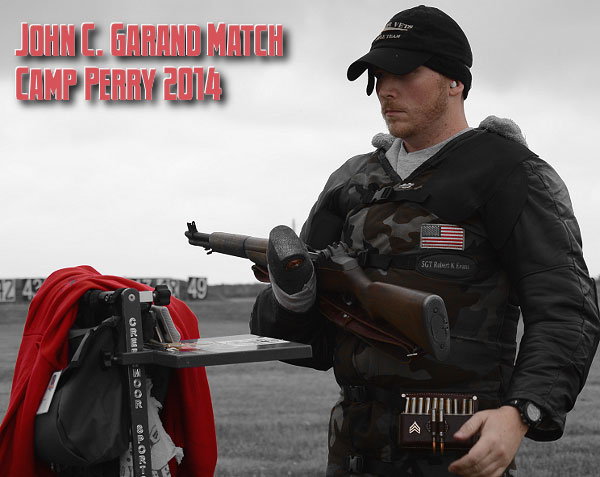
My father carried a Garand in WWII. That was reason enough for me to want one. But I also loved the look, feel, and heft of this classic American battle rifle. And the unique “Ping” of the ejected en-bloc clip is music to the ears of Garand fans. Some folks own a Garand for the history, while others enjoy competing with this old war-horse. Around the country there are regular competition series for Garand shooters, and the CMP’s John C. Garand Match is one of the most popular events at Camp Perry every year. This year’s Perry Garand Match will be held Saturday, 22 July 2017.
The CMP also has a John C. Garand Match each June as part of the D-Day Competition at the Talladega Marksmanship Park. Here’s a video from the inaugural Talladega D-Day Event in 2015.
Watch Prone Stage from the Inaugural Talladega D-Day Match in 2015
M1 Garand Manual
Recommended M1 Garand Manual
Among the many M1 Garand manuals available, we recommend the CMP’s U.S. Rifle, Caliber .30, M1: ‘Read This First’ Manual. This booklet covers take-down, reassembly, cleaning, lubrication, and operation. The manual, included with CMP rifles, is available for $3.25 from the CMP eStore. The author of Garand Tips & Tricks says: “It’s one of the best firearms manuals I’ve seen. I highly recommend it.”
M1 Garand Slow-Motion Shooting Video
What really happens when an M1 Garand fires the final round and the En-Bloc clip ejects with the distinctive “Ping”? Well thanks to ForgottenWeapons.com, you can see for yourself in super-slow-motion. The entire cycling process of a Garand has been captured using a high-speed camera running at 2000 frames per second (about sixty times normal rate). Watch the clip eject at the 00:27 time-mark. It makes an acrobatic exit, spinning 90° counter-clockwise and then tumbling end over end.
2000 frame per second video shows M1 Garand ejecting spent cartridges and En-bloc clip.
M1 Garand History
Jean Cantius Garand, also known as John C. Garand, was a Canadian designer of firearms who created the M1 Garand, a semi-automatic rifle that was widely used by the U.S. Army and U.S. Marine Corps during World War II and the Korean War. The U.S. government employed Garand as an engineer with the Springfield Armory from 1919 until he retired in 1953. At Springfield Armory Garand was tasked with designing a basic gas-actuated self-loading infantry rifle and carbine that would eject the spent cartridge and reload a new round. It took fifteen years to perfect the M1 prototype model to meet all the U.S. Army specifications. The resulting Semiautomatic, Caliber .30, M1 Rifle was patented by Garand in 1932, approved by the U.S. Army on January 9, 1936, and went into mass production in 1940. It replaced the bolt-action M1903 Springfield and became the standard infantry rifle known as the Garand Rifle. During the World War II, over four million M1 rifles were manufactured.
Camp Perry photo. Starting this year, the High Power Championships will be held at Camp Atterbury, IN.
There are some big changes this year for the NRA National Rifle and Pistols Championships. The NRA High Power Rifle Championships will be held in Indiana (at Camp Atterbury), not at Camp Perry, Ohio. That’s new for 2017. The smallbore championships was moved a few years back to Camp Wa-Ke’-De Range in Bristol, Indiana. The Pistol Championships will remain at Camp Perry. So, when once all three Championships were held in the same historic place, Camp Perry, now they are in three locations. Some folks lament that change…
REGISTRATION OPEN for Championships
If you want to compete in any of the NRA National Championships, you can now register online. We provide links below for Highpower Rifle, Smallbore, and Pistol Event. When you register, you’ll need an identifier — NRA Member ID, NRA ID (15 digit number) or an NRA National Rifle and Pistol Championships Online Entry ID from a previous year’s entry. See the individual championship entry links listed below.
With the NRA Moving the National High Power Rifle Championships away from Camp Perry starting in 2017, the CMP has stepped into the breach, offering a new series of rifle matches in the first part of the June 2017 National Match Schedule. The new CMP Cup Individual Matches, CMP Cup Team Match, and EIC Rifle Match will provide rifle competitors an opportunity to participate in the type of matches that have been fired on the shore of Lake Erie since 1907.
In the opening week of the National Matches schedule, June 26-30, 2017, the Civilian Marksmanship Program (CMP) will lead off the competitions with CMP Service Rifle and CMP Match Rifle events, called the CMP Cup Matches. The CMP Cup series includes a CMP Four-Man Team Match, three days of CMP 800 Aggregate Matches (2,400-point Overall Aggregate), and wrapping up with a CMP Excellence-in-Competition (EIC) Service Rifle Match.
NOTE: The New Matches (Marked as CMP CUP WEEK) Will Be Held June 26-30, 2017:
“We are pleased to announce the introduction of new CMP service rifle and match rifle events during the first phase of the National Matches, previously occupied by other events”, said Mark Johnson, CMP Chief Operating Officer. “It is our mission… to host competitive rifle and pistol matches befitting our nation’s best shooters at the permanent home of the National Matches at Camp Perry, Ohio.” The CMP’s expansion of marksmanship events at Perry began in 2016 with the Legacy Series events for vintage and modern military rifles.
BACKGROUND: NRA MOVES RIFLE EVENTS to INDIANA
The NRA has announced that it is moving the National High Power XTC Rifle Championship, Mid-Range Championship, and Long Range Championship away from Camp Perry, Ohio, starting in 2017. These matches will henceforth be held at Camp Atterbury, Indiana. These changes are subject to final approval by the NRA Board of Directors in 2017, but we do not anticipate a change. That means if you want to compete in both CMP and NRA rifle matches, you would need to go two different venues, located 280 miles apart, in two different states.
On July 14, the CMP will fire its second set of National Matches rifle events including SAFS for Rifle, the CMP National Trophy Rifle Matches, and CMP Rifle Games Events, which conclude July 25. The final event, CMP National Rimfire Sporter Match, will be conducted on Saturday, July 29.
For more information about the National Matches, including the finalized 2017 calendar, visit the CMP 2017 National Matches website.
In response to the NRA’s just-revealed plans to move NRA High Power Rifle Matches away from Camp Perry starting in 2017, the Civilian Marksmanship Program (CMP) has announced that it will offer MORE matches at the storied Camp Perry facility in 2018. CMP is demonstrating its commitment to Camp Perry, which has been the site of the National Matches since 1907.
CMP Announces New Programs for 2018 National Matches
The Civilian Marksmanship Program (CMP) is pleased to announce planning is underway for a number of new and exciting programs for the 2018 National Matches at Camp Perry, Ohio.
“In an effort to continue to attract new competitors and to reward the thousands who annually participate in our matches, the CMP will add new pistol, smallbore, high power rifle, and long range rifle matches in 2018,” said Mark Johnson, CMP Chief Operating Officer.
“A major part of our mission is to conduct competitions, provide marksmanship training and recognize competitors for their progress and achievements as has been done at the National Matches since 1903. Accordingly, we enthusiastically look forward to the opportunity to expand our role at the National Matches at Camp Perry. We are committed to Camp Perry and our published dates for events in 2017 remain set. We have invested in Camp Perry with electronic targets on Petrarca Range, the Bataan Armory, our headquarters building, the CMP North Store, and the Gary Anderson Competition Center.”
Planned enhancements include a new CMP High Power Ranking System which will provide a fair and accountable method of rewarding success on the firing line at every level of experience, above and beyond our current awards. New, challenging pistol and rifle matches will be added to the schedule. Greater shooting opportunities for women and junior competitors are being developed. Increased use of electronic targets is being considered for many events. A CMP Range Officer Certification and Licensing Program has been developed for pistol, rifle and airgun disciplines and will be introduced by year-end.
“The CMP will not waver in its mission of promoting firearm safety and marksmanship training with an emphasis on youth,” Johnson said. “The tradition of the National Matches at Camp Perry will continue, supported by the CMP and the Ohio National Guard, with or without the participation of other organizations.”
No more High Power Championships at Camp Perry. No, this is NOT an April Fools Day story. The NRA has announced that it is moving the National High Power XTC Rifle Championship, Mid-Range Championship, and Long Range Championship away from Camp Perry, Ohio, starting in 2017. These matches will henceforth be held at Camp Atterbury, Indiana. The CMP Matches will continue to be held at Camp Perry, so we are told. That means if you want to compete in both CMP and NRA rifle matches, you would need to go two different venues, located 280 miles apart, in two different states.
There is a century of tradition at Camp Perry, with the National Matches held there since 1907. It appears that this venue change is going to happen, although one source states that it might be subject to change: “The move was apparently prompted by the director of NRA Competitive Shooting, and will face final approval by the NRA Board of Directors in January 2017. If enough support is garnered among the competition community by then, it could be feasible that it would be reversed, but we doubt that is the case.” Source: The Firearm Blog.
NRA Moving National High Power Rifle Championships from Camp Perry
In an effort to keep the National High Power Rifle Championships up to the high standards that competitors have enjoyed for over one-hundred years, the NRA will move the Championship from its historic home at Camp Perry, OH, to Camp Atterbury, IN. This change in venue will take effect during the 2017 National Matches, pending approval by the NRA Board of Directors in January 2017.
Dennis Willing, director of NRA Competitive Shooting explained the decision.
“The NRA High Power Rifle Committee met and determined it would be beneficial to all competitors if we moved the Championship from Camp Perry to another site. After much discussion, the range at Camp Atterbury, IN, was selected as the new home of the NRA National High Power Rifle Championships.”
The proposed match schedule (subject to change) is below:
— First Shot Ceremony – July 7
— Welcome BBQ (afternoon) – July 7
— Across the Course – July 8-13
— Mid-Range – July 14-17
— Long-Range – July 18-22
Willing added, “I intend to change the face of High Power Rifle as a discipline, and will be presenting matches that are better than competitors have ever seen before.”
Since Across the Course is scheduled to end on July 13th, there will be sufficient time for competitors to attend the CMP National Trophy Matches.
The NRA Smallbore Prone Championship is scheduled to end with sufficient time for competitors to leave Bristol, IN, and come to Camp Atterbury to compete in Mid-Range Prone and Long-Range Prone. The NRA National Pistol Championship will remain at Camp Perry but will be held July 9-14, 2017, following previous year’s practice.
The Camp Atterbury Joint Maneuver Training Center is administered by the Indiana National Guard, and has just under 35,000 acres of training and maneuver space—plenty of room in case the NRA decides to expand beyond the High Power Rifle Championships. Additionally, Camp Atterbury is home to several active U.S. Army components, including several from the First Army Division East. The site also provides various training and testing sites for military and civilian responders from around the world.
Competitors’ Comments — Pro & Con
Comments on this Venue Change have been both negative and positive.
“Nothing like abandoning over 100 years of tradition. Really stupid idea!” — C.G.
What venue could possibly be better than Camp Perry? It’s not a destination, it’s an experience.” — Stephen B.
“Very disappointing decision. The NRA should have asked shooters for their input instead of decision by committee, and, my bet…some politicians.” — Jeffrey C.
“How about the people that wants to shoot long range and CMP? Keep it Camp Perry or change the dates.” — Kevin G.
“Don’t see how this will help attendance. It doesn’t make sense.” — Alton N.
“It makes beautiful sense! Are you kidding?! Atterbury is a much more modernized facility and is HUGE. The accommodations for sleeping quarters are infinitely better and more extensive than Perry and with Indianapolis only 30 min away or less it will make attendance MUCH easier for so many people. I love Perry but you will see just how superior this facility is when you come. This should have happened a LONG time ago.” — Ron W.
“Atterbury’s ranges are outstanding, and there’s LOTS more housing options available on base if that’s part of the package put together with the base. The carriers are the same as the new ones at Perry (they were installed at Atterbury first).” — W.M.
History of the National Matches at Camp Perry
The National Matches have been held at Camp Perry since 1907. The range is located along the shores of Lake Erie in northern Ohio near Port Clinton. The site was first acquired in 1906, in response to the need for a larger facility for military training and the NRA’s shooting programs. In 1906 Gen. Ammon B. Crichfield, Adjutant General of Ohio, ordered construction of a new shooting facility on the shores of Lake Erie, 45 miles east of Toledo, Ohio. The original land for Camp Perry was purchased in 1906, and the reservation was named after Commodore Oliver Hazard Perry, the American naval commander.
On August 19, 1907, Cpl. L. B. Jarrett fired the first shot at the new Camp Perry Training Site. And that year, 1907, Camp Perry held its first National Pistol and Rifle Championship events. This location has hosted the annual NRA National Matches ever since. Today, over 4,000 competitors attend the National Matches each year, making it the most popular shooting competition in the western hemisphere.
This summer, our friend Dennis Santiago made his first-ever pilgrimage to Camp Perry, Ohio to compete in the National Matches. He recounts his experience in a fascinating, informative, and often humorous story on his Dennis Talks Guns Blog. When you have a few moments to spare, you should definitely read Santiago’s account of his First Time at Camp Perry. This is much, much more than a match report. Dennis gives insights into the human side of the experience — and the little things that make Camp Perry so special. CLICK HERE to Read Full Camp Perry Story.
Dennis competed in a number of events during his two-week stay. Shooting “classic” service rifle and his new scoped, “modern AR” service rifle Dennis competed solo (in Presidents 100 and NTI matches among others) and also as a member of the California Adult Team in the 4-man NTT match.
Santiago’s First Time at Camp Perry report is a “must-read” for anyone contemplating a Camp Perry visit. Here are some highlights — but honestly folks, do read the entire story — it’s well worth it.
First Time at Camp Perry, by Dennis Santiago
Perry Ain’t Like Home
Iron Sights and “Perry-Vision”
This range is kicking me hard. I tell people about how hard I was pushing my eye into my aperture. They smile that “welcome to Camp Perry” smile again. They ask what sights I’m shooting on my A2 and I tell them I’ve got an 0.050″ front and 0.038″ rear to maximize depth of field. They smile more broadly and tell me my problem is that I’m from the Western provinces where the sun is bright and the ground is devoid of flora. Lots of light. It’s green here and we have clouds I’m told. Not nearly the same ambient lighting. You have the wrong sights my son. Where the green grass grows you want a big fat 0.072″ front the size of an aircraft carrier deck and a huge 0.046″ hole in the morning and maybe close it down to an 0.042″ rear aperture later if the sun comes out. But that desert glare sight system of yours will lose you about 5-8 points in these parts. Well there you go. Learn something every day.
Baptism at Camp Perry
One’s first visit to Camp Perry is a series of baptismal rites. I shall now enumerate them…
Walk the Base. Do not drive around. Get used to walking. Walk from your hut to everything. Walk to the administration buildings. Walk to the ranges. Walk to commercial row. Walk to the CMP North Store. Walk to the CMP or Army trailer to have the triggers of your rifles(s) weighed. Walk. This is your primary mode of transportation while on base for the next couple of weeks.
Go Shopping. It’s called Commercial Row. It is the best shopping mall for competitive shooters ever. The sale prices here are Black Friday quality. You stock up on supplies. You can buy elusive powders in quantity with the same lot number. Same with bullets and primers. Everything you need to keep making your pet loads. Oddly, not cases. This is a service rifle tournament. Pretty much everyone is using LC or WCC cases. I stocked up. Then I began politely watching my expected cubic feet and gross weight capacity for the drive home as other people asked if I could take stuff back for them instead of shipping their loot.
Learn about the Perils of Perry. One, evacuate the range. It rains at Camp Perry. Sometimes that rain comes with lightning. When that happens range controls issues an evacuation order. Depending on where you are and how much time you have, you either grab your stuff and make for a sheltered structure or leave your stuff under whatever rain cover you have and leave it there until the storm cell passes. This happened on squadded practice day. There was no squadded practice. There was learning to make a better rain cover for the next two weeks because it’d probably happened again. I was particularly proud of my final design which involved a very large tarp and many bungee cords. Modern art to be sure. I received many compliments.
Peril Two — Cease fire, boat in the impact area. One has not truly been to Camp Perry until your shooting string is put on hold while range control sends someone out to tell an errant yacht or jet ski that it’s not a good idea to go into that area with all the buoys with the signs on them that say, Danger. Live Fire. Keep Out.
Shooting Gear
I brought two rifles with me to Camp Perry. The first was my iron sights-configured AR-15. Being my very first trip to the Nationals, I wanted to check off a bucket list item to shoot irons at a National Match. The gun has a Geiselle trigger and an upper I assembled from White Oak Armament parts. The barrel is a Krieger that had 3,800 rounds arriving at Perry. The sights are pinned 1/4×1/4s. I run Sierra 77gr SMKs short line and 80gr SMKs seated .015″ off the lands Long Line with it.
The other rifle I brought was for NRA week. It’s a 2016 Rule Service Rifle, Optic. It has a collapsible UBR stock and a Geiselle Mk VII quad rail. The barrel is an older DPMS .223 that was cryo-treated back in the day. Round count on arrival at Nationals was around 1,800. Same ammunition combination [as the iron sights rifle]. The chamber on this barrel has a shorter throat so I brought a Lee Hand Press with an RCBS competition seater die to set the 80gr SMKs back to proper jump for NRA week. The sighting system for this gun was one of the very new Nightforce 4.5X Competition SR’s with the CMP R223 reticle. Parallax is set to 200 yards. It’s mounted using Nightforce’s superbly engineered AR-15 service rifle Unimount.
Members of the State of California Teams at Camp Perry. Dennis is front row left.
Coaching — When It All Comes Together, at Last
I coached one of the California teams in the NTIT Rattle Battle match. This was the day I finally began to be comfortable at Camp Perry. Walking up and down the field, first as a verifier and then as a coach, I felt back in the game. At team matches you get to confer with your teammates comparing wind calls and observing the effects of their calls as the shooting members of their squads send rounds downrange. You watch the traces of bullets arcing in the air going left or right of the bull’s center depending whether or not the call was right. This process was cathartic. I began to remember that I really can read a range once I get the hang of it.
Tech Milestone — Norm Crawford won the 2016 Wimbledon Cup at Camp Perry using a carbon-fiber composite barrel. That’s a first for composite barrel technology.
With a score of 200-16X, Norman Crawford won the Wimbledon Cup Match during the 2016 National Long Range Rifle Championships using a 32″ Proof Research carbon-fiber composite barrel chambered in .284 Shehane. The Wimbledon Cup Match, a prestigious 1,000-yard shooting competition, dates back to 1875. The current course of fire consists of 20 timed shots, fired from prone. Crawford’s win represents the first time in the Cup’s 141-year history that it has been won with anything other than an all-steel barrel. The Proof Research barrel features a steel core with an external multi-axis carbon wrap.
Crawford’s Wimbledon Cup win really is an important technological milestone. Crawford’s performance may encourage other competitors to consider steel/carbon composite barrels for a variety of shooting disciplines. Without question, composite technology barrels offer significant weight-savings over conventional all-steel barrels. And Crawford proved that a composite barrel can deliver winning accuracy, at least in a sling/prone discipline.
“I don’t know of anyone else in this sport using a carbon fiber [composite] barrel,” said Crawford, who has been shooting Proof composite barrels since 2013.
“The benefits over a steel barrel are that you get a larger-diameter, stiffer, faster-cooling barrel that weighs less than a standard, medium Palma-taper barrel. [There is] no real downside I’ve been able to identify in three years of shooting them. All five Proof barrels I own are capable of winning any match — providing I do my part.”
A 30-year Army vet and former Army Special Operations Sniper, Crawford has been shooting competitively since 1990. He has won many major titles, including the NRA National Long Range Championship in 2005. His 2016 Wimbledon Cup victory was his second — Norm also won the Cup in 2003. A three-time member of the U.S. Rifle Team at the World Championships, Crawford also used a Proof Research barrel to tie the national record for a 600-yard Any Gun, Any Sight competition in North Carolina last November, one of five national records he has set or tied during his shooting career.
Proof Research CEO Larry Murphy praised Crawford: “We are honored that Norm chose our barrel to go up against the best shooters in the world with. By putting our barrels to the test in intense competition, he pushes us to do our best as well.”


 Champion shooter Kevin Nevius grew up in a household that did not allow firearms, an unlikely beginning for one of the United States’ premier prone rifleman and gunsmiths. Once out on his own he fell in with his brother who enjoyed long-range varmint hunting. His natural bent for things mechanical (he is a professional structural engineer) soon had him tinkering with rifles, which eventually led him to building his own.