Eurooptic vortex burris nightforce sale


teslong borescope digital camera barrel monitor


As an Amazon Associate, this site earns a commission from Amazon sales.


January 12th, 2014

Barrel Stub Gauges — Handy for Many Reloading Tasks

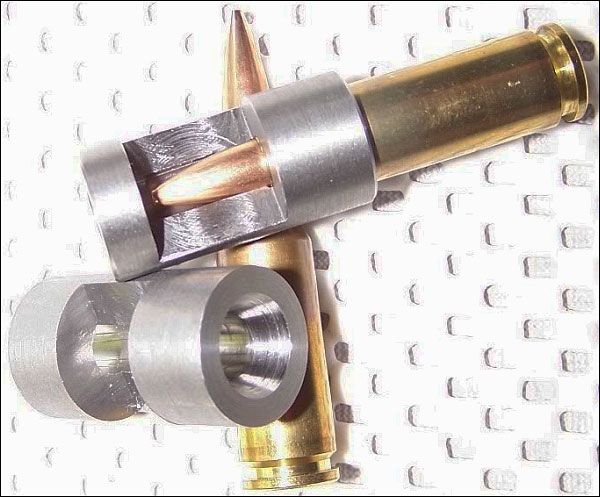
Next time you have a barrel fitted, consider having your gunsmith create a “stub gauge” from a left-over piece of barrel steel (ideally taken from your new barrel blank). The outside diameter isn’t important — the key thing is that the stub gauge is created with the same reamer used to chamber your current barrel, and the stub must have the same bore diameter, with the same land/groove configuration, as the barrel on your rifle. When properly made, a stub gauge gives you an accurate three-dimensional model of the upper section of your chamber and throat. This comes in handy when you need to bump your case shoulders. Just slide a fired case (with spent primer removed) in the stub gauge and measure from base of case to the end of the gauge. Then, after bumping, re-measure to confirm how much you’ve moved the shoulder.
Barrel Stub Gauge

In addition, the stub gauge lets you measure the original length to lands and freebore when your barrel was new. This gives you a baseline to accurately assess how far your throat erodes with use. Of course, as the throat wears, to get true length-to-lands dimension, you need take your measurement using your actual barrel. The barrel stub gauge helps you set the initial bullet seating depth. Seating depth is then adjusted accordingly, based on observed throat erosion, or your preferred seating depth.

Forum member RussT explains: “My gunsmith [makes a stub gauge] for me on every barrel now. I order a barrel an inch longer and that gives him enough material when he cuts off the end to give me a nice case gauge. Though I don’t have him cut that nice-looking window in the side (as shown in photos). That’s a neat option. You can tell how much throat erosion you are getting from when it was new as well. For measuring initial seating depths, this is the most useful item on my loading bench next to calipers. Everyone should have a case gauge made by there smith if you have a new barrel put on.”

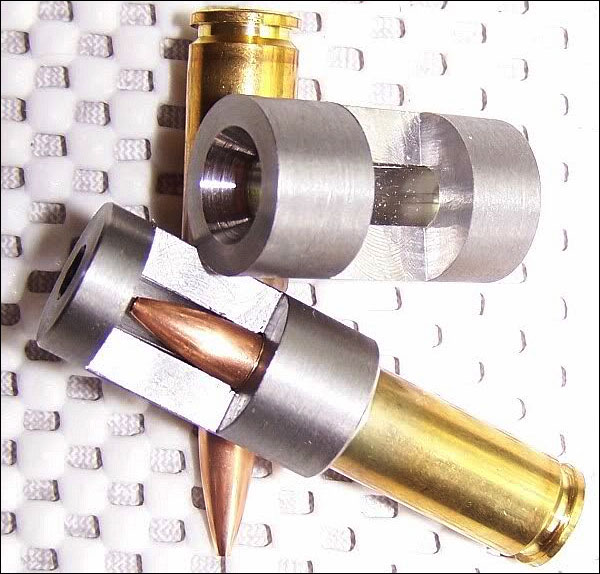
Forum member Lawrence H. has stub gauges made with his chamber reamers for each new barrel. He has his smith cut a port in the stub steel so Lawrence can actually see how the bullet engages the rifling in a newly-cut chamber. With this “view port”, one can also see how the case-neck fits in the chamber. Lawrence tells us: “My stub gauges are made from my barrels and cut with my chamber reamers. With them I can measure where my bullets are ‘touching the lands’ and shoulder bump dimensions. This is a very simple tool that provides accurate information.” To learn more about stub gauges, read this Forum Thread. The photos above and below show Lawrence’s stub gauges:
Barrel Stub Gauge

Permalink Bullets, Brass, Ammo, Gunsmithing, Reloading 3 Comments »
December 9th, 2011

NEW Caliber-Specific Laser Trainer Cartridges from LaserLyte

Here’s a clever product that provides visual feedback of your aim on the target while you dry-fire. LaserLyte, makers of laser pistol sights and bore-sighting tools, has come up with a smart new application of a miniature laser system. The new caliber-specific Laser Trainer Cartridge fits inside the pistol chamber and features a firing-pin activated switch that indicates bullet impact with a bright red laser dot. To practice, simply cock the hammer or striker, and pull the trigger as you would normally. When the firing pin hits the Laser Trainer Cartridge, a bright red laser displays on your target for 100 milliseconds. Available for 9mm, .40 S&W, and .45 ACP, the $99.95 (MSRP) Laser Training Cartridges are rimless so you can work the slide without ejecting the Laser Cartridges.

Laser Training Cartridge

With a Laser Trainer Cartridge in the chamber of your 9mm, .40 S&W, or .45 ACP pistol, you can practice your trigger pull and sight acquisition. But unlike traditional dry-firing, you can see your point of aim when you “break the shot”. This modified cartridge is rimless, so the Laser Trainer Cartridge is not expelled during dry fire, which allows for tap, rack, bang or malfunction training drills. A hardened rubber plunger on the laser also acts as a built-in snap cap to protect the firing pin. The Laser Trainer Cartridge requires three #377 batteries, good for approximately 3,000 shots. For more info on Laser Training Cartridges visit LaserLyte.com.

YouTube Preview Image
Permalink - Videos, New Product, Shooting Skills 1 Comment »
December 4th, 2011

FREE Official Cartridge Diagrams on SAAMI Website

SAAMI, the Sporting Arms and Ammunition Manufacturers’ Institute, is an association of the nation’s leading manufacturers of firearms, ammunition and components. Founded in 1926, SAAMI promulgates industry standards for firearms ammunition safety, interchangeability, reliability and quality.

SAAMI Cartridge Diagrams

New SAAMI Website Offers Free, Printable Cartridge Diagrams
SAAMI recently rolled out a new website loaded with invaluable info for shooters. From the new SAAMI site you can access hundreds of FREE official cartridge diagrams and chamber drawings for all ammo types: Rimfire, Pistol Cartridges, Rifle Cartridges, and Shotshells. Are you looking for the official 17 HMR diagram, or 6.5 Creedmoor, or 7mm Winchester Short Magnum? You’ll find them all, along with hundreds more, on the SAAMI site. Said Rick Patterson, SAAMI’s managing director. “This redesigned website will help provide greater visibility and understanding of SAAMI’s important work.”

Please Read These Instructions Carefully
To access the cartridge diagrams, go to SAAMI’s Technical Information webpage, and CLICK ON Cartridge and Chamber Drawings to reveal categories. You will find links to 20 new and/or updated cartridges there.

To find the full set of cartridge diagrams, you need to click on the link to Current Cartridge & Chamber Drawing documents — American National Standards Published by SAAMI. There you will find links to four categories of diagrams: Rimfire, Shotshell, Centerfire Pistol/Revolver, and Centerfire Rifle. These links will launch large PDF files that have diagrams of the cartridge types. NOTE: These are very large PDF documents. For example, the Centerfire Pistol/Revolver PDF is 189 pages long. You must scroll down to see the cartridge type you want.

Saami cartridge drawings

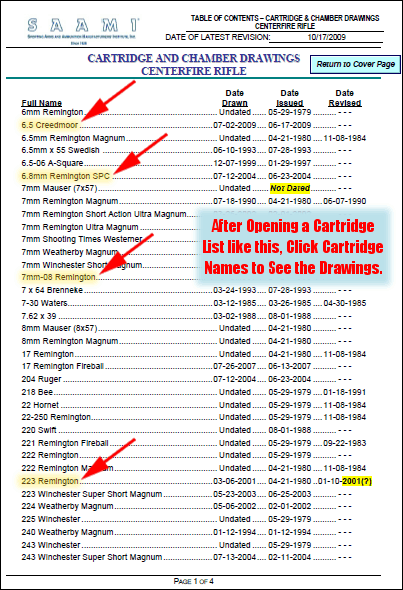
Unfortunately, the organization of the SAAMI site is much less convenient than before. Previously you could access a page and then simply click on a link for the cartridge you wanted to view. Below is a sample of the first page of the previous Rifle Cartridge Diagram List.

Red arrows show you where to click, after you launched the page under the old website.

SAAMI Cartridge Diagrams

SAAMI Standards Documents With Additional Info
You can also click the subcategory links under SAAMI/ANSI Standards to see multiple diagrams in a larger PDF file. You may have to click the SAAMI/ANSI standards line first to display the four sub-categories: Pistol/Revolver, Centerfire Rifle, Rimfire, and Shotshell.

Credit Boyd Allen for finding SAAMI’s Cartridge Diagram PDF Archive.

.

Permalink - Articles, Bullets, Brass, Ammo, Gunsmithing 9 Comments »