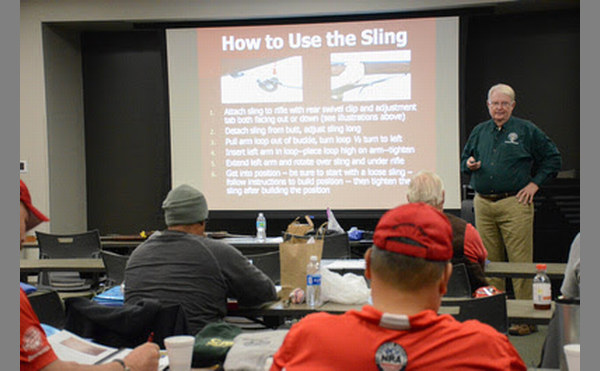
Want to learn marksmanship from top-flight instructors, with guns AND ammo provided? Then check out the CMP’s Small Arms Firing School (SAFS) program. The CMP will host several travel Small Arms Firing Schools this year. The programs include classroom instruction, range training, practice, and firing a service rifle match. Rifles and Ammunition will be provided by the CMP, as well as Kongsberg Electronic Targets. Visit the CMP website for additional information.
SAFS is designed to train beginners on rifle essentials and competition basics in a closely monitored setting, utilizing the talents of qualified CMP staff, trainers and members of the U.S. Army Marksmanship Unit. Participants learn through classroom discussion and hands-on training At the conclusion of the course, participants fire in a real match, under the supervision of instructors. No previous knowledge in marksmanship is required for the course, with all experience levels welcome to attend.
CMP Provides Rifles and Ammo at Small Arms Firing Schools
At each SAFS, equipment, including rifles and ammunition, will be provided. Personal equipment, such as a shooting jacket or glove, will be permitted during the course as well. Participants are required to bring hearing protection and eye protection is strongly encouraged. Matches will be shot on the CMP’s traveling Electronic Targets (see video below):
SAFS Course Objectives
Led by certified military and/or civilian instructors, SAFS programs are structured toward teaching new shooters, so no past firearm experience is required, though intermediate and advanced marksmen are also welcome to participate. During the course, students will learn basic instruction and firing practices, competition skills and live range firing, as well as compete in a real Service Rifle EIC Match.
M1 Garand Springfield Armory July 1941 production. Facebook photo by Shinnosuke Tanaka.
Want an authentic surplus M1 Garand? You can get these classic battle rifles from the Civilian Marksmaship Program (CMP) through direct sales as well as auctions. If you are looking to obtain an authentic, safe-to-shoot M1 Garand, the CMP is your best bet. Each M1 Garand rifle sold by the CMP is an genuine U.S. Government rifle that has been inspected, head-spaced, repaired if necessary, and test fired for function. Each rifle is shipped with safety manual, one 8-round clip, and chamber safety flag. CMP operations, warehousing, inspection & repair, test firing, sales order processing and distribution activities are headquartered in Anniston, Alabama.
M1 Garand Manufacturer Codes: SA (Springfield Armory), HRA (Harrington & Richardson Arms), IHC (International Harvester Co.), WRA (Winchester Repeating Arms)
The federal law that established the new CMP authorizes the Corporation to sell surplus .30 and .22 caliber military rifles, parts and ammunition to qualified U.S. citizens “for marksmanship”. Accordingly, the CMP sells government-surplus M1 Garands, .22 caliber target rifles, and small quantities of other rifles to qualified purchasers.
M1 Garands at CMP Retail Store in Anniston, Alabama.
How to Order an M1 Garand from the CMP
To purchase an M1 Garand through the CMP, you must be an adult U.S. Citizen, who is a member of an affiliated organization, and who has participated in a “Marksmanship Activity”*. This basically meas you need to join a a gun club and participate in a clinic or match. Proof of club membership and citizenship is mandatory for all ages. However, the marksmanship requirement is waived for those over 60 years. Garands must be ordered by mail or through official CMP Auctions. Orders are filled on a first-come, first-serve basis. Rifles of all grades are packed for shipment purely by “luck of the draw”. Most orders ship within 2-4 weeks. If price has changed after an order has been received, customers will be notified before new prices are charged. Free Shipping except Puerto Rico and P.O. Boxes. CLICK HERE for ordering information.
How would you like to get marksmanship training from the reigning High Power National Champion? Get yourself to Oregon this June and you can. SFC Brandon Green of the USAMU will be one of the instructors for the CMP Small Arms Firing School in Eagle Creek, Oregon in June. A three-time National High Power Champion, Brandon is one of the greatest marksmen on the planet. Yesterday he posted: “Three of us will be at the SAFS/junior clinic in Oregon. Come check it out!” If you can make it to Oregon June 8-9, we definitely recommend this class. It will be the only SAFS in the Western USA this year.
Along with the June SAFS in Oregon, there will be eight other rifle SAFS programs this year at locations nationwide. Some of these will be held in connection with major matches, such as the Eastern CMP Games in April at Camp Butner.
CMP Rifle SAFS Locations and Dates:
1. Eastern Cup & Games Matches, April 30 | Camp Butner, NC
2. Douglas Ridge Rifle Club, June 8-9 | Eagle Creek, OR (Range Officer Class is Jun 7)
3. Fairfax Rod & Gun Club, June 22-23 | Manassas, VA
4. National Matches, July 27-28 | Camp Perry, Port Clinton, OH
5. Oak Ridge Shooting Assoc., August 24-25 | Oak Ridge, TN
6. Camp Ethan Allen, September 19 | Camp Ethan Allen Training Site, Jericho, VT
7. Fort Hill Rifle & Pistol, September 28-29 | Keyser, WV
8. Oklahoma Cup & Games Matches, October 10 | Oklahoma City Gun Club, OK
9. Talladega 600 Matches, November TBD | CMP Talladega Marksmanship Park, AL
Led by certified military and/or civilian instructors, SAFS programs offers high level training in a safe, supportive setting, with rifles and ammo provided. The school is structured toward teaching new shooters, so no past firearm experience is required, though intermediate and advanced marksmen are also welcome to participate. During the course, students will learn basic instruction and firing practices, competition skills and live range firing, as well as compete in a real M16 EIC Match.
CMP Provides Rifles and Ammo at Small Arms Firing Schools
At each SAFS, equipment, including rifles and ammunition, will be provided. Personal equipment, such as a shooting jacket or glove, will be permitted during the course as well. Participants are required to bring hearing protection and eye protection is strongly encouraged.
For more information or ask additional questions, please contact Amy Cantu at acantu@thecmp.org or (419) 635-2141 ext 602. The Small Arms Firing School (SAFS) has been an instrumental source for individuals to delve into firearm safety and competition technique. The SAFS course has been a staple event in the National Matches at Camp Perry since 1918 and has expanded its outreach to other areas of the country through CMP’s Travel Games matches in recent years.
Three-Position (3P) Air Rifle Shooting is the most popular and fastest-growing form of shooting sports competition for junior shooters (High School age and younger). The Civilian Marksmanship Program (CMP) conducts two different 3P Air Rifle events. Precision Air Rifle is modeled after Olympic-style shooting and allows the use of specialized target rifles and equipment. Sporter Air Rifle is designed for new competitors or those who desire to compete with a minimum of equipment and expense.
In both types of shooting, competitors fire at targets at a distance of 10 meters in three different positions, prone, standing and kneeling. Three-Position Air Rifle provides young competitors with competitive shooting sports opportunities that can be offered on a wide variety of easily accessible or easily constructed ranges, with equipment that is commonly available at affordable costs.
The CMP actively promotes Three-Position Air Rifle shooting as a premier youth marksmanship competition by providing low-cost equipment and pellets as well as training materials and competition activities. In addition, other air gun events for juniors and adults are hosted by CMP throughout the year. CMP facilities have Open Public Shooting evenings, and matches for air rifle and air pistol take place at the CMP Marksmanship Centers.
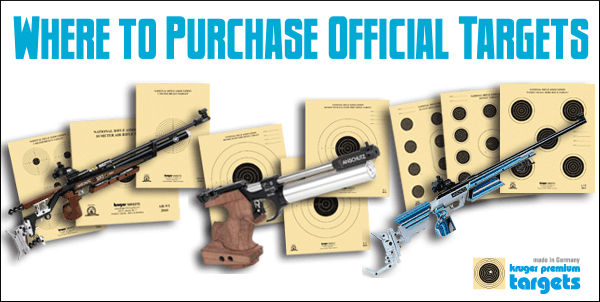
AccurateShooter.com offers dozens of FREE, printable targets for target practice, load development, and fun shooting. We also offer a few of the most popular NRA Bullseye targets. One or more of these printable targets should work for most training purposes. However, some readers have asked: “Where can we get the real targets… exactly like the ones used in NRA, IBS, and NBRSA shooting matches?”
All these vendors carry nearly all the NRA High Power and Smallbore targets, including the new, smaller F-Class targets. Germany’s Kruger Targets sells all the important NRA targets, and international (ISSF) air rifle and smallbore targets too.
Orrville Printing currently sells IBS targets for rimfire (50 yard) benchrest, short-range centerfire Benchrest (100, 200, 300 yards), Hunter BR Rifle (100, 200, 300 yards), plus the official 600-yard and 1000-yard IBS targets. National Target Company also has most of the IBS targets. NBRSA short-range, 600-yard, and 1000-yard benchrest targets are available directly from the NBRSA Business Office. Call (307) 655-7415 to order for the season.
At Western CMP Games, veteran rifle competitors Leon Rutherford, left, and Don Rutherford, demonstrate how to score targets at the GSM new shooter clinic. Note the use of a separate Target Center, which is available from many of the vendors listed above.
This fall in Vermont, Coast Guard Petty Officer First Class (PO1) Charlie Petrotto proved he is one of the nation’s top pistol shooters. At the Civilian Marksmanship Program (CMP) New England Travel Games, held at the Camp Ethan Allen in Vermont in September, 34-year-old PO1 Petrotto won every single pistol competition during the event. As the “Top Gun” in every pistol match, Petrotto took home SEVEN plaques for his pistol marksmanship — a remarkable trophy haul.
Report based on story by Ashley Brugnone, CMP Writer
At the 2018 New England Games, Charlie Petrotto swept all the pistol events. Competitors during the pistol events saw the skies open up to periodic rain showers, but, according to Petrotto, the biggest challenge wasn’t the precipitation so much as the darkness brought on from the clouds overhead.
That created a challenge he explained, “Obviously you need to be hard on your front sights and smooth on the trigger, and it was hard to do the first part, so it was hard to get on your sights and stay on your sights – the target was so bright, and your sights were so dark. It was easy to just jump to the target. I shot a couple of 7’s that way, not paying attention to my sights.” Though adequately tested, he captured each win during the weekend.
Petrotto is passionate about marksmanship. He’s a Coast Guard Petty Officer First Class (Gunners Mate) currently stationed at the Coast Guard Academy. There he studies marksmanship and works with cadets and Officer Candidate School (OCS) candidates.
Being stationed at the Coast Guard Academy has definitely helped Petrotto’s skill set: “It’s really a fortunate opportunity,” he said. “I get to come in early to work, we have a range where I shoot air pistol, I shoot free pistol, .45, .22 – all the things – before we have a cup of coffee and get to work. With that, we really get to do a lot of shooting,” he said with a grin.
Petrotto has achieved both Pistol and Rifle Distinguished badges. And he has reached the President’s Hundred in pistol at the Camp Perry National Matches four years running. Petrotto’s love for marksmanship competition began when he was in A-school in the Coast Guard. Looking through a manual he saw a picture of the Distinguished Badges. He photocopied the pages, put them in his locker and told himself, “I have to get that.” And he did — he is now double-distinguished in both pistol and rifle.
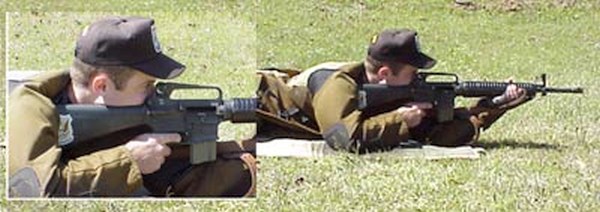
The First Shot, the CMP’s online magazine, features a well-written article on Prone Shooting Technique by SPC Matthew Sigrist of the U.S. Army Marksmanship Unit (USAMU). The article covers all the major points of gun hold and body position: hand position, elbow position, stock weld, buttstock placement, and sling position/tension.
Keep it Steady — The Elements of a Good Prone Position
Part 1 — Building the Position By SPC Matthew Sigrist
Imagine the following scenario: You are at the last stage of fire in the National Trophy Individual Match, firing at the 600 yard line in the prone position and every point matters. What should you reflect on as you prepare to shoot this final string? As your eyes cloud from sweat, you realize that all you have to rely on is your experience and knowledge of the fundamentals.
During the National Trophy Individual Match, you will fire 60 percent of your shots from the prone position. This article will address the fundamentals of a good prone position and help you learn the techniques required to be successful in both the slow and rapid-fire stages of National Match competition.
This article will be divided into two parts. In part one, we will discuss the elements of a good prone position. In part two, we will cover the techniques you will in the rapid-fire and slow-fire stages.
The Fundamentals
The fundamentals are the building blocks of a position. Much like the framework of a house, a correct application of the fundamentals ensures a solid and stable structure. Since each person’s position will depend on their particular body build and shape, there is no “perfect position” that applies to everyone. Experience, practice and knowledge of the correct fundamentals will dictate the best position for you.
There are six key elements of any position. The purpose for these six points is to achieve a solid platform that allows for consistent sight alignment using the least amount of muscle tension.
1. Placement of the Firing Hand (the hand that pulls the trigger)
The firing hand needs to be placed high on the pistol grip. This high hand position will give you better control of the rifle. Combined with a firm grip there will be a reduced amount of hand movement when pulling the trigger. Wrap your thumb over the three fingers on the pistol grip (excluding the trigger finger). This will help isolate the movement of the trigger finger.
2. Placement of the Non-firing Hand (the hand supporting the rifle).
The non-firing hand should grip the handguard or stock in the flat portion of the hand between the thumb and forefinger. The fingers should curl naturally around the stock, but they should not grip it tightly. The position of the hand on the stock will depend on the physical size of the shooter. Generally speaking, taller shooters with longer arms will grip the rifle further out, near the sling swivel, while shorter shooters will need to pull their hand rearward. This is sometimes referred to as “short-stocking” the rifle.
3. Stock Weld
Stock weld is the contact that the face makes with the stock. It is important because it directly effects your sight alignment. Consistent head placement will help you achieve consistent sight alignment. The human head weighs an average of 8 to 10 pounds. The full weight of the head must rest on the stock. In doing this you achieve two things, a relaxed neck and reduced recoil because of the pressure of the head.
4. Placement of the Rifle (the contact that is made in the firing shoulder)
The rifle butt placement needs to be consistent. If this changes between shots, it effects your sight alignment and the effect of recoil. In the prone position the rifle will sit lower in the shoulder compared to other shooting positions. This allows for a more forward head and a lower position as a whole.
5. Position of the Sling
The sling should be high on the arm, above the bicep. This way the sling will have less leverage on the arm so it doesn’t cut off the circulation.
Demonstration of the placement of the firing elbow (left) and non-firing elbows (right).
6. Placement of both the firing, and non-firing elbows
A guideline for non-firing elbow placement is that there should be 1 ½’’ to 2’’ gap between your non-firing arm and the rifle’s magazine. (NOTE: this references the AR-15 service rifle) Your arm should be almost straight up and down; this will transfer the weight directly down the arm and not to the side (see picture above). Think of the firing arm as only a kind of kickstand, it doesn’t support weight it only holds the firing hand in position.
Variations of the Prone Position
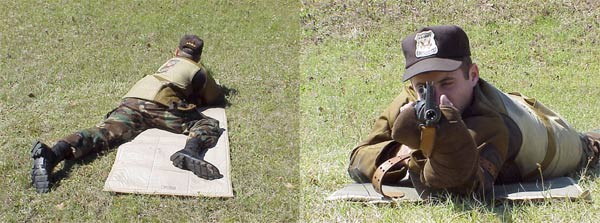
There are two main variations of the prone position; open/spread legged, and bent-legged. The two types will be discussed below.
Open/Spread Leg Position
Demonstration of the Open/Spread Leg Position.
The first position is the open/spread legged position. This is when the shooter spreads their legs shoulder width or more apart. This allows for a more forward pressure on the sling and elbows. This position requires a tighter sling and solid elbow placement. The rifle should sit tight in the shoulder. With this position, your body will be farther behind the rifle compared to the bent leg position, allowing for minimum disturbance from recoil.
Bent Leg Position
Demonstration of the Bent Leg Position.
The bent leg position is when the shooter bends the firing side leg up towards the firing hand making the knee at a rough 90 degree angle to the body. The non-firing leg will remain straight and inline with the body. This will take pressure off the lungs and heart minimizing the pulse from the chest as well as easing the pressure on the lungs which will allow for easy breathing and control.
Summary
You now know the fundamentals of a good prone position, as well as the two types most commonly used. Extensive dry-firing will reveal which is the best position for you. If possible, have a friend take pictures of you in position. This will enable you to better diagnose and correct your errors. Remember, a position must be both fundamentally sound and comfortable. Practice frequently to learn your new position and to develop the conditioning required to endure long days on the range.
Shooting USA will broadcast a great episode today, September 19, 2018. There are three segments worth watching. First the TV show spotlights the popular GAP Grind, a Pro-Am PRS event at the K&M Precision complex in Tennessee. Then this episode covers the CMP Western Games at Ben Avery Shooting Facility in Phoenix. Finally John Scoutten reviews two new 6.5 Creedmoor Savage rifles.
AIR TIMES — NOTE possible changes this week during the Outdoor Channel’s Deer Week promotion. Check Outdoor Channel TV listings in your cable menu. Shooting USA Episode normally airs Wednesdays at 9:00 PM Eastern and Pacific, and 8:00 PM Central.
Part One: GAP Grind Pro-Am PRS Match
Lots of Action, with 20+ Stages
The GAP Grind, the biggest PRS match in the country, is a notoriously challenging, “high tempo” match with minimal down-time between stages. Over the course of 20+ stages, competitors will fire 200+ shots at a variety of steel, paper, moving, and reactive targets out to 1,200 yards. Targets vary in size/difficulty based on the shooter’s position, distance, and time allotted. Most stages include “stressors” — i.e. time limits or required movement(s).
Part Two: CMP Western Games
The Civilian Marksmanship Program (CMP) was established by act of Congress in 1903, with the purpose of teaching shooting skills to American citizens. The Western Games at the Ben Avery Facility North of Phoenix draws enthusiasts from many Western states for competition with Service Rifles, vintage military rifles, M1 Carbines, and Rimfire Sporter rifles. Along with numerous matches (including the Vintage Sniper Team match), the Western Games features Small Arms Firing School (SAFS) shooting clinics.
“Our mission is to teach marksmanship and give the citizens of the United States the opportunity to learn marksmanship, with an emphasis on youth”, states Mark Johnson, CMP Chief Operating Officer.
Part Three: Savage 6.5 Creedmoor Rifles Review
In this review segment of today’s Shooting USA episode, John Scoutten reviews two new 6.5 Creedmoor rifles from Savage Arms. The Model 10 BA Stealth is a short action bolt gun priced at $1,207 MSRP. The MSR 10 Long Range is am AR-platform semi-auto priced at $2,284 MSRP. Both rifles showed good accuracy with factory ammunition. For this test both Savage rifles were topped with Bushnell Elite LRTS optics.
Readers often ask us: “Is there an inexpensive way I can get started in position shooting?” The answer is “yes” — across the country CMP-affiliated clubs host Rimfire Sporter matches. You can use a wide variety of .22 LR rimfire rifles — manual actions (such as a Winchester model 52) or semi-automatics (such as a Ruger 10/22). There are prone, sitting/kneeling, and standing stages. CMP rules provide separate classifications for scoped rifles, open-sighted rifles, and aperature-sighted rifles. The matches are fun, the ammo is inexpensive, and everyone has a good time while improving their marksmanship.
The rapid-fire sitting or kneeling stage of a CMP-sanctioned .22 Sporter Match consists of two, 5-shot strings. A manually-operated or semi-automatic rifle may be used for this match.
The video shows the sitting/kneeling rapid-fire stage of a Rimfire Sporter match.
Our friend Dennis Santiago helps run CMP Rimfire Sporter Matches in Southern California. Dennis observes: “You want something challenging? Well that X-Ring 50 yards away is the diameter of a 50 cent piece, and there are people out there that can womp that thing with iron sights.”
Dennis notes: “There are six (6) stages of fire on a tough little target. Notice the rifles that can be used run the gamut from pump and bolt actions to variations on the semi-auto theme. All still require a good eye and a steady hold to earn one’s bragging rights for the day. A match takes about an hour and a half per relay. The slowest part of the match is initial sighting in. It’ll take longer than the allocated 5 minutes for the typical first timer coming to a club match.”
At Dennis’s Burbank Rifle & Revolver Club (BRRC), procedures are modified a little bit: “What we typically do at BRRC is run two relays. Experienced competitors shoot per the full rulebook. New shooters are afforded a bit more relaxed environment to make the experience more fun and inviting. We do the same thing in our M-1 Garand Clinic/Match series.”
Rimfire Sporter Match Basics
The CMP Rimfire Sporter Rifle Match is an inexpensive, fun-oriented competition using .22 caliber sporter rifles (plinking and small game rifles) commonly owned by most gun enthusiasts. To compete, all you need is a basic rifle, safety gear, and ammunition. No fancy, high-dollar rifles are required.
The event is shot with standard sporter-type, rimfire rifles weighing no more than 7 ½ lbs, with sights and sling. Rifles may be manually-operated or semi-automatic. Shooters with manually-operated actions are given extra time in the rapid-fire stage to compensate for the difference. (See Video).
There are three classes of competition — the standard “O Class” for open-sighted rifles, “T-Class” for telescope-sighted and rear aperture-sighted rifles and “Tactical Rimfire” class, which is a .22 caliber A4 or AR15 style rifle. Firing for all classes is done at 50 and 25 yards on a target with a 1.78″ ten-ring and an 18″ outer one-ring. Even new shooters can get hits on this target, but it’s still tough enough that no one yet has fired a perfect 600×600 score.
The Civilian Marksmanship Program (CMP) has a CMP Guide to Rimfire Sporter Shooting. This FREE, 50-page digital publication covers equipment, positions, course of fire, rules, scoring and much more. You’ll find helpful “how-to” sections on aiming, sight picture, hold control, and trigger control. Reading these instructional sections can benefit any prone or three-position competitive shooter.
We all enjoy shooting rifles, but it’s also fulfilling to share your knowledge as a mentor. Serving as a rifle instructor can be very rewarding. Now the CMP offers a program to certify Master Instructors for the CMP’s most popular rifle programs — Vintage Military and Rimfire Sporter.
CMP Master Instructor Training Workshops
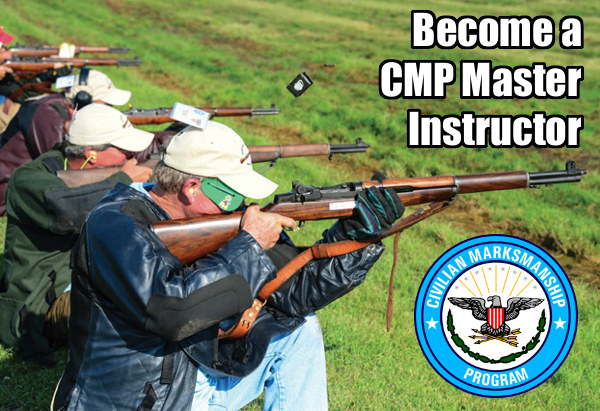
As a CMP Instructor you can help novices learn to safely shoot the M1 Garand, M1903 Springfield, and other vintage military rifles. You can also help with the very popular Rimfire Sporter program. Later this year, the CMP is offering an excellent program to help train new Master Instructors.
Experienced rifle marksmanship instructors and shooters who wish to receive advanced training and be certified as “Master Instructors” to teach CMP-sanctioned Clinics are invited to apply to attend a CMP Master Instructor Training Workshop. These workshops will train instructors to conduct Garand, Springfield, and Vintage Military Rifle Clinics and/or Rimfire Sporter Clinics. There will be two (2) instructor training workshops this year, one at Camp Perry in October and the second in Talladega in December. Dates and locations are:
M1903 Springfield shooter at Camp Perry. From GarandThumbBlog’s 2015 CMP Games Video.
CMP Master Instructor Class — In the Beginning
Our friend Dennis Santiago has been a CMP instructor for many years. He reports this has been a great experience and the CMP is a great organization. Dennis earned his “teaching credentials” at the first-ever GSM (Garand/Springfield/Vintage Military) Master Instructor Class.
CMP Director Gary Anderson is top row far left, with Dennis in front row center.
My Decade as a CMP Master Instructorby Dennis Santiago
I was in the first GSM Master Instructor class. It was taught at Camp Pendleton (CA) in November 2006 as part of the CMP Western Games. It was a three-day class by then-head of the Civilian Marksmanship Program, Gary Anderson.
We were the guinea pigs for an experiment. Our mission would be to take what we learned back to our clubs and create programs to teach the sport of High Power riflery to Americans, most of whom, were unfamiliar with shooting, let alone the details of serious competition. It was one of the most rewarding shared experiences of my life and it began a 10-year journey that helped build my love for the sport.
Gary spent lots of time not only teaching his prepared material but working with us on feedback about how to improve the curriculum. I took what I learned back to the Burbank Rifle and Revolver Club (BRRC) and, working with Wayne Fenner (left in photo), my friend and fellow sponsor of the California Grizzlies Junior Rifle Team, adapted BRRC’s training match program to the CMP’s approach.
Over the course of almost a decade, I taught a battalion of Americans from every walk of life and every political and ethnic background how to operate and compete with the U.S. Rifle M-1 Garand. It defined one weekend of every month of my life. We experimented with every CMP match format that came out, often discussing concepts with Gary and the CMP team.
Many of the students I taught went on to become accomplished competitors in their own right. I’ve watched them win medals, major tournaments, become distinguished riflemen. Some set national records. One made it to the Olympic Trials. The true reward was to hear from all of them again and again over the years. I’m from the old school that says you pass on what you have learned because you pay forward in gratitude to those who taught you. And so it was the decade I was BRRC’s GSM Master Instructor of record.
If you want to make a difference to the growth of our sport, consider taking the time to become a GSM Master Instructor. Teach another battalion of Americans what it means to be the caretakers of our heritage from behind every blade of grass.
DCM Emeritus Gary Anderson Teaches Clinic at Camp Perry, Ohio:
Here a Springfield M1903 shooter (in period-authentic uniform) competes in CMP Legacy Match.


 Three-Position (3P) Air Rifle Shooting is the most popular and fastest-growing form of shooting sports competition for junior shooters (High School age and younger). The Civilian Marksmanship Program (CMP) conducts two different 3P Air Rifle events. Precision Air Rifle is modeled after Olympic-style shooting and allows the use of specialized target rifles and equipment. Sporter Air Rifle is designed for new competitors or those who desire to compete with a minimum of equipment and expense.




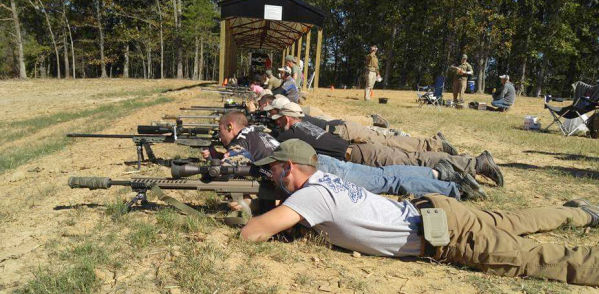
 The Civilian Marksmanship Program (CMP) was established by act of Congress in 1903, with the purpose of teaching shooting skills to American citizens. The Western Games at the Ben Avery Facility North of Phoenix draws enthusiasts from many Western states for competition with Service Rifles, vintage military rifles, M1 Carbines, and Rimfire Sporter rifles. Along with numerous matches (including the Vintage Sniper Team match), the Western Games features Small Arms Firing School (SAFS) shooting clinics.
 In this review segment of today’s Shooting USA episode, John Scoutten reviews two new 6.5 Creedmoor rifles from Savage Arms. The




 We were the guinea pigs for an experiment. Our mission would be to take what we learned back to our clubs and create programs to teach the sport of High Power riflery to Americans, most of whom, were unfamiliar with shooting, let alone the details of serious competition. It was one of the most rewarding shared experiences of my life and it began a 10-year journey that helped build my love for the sport.