The Second Annual D-Day Match in Talladega was a big success. On the weekend of June 4-5, over 250 eager competitors arrived at the Civilian Marksmanship Program’s (CMP) Talladega Marksmanship Park for the D-Day Match commemorating the 72nd Anniversary of the Allied Forces’ landing at Normandy. This was a major match, attracting rifle and pistol shooters from throughout the country.
The Talladega range complex is an impressive, modern facility equipped with a computerized, high-tech Kongsberg electronic target system that plots shot locations and displays scores on monitors at each shooting station. For many competitors, this D-Day match was their first experience with electronic scoring. None complained about being freed from pit duties (the Kongsberg system eliminates the need to raise and lower targets or mark shots).
The John C. Garand Match has become hugely popular…
Georgia boys dominated the popular John C. Garand Match. Winning gold was SSG Jonathan O’Neal of Marietta, GA, who fired a score of 291-13X. Larry Sollars (Cumming, GA) followed closely behind, one point back with a score of 290-9X. Keith Schachle of Brooks, GA, shot a 288-7X for third.
Vintage Sniper Rifle Matches at Talladega
New this year, the D-Day Matches featured the inclusion of one of the CMP’s most popular competitions, the Vintage Sniper Match. During the event, a team of two uses a scoped Korean War, World War II or earlier “as-issued” military rifle to fire at distances of 300 and 600 yards. All shots are taken from the prone position with sand bag rests permitted. Each partner takes a turn as both shooter and spotter.
Over 60 shooters registered for the event’s first showing at the D-Day Matches. CMP Competitions Department manager Shannon Hand said, “The addition of the Sniper Match was very well-received by the competitors! It was a great event!”
Winning the Manual (bolt-action) Vintage Sniper Match were Bobby Robinson and Daniel Henk. In the Semi-Automatic Sniper Match, the team of Franklin Hines III and CMP North general manager Steve Cooper fired the winning overall score of 368-7X.
In pistol action, SSgt. Chad Ranton, 29, of Beaufort, SC, was the overall competitor in the .22 Rimfire Pistol EIC Match with a score of 276-5X. Notably, 15-year-old Katelyn Abeln proved she came to win after recording a score of 254-3X to earn Junior Division gold in the EIC Pistol Match. Katelyn was also the High Non-Distinguished pistol shooter of the match.
All persons are welcome to visit the Talladega Marksmanship Park, which is open to the public all year long. More information on the Talladega Marksmanship Park, including a facility map and description of facilities, can be found at the CMP’s Talladega Webpage.
Story based on article by Ashley Brugnone, CMP Writer
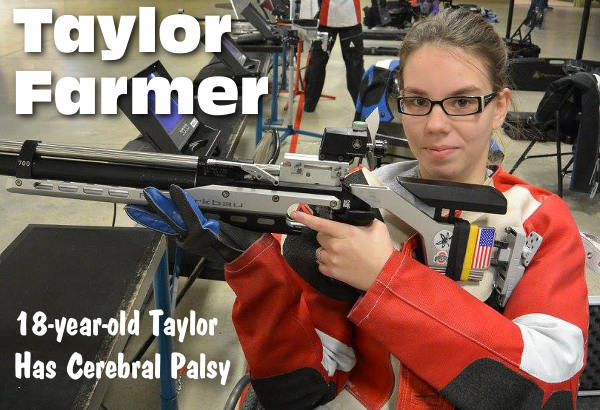
This story is about two shooters who have shown dedication, courage, and the ability to overcome physical limitations. 18-year-old Taylor Farmer has cerebral palsy. Her mentor and shooting coach, Greg Drown, has multiple sclerosis. But working together, Taylor has shown amazing abilities in competitive shooting. Taylor hopes someday to compete for the USA as a paralympic shooter in the Olympics.
Taylor Farmer was born to persevere. Her entire life, cerebral palsy (a neurological condition that limits muscle coordination) has forced her to work harder than others to achieve her goals. The effects of the disease on her body cause her to walk with crutches and to use a wheelchair for longer distances — but that hasn’t slowed her down.
As a teenager, Taylor began shooting rifle with her dad and her older brother. She never let the cerebral palsy get in the way of her desire to shoot. “I didn’t really think of it as being a challenge. I just wanted to do it…” she said.
Taylor built her marksmanship skills shooting rimfire rifles with a junior 4-H club. Her 4-H coach, Mary Ann Miller, recognized Taylor’s talent and introduced her to Greg Drown, a past State Champion shooter. That was the beginning of a great partnership…
Shooting Champion Doesn’t Let Multiple Sclerosis Stop Him
Greg Drown, 56, was a member of the Ohio State University Rifle team from 1980-1984, serving as team captain and earning numerous shooting honors. He competed in the 1984 Olympic Team Tryouts in Los Angeles and has been a State Champion in Three Position Air Rifle and Smallbore Prone. But a greater challenge lay ahead…
From 1995-2000, Greg gradually developed multiple sclerosis, a disabling condition of the central nervous system. His disease placed him in a wheelchair, but his determination kept him moving further into his shooting career (and winning a slew of gold medals and championships).
“It was a daunting task to re-learn the positions, not to mention shooting out of a chair with an attached table,” he said. “I had my trials and tribulations, but it took three or four years to become competitive again.” With determination, Greg reached the pinnacle of his career by winning the 2009 3P Any Sight Para National Championship at Camp Perry. He also made it to a Para World Cup in 2011.
Greg and Taylor Work Together
In September 2015, Greg and Taylor connected for the first time during the Ohio Day at the Range at Camp Perry. This event, held annually at the Gary Anderson CMP Competition Center, is conducted for children and adults with disabilities and their families.
“I grabbed a sporter rifle off the rack and Taylor began shooting off the foam rests,” Greg said. “She consistently put 20 or so shots in the 10 ring.”
Taylor then asked Greg if she could get rid of the rest and shoot out of the adapted standing position while seated in her wheelchair. To Greg’s amazement, she continued to put shot after shot in the 9 and 10 ring — all without a coat and glove.
TALLADEGA, Alabama — The 2nd Annual D-Day Anniversary Matches will be held June 4-5, 2016, at the CMP’s Talladega Marksmanship Park in Alabama. The event commemorates the 72nd Anniversary of the Allied landing at Normandy in 1944. Last year, the new $20-million-dollar Talledega Park marked its Grand Opening to the public with the inaugural D-Day Match. That was a great success, and the 2016 D-Day Match promises to be even bigger and better. It’s not too late to join the fun — there are still slots available for the event.
Watch Prone Stage from the Inaugural Talladega D-Day Match in 2015
The CMP’s John C. Garand D-Day Anniversary Match is a big event with many different competitions for rifle and pistol shooters. Along with the signature M1 Garand event, a Vintage Sniper Match, EIC Service Rifle Match, .22 Rimfire Pistol Match, and a EIC Service Pistol Match, and .22 Rimfire Pistol matches will be conducted. Last year’s D-Day match saw the debut of Talladega’s electronic target system. The John C. Garand Range has a huge firing line with monitors at all shooting stations. These connect to three banks of electronic targets positioned at 200, 300, and 600 yards.
Last year, 55-year-old Douglas Armstrong fired a score of 293-10X to become the first overall winner in the D-Day John C. Garand Match — breaking the previous National Match Record. He was also the winner of the EIC Rifle Match.
State of the Art Shooting Facility in Alabama
The 500-acre CMP Talladega Marksmanship Park is one of the most advanced outdoor shooting facilities in the Western Hemisphere. The facility includes a 600-yard rifle range, a 100-yard multi-purpose range, and a 50-yard pistol range, equipped with Kongsberg electronic targets and scoring monitors that allow shooters on the firing line to review shots in a matter of seconds. Since the 54 targets at each line register hits and calculate the scores, no pit duty is required at Talladega. For more info, send email to shall[at]thecmp.org or phone 256-474-4408 ext. 414.
State-of-the-art Kongsberg target systems are used at the CMP’s Talladega Marksmanship Park.
Talladega Marksmanship Park also contains 15 action pistol bays, a trap field with a 5-stand overlay, and a 15-station sporting clay field. The crown jewel of the Park is the 13,000-square-foot CMP Park Club House, featuring indoor and outdoor viewing areas, a CMP Pro Shop operated by Creedmoor Armory, classrooms, and lounge areas. To learn more about the CMP’s Talladega Marksmanship Park visit: Talladega Marksmanship Park Webpage.
Recently the CMP adopted new rules that allow the use of magnified optics, up to 4.5X power, in Service Rifle competition. The Nightforce NXS 1-4x24mm Compact Riflescope, while not designed specifically for Service Rifle competition, complies fully with the new Service Rifle optics rules and works very well. In fact, our correspondent Johnny Fisher used this scope to take third place in the recent California State Service Rifle Championship. Here’s a run down of the scope’s features and performance. Johnny says this is a “great scope” and “results are extremely promising” so far.
Gear Review: Nightforce NXS 1-4x24mm as Considered for Service Rifles by Johnny Fisher
2016 has brought with it a long anticipated rule change that allows for the use of optics in Service Rifle competition. The rule allows scopes (fixed or variable) up to 4.5 power with an objective lens no greater than 34mm. Given the strict limits on max magnification and objective size for Service Rifle optics, there are somewhat limited options on the market at this time. Service Rifle competitors are now challenged with selecting an optic that fits the rules while offering high-end performance. Thus far, it seems the biggest concerns that Service Rifle shooters have when considering an optic are: quality, repeatability, parallax, reticle choices, and durability.
Click Image for Full-screen Version.
PARALLAX Considerations
The vast majority of Service Rifle Rule-compliant scopes currently on the market have a fixed parallax. That means there is no separate focus knob to adjust parallax to target distance. Accordingly, there has been much concern about the potential for parallax error over the three different distances in Across-The-Course competition. It is possible that the repeatably-indexed head position maintained while shooting a Service Rifle, along with a little extra emphasis on sight alignment to ensure that the shooter’s eye is directly behind the scope, can greatly mitigate the potential effects of parallax error.
The Nightforce NXS 1-4x24mm comes with the parallax factory-set at 75 yards. Combined with the right amount of eye-relief and low-enough rings to ensure an easy-to-maintain and clear/full sight picture, it seems like the fixed parallax is not really the problem some folks think it may be. Below are two, 10-round test strings shot at 300 yards (each with a magazine change). Note that I didn’t drop a point, even with the non-adjustable parallax.
The Fixed Parallax is not a “deal-breaker”. Witness 20 shots at 300 yards — all 10s or Xs.
RETICLE Options
For the NXS 1-4x24mm scope, Nightforce offers two reticle types: the International Hunting Reticle (IHR) and the FC-3G (with 5.56 NATO or .308 NATO BDC hold-over features). My scope has the IHR Reticle, which provides a very clear, unobstructed and simple sight picture. The IHR reticle for the NXS 1-4x24mm boasts an illuminated center cross-hair. Unfortunately, the red-color illumination is really only intended for low-light situations and is not bright enough to offer any aid to National Match shooters competing in broad daylight at stationary targets.
ZERO-STOP (Optional)
For Service Rifle shooters accustomed to keeping track of their sight settings as “clicks from bottom”, the optional Zero-Stop might be welcome. After loosening the turret and establishing the desired Zero-stop location, tightening the set screw blocks rotation below this point. NOTE: Once set, the Zero-Stop turret only allows for one full revolution of elevation adjustment. However, the Nightforce NXS 1-4x24mm offers 20 minutes of elevation adjustment per revolution. That should be more than enough elevation adjustment for come-ups to 600 yards (even with a 100-yard zero established near bottom).
PRICE and DURABILITY
The Nightforce NXS 1-4x24mm carries a price tag of just over $1500.00. The scope just feels solid –nothing plastic — especially when compared to some of the other consumer- or recreational-grade options on the market. All touchable tolerances feel extremely tight. There was quite an amount of attention given to every little detail, as you would expect from an optic at this price point. It is hoped that the scope’s mil-spec robustness will assure continued excellent performance — even after seasons of the kind of abuse that High Power shooters put on their equipment. More will be revealed as I use the scope at future competitions, but initial results are very good. This is a quality optic. I have high hopes that it will prove a good investment.
Camp Perry is moving into the future. The first fifteen (15) electronic targets are being installed right now at Camp Perry’s Petrarca Range. This is the beginning of a process to supply many ranges at Camp Perry with state-of-the-art Kongsberg (KTS) electronic targets similar to those installed at the CMP’s Talladega Marksmanship Park. NOTE — the CMP is not planning a whole-scale replacement of all of Camp Perry’s old-fashioned targets. However the CMP hopes to modernize the Camp Perry facility, by installing some electronic targets on all Camp Perry ranges by summer 2018.
Camp Perry’s new Kongsberg electronic targets will be similar to the targets installed at the Talledega facility (shown above). Image courtesy CMP and www.AL.com.
New Kongsberg Electronic Targets for Camp Perry
On the Camp Perry Petrarca Range in Ohio, KTS targets for rifle, pistol and smallbore are currently being installed. The CMP states: “The project is going according to plan and is within budget, with completion expected by the end of June for CMP use and those attending the National Matches.”
When the new target systems are installed, the Petrarca Range will offer 10 KTS targets for rifle and five KTS targets for pistol and smallbore. Though the rifle targets will be located at the 200-yard line, the changing of the target faces and the use of reduced target definitions will allow shooters to practice for longer distances as well. Pistol targets will be mounted in portable carriers that will allow them to be set up at 25 or 50 yards.
More Electronic Targets at Camp Perry by 2018
It is hoped that some KTS rifle targets will be available on ALL of the Camp Perry ranges by summer of 2018. (These will supplement the conventional target frames, not replace them altogether). 2016 National Match competitors will be able to try out the new KT targets when they visit the Camp Perry training site in July. In the future, the Petrarca Range will be open for public use.
Monitors Display Score and Shot Location Instantly Each Kongsberg target connects to a monitor that displays the hit locations to the shooter. Easy push-button controls allow the shooter to cycle through hits and options without having to change positions. The monitors employ non-glare glass protected by an aluminum frame that acts as a shade. This ensures good visibility for the shooter.
Engineered in Norway, Kongsberg target systems do more than just display shot locations to competitors. The system automatically calculate scores, and every target is networked to a central, “command” computer. This can provide updated competitor rankings, and can even display the results to event spectators on large view screens. See how it works in this video from Kongsberg:
Video Demonstrates Kongsberg Target System
Mobile Electronic Targets Will Be Moved Around the Country
The CMP now has set of mobile electronic Kongsberg High Power targets. The CMP plans to shuttle these transportable targets to a variety of ranges in the north, south, east, and west, allowing shooters around the country to experience the benefits of electronic target systems. The CMP has found that shooters love the fact that matches run much more quickly and efficiently with electronic targets, as shooters do not have to be shuttled to the pits between relays. In addition, each shooter has a monitor providing instant feedback of his shot locations and scores.
In April, 15 mobile electronic targets were temporarily installed and fired upon from 200, 300 and 600 yards at the Oklahoma City Gun Club during the Oklahoma CMP Games Matches. The mobile targets were transported from Talladega and mounted by the CMP and volunteers for use during the event. The targets were removed at the conclusion of the event for future use at other High Power ranges.
To succeed in long-range shooting matches, given the high level of competition these days, you’ll need solid wind-reading abilities. We’ve found an article by SFC Emil Praslick III, retired USAMU Service Rifle coach and U.S. Palma Team Coach, that can help you make better wind calls in competition.
Emil Praslick, now retired from the U.S. Army, is considered one of the best wind gurus in the United States, if not the world. During his service with the USAMU he authored an excellent two-part article on wind reading that is available on the CMP (Civilian Marksmanship Program) website. Both articles contain helpful illustrations, and are “must-read” resources for any long-range shooter–not just Service Rifle and Highpower competitors.
Part One covers basic principles, tactics, and strategies, with a focus on the 200-yard stages. Emil writes: “There are as many dimensions to ‘wind reading’ as there are stages to High Power competition. Your tactical mindset, or philosophy, must be different for the 200 and 300 yard rapid-fire stages than it would be for the 600 yard slow-fire. In the slow-fire stages you have the ability to adjust windage from shot to shot, utilizing the location of the previous shot as an indicator. Additionally, a change to the existing conditions can be identified and adjusted for prior to shooting the next shot.”
In Part Two, Praslick provides more detailed explanations of the key principles of wind zeros, wind reading, and the “Clock System” for determining wind values: “The Value of the wind is as important as its speed when deciding the proper windage to place on the rifle. A 10 MPH wind from ’12 o-clock’ has No Value, hence it will not effect the flight of the bullet. A 10 MPH wind from ‘3 o’clock’, however, would be classified as Full Value. Failure to correct for a Full Value wind will surely result in a less than desirable result.”
Praslick also explains how to identify and evaluate mirage:
Determine the accuracy of the mirage. Mirage is the reflection of light through layers of air that have different temperatures than the ground. These layers are blown by the wind and can be monitored to detect wind direction and speed.
Focus your scope midway between yourself and the target, this will make mirage appear more prominent. I must emphasize the importance of experience when using mirage as a wind-reading tool. The best way to become proficient in the use of mirage is to correlate its appearance to a known condition. Using this as a baseline, changes in mirage can be equated to changes in the value of the wind. Above all, you must practice this skill!
Click HERE for more excellent instructional articles by Emil Praslick and other USAMU Coaches and shooters.
Report based on story by Ashley Brugnone, CMP Writer
Registration for the 2016 National Trophy Pistol and Rifle Matches will open April 1, 2016. The National Matches will take place at Camp Perry, Ohio, six miles west of Port Clinton, during the months of July and August. Starting April 1st, you can register on the Civilian Marksmanship Program (CMP) website to claim your spot at this year’s event.
2016 National Match Schedule Includes Legacy Series
The 2016 Match Schedule will be different from the 2014-2015 National Matches, returning to the original schedule of years past. Events featured will include the John C. Garand, President’s Rifle, Hearst Doubles, Vintage Sniper, as well as a multitude of prestigious pistol events. New this year, the CMP will introduce its Legacy Series — an extra week with competitions featuring both vintage and modern military rifles. Each event has been named to honor the memories of important figures in marksmanship history, as well as to commemorate the spirit of past and present National Matches.
Shooting Clinics at Camp Perry This Summer
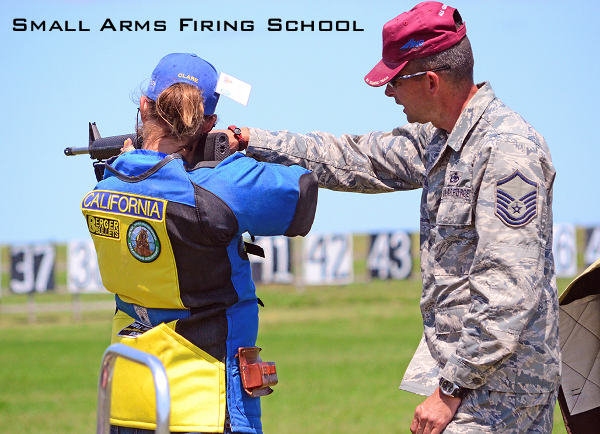
The Small Arms Firing School (SAFS) will also be held for rifle and pistol enthusiasts this summer. Participants will be taught firearms handling and competition skills by some of the top military shooters in the country. The SAFS courses have been a staple in the National Matches at Camp Perry since 1918. Many other clinics and learning opportunities, taught by qualified professionals, will also be available during the National Matches.
Spectators Are Welcome at the National Matches
Events are open to the public, and spectators are welcome to observe firing on the Camp Perry ranges at any time. Guests are encouraged to visit Camp Perry and watch the many events held during Match season. The photo below shows spectators watching Pistol events at the 1956 National Matches. That was quite a crowd…
The Civilian Marksmanship Program (CMP) is a federally chartered 501 (c) (3) non-profit corporation. It is dedicated to firearm safety and marksmanship training and to the promotion of marksmanship competition for citizens of the United States. For more information about the CMP and its programs, log onto www.TheCMP.org.
Report by Johnny Fisher
The Civilian Marksmanship Program has just finished temporary installation of 15 traveling electronic Kongsberg Targets at the Oklahoma City Gun Club in Arcadia, OK. These high-tech targets will be employed during the Oklahoma CMP Games, slated for April 6-10, 2016. All the High Power rifle events during this year’s Oklahoma Games will be run exclusively on these electronic targets. Competitors will be scored electronically with match results being processed in real-time. Notably, this means High Power competitors will not have to do “pit duty” the entire week since manual target-pulling and shot-marking is no longer required.
The majority of shooting at the Oklahoma CMP Games will be fired at the 200-yard line for the Garand / Springfield / Vintage & Modern Military (GSMM) matches. However, the electronic targets have also been readied for use in the scheduled Excellence In Competition (EIC) and Vintage Sniper matches. Those events require additional firing from 300 yards and 600 yards.
Electronic Target Technology — How Kongsberg Targets Work
CMP Targets technician Bryan Parris explains what makes these targets so special: “These targets were designed by the experts at Kongsberg Targets exclusively for the CMP to fit the standard US target dimensions of 72″ square target backers. What shooters discern as the black of the aiming bull is actually black rubber sheeting that is the entire size of the backer. A layer of white corrugated plastic then covers this rubber with a center hole having been cut out to reveal the appropriate sized bull for that yard-line. All that is required as competitors move further back through the course is to change out the plastic cover to reveal a larger aiming black.”
This acoustically-scored target system uses four microphones to locate the bullet as it passes through the target. The microphone closest to the bullet traveling through the target actuates the remaining three to triangulate the exact shot location for the scoring system and simultaneously display the shot on the shooter’s monitor.
Behind the coroplast face and inside the foam insulation, the target is wrapped with rubber to form a type of chamber. This helps insulate the target’s four microphones stay insulated from extreme temperature changes and also helps keep out ambient noise. This chamber need only exist to the extent that it separates itself from the other targets. Parris states: “We’re building these targets to last a great long while. They are extremely durable and can have anywhere from 3000 to 5000 rounds fired through them before any maintenance is required whatsoever.”
The entire system can be powered via battery, generator, or combination of both. The target line communicates wirelessly with the firing line computer system for timing courses of fire and recording scores. And of course, there is virtual real-time communication with monitors set up on each firing point to display shot / group location and value.
When fully assembled, each target weighs about 200 pounds. They are a little cumbersome in their current form, but the CMP’s target technicians are “still working some things out [for] potential future travel games.”
Registration Still Open for Oklahoma CMP Games
The 2016 CMP Oklahoma Games will be held at the Oklahoma City Gun Club in Arcadia, OK from April 6 – 10, 2016. Registration is still available. For more information about these Kongsberg Electronic Targets, contact Bryan Parris of CMP Targets at (256) 835-8455 or bparris@thecmp.org.
Newly-issued CMP and NRA competition rules now allow Service Rifle competitors to use optics with a max magnification of 4.5X. That’s right, Service Rifle shooters can now use scopes, not just iron sights. These rule changes have created a need for a new type of riflescope, one optimized for today’s “optics-allowed” Service rifle discipline.
March Optics has just introduced a brand new 1-4.5x24mm scope designed for Service Rifle competition and tactical applications. With ultra-sharp ED glass, this new March scope should set the standard for AR-friendly 4.5X optics. This compact variable-power scope offers ideal eye relief for AR-type rifles, along with plenty of windage and elevation range. The new March 1-4.5x24mm scope is a second focal plane optic with 1/4-MOA clicks. Weight, without caps, is 18.7 ounces. The scope comes standard with a speed lever for quick zooming throughout the magnification range.
The optics experts at March tell us: “This scope was specifically designed for the Service Rifle match shooter. New rules were announced in October 2015 that allow scopes with magnification up to 4.5X power. This 1-4.5x24mm scope also makes a great optic for SWAT work as well as for a sporting rifle. Oversized tactical turrets allow for easy windage and elevation adjustments. The high quality ED lenses provide superior image resolution that make March the best in its class”. The MSRP of this high-end scope is $2750.00. March is offering a 15% OFF special now for regular purchasers*. This scope will be on display at SHOT Show Booth 549.
* March offers a 20% off MSRP price on this scope for Law Enforcement/Military members (current and retired), Pros, and U.S. Team members.
The most important 2016 CMP rule change allows 4.5X (max) optical sights for Service Rifle shooting.
The new 2016 rulebooks for CMP-governed Service Rifle, Pistol and CMP Games shooting events have just been released. There are some very important changes for 2016, including the authorization of scopes for Service Rifle competition. You can download the new Rulebooks for free with the links below. NOTE: The most important 2016 Rules changes are indicated with underlined text in the new Rulebooks.
The big rule changes in the 2016 CMP competition rules concern the modernization of CMP Service Rifle standards. Starting in 2016, Service Rifle competitors will be able to choose between service rifles with traditional metallic sights or rifles with telescopes with a maximum of 4.5X magnification. These scopes may be fixed-power or variable, with max 4.5 power zoom. This rule change was coordinated with a similar rule change adopted by the NRA.
The CMP states: “The decision to legalize optical sights on service rifles was taken after several years of discussion and a recognition that U.S. military personnel no longer use anything but optical sights on their military rifles. CMP Service Rifle rules have traditionally tried to keep abreast of military rifle and training developments so opening Service Rifle shooting to optical sights became an inevitable change. To quote one comment received by the CMP, “It is very difficult now to say that as-issued ‘AR-15 or M16′ does not include telescopes.”
Another major change in the CMP Service Rifle rules will allow the use of a much wider variety of M16/AR15-type rifles. Legal service rifles will no longer be restricted to rifles that rigidly comply with the M16 service rifle profile. Starting in 2016, Service Rifles can be any “M16 U. S. Service Rifle or a similar AR15 type commercial rifle that is derived from the M16 service rifle design” and that complies with these restrictions:
Chambered for the 5.56 x 45 mm (.223) NATO cartridge.
Designed or modified for semi-automatic fire only.
Have either a gas-impingement system or a piston-operated gas system.
Have a barrel that is no longer than 20 inches, or 21 5/8 inches if the barrel has a flash suppressor.
Must use the same upper receiver and barrel for the entire match.
Have a trigger pull of at least 4.5 pounds.
Quad rails or similar hand guards are permitted, but the front sling swivel location must be fixed at 13 ¼ inches (+/- ½ in.) ahead of the forward edge of the magazine well (8.0 inches on M4 configured rifles).
Use standard service magazines or commercial equivalents.
Have a fixed or collapsible butt-stock that may vary in length and even be adjusted between firing stages. Butt-plates or cheek-pieces may not, however, be adjustable.
Have a standard A1 or A2 pistol grip.
Extended bolt releases and mirror-image left-hand receivers will be permitted.
No Weight Limit For Service Rifles
Before issuing its new rules, the CMP solicited comments. A substantial majority of competitors’ comments supported allowing optical sights and the broadening of the Service Rifle rule. The one rule change that most shooters opposed was a proposed weight limit for Service Rifles with optical sights. After considering these comments, the CMP Rules Committee rejected the the Service Rifle weight limit proposal. Accordingly, in 2016, there will be no weight limits for Service Rifles, whether they have optical or metallic sights.
Iron Sights and Optics Will Compete in the Same Class
The CMP considered having optics-equipped Service Rifles in a separate classification. That idea was rejected. So, for 2016 there will be ONE CLASS for all Service Rifles (both iron-sighted and scoped). The CMP observed that “the arguments for having one unified competitor category competing together for EIC points and Distinguished Badges prevailed. Having separate categories and one Distinguished Badge would have created nightmare administrative challenges. Having two categories and separate Distinguished Rifleman Badges for optical and metallic sighted rifles would have become a formula for diminishing the prestige of the traditional Distinguished Rifleman Badge. The final CMP decision was to keep one strong, unified Service Rifle event instead of two smaller categories[.]”
Rule Change Concerning Malfunctions (No more Alibis)
Another major Service Rifle rule change will abolish allowing extra time or refires for malfunctions. This change will save time because malfunction refires effectively double the length of time needed for rapid-fire relays in big matches. The main reason for this change is to place more responsibility on competitors for having rifles and ammunition that function with complete reliability. Comments received by the CMP concerning this change showed that it is controversial, but a majority of shooters supported the change. One shooter wrote: “The elimination of “alibis” is long overdue. It was always most frustrating to me when it takes longer to shoot rapid fire than slow fire.”
Story Tip by Shiraz Balolia of Bullets.com. We welcome reader submissions.


 The Second Annual D-Day Match in Talladega was a big success. On the weekend of June 4-5, over 250 eager competitors arrived at the Civilian Marksmanship Program’s (CMP) Talladega Marksmanship Park for the D-Day Match commemorating the 72nd Anniversary of the Allied Forces’ landing at Normandy. This was a major match, attracting rifle and pistol shooters from throughout the country.




 Each Kongsberg target connects to a monitor that displays the hit locations to the shooter. Easy push-button controls allow the shooter to cycle through hits and options without having to change positions. The monitors employ non-glare glass protected by an aluminum frame that acts as a shade. This ensures good visibility for the shooter.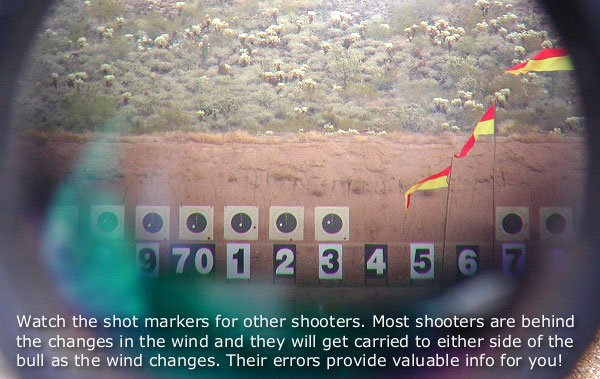
 To succeed in long-range shooting matches, given the high level of competition these days, you’ll need solid wind-reading abilities. We’ve found an article by SFC Emil Praslick III, retired USAMU Service Rifle coach and U.S. Palma Team Coach, that can help you make better wind calls in competition.
 Part One covers basic principles, tactics, and strategies, with a focus on the 200-yard stages. Emil writes: “There are as many dimensions to ‘wind reading’ as there are stages to High Power competition. Your tactical mindset, or philosophy, must be different for the 200 and 300 yard rapid-fire stages than it would be for the 600 yard slow-fire. In the slow-fire stages you have the ability to adjust windage from shot to shot, utilizing the location of the previous shot as an indicator. Additionally, a change to the existing conditions can be identified and adjusted for prior to shooting the next shot.”