A good riflescope is essential for many types of competition, and the vast majority of hunters have scoped rifles. Some F-Class and benchrest competitors are now using optics with up to 60X magnification. Over the past 30 years, scopes have continued to evolve with improved glass, more reticle types, vastly increased elevation travel, bigger main tubes, FFP and SFP options, and even built-in electronics.
When shopping for a riflescope, it’s useful to understand how scopes work — how the internal mechanisms control windage and elevation, how parallax controls work, and how magnification levels are controlled. For today’s Saturday Showcase we feature seven videos that explain, in detail, how modern optics are constructed, and how scope components (body, lenses, controls, eyepiece etc.) function.
Scope Body Tube Engineering
The scope’s body tube is responsible for holding all riflescope components in place, and needs to be manufactured to very tight tolerances to ensure that everything lines up correctly. It is important that the body tube is crafted very uniformly and is weatherproof. Most scope tubes are aluminum for weight savings. The most common material is 6061-T6 aluminum. This offers a good balance of lightweight strength, corrosion resistance, and machinability. Schmidt & Bender and some other premium brands use 7075-T6 aluminum. This higher-grade alloy provides higher tensile and yield strength, making it more rugged under heavy recoil or harsh tactical use.
The Functions of the Many Lenses Inside a Riflescope
Riflescopes require multiple lenses, each performing a specific task. Most standard riflescopes contain at least six lens groups/elements, though complex or high-magnification tactical scopes can boast 10 to 18 individual lens elements. From front objective to rear eyepiece, a typical scope lens set includes:
• Objective Lens (Front): Gathers light (and image from the target) and forms the initial (upside-down and reversed) focal image.
• Focus / Parallax Lens: Adjusts position (often via a side-focus or adjustable objective turret) to bring the image and reticle onto the same focal plane.
• Erector Tube Lenses: Located inside the central erector assembly, these lenses flip the inverted image back to right-side up and handle zoom/magnification adjustments.
• Ocular Lens (Rear Eyepiece): Final lens closest to your eye that magnifies and focuses the finished image.
Scope Turrets — Features and Function
Turrets have come a long way over the years, but at their core, they are all responsible for the same thing — moving your erector tube to shift your point of aim via the reticle crosshairs. Elevation turrets can be set up to rotate a single time or multiple times, depending on the total elevation offered by the scope. Most scopes have perceptible clicks, which are typically set at 1/4 MOA, 1/8 MOA, or 1/10 milliradian (MIL). Recently some benchrest or extreme long-range (ELR) competition scopes have 0.05 MIL clicks.
Reticle Design, Properties, and Illumination
When choosing a scope, along with magnification, one of the most important things to consider is the reticle design — how the lines and circles appear, and whether it is a First Focal Plane (FFP) or Second Focal Plane (SFP) configuration. With a SFP scope, the lines/divisions in the reticle appear constant (unchanged) at ALL magnifications. With a FFP scope, the reticle lines/marks change in size as the scope magnification is increased or descreased. So when you zoom a FFP scope to higher magnification, the reticle will appear thicker, and importantly, the marked divisions will remain constant relative to the target.
FFP Design: A FFP reticle is placed in front of (before) the magnification erector assembly. As you increase or decrease the magnification, the reticle scales (grows or shrinks) right along with the target image. The subtensions (hash marks) remain accurate (in angular measurement) at all magnification level.
SFP Design: The SFP reticle is placed behind (after) the magnification erector assembly, near the eyepiece. As you zoom in or out, the target image changes size, but the reticle stays the same size. The hask mark subtensions (angular divisions) are only precise at one specific, manufacturer-calibrated magnification setting. This SFP design is commonly favored for benchrest and F-Class shooting at fixed distances.
Milrad vs. MOA — Key Differences
This video explains the functional differences between Milrad and MOA optics. One Milrad (milliradian or “MIL”) is about 3.3 inches height at 100 yards, so 0.1 MIL is roughly a third of an inch. One MOA is abou 1.047 inches at 100 yards, so one-quarter MOA is very close to a quarter inch at 100 yards. For benchrest, F-Class, and target shooting, MOA-based scope are most commonly used. For tactical and PRS/NRL applications, Milrad scopes are favored. Both reticle types are now popular for hunting applications. In precision shooting, the terms MIL, Milrad, MRAD, and milliradian are generally used interchangeably.
Understanding Parallax and How to Minimize Parallax Errors
The video first defines what is riflescope parallax. Then the video shows how to correct parallax and minimize it in the field. The video also explains why and how parallax errors can cause missed shots on target. After watching this video you should have a much better understanding of parallax, and how to minimize parallax issues.
How to Utilize the Diopter and Optimize the Setting
This video explains the function of a scope’s diopter control, explaining how the diopter works. The video then explains what you should be seeing through the scope and how to optimize the diopter setting quickly and efficiently. Starting at 1:40 time the video explains a 5-step process for setting the diopter properly.
0:00 – Your Reticle Is Blurry (Here’s Why)
0:15 – What the Diopter Actually Does
0:25 – Reticle vs Target Focus (Critical Difference)
0:40 – Why Most Shooters Get This Wrong
0:55 – What a Bad Diopter Setting Looks Like
1:12 – Quick Process for setting the diopter
1:40 – Step 1: Max Magnification
1:48 – Step 2: Use a Blank Background
2:05 – Step 3: The 1-Second Glance Trick
2:30 – Step 4: Adjust for Instant Sharpness
2:58 – Step 5: Repeat and Lock it in
3:09 – Diopter locking ring
3:30 – Tweaking for 1x performance
3:50 – Diopter marking trick
4:20 – Final Result is Faster + Clearer
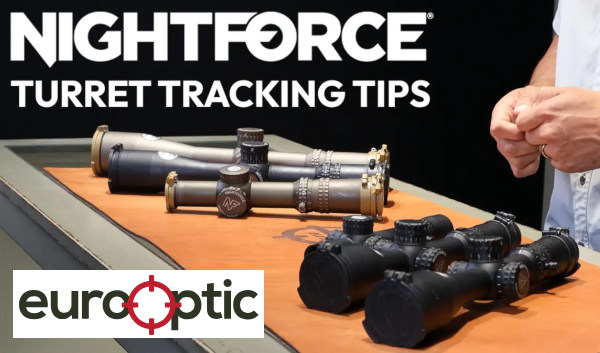
Bonus READ: Nightforce Turret Tracking Tips
What Is Turret Tracking?
The term “turret tracking” refers to the precision with which a riflescope translates turret adjustments into actual point-of-impact changes. Even the smallest inconsistency in tracking can lead to missed shots, wasted ammunition, or lost opportunities in the field. Without accurate turret tracking, even a perfectly calculated firing solution won’t translate to hits on target.
Turret tracking is the relationship between what you dial on your scope’s elevation or windage turrets and how the bullet point of impact shifts downrange. This precise mechanical function is what allows shooters to make repeatable adjustments based on ballistic data. For example, if you dial 1 MRAD or 4 MOA, the bullet should land at the exact calculated offset. Any deviation means your turret isn’t tracking perfectly.
For many years, the Swarovski Optik website featured a blog with interesting technical articles. (Unfortunately some of these articles have been taken offline.) In the “On Target” series of blog stories, Swarovski provided a handy explanation of how optics systems work, with exploded diagrams of rifle scopes, spotting scopes, and binoculars. We’ve reproduced the key diagrams here. CLICK HERE for Swarovski On Target Archive.
Scope Terminology
Focusing Lens
The focusing lens is an adjustable lens inside the optical system for focusing the image at different distances…. In the case of rifle scopes, apart from focusing, the focusing lens also facilitates parallax compensation.
Objective Lens
The objective lens is the optical system’s front lens group facing the object and operates like a converging lens. Its purpose is to display an image which, at the image plane, appears upside down, laterally transposed and reduced, and which is subsequently displayed correctly again by the reversal system.
Diopter Adjustment
For rifle scopes, the reticle can be focused using the diopter adjustment on the eyepiece, thereby correcting any visual impairment. [Editor’s Note: Movable eyepiece diopter adjustment is not offered on all rifle scopes. It is a useful feature on Swarovski and other premium scopes. This allows shooters who need eyeglasses to get a sharply focus image even without wearing corrective lenses. Of course shooters should always wear ANSI-certified eye protection. With the diopter, folks who need correction can use inexpensive, non-Rx safety eyewear instead of expensive prescription safety glasses.]
Reversal System
The purpose of the reversal system is to reverse the image by means of prisms in binoculars and telescopes, and lenses in rifle scopes….The lens reversal system is needed in rifle scopes to control the variable magnification and move the exit pupil[.]
Resource tip by ELR Researcher. We welcome reader submissions.
For many years, the Swarovski Optik website featured a blog with interesting technical articles. (Unfortunately some of these articles have been taken offline.) In the “On Target” series of blog stories, Swarovski provided a handy explanation of how optics systems work, with exploded diagrams of rifle scopes, spotting scopes, and binoculars. We’ve reproduced the key diagrams here. CLICK HERE for Swarovski On Target Archive.
Scope Terminology Focusing Lens
The focusing lens is an adjustable lens inside the optical system for focusing the image at different distances…. In the case of rifle scopes, apart from focusing, the focusing lens also facilitates parallax compensation.
Objective Lens
The objective lens is the optical system’s front lens group facing the object and operates like a converging lens. Its purpose is to display an image which, at the image plane, appears upside down, laterally transposed and reduced, and which is subsequently displayed correctly again by the reversal system.
Diopter Adjustment
For rifle scopes, the reticle can be focused using the diopter adjustment on the eyepiece, thereby correcting any visual impairment. [Editor’s Note: Movable eyepiece diopter adjustment is not offered on all rifle scopes. It is a useful feature on Swarovski and other premium scopes. This allows shooters who need eyeglasses to get a sharply focus image even without wearing corrective lenses. Of course shooters should always wear ANSI-certified eye protection. With the diopter, folks who need correction can use inexpensive, non-Rx safety eyewear instead of expensive prescription safety glasses.]
Reversal System
The purpose of the reversal system is to reverse the image by means of prisms in binoculars and telescopes, and lenses in rifle scopes….The lens reversal system is needed in rifle scopes to control the variable magnification and move the exit pupil[.]
Resource tip by EdLongRange. We welcome reader submissions.
Those of us over-50 types can use some help when shooting iron sights. As one gets older, your eyes lose the ability to rapidly adjust to different points of focus. In practice, when shooting a rifle, this means the target image may be sharp but the sights are blurry, or vice-versa. Or you may be able to see the target and front sight reasonably well, but the rear sight is a complete blur. (That is this Editor’s problem when shooting a rifle, such as a Swedish Mauser, with a notched blade rear sight.) Even if you are using a rear peep sight, you may see a blurry rear circle (or two circles if you have astigmatism). Placing a diopter sight (sighting disc) on your shooting glasses can help many people see open sights better, when shooting both handguns and rifles.
Merit Corp. in Schenectady, NY, offers an adjustable optical disc that attaches to shooting glasses with a rubber cup. Though primarily intended for pistol shooters, the Merit optical attachment can also be helpful when shooting rifles with open sights, such as military bolt actions. Priced at $65.00, the Merit device features a shutter-style, adjustable aperture iris.
Merit explains: “The human eye, whether or not prescription glasses are required, cannot focus on both sights and the target at the same time. The eye will constantly shift focus from the sights to the target trying to ensure proper alignment. Unfortunately, as we age, the eye loses the flexibility which allows it to do this; thus, sights and target begin to grow fuzzy. There is a simple way to combat this by increasing your eyes’ depth of field (range of focus). If you look through an aperture or pinhole of the correct size, you will be able to see both sights clearly, and the target will be clearly defined as well.”
In addition to optical attachments for eyeglasses, Merit produces a variety of adjustable iris sight products for rifles, including the Variable Iris Aperature for AR15s. Visit MeritCorporation.com or call (518) 346-1420.
The Swarovski Optik website features a blog with interesting technical articles. In the “On Target” series of blog stories, Swarovski has provided a handy explanation of how optics systems work, with exploded diagrams of rifle scopes, spotting scopes, and binoculars. CLICK HERE for Swarovski Optics Blog.
Scope Terminology Focusing Lens
The focusing lens is an adjustable lens inside the optical system for focusing the image at different distances…. In the case of rifle scopes, apart from focusing, the focusing lens also facilitates parallax compensation.
Diopter Adjustment
For rifle scopes, the reticle can be focused using the diopter adjustment on the eyepiece, thereby correcting any visual impairment. [Editor’s Note: Movable eyepiece diopter adjustment is not offered on all rifle scopes. It is a useful feature on Swarovski and other premium scopes. This allows shooters who need eyeglasses to get a sharply focus image even without wearing corrective lenses. Of course shooters should always wear ANSI-certified eye protection. With the diopter, folks who need correction can use inexpensive, non-Rx safety eyewear instead of expensive prescription safety glasses.]
Reversal System
The purpose of the reversal system is to reverse the image by means of prisms in binoculars and telescopes, and lenses in rifle scopes….The lens reversal system is needed in rifle scopes to control the variable magnification and move the exit pupil[.]
Resource tip by EdLongRange. We welcome reader submissions.
It’s official. No more “vaporware”. In 2014, Leupold will sell a 7-42x56mm VX-6 scope for approximately $1800.00. This scope will be “coming out this summer”. This is a very impressive optic that will give other premium high-magnification competition scopes a run for their money. The new 7-42 features a 34mm main tube. That large diameter tube helps the scope deliver an estimated 70 minutes of elevation (final specs subject to change). There is a side parallax control, and target turrets with 1/8th-MOA click values and built-in zero stop. We were pleased to see that the scope features a “fast-focus” eyepiece with plus/minus diopter adjustment. Initially the scope will be offered with two (2) reticles, the TMOA and TMOA Plus. These feature MOA-based hash marks, with a small gap in the very center with a target dot at the aiming point.
We did get a chance to test the scope. Jason successful engaged targets at 960 yards using a .308 Win Colt modular rifle fitted with the new 7-42x56mm Leupold. Jason reports that the clicks are tactile and positive. The scope is sharp and bright all the way out to the edges of the viewing circle, even at max 42 power. We liked this optic, and can’t wait to get our hands on a final production version.
Those of us over-40 types can use some help when shooting iron sights. As one gets older, your eyes lose the ability to rapidly adjust to different points of focus. In practice, when shooting a rifle, this means the target image may be sharp but the sights are blurry, or vice-versa. Or you may be able to see the target and front sight reasonably well, but the rear sight is a complete blurr. (That is this Editor’s problem when shooting a rifle, such as a Swedish Mauser, with a notched blade rear sight.) Even if you are using a rear peep sight, you may see a blurry rear circle (or two circles if you have astigmatism). Placing a diopter on your shooting glasses can help many people see open sights better, when shooting both handguns and rifles.
Merit Corp. in Schenectady, NY, offers an adjustable metal diopter that attaches to shooting glasses with a rubber cup. Though primarily intended for pistol shooters, the Merit diopter can also be helpful when shooting rifles with open sights, such as military bolt actions. Priced at $65.00, the Merit device features a shutter-style adjustable aperture iris.
Merit explains: “The human eye, whether or not prescription glasses are required, cannot focus on both sights and the target at the same time. The eye will constantly shift focus from the sights to the target trying to ensure proper alignment. Unfortunately, as we age, the eye loses the flexibility which allows it to do this; thus, sights and target begin to grow fuzzy. There is a simple way to combat this by increasing your eyes’ depth of field (range of focus). If you look through an aperture or pinhole of the correct size, you will be able to see both sights clearly, and the target will be clearly defined as well.”
In addition to diopters for eyeglasses, Merit produces a variety of adjustable iris sight products for rifles, including the Variable Iris Aperature for AR15s. Visit MeritCorporation.com or call (518) 346-1420.
Cheaper Diopter from Lyman
If you can’t afford a Merit adjustable diopter, Lyman offers a similar all-plastic device for under $20.00. The Lyman Hawkeye Shooting Aid mounts directly to your eyeglass lens with a rubber suction cup. The diopter section is made of plastic, and aperture diameter is non-adjustable.
Though it is simple and inexpensive, the Lyman Hawkeye works for many shooters, if positioned properly. (Don’t think this is anything close to the Merit Diopter in quality though!) Currently, Cabelas.com has the Lyman Hawkeye on sale for just $12.88, item # IK-229094. MidwayUSA sells the Lyman Hawkeye for $18.99, item # 936878. One MidwayUSA customer reports:
“This thing really works! I have it on my shooting glasses, and it has made a significant improvement in my ability to keep the front sight and target in focus at the same time. If you are older and find that you are having a hard time keeping the target in focus over ‘iron sights’, then this may be the answer to your problem. Mine works equally well for both pistol and rifle, although I do have to change the device’s position on my shooting glasses when changing weapon types.”
Texas discount vendor CDNN Investments has released its latest 2009-5 catalog (30 mb PDF file). As usual, the catalog features big discounts on handguns, rifles, and shotguns. Among the many bargains, we spotted two exceptional deals in the latest CDNN catalog….
Half-Price Kahles Hunting Scopes
CDNN acquired a selection of 1″-tube Kahles Helia CL hunting scopes and is selling them at liquidation prices. Kahles is a highly respected Austrian optics-maker. We wouldn’t say that Kahles is on a par with Swarovski or Schmidt & Bender, but Kahles scopes are very high quality, with excellent glass, etched reticles (no reticle wires to drift or break), wide field of view, +2/-3.5 diopter eyepiece, and very good fit and finish. If you’re looking for a quality 3-9 or 4-12 hunting scope, here’s a chance to own a premium European scope for a “below wholesale” price.
Uncle Mike’s Holster for $9.99
CDNN is selling the Uncle Mike’s straight drop belt holster for half price — just $9.99. Models are available for popular Beretta, Glock, HK, Ruger, S&W, SIG, Springfield, and Walther pistols. The holster is made from injection-molded Kydex. Injection molding allows for a MUCH more precise fit than the typical folded-over Kydex holster. This editor has used this injection-molded Uncle Mike’s holster for my Glocks and HKs, and the fit is excellent. The handgun is secure but the draw is easy. Injection-molding allows nice straight corners, so the plastic doesn’t bind or grab as with many “hand-made” Kydex holsters. If you want an “on the belt” holster, I highly recommend this model. You may be surprised to see how much better it works than holsters costing 5 or 10 times as much.
Don’t be put off by the low price. This editor owns and uses Uncle Mike’s injection molded holsters for various handguns. I consider this the best outside-belt holster I’ve ever tried. It is clearly superior to a $85 Blade-Tech Kydex I had for an HK USP, and, I have to admit, it works better than the pretty $125 Milt Sparks leather holster I had custom-made for a 1911. The straight-drop is ideal for range use, and in a vehicle you can wear it on the left-side as a cross-draw (CCW permit required). These holsters fit close to your belt and all metal fittings are recessed or covered so they don’t scratch your gun. IMPORTANT: All plastic/Kydex holsters will cause some wear on high-gloss blued finishes. If your pistol is high-gloss blued, I suggest a soft leather holster instead.




 Merit Corp. in Schenectady, NY, offers an
 Merit explains: “The human eye, whether or not prescription glasses are required, cannot focus on both sights and the target at the same time. The eye will constantly shift focus from the sights to the target trying to ensure proper alignment. Unfortunately, as we age, the eye loses the flexibility which allows it to do this; thus, sights and target begin to grow fuzzy. There is a simple way to combat this by increasing your eyes’ depth of field (range of focus). If you look through an aperture or pinhole of the correct size, you will be able to see both sights clearly, and the target will be clearly defined as well.”


 Half-Price Kahles Hunting Scopes


 Uncle Mike’s Holster for $9.99


