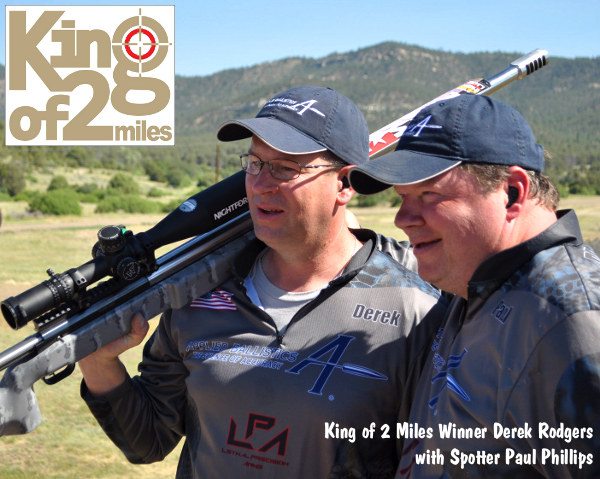
The 2018 King of 2 Miles (KO2M) event took place July 2-4 in Raton, New Mexico. Conditions were very challenging this year, yet three shooters managed to hit the most distant 3,525-yard plate at least once in five shots, a remarkable accomplishment. At that range the bullet was in flight about six seconds.
Robert Brantley of Team Manners Composite Stocks is the new King of 2 Miles. Congrats to Robert and his team-mates. Robert amassed 85178 points, finishing over 20,000 points ahead of runner-up John Buhay. Paul Phillips of Team Applied Ballistics finished third. FULL K02M 2018 RESULTS HERE.
Here’s Robert Brantley after his superb qualifying performance, which set a new 2018 King of 2 Miles qualifying round record. Going perfect on targets 1, 2, and 3, Robert missed just one shot on Target 4 of the qualifying phase, amassing 51355 points, a new K02M record.
CLICK HERE for a very complete and thorough KO2M report created by The Precision Rifle Blog (PRB). This excellent PRB Report contains complete load and rig specifications for the top five shooters. In addition, the PRB Report includes a full run-down on this year’s event.
Though the trigger pullers get the glory, this is really a three-man game. One guy shoots, a second team member spots for hits and calls corrections, and a third watches mirage and makes wind calls.
Multi-Day, Multi-Distance Competition with Farthest Target at 3525 Yards
The K02M Competition runs in stages, with the distances getting farther with each round. After five shots on target 1 at 1547 yards, there are then three shots per target for the remaining three parts of the Qualifying round. Then, in the three-target Finals phase, there are with five shots per target. You get more points for earlier hits in each string, and there are no sighters during the match. The event started with a tough Cold Bore Challenge — a single-shot at 1689 yards, just shy of one mile. Only three out of 62 competitors made that cold-bore mile shot on a 16″ plate, about 1 MOA at that distance. After that there are two rounds with the targets arrayed as follows.
KO2M Qualification Round
1,547 yards: 5 shots, 24” x 37” rectangle
1,719 yards: 3 shots, 24” x 37” rectangle
1,890 yards: 3 shots, 30” x 37” rectangle
2,095 yards: 3 shots, 30” x 37” rectangle
KO2M Finals Round — July 4
2,727 yards: 5 shots, 33” x 41” rectangle
3,166 yards: 5 shots, 42” x 54” rectangle
3,525 yards: 5 shots, 48” x 60” rectangle
Big Bore Rifles with High-BC Bullets
This year saw the continued evolution of equipment. Top shooter Brantley shot a .416 Barrett with 500gr Cutting Edge bullets. Robert’s massive 44-lb rifle featured a 39″ K&P barrel, McMillan action, and a Manners LRT (Long Range Tactical) stock designed expressly for this KO2M competition.
Second Place John Buhay shot an improved version of the .375 CheyTac, with 353gr Lehigh Defense Match Solid bullets. Buhay’s 37.6-lb rig bosted a BAT action and 36″ Krieger barrel along with a fairly conventional McMillan MBR 1K benchrest stock. Mark King built the rifle.
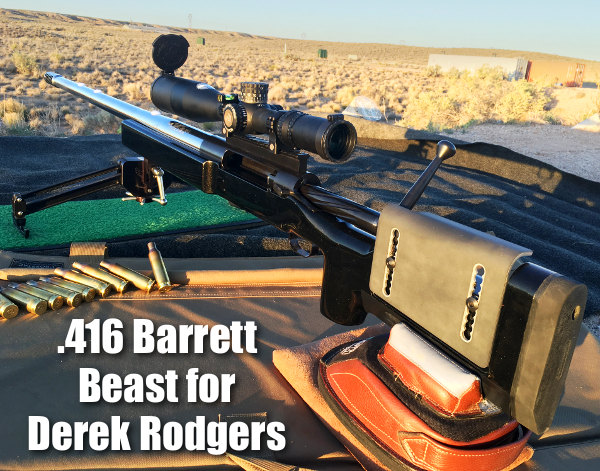
Third Place Paul Phillips campaigned a .416 Barrett with 550gr Cutting Edge Lazer bullets. Paul’s 42-lb rig featured a BAT action and McMillan Beast 1 stock. Shown below is the latest rifle of 2017 K02M champ Derek Rodgers, a .416 Barrett also in a McMillan Beast. Derek spotted for Phillips in the match.
Optics Options
There was quite a variety of scopes used by Top K02M competitors, evidence that a number of manufacturers now offer optics with abundant elevation and the ability to stand up to heavy recoil. Here are the optics choices for the Top Five Shooters:
1. Bushnell XRS II 4.5-30x50mm with G3 reticle in Badger UniMount
2. Nightforce ATACR 5-25x56mm with MOAR reticle, with ERA-TAC Inclined Mount
3. Nightforce ATACR 5-25×56mm, with Charlie TARAC external Prism System for Elevation
4. Leupold Mark 5HD 5-25×56mm, in Spuhr mount with Charlie TARAC
5. Burris XTR II 5-25x50mm in Barrett rings
Notably, two of the top five used the Charlie TARAC prism system. This provides a ton of extra elevation by essentially shifting the view seen through the scope. The unit fits to the scope’s front objective.
Current F-TR World Champion Derek Rodgers is also the reigning King of 2 Miles champ, so he knows something about Extreme Long Range (ELR) shooting. While Derek won his KO2M title at Raton shooting the .375 CheyTac cartridge, Derek decided that something even bigger was in order. This season, Derek will be shooting a .416 Barrett. Last week we showcased his impressive .416 Barrett ammo, with massive Cutting Edge bullets.
Now we can show the Big Rig that will deliver those .416-caliber projectiles. This monster weighs 40+ pounds and sports a 40″ Bartlein barrel — more length for more velocity. Derek’s new ELR rifle features a McMillan Beast 2 stock, BAT EX action, and Nightforce ATACR 7-35x56mm scope. Derek explained why he moved up to a bigger caliber: “I built a new rifle with the anticipation of seeing impacts easier. It was not just a larger caliber being more effective on hitting ELR targets, but rather hoping that a missed shot would have a much larger impact. Impacts beyond a mile become harder to see due to terrain and vegetation. So any added dust or splash erupting from the earth is a decisive benefit over an equally-accurate smaller caliber.” Here is Derek’s full report on his new .416 Barrett rifle.
Derek Rodgers Campaigns a .416 Barrett
Report by Derek Rodgers Cartridge Choice — I chose a standard .416 Barrett cartridge as it allows for bullets up to and slightly exceeding 550 grains. It really does bridge the gap between the .375 variants and a 50 BMG. There are several great solid ELR bullet options from manufactures like Cutting Edge that range from 475-550 grains. These offer a variety of extremely high BC options for barrels that have different twist rates. Most loads will utilize the slowest burn rate powders commercially available. Good options are Vihtavuori 20N29, RL50, H50BMG and other powders with a similar burn rate.
Shooting the .416 — Tamer than Expected
An initial observation is that the rifle is very controllable and feels much like a larger F-TR gun. The rifle weighs 40+ pounds, balanced and stays on target very well. The recoil is manageable and linear. This seems to give a straight rearward impulse that does not affect positioning. This allows for quick repositioning into battery and faster follow-up shots.
Rifle Details — BAT EX Action, Bartlein 40″ Barrel, McMillan Beast 2 Stock
Derek’s .416 Barrett ELR Rig features a BAT EX action with a Bix N’ Andy trigger. Out front is a gigantic 40” long, 1:9″-twist Bartlein barrel fitted with a Terminator T5 muzzle brake. The handsome McMillan Beast 2 stock combines a lower center of gravity design with a higher butt location. Given that high butt geometry, McMillan cleverly fitted the higher buttpad with a port allowing the cleaning rod to pass through (see photo below). On top is a Nightforce ATACR 7-35x56mm scope in NF rings on a +60 MOA rail, with Holland 34mm bubble level. The stock is supported by a Phoenix bipod and rests in an Edgewood bag designed for the McMillan Xit F-TR stock.
Note the extended Buttpad height. That helps with recoil in prone position. This McMillan Beast 2 stock includes a pass-through hole for the cleaning rod.
Gunsmithing by Blake Barrel and Rifle in Arizona
Derek’s rifle was built and chambered by Bryan Blake of Blake Barrel and Rifle in Phoenix, Arizona. The chambering was done with a Manson Precision reamer. Derek explains: “Bryan and his family have been in the machine shop business for several generations and have the expertise and equipment to handle larger barrel diameters associated with F-Class to ELR type rigs. I tried to consider all angles and potential pitfalls that might occur during the building process. However, Bryan added his own touches to make the project his own. He truly created a work of art and supplied a turn-key rifle that is meticulously built from the inside out and looks as great as the tolerances it holds.”
At the 2018 NRA Show in Dallas last week, Trijicon unveiled a notable new scope that should interest Benchrest shooters and Long-Range competitors. The all-new Trijicon AccuPower 5-50x56mm Long Range Scope offers an impressive ten times zoom range, plus an illuminated reticle. This RS50 Series Second Focal Plane scope with 34mm main tube is offered in both MOA and MIL systems. The MOA version features 1/8 MOA clicks plus a reticle with 1 MOA subtensions at 40X power. The MIL version has 1/20 Milrad click values and a ranging style reticle with wind hold dot system. Both MOA and MIL versions have a full 100 MOA of elevation travel.
New Trijicon 5-50x56mm Scope Revealed at NRA Show in Dallas:
Credit Erik Cortina for providing this video.
With a $2700 MSRP, we expect Trijicon’s new 5-50X scope to have a “street price” of about $2400. That lines up with the NightForce 15-55x52mm Competition, now priced at $2352.00 on Amazon.
The new Trijicon 5-50x56mm (RS50 Series) scope boasts some nice features. Employing extra-low dispersion glass, the scope offers high light transmission with minimal chromatic aberration. The magnification control lever can be moved to two different positions to suit the operator. Both MOA and MIL reticle styles are illuminated with 5 red and 5 green user-selectable brightness settings.
We hope to get our hands on one of these new Trijicon 5-50X scopes soon for testing. We’ll let you know how it stacks up against other high-magnification zoom scopes, such as the Vortex 10-60x52mm Golden Eagle, the Nightforce 15-55x52mm, and the March 5-50x56mm.
Please note, along with this 5-50x56mm scope, Trijicon has also introduced a 4.5-30x56mm RS30 Series scope. This 4.5-30X optic will be offered in both First Focal Plane and Second Focal Plane versions. SEE AccuPower Scope Brochure.
Product Tip from EdLongrange. Video and Trijicon Brochure from Erik Cortina.
Story based on report by Paul Phillips of Global Precision Group
Extreme Long Range (ELR) shooting continues to evolve, with new forms of competition “pushing the envelope” of marksmanship (and ballistics) at distances out to 4900 yards (2.8 miles) and beyond. The latest big-time ELR shooting match was the World’s Longest Shot Challenge (WLSC) in Texas. This match was held at the Valdina Ranch, 1700+ acres of gorgeous hill country property, located about 1.5 hours west of San Antonio, Texas. The event attracted 28 shooters competing in four classes. Each competitor could be supported by a spotter and a wind coach, shooting as a three-person team.
Key “Take-Aways” from the 2018 WLSC Match:
1. Prototype Berger .375 Caliber Bullet is a Winner
The new .375 caliber monolithic Berger bullet designed by Bryan Litz was used by the first and second place finisher in the above .338 Caliber class. It performed great and the ultra-high BC was confirmed.
2. Team Applied Ballistics Dominated
The combined Applied Ballistics Team made first-round impacts at 1760, 2000, 2200, and 2400 yards. Also, 11 out of the 12 impacts total at 2200 yards belonged to Team AB. And Team AB’s Chris Palka had the top score overall, in his first-ever major ELR competition. That demonstrates how well the AB ballistics solutions work. By yardage, Chris recorded 68280 points total, as follows: 1760×6, 2000×10, 2200×9, 2400×3, 2680×4.
Christopher Palka (Team AB), shooting his first-ever ELR match, finished First Overall. Tactiholics Photo.
3. Got Doppler? Advanced Radar Technology for ELR
To shoot at these extreme ranges, you need rock-solid BC information on your projectiles. Luckily Applied Ballistics brought a Doppler Radar and allowed competitors to shoot their ammo to give them personalized ballistic information.
Top Shots By Class
Above .338 Non-Factory (mostly .375 CheyTac)
.338 and under Factory (mostly .338 Lapua Mag)
.338 and under Non-Factory (mostly .338 Edge)
Chris Palka 68280 HIGH SCORE
Paul Phillips 57360
Chase Stroud 47520
Pete Contacos 44360
Paul Phillips 20080
Chris Wiencke 14160
Tim Seller 25760
Eddie 14560
Calvin 11200
NOTE: There was also a fourth class at the WLSC, the “Above .338 Factory Class” (.50 BMG) with Jay Divorsky scoring 14560.
WLSC Match Procedures and Scoring:
Competitors shot with time limits at each distance: 5 minutes to make 5 shots at each plate. Hits on steel scored points, with a big premium on first-round hits. The point values (for hits) were based upon standard ELR practice: 5 times the distance on the first shot, 4 times the distance on the second shot, and so on. In this ELR match each team may have three members: Shooter, Wind Coach, and Spotter.
Paul Phillips reported: “After drawing names randomly for shooting order, on Day One we shot 36″ metal plates at 1760, 2000, 2200, and 2400 yards. The second day was elimination day — you had to make impact on each target at least once to advance to the next distance. These targets started at 2680 ranging out to 4900 yards. We had winds from 4-8 mph on the first day and 6-15 mph on the second day which made it very challenging.”
Proof in the Shooting — AB Solvers and Berger Bullets
Bryan Litz of Applied Ballistics stated: “This event was a successful test of several new things. Berger’s prototype .375 caliber solid bullets worked well in numerous guns and tracked perfectly to the most distant targets. Radar measurements of these new bullets indicate extraordinary performance as well. The AB Team also had a couple new staff members shooting their first ELR competition (Chris Palka and Chris Wiencke) who both did well with Chris Palka actually winning the event. This match was a successful demonstration of the science of accuracy being used to put rounds on target. The thing about science, is that it works the same for everyone. The ballistic software and Custom Drag Model (CDM) data that we used to put first-round hits on targets out to 2400 yards is the same software that’s available to everyone in the AB devices (Kestrel, Sig Kilo, Garmin Fortrex) and Mobile Apps.”
The AB ELR Team dominated the Podium in the above .338 Non-Factory Class. Chris Palka was high scorer followed by Paul Phillips (Second) and Chase Stroud (Third). The top two finishers were using Applied Ballistic Weapon Division Rifles sending the new Berger .375-Cal solid bullets designed by Bryan Litz. The third place finisher shot a .375 CheyTac with 400 grain Cutting Edge Laser bullets.
In the .338 and under Factory Class there were mostly .338 Lapua Magnums. These .338s did very well and two out of the three shooters made it to the two-mile plate. The final standings in the 338 and under Factory Class: Peter Contacos (first), Paul Phillips (second), Chris Wiencke (Third). Both Paul and Chris were shooting 300 grain Berger bullets.
Title Sponsor ELRHQ, a McMillan company, brought tables full of gear. Everything was on display: scopes, bipods, mats, bags, triggers, actions, brakes, stocks, LabRadars, TargetVision target cams, and more. ELRHQ.com is a great one-stop online vendor with the latest and greatest gear for those interested in the ELR discipline and precision shooting.
The match was organized by Travis Walla who did a great job. The event ran smoothly and shooters say the Texas BBQ was great. Travis posted: “We had an awesome event, thanks to all of our sponsors that helped make this event a huge success. We also had a awesome opportunity for those that shot this match — they were able to shoot across the Oehler Research 88 and Applied Ballistics LLC radar at the same time out to 2400 yards on Saturday afternoon. Thanks again…”
We want to congratulate Bryan Litz and his talented team at Applied Ballistics LLC. We have followed Bryan’s career as a bullet designer, ballistician, author, software product developer, and ELR pioneer. His team leads the world in advancing the science of long range shooting. And it looks like all the hard work has paid off — Applied Ballistics has secured a major contract to develop extreme long-range sniper capability for the U.S. Military.
Applied Ballistics LLC, a Michigan-based tech company, has been awarded a $1,300,000 contract by the Combating Terrorism Technical Support Office (CTTSO) to execute Phase 1 of the Extreme Sniper Strike Operations (ESSO) project.
Phase 1 of the ESSO project is focused on advancing the predictive capabilities of modern ballistic solvers by performing Doppler radar measurement and modeling of current service rounds at Extreme Long Range (ELR) as a function of gyroscopic stability, and refining the models of secondary ballistic effects such as spin rate decay and spin drift at ELR. Phase 1 will conclude with the ballistic modeling enhancements being integrated into the existing Applied Ballistics ecosystem of electronic devices which are currently deployed by numerous U.S. and allied armed forces around the world. Phase 1 is scheduled for completion in late 2018.
Phase 2 of the ESSO project is a potential follow on (2019) that focuses on the development and fielding of an advanced ELR sniper rifle system designed to drastically increase first-round hit probability at ELR on man-sized targets. The Applied Ballistics Weapons Division is currently conducting research and development on weapons platforms, as well as new cartridge and bullet options, that will maximize ELR ballistic performance from lightweight, practical, magazine-fed systems.
Bryan Litz, owner of Applied Ballistics LLC, said: “Our team of Aerospace, Mechanical, Electrical and Computer Science Engineers, and Technicians will apply our combined experience including years of testing and competing in ELR Shooting to the successful completion of the ESSO program objectives. This means extending the maximum effective range of U.S. and allied snipers, achieving decisive overmatch on the battlefield. I can’t imagine a better application of Applied Ballistics’ collective efforts.”
Applied Ballistics has developed ballistics software for mobile Apps. AB’s software has been integrated into numerous products including Kestrels, Laser Rangefinders, and “Smart” optics.
Applied Ballistics Seminar in Utah, June 2-3, 2018
Applied Ballistics will offer a Ballistics Seminar June 2 and 3, 2018 at the Snowbird Cliff Lodge, Salt Lake City, Utah. This will include two full days of instruction with lectures plus Q&A sessions. The $625 cost of the seminar includes all 5 AB books, both AB DVD sets, AB Analytics, and Swag Bag.
CLICK HERE to Register. NOTE: Through April 17th, get $100 Off with discount code ABSEM100.
About Applied Ballistics, LLC:
Applied Ballistics’ mission is to be a complete and unbiased source of external ballistics information for long range shooters. We believe in the scientific method and promote mastery through understanding of the fundamentals. The results of our work are passed on to the government and shooting communities through clear and helpful instructional materials, as well as easy-to-use ballistic software running on many products.
Shown above is David Tubb, the legendary 11-time National High Power Champion, posing with a very serious rifle used in the Extreme Long Range (ELR) game. David has jumped into the Extreme Long Range discipline in a very big way, producing a .375-caliber, long-barreled ELR version of his famous Tubb rifle, called the Adaptive Target Rifle (ATR). A version of this rifle, piloted by David’s son-in-law Nate Stallter, set the current ELR World Record in January 2018. See video below for a full report.
This video shows Team TUBB setting a new ELR World Record of 2011 Yards using the Tubb Adaptive Target Rifle in .375 CheyTac. Nate Stallter nailed three shots at over one mile — 1768 yards. Then Nate broke his own record, going 3 for 3 at 2011 yards. ELR Central hosted this match, held at the Front Sight gun range, Pahrump, NV on January 21, 2018.
David Tubb will Be Working with Chase Stroud
David has been working with Chase Stroud, a talented young Texan who has competed in tactical rifle competitions and worked with Team Applied Ballistics on ELR projects. Chase has long respected Tubb’s shooting ability as well as his design/engineering talent in developing successful rifle platforms, such as the ground-breaking Tubb 2000.
Recently, Chase had the opportunity to shoot long range with David Tubb. David crafted a left-hand ATR rifle for Chase who will be working with David in the future. Posting on Facebook, Stroud wrote:
“Growing up as a kid I taught myself to shoot long distance from David’s videos. David Tubb was my idol then and still is now. Never in my wildest dreams did I think I would share the line with him much less get to represent his product in the long range community. A literal dream come true for me….
Yesterday we shot some video for the new Tubb ATR system. After pressing him for years he made me a [left-hand ATR] and it shot unreal using his absolute ammo. I thank you … David. It’s time to get some practice under my belt and start shooting again…”
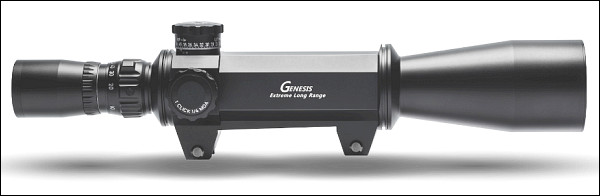
March Scopes (from DEON in Japan) has unveiled a remarkable new riflescope, the likes of which has never been seen before. The new Genesis ELR Scope has more elevation travel than has ever been packed into a scope before — 400 Minutes of Angle. That’s four or even five times as much as most other optics. This will allow the Genesis to get you on target, with no special external mounts, at three miles with a .416 magnum cartridge*.
For other popular cartridges/calibers, this is the range you can shoot and still have sufficient elevation travel with the Genesis. This is with the built-in elevation alone, no need for adjustable mounts, tilting rails, or prism systems:
.224 Cal to 2450 yards** | .308 Win to 2950 yards | .338 Lapua Magnum to 4000 yards
Take a good look — we bet you’ve never seen anything like this before (Big PHOTO). The new Genesis was unveiled at the IWA trade show in Germany this morning. The video below shows the Genesis being unveiled by Mr. Fumio Shimizu of Deon Optics and UK/Euro Distributor Gary Costello. Thanks to Vince Bottomley of TargetShooter.co.uk for the report from IWA.
NOTE: Click the Speaker Icon to hear audio.
How Much? Global Price for the March Genesis isn’t finalized yet, but March USA just took the first order at $5000.00 USD, without accessories. March expects to start shipping in four (4) months.
Claimed to be effective up to three miles with popular large, magnum ELR cartridges, the New Genesis sets a new benchmark in the Optics field. This won’t be cheap — posting on Facebook, a March representative said the the price is “still to be determined” but will be “approximately $5000 to $6000″. One of our Forum members just placed the first order in North America, and was told the base price (without accessories) was $5000.00 plus $50.00 shipping.
The All New March Genesis 6-60x50mm ELR Rifle Scope
The new March Genesis represents a revolution in scope technology/design — the dawn of a new era for ELR (extreme long range) shooting. The Genesis concept began in late 2016 when a group of world-class shooters asked for a scope that could be used effectively at ranges of two miles and beyond…
The chief engineers of DEON Optical Design took on the challenge and produced several prototype designs, tested extensively on three continents. Eventually DEON produced a truly ground-breaking optic — a new beginning in scope design. The Genesis ELR rifle scope offers up to 400 MOA of elevation, which will allow the shooter to shoot from 10 yards out to 3 miles*.
The unique design of the Genesis allows the shooter to always see through the central part of the lens, producing clarity, definition, and minimal chromatic aberration. This holds true even on 400 MOA! On other scopes, when the extremes of elevation are used, you won’t get the same performance — you may seen distortion and darkening. Also incorporated into Genesis is the proven DEON ‘High Master’ lens system — super ED lenses with high-refractive glass offering very high resolution and natural colour right to the edge of the image.
March Genesis 6-60x56mm Specifications:
– 400 MOA of total elevation travel with Zero-set feature (300 up, 100 down)
— 6-60X Power First Focal Plane (Highest FFP zoom ratio and magnification sold)
— 150 MOA of total windage travel (75 MOA left and right)
— 50 MOA per turn, 1/4 MOA clicks
— Wide-angle eyepiece with 25 degrees apparent field of view
— Eye relief 67-82mm and exit pupil 3.3mm at 6X to 0.93mm at 60X
— Six-step illumination module with on/off clicks
— Integral Picatinny mounting-points on the main frame.
— High Master ED lens system with 56mm objective.
— Side-Focus Parallax from 10 yards to infinity.
— FMA-MT MOA-based Reticle for ELR (MIL-based reticle coming later)
— Central gimble system and slider bearings with main frame (worldwide patents pending)
— Weight 1.5 Kg
_________
* March says there is 3 mile range with a “.416 Cheytac”. Well, there is a recognized .416 Barrett cartridge and a .408 Cheytac. March says the .416 Cheytac is a “special wildcat … developed due to licensing needs for Norway.”
** March lists “.224 Cal”. We assume this refers to the .223 Remington cartridge, but it could be something completely different, such as a 22 Nosler, or .224 Valkyrie.
The Coriolis Effect comes into play with extreme long-range shots like this (2100 yards at Raton, NM). The rotation of the earth actually moves the target a small distance (in space) during the long duration of the bullet’s flight.
When you’re out at the range, the Earth seems very stable. But it is actually a big sphere zooming through space while spinning around its axis, one complete turn every 24 hours. The rotation of the earth can create problems for extreme long-range shooters. During extended bullet flight times, the rotation of the planet causes an apparent deflection of the bullet path over very long distances. This is the ballistics manifestation of the Coriolis Effect.
Bryan Litz of Applied Ballistics discusses explains the Coriolis Effect in his Ballistics Books and Seminars. Bryan notes that Coriolis is “a very subtle effect. People like to make more of it than it is because it seems mysterious.” In most common shooting situations inside 1K, Coriolis is not important. At 1000 yards, the Effect represents less than one click (for most cartridge types). Even well past 1000 yards, in windy conditions, the Coriolis Effect may well be “lost in the noise”. But in very calm conditions, when shooting at extreme ranges, Bryan says you can benefit from adjusting your ballistics solution for Coriolis.
Bryan explains: “The Coriolis Effect… has to do with the spin of the earth. You are basically shooting from one point to another on a rotating sphere, in an inertial reference frame. The consequence of that is that, if the flight time of the bullet gets significantly long, the bullet can have an apparent drift from its intended target. The amount [of apparent drift] is very small — it depends on your latitude and azimuth of fire on the planet.”
Coriolis is a very subtle effect. With typical bullet BCs and velocities, you must get to at least 1000 yards before Coriolis amounts to even one click. Accordingly, Bryan advises: “Coriolis Effect is NOT something to think about on moving targets, it is NOT something to think about in high, uncertain wind environments because there are variables that are dominating your uncertainty picture, and the Coriolis will distract you more than the correction is worth.”
“Where you could think about Coriolis, and have it be a major impact on your hit percentage, is if you are shooting at extended range, at relatively small targets, in low-wind conditions. Where you know your muzzle velocity and BC very well, [and there are] pristine conditions, that’s where you’re going to see Coriolis creep in. You’ll receive more refinement and accuracy in your ballistics solutions if you account for Coriolis on those types of shots. But in most practical long-range shooting situations, Coriolis is NOT important. What IS important is to understand is when you should think about it and when you shouldn’t, i.e. when applying it will matter and when it won’t.”
The Coriolis Effect — General Physics
The Coriolis Effect is the apparent deflection of moving objects when the motion is described relative to a rotating reference frame. The Coriolis force acts in a direction perpendicular to the rotation axis and to the velocity of the body in the rotating frame and is proportional to the object’s speed in the rotating frame.
A commonly encountered rotating reference frame is the Earth. The Coriolis effect is caused by the rotation of the Earth and the inertia of the mass experiencing the effect. Because the Earth completes only one rotation per day, the Coriolis force is quite small, and its effects generally become noticeable only for motions occurring over large distances and long periods of time. This force causes moving objects on the surface of the Earth to be deflected to the right (with respect to the direction of travel) in the Northern Hemisphere and to the left in the Southern Hemisphere. The horizontal deflection effect is greater near the poles and smallest at the equator, since the rate of change in the diameter of the circles of latitude when travelling north or south, increases the closer the object is to the poles. (Source: Wikipedia)
Most bolt-action rifle shooters work the bolt with their trigger-pulling hand. This is because most rifles sold to right-handed shooters come with right-side bolts, while “lefty” rifles come with left-side bolts. This “standard” configuration requires the shooter to take his dominant, trigger-pulling hand off the stock to cycle the bolt, then re-position his hand on the stock, and “re-claim” the trigger. Often the shooter must lift or move his head to work the bolt, and that also requires him to re-establish his cheek weld after each and every shot. Not good.
This really doesn’t make much sense for precision shooting with fore-end support*. There is a better way. If you leave your trigger hand in position and work the bolt (and feed rounds) with the opposite hand, then you don’t need to shift grip and head position with each shot. All this requires is a weakside-placed bolt, i.e. a left bolt for a right-handed shooter or a right bolt for a left-handed shooter. The video below shows a “Lefty” working a right bolt. Note how efficient this is:
As our friend Boyd Allen explains: “If you think about it, if you are going to work with a factory action where your options are left bolt and left port or right bolt and right port, and you are building a rifle that will only be shot from a rest, using the left/left for a RH shooter or using a right/right for a LH shooter works better than the conventional configuration”.
Shoot Like a Champ and Work the Bolt with Your Weakside Hand
Derek Rodgers, the current F-TR World Champion, the reigning King of 2 Miles, and the only person to have won BOTH F-Open and F-TR U.S. National Championships, runs this kind of “opposite” bolt set-up. Yep, Derek shoots right-handed with a left bolt. Though Derek is a right-hander, he shoots with a Left Bolt/Left Port (LBLP) action. He pulls the trigger with his right index finger, while working the left-side bolt with his left (weakside) hand. This allows him to stay in position, and maintain his cheekweld. He places his right hand on the grip, while manipulating the bolt (and feeding rounds) with his non-trigger-pulling hand.
Current King of 2 Miles (and F-TR World Champion) Derek Rodgers
This is the rifle with which Derek won the 2013 F-TR National Championship.
*For true standing, off-hand shooting (whether in competition or on a hunt), a conventional strongside bolt placement makes sense, since the non-dominant arm must support the front of the rifle all the time. When shooting from bipod or rest, it’s a different story.
First there were books, then Videos/DVDs, then Ballistic Apps, then Seminars, and now Applied Ballistics is moving into the gun-building business. Founded by Ballistics guru Bryan Litz, Applied Ballistics LLC has been a world leader in the science of ballistics for the shooting sports. Now Applied Ballistics is using its expertise to produce complete rifle systems capable of world-beating Extreme Long Range performance.
Applied Ballistics Weapons Division Will Offer Complete Tactical ELR System
Applied Ballistics Weapons Division (ABWD) states: “We have the capability to build you a custom rifle, with ammo matched for that system. We can test the ammo and rifle combination over Radar in the lab. ABWD [will be] offering a complete system, with a CDM specific to that rifle. The first rifles are purpose built for 2500+ yard engagements.”
Based on the “teaser” video above, ABWD will offer a complete rifle system featuring Nightforce riflescope, ELR optical prism, laser rangefinder, Kestrel wind meter, and ammo that has been tuned for the rifle and trajectory-verified with Doppler Radar. This promises a “turn-key” system with sub-MOA 1000-yard accuracy plus hit capability at ranges out to 2500+ yards.
One Facebook reader asked: “Will you focus your rifle builds to just Extreme Long Range or will you be doing PRS-style type rifles as well?
AB states: “We are starting out with this ELR system, but will be offering more systems in the near future, as well as custom rifle builds. Stay tuned as the ABWD website should be up soon!”
Many Questions about ABWD’s New Products:
Of course, like our readers, we have many questions about this new project:
1. What cartridge types will be available in ABWD Rifles?
2. What companies will supply the rifle actions and chassis systems?
3. Who will supply the barrels and what are length/chambering options?
4. Will ABWD rifle systems be offered to the general public (vs. military/LEO)?
5. When will the first ABWD rifle systems be available?
And last but not least…
6. What will these ABWD ELR Rifles cost, both by themselves and as a complete package (with solvers, LRFs, optics etc.)?
News Tip from EdLongrange. We welcome reader submissions.




 The chief engineers of DEON Optical Design took on the challenge and produced several prototype designs, tested extensively on three continents. Eventually DEON produced a truly ground-breaking optic — a new beginning in scope design.
The Genesis ELR rifle scope offers up to 400 MOA of elevation, which will allow the shooter to shoot from 10 yards out to 3 miles*.
The chief engineers of DEON Optical Design took on the challenge and produced several prototype designs, tested extensively on three continents. Eventually DEON produced a truly ground-breaking optic — a new beginning in scope design.
The Genesis ELR rifle scope offers up to 400 MOA of elevation, which will allow the shooter to shoot from 10 yards out to 3 miles*.
 When you’re out at the range, the Earth seems very stable. But it is actually a big sphere zooming through space while spinning around its axis, one complete turn every 24 hours. The rotation of the earth can create problems for extreme long-range shooters. During extended bullet flight times, the rotation of the planet causes an apparent deflection of the bullet path over very long distances. This is the ballistics manifestation of the