This SunDay GunDay story features a stunning rifle constructed as a raffle prize to benefit Team USA members who will be traveling to South Africa in 2021 for the upcoming F-Class World Championships. Raffle tickets purchased for this F-Open rig, as well as two other rifles, will help defray expenses for Team USA members, both adults and juniors. Along with the stunning F-Open rifle featured here, there are two other great prizes: A KW Precision-built .308 Winchester F-TR rifle with Borden Rimrock action, and a Kelbly Koda Rifle in 6.5 Creedmoor with Nightforce scope.
.284 Shehane F-Open Prize Rifle with Superb Components
Report by Katie Blankenship
This eye-catching F-Open rifle was crafted by Blake Barrel and Rifle in Arizona. This prize rifle features all top-of-the-line components: Borden BRMXD Action, Cerus multi-laminate stock with forearm extension, R.A.D. recoil reduction system (hydraulic-damped buttpad), Bix ‘N Andy trigger, and Nightforce Competition scope. The stainless Blake barrel is chambered for the .284 Shehane wildcat, and sports an F-Class Products tuner on the end.
If you like this rifle, you can participate in a Team USA Contest with a chance to win this beauty. Team USA is running a raffle that supports all three divisions of the United States F-Class Team: F-Open, F-TR, and Under-25. After each member sells $250 dollars worth of tickets, the proceeds go into individual accounts to pay for trip expenses such as air travel, hotel, food, entry fees, uniforms, ammunition, and other costs.
The prize drawings will be held at Ben Avery Range in Phoenix, AZ in November 2020. All winners must comply with all Federal and State laws in order to take possession of firearms. $2,500 may be awarded in place of firearm. Entrants do not need to be present to win. Winners will be announced after confirmation of legal eligibility and with consent of the winner. Raffle tickets cost $10.00 each or you can get three tickets for $25.00. CLICK HERE for prize raffle details.
About the Under-25 F-Class U.S. Rifle Team
My sister Kaycie and I are both on the Under-25 United States F-Class Team. We both started out shooting F-Class on the Wickenburg High School Rifle team. I started in 2012 while Kaycie started in 2015. We went from using loaner guns with Wickenburg to shoot the F-Class sport, to now having a couple generous sponsors and making the Under-25 United States Team.
The raffle is for three different rifles. The one featured here is the sponsored F-Open rifle built by Blake Barrel and Rifle. For this special rifle, I was actually involved in the build process at Blake Machine in Phoenix, Arizona, where I work.
How Sisters Katie and Kaycie Got Involved in Rifle Competition
Kaycie and I grew up in a family that spent a lot of quality time together in the outdoors — hunting, shooting, and fishing. With my passion for hunting (inspired by my Dad), I wanted to further my shooting skills. So, I decided to join Wickenburg High School’s Rifle Team coached by Rex Powers. Upon joining, since I was a small, 90-lb girl, some people thought I would never be a top competitor on the team — not able to compete with the bigger boys on the team. But within my freshman year of high school I was the team’s top shooter and held that spot all 4 years of high school. I developed a passion for F-Class shooting. After graduating from HS, I continued to assistant-coach the team and compete in local matches. My sister Kaycie accompanied me in 2015 and also found a love for the sport. Now a senior in high school, Kaycie is still shooting with the high school team, while earning a sport on the Under-25 U.S. F-Class Rifle Team.
What Katie Likes about F-Class Competition
F-Class shooting has given me the opportunity to meet many influential people, to travel, and to work in a specialized job that I love. This sport has taught me patience, attention to detail, and discipline. And that, in turn, has had a positive impact on many other areas in my life. Kaycie and I’ve have also met many other junior shooters who have become great friends. It’s great to have that camaraderie at matches. The community behind this sport includes many very generous people with tons of knowledge — there is such a healthy competitive atmosphere at the range.
How Young Shooters Can Get Started in F-Class
If you are interested in F-Class we highly suggest going to your local range and watching an F-Class match being held. There are so many people willing to provide knowledge and guidance to help you get started in the sport and join the fun!
The Bryan Blake Connection — How He Helps Young Shooters
I met Bryan Blake (Blake Barrel and Rifle) in early 2018 at a local mid-range Championship. At the time I was shooting a 6.5×47 Lapua with a shot-out barrel and was just there for fun, knowing my scores would be low. Bryan loaned me one of his rifles for a string and offered to loan me a gun for the upcoming October State 600-yard championships. Since then I now have my own F-Class rifle build by Blake Barrel and Rifle and now work for Bryan’s family-owned business. Bryan has helped raise my shooting to the next level with his knowledge of the sport and his dedication to encouraging young competitors.
Get Rifle Prize Raffle Tickets to Support Team USA
Team USA Raffle Prize Drawing will take place in November 2020.
Kaycie and I are proud to represent our country in the 2021 F-Class World Championships. We appreciate your support for F-Class Team USA by purchasing raffle tickets. You can purchase tickets on the webpage linked above. NOTE: When tickets are purchased through that page, the funds will go directly towards travel expenses Kaycie and I will incur going to the 2021 World F-Class Championships.
If you buy one book about Long Range Shooting, this should be it. Based on sophisticated testing and research, this 356-page hardcover from Applied Ballistics offers important insights you won’t find anywhere else. Modern Advancements in Long Range Shooting – Volume II, the latest treatise from Bryan Litz, is chock full of information, much of it derived through sophisticated field testing. As Chief Ballistician for Berger Bullets (and a trained rocket scientist), author Bryan Litz is uniquely qualified. Bryan is also an ace sling shooter and a past F-TR National Champion. Moreover, Bryan’s company, Applied Ballistics, has been a leader in the Extreme Long Range (ELR) discipline.
AUDIO FILE: Bryan Litz Talks about Modern Advancements in Long Range Shooting, Volume 2. (Sound file loads when you click button).
Volume II of Modern Advancements in Long Range Shooting ($39.95) contains all-new content derived from research by Applied Ballistics. Author Bryan Litz along with contributing authors Nick Vitalbo and Cal Zant use the scientific method and careful testing to answer important questions faced by long range shooters. In particular, this volume explores the subject of bullet dispersion including group convergence. Advanced hand-loading subjects are covered such as: bullet pointing and trimming, powder measurement, flash hole deburring, neck tension, and fill ratio. Each topic is explored with extensive live fire testing, and the resulting information helps to guide hand loaders in a deliberate path to success. The current bullet library of measured G1 and G7 ballistic coefficients is included as an appendix. This library currently has data on 533 bullets in common use by long range shooters.
Bryan tells us that one purpose of this book is to dispel myths and correct commonly-held misconceptions: “Modern Advancements in Long Range Shooting aims to end the misinformation which is so prevalent in long range shooting. By applying the scientific method and taking a Myth Buster approach, the state of the art is advanced….”
Bullet Dispersion and Group Convergence
Part 1 of this Volume is focused on the details of rifle bullet dispersion. Chapter 1 builds a discussion of dispersion and precision that every shooter will benefit from in terms of understanding how it impacts their particular shooting application. How many shots should you shoot in a group? What kind of 5-shot 100 yard groups correlate to average or winning precision levels in 1000 yard F-Class shooting?
Chapter 2 presents a very detailed investigation of the mysterious concept of group convergence, which is the common idea that some guns can shoot smaller (MOA) groups at longer ranges. This concept is thoroughly tested with extensive live fire, and the results answer a very important question that has baffled shooters for many generations.
Part 2 of this Volume is focused on various aspects of advanced hand-loading. Modern Advancements (Vol. II) employs live fire testing to answer the important questions that precision hand loaders are asking. What are the best ways to achieve MVs with low ES and SD? Do flash hole deburring, neck tension, primer selection, and fill ratio and powder scales sensitivity make a difference and how much? All of these questions are explored in detail with a clear explanation of test results.
One of the important chapters of Part 2 examines bullet pointing and trimming. Applied Ballistics tested 39 different bullet types from .224 through .338 caliber. Ten samples of each bullet were tested for BC in each of the following configurations: original out of the box, pointed, trimmed, pointed and trimmed. The effect on the average BC as well as the uniformity in BC was measured and tabulated, revealing what works best.
Part 3 covers a variety of general research topics. Contributing author Nick Vitalbo, a laser technology expert, tested 22 different laser rangefinders. Nick’s material on rangefinder performance is a landmark piece of work. Nick shows how shooters can determine the performance of a rangefinder under various lighting conditions, target sizes, and reflectivities.
Chapter 9 is a thorough analysis of rimfire ammunition. Ballistic Performance of Rifle Bullets, 2nd Edition presented live fire data on 95 different types of .22 rimfire ammunition, each tested in five different barrels having various lengths and twist rates. Where that book just presented the data, Chapter 9 of this book offers detailed analysis of all the test results and shows what properties of rimfire ammunition are favorable, and how the BCs, muzzle velocities and consistency of the ammo are affected by the different barrels.
Chapter 10 is a discussion of aerodynamic drag as it relates to ballistic trajectory modeling. You will learn from the ground up: what an aerodynamic drag model is, how it’s measure and used to predict trajectories. Analysis is presented which shows how the best trajectory models compare to actual measured drop in the real world.
Finally, contributing author Cal Zant of the Precision Rifle Blog presents a study of modern carbon fiber-wrapped barrels in Chapter 11. The science and technology of these modern rifle barrels is discussed, and then everything from point of impact shift to group sizes are compared for several samples of each type of barrel including standard steel barrels.
Introducing the Hybrid-X Shooting Rest
The new, patent-pending Hybrid-X front rest from 21st Century Shooting is a true hybrid between a joystick and a traditional “wheel” rest. Windage (left/right point of aim) changes are made via a control stick that extends back to the shooter. This control stick travels on a horizontal plane. Elevation is controlled through a knob on the end of the control stick, OR a large, traditional wheel on the post. So you have TWO elevation control options — the Big Wheel or the smaller knob on the end of the control rod.
The entire central assembly of the rest is mounted on a circular plate that is mounted in the base plate. This central assembly and plate is called the Target Acquisition System or “T.A.S”. This allows the user to easily self-align the rifle and rear bag by simply loosening a few levers. Self-alignment will help minimize set-up time and improve repeatability by eliminating binding of the rifle in the shooting bags. In addition, this will allow for rapid windage adjustment if needed to acquire a target. This really is an important advancement — you can simply place the rest on bench or ground, and then use the T.A.S. function to get perfect target alignment. No more trial and error placing the rest multiple times to get the correct orientation to the target.
The Hybrid-X design team tells us: “Smooth operation and ease of control are what this rest represents. The utilization of a ball screw plus bearing block provides glass-smooth elevation adjustment. And the elevation is stable.” Guys, this is important. Unlike some joystick rests which move when you release the joystick, on the Hybrid-X, the cradle holding your rifle does not “droop” when you release the Hybrid-X control stick. Repeatability from shot to shot is provided by the rock-solid platform and the fact that elevation does NOT change when you let go of the control stick.
The entire center section of the rest rotates as one unit for fast, perfect alignment to target.
Key Features of New Hybrid-X Shooting Rest
1. Weight of rifle is not a factor in ease of controls due to the use of ball screws/bearing blocks in the post.
2. Windage range is more than you would ever need — more than other rests on the market.
3. Elevation is not lost from shot to shot even if you release control stick.
4. Total weight of Hybrid-X prototype is 28 pounds.
5. Designed, machined and built in the USA!
How does it work? Very well indeed! The folks at 21st Century report: “Everyone that has shot off this rest so far is blown away with the repeatability, smoothness, and the ease of the controls.” The innovative Hybrid-X rest is Patent Pending, and is 100% made in the USA. Priced at $1950.00, the Hybrid-X is in production now. You won’t see it (yet) on the 21st Century website, but you can email or call (260) 273-9909 to order. Currently, expect a 60-day wait from time of order to delivery. The rest includes a front bag.
Field Test of New 21st Century Rest in Competition
Report from F-Class Competitor Bret Solomon
I would like to first start out by saying “Thank You” to all the persons involved at 21st Century Shooting for getting me this new rest. I used the new rest for the first time on Friday, August 7, 2020 for a team match in The Michigan State Long Range Team Match Championship. My team took first in the F-Open Division and I had a very quick learning curve with the rest. Saturday, I again used the rest for the Michigan Long Range/F-Class Regional individual matches. We shot one match and called the rest of the day due to weather concerns. Sunday we came back for three matches.
As the day progressed, the winds came up and starting switching considerably more and I put the new rest to work. I was able to concentrate on wind switches, feeling very confident that the gun was staying where I put it in the rest and on target. Adjustments were very smooth and I was able to shoot multiple shots with no elevation changes. The controls are in a position where you can get behind the gun and not have to reach out for changes. Yes the rest performed great — I was able to come from behind to take a one-point win in the F-Open Division. I believe the new rest from 21st Century Shooting made a significant difference for me. In the future, I hope the Hybrid-X rest will help advance my shooting game.
Once again, thank you to 21st Century Shooting for a great addition of technology, innovation, craftsmanship, and customer service to the shooting community. — Bret Solomon
Here is an interesting project by one of our Forum members. Martin C. (aka “Killick”) modified an Anschutz 1411 Match 54 rimfire prone stock to become a comfortable, great-tracking F-Class Open Division Stock. No Killick didn’t sacrifice a perfectly good rimfire rifle for this project — he bought the Anschutz stock by itself on eBay, then transformed it…
Killick explains: “This project started about seven years ago. I bought the Anschutz prone stock on eBay and whittled it a bit into a Palma rifle with a Barnard action and block and a Doan Trevor cheek piece and scope rail. Then about two years ago I decided to re-task the stock/action assembly into an F-Open rig. With more whittling, gluing, sanding, body fillering, sanding, filling, sanding, more sanding…and sanding, forming, priming, sanding, painting, waiting, painting, painting…painting and before you know it, Bob’s your uncle.”
Here is the eBay-sourced Anschutz 1411 stock, with new high-gloss blue finish, as initially modified for use in Killick’s centerfire Palma rifle. Looks nice!
Next step was the addition of a 3″-wide wood fore-end for F-Open duties with front rest:
Almost done here… just needs priming and final painting:
Here is Killick’s completed F-Open rifle with its much-modified Anschutz stock now finished in fire-engine red lacquer. This image shows the detail of the grip and customized cheekpiece.
One recent trend in F-TR competition is the use of low-profile, benchrest-type stocks shot with a light hand-hold and little or no face contact. For this method of F-TR shooting to work, you need the right equipment, and practice a “minimalist” shooting technique. One of the pioneers in this style of F-TR shooting is action-maker John Pierce of Pierce Engineering. Above you can see John shooting one of his F-TR rifles at the 2015 Canadian F-Class Championships. Note the straight-line stock and see how the adjustable bipod is set quite low to the ground (in fact the bipod’s arms are almost straight out).
Members of the Michigan F-TR Team, including Bryan Litz, have used similar rigs with success. Bryan said it took a while to adapt his shooting technique to this kind of rig, but there is a pay-off. Armed with a Pierce-built F-TR rifle, Bryan won his first-ever F-TR Match. Bryan explains the technique he uses when shooting this kind of rifle:
“Coming over from sling shooting, I knew there would be unique challenges to F-TR which I wanted to learn prior to (not during) a major tournament. I learned a new shooting position which doesn’t involve drawing the right knee up. For F-TR I get more straight behind the gun rather than at an angle. I found that the rifle shoots best with very light cheek, shoulder and grip pressure, approaching free recoil. This is how Eric Stecker shot his similar rifle into second place in the SW Nationals [with high X-Count by a large margin]. I learned the rifle’s sensitivity to different bipod and rear bag supports, and found the best buttplate position to allow the rifle to track and stay on target after recoil. This set-up shot best with a mostly free-recoil approach, that means ‘hovering’ over the comb, rather than resting your head on the stock. This took some ‘getting used to’ in terms of neck and back muscle tone. These are the kind of details I think it’s important to focus on when entering a new discipline.”
Bryan’s Pierce-built F-TR rig is a tack-driver: “I can certainly vouch for this set-up! In [a 2015] mid-range State Championship in Midland, MI, I shot my Pierce rifle into first place with a 598-44X (20 shots at 300, 500 and 600). Once you get used to the positioning and way of shooting these rifles, they just pour shots through the center of the target.”
Pierce F-TR Rifles with Scoville Stocks
Shown below are three complete Pierce F-TR rifles, along with a barreled action for comparison. The carbon-fiber/composite stocks are built by Bob Scoville. These Scoville stocks are very light, yet very strong and very stiff.
Many of our Forum members have expressed interest in a recoil-reduction system for prone F-Open competition rifles shooting heavy bullets from powerful cartridges. A .300 WSM shooing 200+ grain bullets can definitely take its toll over the course of a match. One system that has been used with considerable success is the hydraulic “Bump Buster” recoil system. This definitely reduces the pounding your shoulder gets during a long match. To illustrate this system, we’ve reprised an article on Bret Soloman’s F-Open rifle from a couple years back. Watch the Videos to see the Bump Buster in action.
On his Facebook page, Hall-of-Fame shooter and ace gunsmith Thomas “Speedy” Gonzalez unveiled an impressive new F-Open rifle built for Bret Solomon. The rifle features Speedy’s new low-profile F-Class stock.
Bret’s gun is chambered for his 300 Solomon wildcat, shooting heavy 210gr bullets, so it can can be a real shoulder-buster, without some kind of buffer. The stock is fitted with a Ken Rucker’s Bump Buster hydraulic recoil reduction system to tame the recoil. The Bump Buster was originally designed for shotguns and hard-hitting, big game rifles. It is interesting to see this hydraulic buffer adapted to an F-Open rig.
Here you can see Bret shooting the gun, coached by Nancy Tompkins and Michele Gallagher:
Bret’s gun features a stainless Viper (Stiller) action, barrel tuner, and an innovative Speedy-crafted wood stock. Speedy says this stock design is all-new: “It is a true, low Center-of-Gravity F-Class stock, not a morphed Palma stock merely cut out on the bottom”. See all the details in this short video:
Stock Features: Glue-in or Bolt-In and Optional Carbon Pillars and Cooling Ports
Speedy explained the features of the new stock design: “Terry Leonard and I started working on an F-Class version of his stocks last year during the F-Class Nationals and came up with what he and I consider the first true low-CG stock in the sport. As you can see by the videos, there is very little torquing of the stock during recoil. I add the carbon fiber tunnel underneath the forearms to save Terry some time. This bonds very well to his carbon fiber skeleton within the stock adding addition stiffness to the forearm to support the heavy barrels found on the F-Class rigs.
We are playing with both glue-ins like we benchresters use and bolt-ins as well. The rifles on the videos are glue-ins. Bret just took delivery today of his first bolt-in employing carbon fiber pillars and the first Leonard stock ever to have cooling ports.”
Need for Recoil Reduction Follows F-Class Trend to Bigger Calibers and Heavier Bullets
In recent years we have seen F-Open competitors move to bigger calibers and heavier bullets in pursuit of higher BC. There is no free lunch however. Shooting a 210gr .30-caliber bullet is going to produce much more recoil than a 140gr 6.5mm projectile (when they are shot at similar velocities). Does this mean that more F-Open shooters will add hydraulic buffers to their rigs? Will a recoil-reduction system become “de rigueur” on F-Open rifles shooting heavy bullets?
Our friend Boyd Allen observes: “You may imagine that shooting a short magnum, or even a .284 Win with heavy bullets, involves a fair amount of recoil, and in the prone position this can be more than a little wearing. It can in fact beat you up over the course of a match. Some time back, Lou Murdica told me about having a hydraulic recoil absorbing device installed on one of his F-Class rifles, chambered in .300 WSM. Lou is shooting heavy (210-215gr) bullets so the recoil is stout. According to Lou, the hydraulic recoil-reduction system made all the difference.”
Story tip from Boyd Allen. We welcome reader submissions.
The best F-Class and Sling shooters in the nation compete each year at the Berger Southwest Nationals at the Ben Avery range in Arizona. Walk down the firing line and you’ll see the absolute “best of the best” in equipment — from $3500 optics to $2000 stocks and $400 triggers. Berger SWN shooters have some of the best equipment you can buy. In this game, where just 1 or 2 points can separate first from third place (considering X-Count), it’s important to have top-flight equipment. That means a custom action, custom barrel, and high-end stock or chassis system.
Matt Schwartzkopf, a range supervisor at Ben Avery, and member of the USA F-TR Team, has collected comprehensive gear reports from the 2020 Berger SW Nationals. Matt has created charts showing competitors’ choices for Actions, Barrels, Stocks, Riflescopes and Spotting Scopes. In addition, Matt has compiled bullet choice data for all classes and Cartridge rankings for F-Open Division.
There is a discussion of the 2020 SWN Gear Selection in our Shooters’ Forum. CLICK HERE to follow that Forum thread. Many top SWN shooters, including past F-Open National Champion Larry Bartholome, have contributed to this Forum discussion about gear options.
ACTIONS Listed by Division (Sling, F-TR, F-Open)
ACTIONS by Brand (Combined Listing — All Divisions)
BARRELS by Brand (Combined Listing — All Divisions)
BULLETS by Brand (Combined Listing — All Divisions)
CARTRIDGE BRASS by Brand (Combined Listing — All Divisions)
POWDER by Brand (Combined Listing — All Divisions)
STOCKS by Brand (Combined Listing — All Divisions)
RIFLESCOPES by Brand (Combined Listing — All Divisions)
SPOTTING SCOPES Listed by Class (Sling, F-TR, F-Open)
Cartridge Selection in F-Open Division
In addition, Matt produced an interesting listing of cartridge/caliber types for the F-Open division. This is helpful because cartridge choice is unrestricted in the F-Open class. By contrast, the F-TR division is limited to .223 Remington (5.56×45) or .308 Winchester (7.62×51). You can see that the .284 Winchester (and variants) currently dominate F-Open.
Want to see new-born Pandas? No, not the furry kind — rather Stolle Panda actions produced with state-of-the-art CNC machinery. If you’ve ever wondered how precision benchrest, long-range, and tactical rifles are built, check out video from Kelbly’s. You’ll see actions finished, barrels chambered and crowned, pillars installed in stocks, barreled actions bedded, plus a host of other services performed by Kelbly’s gunsmiths and machinists.
If you’re a fan of fine machine-work, this video should be both informative and entertaining. You can see how precision gun work is done with 21st-Century technology. Tip of the hat to Ian Kelbly and crew for producing this excellent video visit to the Kelbly’s production center.
Click Volume Control to Activate Sound for Kelbly’s Video:
A while back, our friend Vince Bottomley in the UK wrote an excellent article for Target Shooter Magazine. Vince offers “solid-gold” advice for new F-TR and F-Open shooters. Vince reviews the cartridge options, and offers suggestions for a shooter’s first (and hopefully affordable) F-Class rifle. Vince also reviews various bipod choices for F-TR and discusses optics options (from $300 to $3000).
Getting Started in F-Class by Vince Bottomley
As membership secretary of a large club, one of the questions I’m frequently asked – “What’s the best way to get started in F-Class?” My club has an F-Class shoot every couple of weeks at ranges from 300 to 1000 yards and, not surprisingly, it’s very popular.
F-TR or Open Class?
From a shaky start way back in 2004, the F-TR Class is now proving as popular as Open Class and, at GBFCA League shoots and club shoots, many shooters choose to start with a 308, shooting off a bi-pod – in other words F-TR. In Open Class, the 7mm WSM soon established itself as the “must have” cartridge – if you wanted to win but, the WSM’s appetite for barrels eventually brought another 7mm cartridge into play – the 284 Winchester. This 50-year-old stalwart was revived a decade or so ago as the 6.5-284 and indeed this cartridge found some favor with F-Class pioneers – before the potency of the WSM was discovered. If you don’t mind shelling out for a couple of barrels per year (barrel life is about 750 rounds with the WSM) go for the 7mm WSM but, if you require a decent round-count, then opt for the .284 Win and learn to read the wind a bit better!
Scopes for F-Class
If you will be shooting 1000 yards then I would recommend at least 32 power and preferably a variable – like the 8-32. The cheapest “usable” scope in this range is the Sightron. It’s a great scope for the money and at under $900 (in the USA) it’s half the price of its nearest competitor. It’s also light – at 1.5 lbs – and there are some great reticles for the F-Class shooter – like the LRMOA.
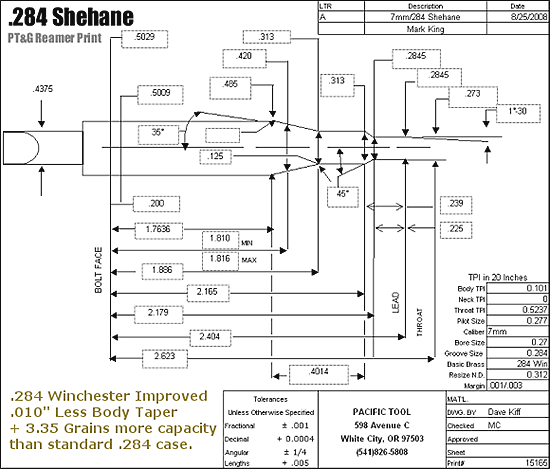
If you look at that 5-round group you might think it was shot with a 6 PPC or maybe a 6mmBR. But no, this was done with heavy 180gr Berger Hybrid bullets and the .284 Shehane, an improved version of the .284 Winchester. In fact, this impressive sub-quarter MOA group was shot while fire-forming with a very well-worn barrel! Gun builder Ryan Pierce of Piercision Rifles explains:
Here’s a 5-shot 0.191″ group at 100 yards with my .284 Shehane fire-forming loads. This barrel has 2200 rounds through it. It had 2000 as a straight .284 Win and then I set it back to .284 Shehane to form brass with. This was the first five rounds through it after I cleaned it after the last match. [The load was] 180 Hybrids with 54.0 grains of H4831 SC.
Ya, I figured why not I had some old barrels laying around so I just chopped 2″ off the back and 1″ off the front and chambered it up as a Shehane. Had 1000 pieces to fireform and didn’t want to do all that on a brand new barrel.
My fireform loads are going 2765 FPS. I have a 29″ barrel also though since it’s a setback. Once you get it formed I would push it faster than that or I wouldn’t even bother with the Shehane. My old straight .284 load at 2890 fps had ES spread in single digits for 10 shots. I figured if I get it up to 2935-2950 fps that will be a point or two saved in a several day match.
Our friend Erik Cortina notes that the .284 Shehane has a velocity edge over the straight .284 Win because it holds more powder: “The Shehane has more capacity than the .284 Winchester. Ryan is using 54.0 grains simply as a fire-forming load. Typical load for a Shehane is around 57.0 grains of Hodgdon H4831 SC.” By blowing the sidewalls out 0.010″, the .284 Shehane picks up about 3.3 grains of extra case capacity. That enhancement makes a BIG difference. The extra boiler room is enough to drive the 180s at 2900-2950 fps with H4831sc, with long barrels.
Forum member Jim Hardy has shot the .284 with great success. He tells us: “In my humble opinion, the .284 Shehane is the best balanced long-range round there is — bar none. Here is why:
You have to shoot a 30 Cal Magnum with a 240gr bullet to equal the performance of most 7mm chamberings with the 180 Berger VLD. With the .284 Shehane, you have a .308 bolt face, medium action, and Lapua brass. You use less powder than the 7 mags, and have great accuracy and ballistics even while fire-forming. The .284 Shehane shoots inside the 6.5 AND the straight .284, the .300 WSM, and the .300 Win Mag with less recoil. What is not to love about the 284 Shehane? It is a no-brainer for long range — F-Class or Prone or 1000-yard Benchrest.”
Scotland’s Grant Taylor. who used the .284 Shehane to finish third at the 2009 F-Class Worlds in England says the .284 Shehane is “very accurate with superb vertical spreads at 1000 yards. [This] caliber… has awesome accuracy. I’m getting 2930-2950 fps with spreads in the 3-5 fps range. I use Hodgdon H4831sc powder, CCI BR2 primers, and pointed 180gr Bergers.”


 Part 2 of this Volume is focused on various aspects of advanced hand-loading. Modern Advancements (Vol. II) employs live fire testing to answer the important questions that precision hand loaders are asking. What are the best ways to achieve MVs with low ES and SD? Do flash hole deburring, neck tension, primer selection, and fill ratio and powder scales sensitivity make a difference and how much? All of these questions are explored in detail with a clear explanation of test results.


 On his