In the video below, Forum member (and F-Class ace) Erik Cortina shows how to install a Jewell Benchrest trigger into a Kelbly F-Class Panda action. You could follow the same simple procedure to install a Jewell in a standard Panda action. Kelbly’s sell both standard and long versions of the F-Class Panda action. Both versions feature integral recoil lugs in the front.
To see more detail in this “how-to” video, you can zoom it to full-screen size. Simply click the full-screen icon (4-cornered frame) just to the right of the YouTube logo in the lower right.
Our friend Erik Cortina is at Raton, NM this week at the F-Class Nationals. When he’s not shooting (or working) Erik produces YouTube videos. One of his most popular videos explained why you should full-length size cartridge brass. In no uncertain terms Erik says: “Quit Neck Sizing!!!” Watch the Video:
Why It’s Smart to Full-Length Size Your Brass
Commentary by Erik Cortina
Should You Full-Length Size Your Cartridge Brass?
Absolutely. Let Me Explain Why…
I have seen it time and time again, shooters on the line wrestling with their rifle trying to get the bolt closed while the wind is switching. They were too focused trying to get their bolt to close and getting their rifle settled back on the bags that they missed the wind switch. Bang… Eight! The straw that broke the camel’s back for me was at the 2017 Canadian Nationals. I was paired up with a young girl and she would try really hard to close the bolt on her rifle. The majority of the time she would get it to close, but often times she could not even get the round to chamber. She was focused on her rifle the entire time rather than on the conditions. When we completed our strings, she had five rounds that did not chamber our of 15! That is way too many!. I told her she needed to think about Full-length sizing with 0.002″ shoulder bump, or Controlled Full-length Sizing like I call it. I told her not to worry about losing accuracy. I told her that I full-length size all my rounds and asked if she noticed how smooth my bolt was and noticed my score. She said yes, they were both great!
Controlled Full-length Sizing Does NOT Harm Accuracy
I have found that Controlled Full-length Sizing does NOT hurt accuracy or shorten brass life. I find that I can focus much more on the conditions when I don’t have to think about chambering a round nor extracting it. It has become second nature. After firing, I keep my head welded to the stock, I open the bolt by placing my thumb on top of stock and rotating hand upwards. I reach in and retrieve spent case, place it back in ammo box, and pick up another loaded round and put in chamber. I verify conditions and when ready, I push the bolt in and close it with my index and middle finger.
With Controlled Full-length Sizing you “bump” the shoulder around .002″ for bolt guns.* Image courtesy Sinclair International which carries a variety of Full-length dies.
Whidden Full-Length Sizing Dies by AccurateShooter.com Editor
For proper Full-length sizing, you want a quality die that’s a very good match to your chamber. For our project rifles we usually turn to Whidden Gunworks which offers both bushing and non-bushing FL dies. And if you want the hot new option, check out Whidden’s patent-pending, click-adjustable FL-sizing die. This gives instant, precise control over shoulder bump. It works great.
*With gas guns, such as the AR10, you may want to increase shoulder bump to .003″ or more. With some benchrest cartridges, .0015″ bump may prove optimal. But .002″ is a good starting point.
Proud owner Dirk L. says: “This is my first build — never thought it would be a .308!”
Here’s a handsome F-TR rifle with a beautiful red stock that suits the holiday season. This ruby red beauty was a recent addition to the long-running Pride and Joy Rifle thread in our Shooters’ Forum. The rifle belongs to Forum member Dirk L. (aka “Pinkes”) who hails from South Africa. This is a .308 Win, with 30″ Bartlein barrel, and X-Max action. The stock is a custom composite with carbon fiber for strength and lightness. And yes this rifle shoots as good as it looks. Check out the impressive 5-shot groups below…
X-Max for Xmas — Impressive Metal-work
Along with that beautiful red stock, this F-TR rig has some very cool features, including a South African-crafted X-Max Action. The action designer Piet Welgemoed explains: “The X-Max action body is 17-4PH stainless steel pre-hardened to 44° Rockwell. Bolt and handle are one-piece stainless steel, nitrated to 55° Rockwell 0.2mm deep. Bolt is also fluted. Inside is the firing pin with washers (see below). The washer cuts the lock-time almost by half and also weighs less. The bolt-knob and bolt shroud are CNC aluminum. The action has very tight tolerances.” The complete action with +20 MOA rail and trigger weighs 1.475 kg (3.25 lbs).” Owner Dirk notes that the competition trigger, set at 3.0 ounces, is also Welgemoed’s design.
Wicked Accuracy with Bartlein Barrel, Varget, and 220gr SMKs
This gun has already proven to be a great shooter. Below are two FIVE-shot groups at 100 meters. The group on the left is in the low threes, with three of five shots essentially in one hole. Dirk loads Lapua .308 Palma brass and #2231 200gr Sierra Matchkings, seated 20 thousandths off the lands. The Varget powder and CCI primers drives the 200gr SMKs at 2620 fps.
Brass: Lapua .308 Win Palma (small primer) | Primers: CCI 450 | Powder: Varget
Bullet: New 200gr SMK #2231 | Seating: 0.020″ Off | Velocity: 2620fps
Composite Stock — One of Three by Renier Mostert
And what about that beautiful red stock? The rifle’s owner told us: “This was one of three similar stocks built as a test run by Renier Mostert, a professional composite stock builder and former benchrest shooter from Pretoria, South Africa. Renier was approached by three friends, who were all looking for decent, custom-built FTR composite stocks. There were a number of stocks available to them (mostly imported), but [those] were either made of wood or aluminum. The requirements for the composite stock build was very specific. Aluminum V-Blocks for the actions were required. The stocks had to be light enough to carry some beefy barrels and optics without compromising rigidity and still be within the F-TR weight limit. The three friends supplied Renier with an imported wooden stock as their shape of choice. Although the shape was quite straight-forward, Renier made a few dimensional changes to features which were not symmetrically correct on the sample, and then built a mold from it.”
Renier uses several methods to craft composite stocks for various disciplines: F-Class, benchrest, competition rimfire, hunting, and tactical. For this build he chose to build a shell constructed of a well-planned mix of woven fiberglass cloth and bi-directionally woven carbon fiber with aerospace quality epoxy resin to reduce weight in some areas and increase stiffness in other areas. He used a wet lay-up process where the two halves gets laid up and joined together while still wet to form a complete, continuous shell. The closed mold gets cured under pressure in an oven for several hours at very specific temperatures. After curing, the shell is filled with a high-tech mix of lightweight filler and epoxy resin. The composition of the mix varies in different areas of the stock to facilitate more strength or reduced weight where applicable.
After the initial build, the aluminum hardware was installed. An adjustable cheek piece, Anschutz rail, and adjustable recoil pad mechanism were installed. The stocks were inletted by Renier, while the final fitting and bedding procedures were left for each customer’s gunsmith to complete. The stocks were light enough for the rifles to comfortably be within the F-TR weight limit. A barrel tuner was mounted on one of the rifles, and the rifle still made the F-TR Class weight limit, 8.25 kg (including bipod). The bipod shown in photos in the SEB Joy-Pod.
Paint — Candy Apple Red over Metallic Silver Base
After final gunsmithing, the stocks were returned to Renier Mostert for custom painting. The rifle featured in this article was done in Candy-Apple Red paint from DNA Paints (an Australian company). To get the desired effect, a metallic silver base coat was used, enhanced with a modest amount of medium coarse glitter, followed with multiple layers of candy until the correct shade was achieved. A high-quality automotive clear coat was used to finish off the paintwork.
If you’re planning a build with a Remington or Rem-clone action, take heed. Here’s a trigger upgrade worth considering for an F-Class or Long-Range rig. David Tubb offers an excellent two-stage trigger for Remington 700 rifles, the Model T7T. Priced at $349.00, the Tubb T7T Trigger is a true two-stage design: first and second stages are independently adjustable for both weight and feel. Overall (combined stage) trigger pull weight can be adjusted from just under 1 pound to slightly over 3.5 pounds.
If you are interested in the T7T, watch these two videos. The first shows how to adjust pull-weights for both stages. The second video shows how to modify your stock to provide clearance for the T7T.
This video shows how to adjust the new Tubb T7T two-stage trigger for Remington 700s:
The new T7T is a quality product. We’ve received good feedback from “early adopters” who tell us the two-stage function works well. While installation of the T7T may require minor modifications to your action, most gun owners with basic mechanical skills can install the T7T by themselves. The T7T is made using stainless steel and aluminum for maximum corrosion resistance. Note, a full installation of the T7T trigger (either Right-Hand or Left-Hand) also requires a companion T7T bolt release, offered by DavidTubb.com for $10.00.
This video shows how to modify your stock to fit the T7T trigger:
After Norm Harrold won the 2018 F-Open National Championship in Raton, New Mexico, setting a new 1000-yard National Record in the process, many of our Forum members wanted to see Norm’s championship-winning rifle, and learn more about Norm’s experience at the Nationals. Read on for coverage of Norm’s equipment and .284 Shehane ammo. Scroll down and you’ll find a detailed video showing how McMillan builds the advanced Kestros ZR stocks, like the one Norm used at Raton.
Norm posted: “I made it home from Raton 2018 F-Class Nationals and what an unbelievably amazing week I had. I was blessed enough to bring home a new F-Open 1000-yard record and the National Championship! Our Team McMillan took second in Mid-range and fourth overall in Long Range. I am so thankful and blessed to have this opportunity and to be able to do it with such a stand-up group of competitors and lifelong friends. Thanks to all our sponsors: McMillan Fiberglass Stocks, Nightforce Optics, Kelbly’s [Actions], Bartlein Barrels, and Berger Bullets.”
Gun and Load: Norm’s F-Open rig features a McMillan Kestros ZR stock and Bartlein barrel chambered for the .284 Shehane, which has a bit more case capacity than a standard .284 Winchester. Norm loaded Berger 184gr 7mm bullets in Lapua brass. Norm revealed his load in an Erik Cortina YouTube Video. Fellow shooter Erik Cortina joked — “the minute this video goes live, the 184s will be hard to find”. Norm says “Stock up guys — they shoot good!”
Here Norm Harrold shows his shooting form. Note how low the McMillan Kestros ZR forearm sits on Norm’s SEB NEO front rest. Norm also uses a large footprint rear bag for enhanced stability.
Harrold Shoots 200-22X to Smash 1000-Yard F-Open Record
On a rainy day at Raton, Norm shot brilliantly to set a new F-Open National Record: 200-22X at 1000 yards. (The previous record was 200-17X.) How could he get 22 Xs for a 20-shot string? Under NRA rules, if you shoot all Xs for the full string, you are allowed to keep shooting for as long as you can put shots in the X-Ring. Norm almost missed the chance to extend his X-Count. After his 20th shot, Norm recalled, “I said ‘I’m done, give me my target’, but … my shooting partner said ‘No! Keep shooting!’” So Norm did, drilling two more Xs to set the new National Record.
Kelly McMillan Shows Design and Construction of the Kestros ZR:
In this video, Kelly McMillan explains the design features and construction methods for the Kestros ZR, a fiberglass Kestros with aluminum extension rails in the front. Kelly explains “how and why we made the stock the way we did” and he shows how to retro-fit standard Kestros stocks with the new front rails. On the ZR the rails are anchored to a reinforced area for extra rigidity. In addition, the cantilevered rails are milled to be perfectly parallel. If you shoot F-Class we strongly recommend you watch this video.
Kelly McMillan showed us the prototype Kestros ZR at the 2018 Berger Southwest Nationals.
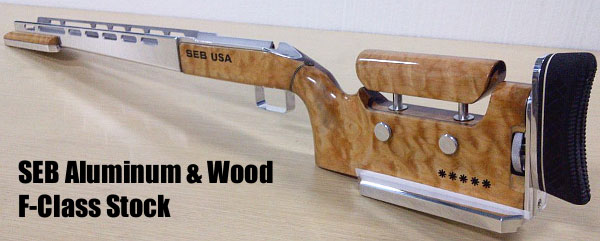
NOTE: This is an older article, but with the F-Class National Championships underway this week in Raton, NM, we thought our readers might enjoy this view of a very rare and unique F-Class rig. This hybrid wood and aluminum stock is a “one-of-kind” custom, crafted by Sebastian (“Seb”) Lambang, creator of the SEB Coaxial Rests and Coaxial Joystick Bipod.
Back in 2013, our friend Seb Lambang engineered an impressive wood and aluminum F-Class stock. The stock features a long, box-section aluminum fore-end with a wood rear section and wood-trimmed “wings” on the front bag-rider. The aluminum fore-arm has “buick vents” for weight reduction. From the end of the action rearward, the stock is mostly wood, with light and dark fancy wood laminates on opposite sides (left and right).
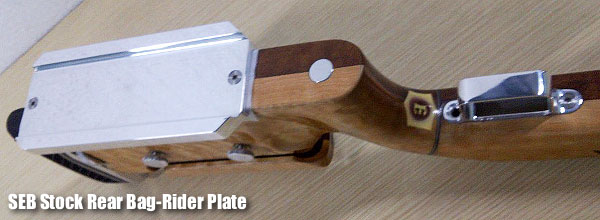
The foot of the buttstock has a very wide aluminum rear bag-rider with rails. The rear wood section appears to be two solid pieces of wood — but that is deceiving. Seb explains: “To save weight, the buttstock is hollow (using thin-walled wood)”. To strengthen the construction, Seb added carbon fiber inside the buttstock. So what you see is a wood outer shell with carbon fiber layers on the inside. The stock sports vertically-adjustable cheek-piece and buttplate. The thick, rubber buttpad should diminish felt recoil even when shooting big cartridges with heavy bullets.
This is an interesting, innovative stock design. And as with everything Seb produces, the craftsmanship, fit and finish are superb.
To go with this gun, Seb also crafted a handsome set of angled scope rails with beautifully-machined scope rings. Imagine being able to custom-make one-off products of this quality in your own machine shop!
Anschutz .22 LR rifle set up for F-Class competition. Photo courtesy Sportschieben Blog.
Here’s a new discipline we think should become very popular — Smallbore F-Class with .22 LR rimfire rifles. Rest-supported prone rimfire matches have been held around the world for quite some time, but only a few years ago was the discipline officially codified in the NRA Smallbore Rulebook. And the first-ever Smallbore F-Class National Championship was held this past July in conjunction with the Smallbore Nationals at Camp Wa-Ke’-De in Bristol, Indiana. The Nationals involved multiple days of prone shooting at 50 meters and 100 yards.*
Jim Murphy, a respected centerfire shooter and coach, became America’s very first Smallbore F-Class National Champion, shooting an impressive 2374-146X score. Fourteen points behind, but with the same X-Count, was runner-up David Pessall (2360-146X). Jess Huehn finished third with 2358-137X.
Competitors could either shoot off a bipod F-TR style, or use a front rest. In this photo from the inaugural NRA National Championship you can see a shooter with SEB Coaxial Rest at top, with a competitor using a low-profile bipod at bottom. Note the extended handle used to adjust bipod elevation. This is not a coaxial joystick, but rather a long handle attached to the mariner wheel.
Smallbore F-Class — The Future Looks Bright
With the high cost of centerfire ammunition, and the limited number of 1000-yard (or even 600-yard) ranges, we can envision that Rimfire F-Class will become a popular event at ranges across the country. Clubs don’t even need benches — just a 100-yard target bay and flat ground for the shooters. You can start with an inexpensive rimfire rig and Harris bipod. Then work up from there. Here is a custom rimfire F-TR style rig that belongs to F-Class ace and past centerfire F-TR National Champion James Crofts.
Smallbore F-Class Course of Fire
The Smallbore F-Class Nationals was completed on paper targets at 50 yards and 100 yards. According to Shooting Sports USA: “The tournament ran during the any sight and metric phases of the 2018 NRA National Smallbore Rifle Championships, featuring a daily course of fire which mirrored the sling shooters, 40 shots at 50 meters on the A-50 target, a Metric Dewar, followed by 40 shots at 100 yards on the A-33 target. Although the international targets were shot throughout, the first two days were titled ‘conventional’ and the last two ‘metric’.”
The specifics of the match such as rifle requirements, rests, and sights may be found in the Provisional Smallbore Rifle F-Class Rules (Section 23), found on page 65 of the current NRA Smallbore Rifle rulebook. Any rules not covered in Section 23 will [reference] the normal rules of Sections 1 through 22.
* All ‘short range’ F-Class was shot at 50 meters on the A-50, the 50 meter International Shooting Sports Federation (ISSF) target. All ‘long range’ stages were shot at 100 yards using the NRA A-33 target, the ISSF 300-meter target reduced to 100 yards.
One recent trend in F-TR competition is the use of low-profile, benchrest-type stocks shot with a light hand-hold and little or no face contact. For this method of F-TR shooting to work, you need the right equipment, and practice a “minimalist” shooting technique. One of the pioneers in this style of F-TR shooting is action-maker John Pierce of Pierce Engineering. Above you can see John shooting one of his F-TR rifles at the 2015 Canadian F-Class Championships. Note the straight-line stock and see how the adjustable bipod is set quite low to the ground (in fact the bipod’s arms are almost straight out).
Members of the Michigan F-TR Team, including Bryan Litz, have used similar rigs with success. Bryan said it took a while to adapt his shooting technique to this kind of rig, but there is a pay-off. Armed with a Pierce-built F-TR rifle, Bryan won his first-ever F-TR Match. Bryan explains the technique he uses when shooting this kind of rifle:
“Coming over from sling shooting, I knew there would be unique challenges to F-TR which I wanted to learn prior to (not during) a major tournament. I learned a new shooting position which doesn’t involve drawing the right knee up. For F-TR I get more straight behind the gun rather than at an angle. I found that the rifle shoots best with very light cheek, shoulder and grip pressure, approaching free recoil. This is how Eric Stecker shot his similar rifle into second place in the SW Nationals [with high X-Count by a large margin]. I learned the rifle’s sensitivity to different bipod and rear bag supports, and found the best buttplate position to allow the rifle to track and stay on target after recoil. This set-up shot best with a mostly free-recoil approach, that means ‘hovering’ over the comb, rather than resting your head on the stock. This took some ‘getting used to’ in terms of neck and back muscle tone. These are the kind of details I think it’s important to focus on when entering a new discipline.”
Bryan’s Pierce-built F-TR rig is a tack-driver: “I can certainly vouch for this set-up! In [a 2015] mid-range State Championship in Midland, MI, I shot my Pierce rifle into first place with a 598-44X (20 shots at 300, 500 and 600). Once you get used to the positioning and way of shooting these rifles, they just pour shots through the center of the target.”
Pierce F-TR Rifles with Scoville Stocks
Shown below are three complete Pierce F-TR rifles, along with a barreled action for comparison. The carbon-fiber/composite stocks are built by Bob Scoville. These Scoville stocks are very light, yet very strong and very stiff.
Are you a sling shooter who would like to get into the F-Class game? Gary Eliseo has a great, affordable solution for TubeGun owners. A simply bolt-on forearm accessory lets your TubeGun ride a conventional front bag like a dream, with less torque effect and great tracking.
Competition Machine’s Gary Eliseo is a very smart designer as well as a talented shooter. The inventor/builder of the popular Competition Machine Tubegun chassis systems, Gary has come up with something new, which he calls the PickleForks. These are rails that fit to the sides of the tubular fore-end/handguard on his chassis systems. This allows you to use a pedestal-style front rest for F-Class competition. It also provides a much more stable platform for load testing, varmint hunting, or any kind of rest-assisted precision shooting. These new PickleForks transform a Tubegun into an ultra-stable, straight-tracking rig when used with a competition-style front rest.
Gary explains: “Now you can have the same super low-boreline, long ‘wheelbase’ and vertical sides of our innovative F1 F-Class chassis system for your tube chassis. The new PickleForks attach directly to the sides of the F-Class/Tactical fore-ends, no modifications are required. They are very rigid with no flex or twist and make the rifle track like it’s on rails.” The new Eliseo Competition Machine PickleForks are offered for a very reasonable $70.00 per pair, with Cerakote finish. (You get two metal units, one for each side of the fore-arm). For more information, visit www.GotXRing.com or call (928) 649-0742.
New Product Tip from EdLongrange. We welcome reader submissions.
Forum member Keith W. (aka “Cigarcop”) of KW Precision LLC is a talented riflesmith whose projects display outstanding finish work and attention to detail. Keith does some of the best bedding work we’ve ever seen. Here is one of his latest creations. Keith recently completed a stunning F-Class rig for a shooter in Delaware. It’s a beauty, that’s for sure. Keith has posted more details about this rifle in a Shooters’ Forum Thread.
This handsome rifle features a polished Stolle (Kelbly) Panda Action, and two (2) Brux barrels, both chambered for the .284 Winchester cartridge. The real eye-catching component of this rifle is the stunning Cerus F-Open stock. This features multiple laminations with highly-figured Walnut on the sides. This certainly ain’t your “off-the-shelf” laminated stock. This just shows the beauty that can be achieved with carefully-chosen lamination layers (plus 12 coats of clear).
This beautiful F-Open rig features a laminated wood stock with stunning figured walnut on the outside.
Keith of KW Precision LLC is renowned for his bedding work, and this rifle shows why. Keith takes great pride in his work, and his attention to detail is second to none. This bedding job is as good as it gets.
Bringing out the figure in the wood requires multiple finish coats (and careful sanding between coats). But the results are worth it. Shown below is the Cerus stock, BEFORE the finish coats were applied. It took time and effort to transform the “naked” Cerus stock into a true stunner. Keith applied twelve (12) coats of PPG Automotive Clear with wet sanding between each coat.