A past F-TR National Champion, James “Jimmy” Crofts is one of America’s top F-Class competitors. And now this F-TR ace has a stunning new rifle in his arsenal. AccurateShooter Forum member CigarCop, head honcho of KW Precision LLC, recently completed a new F-TR rig for Crofts. This handsome, state-of-the-art rifle features top-tier components: Borden action, twin Brux barrels, Cerus RifleWorks F-TR Stock, and Jewell trigger, all resting on a wide-base Phoenix Bipod.
James Crofts photo by Kent Reeve.
Have a good look at these photos below. Yes, envy is the appropriate reaction. With the smooth operation of the Borden action and the predictable accuracy of Brux barrels, we bet James’s new rig will shoot as good as it looks.
CigarCop actually chambered two barrels for James, with different fluting patterns — conventional linear flutes for one tube, and lines of staggered ovals for the other. Finished length for both barrels is 30″. Yes it looks cool, but the fluting was done mainly to save weight with the 30″-long lengths. CigarCop tells us the complete rifle, without scope and rings, weighs just under 15 pounds. Max allowed weight for an F-TR rifle, with scope, is 18.18 pounds (8.25 kg).
There are three notable articles in the latest January 2018 Digital Edition of Shooting Sports USA Magazine. F-Class competitors will definitely want to read the report on the 2017 World Championships. And hand-loaders will appreciate the insightful article on the AMP induction annealing machine. The third recommended article provides tips and techniques for sighting in hunting, tactical, and benchrest rifles. Access the entire SSUSA 54-page January 2018 eZine by clicking THIS LINK.
F-Class 2017 World Championships in Canada Story by Larry Bartholome
Fifteen years ago, the very first F-Class World Championships were held in Canada. In 2017, the Championships returned to Canada for the fifth edition of the match. This year there were triple the number of entries, representing the growing popularity of F-Class competition. Notably, this year’s event was preceded by the Canadian F-Class National Championships. This issue contains a full report on the event, written by Larry Bartolome, a past National F-Open Champion. Shown at right above is the new F-TR World Champion, our friend Derek Rodgers from New Mexico.
AMP Annealing Machine — Annealing .30-06 Brass for Vintage Military Rifles Story by Art Merrill
Produced in New Zealand, the AMP (Annealing Made Perfect) unit is a sophisticated, microprocessor-controlled annealing machine that achieves ultra-consistent results using an electrical INDUCTION process. By contrast, with butane torch systems you may have to adjust the system when the ambient temperature changes, or even if your butane fuel is slightly different. In this month’s issue of Shooting Sports USA, Field Editor Art Merrill uses the AMP to anneal .30-06 brass for vintage military rifles. The review shows how to use the AMP and explains the advantages of the Induction Annealing vs. flame-based annealing.
Sighting In Your Rifle — Tips for All Shooters Story by Jim Shults
This month’s “Rifle Issue” of Shooting Sports USA focuses on rifle shooting in various forms. Author Jim Shults has written an lengthy article offering tips and techniques for sighting-in your rifle. Shults says “The trick in effective sighting-in (zeroing) is shot-to-shot consistency”. To achieve that consistency, you must first eliminate driver error. You need a stable set-up. Good ammo is also essential and Shults offers an important tip: “Keep your ammo cool and out of direct sun at the range”. Shults also explains there is a big difference between load testing and zeroing. You want to finalize your zero AFTER you have developed your match or hunting load.
Emil Kovan is one of the top F-Class shooters in the world. He won the 2014 United States F-Open Championship. Earlier this month Emil finished second in F-Open Division at the 2016 Canadian National F-Class Championship in Ontario. Emil actually tied Open-class winner Shiraz Balolia for overall score AND “V”-count, but Emil was awarded second on the tie-breaker.
“What are the best components for an F-Open class rifle, and why?” That’s a question that I get asked all the time and will try to answer in this article. Two months ago, I was contacted by Duane, a gentleman I met at the 2015 F-Class Nationals. He was interested in building a rifle with the new Master Class Low Profile F-Open Stock, created by Carl Bernosky and Alex Sitman of Master Class Stocks.
I have known Alex Sitman for many years, and use his stocks exclusively, but was not very familiar with his new Low Profile F-Open stock. After a brief conversation with Alex, I placed an order, and had the stock inletted and bedded at my shop in a month. My first impression was “Wow that’s a long stock” — the forearm is significantly longer than on the original Master Class F-Class prone stock. I bolted the barreled action in, and squeezed the end of the forearm and barrel together, the stock flexed a little bit, but not as much as other designs that I have tested. I think that’s due to having “more meat” in the receiver area. The full stock depth continues farther forward that on some other “low profile” designs. That makes the stock stiffer in the vertical plane, reducing the hinging effect forward of the action. The stock was finished in gloss black per the customer’s request. Interestingly, I found that the multiple layers of paint and clearcoat stiffened the stock up quite a bit.
CLICK IMAGE below for full-screen version
Low Center of Gravity Tames Torque
Compared to the original Master Class F-Open stock, the barrel sits about an inch lower. Lower center of gravity equals less torque, and that is very important when shooting heavy bullets in fast twist barrels. Another significant improvement is that the toe of the stock is flat and parallel to the forearm. I added a 3/4″ track rail in the rear, and milled the underside of the fore-end to create two parallel “rails” in the front to help the stock track better.
One of the biggest reasons why I like Master Class stocks, is the pistol grip. I don’t shoot “free recoil” and a comfortable pistol grip is super important to me when selecting a stock. The new Master Class Low Profile stock shares the same grip as the old model. This allows the stock to accommodate either a “hard hold” style or a more free-recoil style of shooting — whatever the rifle’s owner prefers. This design versatility is one reason I recommend Master Class stocks. Shooters may experiment with either shooting style to find what suits them best.
Cartridge Choice — A 40° .284 Win Improved
Duane decided to have the barrel chambered for my 284 KMR IMP (Improved) wildcat. What is .284 KMR IMP and why choose it over the straight .284 Winchester? Improved by definition means “made better”, I took a great cartridge, and modified it to increase capacity, reduce pressure, and increase brass life.
There are many “improved” variants of the original .284 Winchester: 7mm Walker, .284 Shehane, .284 Ackley and so on. My version, the 284 KMR IMP, shares the .010″ blown-out sidewalls of the .284 Shehane, but I have further increased the case capacity by changing the shoulder angle from 35 to 40 degrees. The 284 KMR IMP allows you to almost match magnum cartridge velocity in a standard-bolt-face action. If you want to run 180gr-class 7mm bullets over 2900 FPS, it is cheaper and more convenient to have a barrel chambered in 284 KMR IMP than to spend $650 for a magnum bolt.
Tuning Loads for the .284 Win Improved Cartridges
The 284 KMR IMP seems to have two nodes, one around 2820 fps and other at 2940 fps. My match load clocks at 2935 fps with single-digit ES. Note –I selected that load based on accuracy, NOT raw speed. A lot of novice (or hard-headed) shooters make the mistake to push their cartridges to the max, and disregard more accurate loads at lower velocity.
The sport of F-Class is rapidly growing, and the equipment used is improving constantly. I remember that only few years ago, an F-Open rifle that could shoot sub-one-inch of vertical at 300 yards was considered competitive. Now, we are pursuing sub-one-inch vertical at 600 yards! It takes a great rifle to approach that goal, but it is also up to the shooter to learn and experiment as much as possible in order to achieve success.
Dies for an Improved .284 Win Cartridge
One of the biggest challenges in campaigning a wildcat cartridge has been obtaining great dies. When searching for custom dies, it almost seems like that the odds are stacked against us. The most common problem is wait-time — custom die orders can take months to be completed. Also, most custom die makers want you to send them two or three cases, each fire-formed three times. I find that funny because if could somehow properly size the cases for three fire-forming cycles, I would not need a sizing die.
Custom-made dies should size the case just right, but sometimes the die’s internal dimensions are slightly off, and this leads to problem number two: dies sizing too much (or even worse) too little. I had a one “custom” die that would not size the bottom of the case enough. This made the extraction of fired cases very difficult. I feel that the best option (if available) for shooters interested in wildcat chambers is to have their gunsmiths make the dies. I offer that die-making service in addition to barrel chambering.
BAT Machine “M” Action
Duane decided to use a BAT M action for this rifle, and I think that he could not have made a better choice. We are blessed with many good match-quality receivers: Barnard, BAT, Borden, Kelbly, Nesika, and Stiller just to mention a few. These are all very well-made and suitable for F-Class. Among BAT Machine Co.actions, I like BAT models M, MB, and 3LL best. I prefer these because because of their size (large bedding footprint) smoothness, timing, options available, and last but not least visual appearance.
Trigger: I recommend and use Jewell triggers. Other good options are: Kelbly, CG Jackson (good 2-Stage) Anschutz (best 2-Stage for Bat and Kelbly actions), Bix’N Andy, and David Tubb.
Barrel: Duane made another good choice here. He decided to go with a Brux 1:8.5″-twist, 4-groove cut-rifled barrel. If you look at the F-Class and Long Range benchrest equipment lists, you will see that cut-rifled barrels are currently dominating. Many records have been shot with both button-rifled, and cut-rifled barrels. I have shot both, and prefer cut-rifled barrels. I am not saying that button-rifled barrels are not capable of shooting as well as cut-rifled barrels, but on average, in my experience, four out of five cut-rifled barrels (from top makers) will shoot well, vs. three out of five buttoned barrels. YMMV, but this is what I’ve observed.
Scope: Duane’s rifle was fitted with a Nightforce 15-55x52mm Competition scope with DDR-2 reticle. This optic is ultra clear, reasonably lightweight (28 oz.), super reliable, and has 1/8 MOA clicks — what you want for long range F-Class competition. In this 15-55X NF model, I like the DDR-2 reticle best, because fine cross hairs (FCH) are hard to see in heavy mirage. The DDR-2 has a heavier horizontal line, with a center dot. March scopes are also very popular and very well-made.
Thanks for reading, and keep ‘em in the middle…
Emil Kovan Competition History:
– 2014 F-Class Open National Champion
– 2016 F-Class Open Canadian Championship, Silver Medal (tied for first on score)
– 2015 F-Class Open National Championship, Silver Medal
– F-Class Open National Championship Teams, 2015, 2014, 2013, Shooting Team Member
– Over 15 wins in Regional and State Championships in Palma, F-TR, F-Open
This article was written in 2014 for the Sierra Bullets Blog. It describes one method of load development that is commonly used. There are other methods that can work also. Some guys first isolate seating depth and then fine-tune velocity with charge weights. Other guys may aim for a known velocity node (speed range) and then optimize accuracy by adjusting seating depth. Still others look for smallest ES and tightest vertical to minimize 1000-yard vertical dispersion. There are many ways to skin a cat. Different rifles (and even different barrels) can demand different styles of load development.
In this instance the writer achieved desired results seating his bullets .007″ back from max “jam” length. For other applications (and other barrels) you may get the best, most consistent results seating off the rifling by .020″ or more. In disciplines with quick-fire such as PRS, it may be wise to develop loads that “jump” the bullet.
F-Class Long Range Load Development Methodology
by Mark Walker, Sierra Bullets Product Development Manager
Since I just put a new barrel on my F-class rifle… I figured it might be a good time to discuss load tuning for long range shooting. Getting the most accuracy out of your rifle is one of the most important aspects of load tuning. For long range shooting in particular, using a load that produces the least amount of vertical variation is vital. There are several steps to the process that I use, so I will go through the basics of each.
When I first get a new barrel installed, I like to determine what the loaded cartridge “jam” length is. I do this by taking an empty case (no powder or primer) that has been neck sized with the proper bushing (I like to shoot for 0.002 smaller than the loaded cartridge neck diameter) and seat a bullet long in it so that the throat of the rifle will move the bullet back into the case when I close the bolt. I close the bolt several times until the bullet stops moving back into the case at which point I use a comparator with my calipers and get a length measurement on the cartridge. This is what I consider to be the “jam length” for this barrel and chamber. I came up with 3.477″ as the “jam length” for this particular barrel. [Editor: In this instance, Mark is using “Jam length” to mean max seating depth he can achieve without bullet set-back.]
Next, I will fire-form some brass using a starting load of powder and bullets seated to “jam” while breaking in the barrel. My barrel break in process is not very technical; it’s mostly just to get the brass formed and the rifle sighted in. I do clean every 5 rounds or so just because I feel like I have to.
Once I have the brass formed, I use them to load for a “ladder test” to see what powder charge the rifle likes. With a ladder test, you take your starting load and load one round each with a slightly increasing amount of powder until you reach your max load for that cartridge. You then fire each round using the same aiming point to see where the bullets start to form a group. For this barrel and cartridge, I started at 53.3 grains of H4831SC powder and increased the load by 0.3 grains until I reached 55.7 grains. I always seat my bullets to “jam” when doing a ladder test. We will determine the final seating depth in another test later. It’s usually best to shoot this test at a minimum of 200 yards because at closer ranges the bullets will impact too close together making it hard to determine which load works best. I shot this test at 300 yards.
As you can see from the target, the lightest load #1 had the lowest velocity and impacted lowest on the target. Shots #2 and #3 were a little higher and in the same hole. Shots #4 thru #6 were slightly higher yet and all had the same elevation. Shots #7 and #8 were the highest on the target however pressure signs were starting to show. For some reason shot #9 went back into the group and the chronograph didn’t get a reading so I ignored that shot.
When picking a load, I am looking for the most shots at the same vertical location on the target. As you can see that would be shots #4 through #6 so I would pick a powder charge from those shots which would be 54.2 grains to 54.8 grains. As a side note, shots #2 and #3 are only 0.851 lower so I wouldn’t be afraid of using one of those loads either. I settled on 54.5 grains as the load I wanted to use. It’s right in the middle of the group so if the velocity goes up or down slightly, the bullet should still hit in the same place on the target.
Now that we’ve settled on a powder charge, I want to find the seating depth the rifle likes. I usually start at jam length and [shorten the COAL] in 0.003 increments until I get to 0.015 deeper than jam. [Editor: By this he means he is seating the BULLET deeper in the case, NOT deeper into the lands. He ended up at .007″ shorter than his hard jam length of 3.477″.]
I load 3 rounds at each depth using the 54.5 grain powder charge and shoot a group with each depth at 150 yards. As you can see from the target, the first two groups are not good at all. Next one looks good and is the smallest group on the target. The next three are not quite as small but the vertical location on the target is almost the same which indicates a sweet spot which will help keep the vertical stringing to a minimum on target. I went with 3.470″ which is right in the middle once again and should give some flexibility with the seating depth.
So after all of that, my load is 54.5 grains of H4831SC and a cartridge length of 3.470. I plan on loading up enough ammo to shoot five groups of five shots and see exactly how this load works on target as well as what the extreme velocity spreads are over several groups.
I sincerely hope some of this information helps you to get the best accuracy out of your rifle. I do not take credit for coming up with any of this, a whole lot of good shooters use this same method or a variant of it when working up their loads.
For more information about load development, please contact the Sierra Bullets technical support team at 1-800-223-8799 or by email at sierra [at] sierrabullets.com.
Disclaimer: Load data represented here may not be safe in your rifle. Always start low and work up, watching for pressure signs.
Shooter Profile by Des Parr, UK
We have a new European F-Open Champion: Paul Hill from the UK. If he looks familiar, it’s because Paul appeared here 12 months ago when he set a new F-Open record score of 100-17X at 900 yards at last year’s European Championships. There are some factors which make Paul’s victory all the more significant. First, he didn’t employ a top gunsmith to do his work — he’s a real working-class here who did it all himself. To keep costs down he taught himself to do all his own machining and bedding. Paul acquired a lathe, learned how to run it, and then carefully did all his own chambering and fitting. He then taught himself how to bed the rifle too. You have to admire a man who teaches himself how to build Championship-winning rifles.
Another unusual factor is Paul’s choice of components. Paul used the Lapua Scenar 180-grain bullet, the same bullet used to set his 2016 record. The 180gr Scenar is a fairly “old-fashioned” shape, but Paul points them using a “shooting shed” pointing tool. For seating, he uses his own home-made die with a Wilson top. Whatever the Lapuas may lack in BC, they more than compensate for in consistency, and that’s the key to success. As an aside, they compare very favourably in tests on the Juenke ICC machine, indicating that they’re very well made indeed.
Paul Hill Equipment List
Paul shot in the F-Open class firing the 7mm RSAUM cartridge, a short magnum. He ran a 30″ Krieger 1:9″-twist barrel mated to a Barnard Model P action bedded in a Joe West laminated stock. His pushed those Lapu8a Scenar with the relatively new Reload Swiss RS70 powder. Paul rates this RS70 propellant very highly. It may be unfamiliar to shooters in the USA, but RS70 is REACH compliant and is likely to become more popular when many other powders are forbidden from the EU next year. Paul is also a big fan of the Russian KVB-7 primer, a very mild and consistent primer — marketed under “Wolf” in the USA.
It is not just about having the right equipment though, it is also all about the application of skills and techniques and Paul was very keen to acknowledge his debt of thanks to Erik Cortina for his reloading techniques and Brian Litz for his writings on range mind set and diet. There is another, until now, secret factor that may have helped Paul. He is an Apiarist (bee-keeper) and he swears by the beneficial effects of his daily honey on toast. Who knows? Perhaps he’s on to something — nothing sells like success, so Paul’s honey sales may take off now just like his shooting career.
Here’s a good video showing F-Class Shooters at Bisley (FieldSports Channel 2015)
2016 Wasn’t So Bad Either
Paul Hill’s 2017 Championship win followed an impressive performance last year. At the 2016 European F-Class Championships at the Bisley Ranges, Paul set a record score at 900 yards: 100-17V! That’s 17 shots placed in a five-inch circle the size of a CD (compact disc) at over half a mile. [NOTE: At Bisley, the maximum score is FIVE points, not ten points. So the maximum score for 20 shots is 100. Also what Americans call an “X” is called a “V” at Bisley.]
Record Set with Slower Pair Firing Method
The style of shooting in Great Britain is pair-firing. Under this procedure, each of two competitors shoots alternately, taking turns from shot to shot. Each shooter has 45 seconds to take his shot. Allowing for the target pullers to do their jobs, this means that each shot can take up to one minute. As Paul was pair firing, he had to concentrate for up to 40 minutes to get all 20 shots off! You can imagine how many times the wind changed course in those 40 minutes –pick-ups, let-offs, changes of angle and direction. Paul had to counter each change and still managed to put 17 shots in that 5-inch circle!
Here is an interesting project by one of our Forum members. Martin C. (aka “Killick”) modified an Anschutz 1411 Match 54 rimfire prone stock to become a comfortable, great-tracking F-Class Open Division Stock. No Killick didn’t sacrifice a perfectly good rimfire rifle for this project — he bought the Anschutz stock by itself on eBay, then transformed it…
Killick explains: “This project started about seven years ago. I bought the Anschutz prone stock on eBay and whittled it a bit into a Palma rifle with a Barnard action and block and a Doan Trevor cheek piece and scope rail. Then about two years ago I decided to re-task the stock/action assembly into an F-Open rig. With more whittling, gluing, sanding, body fillering, sanding, filling, sanding, more sanding…and sanding, forming, priming, sanding, painting, waiting, painting, painting…painting and before you know it, Bob’s your uncle.”
Here is the eBay-sourced Anschutz 1411 stock, with new high-gloss blue finish, as initially modified for use in Killick’s centerfire Palma rifle. Looks nice!
Next step was the addition of a 3″-wide wood fore-end for F-Open duties with front rest:
Almost done here… just needs priming and final painting:
Here is Killick’s completed F-Open rifle with its much-modified Anschutz stock now finished in fire-engine red lacquer. This image shows the detail of the grip and customized cheekpiece.
Here is some serious Sunday “gun glamour” from the folks at Star Shooter Precision, a bipod-builder and stock-maker based in Montreal, Canada. This stunning .308 Win F-TR rifle features a carbon-wrapped Star Shooter stock, angle-adjustable tubular bag-rider, star-shaped escutcheons, and a Kelbly Panda action. Up front is Star Shooter’s signature lightweight bipod.
Click Each Image for Large, Full-Screen Version
About the Rifle Builders Star Shooter Precision is a company located on the south shore of Montreal, Quebec, Canada. Fred Harvey is the designer. Fred says: “Our goal is to perfect the art of competition shooting the best we can with our custom bipods. The Star Shooter bipod is designed for shooters in F-Class competition, varmint hunting, load testing, tactical shooting and sighting in rifles.”
“A big congratulations to Bob Mead (1582-68X), who utterly destroyed the competition in tricky wind conditions to take the Gold.” — Jay Christopherson, 2017 F-Open Nationals Second Place.
In this 15-minute video, Team Lapua’s Erik Cortina interviews Robert Mead, the 2017 LR F-Open Champion. Robert (Bob) discusses his wind reading techniques with Erik, and the newly-crowned F-Open Champ explains how to set up a reliable wind zero. Bob also discusses cartridge choices in F-Open. He admits the straight .284 may be the tightest grouping 7mm cartridge, but he has used the 7mm RSAUM for a decade now. He believes the RSAUM may the best cartridge for 1,000 yards in 7mm, all things considered (grouping ability, ballistics): “To me it’s a light magnum, it’s capable of high speed, yet burns less powder than your regular magnums. [But] it’s a finicky cartridge — you’ve got to do a fair amount of load development.”
Every serious F-Class competitor should watch this video start to finish:
Credit Erik Cortina for video and the photo of Robert Mead with trophy above.
WA Team members, left to right: Tod Hendricks, Jay Christopherson, Monte Milanuk, David Oakes.
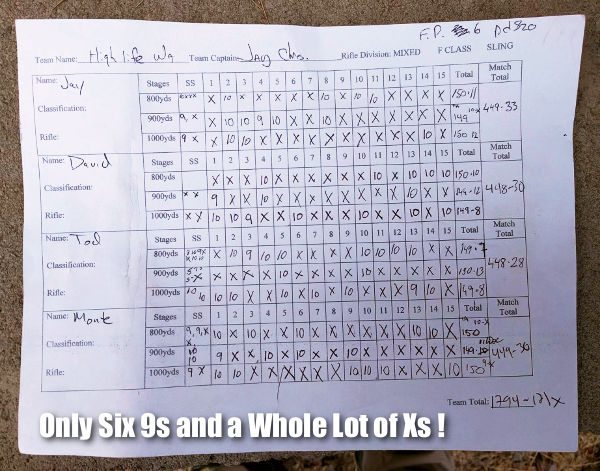
F-Class competition continues to evolve, as guns and shooters get better every season. That means records get broken. Yet another record was smashed this month as the “Washington F-Open” team scored 1794-121X, a new pending National Record. That stunning combined team score beats the previous best by five points and more than 20 Xs. We believe the current record is 1789-100X, set at the 2017 Berger Southwest Nationals.
The new 1794-21X team record was set at the 2017 Northern Rockies LR F-Class Regional Match, held September 6-8 at the Deep Creek Range outside Missoula, Montana. This is a three-day, long range regional F-Class match consisting of two individual days and one team day.
Team Member Jay Christopherson, who won the F-Open Division, was proud of his Team’s accomplishment: “We were very excited when our shooting held up at 1000 yards to break the record.” Forum member Pat F., who also shot the match in Montana, said this was a really impressive performance: “I think that record will stand for a while.”
World’s Most Accurate IT Guy Wins F-Open with Brilliant Performance
Our AccurateShooter.com Systems Administrator, Jay Christopherson, won the F-Open Division with a superb 1047-62X individual performance. Remarkably, when you combine that 1047-62X with his 449-33X score in the team match, Jay dropped only four (4) points the entire weekend over 150 shots (105 shots in individual competition and another 45 in the team match). That is a combined percentage 99.73% in the Ten-Ring. Amazing! Jay is definitely “The World’s Most Accurate IT Guy”. Congrats Jay.
Jay was shooting a new F-0pen rifle built with his favorite hardware: a smooth-cycling Borden BRMXD action riding in a hardwood X-Ring stock. The barrel was a 32″-long, 1:9″-twist Bartlein chambered for the .284 Winchester cartridge. All team members were shooting straight .284 Wins with Berger 180gr Hybrid bullets. Jay was using a new scope, a fixed-power 48x52mm March High Master. Jay was impressed with the sharpness, clarity, and reliability of this scope. He said that during the match he never felt the need to dial-down power, so the 48X fixed magnification worked fine.
Jay reports: “Conditions were generally pretty good. Not perfect, but almost… There was enough change to push you out of the 10-Ring if you were not careful, but overall, the conditions were about as consistently good as you can expect. There was also some smoke haze, particularly on Friday and Saturday, that made seeing the target a challenge and looking at mirage was basically impossible. But, for all that, the wind was mostly very, very kind.”
“This is the fourth year I have traveled to shoot this match and as always, it was an excellent match. Jamey Williams does an outstanding job of herding cats and ensuring that the match runs smoothly. Bob Evans ran the line and really did an excellent job of keeping everyone safe and the match moving.”
Here is an aerial view of the Deep Creek Range (Drone video by David Gosnell):
Northern Rockies LR F-Class Regional Match Results
Individual Top Three Shooters (1050-105X Possible)
F-Open Division:
Jay Christopherson, 1047-62X, MW
Tod Hendricks, 1043-61X, 2nd MW
Jim Williams, 1041-51X, 3rd MW
F-TR Division:
Justin Covey, 1030-48X, MW
Tom Hubbard, 1030-41X, 2nd MW
John Van Santford, 1027-36X, 3rd MW
Jay Christopherson, 449-33X
Tod Hendricks, 448-28X
David Oakes, 448-30X
Monte Milanuk, 449-30X
F-TR Winning Team: “Misfits”, 1751-50X
John Van Santford, 436-14X
Beverly Van Santford, 441-13X
Phil Brackenbury, 436-12X
Larry Bandaccari, 438-11X
Course of Fire: The individual days are a 105-shot aggregate, consisting of a 45-shot Palma (800/900/1000) followed by a 20-shot x 1000 (Day 1) and a 40-shot x 1000 match (Day 2). The team match is a 45-shot per team member Palma match (800/900/1000).
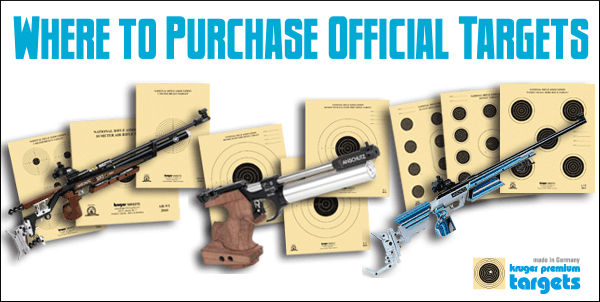
Need targets — not just any old targets, but the correctly-sized targets for specific shooting disciplines (such as NRA Smallbore, F-Class, and 1K Benchrest)? Well you won’t find them at your neighborhood Wally World store. Precise, dimensionally-correct competition targets are producted by a half-dozen specialty printers. In this article we provide links to the leading target sellers, with a chart showing “who’s got what”. Look for your particular discipline and the vendors will be specified.
Sources for Official Shooting Competition Targets:
AccurateShooter.com offers dozens of FREE, printable targets for target practice, load development, and fun shooting. We also offer a few of the most popular NRA Bullseye targets. One or more of these printable targets should work for most training purposes. However, some readers have asked: “Where can we get the real targets… exactly like the ones used in NRA, IBS, and NBRSA shooting matches?”
All these vendors carry nearly all the NRA High Power and Smallbore targets, including the new, smaller F-Class targets. National Target has the F-Class and High Power targets, including 100-yard reductions of the 200, 300, and 600-yard military targets. Germany’s Kruger Targets sells all the important NRA targets, and international (ISSF) air rifle and smallbore targets too.
Orrville Printing currently sells IBS targets for rimfire (50 yard) benchrest, short-range centerfire Benchrest (100, 200, 300 yards), Hunter BR Rifle (100, 200, 300 yards), plus the official 600-yard and 1000-yard IBS targets. National Target Company also has most of the IBS targets. NBRSA short-range, 600-yard, and 1000-yard benchrest targets are available directly from the NBRSA Business Office. Call (307) 655-7415 to order for the season.


 Emil Kovan Competition History:


 Paul Hill Equipment List


 About the Rifle Builders