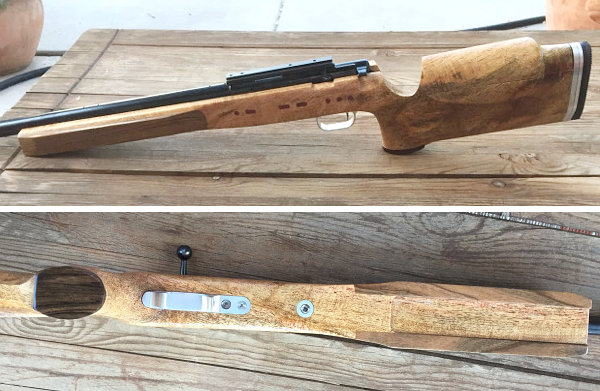
The dots and dashes are Morse Code for the shooter’s initials. The wood is Mango with Walnut fore-end wing inlays. The barreled action is an older Anschutz Model 54 that spent years in a prone stock.
Build Report by Doan Trevor
How do you build a stock for the grand-daughter of an award-winning shooter? Over the years I have built five or six rifles for this shooter, and now his grand-daughter had taken an interest in F-Class. He wanted her new rifle to mirror his own F-Class rifle, and he provided me with an old Anschutz Model 54 barreled action. Her new rifle would get her started in rimfire with the possibility of graduating to High Power (centerfire) shooting. The dots and dashes on the sides of the stock are Morse Code for his grand-daughter’s initials — “AMS”.
Rimfire F-Class Stock Design Factors
Typically when I build a rimfire F-Class stock I use the same pattern as I do for High Power stocks. The pattern has evolved from my prone stocks, as it has proven very successful with time. Also, there is a known issue of using wood for a stock in F-Class. The wood needs to be cured, and unfortunately, finding wood in the specific dimension for the stock is near to impossible. Therefore, I inlay pieces in the fore-end making sure that it is straight and on center. Other materials can be used for an F-Class stock, but keeping them straight and centered can be very difficult. Using cured wood during the build process, I continually check the centerline from fore-end to the rear slider, ensuring that the stock stays centered. This helps ensure good tracking and return to point of aim.
Adapting Prone Stock for F-Class Use
There is a current trend of older Palma and prone shooters to convert their rifles for F-TR and F-Open due to eyesight problems and other disabilities. The stocks that they have been using (and loving) can be recycled to their new shooting styles with a few design changes. I have been doing this successfully for the last several years. Whether it be a new shooter or an older one, you can either plan for the future or adapt older equipment so that all can shoot the style that they want. My philosophy in rifle building is to create every rifle with the potential to win a national or world championship. I am proud to say that I have build rifles for Derek Rodgers, Trudie Faye, Lige Harris, Barry Smith, Eric Rhodes, Kent Reeves, Terry Glen and many more award-winning shooters. And I look forward to many more.
What the Heck is .22 LR Rimfire F-Class?
There is no official NRA F-Class rimfire discipline (at least not yet). However, many F-Class shooters (both F-0pen and F-TR) employ .22 LR rifles for low-cost training. For example, James Crofts practices extensively with his 40X rimfire F-TR rig. In addition, many shooting clubs offer F-Class style rimfire fun matches, shot prone with front rest or match bipod. This rifle was built for an F-Class fun match hosted regularly by the Los Angeles Rifle & Revolver Club (LAR&R).
The photo below displays a different Doan Trevor-crafted rifle, a rimfire benchrest rig with Turbo action. This shows how Doan makes the 3-inch-wide fore-end. Outboard left- and right-side wings are bonded to the central stock material, then the wings are carefully shaped for straightness. Getting the geometry “just right” helps the rig track perfectly.
Review by James Mock
If you were charged with building a scope for F-Class or long range Benchrest, what features would you want? Vortex asked that question, received feedback from many competitors, and then set out to build a new high-magnification, zoom comp scope that would set a new “performance for price” standard.
The new Vortex Golden Eagle has features that this shooter really appreciates. It has a power range of 15x to 60x with a 52mm objective lens. Vortex has attempted to keep the weight as low as possible and the cost reasonable. My initial impression is that Vortex spared no expense in developing this scope. The “street price” for this premium scope is a reasonable $1499.00. Plus it has Unconditional Lifetime Warranty. Given its features, performance, and price, I believe that this scope will sell very well.
Premium HD, extra-low dispersion glass
APO (apochromatic) objective lens system with index-matched lenses
XRP multi-coated lenses for max light transmission
ArmorTek extra-hard lens coating to protect lens from dust, dirt, and smudges
Fogproof and Waterproof (Argon gas purged)
Specifications
Field of View at 100 yards: 6.3 feet at 15X; 1.7 feet at 60X
Main Tube: One-piece 30mm
Length: 16.1 inches; Weight is 29.7 ounces
Objective Lens: 52mm
Eye Relief: 3.9 inches
Reticles: SCR-1 FCH; ECR-1 MOA
Testing the Golden Eagle
I recently tested a Golden Eagle with the ECR-1 reticle. On this model the Hash Marks subtend 1 MOA at 40X. There is also a fine crosshair reticle (SCR-1) available. Initial tests with the scope were done on June 28th and I was very impressed with what I saw. With a new scope I always shoot the square (box test) to test tracking and amount of movement. I shot the square today after shooting a 5-shot group at 250 yards (my longest available distance). Below is a picture of the box test target that I shot. Yes, shot #5 went through the exact same hole as shot #1.
Below is the 250-yard target I shot before doing the box test. To get to the 100-yard target, I clicked down 14 clicks (1/8th MOA) and the scope was spot on. It is really a pleasure to use instruments that do exactly what they are supposed to do. With the Louisiana mirage, I shot this orange/white target at 40X instead of the maximum 60X. I did not have any problem seeing the 6mm bullet holes at 40X. The optics in this scope are to my old eyes are as good as any that I have used (regardless of price).
Competition Test Success — Golden Eagle Delivers a Win
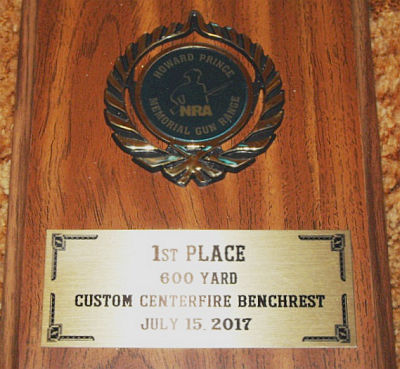
My next use of this scope was at our monthly 600-yard match on July 15th. It was a typical mid-July day in north Louisiana — very hot and humid with light switching winds. The mirage was terrible, but I managed to squeak out a victory with a 188/5X score out of 200/20X possible. I shot the Golden Eagle at 40X all day and it performed perfectly. No one could see bullet holes today, even with the high powered premium spotting scopes. This is a quality scope and it may be a “lucky” scope in that I did not expect a win with a 6mm Dasher barrel with 2500 or more rounds through it.
Point of Aim Test with Hood Scope Checker
I also tested the Golden Eagle for holding Point of Aim (POA). For this procedure, I used the Hood scope checker (loaned to me by Bart Sauter). To use this, one mounts two scopes side by side. Ideally one scope has proven its ability to hold POA. Here I used a Valdada 36X BR model as my control scope. It has proven over an 8-year period of time to hold its point of aim. I mounted these scopes on my BAT/Leonard 6mm PPC and adjusted each to the same point on the target.
As one can see in the above picture, these are big scopes. After the first shot, I noticed that the reticle dot on the Vortex seemed to be about 1/8th MOA to the right of its original position. I stopped to check for ring slippage (which I had experienced in prior tests). There was no apparent slippage, so I checked the parallax and found that there was some parallax correction needed. This was probably the source of the apparent shift in point of aim, but I cannot be sure of that. I fired three more shots (checking after each) and found no shift.
After testing for POA shift, I fired the remaining rounds using different aiming points. I fired 5 rounds (upper left) using the Vortex and 3 rounds to the right of those using the Valdada scope.
CONCLUSION — A Very Fine Optic at a Reasonable Price
While testing this Vortex Golden Eagle scope, I developed a real fondness for it. I appreciate its great optics, eye relief and crispness of adjustments. If I thought that this scope did not hold POA, I would use my old Valdada in the 600-yard matches in which I participate. Further testing has shown no tendency to shift point of aim.
If I am allowed to keep this scope until the fall, I am sure that I will be able to see 6mm bullet holes in the white at 600 yards. Seeing those 6mm holes is very difficult, but that is my dream for a premium high-powered scope. During the summer months in north Louisiana, the air is much too “dirty” to spot small holes at 600 yards. By October, there should be some conditions in which one can use the premium optics to see bullet holes in the white at 600.
In summary, let me say that this scope has become one of my all-time favorites because of its bright, clear images and its great reliability. If you are looking for a great long-range scope that is reasonable in cost, try the Golden Eagle from Vortex.– James Mock
Photo Credits Laura Perry(top) and Kelly McMillan (bottom)
The 2017 F-Class World Championships wrapped up August 17 with the final day of Team competition. Over the past two days, 8-shooter squads competed in the major international challenge match while 4-shooter teams vied for honor in the Rutland match. Team USA F-TR stole the show with a stirring come-from-behind victory over a very strong Australia F-TR squad. Not to be denied, Aussie F-Open shooters countered America’s F-TR success with a solid win for Australia in the 8-shooter F-Open match. It was Deja Vu… this result was a replay of the 2013 Worlds, where Team USA won the F-TR Team Title, while Team Australia won F-Open.
F-TR World Champions: Team USA, Richardson Trophy — Score: 3400-264V
PERRY, LAURA, AL — 419v31
DROELLE, JOHN, MI — 418v27
BARNHART, ALAN, MI — 433v36
HOGG, TRACY, NC — 424v31
KLEMM, IAN, WI — 426v39
RODGERS, DEREK, NM — 435v39
RORER, JEFFREY, NC — 429v35
POHLABEL, DANIEL, OH — 416v26
GROSS, RAYMOND, MI
HARDIN, CARLTON, GA
PHILLIPS, PAUL, MI
LENTZ, DANIEL, WI
LITZ, BRYAN, MI
FULMER, SCOTT, NY
REEVE, KENT, NC
BOYER, DOUGLAS, MI
F-Open World Champions: Team Australia, Farquharson Trophy — Score: 3511-342V
DAVIES, ROD — 441v45
CARTER, PETER — 437v37
LARSEN, PETER — 442v38
LOBERT, MARTY — 437v43
POHL, ADAM — 440v48
BRAUND, STUART — 431v39
BUNYAN, BRETT — 440v40
NUGENT, TIM — 443v52
MCGOWAN, CRAIG
BRAUND, RICHARD
WAITES, MICHAEL
LAZARUS, STEVE
REID, JOSH
FERRARA, BEN
TILLACK, LOWELL
DOBSON, DAVID
Team USA — Three-time World Champions deliver a come-from-behind win at the 900 meter line.
Along with winning F-Open, the Aussies did well in the 8-man F-TR competition, finishing second overall with a score of 3394-237V, six points behind Team USA F-TR (3400-264V). Third in F-TR was Team South Africa, with 3376-250V.
Team Canada (3506-346V) finished second in F-Open, while Team USA (F-Open) finished third with the interesting score of 3500-350V (that’s not a misprint). We believe Calvin Waldner of Canada had the top individual F-Open score for the match — 444-51V.
The F-TR Team Battle — It Paid to Wait
The top two F-TR squads, Team USA and Team Australia, followed very different strategies. The Australians got off to a quick start, while the Americans waited… and waited … and waited. Being patient and waiting for more readable and stable wind conditions proved a winning strategy for the Yanks who overcame a 9-point deficit to finish with a six-point margin as time closed down in the firing period.
Team USA Captain Ray Gross reports: “The match came down to the last yard line. The Australians were up 11 points to start the day and the Canadians were 6 points behind. We made up 2 points at 700m and shot even with the Australians at 800m, leaving us 9 points down going into the final 900m stage.
The Aussies chose to start shooting right away in what looked liked easy conditions and we waited, hoping for better. While we waited the team stayed focused and ready. Luck was on our side, it calmed down and the shooters and coaches performed flawlessly, making up the nine points and finally pulling ahead in the last few minutes of the match.
We were the last team on the line shooting and everyone was behind us watching. After two days of very close competition, the match was not decided until our last two shooters. Our last shooter started with only 12 minutes left in the match and he finished his string of 15 shots in about five minutes. He only dropped two points giving us a six point victory.
We were so focused on delivering our best performance that we weren’t sure how the other teams had finished. After the last shot the Australian captain came over and congratulated me. They had been watching our score after they had finished and knew that we had won the match. Our gritty determination had paid off and it had been one of the most exciting matches that I’ve ever been a part of. Everyone on the team should be proud that they did not let our slim chances discourage them going into that last yard line. They stayed focused and each delivered a top performance.”
American F-Open Squads Dominate 4-Shooter Rutland Match
In the F-Open Rutland competition for 4-shooter teams, American squads dominated, taking the top 4 places. Team USA Blue (1758-177V) won the Rutland title, edging Spindle Shooters by a slim one-point margin. In third place was Team USA Red followed by the Texas State Rifle Association team.
In F-TR Rutland competition, Team “Da Bulls” secured a very convincing win. Da Bulls’ 1709-131V score was a full 14 points ahead of Team KP Ballistics. This was sort of an American victory… though Da Bulls did have one Canadian “ringer” on the squad, Stephen Ireland of Toronto. Runner-up KP Ballistics was just the opposite — KP had all Canadian members except one Yank, Wade Fillingame of New Hampshire.
Above Team Da Bulls member James Crofts waives “good-bye” from the Connaught Ranges in Ottawa, Ontario, Canada. The next F-Class World Championships will be held in South Africa in 2021. ICFRA Web Page for 2021 FCWC.
CLICK HERE to see full-screen version of Wind Plot.
The Battle of Nations begins. Today is Day 1 of international team competition at the 2017 F-Class World Championships (FCWC) in Ottawa, ON, Canada. Talented teams, in their nation’s colors, will be competing for glory and national pride.
Team shooting is very different than individual competition. Typically a team coach makes the wind calls for the shooters. In some cases (where the rules allow), the wind coach even dials elevation and windage changes for the active shooter. For the wind coach to do his job effectively, he must follow the changes in the wind and determine what the correct wind call should have been for each shot. (In other words — what was the “right call”)
Past F-TR USA Nat’l Champ Bryan Litz was wind coach for the winning 4-man LUM F-TR Team at the 2017 Canadian F-Class Championships, which preceded the FCWC Worlds. Here Bryan explains how he uses a Wind Plot to make better wind calls, helping his team-mates maximize their scores.
Wind Plot Methodology by Bryan Litz
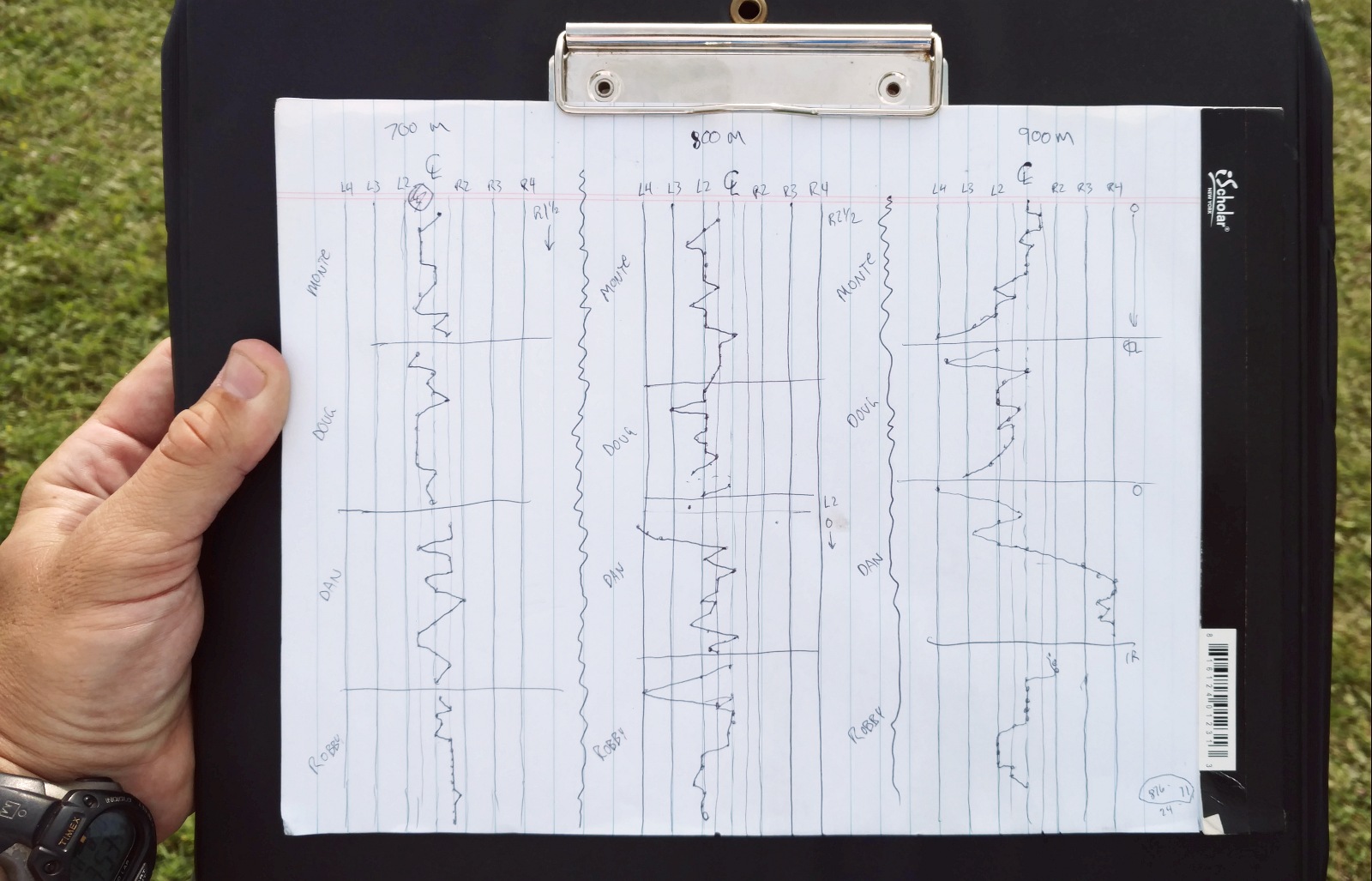
The wind plot I use is a running history of what the correct wind call was for every shot fired. The more you shoot, the more history you have in a condition, and I find that very useful information. This kind of plot IS NOT showing where the bullet hit, and is NOT showing what you held. It’s showing what you should have held to center each shot. IMO, this is the most valuable information to have when guessing where to hold next for each shot. Here are some key points:
1. I always look for blocks of stable conditions to shoot in and wait out the rest.
2. If the wind plot shows drastic changes, either I’m not picking the right time to shoot or it’s just a really unstable wind condition.
3. When you see many shots using the same hold (e.g. Robby’s 700m and 900m strings on plot), it can indicate very fast shooting and fast pit service.
Q. What are the numbers and Markings on this Wind Plot?
Litz: The wind plot represents the rings on the target. Left 2 for example, is the 5 line on the international target, while Left 2 is the 10 line on the USA target. F-Class shooters and coaches talk about wind holds in relation to these rings. A Left 2 hold isn’t left 2 MOA or 2 MILS, it’s the second ring from center. The vertical lines on the plot represent the rings going out from center, 4 or 5 in each direction. A left or right 5 hold is edge of black on the int’l target.
Q: What Does this Specific Plot Reveal?
Litz: Looking at the plot, from left to right is 700m, 800m, and 900m that we shot progressively through the day. Top to bottom shows each shooter in sequence (shooters names are shown by their blocks). To the right I note what was on the gun for that shooter, and note when it changes. Often times we run the same wind on the gun for several shooters but if it changes, I note what the new windage is and continue on. For example if we’re settled into a condition where we’re shooting Vs with a right 3 hold, I might adjust the scope 1 MOA right because a right 3 hold is equal to 1 MOA. So we can move the scope and start shooting with a center hold.
Q. Are you Plotting Where the Bullet Hits?
Litz: Not exactly. This kind of plot IS NOT specifically showing where the bullet hit, and IS NOT showing what the shooter held. It’s showing what the shooter should have held to center each shot. IMO, this is the most valuable information to have when guessing where to hold next for each shot.
On each shot, the shooter or coach takes a guess about where to hold, and fires the shot. If the bullet hits the center, you plot the point right where you held because it was the correct hold. However, if you miss the call, you plot what hold was required to put that shot in the center. For example if you shoot a right 3 and hit where you held, the correct call would have been “center”. In this way, you’re building a history of what you should have done, which may or may not be what you actually did. This shows you the trends, and brackets which can be used to make future decisions.
Q: Is this Type of Wind Plot Something New?
Litz: I didn’t invent this method, it’s been around a long time. Vertical can be plotted the same way. In team matches, we have a plotter who is advising on elevation trends and suggesting corrections. But, as wind coach, my job is the horizontal so I only keep the wind plot. I have learned lots of strategies from my coaches Emil Praslick and Steve Hardin.
There are many ways to plot and many standard work sheets for this. They’re all tools and the key is to find something that works for you in different situations. I don’t keep a plot when I am personally behind the trigger string firing because I lose more points when I take the time to do it vs. just shooting fast. When pair firing or coaching, I can keep the wind plot without compromising the shooting.
Team Australia used plots and comms linking coaches to help win the 2013 F-Open Team World Championship. We expect other teams will follow suit in Canada in 2017.
Know Your Goal — Keep It Simple
Know your goal of plotting. The simplest plot is where you write the shot number where it hit on a target face. This kind of plotting is useful for evaluating shooter performance because it shows how big the group is (in particular the vertical dispersion). However keeping a plot like this does little to help you figure out the wind. It just shows you what shots you messed up on. It does nothing to help you find the center. [Editor: That’s a whole different matter with many variables.] The wind plot I use is a running history of what the correct wind call was for every shot fired. The more you shoot, the more history you have in a condition, and I find that very useful information.
The F-Class World Championships (FCWC) commence today at the Connaught Ranges outside Ottawa, Ontario, Canada. We wish good luck to all the competitors. Based on the conditions at the recent Canadian F-Class National Championships, conditions could be challenging.
F-Class World Championships EVENT SCHEDULE: Friday, August 11 (REST DAY – RANGE CLOSED)
Competitor Check-In for FCWC; Rifle Inspection; International Teams Reception
Saturday, August 12: Opening Ceremonies; ICFRA FCWC (Individual)
Sunday, August 13: ICFRA FCWC (Individual)
Monday, August 14: ICFRA FCWC (Individual); Awards Prize Giving
Tuesday, August 15: TEAM PRACTICE DAY
Wednesday, August 16: ICFRA FCWC (Teams)
Thursday, August 17: ICFRA FCWC (Teams): Awards Prize Giving & Closing Ceremonies
Tips for Success at the F-Class Worlds — #1, Avoid Train Wrecks
As an assist to all the competitors, we’re repeating an article by Bryan Litz, which many have found very helpful — how to avoid “Train Wrecks” at major championships.
When you have a major, critical problem at a shooting match, i.e. a “train wreck”, this can be the end of your weekend. In this article, Ballistics Guru Bryan Litz talks about “train wrecks” — the big disasters (such as equipment failures) that can ruin a whole match. A recent USA F-TR Champion, Bryan illustrates the types of “train wrecks” that commonly befall competitors, and he explains how to avoid these “unmitigated disasters”.
Success in long range competition depends on many things. Those who aspire to be competitive are usually detail-oriented, and focused on all the small things that might give them an edge. Unfortunately it’s common for shooters lose sight of the big picture — missing the forest for the trees, so to speak.
Consistency is one of the universal principles of successful shooting. The tournament champion is the shooter with the highest average performance over several days, often times not winning a single match. While you can win tournaments without an isolated stellar performance, you cannot win tournaments if you have a single train wreck performance. And this is why it’s important for the detail-oriented shooter to keep an eye out for potential “big picture” problems that can derail the train of success!
Train wrecks can be defined differently by shooters of various skill levels and categories. Anything from problems causing a miss, to problems causing a 3/4-MOA shift in wind zero can manifest as a train wreck, depending on the kind of shooting you’re doing.
Below is a list of common Shooting Match Train Wrecks, and suggestions for avoiding them.
1. Cross-Firing. The fastest and most common way to destroy your score (and any hopes of winning a tournament) is to cross-fire. The cure is obviously basic awareness of your target number on each shot, but you can stack the odds in your favor if you’re smart. For sling shooters, establish your Natural Point of Aim (NPA) and monitor that it doesn’t shift during your course of fire. If you’re doing this right, you’ll always come back on your target naturally, without deliberately checking each time. You should be doing this anyway, but avoiding cross-fires is another incentive for monitoring this important fundamental. In F-Class shooting, pay attention to how the rifle recoils, and where the crosshairs settle. If the crosshairs always settle to the right, either make an adjustment to your bipod, hold, or simply make sure to move back each shot. Also consider your scope. Running super high magnification can leave the number board out of the scope’s field view. That can really increase the risk of cross-firing.
2. Equipment Failure. There are a wide variety of equipment failures you may encounter at a match, from loose sight fasteners, to broken bipods, to high-round-count barrels that that suddenly “go south” (just to mention a few possibilities). Mechanical components can and do fail. The best policy is to put some thought into what the critical failure points are, monitor wear of these parts, and have spares ready. This is where an ounce of prevention can prevent a ton of train wreck. On this note, if you like running hot loads, consider whether that extra 20 fps is worth blowing up a bullet (10 points), sticking a bolt (DNF), or worse yet, causing injury to yourself or someone nearby.
3. Scoring/Pit Malfunction. Although not related to your shooting technique, doing things to insure you get at least fair treatment from your scorer and pit puller is a good idea. Try to meet the others on your target so they can associate a face with the shooter for whom they’re pulling. If you learn your scorer is a Democrat, it’s probably best not to tell Obama jokes before you go for record. If your pit puller is elderly, it may be unwise to shoot very rapidly and risk a shot being missed (by the pit worker), or having to call for a mark. Slowing down a second or two between shots might prevent a 5-minute delay and possibly an undeserved miss.
4. Wind Issues. Tricky winds derail many trains. A lot can be written about wind strategies, but here’s a simple tip about how to take the edge off a worse case scenario. You don’t have to start blazing away on the command of “Commence fire”. If the wind is blowing like a bastard when your time starts, just wait! You’re allotted 30 minutes to fire your string in long range slow fire. With average pit service, it might take you 10 minutes if you hustle, less in F-Class. Point being, you have about three times longer than you need. So let everyone else shoot through the storm and look for a window (or windows) of time which are not so adverse. Of course this is a risk, conditions might get worse if you wait. This is where judgment comes in. Just know you have options for managing time and keep an eye on the clock. Saving rounds in a slow fire match is a costly and embarrassing train wreck.
5. Mind Your Physical Health. While traveling for shooting matches, most shooters break their normal patterns of diet, sleep, alcohol consumption, etc. These disruptions to the norm can have detrimental effects on your body and your ability to shoot and even think clearly. If you’re used to an indoor job and eating salads in air-conditioned break rooms and you travel to a week-long rifle match which keeps you on your feet all day in 90-degree heat and high humidity, while eating greasy restaurant food, drinking beer and getting little sleep, then you might as well plan on daily train wrecks. If the match is four hours away, rather than leaving at 3:00 am and drinking five cups of coffee on the morning drive, arrive the night before and get a good night’s sleep.”
Keep focused on the important stuff. You never want to lose sight of the big picture. Keep the important, common sense things in mind as well as the minutia of meplat trimming, weighing powder to the kernel, and cleaning your barrel ’til it’s squeaky clean. Remember, all the little enhancements can’t make up for one big train wreck!
The 2017 Canadian F-Class Championships have concluded. As the event preceded the 2017 F-Class World Championship (in the same venue) by a few days, many of the world’s best F-Class shooters were on hand at the Connaught Ranges outside Ottawa, Ontario. Competition was fierce — as were the winds at times. The challenging conditions gave shooters a good test in preparation for the FCWC which gets underway in earnest on Saturday, August 12, 2017.
Kevin Chou Wins Second Straight F-TR Canadian Title
Canada’s Kevin Chou (Aurora, ON) shot great to win the F-TR match with a strong 426v30 score. This made was two wins in a row for Kevin, who also took the F-TR Title in 2016. Two Yanks completed the podium, with Jeff Rorer (420v25) taking second place, and Robby Burton (418v25) placing third.
Rhys Ireland Wins F-Open Canadian Championship
The F-Open Championship was a tightly-fought match that went down to the wire. Rhys Ireland won the Individual F-Open Championship with a 434v30. Just one point behind at 433v39 was Australia’s Rod Davies. Third, again just one point back, was Canadian Barry Price (433v30).
Team USA (Litz) Wins F-TR Team Championship
American F-TR Teams managed a clean sweep of the top three places in the 4-shooter LUM Team Match. Team USA Litz secured the team victory with a 875v71 score. Finishing second in F-TR was USA Team Swartzkopf (871v74), followed by Team USA Hardin (870v72).
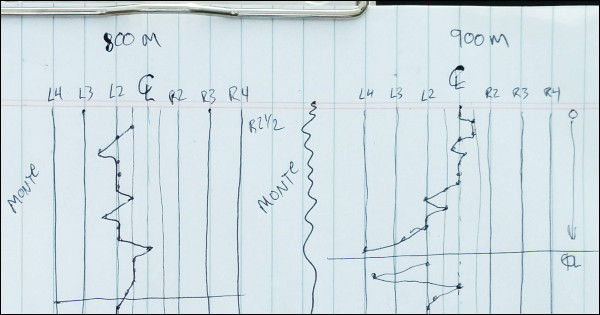
Who can explain the lines and dots on this shot tracking chart used by Bryan Litz?
F-TR Team USA (Litz) members (alphabetically) Douglas Boyer, Robby Burton, Dan Lentz, Monte Milanuk; Bryan Litz (head coach), Stan Pate (asst.)
Team USA (Nancy) Wins F-Open Team Title
The F-Open 4-shooter Team Competition was also dominated by American squads which finished first and second. Winning F-Open Gold, with a score of 888v98, was Team USA (Nancy), coached by Nancy Tompkins, America’s “First Lady of Shooting”. Finishing second was Team USA (Walker) with 887v100, followed by the Canadian F-Open Team at 887v90.
F-Open Team USA (Nancy) was packed with talent. Shooters were: Shiraz Balolia, Ken Dickerman, James Laney, and Pat Scully. Another American deserves mention, John Myers of the Texas F-Open Team. We believe John’s 225v27 was the high score for the team match, and he was the only competitor to shoot “clean”, not dropping a point.
Sebastian Lambang, inventor/builder of SEB Rests, competed in the Canadian Championships. Over half the competitors used SEB rests — Joy-Pods for F-TR and NEOs and MINIs for F-Open.
Conditions were windy and challenging at the 2017 Canadian F-Class Championships. Will the strong winds continue for the F-Class World Championships (FCWC) starting tomorrow, August 12, 2017. Only the wind gods know for sure. Good luck to all the FCWC competitors from all nations!
The movie “The Patriot” gave us the phrase “Aim small, miss small”. While that’s a good mantra, aiming strategies for long-range competition are a bit more complicated, as this article explains…
The The F-Class World Championships (FCWC) in Canada are just one week away. This August 11-17, the world’s top F-Class shooters will gather at the Connaught Ranges outside Ottawa, Ontario. Here are some tips that can help F-TR and F-Open shooters aim more precisely, and achieve higher scores. F-Class ace Monte Milanuk reviews reticle choices and strategies for holding off.
In our Shooters Forum, one newcomer wanted some advice on selecting a reticle for F-Class optics. He wondered about the advantage of Front (first) Focal Plane (FFP) vs. Second Focal Plane scopes and also wondered if one type of reticle was better for “holding off” than others.
In responding to this question, Forum regular Monte Milanuk provided an excellent summary of aiming methods used in F-Class. For anyone shooting score targets, Monte’s post is worth reading:
Aiming Methods for F-Class (and Long-Range) Shooting — by Monte Milanuk
F-Class is a known-distance event, with targets of known dimensions that have markings (rings) of known sizes. Any ‘holding off’ can be done using the target face itself. Most ‘benefits’ of Front (first) focal plain (FFP) optics are null and void here — they work great on two-way ranges where ‘minute of man’ is the defining criteria — but how many FFP scopes do you know of in the 30-40X magnification range? Very, very few, because what people who buy high-magnification scopes want is something that allows them to hold finer on the target, and see more detail of the target, not something where the reticle covers the same amount of real estate and appears ‘coarser’ in view against the target, while getting almost too fine to see at lower powers.
Whether a person clicks or holds off is largely personal preference. Some people might decline to adjust their scope as long as they can hold off somewhere on the target. Some of that may stem from the unfortunate effect of scopes being mechanical objects which sometimes don’t work entirely as advertised (i.e. one or two clicks being more or less than anticipated). Me personally, if I get outside 1-1.5 MOA from center, I usually correct accordingly. I also shoot on a range where wind corrections are often in revolutions, not clicks or minutes, between shots.
Some shooters do a modified form of ‘chase the spotter’ — i.e. Take a swag at the wind, dial it on, aim center and shoot. Spotter comes up mid-ring 10 at 4 o’clock… so for the next shot aim mid-ring 10 at 10 o’clock and shoot. This should come up a center X (in theory). Adjust process as necessary to take into account for varying wind speeds and direction.
Others use a plot sheet that is a scaled representation of the target face, complete with a grid overlaid on it that matches the increments of their optics — usually in MOA. Take your Swag at the wind, dial it on, hold center and shoot. Shot comes up a 10 o’clock ‘8’… plot the shot on the sheet, look at the grid and take your corrections from that and dial the scope accordingly. This process should put you in the center (or pretty close), assuming that you didn’t completely ignore the wind in the mean time. Once in the center, hold off and shoot and plot, and if you see a ‘group’ forming (say low right in the 10 ring) either continue to hold high and left or apply the needed corrections to bring your group into the x-ring.
Just holding is generally faster, and allows the shooter to shoot fast and (hopefully) stay ahead of the wind. Plotting is more methodical and may save your bacon if the wind completely changes on you… plotting provides a good reference for dialing back the other way while staying in the middle of the target. — YMMV, Monte
The F-Class World Championships are coming up next month in Canada, August 11-17. The world’s top F-TR and F-Open shooters will compete at the Connaught Ranges outside Ottawa, Ontario, Canada. There will be a wide variety of high-end equipment on display. This article covers some of the hardware choices made by the U.S. F-Open team.
Are you trying to decide what components to use for your next F-Class build, or are you looking to upgrade your current rig? Wonder what the “big dogs” in the sport have selected as their hardware? Here’s what United States F-Open team members were using (as of 2016). The most popular chambering is the .284 Winchester, followed by the 7mm Walker (a 40° .284 Winchester Improved). Kelbly and BAT actions were the most popular (but many guys are using Bordens in their latest builds). Nearly all team members are using cut-rifled barrels. A wide variety of stocks are used, with PR&T holding a slight edge over second-place McMillan. NOTE: This survey was taken last year.
Click Image Below for Larger Version:
F-0pen competitor Brett Solomon will be using this stunning Speedy-Built .284 Win. It features a “Spear of Destiny” Flame Maple stock milled by Will McCloskey, with a Melonited BAT action, and a 32″ 7mm Bartlein barrel with Stewart Barrel Tuner.
F-Class World Championships Schedule
Canadian F-Class National Championship
Monday, Aug 7: Competitor Check-In for FCNC (Inspections and Squadded Practice)
Tuesday, Aug 8: Canadian F-Class Nationals
Wednesday, Aug 9: Canadian F-Class Nationals
Thursday, Aug 10: Canadian F-Class Nationals Finals and Awards Prize Giving
F-Class World Championships
Friday, Aug 11 (REST DAY – RANGE CLOSED)
Competitor Check-In for FCWC; Rifle Inspection; International Teams Reception
Saturday, Aug 12: Opening Ceremonies; ICFRA FCWC (Individual)
Sunday, Aug 13: ICFRA FCWC (Individual)
Monday, Aug 14: ICFRA FCWC (Individual); Awards Prize Giving
Tuesday, Aug 15: TEAM PRACTICE DAY
Wednesday, Aug 16: ICFRA FCWC (Teams)
Thursday, Aug 17: ICFRA FCWC (Teams): Awards Prize Giving & Closing Ceremonies
There are hundreds of cartridge types capable of winning in F-Open. For F-TR you can shoot either the .223 Rem or .308 Win, but you have many load options. This article will focus on proven choices, currently used by the top F-Class shooters in the world. Our discussion will analyze cartridge selection based on the four different F-Class sub-disciplines: Open Mid-Range, Open Long-Range, F-TR Mid-Range, and F-TR Long Range.
Click image to view full-screen photo.
Mid-Range F-Open Cartridges
For starters, a .300 WSM is certainly capable of winning mid-range matches but it is not ideal. So what is ideal, and why? F-Class Mid-Range matches usually are usually shot at 300, 500, or 600 yards — or all three. At those distances the 6mm and 6.5mm cartridges rule. In moderate conditions, the 6mm Dasher is unbeatable. Its low recoil along with its super grouping ability and good ballistics make it my number one choice for Mid-Range.
Best bullets for the 6mm Dasher are: Vapor Trail 103gr, Berger 105 Hybrid, 108 BT, and 105 VLD (hunting). Best powders are: Varget, H4895, and Reloder 15.
Choices for Mid-Range in Tougher Conditions:
We all know that conditions are not always “moderate” that’s why something a little bit bigger will save you a “Nine” or two. The 6.5X47 Lapua was designed for 300-meter competition, but as soon as it was released, it was adopted by F-Class, benchrest, and tactical shooters. It offers great ballistics with very low recoil and big “accuracy window”. Lapua makes great brass for it (no surprise there) and Berger makes great bullets: 130gr VLD, 140gr VLD, 140gr Hybrids. Best powders in most barrels are Varget and H4350, I don’t use double-based powders such as Reloder 17 and the Vihtavuori N500 series because of their unpredictable performance day to day (greater temp sensitivity).
The 6.5X47 Lapua necked down to 6mm is also a great option for mid range matches. I was able to easily get 3200 fps with 105 hybrids and H4350.
Choice for Long-Range F-Open Competition
In Long-Range F-Open Class (out to 1000 yards), the big, high-BC bullets rule. If I had to pick one cartridge for F-Class (both mid- and long-range) I would pick the .284 Winchester or one of its variants. The .284 Win is currently dominating in F-Open competition. It offers great barrel life, it is super-easy to tune and its recoil is very manageable. The best bullets for it by far (in my opinion), are the Berger 180 Hybrids. But Sierra’s new 183gr MK bullet (with factory-uniformed meplats) seems to perform very well as does the Berger 180 VLD. Best powders for the .284 Win are H4350 and H4831SC.
Long-Range Only F-Open Cartridge
As much as I like the .284 Win, for long-range competitions I like the .300 WSM even more. If you look at a .300 WSM and a 6mm Dasher side by side, they appear almost identical in geometry — the .300 WSM looks like an “super-sized” Dasher. Both cartridges are currently the “darlings” of long-range benchrest due to their extraordinary grouping ability and huge “node’’ windows. Big accuracy windows allow loads to perform well in different conditions and geographical locations. That’s obviously very important if you travel to compete. The .300 WSM loaded with Berger 215gr or 230gr Hybrids is very tough to beat at long range, and it is currently my number one choice.
The 7mm RSAUM is another outstanding long-range round. It resembles a 6BR on steroids and it is almost as easy to tune. Best bullets for it are Berger 180gr Hybrids, 195gr EOLs, and Sierra’s 183gr MatchKing. Best powders for the 7mm RSAUM are: H4350, H4831SC, and VV N160.
Top Caliber/Bullet Combos for F-TR
In F-TR competition, the choice is clear — a .308 Win throated for Berger 185gr BTLRs and 200gr Hybrids will win in mid-range AND long-range comps. Many championships have been won, and many records set with those two bullets in the .308 Win. To quote Danny Biggs (a two times FTR National Champion) “The 185 BTLR is the best bullet for .308 Win ever made”.
The Berger 215gr Hybrids have been used to win many competitions including recently the 2015 F-Class Nationals. Bryan Litz won both the Mid-Range and Long-Range 2015 Championships using 215s. Bryan’s rifle is shown below:
I recommend chambers throated for the 185/200 grain projectiles over the 215/230 grain bullets. The reason is that if you have your barrel throated out for the 215s or the 230s, you could have a “slow” barrel and max out on pressure before the desired velocity is reached. Optimum freebore for the 230s is too long for the 185/200s, so you would be limited to using only 215/230gr bullets in that barrel.Furthermore, the recoil increase with heavier bullets is substantial, causing the rifle to be more difficult to shoot.
.223 Rem — Not A Competitive Option
I would stay away from the .223 Remington. On paper the 90gr VLD will shoot inside most .308 Win loads even at a 1000 yards. But in reality, on average, the .223 Rem, regardless of what powder/bullet combo is used, cannot compete with the .308 Win. [Editor: The equipment lists at major F-TR matches will confirm Kovan’s conclusion here.]
Conclusion (and Other Options)
This article covers only the (currently) most popular cartridge/bullet combos for F-Class (F-Open and F-TR). As I said in the beginning, many cartridge types are capable of winning but are not listed due to their low popularity, case design, or lack of quality components. All of the above information is based on my personal experience and it is meant to help new shooters choose the right cartridges for F-Class matches. Thanks for reading and good luck — Emil Kovan
Emil Kovan Competition History:
– 2014 F-Class Open National Champion
– 2015 F-Class Open National Championship, Silver Medal
– F-Class Open National Championship Teams, 2015, 2014, 2013, Shooting Team Member
– Over 15 wins in Regional and State Championships in Palma, F-TR, F-Open
In response to many requests from Forum members who shoot F-Class, we are republishing this informative interview, which first appeared last summer. You’ll find many “solid good” tips that can help any long-range rifle competitor.
Dan Pohlabel is a member of the all-conquering Team Sinclair F-TR squad. This talented group of shooters hasn’t lost a team match in years. What’s the secret of Team Sinclair’s success? Well there is not one single factor. These guys have very accurate rifles, they work hard on load development, and they practice in all conditions. In this interview, Dan Pohlabel talks about F-TR competition, reviewing the hardware (and skill set) it takes to win. He offers some great tips on developing loads. You’ll find a longer version of this interview on the Sinclair Int’l website. CLICK HERE to Read Full Interview.
Q: What do you find most challenging in F-TR Shooting?
It has to be keeping up with the competition, our sport has grown so quickly with new talented shooters. Staying at the top requires having a laser of a rifle, perfect loads, near perfect wind reading, and, of course, breaking good shots.
Q: How can novice shooters improve their game?
Seek out the local F-TR shooters and go to matches with them, listen and learn. Attend team matches and offer to score for one of the teams. As a scorer, you will sit close enough to hear the coach make wind calls and see the results on the target. Through the spotting scope you will see changes in mirage and it’s the quickest way to learn the basics of wind reading. Choosing and buying equipment is relatively easy, learning to read the wind is a journey.
Q: What’s in your range bag for match days?
Rear bag, towel, shooting glasses, canned air, ear protection, data book, pen, rifle rain cover, hat, rifle tools, timer, ammo, and bug spray.
Q: What specialized gear can you not live without?
1. A good set of elbow pads. It’s hard to keep concentrating on shooting when your elbows are rubbed raw from days of competing on them.
2. Good bug spray. We shoot from the ground but our shooting mats aren’t that big. It’s hard to concentrate with bugs crawling or chewing on you.
Q: Load Development — How do you work up a load?
First, I call Derek Rodgers and get his load data, he is the best load development shooter I know! Otherwise, here is the procedure I recommend. Measure throat length with bullet of your choice, to determine how much room is left in the case. The above measurement determines what powders you can use. We use only Hodgdon Extreme powders. Shoot a ladder test, five rounds each in 0.2 grain increments, to find the accuracy node for that bullet/powder combination. Take the best two loads and do a jump test with five rounds each, test at .005″, .025″, .060″ jump. One of these groups will be significantly better than the rest, now you can tweak that measurement +/- .002” or .005” to get the best accuracy.
Test at least three different primers to determine which offers a little better ignition for your load, a 5-shot test will usually tell you which is the best. Go back and test the two best combinations in a 10-shot test at least twice, pick a cool overcast day and also a hot sunny day and compare results. Take your final “best load” back and do a “simulated match”, 20 shots, waiting at least 20 seconds between shots. If you like those results it’s probably a reliable and accurate load.
Q: What rear bag do you use?
I use a two-bag system, large bag on bottom with a smaller bag on top. I had the bags made of marine canvas, zippered and filled with plastic beads. I can adjust the amount of fill to make them a perfect height for my shooting position. Teammate Jeff Rorer uses a similar system and mine is nearly a copy of his rear bags.
Q: How often do you practice and how many rounds do you shoot per year?
In good weather I practice a couple times a week at the local range, a couple more dry-firing practices/week at home. I typically shoot between 2,000-2,500 rounds per year.
Q: How do you prepare mentally before a match?
[I do] lots of visualization — run the video in my head of what I expect to see and of my performance. I think about the correct strategy for the conditions, staying disciplined to the strategy.
Q: What do you avoid before a shoot?
No late nights or excessive alcohol. Very little caffeine in the morning. Leave your cell turned off. Avoid emotional people.
Q: What’s your procedure on a Match day?
I arrive early, get squadding card, move gear, watch wind speed/direction, check over rifle and gear, sit and relax, visualize and focus on the most important goal of the day. Most days we shoot three relays of 20 shots. It’s important to eat and hydrate continually all day. My focus and concentration are better when I snack all day with fruit and energy bars, and lots of water. While taking my turn in the pits, I try to relax and only focus on what is ahead of me and [not] what’s already happened.
Q: What is your favorite reloading product?
My favorite reloading product is the Sinclair Premium Neck Turning Tool with Handle, I also use the expander mandrels provided by Sinclair for sizing the brass in preparation for the turning process. Correct and repeatable neck tension begins with turning necks to a uniform thickness. Sinclair also has mandrels to size the necks after neck turning that accurately size the necks for a specific neck tension.
Q: What is your preferred scope?
The scope I find the most useful is the Nightforce Competition Scope. This scope is very light-weight, has 15-55X magnification, world-class quality glass, 10 MOA per revolution on the turrets, 1/8 moa adjustments. It’s perfect for F-Class competition.
Q: What advice do you have for someone wanting to get into the sport?
Find a local club with some F-TR shooters and ask for their help. Most shooters will be happy to take you with them to a match, listen and learn while you’re there. You may find out it’s not what you thought, or you may be hooked. If you decide to jump in, start with an inexpensive rifle. This sport is expensive and you don’t need a $5000 rifle to learn good wind-reading skills. Start with a used Savage F-TR rifle and learn the basics, shoot for a year at least before making a larger investment. The money you saved buying a used Savage rifle will help pay for your divorce lawyer, LOL.
Q: What training drills do you use?
Dry-firing the rifle at home is a good way to practice when you can’t get to the range and shoot. It allows me to practice set-up, rifle handling, and position. When I can practice at a local range, I also dry-fire between shots to increase the amount of repetitions and increase the time spent in position.
Q: Who has been your biggest influence in shooting?
Eric Bair, 2006 F-Open National Champion helped me get started and gave me great advice. Most of the shooters on Team USA and Team Sinclair help each other, nobody knows all the answers but we share what we have learned. Danny Biggs, 2008 and 2009 F-TR National Champion also helped me when I was struggling to learn some of the ranges. I learned a lot from Danny.




 Competition Test Success — Golden Eagle Delivers a Win





 Train Wrecks (and How to Avoid Them)
 4. Wind Issues. Tricky winds derail many trains. A lot can be written about wind strategies, but here’s a simple tip about how to take the edge off a worse case scenario. You don’t have to start blazing away on the command of “Commence fire”. If the wind is blowing like a bastard when your time starts, just wait! You’re allotted 30 minutes to fire your string in long range slow fire. With average pit service, it might take you 10 minutes if you hustle, less in F-Class. Point being, you have about three times longer than you need. So let everyone else shoot through the storm and look for a window (or windows) of time which are not so adverse. Of course this is a risk, conditions might get worse if you wait. This is where judgment comes in. Just know you have options for managing time and keep an eye on the clock. Saving rounds in a slow fire match is a costly and embarrassing train wreck.


 F-Class is a known-distance event, with targets of known dimensions that have markings (rings) of known sizes. Any ‘holding off’ can be done using the target face itself. Most ‘benefits’ of Front (first) focal plain (FFP) optics are null and void here — they work great on two-way ranges where ‘minute of man’ is the defining criteria — but how many FFP scopes do you know of in the 30-40X magnification range? Very, very few, because what people who buy high-magnification scopes want is something that allows them to hold finer on the target, and see more detail of the target, not something where the reticle covers the same amount of real estate and appears ‘coarser’ in view against the target, while getting almost too fine to see at lower powers.
 Others use a


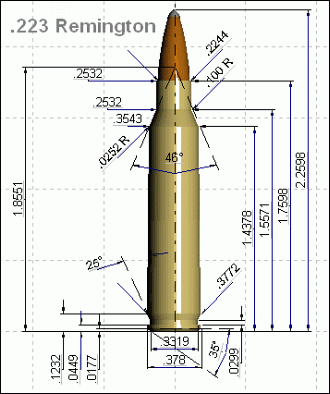 .223 Rem — Not A Competitive Option
 Emil Kovan Competition History:


