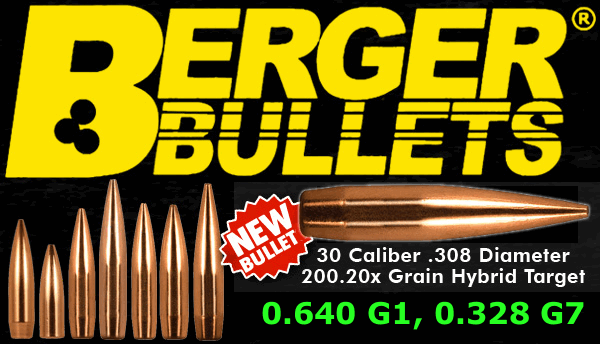
Berger Bullets’ much-awaited 200.20X bullet is now available at Midsouth Shooters Supply for $54.65 per 100*. That’s not inexpensive, but this new design could well prove to be the “bullet to beat” for F-TR competition with the .308 Win cartridge. With a high Ballistic Coefficient (0.640 G1, 0.328 G7), the new 200.20X Hybrid Target projectile (Part #30417) should have less wind drift than other .30-caliber bullets in its weight range. The new 200.20X is even more slippery than Berger’s own older 200gr Hybrid (Part #30427), which has a 0.316 G7 BC. The 200.20X bullet has a shorter bearing surface than Berger’s 200gr Hybrid, which should allow higher velocities, and (perhaps) enhanced barrel life. The shorter bearing surface also makes this bullet easy to load and shoot in standard chambers, which means you don’t need a special long-throated reamer to make it work.
The new 200.20X has a 0.328 G7 BC compared to 0.316 G7 for the older 200 grain .30 caliber Hybrid. That’s a significant, 4% reduction in drag. Recommended twist for the new bullet is 1:10″, same as with the earlier 200-grainer.
Tested and Endorsed by U.S. Rifle Team (F-TR)
Developed with extensive testing by U.S. Rifle Team members, Berger’s new 200.20X bullet is optimized for F-TR competition with the .308 Win cartridge. Compared to the standard 200 grain Hybrid Target, the 200.20X has a longer boat tail, longer nose, and a shorter bearing surface. The longer nose and tail of the 200.20X allow the bullet to fly with less drag and a higher BC, which means fewer points lost to wind. Like other Berger Hybrid designs, this bullet is more “forgiving” about seating depths that pure VLD designs. Shooters should find that the 200.20X works well at various OALs, both “jumped” and seated into the lands. Bryan Litz recommends starting with this bullet .020 or more off the lands. When the bullet is jumped a bit, the accuracy should hold pretty well even as the throat moves out.
After extensive field testing at 600-1000 yards, the U.S. Rifle Team (F-TR) has named the Berger 200.20X as the Team’s official bullet of choice. Shown above are Dan Pohlabel and Bill Litz (shooter).
*Grafs.com ($52.99/100) and PrecisionReloading.com ($53.99/100) will also sell this new bullet, but both these vendors are currently awaiting delivery. We’re told that supplies should arrive soon.
It’s great to see two important businessmen give back to the shooting sports. Kelly McMillan and Jim Borden are working together on a project — creating an F-Class Open rifle that can be loaned out to young shooters to help them get started with the sport. Great idea — we need to get more young folks involved in precision shooting. In F-Class (as well as benchrest) it seems we have an “aging population”. Engaging the next generation of shooters is vitally important.
“Big shout out to Jim Borden. He heard I want to build a mid-range/entry level F-Class rifle to be loaned out to new junior shooters interested in finding out whether they like competing in F-Class Open. He contacted me a couple of weeks ago and said he would like to be involved in this project and wanted to send an action on which to build this rifle. Oh boy, it has arrived. Borden’s [operation] has always been synonymous with quality firearms and components but this action is an example of quality craftsmanship in every aspect. Thanks Jim for doing what you do. Hope I can do this thing justice.”
We’d like to see the looks on the faces of the juniors who’ll get to shoot this new rifle Kelly will be building. That’s like a Driver Training student getting to pilot a Ferrari. When this Editor got started in shooting, it was with very well-worn, hand-me-down 22 LRs at a local Boy Scout summer camp. We think it’s great that juniors will be able to sample something built with all-top-quality components.
Every Friday at 11:00 am, Kelly McMillan hosts the Talking Stock Radio Show on the Voice America Network. This week’s show features guest Robbie Barrkman, founder of The Robar Companies and CTI (Coating Technologies Inc.). If you have used any firearm product coated in NP3, you have Robbie to thank for it. Kelly will also interview Extreme Long Range (ELR) shooter Randy Powell from Thunder Ammo & Arms in Oklahoma.
The 2017 Berger Southwest Nationals (SWN) are now history. This was a great match, with extremely close competition, and record-setting scores. For the first few days, conditions were very mild. That allowed the “top guns” to shoot “cleans” and even set a few new National records. In individual competition, there were familiar faces among the Top Ten, but also some rising stars. In the F-Open and Sling team events, two new squads topped some of the experienced “all-star” teams. Overall it was a great match — one of the most tightly contested ever. Even with 400 competitors, everything ran smoothly. For those who attended the 2017 Berger SW Nationals, this has been a truly memorable week at Ben Avery. F-Open and F-TR Final Results Posted HERE.
This is our final Berger SW Nationals video for 2017, with interviews with the three class winners: John Whidden (Sling), David Gosnell (F-Open), Donald Erpenbach (F-TR).
Top Five Competitors in Each Class
SLING
John Whidden, 1248-84X
Adrian Harris, 1243-74X
Allen Thomas, 1242-65X
Justin Skaret, 1242-59X
Erik Rhode, 1241-59X
F-OPEN
David Gosnell, 1247-84X
Jay Christopherson, 1246-74X
Keith Glasscock, 1245-79X
Pat Scully, 1243-71X
Dan Bramley, 1243-70X
F-TR
Donald Erpenbach, 1230-53X
James Crofts, 1225-43X
Alan Barnhart, 1224-32X
Ian Klemm, 1222-55X
Bryan Litz, 1222-49X
Bryan Litz congratulates Sling winner John Whidden. John is reigning National Long Range Rifle Champion.
Below are SWN F-Open Champion David Gosnell (left) and F-TR Winner Donald Erpenbach (right).
Record-Setting Performances in 2017
This year Ben Avery conditions were very good — calm mornings, and little wind in the afternoons for the first three days. With the very calm Day 1-3 conditions, we witnessed some spectacular individual and team performances. Lester Bruno shot a brilliant 200-23X at 600 Yards, setting a new National record. Ian Klemm set a new 60-shot, 600-yard National record of 599-38X. The Cluster Ducks set a new National F-Open Team Record for 800/900/1000 yards with their 1789-100X Score. And the talented North-by-Southwest F-TR squad set both a National Record and an overall SWN match record.
The North-by-Southwest team won the 2017 SWN F-TR team event in fine fashion, setting new National and range records in the process.
And here is Team Longshots, winner of the F-Open Team Title. Individual F-Open Champ David Gosnell is at far right. The winning Sling Team was Scotland Thistle.
Forum Admin Finishes a Very Close Second in F-Open
Hats off to AccurateShooter.com’s very own Systems Admin, Jay Christopherson. A talented tech expert, Jay runs our web servers and manages our Forum software. His skills and dedication keep the Forum running smoothly, even as we approach 35,000 members. Jay shot a brilliant match at Ben Avery this week, finishing second in F-Open, just one point behind F-Open winner David Gosnell. We’re proud of Jay, and we want to recognize his achievement. It’s interesting to note that Jay shot the entire match with the new SEB Mini rest, and he was using a Vortex 15-60x52mm Golden Eagle scope. Here’s a short video of Jay shooting his .284 Win rifle on Saturday.
The show’s over — it’s time to pack up the gear and head on home. We’re already looking forward to the 2018 Berger SWN. See you next year!
Big News for Berger Bullets
Big news in the Industry is that Berger Bullets is becoming part of the Nammo Group, parent of Lapua, Vihtavuori, SK and other companies. This major acquisition will combine Nammo’s resources and advanced engineering with Berger’s match-winning bullet designs and strong focus on competition. Yes, you can expect to see factory-loaded ammunition with Berger projectiles and premium Lapua brass. To learn more about the big Berger/Nammo deal, watch this interview with Berger President Erik Stecker.
Eric Stecker, Berger’s President, says the exact timing of the move has not yet been set, nor has the location been chosen. Arizona is high on the list of potential sites, but Berger is considering other states as well. Once the new factory location is determined, Eric says he expects the move to be completed “by December 2018 at the latest”.
We saw a change in weather on Saturday. It dawned warm and relatively calm, but the winds picked up in the afternoon as clouds rolled in. There wasn’t any rain though, and for shooters who were sunburned after many days in the Arizona sunshine, the overcast was a bit of a relief. On Saturday, Ben Avery hosted both individual and team matches. All three classes (Sling, F-Open, F-TR) shot two 1000-yard individual matches. This was followed by 4-person Team Matches at 1K. Here are the top five performers in Saturday’s individual matches:
Top Five Competitors in Each Class
SLING
Kevan Hoffarth (P), 400-19X
Jerry Iliff (A), 400-18X
John Whidden (A), 399-23X
Peter Church (A), 399-22X
Gary Rasmussen (A), 399-16X
F-OPEN
Dan Bramley, 399-28X
Robert Hoppe, 399-27X
Pat Scully, 399-24X
Erik Cortina, 399-22X
John Meyers, 399-20X
F-TR
Ian Klemm, 394-16X
Bryan Litz, 393-16X
Nancy Tompkins, 392-19X
Peter Ricci 392-13X
Alan Barnhart, 392-9X
In a great individual performance, Kevan Hoffarth, shooting a Palma Rifle, shot clean to beat ALL sling shooters, including those in the “Any Rifle” sub-class. In fact, “Any” shooters took the next four sling places. In the F-Open Division, it was a very tight race, decided by X-Count for the top five places, with Dan Bramley edging Robert Hoppe for the win by one X.
Watch Highlights of Day 4 at the Berger SW Nationals:
What the Berger SW Nationals is All About
When folks usually talk about shooting matches they focus on the obvious — scores and hardware. But the Berger Southwest Nationals (SWN) is about much more than putting holes in paper with bangsticks. We’d say this match has become so popular (with 400 entrants) because it offers the whole experience — fun, challenge, a warm-weather escape, and above all, camaraderie.
Some shooters come to Ben Avery for the swag (the prize table is amazing). Others come for the sunshine (think warm 75-85° weather). And even more folks come to try out their shiny new toys and to test their skills against the nation’s best shooters.
But we’d say the number one reason most folks make the pilgrimage to Ben Avery every year is the camaraderie — the chance to connect with friends, rekindling connections that may go back decades. Fundamentally, then, the Berger SWN is about the people. For this Editor, the chance to meet good friends such as John Whidden, Gary Eliseo, Doan Trevor, Nancy Tompkins, Anette Wachter, Shiraz Balolia, Adam Braverman, Jay Christopherson, Erik Cortina, Scott Harris, and so many others, gives me plenty of motivation to make the 7-hour drive from California.
For many of us, this is the only time of the year when we get a chance to meet fellow shooters from distant corners of the USA. And where else will you find a past NRA President (John Sigler) on the firing line, and have a chance to chat with him during a lunch break. The SWN is very special.
The Brain Trust — Experts Galore
The best minds of the shooting world come to Ben Avery every year. Got a question about ballistics? Well, Ballistics Guru Bryan Litz will be happy to answer your questions between relays. Want some expert advice about wind reading? Seek out Mid Tompkins (usually found hanging around the club-house) or Emil Praslick, one of the most knowledgeable wind coaches on the planet (Emil was shooting and coaching this year). And if you have a gunsmithing question, you’ll find some of the top barrel-fitters and stock makers, including Doan Trevor and Gary Eliseo.
Emil Praslick III heading out to the firing line…
Tubegun Chassis-Maker Gary Eliseo was at the match
Compete against the Best
If you want to test your mettle against some of the best shooters in the world, get yourself to Ben Avery in February. Here you can compete, shoulder to shoulder, against the best Sling and F-Class shooters on the planet. Guys like John Whidden (reigning Long Range National Champion) and Kenny Adams (reigning World F-Open Class Champion). If you want to play with the “Big Boys”, Ben Avery is the place. Having said that, novice shooters will enjoy the experience as well, because you’ll find that these top shooters are (almost universally) happy to share their knowledge.
Learn from Top Talents
If you want to improve your game, this is the place. Walk down the firing line and you’ll stand shoulder to shoulder with many national champions. There is no question that you can improve your techniques by watching top shooters, and you can get ideas about hardware by looking at the rigs campaigned by the best. Where else will you find a half-dozen national F-Class champs seated around a table. Or an 11-time National High Power Champion (David Tubb), hanging out at the Lapua trailer in the parking lot.
2015 F-TR National Mid-Range and Long-Range Champion Bryan Litz helps a Junior shooter
Mid Tompkins at Shooters’ Clinic
Gun Gear Candy Store
If you are thinking about upgrading your match rifle, you’ll find plenty of inspiration at Ben Avery. On the firing line you’ll fine the newest actions from Barnard, BAT, and Borden, the latest/greatest optics (see Vortex Golden Eagle below), and the newest most advanced stocks. F-TR guys will find a wide variety of exotic bipods plus the latest generation of sandwich-construction bipod “mats”. (NOTE: These are becoming rigid, elevated platforms with low-friction tops — will the rules be tightened?).
Warm Arizona Weather
When we arrived in Phoenix on Tuesday it was a relatively mild 76°. By Friday it had warmed to a balmy 84°. We didn’t hear any complaints from the Canadians who fled ice and snow to shoot the match. Even while California was getting soaked with rain it was sunny and warm in Arizona. And you can even have a balloon ride right over the Ben Avery range.
Enjoy a Desert Escape
The Ben Avery Shooting Facility is located in a scenic corner of Arizona, north of Phoenix. Get here early in the morning and watch the balloons take off. Head northwest and you can visit the historic town of Prescott. Two hours north is Sedona, famed for its stunning Red Rock scenery. A few hours south you can visit Tombstone and the OK Corral. There’s a lot to see and do in the Phoenix area that makes the trip worthwhile in addition to the gun fun at the range.
Friday at the Ben Avery Range in Phoenix, hundreds of competitors shot the individual Palma Match, a three-yardage (800/900/1000) day-long event. Competition was tough. The first four F-Open competitors didn’t drop a single point, all finishing with 450-point “cleans”. In F-TR it was equally close. Phil Kelley won with 447-23X, but the next three finishers were just one point behind at 446. In the sling division, John Whidden topped a very strong field with his 449-31X score, showing why he is the reigning National Long-Range Champion. But the next four Sling competitors were just one point behind at 448 points.
Top Five Competitors in Each Class
SLING
John Whidden, 449-31X
Anette Wachter, 448-26X
Randy Teissedre, 448-24X
Robert Stekette, 448-23X
Allen Thomas, 448-22X
F-OPEN
David Gosnell, 450-38X
Keith Glasscock, 450-34X
Danny J. Biggs, 450-32X
Jay Christopherson, 450-25X
Gilber Lucero, 449-27X
F-TR
Philip Kelley, 447-23X
Donald Erpenbach, 446-21X
Richard Dixon, 446-20X
Alan Barnhart, 446-16X
Daniel Lentz, 445-16X
Berger SW Nationals DAY THREE Highlights Video:
The match can’t happen without the dedicated folks doing pit duty — it’s all part of the experience.
Aussie Tim Lawrence’s stock was custom-built from Rosewood in New South Wales, Australia.
The state of the art in F-Open rifles is very high indeed. Check out this handsome F-Open rig with a Speedy-designed Shurley Brothers ARK series wood stock.
Four F-Open Competitors All Shot Clean
Remarkably, the four top F-Open Competitors all shot “clean” 450s, not dropping a single point. That’s mighty impressive for a 45-shot match at three yardages. AccurateShooter’s Systems Manager Jay Christopherson, who finished fourth, said: “Shooting clean today doesn’t suck. Shooting clean and still taking 4th place is a little harder to accept. Extremely tough crowd of competitors, as always.”
Checking the wind at the beginning of the day. Dawn at Ben Avery is beautiful. (Photo by Steve Fiorenzo).
Interview with Multi-Time Champions David Tubb and John Whidden
We had a chance to chat with David Tubb and John Whidden. Between the two of them, David and John have won 21 National Rifle Championships. David has 11 National High Power titles plus 6 Long-Range titles. Reigning National Long Range Champion John Whidden holds 4 Long-Range titles, having won his latest LR championship in 2016. David is truly a living legend in the world of competitive shooting and John is one of the best sling shooters in the game today, a man capable of winning any match he enters. In fact he did win Friday’s match in the Sling division, topping the field with a 449-21X.
Berger SW Nationals Gallery of Competitors
At the Berger SW Nationals we have the opportunity to meet old friends from all over the country and make new friends. Here are some folks we saw at yesterday’s match.
Here’s Friday’s Sling Class winner John Whidden (449-31X) buckling up right before his relay.
Noma Mayo, one of our great senior shooters. She’s always smiling and helping others…
Tom Whitaker (left) chats with Emil Praslick III (right), one of the best wind coaches in the world.
Like father, like daughter. This smiling twosome is from Texas. Father David, an Accurateshooter Forum member, tells us: “Claudette turned 15 on the day we drove out, Tuesday, and this is her first Berger SWN match. She and my son Royse (17) have won Texas junior championships, but this match is the largest we’ve attended.”
We caught past F-Open National Champion (and past SWN winner) Larry Bartholome logging his score at the 900-yard line. Larry is one of the greatest F-Open shooters ever. Larry posts in our Forum as “LBart”.
And here’s the man who started it all, Walt Berger himself. Without his dream to build better bullets, and his hard work over many decades, there wouldn’t be this wonderful match each year. The popularity of this event is testimony to Walt’s dedication and passion for the sport. Walt still competes in Benchrest matches.
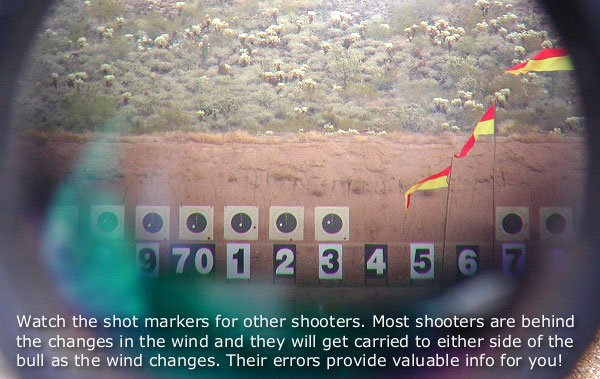
For you guys competing at the Berger SW Nationals this week, we’re repeating an excellent article by Steven Blair on wind reading. Steven, a top F-Class shooter, talks about mirage, topography effects, tail winds, and other subtle factors that can cause frustration for shooters. Steve explains that wind effects can be complex — there’s more going on than just velocity and angle. You need to notice things like berm locations and effects of temp changes over the course of the day.
Wind Reading Tips for Competitive Shooters by Steven Blair, 2012 California State Long Range F-Open Champion
Assess the Terrain and How the Wind Will Interact with It
Before you begin a match, take a few minutes to look around the range at the terrain, any obstructions, range topography (berms and backstop), and trees, buildings or structures that could affect wind flow over the range. Imagine what might happen if the wind was from the left or right, headwind or tailwind. Depending upon the direction, significant effects may be seen on range. A head or tail wind may ripple across the berms, causing elevation changes, both high and low. A tall side berm, like the east side berm at Ben Avery, may cause turbulence when the wind comes from that direction. Blocking features might shield most of the wind but a break along the range can funnel strong gusts through the gap with no other indications. Take a few notes about the effects of different wind directions and refer to them if the prevailing direction changes. (Tip courtesy Tony Robertson.)
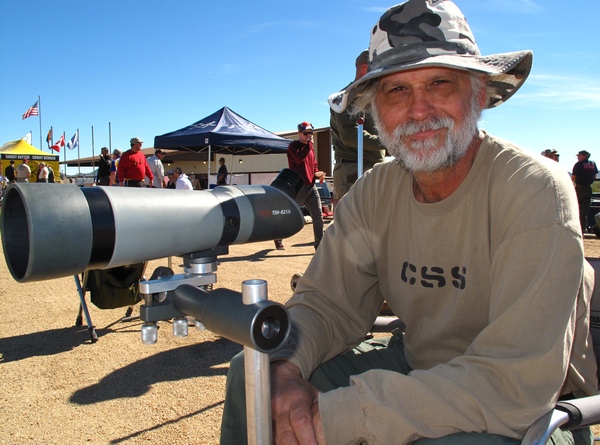
Use a Spotting Scope, Even When Shooting a Scoped Rifle
A good spotting scope can “see” mirage much more clearly than even an expensive rifle scope. Take your spotting scope to the line and position it as sling shooters do, close enough to use without much movement. Focus the scope approximately 1/3 of the way down range or where the most significant wind effects are likely to occur. Take a quick look while waiting for pit service, glance at the flags and compare to your scope sight picture. I often see ambiguous indications at the target through the rifle scope, but see a clear indication of wind direction and speed through the spotting scope at the shorter distance. When shooting the Arizona Palma Championship at Ben Avery last weekend, I was scoring while the wind was coming from the east. Shooters up and down the line were out to the left, losing points. Mirage at the target looked moderate and the flags weren’t indicating strong wind. As I focused the spotting scope back, the mirage suddenly looked like it was flowing twice as fast around 500 yards than it was closer or farther. It wasn’t until I realized that the access road cut through the berm there that I understood what was happening. (Tip courtesy Gary Eliseo.)
Don’t Over-React to Something That May Be an Anomaly
On ranges with sizable berms, a headwind or tailwind can cause significant elevation problems. It is generally not possible to see or predict when this will occur. When the conditions exist that cause elevation changes and other competitors are experiencing the same problem, the best strategy is to ignore it. Certainly, avoid shooting when the head or tail wind is gusting, the same as you would in a crosswind. But, if you react to random, range-induced elevation changes, the only likely result is to make it worse. Whether the problem is caused by range or ammunition, maintain your waterline hold until you have evidence that something has fundamentally changed.
My .284 Shehane will usually require a click or two down during a string as the barrel warms. That is normal and manageable. But, if your shots are just bouncing up and down in the 10 ring, leave it alone. The same is also true of an occasional gust pushing a shot into the 9 ring. If the conditions have not changed and one shot just went out, it may be the result of a random occurrence that was not predictable. (Tip courtesy “School of Hard Knocks”.)
Adjust Spotting Scope Focus and Magnification as Needed to View Mirage vs. Target Details
In F-Class we only need to see mirage, spotters, and scoring disks. That does not take a lot of magnification. My scope is a Nikon 25-75x82mm ED. It is a superb scope for the money and makes it trivial to see minor variations in mirage. It is good to have the high magnification available, and it can always be reduced if necessary. I use different power settings for different situations.
Setting Magnification Levels
During a match, in very good viewing conditions, I set my spotting scope at 75X, full power. The mirage is more subtle in the morning and greater magnification is needed.
During a match with heavy mirage I set my spotting scope at about 40X. I have no problem seeing mirage, even at this magnification.
When practicing at 300 yards or closer I set my spotting scope at max power (75X) so I can see the little 6mm holes from my 6BR rifle. I usually need to focus back and forth between shots to see both bullet holes and mirage.
Steven Blair, 2012 California State Long Range F-Open Champion, has been shooting since childhood and competing for over 30 years. Before retiring, Steve spent 16 years in Engineering and IT with General Atomics. He has held Engineering and Marketing positions with several firearms companies and worked on projects from pistols to 155mm howitzers.
The Berger Southwest Nationals (SWN) kicked off with a two-day shooting clinic held Monday and Tuesday, February 6-7, 2017. Competition at the Ben Avery range begins with a 600-yard Mid-Range Match on Wednesday, followed by long-range matches Thursday through Sunday. Three classes of competitors will be on the firing line: Palma (.308 Win sling), F-TR, and F-Open. This is one of the most popular matches of the year, drawing competitors from around the nation (and a few foreign countries).
The Berger SW Nationals event has become the premier long-range match of the year in the Western United States. This prestigious rifle competition, hosted at the Ben Avery Shooting Facility, outside Phoenix, Arizona, draws the nation’s top F-Class and sling shooters. Over 360 shooters have already registered for the SWN.
2017 Berger Southwest Nationals Schedule of Events
Monday, 6 – Tuesday, 7 February 2017, 9:00 AM
Shooting Clinic: Two-Day clinic includes instruction in both classroom and live fire settings. Instruction will start at 9:00 AM.
Wednesday, 8 February 2017, 9:00 AM
Mid-Range Match – Three, 20-shot matches at 600 yards.
Divisions: Palma, Any Rifle/Any Sight, F-Open, F-TR
Thursday, 9 February 2017, 9:00 AM
4-Man Palma Team Match – 15 shots for record at 800, 900 and 1000 yards.
Divisions: Palma, F-Open, F-TR
Practice available to those not shooting with a team.
Friday, 10 February 2017, 8:30 AM – Start of Grand Agg
Individual Palma Match – 15 shots for record at 800, 900 and 1000 yards.
Divisions: Palma, F-Open, F-TR
Swap Meet – after conclusion of fire at 1000-yard line.
Saturday, 11 February 2017, 8:30 AM
Individual 1000-Yard Matches – Two 20 shots matches at 1000 yards. Any Rifle-Iron Sight (Any sight for F-Class shooters). (Divisions – Palma, Any Rifle-Iron Sight, F-Open, F-TR)
4 Man Team Match – 20 shots at 1000 yards. Any Rifle-Iron Sight (Any sight for F-Class shooters). (Divisions – Palma, Any Rifle-Iron Sight, F-Open, F-TR)
Banquet Dinner – Approximately 5:00 pm at Indoor Range.
Sunday, 12 February 2017, 8:30 AM
Individual 1000-Yard Matches – Two 20 shots matches at 1000 yards. Any Rifle-Any Sight (Any sight for F-Class shooters). (Divisions – Palma, Any Rifle-Any Sight, F-Open, F-TR)
Awards Ceremony at the Indoor Range.
To help you prepare for the Berger SW Nationals, here are some competition tips from Bryan Litz. Bryan knows the Ben Avery range well. He won the Mid-Range and Long-Range F-TR National Championships there in 2015. And twice he has won the sling division at the Southwest Nationals. Here are wise words from Bryan:
Competition TIP ONE. Improving your scores in long range competition is a constant process of self-assessment. After each match, carefully analyze how you lost points and make a plan to improve. Beginning shooters will lose a lot of points to fundamental things like sight alignment and trigger control. Veteran shooters will lose far fewer points to a smaller list of mistakes. At every step along the way, always ask yourself why you’re losing points and address the issues. Sometimes the weak links that you need to work on aren’t your favorite thing to do, and success will take work in these areas as well.
Competition TIP TWO. Select your wind shooting strategy carefully. For beginners and veterans, most points are typically lost to wind. Successful shooters put a lot of thought into their approach to wind shooting. Sometimes it’s best to shoot fast and minimize the changes you’ll have to navigate. Other times it’s best to wait out a condition which may take several minutes. Develop a comfortable rest position so you have an easier time waiting when you should be waiting.
Competition TIP THREE. Actively avoid major train wrecks. Sounds obvious but it happens a lot. Select equipment that is reliable, get comfortable with it and have back-ups for important things. Don’t load on the verge of max pressure, don’t go to an important match with a barrel that’s near shot out, physically check tightness of all important screws prior to shooting each string. Observe what train wrecks you and others experience, and put measures in place to avoid them.
Forum member Bill Goad’s 6XC II Hunter Rests in a Whitetail Rack taken this past year.
One of the most popular items in our Shooters’ Forum is the ongoing “Pride and Joy” thread. Since 2009, Forum members have posted photos and descriptions of their most prized rifles. Here are some of the most recent “Pride and Joy” rifles showcased in our Forum. Do you have a gun you’d like to see featured there? Just Register for the Forum and you can add your favorite gun to the list.
TT Freestyle’s Husband and Wife Borden Benchrest Rifles
Here’s a pair of “His and Hers” rigs delivered by Santa in December. Forum member TT Freestyle reports: “After our rookie year in Short Range Benchrest with good used equipment, my wife and I decided we liked it enough to get two new Bordens for Christmas!”
FalconPilot’s Fabulous F-Classer in Shurley Claro Walnut Stock
This beauty belongs to Forum member FalconPilot. He tells us that his “Lastest F-Classer features a Shurley Brothers SOD stock in beautiful Claro Walnut.” Components include Bat M action, Bix-N-Andy trigger, and Nightforce Comp scope. FalconPilot has several barrels for this Open-Class rig, including tubes chambered for .284 Win and 6mm Dasher.
Eric’s Blacktical .308 Win for Precision Rifle Series
Forum member Eric32 spent months building out this rifle, “getting it to work just right for PRS”. Designed for practical/tactical matches, this rugged rig features a blue-printed Rem 700 action (with 1.5-lb 40X trigger) in an XLR Element chassis. On the end of the .308 Bartlein 5R barrel is a JP brake. Other components include: PiG skins barricade grips, Atlas Bipod, and GGG bungee sling. On top is a SWFA HD 5-20x50mm optic with Vortex scope level and custom throw-lever.
Forum member Willow reports: “Here is my new F-Open gun. It features a hydro-dipped LowBoy stock and LH Barnard Model P action with ‘V’ bedding block. The barrel is a straight profile 32″, 1:8.5″ twist Bartlein 5R, chambered in 280AI by Matt Paroz”. On top is a Vortex 10-60x52mm Golden Eagle in a Spuhr 3001 mount. Willow says his lightning bolt rig is a shooter: “After 42 rounds through the barrel, I’m liking what I am seeing so far”. Check out that trick aluminum base for his rear Edgewood bag.
Stinnett’s 6.4×47 Lapua Tactical Rig
Forum member Stinnett tells us: “This is my third 6.5×47 Lapua rifle — the 6.5×47 is the best cartridge ever! I’m not a huge fan of muzzle brakes. I look at them as tools — use the correct tool for the job. The ’47 doesn’t need a brake. .308 Winchester and up need muzzle brakes. For this rifle, I’m going to start out with 123gr Scenars and Reloder 15. I also like to shoot the 123gr SMKs and Varget. The SMKs are much less seating-depth sensitive. Very easy to find a load! Also gonna try the Berger 130 Hybrids and H4350.”
Components: McMillan A5 adjustable stock in GAP Camo, Stiller TAC 30 A/W action, Jewell HVR trigger, Badger bottom metal and DBM, Atlas Bipod, Nightforce NXS F1 3.5-15×50 with MLR 2.0 reticle. Metal has been Cerakoted graphite black.
6mm BRX Benchgun with Home-Made Cherry/Redheart Stock
You have to give credit to a guy who crafts his own custom wood stock. This 6mm BRX benchgun features a custom-built laminated stock featuring Cherry wood with vivid Redheart pieces on the sides and Redwood Burl on the buttplate. The front of the stock is 4″ wide. The action is a Benchrest Borden RBLP Right Eject unit, with custom titanium scope rings on top. Owner Erick C. is proud of this stock, saying it is “the best one I’ve built so far”. We agree it’s a beauty.
With the Berger Southwest Nationals coming up soon (Feb. 6-12), we thought we would share some tips from a past Champion who really knows the Ben Avery range in Phoenix. In 2015, Bryan won the F-TR Mid-Range AND Long-Range National Championships hosted at Ben Avery. And at the 2014 Berger SW Nationals (SWN), Bryan took top honors among all sling shooters. If you only know Bryan Litz from his Applied Ballistics Books and DVDs, you may not realize that this guy is a great marksman (along with being an actual rocket scientist). This guy can shoot.
Given his impressive track record at Ben Avery, we asked Bryan if he had any advice for other long-range competitors. First Bryan provided three tips concerning Ballistics, his special area of expertise. Next Bryan offered three more general tips about long-range competition — how to analyze your shooting, how to choose your ‘wind strategy’, and how to avoid the most costly mistakes, i.e. how to avoid the “train-wrecks”.
Here is the sleek F-TR Rig Bryan Litz used to win the 2015 F-TR Mid-Range and Long-Range Championships at Ben Avery:
Litz Ballistics Tips
Ballistics TIP ONE. If you’re having trouble getting your ballistic software to match actual drops, you need to look at a number of possible reasons. Here are some common issues that can cause problems.
Click Values Are Not Exact. Scopes and iron sights don’t always produce accurate adjustments. In other words, if your ballistics program predicts 30 MOA of drop, and you dial 30 MOA but hit low, it might be that your sight actually only moved 28 MOA (for example). To see if your sight is adjusting accurately, shoot a tall target at 100 yards and measure group separation when dialing your sight.
Barometric vs. Station Pressure. This is a commonly misunderstood input to ballistics programs. You can avoid this pitfall by remembering the following: station pressure is the actual measured pressure at your location, and you don’t need to tell the program your altitude when using station pressure. Barometric pressure is corrected for sea level. If you’re using barometric pressure, you also have to input your altitude.
Muzzle Velocity. Chronographs are not always as accurate as shooters think they are — your true MV may be off by 10-20 fps (or more). If your drop is different than predicted at long range, it might be because your muzzle velocity input is wrong.
Mixing Up BC (G1 vs. G7). Knowledgeable long range shooters know that the G7 standard is a more representative standard for modern LR bullets. However, using G7 BCs isn’t just a matter of clicking the ‘G7′ option in the program. The numeric value of the BC is different for G1 and G7. For example, the G1 BC of the Berger 155.5 grain Fullbore bullet is .464 but the G7 BC is .237. If you were to enter .464 but click on G7, the results would be way off.
Ballistics TIP TWO. A properly installed level is absolutely essential for long range shooting. Without a good level reference, your long range wind zero will be off due to minor canting of the rifle from side to side. You can verify that your level is installed correctly on a 100-yard ‘tall target’. Draw a plumb line straight up the target and verify that your groups track straight up this line as you go up in elevation.
Ballistics TIP THREE. If your long range ballistic predictions aren’t tracking, always come back and verify your 100-yard zero. Sometimes a simple zero shift can be misconstrued as errors in long range ballistics predictions.
Litz Competition Shooting Tips
Competition TIP ONE. Improving your scores in long range competition is a constant process of self-assessment. After each match, carefully analyze how you lost points and make a plan to improve. Beginning shooters will lose a lot of points to fundamental things like sight alignment and trigger control. Veteran shooters will lose far fewer points to a smaller list of mistakes. At every step along the way, always ask yourself why you’re losing points and address the issues. Sometimes the weak links that you need to work on aren’t your favorite thing to do, and success will take work in these areas as well.
Competition TIP TWO. Select your wind shooting strategy carefully. For beginners and veterans, most points are typically lost to wind. Successful shooters put a lot of thought into their approach to wind shooting. Sometimes it’s best to shoot fast and minimize the changes you’ll have to navigate. Other times it’s best to wait out a condition which may take several minutes. Develop a comfortable rest position so you have an easier time waiting when you should be waiting.
Competition TIP THREE. Actively avoid major train wrecks. Sounds obvious but it happens a lot. Select equipment that is reliable, get comfortable with it and have back-ups for important things. Don’t load on the verge of max pressure, don’t go to an important match with a barrel that’s near shot out, physically check tightness of all important screws prior to shooting each string. Observe what train wrecks you and others experience, and put measures in place to avoid them.
“Must-Watch” SWN Video has aerial view of Ben Avery plus highlights from Saturday
Get ready for a revolution in the F-Open, ELR, and Long-Range Benchrest games. Sierra just introduced a new 7mm bullet with a stunning 0.780 G1 BC. This new 197-grain HPBT MatchKing is one of the highest-BC, jacketed .284-caliber projectiles ever offered to the public. By comparison, Sierra’s own advanced 183-grain 7mm Matchking has a .707 G1 BC. That means the new 197-grainer has a 10% higher BC than the already slippery 183-grainer. That’s an impressive achievement by Sierra.
We expect top F-Open and long-range shooters will be trying the new 197-grainer as soon as they can get their hands on this new projectile. They may need new barrels however, as Sierra states: “This bullet requires a barrel twist rate of 1:7.5″ or faster”. Sierra expects to start shipping these slippery 7mm 197s very soon. You can order directly from Sierra’s website, stock code #1997, $54.20 for 100 bullets.
Factory Uniformed Bullet Tips
Sierra has officially announced that the 197gr SMK will come “pointed” from the factory. These impressive new 197s will have a “final meplat reducing operation” (pointing). This creates a higher BC (for less drag) and also makes the BC more uniform (reducing vertical spread at long range). Our tests of other factory-pointed Sierra MKs have demonstrated that Sierra does a very good job with this pointing operation. The “pointed” MatchKings we’ve shot recently had very nice tips, and did hold extremely “tight waterline” at 1000 yards, indicating that the pointing process does seem to enhance BC uniformity. Morever, radar-derived “real-world” BCs have been impressively uniform with the latest generation of pointed Sierra MKs (such as the new 110gr 6mm MatchKing).
Here is the statement from Sierra about the new bullets:
Shooters around the world will appreciate the accuracy and extreme long range performance of our new 7mm 197 grain HPBT (#1997). A sleek 27-caliber elongated ogive and a final meplat reducing operation (pointing) provide an increased ballistic coefficient for optimal wind resistance and velocity retention. To ensure precise bullet to bore alignment, a unique bearing surface to ogive junction uses the same 1.5 degree angle commonly found in many match rifle chamber throats.
While they are recognized around the world for record-setting accuracy, MatchKing® and Tipped MatchKing® bullets are not recommended for most hunting applications. Although MatchKing® and Tipped MatchKing® bullets are commonly used for varmint hunting, their design will not provide the same reliable explosive expansion at equivalent velocities in varmints compared to their lightly jacketed Hornet, Blitz BlitzKing, or Varminter counterparts.
New product tip from EdLongrange. We welcome reader submissions.












 Setting Magnification Levels


 With the


