|
|
November 6th, 2015

Benchrest Hall-of-Famer Thomas “Speedy” Gonzalez has teamed up with the Shurley Brothers on a new ARK series of wood laminate competition stocks. Speedy has combined the best features of various popular F-Class and Long-range Benchrest stocks into new designs to be produced by Shurley Brothers Custom in Austin, Texas. These stocks should be very straight and geometrically correct as they will be crafted on the Shurley Brothers’ new CNC mills. These stocks will be made with new-generation precision technology, not old school duplicating machines.
Initially two models will be offered: the “Hand of God” (HOG) and the “Spear of Destiny” (SOD). Both are designed for multiple shooting disciplines, so they should work well both for benchrest and for prone F-Open shooting. (FWIW, John Myers used a Speedy-crafted stock to win the 2015 Mid-Range National Championship). The forearm is 76mm (2.99″) to comply with F-Open limits. A wide variety of options will be available including adjustable Cheek Piece, adjustable length of pull, carbon fiber inserts, and exotic woods.

We like many aspects of the new stocks. First, the front of the stock is low profile, placing the barrel close to the bags for better tracking (and less hop). However, a deeper (top to bottom) section extends forward of the action — this is important. We have seen some low-profile stocks that suffer from forearm flex/hinging because they don’t leave enough wood under the action area. Speedy’s design eliminates this problem. Another nice feature of this stock is the subtle curve from the back of the action to the buttpad mount. Speedy calls this the “scooped cheek”. This allows the “driver” to shoot without face contact if he prefers, but it also allows for a higher buttpad position — which is useful when shooting heavy recoiling chamberings such as the .300 WSM.
Note how the comb area has a curve to provide clearance. For those shooters who prefer to have face contact on the gun, an adjustable Cheek Piece is offered.

Shurley Brothers Custom says these new ARK stocks are fully customizable for competition shooters with optional carbon fiber, adjustable R.A.D. systems, and many other features. The stocks, uninletted, will run $750.00. CNC-inletting (for action of your choice) is an additional $100.00. Here are some of the many available options:
— Pillar Bed and Inlet: $425.00
— Custom Wood Upgrade (Price Dependent On Wood): $100.00 – $500.00
— Full-length Carbon Fiber Stringers: $200.00
— Cheek Piece Addition: $100.00
— Cooling Ports (Buick Vents): $60.00
— R.A.D. System #2A: $335.00 (plus $100.00 to install)
— 3-Way Butt Plate: Call for Price
— Adjustable Neodymium Magnetic Cheek Piece: Call for Price
— Install Neodymium Magnetic Cheek Piece: $150.00
— Stock Finish & Clear Coat: $350.00
— Carbon Fiber Forearm Tunnel: $300.00
The underside of the forearm is relieved in the center, leaving twin outboard rails. This helps stabilize the rifle and aids tracking. (A conventional, flat forearm without rails tends to rock if there is any hump in the middle of the sandbag). Between the rails is a carbon-fiber stiffening insert.

November 6th, 2015

Click above image to zoom to larger size.
Here’s a very interesting spotting scope stand, from Forum member (and ace F-Class shooter) Monte Milanuk. You can see this stable rig can be adjusted super-low for prone shooting. The components are from Italian photography accessory maker Manfrotto (but it’s not as expensive as you might think).
Monte tells us about his spotting scope stand, which is really a conventional photography tripod adjusted to a very low position, with a special head:
This stand has a Manfrotto 322RC2 pistol-grip head to make positioning easier. It actually goes even lower, and much, much higher. Both the head and the tripod are about $170-ish each, so it’s a bit more expensive than a Ray-Vin, a little less than a Creedmoor Polecat, and a whole lot more flexible overall.
This Manfrotto 055XPROB Pro Tripod is actually a little on the big side – probably should have gone with a Manfrotto 190 model (couple inches shorter on the legs) so it can be a bit of a hassle to set up when you have to shoot two-to-a-mound a la Fullbore.
It’s probably not as [expensive] as you might think… a Ray-Vin F-Class stand (without head) is about $170 from Creedmoor Sports. A Ray-Vin stand head is $150, plus the outrigger attachment is another $100+. I’ve got two of them downstairs for when I used to shoot conventional prone[.]
Comments from Facebook Fans:
Pretty high end setup, should work well for prone, not sure about other positions. — John T.
An excellent and sturdy Manfrotto stand. I have one that I use not only for a spotting scope but to mount the rifle on when allowed for unknown distance tactical matches.–Dennis Santiago
November 1st, 2015

Photo by R.J. Hamilton.
At the 2015 F-Class National Championships, nearly three-quarters of the F-Open shooters were using SEB coaxial front rests. And the man who makes them, Sebastian Lambang, was on the firing line too. Seb shot very well, finishing in second position in the F-TR division for the Saturday (Oct. 31) session. For those shooting F-Open or benchrest matches, Seb’s joystick rests really do represent the current state-of-the-art in front rest design. Courtesy of Seb, here are some photos that illustrate the “inner workings” of the SEB NEO Front Rest.

If you’ve ever wondered how a joystick front rest works, and how the parts go together, study the photos below. In addition, for those who use a NEO rest in competition, Benchrest Champion Mike Ratigan offers some PRO USER Tips that will help you get the best results from your NEO.


Unique Features of the SEB NEO Front Rest:
- Lots of Travel — 43 MOA Vertical and 48 MOA Horizontal via joystick alone. The NEO offers more joystick travel than any other coaxial rest.
- Variable Joystick Movement — The NEO is the only rest that can be configured for reverse action mode. That means you can optionally set it to lower the rifle with an up movement of the joystick if you prefer. (Standard setting raises rifle with up joystick movement.)
- Rack & Pinion Risers — The NEO has dual support columns with Rack & Pinion system, offering a very broad vertical adjustment range.
- Optional Counter-Weights — The NEO comes standard with a spring-loaded top mechanism to help hold up the rifle. Optional counter-weights allow you to reduce spring “pre-load”. Many people feel the counter-weights also allow a smoother, less jerky movement.
- Reversible Base — The NEO’s base can be set-up with either the long leg in the rear or the long leg in the front. Putting the long leg in front gives more room under the rifle.
- NEO Packs Flat — The SEB NEO is easily dismantled for transport, and can pack nearly flat. This is a big advantage when traveling.
CLICK HERE for Complete SEB NEO Coaxial Rest Instructions (PDF File)
SEB NEO PRO TIPS from Mike Ratigan:
Counter-weight Function and Calibration: “With the Seb NEO, equipped with the optional static counter-weight, the shooter can calibrate the counter weight to the rifle weight. The counter-weight is used to hold up the rifle. Clamping pressure of the sliding plates is NOT used to hold up the rifle like other coaxial rests on the market today. Other coaxial rests apply enough clamping force to the rest top mechanism sliding plates to resist the downward movement of the top when the rifle weight sets on the rest. This one feature of the Seb NEO almost completely eliminates bullets falling out of the bottom of your groups because the rest moved (or falls) down when you fired the rifle. This function is very important.”

On Hand Position: “I try to keep the palm of my hand grounded to the bench at all times. To do this at the closer distances, the handle will be laying flat (bend to the side) while shooting on the bottom of the target. To move to the top up (for right-handed shooters) I rotate the handle counter clockwise, which [raises the top] while maintaining my palm grounded to the bench.”
On Front Bag Fill: “Give some coarse sand blasting sand a try with the small stuff screened out. This will help reduce compaction from daily use.”
October 31st, 2015

We have two new National Champion F-Class Teams. At the 2015 Long-Range Team Championships in Phoenix yesterday, Team Grizzly won the F-Open Division while the X-Men team secured the F-TR Title. The teams had to deal with tough conditions, requiring wind coaches to bring their “A Game”. James Crofts of the X-Men said: “The highest level of winds in recent nationals memory greeted all on the line today.” And Shiraz Balolia, who finished with the highest score (395-17X) among all shooters, observed: “High winds in the second match really made a huge difference in scores.”
Team Grizzly Wins 2015 F-Open Long-Range National Championship
Team Grizzly finished first in the F-Open Division with a 1560-49X score. In second, nine points back with 1551-49X, was the Tex-Mex Squad, while local favorites the Wide Nines team finished third with 1548-45X. Team Grizzly’s 9-point winning margin was impressive — Leo Ahern joked that: “9 points is more like a spanking than a win!”
Team Grizzly Captain Shiraz Balolia had the top score (395-17X) of all shooters participating in the team event. (This is a file photo from previous match).
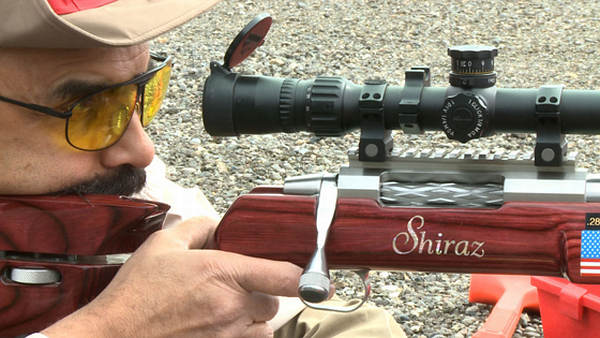
Team Grizzly’s Captain Shiraz Balolia said: “My hat is off to our coach, Trudie Fay, who has coached and won us the last three consecutive Team matches at the National Championships. I have been fortunate to have been a shooter and Captain of all three gold medal wins, three years in a row, one with Team USA and two with Team Grizzly. Trudie did a great job and my Team gun just hammered!” Along with Faye and Balolia, Team members included Kenny Adams, Emil Kovan, and John Myers.

X-Men Team Tops F-TR Field
Hail the Orange and Green invaders. The X-Men are the 2015 US Long Range National F-TR Champions. The Team included shooters Tracy Hogg, Phil Kelley, Ian Klemm, and Dan Lentz, along with Wind Coach James Crofts and Captain Ken Klemm. Crofts said: “Big thanks to our remaining X-men teammates Joseph Conley, Mike Hardy, and Radoslaw Czupryna. Special thanks to Ray Bowman as we were all shooting PR&T hammers. We have great respect for Team Sinclair (that has motivated us for a long time) and Team Michigan, our friends from up North. Today was a good day!”
All four X-Men rifles featured Precision Rifle & Tool (PR&T) Low Boy stocks. PR&T’s Ray Bowman observed: “Ian Klem built his rifle on our stock, PR&T stocked Dan Lentz’s rifle and we built Phil Kelley’s and Tracy Hogg’s “HAMMER” rifles.” Gunsmith Ryan Pierce chambered two of the X-Men barrels.
It was sunny but quite windy on Friday for the Team Match (Sherri Judd Photo).

Finishing second in the F-TR division was the Michigan Rifle Team, winners of the Mid-Range F-TR National Championship. The Team was coached by newly-crowned, Mid-Range F-TR Nat’l Champ Bryan Litz. Shooters include Doug Boyer, Jim Grissom, Bill Litz (Bryan’s father), and gunsmith John Pierce. Grissom shot a great match, finishing with 385-12X, but it was not enough to carry the Michiganders to victory. The squad finished with 1524-29X, six points behind the winning X-Men (1530-33X). Team Sinclair placed third with 1512-35X.
October 30th, 2015

Ben Avery 10/30/2015 panorama photo by Tracy Hogg. CLICK HERE to zoom image.
Today is the Team Match Day at the F-Class Long-Range National Championships. F-Open and F-TR team shooters will have to deal with damp conditions on the range, as a storm front recently dropped rain at the Ben Avery Shooting Facility outside Phoenix. James Crofts says: “The 2×1000 Team match today is going to be a good day. Wind will be up to 10 mph and quartering.”

In the F-TR division, competition will be fierce. The Michigan F-TR Team, winner of the Mid-Range Championship earlier this week, looks to add a matching 1000-Yard National Team victory today. The shooters of Team X-Men, lead by 2014 individual F-TR Champion James Crofts, hope to reverse their fortunes, and win at the longer distance. And Team Sinclair, the “winningest” squad in F-Class history, looks to grab another title. Team Sinclair boasts multiple champions on its squad, including Derek Rodgers, the only man to have won both the F-TR and F-Open National Championship.


October 29th, 2015

High-BC 7mm bullets are favored by many of the top long-range and F-Class (Open) shooters. Now, thanks to Sierra Bullets, there is a new “heavy-weight contender” in the 7mm match bullet category. Sierra has just introduced an all-new 183 grain 7mm HPBT MatchKing, part # 1983. This impressive new projectile boasts a 0.707 G1 Ballistic Coefficient (at 2300+ fps), plus — get this — it comes “tipped” from the factory. The final meplat tipping operation ensures a higher, more uniform BC. Recommended barrel twist rate is 1:8″ or faster.

Sierra says its new 183gr 7mm MatchKing has a modern, low-drag shape: “A sleek 27-caliber elongated ogive and a final meplat reducing operation (pointing) provide an increased ballistic coefficient for optimal wind resistance and velocity retention. To ensure precise bullet to bore alignment, a unique bearing surface to ogive junction uses the same 1.5 degree angle commonly found in match rifle chamber throats.
The new 7mm 183gr HPBT bullets will be available in boxes of 500 bullets (#1983C) with MSRP of $256.34 per box and boxes of 100 bullet (#1983) with MSRP of $51.80 per box. NOTE: Sierra states that “MatchKing® and Tipped MatchKing® bullets are not recommended for most hunting applications.”
October 27th, 2015

This past weekend, Bryan Litz of Applied Ballistics LLC, topped a field of great shooters to win the 2015 NRA F-TR Mid-Range National Championship. Bryan shot very well, mastering conditions that were tricky and sometimes bewildering, particularly at the shortest range, 300 yards. Consider this, Lou Mudica had the top score on Day Two (all 600 yards), yet he was way down at 41st position on Day One (300/500/600 yards). Finishing Second Overall was Scott Harris. Bryan’s Michigan team-mate Jim Grissom was third, while Bryan’s father (and MI team-mate) Bill Litz was fourth.
F-TR Top Ten at Mid-Range National Championship

Bryan was using a low-profile, carbon/composite-stocked rifle built by John Pierce. Bryan told us: “This was the same rifle and almost the same load with which I won the Midwest Palma match in the summer of 2014. (Story HERE.) My gear consisted of Pierce rifle, Bartlein barrel, Nightforce scope, Berger bullets, Lapua brass, Hodgdon powder (All those companies are sponsors of the USA F-TR team as well as the Michigan F-TR team.) My load for the Mid-Range Nationals was 43.0 grains of Varget with the Berger 215gr Hybrid bullet seated 0.005″ off the rifling.”
Click Image for Full-Size Version:

A lot of wind shooting strategy isn’t just about knowing exactly where to hold at any given point in time. A big part of it is recognizing periods of predictable readable conditions versus UNpredictable unreadable conditions and avoiding shooting in them. — Bryan Litz
At the Mid-Range Nationals, wind conditions at the shorter yardages caught many competitors by surprise. As a result, many shooters, including 2014 F-TR National Champion James Crofts, shot better at 600 yards than at 300. That seems surprising… but there is a reason. Bryan Litz explains that conditions at shorter distances are sometimes more difficult to read than at 1000 yards.
Bryan Litz Talks about Mid-Range Wind-Reading Strategies
Mid-Range is marked by more uncertainty than long range shooting. At long range you can see more flags, more mirage, and conditions tend to be more readable although they have a greater effect. At mid range, the closer you are to the target the less readable the conditions tend to be. Often times at 300 yards there is no mirage and very sparse flags to get a read on. You can still get blown out at 300 yards! 500 yards can be a little better and at 600 sometimes you can get a pretty good read on it, but the majority of strategy for shooting Mid-Range is managing the uncertainty. What is your plan for shooting blind?
Suppose you’re shooting along pretty well centered up in the 10 Ring. Suddenly you shoot a 9 out the side and can’t see an indicator that explains why. Stop! Clearly something is going on which is not readable. It’s likely to be around for a period of time. Its best just to wait for that uncertainty to blow through and start shooting again when things settle out again. How do you know when things have settled out? When everybody else is pretty much back into the 10 Ring for a little while, then you know that a stable condition has settled back in. Take your best guess and get back into it.
A lot of wind shooting strategy isn’t just about knowing exactly where to hold at any given point in time. A big part of it is recognizing periods of predictable readable conditions versus UNpredictable unreadable conditions and avoiding shooting in them. Good equipment is a must, and ballistic performance matters, but when it comes to winning a match versus placing in the top 10, it all comes down to who employs the winning strategy for the various different conditions. It can be more like a chess game then shooting. Competitive judgment is key.
Bryan Litz didn’t do too badly in the Mid-Range Team Match either, shooting a 200-10X. Bryan’s team-mate John Pierce shot a brilliant 200-15X. Looks like those low-profile Pierce-built rigs really hammer:

John Pierce (left) and Bryan Litz, who is holding his Pierce-built F-TR rifle.

October 25th, 2015

The 2015 United States F-Class National Championships are underway now at the Ben Avery Shooting Facility in Phoenix. There’s a “hybrid” format this year. For 2015, the Nationals combine both Mid-Range and Long-Range competitions in one week-long mega-match. The Mid Range F-Class Nationals take place 24-27 October 2015, with shooting at 300, 500, and 600 yards. The Long Range National Championships then run October 28 through 31, with all targets at 1000 yards. The competition consists of two different divisions: F-Open and F-TR (Target Rifle).
The wind arrived early on Saturday…

It started off somewhat windy on Saturday, October 24 for the 300-yard and 500-yard matches. Bryan Litz mastered the conditions to end up leading the F-TR division. (Guess that knowing a thing or two about ballistics helps when the wind is blowing). James Crofts, 2014 F-TR National Champion, shoot well at 500 yards, but struggled at 300 yards (the X-Ring is just 1.5″ at 300 yards). He observed: “Not a bad day today — overall 13th. Bryan Litz has the overall F-TR lead. I’m down 20 for the day but there are lots of shots left to go.”

All the shooting today (Sunday, October 25th), will be at 600 yards. Jim posted from Phoenix: “It’s time to start Day Two of the F-Class Mid-Range Nationals. All 600 yards today and I’m ready. Looks like it could be a tricky day with gusty winds but it will be the same for everyone.”
James Crofts at the 500-yard line. He had a tougher time at 300 yards.

September 29th, 2015

Here’s 2014 F-TR National Champion James Crofts, with his PR&T-built rig.
Are you ready? The 2015 F-Class Nationals event is just three weeks away. The combined mid-range and long-range F-Class National Championships will be held October 23 – 31, 2015 in Phoenix, Arizona.
CLICK HERE for 2015 F-Class National Championships Program and Entry Form.
For 2015, the Nationals will include both Mid-Range and Long-Range competitions. The NRA F-Class Mid Range National Championship will be held 23-27 October 2015. The F-Class Long Range National Championship then runs from October 27 through 31. The competition consists of two different Divisions: F- Open and F-TR (Target Rifle). Each Division is made up of five different Categories: High Master, Master, Expert, Sharpshooter and Marksman. There will also be a series of four-person team matches. The event is limited to 320 competitors maximum. All matches will be held at the Ben Avery Shooting Facility outside Phoenix.
You’ll see some serious hardware on the firing line at Ben Avery. Here’s a modern F-Open rig with a handsome maple stock. The gun, belonging to David Mann of Texas, shoots as good as it looks.

Under Two Inches at 500 Yards
To be competitive at the Nationals, one needs a tack-driving rifle and an ultra-accurate load. Shown below is one of Paul Phillips’s F-TR load development targets at 500 yards. The total 5-shot group size is under two inches. Impressive. That’s with 200gr Bergers, Varget powder, and large primer Lapua brass. Paul tell us: “The X-Ring is 5 inches at 1000 yards (equivalent to 2.5 inches at 500). We strive to be all in the X-Ring. However, wind is the big obstacle. A gust of wind can move you 1-2 feet away.”

F-Class National Championship Registration and Deadlines
Competitors must submit the official Registration & Entry Form (include NRA Membership ID#). Entries MUST be accompanied by check, money order or NRA Points. Make Check payable to Desert Sharpshooters Rifle Club.
Fees are $375.00 for both Mid-Range and Long-Range matches (combined), or $200 for just one match only (either Mid-Range or Long-Range). Team Matches cost $60 per entry.
Mail Entry Forms and checks to:
Middleton Tompkins
P.O. Box 11684
Prescott, AZ 86304.
Phone: (928) 776-8576.
Entry Deadline: The deadline for entries is 6:00 PM Monday, 12 October 2015. Entries after this time are considered late entries and may be accepted to fill vacancies on existing relays only. An additional $20.00 will be charged for late entries, on top of the basic fees.

2014 F-Class Nationals Photos copyright Nightforce Optics, used with permission.
September 21st, 2015
 Derek Rodgers is a member of the Team Sinclair F-TR squad. This talented group of shooters hasn’t lost a team match in years. What’s the secret of Team Sinclair’s success? Well there is not one single factor. These guys have very accurate rifles, work hard on load development, and practice in all conditions. In this interview, Derek Rodgers talks about long range competition, reviewing the hardware (and skill set) it takes to win. He offers some great tips on developing loads. You’ll find a longer version of this interview on the Sinclair Int’l website. CLICK HERE to Read Full Interview. Derek Rodgers is a member of the Team Sinclair F-TR squad. This talented group of shooters hasn’t lost a team match in years. What’s the secret of Team Sinclair’s success? Well there is not one single factor. These guys have very accurate rifles, work hard on load development, and practice in all conditions. In this interview, Derek Rodgers talks about long range competition, reviewing the hardware (and skill set) it takes to win. He offers some great tips on developing loads. You’ll find a longer version of this interview on the Sinclair Int’l website. CLICK HERE to Read Full Interview.
Derek Rodgers BIOGRAPHY
Derek Rodgers (Albuquerque, NM), is the only shooter to have won BOTH the F-Open and F-TR National Championships. Derek shot his first NRA sanctioned-match in 2007, and just three years later Derek won the 2010 F-Open Nationals. He also won the 2013 F-TR Nationals, making him the only person to win both divisions. He has won other major F-TR matches, including the 2013 Sinclair East Coast Nationals and the 2015 Berger SW Nationals. Derek holds the current 1000-yard, 20-shot, National F-TR Record (200-12X). Derek enjoys spending his time outdoors with his wife and two daughters, ages 12 and 7. He is blessed by his faith and supported by his family. Derek’s goal is to pass on what he has learned to the next generation.
Q: What is your favorite reloading product?
I really like my BenchSource Case Annealer. There is something about watching fire that I find relaxing. I can watch those shells go around the wheel for hours.
Q: What’s your preferred front rest or bipod?
I’m currently using a Duplin bipod. At 17.2 ounces it allows me a solid platform to shoot from and the extra wiggle room to make weight with a heavy barrel and Nightforce NXS scope. Also, I can’t do without my board under the bipod. We shoot off sand at my local range and in most cases the feet will tend to dig holes if not supported. The board is necessary gear for me.
Q: What rear bag do you use?
I have an Edgewood bag that I’ve used for years. Recently, I got a SEB Bigfoot and like how it supports the gun and stays put under recoil.
Q: Explain your load development process. What’s your methodology?
I have two log books that have many combinations that work with 308s. I have tried to keep detailed notes in these books. Now I am reaping the rewards, as I can go back to a particular twist and barrel length and find something very close. I usually start with 3-shot groups and check the chamber behavior. If something looks promising I will go back to the range and load up 6-shot groups. If those shoot well, I take it to a match to verify it in a 20-shot string. If it passes that test it is either good to go or I table it and try another. I tend to pick mild loads that the cartridge shoots well — consistently.
Q: What piece of shooting gear helps your load development?
I use a MagnetoSpeed Chronograph to record velocities. Then I can slow down or speed up my loads to reach an accuracy node. It is amazing that most barrels will shoot very accurately when fired at certain known velocity nodes.
Q: What optics do you find most useful?
I would say Nightforce NXS Scopes.
Q: What do you carry in your range bag on Match days?
Multi-piece Brownells tool set, RX Glasses, Sunglasses, Range Rod, Towel, Empty Chamber Indicators, Jacket, Sunscreen, Foam Ear Protection, Ear Muffs, Data Book, Plot Sheets, Pen, Clip Board, iPod with ballistic data, and chewing gum.

Q: How did you get started shooting?
I was raised in New Mexico where outdoor activities are abundant. Once my father introduced me to a Crossman pellet gun, all I wanted to do was shoot and refine my skills. Shooting evolved into hunting and then into perfecting my skills in off-season matches. Shooting local F-Class matches made me better as a marksman. Now I feel like I am competitive with anyone. However, I will never forget that my roots started with hunting and still cherish the opportunity to hunt…
Q: What do you find most challenging? How do you learn from mistakes?
What I find most challenging about precision shooting sports is how great shooters are able to reflect on what was learned — both positively and negatively. It is important to slow down and perform this step. Stopping to reflect and learn from mistakes I’ve made on the firing line is challenging. Not many people enjoy accurately critiquing themselves. Also the wind usually blows here in New Mexico and choosing the right time to shoot and to stop is important. It’s often tempting to try to finish out a string of fire. But sometimes challenging yourself to quit and wait out some wind will pay off[.]
Q: What advice do you have for selecting a gunsmith?
The best recommendation I can give is for a person to get to know a gunsmith. If you can find a local gunsmith that is available — even better! If you run into a snag along the way, it is so nice to be able to work it out without sending things back and forth. Be honest, realistic with your expectations and tell the gunsmith what you want. If he only wants to do things his way, or takes extra or excessive time in meeting the goals, you may want to consider someone else.
Q: Who would you recommend for stock work on your rifle?
Alex Sitman from Master Class Stocks and Doan Trevor can build or fix most anything.
Q: What do you do to mentally prepare before a shooting competition?
I relax and try to remember I do this for fun. I anticipate what game plan I want to go to the line with. I also try to take small snapshots of the conditions. I do not like getting overloaded with staring down a spotting scope for long periods of time. I try not to get overwhelmed with the match and just shoot my game. My approach is “One shot at a time — good or bad”. I will usually tell my scorer what I’m going to do so he or she is ready as well.
Q: What advice would you give to novice competitors?
Partner up with an experienced shooter that is ranked nationally. Mentoring under a veteran shooter would be the best way to help save time learning instead of experimenting. Chances are an experienced shooter has already tried what you are considering. As a new shooter, do not get sucked into reading all of the opinionated blogs on the internet. Stick to good information. AccurateShooter.com | 6mmBR.com is a great resource with a wealth of information from knowledgeable writers. That site has articles that are based from facts and/or industry news and information.
Q: What is something you would NOT recommend before a shoot?
I do not recommend coming unprepared. If you are late, scrambling around, or do not have your gear in order, you will not perform at your best.
Q: How many rounds do you shoot in a year and how often do you practice?
I shoot 3000+ rounds a year. I try to shoot 1 x a week if I can get away in the evening or on the weekend. If I am close to finding a load I may try to get out more until I exhaust that load as an option. So there may be occasions that I will try to shoot three times a week. Fortunately, the winters are mild in New Mexico and it allows me to shoot year round. I actually shoot more when it is colder. The summer sun here can create mirage that makes it nearly impossible to learn anything.
|


