|
|
September 3rd, 2013
 American Kenny Adams is the new F-Open World Champion, winning the individual title last week at Raton, New Mexico. ‘King Kenny’ rose to the top through with skill, countless days of practice, and great determination. He put in the trigger time, including many long days at Raton. But when we cornered Kenny after his win at the Worlds he was quick to give credit to his gunsmith, Stick Starks of S&S Precision Rifles in Texas. American Kenny Adams is the new F-Open World Champion, winning the individual title last week at Raton, New Mexico. ‘King Kenny’ rose to the top through with skill, countless days of practice, and great determination. He put in the trigger time, including many long days at Raton. But when we cornered Kenny after his win at the Worlds he was quick to give credit to his gunsmith, Stick Starks of S&S Precision Rifles in Texas.
Kenny told us: “I want to thank my gunsmith, Stick Starks from S&S — he got me going in this thing in the right direction four and a half years ago. Working with Stick has probably shaved a couple of YEARS off my learning curve.” Kenny’s world-beating rifle features a Panda F-Class action placed in a Robertson F-Class stock. The Krieger barrel is chambered for the 7mm RSAUM.

Kenny Has Four Red F-Class Rifles All By S&S
What’s interesting is that Stick Starks made Kenny three other F-Class rigs, all with red Robertson stocks and Panda F-Class actions. So, counting the championship 7mm RSAUM, Kenny owns a fleet of four fire-engine-red F-Class rigs, all built by Stick at S&S. These three other red rifles were originally chambered in 6.5-284, 6mmBR, and 6.5×47, but Kenny switches barrels (and chamberings) to suit the venue and course of fire. In Raton, Kenny had two (2) of the red rifles chambered in 7mm RSAUM and two (2) chambered for the .284 Winchester. However, in the Individual World Championship he shot just one rifle, a 7mm RSAUM (shown below). He used the second 7mm RSAUM-chambered rifle in the F-Open Team Championship. This second RSAUM (used for team shooting) is the one pictured above, but his other RSAUM is identical in all respects. He did not shoot either .284 Win during the Worlds.
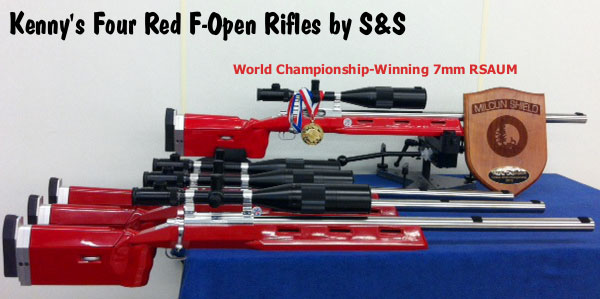
Kenny’s World-Beating 7mm RSAUM Load
For his 7mm RSAUMs Kenny loads Hodgdon H4350 powder and Federal 215m primers into Nosler or Norma RSAUM brass. In the RSAUM he runs Berger 180gr Hybrid bullets seated “just touching” the lands. For his .284 Winchester-chambered rifles he loads necked-up Lapua 6.5-284 brass with 180gr Hybrids pushed by H4831sc powder and Federal 210m primers. Interestingly, he is very precise with his charge weights. Using a Sartorius Magnetic Force Restoration scale, Kenny tries to hold his powder charges to within 1-2 kernels charge-weight consistency.
While Kenny praised S&S for building great rifles, Stick is quick to say that Kenny deserves the credit: “He’s the man that pulled the trigger. He’s the man that beat the world. You can’t believe how dedicated Kenny is to his sport. He spends so much time shooting and practicing — true dedication. Kenny hung in there, never gave up, did the best a man can hope to do. Yeah you have to have good equipment, but you do have to have dedication in this sport. Buy the best equipment you can and the rest is up to you — learning how to read conditions. That’s all there is to it.”
S&S Can Build You a ‘Kenny Clone’ for $3800.00
By the way, if you want a gun just like Kenny’s, Stick told us: “I’ve got barrels, Panda F-Class actions, and I have one last Robertson F-Class stock left. Just one — these aren’t made any more you know. A complete build, with barrel of your choosing and Jewell trigger, will be about $3800.00.”
S&S Precision Rifles is a leading gunsmithing operation based in Argyle, Texas. Stick Starks and the crew at S&S build very accurate rifles, that also exhibit superb craftsmanship. While S&S built a championship-winning F-Open gun for Kenny, they can also built short-range benchrest rigs, as well as varmint and hunting rifles — all with hallmark S&S quality. S&S can handle every aspect of gunsmithing — chambering, bedding, even stock-painting.
In the video above, the folks at S&S put together some tack-drivers for their customers. There are some nice glimpses of bedding work, and barrel finishing. Watch carefully — at the 40-second mark you’ll see a sub-1/4″, 10-shot group that S&S co-owner “Stick” Starks shot at 200 yards with his 6.5×47 Lapua rifle. That’s serious accuracy. Half-way through the video, Stick offers advice for shooters looking for a super-accurate fun gun for club shoots: “If you want to shoot [at] 100 and 200 yards, I’d get me a 6BR or a 30 BR. It would be the most fun gun you ever had… and the barrel will probably last three or four thousand rounds.” If you want a gun to shoot at primarily 500-600 yards, Stick recommends the 6.5×47 Lapua chambering: “Run it with the Berger 130s and Hodgdon H4350 powder. That H4350 works great with the 130 Bergers.”
August 28th, 2013
The F-Class World Championships wrapped up yesterday at Raton. This was the biggest F-Class Worlds ever, and the level of competition was higher than ever before. But the World Championships were not just about wind calls and V-Counts. The event was also about camaraderie. All those who participated made new friends from around the globe. In the end, this event was about fellowship, and the bond of shared challenges with fellow shooters. No matter what the tally on the team score-card, everyone who participated in the World Championships came home a winner — a winner in the game of life.
Two Aussies Share the Joy of Victory…

Team F-TR USA Members Ham it Up After Winning F-TR World Championship.

The U.S. F-Open National Team on its Way to the Silver Medal.

Tough Guys Jim Crofts, Paul Phillips, and Brad Sauve Helped Carry Team USA to Victory.

Team Canada at the 1000-yard Line. Canada Hosts the next F-Class Worlds in Ottawa, 2017.

2013 World Individual F-Class Champion Kenny Adams Shooting in Team Mode.

Past NRA President John Sigler with his Wife. John is an Avid F-Class Shooter Himself.

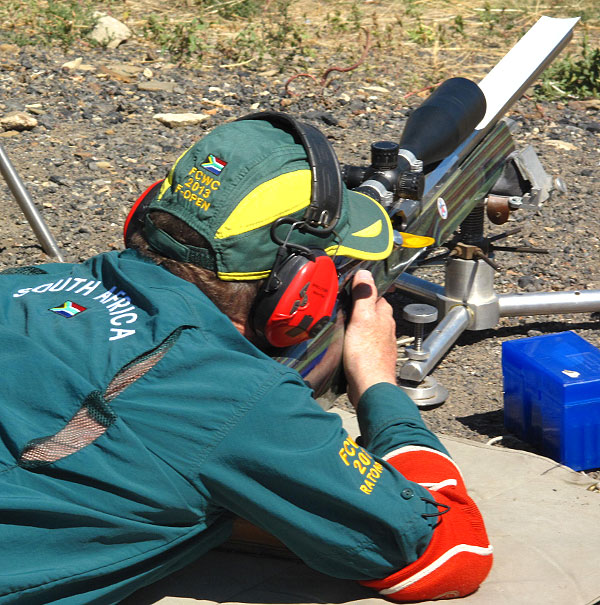
South African F-Open Shooter Hard at Work.
Our British Friends Russell Simmonds and Laurie Holland — both Forum Members.

Spanish Team Genius at work — Farley Rest Bolted to a Truck Brake Rotor. Rock Solid.

Team F-TR USA Captain Darrell Buell with the Superb New Nightforce Spotting Scope.

Two Young Ladies on the Junior F-TR Team Enjoyed the Event.

Team Ireland Proudly Shows the Colors. Erin Go Bragh!

Forum Boss and Raton Range Boss Watch the Action on Day 2.
Editor’s Note: If I learned one unforgettable lesson from this match, it is that we shooters have a common bond that spans oceans and crosses national borders. We truly are a brotherhood of riflemen who share a passion for a challenging and rewarding sport.
I want to thank all the many people who came up to me and said “Thanks for the website — keep doing what you’re doing — it’s important”. I heard that message from Brits, Aussies, Spaniards, South Africans, Germans, Kiwis, Italians, Brazilians, Ukrainians, Irelanders, and of course my fellow Americans. Thank you all for your kind words. Rest assured, we’ll do our best to “keep the faith” in the years ahead.
August 28th, 2013
The 2013 F-Class World Championships are in the history books. Congratulations to Australia, winner of the 8-man F-Open Match (Farquharson Cup) and to the USA F-TR squad which captured both 8-person and 4-person F-TR team titles. Here’s a quick summary of the results (an in-depth report with more photos and videos is in the works).

Not all Australia team members shown in photo.
Marty Lobert Explains How Australia Took the Title:
With his straight .284 Win, Marty Lobert shot 442-46V for Australia during the team championships, one of the highest scores among all F-Open shooters during Team Comps. Marty’s Australian team-mate, Cameron McEwan, had a 443-40X, high score for the match. Congrats to Cameron — great shooting!
Team Australia won the 8-man F-Open Championship with a 3490-339V tally. The USA 8-man F-Open team finished second with a 3475-308V team score. South Africa was third with 3445-267V, while the previous champion Great Britain Team finished fourth with 3427-261V. Team Spindle Shooters won the F-Open Rutland Cup for 4-man teams with a 1750-163V score, 10 points ahead of the 4-man Team USA squad coached by Emil Praslick (1740-169V).

In the F-TR Division, F-TR Team USA won both the 8-person F-TR Richardson Trophy Match (3412-261V) and the 4-person F-TR Rutland Cup Match (1689-130V). Canada’s 8-man F-TR team scored 3400-245V for second place in the 8-man F-TR competition, while Great Britain’s 8-man team tallied 3393-220V for third place. Notably, F-TR Team USA’s 8-man team score would have been good enough for fifth place in the F-Open Division. Yanks dominated the 4-man F-TR match, with Nik Taylor’s BNX/21st Century squad placing second (after F-TR Team USA), and the Michigan F-TR team (Barnhart/Litz) finishing third.


Here are the published official results for the 2013 F-Class World Championships, for both the team and individual competitions. These links all point to PDF files. If you have the right browser plugin, you should be able to simply click and view. Otherwise, right-click the link and “save as” to your hard-drive before viewing.
2013 F-Class World Championship Final Scores and Rankings
FCWC Team Results
8-Person F-Open Team Match (Farquharson Cup)
8-Person F-TR Team Match (Richardson Trophy)
4-Person F-Open Team Match (Rutland Cup)
4-Person Team F-TR Team Match
FCWC Individual Results
Individual World Championship – F-Open
Individual World Championship – F-TR
Individual Day 1 – F-Open
Individual Day 1 – F-TR
Individual Day 2- F-Open
Individual Day 2 – F-TR
August 26th, 2013
 Top marksmen from around the world battled for national honors today during Day 1 of the F-Class Team World Championships. F-Open and F-TR teams from many countries were decked out in their national colors. We saw squads from Australia, Brazil, Canada, Great Britain, Ireland, Italy, New Zealand, South Africa, Ukraine, and the USA. Other nations were represented as well. Top marksmen from around the world battled for national honors today during Day 1 of the F-Class Team World Championships. F-Open and F-TR teams from many countries were decked out in their national colors. We saw squads from Australia, Brazil, Canada, Great Britain, Ireland, Italy, New Zealand, South Africa, Ukraine, and the USA. Other nations were represented as well.
Along with the basic two divisions, F-Open and F-TR, there are separate classifications for 4-man squads and the big 8-member National Teams. One Junior team from the USA is also competing. Right now the 8-man USA F-TR squad has a commanding lead. The talent-laden USA 8-man F-Open squad sits in second place, just three points behind the surprisingly strong Australian squad. But there are hundreds of record rounds left to fire tomorrow, and USA F-Open team members hope to move into the top slot on Day 2. Scroll down the page for a video interview with USA F-Open Team Captain Shiraz Balolia.

More than once in today’s matches dust devils appeared on the range. During the 1000-yard match a large swirling dust cloud formed dead center on the range. We heard coach Mid Tompkins call to his shooters: “Whoa – Whoa, stop firing, stop everything”. Mid told us: “When you have dust devils like that, you have to stop — you can’t out-guess it and you may not even be able to see the target.”

Interview with USA F-Open Team Captain Shiraz Balolia


Many of the top teams are using “comm packages” with microphones and headsets. This allows the coaches to communicate with each other, conferring on observations and wind calls. Wireless communicators are not allowed, so cords are strung between the coaching stations.


August 23rd, 2013
The dust has settled and all the scores have been tabulated at the 2013 U.S. F-Class Nationals. This was a hugely successful event with 350 shooters on the firing line. After three days of individual matches, concluding with blustery conditions on Thursday, we have two new USA F-Class Champions, Larry Bartholome (F-Open) and Derek Rodgers (F-TR). Both men shot great matches from start to finish — we congratulate both on their well-deserved victories.
CLICK HERE for Final F-Open Full Results | CLICK HERE for Final F-TR Full Results
Derek Rodgers (Team Sinclair) is the 2013 U.S. National F-TR Champion. Posting a 1270-44X final score, Derek edged runner-up Lige Harris (1268-44X) by two (2) points, both men finishing with identical X-counts. John Chilton was third with 1264-35X, with Trudie Fay (1263-33X) and James Crofts (1261-33X) rounding out the top five. Lige finished as High Senior, while Trudie was the High Lady.

Fellow F-TR shooter (and past National F-TR Champion) Brad Sauve praised Rodgers:
“Derek is the only person that has won both the F-TR and F-Open U.S. National Championships. Derek just dominated those Raton winds in every match and must have ice in his veins to go into that last match knowing he was tied for first and [still] pull out another great performance.”
In F-Open class, Larry Bartholome won the 2013 National Championship, besting an extremely strong field packed with talent. Larry shot great on all three days, holding on to his lead even in extremely challenging conditions on Thursday. Larry took the F-Open title with a 1283-59X score. The next three positions were decided on X-Count, with three shooters, second-place Kenny Adams (1281-66X), third-place Freddy Haltom (1281-52X), and fourth-place William Wittman (1281-50X) all finishing with 1281 point totals. Kenny’s impressive 66X was the high X-count for the match. Steven Blair finished fifth with a 1280-52X score.

Here’s One of the Next Generation of Champions…

Stormy Conditions on Thursday
On Thursday, the wind started out calm for the first couple of relays. Conditions started to get a little switchy by the 3rd through the 6th relays and then with a storm front coming in, the 7th and 8th relays got a bit wild. Our reporter at Raton, Jeff Williams, reports: “We had dust devils dancing between the line and the targets. Rain held back until after all shooters had finished.”

August 16th, 2013
F-Classers — you better get your ammo loaded and your bags packed. The 2013 F-Class U.S. National Championship commences this Sunday, August 18, 2013 with an official practice day. The United States National Championship matches start on Monday with Registration and Squadding at 0700-0730. (Don’t over-sleep and miss the action.) There will be individual matches on Monday, Tuesday, and Thursday, with a U.S. Championship Team Match on Wednesday.

The F-Class World Championships follow immediately after the U.S. Championships, with the Worlds running Friday August 23rd (practice day) through Tuesday, August 27th. This back-to-back scheduling means that many foreign shooters can come early and participate in the U.S. Championship matches as well. It looks to be an exciting week-and-a-half of competition. Good Luck to all individual shooters and teams. Here is the schedule for the U.S. Nationals:
U.S. F-Class Championships Shooting Schedule
Sunday, August 18, 2013
There will be a squadded practice at 1000 yards for individuals and teams. Squadding at 0700-0730. Commence firing 0800. Squadded practice fee is included in the match entry fee. There will be four relays, 20 minutes per relay. The range will be closed the remainder of the day.
Monday, August 19, 2013
DAY 1: F-Class 1000 Yards
Registration/Squadding at 0700-0730. Opening ceremonies 0720
Commence fire 0800. Three individual 15-record-shot 1000-yard matches plus Aggregate.
Tuesday, August 20, 2013
Day 2: F-Class 1000-Yards
Squadding at 0700-0730, commence fire at 0800
Three individual, 15-record-shot 1000-yard matches plus Aggregate.
Wednesday, August 21, 2013
Day 3: F-Class Team Matches
Team Captains will draw for target assignments 0720, commence fire at 0800
Two, four-person 1000-yard slow fire prone team matches, plus aggregate. Two sighting shots and 20
shots for record per team member.
Thursday, August 22, 2013
Day 4: F-Class 1000-yards
Squadding 0700-0730, commence fire 0800
Two 1000-yard individual 20-record-shot matches plus Aggregate.
The National Championship will be awarded based on Individual Grand Aggregate (total of matches 1-3, 5-7, 9-10). The Award Dinner/Ceremony will be held at the Coors Building at 6:00 PM Thursday, August
22, 2013. Free to all competitors. $10.00 for guests.
 The Aussies Are Coming! The Aussies Are Coming!
The first contingent of the Australian F-Class Team is heading our way. South Australian members Richard Braund, Stuart Braund, Dave Zerbe, and Mike Willment, received an enthusiastic send-off by fellow F-Class shooters in Adelaide, before the foursome jetted off to Sydney. They will join other Aussie team members in Sydney before flying to Los Angeles, and then heading on to Raton, NM.
Coming all the way from the Southern Hemisphere requires hauling a ton of gear through multiple airports. We don’t want to even think about the “excess baggage” charges. At least these intrepid Aussies will be racking up the frequent flyer miles. Sydney to Los Angeles and back again is roughly a 15,000 mile round-trip.
Report by John Cranwell of South Australia, who tells his countrymen: “Go Aussie!”.

CLICK HERE for F-Class World Championship Information Packet
August 6th, 2013
Sebastian (“Seb”) Lambang, creator of the SEB Coaxial Rests and new Coaxial Joystick Bipod, has engineered an impressive new wood and aluminum F-Class stock. The stock features a long, box-section aluminum fore-end with a wood rear section and wood-trimmed “wings” on the front bag-rider. The aluminum fore-arm has “buick vents” for weight reduction. From the end of the action rearward, the stock is mostly wood, with light and dark fancy wood laminates on opposite sides (left and right).
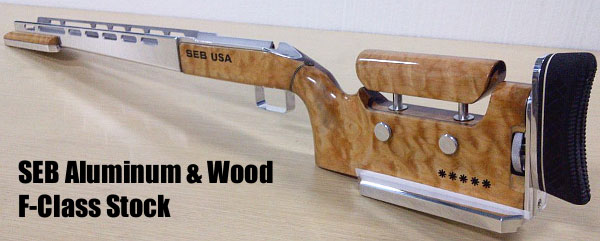

The foot of the buttstock has a very wide aluminum rear bag-rider with rails. The rear wood section appears to be two solid pieces of wood — but that is deceiving. Seb explains: “To save weight, the buttstock is hollow (using thin-walled wood)”. To strengthen the construction, Seb added carbon fiber inside the buttstock. So what you see is a wood outer shell with carbon fiber layers on the inside. The stock sports vertically-adjustable cheek-piece and buttplate. The thick, rubber buttpad should diminish felt recoil even when shooting big cartridges with heavy bullets.

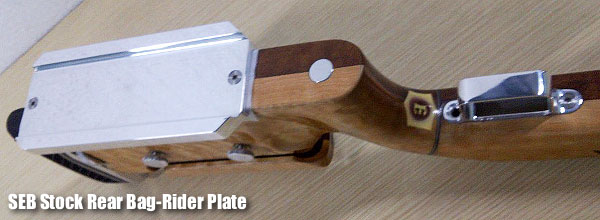

This is an interesting, innovative stock design. And as with everything Seb produces, the craftsmanship, fit and finish are superb. We may get a chance to see how well this new stock shoots at the F-Class World Championships later this month in Raton, New Mexico.
Seb also crafted a handsome set of angled scope rails with beautifully-machined scope rings. Imagine being able to custom-make one-off products of this quality in your own machine shop!

June 29th, 2013
When you’re shooting an F-Class match, the last thing you want is for your fancy front rest to sink into soft ground, hop on hard ground, or otherwise move around from shot to shot. And with more F-Open shooters shooting heavy (180gr+) bullets these days, F-Class front rests have to cope with more torque and recoil than ever before. Well, our buddy John Perkins from 21st Century Shooting has a solution. The new 21st Century Phoenix Foot features unique, bell-style geometry. This allows your rest to sit securely in turf and the feet are very stable even on loose soil or gravel. The Phoenix Foot, shown here with 21st Century’s Front Rest, is compatible with a variety of front pedestal rests with 1/2″-diameter adjustment legs. The bell-shaped foot design (narrow at the bottom and flaring at the top) makes it easy to level the rest front-to-back and side-to-side. Price for a set of three (3) Phoenix feet is $99.00.

21st Century’s Impressive Crank-Windage Front Rest
Also shown in the photo is 21st Century’s impressive new Front Rest, proudly CNC-machined in the USA from aircraft aluminum and stainless steel billet barstock. This big boy, which retails for $1095.00, features a super-large-diameter mariner’s wheel for elevation adjustment, and an ultra-smooth crank adjustment for windage (horizontal). Finish and function are impressive. Elevation and windage can be easily adjusted with fingertips (this is made possible by the ball screw design). This “Rolls Royce of rests” is made to last — all aluminum parts are anodized and the base is machined from 1″-thick 6061 T6 aircraft billet aluminum. If you’re interested, call 21st Century at (260) 273-9909. When production permits, rests usually ship out 3-6 weeks after an order is placed.
Product Tip from EdLongrange. We welcome reader submissions.
June 26th, 2013
 On his Facebook page, Hall-of-Fame shooter and ace gunsmith Thomas “Speedy” Gonzalez unveiled an impressive new F-Open rifle built for Bret Solomon. The rifle features Speedy’s new low-profile F-Class stock. On his Facebook page, Hall-of-Fame shooter and ace gunsmith Thomas “Speedy” Gonzalez unveiled an impressive new F-Open rifle built for Bret Solomon. The rifle features Speedy’s new low-profile F-Class stock.
Bret’s gun is chambered for his 300 Solomon wildcat, shooting heavy 210gr bullets, so it can can be a real shoulder-buster, without some kind of buffer. The stock is fitted with a Ken Rucker’s Bump Buster hydraulic recoil reduction system to tame the recoil. The Bump Buster was originally designed for shotguns and hard-hitting, big game rifles. It is interesting to see this hydraulic buffer adapted to an F-Open rig.

Here you can see Bret shooting the gun, coached by Nancy Tompkins and Michele Gallagher:
Bret’s gun features a stainless Viper (Stiller) action, barrel tuner, and an innovative Speedy-crafted wood stock. Speedy says this stock design is all-new: “It is a true, low Center-of-Gravity F-Class stock, not a morphed Palma stock merely cut out on the bottom”. See all the details in this short video:
Stock Features: Glue-in or Bolt-In and Optional Carbon Pillars and Cooling Ports
Speedy explained the features of the new stock design: “Terry Leonard and I started working on an F-Class version of his stocks last year during the F-Class Nationals and came up with what he and I consider the first true low-CG stock in the sport. As you can see by the videos, there is very little torqueing of the stock during recoil. I add the carbon fiber tunnel underneath the forearms to save Terry some time. This bonds very well to his carbon fiber skeleton within the stock adding addition stiffness to the forearm to support the heavy barrels found on the F-Class rigs. We are playing with both glue-ins like we benchresters use and bolt-ins as well. The rifles on the videos are glue-ins. Bret just took delivery today of his first bolt-in employing carbon fiber pillars and the first Leonard stock ever to have cooling ports.”
Need for Recoil Reduction Follows F-Class Trend to Bigger Calibers and Heavier Bullets
In recent years we have seen F-Open competitors move to bigger calibers and heavier bullets in pursuit of higher BC. There is no free lunch however. Shooting a 210gr .30-caliber bullet is going to produce much more recoil than a 140gr 6.5mm projectile (when they are shot at similar velocities). Does this mean that more F-Open shooters will add hydraulic buffers to their rigs? Will a recoil-reduction system become “de rigueur” on F-Open rifles shooting heavy bullets?
Our friend Boyd Allen observes: “You may imagine that shooting a short magnum, or even a .284 Win with heavy bullets, involves a fair amount of recoil, and in the prone position this can be more than a little wearing. It can in fact beat you up over the course of a match. Some time back, Lou Murdica told me about having a hydraulic recoil absorbing device installed on one of his F-Class rifles, chambered in .300 WSM. Lou is shooting heavy (210-215gr) bullets so the recoil is stout. According to Lou, the hydraulic recoil-reduction system made all the difference.”
Story tip from Boyd Allen. We welcome reader submissions.
June 21st, 2013

F-Class shooting (both F-Open and F-TR) is one of the fastest-growing forms of rifle competition. Each season many new shooters hit the line and attendance at the big matches increases every year. But if you’re new to the game, you may ask “Where can I shoot an F-Class match?”. Well, Forum member Rod V. (aka Nodak7mm) has compiled a useful list of 109 ranges around the USA where F-Class matches are held (plus 6 “possibles”). With venues from Alabama to Wyoming — you should find an F-Class program not too far from home. The list, in Excel spreadsheet format, provides range locations and weblinks (where available). Click the link below to download the F-Class Range List (.xls file):
Download F-Class Range List, Revision 19 (12/30/2014) (.XLS file, right click to “save as”)
Note — this list, now in its 19th Revision, is augmented regularly, but info is still being gathered. No claim is made that the list is comprehensive. But it still covers the the lion’s share of the important F-Class venues nationwide. If you know of a range that should be added to the list, please post the location on our F-Class Range List Forum thread. Rod will update the list as new range info is received. Rod writes: “Range information is wanted and welcomed. I would like your help on collecting specific info on Clubs/Ranges where known F-Class matches are held.” Here’s a partial sample from Rod’s list:


|


